What's inside
- Key Takeaways
- Quick Picks
- How Did We Choose Between One Drum and Two Machines?
- Side-by-Side: Drum, Drying and Design
- What Should You Measure Before a Combo Goes on the Shortlist?
- How Do You Run a Combo So Drying Does Not Take All Day?
- Ventless or Vented: Which Drying Design Fits Your Walls?
- Whose Laundry Rhythm Actually Suits a Single Drum?
- Which Buying Mistakes Turn a Good Combo Into a Return?
- What Does Installation Day Actually Involve?
- Final Recommendation
- Frequently Asked Questions
- Related Guides
As an Amazon Associate I earn from qualifying purchases. This post may contain affiliate links at no extra cost to you.
cottageverdict.com is reader-supported. When you buy through links on our site, we may earn an affiliate commission.
Where to buy: every machine in this guide is sold on Amazon under the listing name used below, and the honest way to shop this category is to read the drying half of the specification before the washing half — the wash numbers are the ones printed large, while the dry numbers decide how your Tuesdays actually go; check price on Amazon once you know which of the two capacities, wash or dry, is the one your household will hit first.
The best combo washer dryers answer a floor-plan problem, not a laundry problem. A combo is a single drum that washes and then dries in the same tub, start to finish, without you moving a wet load across the room. That one-box design is what lets a studio apartment, a small condo, a boat cabin or an RV have real laundry where two separate machines would never fit. If you have the square footage for a washer and a dryer side by side, buy those instead — they will be faster and bigger. This guide is for the homes where that advice is useless.
The trade-off needs saying plainly, because it is the reason combos get returned by people who were never told. Drying in a combo drum is slower than drying in a dedicated dryer, and the load you can dry is smaller than the load you can wash. One listing below states the split outright: it washes up to 25.6 lbs. but dries up to 13.2 lbs., which means a full wash load has to be split before the drying stage, or washed smaller to begin with. Plan around that arithmetic and a combo is a genuinely liberating machine. Ignore it and you will spend your first week wondering why a load started at breakfast is still tumbling at lunch.
The six machines here are all compact front-load units between 1.6 and 2.7 cu. ft., and they divide along a few honest lines: which ones are ventless, which ones spin fast enough to shorten the dry, which ones add steam care, and which one is small enough for an RV bay. None of them pretends to be a family-size laundry pair, and the reviews below grade them against the job they are actually built for.
Key Takeaways
- A combo washes and dries in one drum — the machine you buy when there is physically no room for two machines.
- Dry capacity is the real capacity: on the listing that prints both figures, drying tops out at roughly half the wash load, so size your loads by the dry number.
- Drying takes longer in a combo than in a standalone dryer; overnight and while-you-are-out cycles are how owners make peace with that.
- Ventless models need no duct run at all, which is what makes them legal and practical in many condos and rentals.
- A faster spin (the 1400 RPM listings here) pulls more water out before drying starts and quietly shortens every dry cycle.
- The 1.6 cu. ft. Equator is the only true RV-and-tiny-home size in this set; the 2.7 cu. ft. machines are apartment machines.
- Level feet and a firm floor matter more on a combo than on separates, because the long dry stage gives any vibration hours to become a household noise problem that everyone hears.
Quick Picks
| Machine | Badge | Why it earns its place |
|---|---|---|
| Hamilton Beach 2.65 Cu. Ft. All-in-One Washer Dryer Combo | The apartment-size all-rounder | A 2.65 cu. ft. front-load combo on ordinary 120V power with 12+ wash programs and a delay start that suits set-it-and-leave laundry days. |
| BLACK+DECKER 2.7 Cu. Ft. Washer and Dryer Combo | The clearest wash/dry split | The one listing that prints both numbers — washes up to 25.6 lbs., dries up to 13.2 lbs. — so you know the real working load before you buy. |
| COMFEE’ 24-Inch 2.7 Cu. Ft. Washer and Dryer Combo with Steam Care | Steam care in a 24-inch frame | Adds Steam Care and an Overnight Dry program to the standard 2.7 cu. ft. formula, aimed at people who load at night and unload in the morning. |
| Magic Chef 2.7 Cu. Ft. All-in-One Washer Dryer Combo | The straightforward silver option | Five temperature settings and two dry cycles in a silver finish — a deliberately simple control set for buyers who dislike menu-diving. |
| Midea 2.7 Cu. Ft. 24-Inch All-in-One Washer Dryer Combo, Ventless | The ventless fast-spinner | Ventless drying, Steam Care and a 1400 RPM spin across 16 wash cycles — the specification that attacks drying time from both ends. |
| Equator 24-Inch 1.6 Cu. Ft. Convertible Combo Washer Dryer | The tiny-space specialist | A 1.6 cu. ft., 15 lb convertible combo with a dedicated PET cycle, sized for RVs, tiny homes and the smallest laundry closets. |
How Did We Choose Between One Drum and Two Machines?
Every pick here had to be a genuine single-drum combo: one tub that completes a wash and a dry without the load being moved. That sounds obvious, but the category is polluted with stacked pairs and twin-tub portables wearing combo language, so we filtered for the real architecture first. A stacked pair is a fine thing — it is simply a different purchase, and if your closet has the height for one, our guide to Best Simple Gas Dryers covers the full-size dryer side of that world, where vented gas machines do the heavy lifting that no compact combo attempts.
Second, we weighted the dry-side specification over the wash-side one. Washing is the easy half for a small drum; drying is where combos live or die, so listings that told us something concrete about the dry stage — a stated dry capacity, an overnight dry program, a ventless design, a fast spin speed — ranked above listings that only talked about wash programs. Third, we kept the size spread honest: five apartment-scale machines around 2.65–2.7 cu. ft. and one genuinely small 1.6 cu. ft. unit, because “compact” means different things to a condo owner and an RV owner.
Finally, everything in the spec boxes below comes from the listing titles themselves. Where a listing does not state a figure — a spin speed, a dry capacity — the review says so rather than borrowing the number from a sibling model. Combo listings are especially prone to spec drift between model years, and the figure that matters is the one attached to the exact machine on the page.

Hamilton Beach 2.65 Cu. Ft. All-in-One Washer Dryer Combo — The apartment-size all-rounder
Hamilton Beach built its name on kitchen counters, and this 2.65 cu. ft. all-in-one applies the same appliance logic to the laundry corner: a front-load combo of apartment size that runs on a standard 120V supply, which is the single most important installation fact in this entire guide. A machine that plugs into an ordinary outlet does not need an electrician, a permit conversation or a landlord’s blessing for new wiring, and that is what moves it from “someday” to “this weekend” for renters.
There is also a wardrobe argument for this machine’s gentler spin. Front-load washing is already kinder to clothes than an agitator top-loader, and an 800 RPM extraction is at the forgiving end of front-load practice: elastic, knitwear and anything with a “gentle” label comes through with less mechanical stress. The cost is paid in drying minutes, not in garment life, and for a renter whose wardrobe matters more than their schedule, that is a defensible exchange — particularly since the delay start lets the longer dry run during hours when nobody is waiting on it.
The program list runs to 12+ wash programs with an LED display and a delay start, and the delay start deserves more respect than it usually gets on a combo. Because drying is the slow half of the cycle, the winning habit with any of these machines is to have the load finish when you walk in the door, not when you press start — and delay start is the feature that makes that habit possible. The stated spin speed is 800 RPM, which is gentle by front-load standards; gentler spinning is kinder to fabrics but leaves more water in the load for the dry stage to remove, so expect this machine’s drying to sit at the patient end of the group.
- Drum: 2.65 cu. ft., front load, all-in-one wash and dry
- Power: 120V, per the listing title
- Programs: 12+ wash programs, LED display, delay start
- Spin: 800 RPM, per the listing title
- Dry capacity: not given in the listing title — check the product page before assuming a full wash load dries in one pass
- Where to buy: the Hamilton Beach 2.65 Cu. Ft. All-in-One Washer Dryer Combo listing on Amazon — check price on Amazon
Strengths
- Ordinary 120V power removes the biggest installation barrier in the category.
- Delay start turns the combo’s slow dry from a frustration into a schedule.
- A 2.65 cu. ft. drum is real apartment capacity, not a novelty size.
Trade-offs
- The 800 RPM spin leaves loads wetter than the 1400 RPM machines here, lengthening drying.
- The listing title does not state a dry capacity, so the split-load question needs checking on the page.
- Twelve-plus programs is plenty, but steam care is not among the features the title claims.
Best for: renters and condo owners who need a true one-box laundry on household current and can build their routine around timed cycles. Not suited for: anyone washing daily loads for a family of four, who will feel the dry-capacity ceiling within a week.
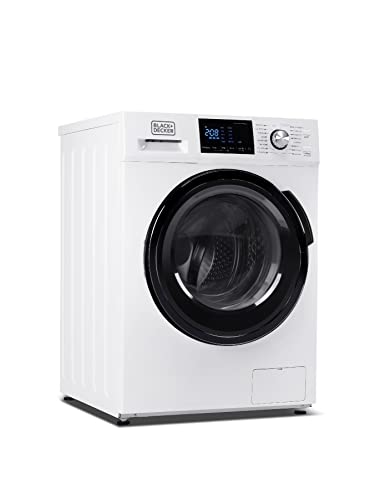
BLACK+DECKER 2.7 Cu. Ft. Washer and Dryer Combo — The clearest wash/dry split
This is the listing we wish every combo maker would imitate, because it prints the two numbers that define the category side by side: it washes up to 25.6 lbs. and dries up to 13.2 lbs. That is not a flaw unique to this machine — it is the physics of drying in a wash drum, where clothes need room to tumble through heated air — but BLACK+DECKER is the one that tells you before purchase instead of after. If you read nothing else in this guide, read that pair of figures and internalise it: your working load size is the smaller number.
Put that split to work and it quietly redesigns your laundry habits in a good direction. A household that washes at the 13 lb scale — roughly a week’s work clothes for one person, or two to three days for a couple — never has to split anything, never waits on a second dry, and finds the machine’s rhythm unremarkable, which is the highest praise a combo can earn. The split only bites when the wash load is planned at the full 25.6 lbs, which is why we keep returning to it: plan at the dry number and this is simply a competent compact; plan at the wash number and it feels like a machine that halves your laundry out of spite.
Around that honesty sits a conventional, well-sorted compact: 2.7 cu. ft. of capacity, an LED display and 16 cycles. Sixteen cycles on a machine of this size is generous without being theatrical, and for the one- or two-person households these combos serve, the practical rotation usually settles on three or four of them. The white BCW27MW cabinet is the standard 24-inch-class footprint shared by most of this group, so it slots into the same closets and alcoves as its rivals.
- Drum: 2.7 cu. ft., all-in-one washer and dryer, model BCW27MW
- Wash capacity: up to 25.6 lbs., per the listing title
- Dry capacity: up to 13.2 lbs., per the listing title
- Controls: LED display, 16 cycles
- Spin speed: none stated in the listing title
- Where to buy: the BLACK+DECKER 2.7 Cu. Ft. Washer and Dryer Combo listing on Amazon — check price on Amazon
Strengths
- The printed wash/dry split lets you plan load sizes with real numbers.
- Sixteen cycles covers everything a small household realistically launders.
- Standard compact footprint fits the alcoves this category is bought for.
Trade-offs
- The 13.2 lb dry ceiling means full wash loads must be halved before drying.
- No steam program is claimed in the title, unlike two rivals here.
- The title states no spin speed, so extraction performance is an open question on the page.
Best for: first-time combo buyers who want the category’s central trade-off stated in numbers, not discovered. Not suited for: households that wash bulky bedding often — a 13.2 lb dry limit and duvets are not friends.

COMFEE’ 24-Inch 2.7 Cu. Ft. Washer and Dryer Combo with Steam Care — Steam care in a 24-inch frame
COMFEE’ aimed this 24-inch, 2.7 cu. ft. combo squarely at the dorm-and-first-apartment buyer — the listing literally tags it “Dorm White” — and then specified it like a machine for grown-ups: Steam Care, an Overnight Dry program, and a 26 lb wash capacity. The Overnight Dry is the headline for real life. A combo’s dry cycle is long; a dry cycle that runs while you sleep is not long at all, it is simply done by morning, and pairing that program with steam care for refreshing and de-wrinkling gives this machine a daily rhythm the others have to improvise.
Steam Care deserves a sentence of honest framing, because steam in a compact combo is a garment-care tool, not a cleaning superpower. What steam does well at this scale is relax wrinkles, freshen clothes that were worn briefly, and soften the stiffness line-dried or long-tumbled fabrics pick up — the difference between ironing a shirt and merely hanging it. Paired with a machine whose dry stage runs overnight, it means the morning version of a shirt can be the refreshed version, and for dorm and first-apartment wardrobes heavy on a few good pieces, that is a genuinely used feature rather than a badge.
The listing also carries a “No Shaking” claim, which we read as a stability pitch rather than a measured specification — compact front-loaders on apartment floors do walk when a load bunches, and no title line can repeal that. Level the feet, do not overload, and treat the claim as encouragement. What is concrete: the machine is a full-automatic front-load combo, which means load, select, and walk away — the entire point of the category — with steam as the differentiator in a group where most rivals compete on cycles alone.
- Drum: 2.7 cu. ft., 24-inch front-load combo
- Wash capacity: 26 lbs., per the listing title
- Features named in the title: Steam Care, Overnight Dry
- Operation: full-automatic wash and dry in one drum
- Dry capacity: not given in the listing title — the overnight program is the practical answer to it
- Where to buy: the COMFEE’ 24-Inch 2.7 Cu. Ft. Washer and Dryer Combo with Steam Care listing on Amazon — check price on Amazon
Strengths
- Overnight Dry converts the category’s slowness into a non-issue for sleepers.
- Steam Care adds garment refreshing that most compact combos skip.
- A 26 lb stated wash capacity is at the strong end of this group.
Trade-offs
- Dry capacity is not printed in the title, so the split-load rule still applies blind.
- The stability claim in the title is marketing language, not a specification.
- Steam and overnight programs reward routine; irregular laundry habits use them less.
Best for: dorm residents, first-apartment renters and anyone whose laundry can run on a night-shift schedule. Not suited for: same-hour laundry emergencies — no combo is, and the overnight design philosophy admits it.

Magic Chef 2.7 Cu. Ft. All-in-One Washer Dryer Combo — The straightforward silver option
Magic Chef’s contribution to the group is restraint. Where rivals stack program counts, this 2.7 cu. ft. all-in-one lists five temperature settings and two dry cycles, and stops there. For a certain kind of buyer — the one who has watched a housemate stare at a 16-cycle dial like it was an exam — that restraint is the feature. Two dry cycles honestly covers the real world of a small household: one for the load you need dry, one for the load you need dry gently.
Two dry cycles also clarifies a decision the busier machines bury: temperature discipline. With five temperature settings on the wash side and a simple pair of dry options, the Magic Chef pushes the user toward the habits that actually protect clothes — wash warm only when the soil demands it, dry on the gentler cycle for anything with elastic or print. Owners of feature-stacked machines often end up using one default for everything anyway; this machine simply admits the default exists and builds the control panel around it, which is a more honest design than a dial full of programs nobody selects twice.
The silver finish is the other deliberate difference. Compact laundry usually lives in visible places — a kitchen corner, a bathroom alcove, a closet with the door left open — and a silver cabinet reads as an appliance rather than a utility box, which matters more in a studio than any spec-sheet line. The listing describes the machine as portable, a word this category uses loosely; read it as “compact and movable between hookups” rather than anything you would carry, because a 2.7 cu. ft. front-load combo is a two-person lift with water connections, wherever it lives.
- Drum: 2.7 cu. ft., front-load all-in-one, silver finish
- Temperatures: 5 temp settings, per the listing title
- Dry programs: 2 dry cycles, per the listing title
- Design language in the title: 2-in-1 portable washing machine with dryer
- Wash/dry load weights: none stated in the listing title
- Where to buy: the Magic Chef 2.7 Cu. Ft. All-in-One Washer Dryer Combo listing on Amazon — check price on Amazon
Strengths
- The simplest control philosophy in the group — five temperatures, two dry cycles, done.
- Silver finish suits combos that live in sight rather than in a laundry room.
- Full 2.7 cu. ft. drum keeps it in the apartment class, not the novelty class.
Trade-offs
- Two dry cycles leaves little room for specialised drying routines.
- No load weights in the title means the page must be checked before planning loads.
- “Portable” in the title overpromises; this is a plumbed compact, not a carry-anywhere unit.
Best for: buyers who value a short menu and a finish that does not clash with a kitchen. Not suited for: laundry enthusiasts who want steam, overnight programs or a dozen specialised cycles.

Midea 2.7 Cu. Ft. 24-Inch All-in-One Washer Dryer Combo, Ventless — The ventless fast-spinner
If drying time is the tax every combo charges, Midea’s 2.7 cu. ft. machine is the one engineered to pay less of it. The title stacks the two specifications that matter: a 1400 RPM spin — the fastest in this group by a wide margin over the Hamilton Beach’s 800 — and ventless drying. The spin comes first in real life as well as in the sentence: every extra litre of water the spin extracts is a litre the dry stage does not have to evaporate, so a fast spin quietly shortens every single dry cycle the machine will ever run.
The condenser routine is the one ownership cost to plan for. A ventless machine gathers the water it removes — either plumbed to the same drain as the wash water or collected — and its lint management matters more than on a vented machine, because everything the air carries stays inside the appliance’s plumbing. None of this is difficult, and the manual walks it, but buyers who have never owned a condensing dryer should budget the ten minutes to read that section rather than discovering it via a slowly lengthening dry cycle in month three.
Ventless is the second half of the argument, and it is an installation argument. A vented dryer needs a duct path to the outside; a ventless condensing design does not, which is why ventless combos dominate in condos with HOA rules about exterior penetrations and in rentals where the lease forbids cutting a vent hole. Add Steam Care, an Overnight Dry program and 16 wash cycles in a 24-inch white cabinet, and this is the most completely specified machine in the set. Small-space living tends to be furnished one compact category at a time — the same households speccing a 24-inch laundry box are often the ones reading our roundup of Best Lightweight Backpack Beach Chairs for a balcony or a car boot with no spare cubic inch in it — and within this group, only the Midea and the convertible Equator make ventless or convertible venting part of their stated design, and only the Midea does it at full apartment capacity.
- Drum: 2.7 cu. ft., 24-inch all-in-one front load
- Drying: ventless, per the listing title
- Spin: 1400 RPM, per the listing title
- Features named in the title: Steam Care, Overnight Dry, 16 wash cycles
- Dry load weight: not stated in the listing title
- Where to buy: the Midea 2.7 Cu. Ft. 24-Inch All-in-One Washer Dryer Combo, Ventless listing on Amazon — check price on Amazon
Strengths
- The 1400 RPM spin attacks drying time at the source — water removal before heat.
- Ventless design installs where ducting is impossible or forbidden.
- Steam Care plus Overnight Dry matches the COMFEE’ feature set and adds the spin advantage.
Trade-offs
- Ventless drying is the slower drying method, even with a fast spin helping it.
- Condensing designs need their water path managed — a drain or a tank routine, per the manual.
- Sixteen cycles plus steam is the busiest control set here; simplicity seekers should look at the Magic Chef.
Best for: condo owners barred from venting, and anyone who wants the shortest realistic dry times a combo can offer. Not suited for: buyers with an easy vent path and no patience, who would still be better served by a separate vented dryer.

Equator 24-Inch 1.6 Cu. Ft. Convertible Combo Washer Dryer — The tiny-space specialist
Everything else in this guide is an apartment machine; the Equator is a space-mission machine. At 1.6 cu. ft. and 15 lbs of capacity, on 110V power, it is built for the places the others cannot go: RVs, tiny homes, boats, and the condo closet that measures its spare room in inches. The title names those homes outright — apartment, condo, RV, tiny home, small spaces — and for once the marketing and the engineering agree, because a 24-inch convertible combo is one of the very few ways to get wash-and-dry in a vehicle at all.
Weight and water discipline are the unglamorous half of RV laundry, and this machine’s numbers are written for them: 15 lbs of laundry is a load that respects both a small drum and a grey-water tank, and 110V running suits the electrical reality of vehicles and off-grid cabins better than any 240V appliance ever will. The PET cycle, meanwhile, solves the specific misery of pet hair welding itself to fleece in a small drum — a cycle tuned for those loads beats discovering, at a campground, that the dog’s blanket has redecorated everything else you own.
Two details separate it from generic smallness. The first is “convertible”: the machine can be set up in different venting configurations, which matters enormously in an RV where one installation may have a vent path and the next may not. The second is the PET cycle, a program aimed at the pet hair and dander loads that RV and tiny-home owners — a demographic with an above-average dog count — run constantly. The 1400 rpm spin matches the Midea’s extraction speed, a specification that matters even more at this size, because a 15 lb load has no spare drum room for drying inefficiency.
- Drum: 1.6 cu. ft. / 15 lbs, 24-inch convertible combo
- Power: 110V, per the listing title
- Spin: 1400 rpm, per the listing title
- Named program: PET cycle, per the listing title
- Intended spaces, per the title: apartment, condo, RV, tiny home, small spaces
- Where to buy: the Equator 24-Inch 1.6 Cu. Ft. Convertible Combo Washer Dryer listing on Amazon — check price on Amazon
Strengths
- The only pick genuinely sized and powered for RV and tiny-home installation.
- Convertible venting adapts to spaces with or without a duct path.
- A 1400 rpm spin at this capacity keeps small loads drying efficiently.
Trade-offs
- 15 lbs is a hard ceiling — this is a one-person or couple’s machine, full stop.
- Bedding and bath-sheet loads will need splitting or a laundromat friendship.
- Specialist sizing means fewer economies of scale than the mainstream 2.7 cu. ft. class.
Best for: RV owners, tiny-home dwellers and anyone whose laundry space is measured in inches. Not suited for: apartment households who actually have room for a 2.7 cu. ft. machine and would outgrow this in a month.
Side-by-Side: Drum, Drying and Design
| Machine | Drum & load | Drying design | Detail that decides it |
|---|---|---|---|
| Hamilton Beach 2.65 Cu. Ft. All-in-One | 2.65 cu. ft.; dry load not stated in title | Combo drying, 120V machine | Delay start for finish-when-you-arrive cycles |
| BLACK+DECKER 2.7 Cu. Ft. Combo | 2.7 cu. ft.; washes 25.6 lbs., dries 13.2 lbs. | Combo drying, split-load by design | The only fully stated wash/dry split |
| COMFEE’ 24-Inch 2.7 Cu. Ft. Combo | 2.7 cu. ft.; washes 26 lbs. | Overnight Dry program | Steam Care in a dorm-ready frame |
| Magic Chef 2.7 Cu. Ft. All-in-One | 2.7 cu. ft.; load weights not stated in title | 2 dry cycles, 5 temperatures | Silver finish, simplest controls |
| Midea 2.7 Cu. Ft. Ventless Combo | 2.7 cu. ft.; 24-inch cabinet | Ventless, 1400 RPM spin | No duct needed; fastest extraction here |
| Equator 1.6 Cu. Ft. Convertible Combo | 1.6 cu. ft. / 15 lbs; 110V | Convertible venting, 1400 rpm spin | PET cycle; RV and tiny-home sizing |
What Should You Measure Before a Combo Goes on the Shortlist?
Start with the space, and measure it like you mean it: width, depth with the door swing, and the path the machine travels from your front door to its home, because a 24-inch combo that cannot turn the hallway corner is a very expensive sculpture. Then measure the hookups. Every machine here needs water in and water out; most need only a standard outlet, and the two that print their voltage — 120V on the Hamilton Beach, 110V on the Equator — confirm the category’s plug-anywhere character, but confirm the exact electrical line on the listing of the model you choose rather than assuming it from a sibling.
Next, audit your laundry honestly for one week. Count loads, weigh the biggest one if you can, and note how much of it is bedding. That audit tells you which capacity figure governs your life: if your typical load is near 13 lbs, the BLACK+DECKER’s stated dry ceiling fits your habits; if your loads run heavier, you will either split loads as a routine or should be looking at the 2.7 cu. ft. class with overnight programs that hide the extra cycle in your sleep. There is no wrong answer here, only mismatched ones.
One more measurement belongs in the audit: your tallest laundry item and your widest. A 2.7 cu. ft. drum swallows a queen duvet cover more willingly than the duvet itself, and knowing which specific items will always be laundromat items — before the machine arrives — converts them from recurring frustrations into a settled arrangement. Many combo households keep exactly such a list: the machine handles ninety percent of life, and a monthly trip handles the rest, which is still a radically better laundry life than the weekly trip the machine replaced.
Finally, decide the venting question before the brand question. If your space has no duct path and your lease or HOA forbids making one, your shortlist is the ventless Midea and the convertible Equator, and the decision between them is pure size. If venting is available, the whole group opens up. Households furnishing a small home end-to-end often run this same space audit room by room — it is the thinking behind our look at Best Large Bean Bag Chairs, where a single oversized piece has to justify every inch it takes — and a combo deserves the same unsentimental arithmetic.
How Do You Run a Combo So Drying Does Not Take All Day?
The technique is mostly load discipline. Wash loads sized to the dry capacity, not the wash capacity, whenever the load will go straight through both stages — the one stated split in this guide, 25.6 lbs washing against 13.2 lbs drying, is the ratio to keep in mind even on machines whose titles do not print it. When you do wash a full load, pull out the heavy cotton pieces before the dry stage and give them a second, smaller dry, or hang them; denim and bath towels are the items that stretch a combo’s dry cycle from long to legendary.
Sort by fabric weight, not just colour. A mixed load dries at the speed of its heaviest member, so lights together and heavies together genuinely shortens the day. Use the spin you have: on the 1400 RPM machines, an extra spin before the dry stage is the cheapest time you will ever buy back. And build the schedule the machines are designed for — delay start on the Hamilton Beach, Overnight Dry on the COMFEE’ and the Midea — so the long dry happens while you are at work or asleep, and the machine’s slowness stops being a property you experience.
There is one more habit worth building in week one: learn your machine’s mid-cycle signals. A combo that has moved from wash to dry sounds different, and a load that has bunched into a single heavy ball announces itself in the spin. Catching a bunched load early — pausing, redistributing, restarting — saves more drying time across a year than any feature difference between the six machines in this guide, and it costs nothing but attention during the first few cycles, while you are still curious enough to pay it.
Maintenance is short and non-negotiable. Condensing and ventless designs collect lint and water in places a vented dryer does not have, so clean the lint filter every cycle and follow the manual’s schedule for the condenser path; a clogged condenser is the number-one reason a combo’s drying gets slower month by month. Leave the door ajar between cycles, as with any front-loader, and run the tub-clean routine your model’s manual specifies.
Ventless or Vented: Which Drying Design Fits Your Walls?
A vented dryer pushes hot, moist air out of the building through a duct. A ventless condensing dryer keeps that air inside the machine’s world: it condenses the moisture out of the exhaust air and sends the water to a drain or a collection tank, releasing only warmed room air. In a combo, the distinction decides where the machine may legally and practically live. A vented installation needs a duct route — through an exterior wall, a window kit, or an existing vent stub — and many leases, condo rules and interior laundry closets simply do not offer one.
Condensing designs trade speed for freedom. Moving moisture out with a fan and a duct is brisk; coaxing it to condense on a cold surface is patient work, which is why ventless drying sits at the slower end of an already slow category. The compensation is total placement freedom and no duct to lint up, plus one less hole in the building envelope leaking heated air all winter. The Midea represents the ventless pattern at full apartment size in this group, while the Equator’s convertible design is the hedge: configure it for the installation you have, and reconfigure if the machine moves to a space with different options.
Heat-pump drying is the third pattern, common in standalone ventless dryers and rarer in compact combos; none of the six titles here claims heat-pump technology, so we will not pretend otherwise. If a listing for a future model does claim it, expect the same placement freedom with gentler temperatures and still-longer cycles. The practical rule stands regardless of pattern: the more constrained your building, the more the ventless premium is worth paying in time; the easier your duct path, the more a vented design’s speed is worth having.
Whose Laundry Rhythm Actually Suits a Single Drum?
The happiest combo owners share a profile, and it is worth checking yourself against it before the purchase rather than after. They live alone or as a couple. Their laundry arrives in a steady trickle — work clothes, gym kit, towels — rather than a weekend landslide. They are out of the home for predictable stretches, at work or asleep, during which a machine can run unwatched. And their wardrobe leans toward the fabrics combos handle best: everyday cottons, synthetics and blends in moderate loads, rather than a weekly rotation of king duvets and bath sheets.
Singles in studios are the canonical case: the machine lives in a kitchen corner or bathroom alcove, runs twice a week on a delay timer, and the laundromat simply leaves their life. Couples in one-bedroom condos are the second case, usually adding a rule — bedding gets its own half-load day — that keeps the dry ceiling from ever becoming an argument. RV and tiny-home owners are the third case, where the comparison is not combo versus separates but combo versus a campground laundry room, and the combo wins that comparison at almost any cycle length.
The profiles that struggle are equally recognisable. Families with children generate load volume and load urgency simultaneously — the school uniform needed tomorrow morning is precisely the use case a slow single drum serves worst, because the drum cannot wash the next load while it dries this one. Anyone who regularly washes bulky items will meet the dry ceiling weekly. And households with a genuine laundry room should use it: separates in the same footprint class will always out-wash and out-dry a combo, and the combo’s one virtue — existing where two machines cannot — buys them nothing.
A word about noise, since compact laundry rarely gets a room of its own. A combo’s wash is quiet in the way of all front-loaders, but its dry stage runs a fan and a tumble for a long stretch, often in a kitchen or bathroom with hard surfaces that flatter no appliance. Machines on properly levelled feet, on a firm floor rather than a hollow one, are dramatically better neighbours; a machine installed on a springy upper floor will announce itself to the room below. If your laundry spot shares a wall with a bedroom, the overnight programs are still usable — but choose the machine and the cycle with that wall in mind, and let the first week’s towel loads tell you the truth about your floor before you commit to a nightly schedule.
Which Buying Mistakes Turn a Good Combo Into a Return?
The first is buying by wash capacity. A buyer who reads “25.6 lbs” or “2.7 cu. ft.” and imagines drying that much laundry in one pass has been set up for disappointment by the category’s marketing, and the disappointment is entirely preventable by planning around the dry figure. The second is expecting standalone-dryer speed. A combo dries with a smaller heater and a drum doing double duty; no setting repeals that, and buyers who need a load turned around in forty minutes need a different appliance architecture.
The third mistake is ignoring the venting and drainage homework until delivery day — discovering that a condensing machine’s water path was never planned, or that the closet door cannot close over the machine’s depth. The fourth is overloading to “save cycles”: an overfilled drum dries unevenly, wrinkles harder, and takes longer than the two honest loads it was trying to avoid. And the fifth is treating a combo as a temporary embarrassment rather than a system: the households happiest with these machines are the ones who reorganised their laundry rhythm — smaller, more frequent, scheduled loads — around what the machine does well.
What Does Installation Day Actually Involve?
Less than a separates installation, more than unboxing a microwave. The machine needs a water supply — most compact combos ship with inlet hoses intended for a standard laundry tap or a sink adapter arrangement — a drain path for wash water, and, on condensing models, a route for the dryer’s collected water, which is often the same drain. It needs a floor that is level and firm; front-load drums punish unlevel installations with noise and walking, and on a combo the dry stage runs long enough for a small vibration to become a household soundtrack. The adjustable feet are not decoration — level the machine, load it with towels, run a spin, and adjust again before you call it done.
Leave working room around it. You will need to reach the lint filter, the drain arrangements and, on condensing designs, whatever water path the manual describes, so a combo wedged into a closet with zero clearance converts five-minute maintenance into an afternoon of furniture moving, and maintenance that is hard gets skipped. First loads should be small and unimportant — a load of old towels teaches you the machine’s cycle rhythm, its noise signature and its dry endpoint without risking anything you love. Note how dry “dry” feels at the end of the first full cycle: combos often leave clothes at a cool, slightly humid-feeling state that finishes in the first minutes of hanging, and learning that endpoint on towels rather than on a work shirt saves a week of suspicion.
Finally, write down your model’s stated capacities — wash and dry, where the listing gives both — and tape the card inside a cupboard door. It sounds precious; it is in fact the single habit that separates households who love these machines from households who list them for sale in month two, because every disappointment in this category begins with a load sized by hope instead of by the dry figure.
Final Recommendation
For most apartment and condo buyers, the Midea 2.7 cu. ft. ventless combo is the strongest all-round answer here: the 1400 RPM spin, the ventless installation and the overnight program attack the category’s weaknesses from three directions at once. The BLACK+DECKER is the pick for buyers who want the trade-offs in writing, the COMFEE’ for steam and dorm life, the Hamilton Beach for 120V simplicity with a proper delay start, the Magic Chef for the shortest menu in the group, and the Equator — alone — for RVs and tiny homes. Choose by your venting reality and your real load weight, and a combo stops being a compromise and becomes the machine that gave you laundry at home. One drum, honestly sized, beats a laundromat run in the rain every single week of the year.
Frequently Asked Questions
Can a combo washer dryer really dry as well as a separate dryer?
It dries completely, but more slowly and in smaller loads. The stated figures in this group make the point concretely: the BLACK+DECKER listing washes up to 25.6 lbs. yet dries up to 13.2 lbs., because drying needs tumbling room. Given time and a right-sized load, clothes come out dry; what a combo cannot give you is a separate dryer’s speed or its ability to dry load two while load three washes.
Do combo washer dryers need a vent?
Some do not. The Midea in this guide is stated as ventless, and the Equator is a convertible design that can be configured for different venting arrangements — the two patterns that suit condos and rentals where ducting is impossible. Other combos may need a vent path, so treat venting as a per-model question answered on the listing and in the manual, never as a category assumption.
Why does drying take so long in a combo?
Three reasons compound: the drum is smaller than a dedicated dryer’s, the heating capacity of a compact 110V/120V-class machine is modest, and the same drum that just held wash water must now evaporate the rest. A fast spin is the countermeasure — the 1400 RPM machines here start the dry with noticeably less water still in the fabric — and overnight scheduling is the lifestyle countermeasure.
What size combo does a single person or couple need?
For one or two people doing regular small loads, the 2.65–2.7 cu. ft. class covers the week comfortably, including most bedding if it is split sensibly. The 1.6 cu. ft. Equator serves one person, an RV or a tiny home where the alternative is no machine at all; couples in a fixed apartment will usually find its 15 lb ceiling tight by the second month.
Can a combo washer dryer go in an RV?
Yes — that is the Equator’s stated home ground: 1.6 cu. ft., 15 lbs, 110V, with a PET cycle and convertible venting for installations with or without a duct path. Check your RV’s bay dimensions, water hookups and weight budget against the listing before ordering, because RV laundry bays vary more than apartment closets do.
Will a combo raise my energy bills?
A combo uses less water than an old top-loader and its total energy per load is modest, but the long dry stage means the heating element works for more hours per load than a standalone dryer’s does. In practice, owners doing two or three right-sized loads a week rarely notice the difference on a bill; owners running the machine daily in a split-load routine should expect the drying hours to show. The honest lever is load discipline — a fast spin and a correctly sized load use less energy than any setting on the dial.
Are combo washer dryers hard to maintain?
No, but they are less forgiving of skipped maintenance than separates. The routine is short: lint filter every cycle, door seal wiped and left ajar, condenser and drain paths cleaned on the manual’s schedule for ventless models, and an empty hot wash periodically to keep the drum fresh. Fifteen minutes a month is a fair budget. The failure mode is gradual — drying gets slower as lint and residue build — which is why the schedule matters more than the effort.
How long does a full wash-and-dry cycle take in one of these?
Longer than you hope and roughly as long as owners plan for: the wash portion behaves like any compact front-loader, and the dry portion stretches the total well past what a separate dryer would need, especially on ventless designs and heavy cotton loads. That is exactly why three of these six machines build scheduling into their feature lists — delay start and overnight dry programs exist so the cycle’s length happens during hours you are not standing in front of the machine.
How long does one full wash-and-dry cycle actually take in a combo?
Plan on a much longer door-to-door time than a separate washer and dryer pair. The wash portion of a 2.7 cu. ft. combo behaves like any compact front-loader, but the drying portion works on a smaller load than the wash drum accepts — the Hamilton Beach title, for example, rates drying at up to 13.2 lbs. against a 25.6 lb. wash load — and ventless condensing designs release heat slowly by nature. In practice, owners split the wash load before drying or use the overnight-style dry programs that models like the COMFEE’ build in, starting a load in the evening and unloading it in the morning. If your household runs several loads back to back every day, that rhythm is the strongest argument for two separate machines instead.
Related Guides
Combos solve the one-box problem; the neighbouring questions are about the machines at the edges of the category — the smallest dryers that pair with a compact washer, and the full-size dryers for homes that do have the room. Start with Best Compact Portable Dryers if a separate compact dryer beside a small washer fits your space better than a single drum.



[…] find the batch laundry those covers generate argues for a dryer that can keep up, and our guide to Best Combo Washer Dryers covers the single-drum answer for smaller […]