What's inside
- Key Takeaways
- Quick Picks
- How did we choose these best air purifiers asthma allergies households can rely on?
- How do the six compare for a sensitive household?
- What can a purifier honestly do for a sensitive household?
- Why does the bedroom dominate every sensible plan?
- What separates allergen-focused filtration from ordinary dust control?
- How should you run a purifier through high-pollen weeks?
- Which household habits multiply a purifier’s effect?
- When should the next step be a clinician rather than a shop?
- How do you judge a purifier’s effect without fooling yourself?
- How do you maintain a purifier so it stays trustworthy for years?
- Which mistakes do sensitive households most regret?
- Final Recommendation
- Frequently Asked Questions
- Related Guides
As an Amazon Associate I earn from qualifying purchases. This post may contain affiliate links at no extra cost to you.
cottageverdict.com is reader-supported. When you buy through links on our site, we may earn an affiliate commission.
Where to buy: each machine below links to its Amazon listing, where you can check price on Amazon and review the manufacturer’s own filtration description before deciding. For this category more than any other, read the listing’s fine print about filter type and room sizing, because the vocabulary on boxes is looser than the vocabulary sensitive households need.
People searching for the best air purifiers asthma allergies households can rely on are rarely shopping for a gadget; they are shopping for better mornings. A note of honesty belongs at the front of this guide: an air purifier is not a medical device, it does not treat asthma or allergies, and nothing in these pages replaces the advice of the clinician who knows your situation. What a good purifier can do is steadily reduce the airborne particles floating through the rooms where you live and sleep — pollen grains, dust mite debris, pet dander, mould fragments — so the air itself carries less of what sensitive airways would rather not meet.
Framed that way, the purchase becomes an environmental decision rather than a medical one, and it can be judged with clear eyes. The six machines below were chosen for the strength and sealing of their filtration, the depth of their carbon stages where odours and household chemicals are part of the picture, and their ability to run quietly and constantly in a bedroom, because consistency is what lowers a room’s background particle level. If you have asthma or significant allergies, treat this guide as a companion to professional guidance, not a substitute for it — and let comfort, sleep quality and a visibly calmer home be the measures you judge by.
A word about language, because it matters in this category: throughout this guide, claims are made about rooms and air — particles lowered, dust settling more slowly, odours fading — and never about bodies, diagnoses or outcomes. That restraint is deliberate, and readers should hold every other seller in this market to the same standard when they compare what is being promised.
Key Takeaways
- A purifier manages a room’s air, not a medical condition; pair it with your clinician’s advice, never instead of it.
- Sealed, high-grade HEPA filtration is the core requirement for pollen, dander and dust debris control.
- The bedroom is the highest-value room, because eight hours of cleaner air outweighs any daytime room.
- The IQAir HealthPro Plus XE offers the deepest filtration here; the Coway Mighty is the balanced classic.
- Carbon depth matters when fragrances, smoke drift or household chemicals are among your personal triggers for discomfort.
- Constant low-speed running lowers background particle levels more reliably than occasional powerful blasts.
Quick Picks
| Pick | Badge | Why it made the list |
|---|---|---|
| IQAir HealthPro Plus XE | Deepest filtration in this guide | A Swiss-built unit with HyperHEPA filtration for rooms up to about 1,125 sq ft, aimed at households wanting maximum particle capture. |
| Coway Airmega Mighty AP-1512HH | The balanced allergen classic | A long-proven Coway rated to about 1,748 sq ft, with true HEPA, a washable pre-filter and eco-aware auto running. |
| Winix 5520 | Large-room value with a monitor | A current-generation Winix for rooms up to about 1,882 sq ft in an hour, with true HEPA, a deep carbon filter and air quality display. |
| Medify MA-40 | Strong coverage for the money | A tower-format Medify rated to clear about 1,793 sq ft in an hour, with HEPA filtration aimed at smoke, pollen and pet households. |
| Austin Air HealthMate B400 | Deep carbon for chemical sensitivity | A steel-bodied, four-stage unit with a large activated carbon and zeolite bed, coverage to about 1,500 sq ft and a five-year filter life. |
| Blueair Blue 211i Max | Quiet power for large rooms | A large-room Blueair rated to about 3,235 sq ft, with HEPASilent filtration, auto mode and a 23 dB floor on its quietest running. |
How did we choose these best air purifiers asthma allergies households can rely on?
Filtration integrity came first, and it was judged strictly. Candidates needed true HEPA-grade media or better, housed so that air cannot sneak around the filter’s edges, because the particles that matter to sensitive households — pollen, dander flakes, mite debris carried on dust — are exactly the ones that exploit leaky housings. Machines built around ionization alone were excluded from this guide entirely; whatever role such features play elsewhere, a household managing asthma or allergies deserves mechanical capture it can verify by looking at a filter and seeing what it caught.
The second lens was stamina. A purifier for a sensitive sleeper must run all night, every night, at a volume the sleeper can accept, and then keep doing so for years. That favoured models with proven filter supply, honest medium speeds, and sleep behaviour designed rather than improvised. It also favoured larger machines loafing at low gear over small machines straining, because a loafing fan is a quiet fan, and a quiet fan is the one still switched on in month six when the pollen season peaks.
Finally, the guide weighed the chemistry side of household air. For some sensitive people the discomfort triggers are particles; for others they include fragrances, cleaning fumes, traffic gases or tobacco drift, which HEPA alone cannot touch. Two picks — the Austin Air with its deep carbon and zeolite bed, and the IQAir with its granular gas-stage options in the family — speak to that second group. The result is a list that treats sensitive households as varied rather than uniform, because they are.
A last note on evidence: this guide prefers filtration claims that a buyer can verify from the manufacturer’s own documentation — filter grades, sealed construction, published room ratings — over testimonials about how any individual felt after a week. Comfort stories are how households talk; specifications are how they should shop, and the picks above were required to satisfy the second standard before their reputations were allowed to count for anything.

IQAir HealthPro Plus XE — Deepest filtration in this guide
The HealthPro Plus XE is what happens when a purifier is engineered without much interest in compromise. Its final filtration stage uses IQAir’s HyperHEPA media, rated by the maker to capture particles far below the size ordinary HEPA grades are specified for, and the stages before it — a pre-filter and a granular gas and odour stage — protect that expensive finale from loading prematurely. The maker sizes the machine for rooms up to roughly 1,125 square feet, and in sensitive households it is most often stationed in the main bedroom, where its thoroughness has the whole night to accumulate into a noticeably calmer room.
Build quality is part of the medical-adjacent appeal, though the machine itself is a household appliance and should be understood as one. The housing is rigid, the seals are serious, the fan is balanced for low vibration, and the unit rolls on castors despite its substantial weight — a mercy, because this is not a machine anyone carries one-handed between rooms. Controls report filter life stage by stage, which suits households that maintain equipment the way they maintain everything else in a managed home: on schedule, with records, without drama.
The ownership commitment matches the engineering. Replacement stages are premium-priced, the unit occupies real floor territory, and its fan at full stretch is purposeful rather than hushed, though its lower and middle gears — where a correctly sized bedroom unit should live — are entirely sleep-compatible. Wi-Fi control in this XE generation lets the machine be governed from another room, useful when the bedroom routine is being run for a child whose door stays closed after lights-out.
Choose the IQAir when the household’s philosophy is to control the environment as thoroughly as a single appliance allows, and when the budget conversation has already accepted that thoroughness is the point of the purchase. It is the deepest filtration in this guide by a clear margin, and for people whose comfort rises and falls with the particle count of their bedroom, that margin is the entire argument.
- Coverage hint: rooms up to about 1,125 sq ft by maker rating
- Filtration: pre-filter, gas stage and HyperHEPA finale
- Build: rigid sealed housing on castors
- Controls: stage-by-stage filter life tracking, Wi-Fi
- Placement: main bedroom or primary living room
Strengths
- Finest particle capture available in this list
- Granular stage addresses gases and odours too
- Filter monitoring suits meticulous households
Trade-offs
- Premium pricing extends to replacement stages
- Heavy, substantial footprint in the room
- Top speeds are purposeful rather than quiet
Best for: households wanting maximum environmental control in one room.
Not suited for: anyone seeking a light, portable, budget-led option.

Coway Airmega Mighty AP-1512HH — The balanced allergen classic
The Mighty has been the default recommendation in this category for so long that its reputation risks hiding how well judged the design still is. A washable pre-filter faces the room and catches the coarse load; behind it, a true HEPA layer and a carbon filter handle particles and everyday odours; the maker rates the system for rooms up to roughly 1,748 square feet. An air quality sensor watches continuously, and the auto mode’s party trick is an eco behaviour that rests the fan entirely when the air stays clean for a stretch, then wakes it the moment conditions stir.
For allergy-season living, that wakefulness is the experience owners describe. The machine notices the evening door openings, the dog’s return, the window cracked for ten minutes on a high-pollen day, and answers each event with a temporary lift in fan speed before subsiding. The bedroom’s background level stays low without the owner choreographing anything, which matters in households where the condition being managed already consumes enough attention and nobody wants an appliance that needs managing too.
Night running is composed: the display can be darkened, the lower gears are even and unobtrusive, and the machine’s footprint is modest for its capability, standing neatly where a bedroom corner meets the wall. The three-year warranty and the model’s long production history mean filters are stocked everywhere and will be for years, an unglamorous virtue that sensitive households — who cannot simply pause filtration while hunting an orphaned cartridge — value more than most buyers.
If there is a ceiling to the Mighty, it is chemical: its carbon stage is a sheet suited to ordinary household odours rather than a deep bed for serious gas concerns, and households in that second category should look at the Austin Air below. For the central case — pollen, dust, dander and the wish for a calmer bedroom through the seasons — the Mighty remains the balanced classic against which newcomers are measured.
- Coverage hint: rooms up to about 1,748 sq ft by maker rating
- Filtration: washable pre-filter, true HEPA and carbon
- Sensor: air quality monitor with auto and eco modes
- Controls: timer, filter indicator and darkening display
- Warranty: three years from the maker
Strengths
- Proven design with filters stocked everywhere
- Eco auto mode rests when the air is clean
- Balanced size, noise and capability for bedrooms
Trade-offs
- Carbon sheet suits odours, not heavy gas loads
- Design has been around long enough to feel familiar
- No app control on this long-running model
Best for: bedrooms needing proven, self-governing particle control.
Not suited for: households whose main concern is chemical fumes.
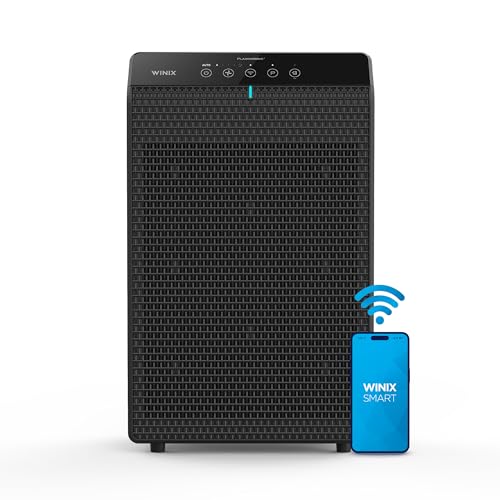
Winix 5520 — Large-room value with a monitor
The 5520 carries Winix’s large-room formula into its newest generation: true HEPA filtration, a high-capacity carbon filter aimed at odours and household gases, and an air quality monitor whose display translates the room’s condition into a reading the whole household can understand. The maker rates it for rooms up to roughly 1,882 square feet in an hour, which in practice means authority over a big bedroom or a family living room — the two rooms where a sensitive household’s hours concentrate.
That display earns more credit than displays usually do, because managing a sensitive home is partly an information problem. Watching the reading respond to real events — falling steadily after the bedroom door closes for the night, stirring when bedding is changed — teaches the household which habits move the needle, and turns the purifier from a talisman into an instrument. Auto mode then acts on the same information, and its modulation is gradual enough that the fan never becomes the loudest thing in a quiet house.
Winix includes its PlasmaWave stage here, and this guide’s position on it for sensitive households is simple: it can be switched off, and owners who prefer purely mechanical filtration, or who are cautious about any ion-based process in a bedroom, can run the machine that way permanently without losing the HEPA and carbon performance they bought it for. The flexibility respects the range of preferences in this audience better than a fixed design could.
Against the Mighty, the 5520 trades a little of the older machine’s ubiquity for newer monitoring and a deeper carbon stage; against the IQAir it trades ultimate filtration depth for a far gentler price and a lighter presence in the room. For a large bedroom or the family’s main living space, it is the point in this list where capability, information and cost settle into an easy balance.
- Coverage hint: rooms up to about 1,882 sq ft in one hour
- Filtration: true HEPA plus high-capacity carbon filter
- Sensor: air quality monitor with numeric-style feedback
- Technology: PlasmaWave stage, switchable on or off
- Placement: large bedrooms and family living rooms
Strengths
- Clear feedback teaches households their own air
- Deep carbon stage broadens odour coverage
- Auto mode modulates without drama or surges
Trade-offs
- Newer model, shorter long-term track record
- Larger body needs a deliberate bedroom corner
- Ion stage will simply stay off for some owners
Best for: large bedrooms and living rooms wanting visible feedback.
Not suited for: small rooms where its capacity is wasted.

Medify MA-40 — Strong coverage for the money
Medify built its name by selling filtration capacity at prices that undercut the famous brands, and the MA-40 is the size most sensitive households actually need: a tower the maker rates to cycle roughly 1,793 square feet in an hour, which translates to calm authority over a main bedroom or a mid-sized living room. Its HEPA filtration targets the standard trio of pollen, dust debris and dander, and the tower format tucks into the vertical corners that bedrooms offer more readily than floor area.
The MA-40’s manner is straightforward rather than clever. Controls are simple, the fan has enough gears to find a sleep-compatible setting with real airflow behind it, and the machine’s whole proposition is that filtration quality should not require a premium badge. For households whose budget is already carrying the costs of managing a condition — bedding, medications, clinic visits — that value stance is not a compromise but a relief, and it leaves room in the budget for the unglamorous consumables that make the whole system work.
Living with it means accepting a plainer interface and a design that prioritises the filter bay over sculptural beauty. The tower is light enough to move between the bedroom and a child’s room as seasons and symptoms dictate, which in practice is how many families deploy it: following the most sensitive sleeper, or standing guard in the living room on the high-pollen weekends when the whole household is indoors and the windows stay shut against the count outside.
Smoke deserves a specific mention because the MA-40 is often bought for it — wildfire drift, a neighbour’s wood stove, the occasional cigar on a nearby balcony. Its filtration handles the particle side of smoke well for its class, while the odour side, as with all sheet-carbon machines, fades faster than the particles do. Households where smoke is the primary adversary should read the Austin Air’s deep carbon bed below before deciding where their money works hardest.
- Coverage hint: about 1,793 sq ft cycled in one hour
- Filtration: HEPA filtration in a tower format
- Controls: simple multi-speed fan operation
- Placement: bedroom corners and living-room edges
- Design: lightweight enough to move between rooms
Strengths
- Generous capacity at a mid-market tier
- Tower shape fits ordinary bedroom corners
- Simple controls suit every household member
Trade-offs
- Interface and finish feel workmanlike
- Carbon depth is modest for heavy smoke odour
- Brand ecosystem is smaller than the giants
Best for: main bedrooms wanting capacity without premium pricing.
Not suited for: households needing deep gas and odour filtration.

Austin Air HealthMate B400 — Deep carbon for chemical sensitivity
The HealthMate approaches household air from the chemistry end. Its four-stage system wraps a large bed of activated carbon and zeolite — measured in pounds rather than sheets — around its HEPA layer, and that mass is the point: gases, fragrances, cleaning fumes and smoke odours need contact and capacity, and this is the machine in the guide built to provide both. The maker rates coverage to roughly 1,500 square feet, and the steel housing, a rarity in a plastic category, signals the design’s intent to serve for a long time in one important room.
Filter life is the second half of the argument. The combined filter is rated by its maker for up to five years of ordinary service, which transforms the ownership rhythm for households tired of cartridge subscriptions: install it, vacuum the pre-filter occasionally, and let years pass. For people whose sensitivity includes the new-filter smell itself, or whose budgets prefer one considered purchase to a drumbeat of consumables, that long interval is a quality-of-life feature disguised as a specification.
The machine’s manner is as plain as its mission. Three fan speeds, no app, no sensor dashboard — the HealthMate does not know what the air contains and does not pretend to; it simply processes a large volume of it through a deep bed, constantly, and lets physics accumulate. Its highest speed is frankly audible, so the correct deployment is the familiar one: size it generously, live on the lower gears, and let the carbon mass do quietly at midnight what thinner filters cannot do at any hour.
Choose the Austin Air when the household’s discomfort map is drawn in smells and fumes as much as in particles — the freshly painted rental, the home office above a garage, the bedroom downwind of a busy road or a smoker’s patio. It will not give you data, and it will not win a beauty contest, but for chemically sensitive comfort it occupies ground that nothing else in this guide seriously contests.
- Coverage hint: rooms up to about 1,500 sq ft by maker rating
- Filtration: four stages with deep carbon and zeolite bed
- Filter life: up to five years under ordinary use
- Housing: powder-coated steel, built for longevity
- Controls: three fan speeds, deliberately simple
Strengths
- Carbon mass dwarfs sheet-filter rivals
- Five-year filter interval ends cartridge fatigue
- Steel build suits a decade of bedroom service
Trade-offs
- No sensors, app or air quality feedback
- Highest speed is plainly audible
- Heavy, single-room commitment by design
Best for: chemically sensitive households and smoke-prone rooms.
Not suited for: buyers who want data and automation.

Blueair Blue 211i Max — Quiet power for large rooms
Scale and silence rarely coexist in purification, because moving a large room’s air usually means a fan everyone can hear. The 211i Max is Blueair’s argument that the trade-off can be engineered away: its HEPASilent approach combines mechanical filtration with an electrostatic assist so air moves with less brute force, the maker rates coverage up to roughly 3,235 square feet, and the quietest operation sits at a level a bedroom can host without negotiation. For a sensitive household in an open-plan home or a very large main bedroom, that combination solves the problem the smaller units circle around.
The washable pre-filter is part of the stamina story. Large rooms in pet-owning, sensitive households load a purifier with hair and dust at a rate that punishes sealed designs, and a pre-filter that rinses clean keeps the main filtration breathing between its scheduled changes. Auto mode reads the room’s particles and governs the fan accordingly, while the app extends that governance to schedules — a stronger gear for the hour of bed-making and vacuuming, a whisper for the sleeping hours either side of it.
Blueair’s design language helps the machine earn its floor space in a main room: the fabric-textured pre-filter reads as furnishing rather than equipment, and the unit’s presence is calm rather than clinical. That matters in the rooms where a family actually lives, because an appliance that looks like it belongs gets left running, and running is the whole game for households managing a background particle level rather than chasing individual events.
The compromises are footprint, price and the electrostatic element, which purists can weigh against the mechanical depth of the IQAir above. What the 211i Max offers in return is the easiest large-room ownership in this guide: set it in the big room, let auto mode conduct, wash the pre-filter when it greys, and enjoy a machine whose loudest contribution to the household is how little anyone mentions it.
- Coverage hint: rooms up to about 3,235 sq ft by maker rating
- Filtration: HEPASilent with washable pre-filter
- Noise: quietest running rated around 23 dB
- Controls: auto mode, app and air quality feedback
- Placement: large bedrooms and open-plan living
Strengths
- Large-room reach without large-room noise
- Washable pre-filter suits pet households
- Furnishing-grade looks for main rooms
Trade-offs
- Substantial footprint and premium tier
- Electrostatic assist is not purely mechanical
- Oversized for ordinary bedrooms
Best for: open-plan homes and very large bedrooms.
Not suited for: compact rooms or tight budgets.
How do the six compare for a sensitive household?
The six divide along two axes: how deep the filtration goes, and whether the household’s problem is mainly particles, mainly chemistry, or the common mixture of both. The table maps each machine to the sensitivity profile it serves best, which is a more useful comparison for this audience than any single performance figure.
One caution about reading any comparison in this category, including this one: filtration depth and room fit are the variables that matter, while the long tail of features — apps, voices, colour displays — matters only insofar as it keeps the machine running constantly. A sensitive household should therefore read the table’s filtration column first, its room column second, and treat everything else as a tiebreaker between machines that already qualify.
| Model | Best room fit | Filtration approach | Standout trait |
|---|---|---|---|
| IQAir HealthPro Plus XE | Main bedroom, maximum control | HyperHEPA with gas stage | Deepest particle capture here |
| Coway Airmega Mighty AP-1512HH | Bedrooms of most sizes | True HEPA plus carbon sheet | Proven, self-governing classic |
| Winix 5520 | Large bedrooms and living rooms | True HEPA plus deep carbon | Feedback display households learn from |
| Medify MA-40 | Bedrooms and mid-sized living rooms | HEPA in a tower format | Capacity at a mid-market tier |
| Austin Air HealthMate B400 | Chemically sensitive rooms | Deep carbon and zeolite bed | Five-year filter, gas-focused |
| Blueair Blue 211i Max | Open-plan and very large rooms | HEPASilent with washable pre-filter | Quiet power at large scale |
What can a purifier honestly do for a sensitive household?
The honest claim is about air, not bodies. A well-chosen purifier, running constantly in a closed room, lowers the concentration of airborne particles in that room — measurably, visibly on its own sensor, and tangibly in the dust that no longer settles as fast. For a household managing asthma or allergies alongside medical care, that lower background is the goal: fewer pollen grains drifting past the pillow in May, less dander suspended in the bedroom of a cat owner, less of the fine debris that ordinary living keeps aloft. What any individual experiences from that change is personal, variable and properly discussed with their clinician.
This framing protects buyers in both directions. It protects them from the extravagant promises that decorate the worst corners of this market, where machines are sold with the vocabulary of treatment; and it protects them from dismissing a genuinely useful environmental tool because it refuses to wear that vocabulary. Clean air in the room where you sleep is a reasonable thing to want and a measurable thing to buy, provided the machine’s filtration is real and its running is constant.
It also clarifies the division of labour in a managed home. Medication, bedding regimes, cleaning habits and medical follow-up address the condition; the purifier addresses the room. When each tool is asked only for its own job, the household can judge each one fairly — and the purifier, judged as a room appliance, earns its place in sensitive homes on evidence anyone can see in a fortnight’s dust.
Why does the bedroom dominate every sensible plan?
Exposure is a product of concentration and time, and the bedroom wins on time by an enormous margin. Nowhere else in the home does a person breathe the same enclosed volume for eight uninterrupted hours, at the slowest breathing rate of their day, with their face centimetres from the textiles that harbour dust mite debris. A purifier that masters that one room has addressed the largest single block of a sensitive person’s airborne exposure, whatever the rest of the house does during the day.
The bedroom is also the easiest room to master. Its door closes, its volume is modest, its sources are few and known — bedding, carpet, the sleeper themselves, a pet if one is admitted — and its routine is stable enough for a machine’s auto mode to learn. Sensitive households consistently report that the bedroom-first strategy is the one that changes how mornings feel, and while this guide makes no medical promises, it can point at the arithmetic: the longest exposure, in the most controllable room, is the rational first target for any budget.
Practically, bedroom-first means the best machine goes there even if it feels extravagant, the door stays closed at night even if the household’s habit is otherwise, and the unit runs through the sleeping hours at the quietest gear that still turns the air over. A second machine for the living room can follow when funds allow; a compromise machine in the hallway serves neither room and satisfies no one, least of all the person whose sleep the purchase was meant to protect.
What separates allergen-focused filtration from ordinary dust control?
The difference is less the filter’s headline grade than the system’s integrity around it. Pollen grains are comparatively large and easy to catch; the harder targets are the fine fragments — dander flakes, mite debris broken small, mould fragments — that stay airborne longest and penetrate deepest into a room’s corners. Catching them reliably requires media rated for the fine fraction, seals that prevent bypass, and airflow that actually cycles the room’s whole volume rather than polishing a bubble around the machine. Ordinary dust control can look identical on a shelf and behave entirely differently across a season.
Pre-filtration is the unsung half of that integrity. The coarse load of a real home — hair, lint, visible dust — will blind a fine filter in months if it reaches it, and a blinded filter quietly stops being an allergen tool while its fan keeps humming reassurance. Every pick in this guide stages its filtration so the expensive layer is protected, and the washable pre-filters on several models turn that protection into a two-minute monthly habit rather than a consumable cost.
Finally, allergen-focused ownership is a rhythm rather than a purchase. Filters changed on schedule, pre-filters cleaned before they grey, the machine left running through the weeks when nothing seems to be happening — because the background level a sensitive household cares about is built exactly in those uneventful weeks. The machines differ in how gracefully they support that rhythm, and the strengths and trade-offs above are written with the rhythm, not the unboxing, in mind.
How should you run a purifier through high-pollen weeks?
Pollen season rewards households that think like air managers. The purifier’s bedroom should become a low-pollen zone with deliberate borders: windows closed during the high-count hours even when the weather tempts otherwise, outdoor clothes changed before sitting on the bed, and a shower or at least a face and hair rinse between the garden and the pillow on the worst days. None of these habits costs money, and each one reduces the load the machine must harvest from the room after the fact.
Within that regime, the machine’s schedule matters. Running a higher gear for the hour before bed pre-cleans the room so the night begins from a low baseline, then dropping to the quiet gear for sleeping keeps the level pinned down as the sleeper’s own movements stir the bedding. Auto models handle much of this themselves, but a manual routine on a simpler machine achieves the same shape — the pattern matters more than the automation, and consistency matters more than the pattern’s perfection.
Filter care tightens during the season too. Pre-filters load faster when the air carries a visible dusting of pollen, and a monthly check can become a fortnightly one until the count falls. Households that keep a spare filter on the shelf avoid the trap of stretching a loaded cartridge through the very weeks it is needed most. When the season breaks, a thorough room clean — textiles washed, surfaces wiped down rather than dusted into the air — resets the zone for the calmer months ahead.
Which household habits multiply a purifier’s effect?
The purifier cleans air; the household decides what enters it. The highest-leverage habits are textile habits, because beds and carpets are where mite debris and dander accumulate between airborne episodes. Washing bedding hot and regularly, encasing mattress and pillows where a clinician has recommended it, and vacuuming with a well-sealed machine all reduce the reservoir that keeps reseeding the room’s air no matter how faithfully the purifier runs. The appliance and the laundry basket are partners in the same project.
Source habits come next. Shoes left at the door carry in less pollen and street dust than shoes worn to the bedroom; a pet’s access to the sensitive sleeper’s pillow is a household negotiation worth having honestly rather than by default; smoking, where it exists in a home, belongs outdoors entirely, because no filter in this guide was designed to win an argument with a cigarette in a closed room. Each source removed is load the machine never has to carry, and capacity saved is quietness and filter life earned.
Humidity is the quiet third partner. Air that stays damp encourages mould in bathrooms and window frames, while very dry air can leave airways uncomfortable for reasons unrelated to particles. A purifier does not govern humidity, and households in damp homes may need to address ventilation and moisture at their source — with professional advice where mould is established — rather than asking filtration to compensate. The purifier’s job is the particle load; a home that handles its moisture and its textiles gives that job a fair chance of visibly succeeding.
When should the next step be a clinician rather than a shop?
This guide sells appliances, and it wants to be plain about the boundary of what appliances are for. Symptoms that are new, worsening, frightening or uncontrolled belong to a medical conversation, promptly and without a shopping detour. A purifier can be part of a household’s environmental management for the long term, but it is never the right first response to a change in health, and no purchase in these pages should delay anyone seeking care, adjusting treatment with their doctor, or asking whether their home environment needs professional assessment.
Clinicians are also the right source for personalising the environmental side itself. Which triggers dominate a particular person’s picture, whether encasings or other measures are worth their cost, how a child’s room should be arranged — these are questions with individual answers, and a good clinician or allergy specialist will give better ones than any buying guide can. Readers are encouraged to bring this guide’s shortlist to that conversation rather than treating it as a verdict; a doctor who knows the patient and a list that knows the machines make a stronger team than either alone.
What shopping can legitimately do is wait for that guidance and then execute it well. If cleaner bedroom air is part of the plan you and your clinician settle on, the machines above are the ones this guide trusts to deliver it — sealed, sized honestly, and capable of the constant quiet running the job requires. That is the whole of their promise, and kept within those bounds, it is a promise they keep.
How do you judge a purifier’s effect without fooling yourself?
Give the experiment structure. Before the machine arrives, note the simple baselines you can actually observe: how quickly dust films the nightstand after a clean, how the bedroom smells when you return from a weekend away, how settled the room feels on waking — recorded in a phone note rather than trusted to memory, because memory edits itself around purchases. Then run the machine properly for three weeks, door closed at night, pre-filter checked, and read the same notes again. Dust intervals and room freshness are honest witnesses; they do not know what the machine cost.
Use the machine’s own feedback as a second witness where it exists. A sensor that shows the bedroom’s level falling each evening and holding through the night is evidence about the room, which is the claim this guide actually makes. Be more sceptical of witnesses with an interest: a household that has spent serious money wants the purchase vindicated, and the kindest favour you can do a sensitive sleeper is to keep the judging environmental — air, dust, comfort — and leave the medical judging to the professionals who follow the case.
If the room evidence disappoints, troubleshoot before concluding. Filters shipped in plastic that was never removed, intakes parked against curtains, a machine sized for a wardrobe asked to serve a ballroom — these mundane failures explain most flat results, and each has a free fix. Only when placement, sizing and running are all honest does a disappointing room become a fair verdict on the machine, and by then the household will also know exactly which larger or deeper-filtered pick should replace it.
How do you maintain a purifier so it stays trustworthy for years?
Maintenance is where sensitive households separate themselves from ordinary owners, because the machine’s promise depends entirely on the state of its filter. Build the rhythm around something that already happens — the first weekend of the month, the bedding wash, the rent payment — and attach the pre-filter check to it, so the habit survives busy seasons. Photograph the filter at installation and at each check; a visual record turns arguments about whether it looks loaded into a glance at evidence, and it teaches the household how its own home loads media across a year.
Keep the paperwork boring and complete: purchase date, filter part numbers, the interval the maker suggests and the interval your home actually observes. Sensitive households often run two machines in sequence — bedroom first, living room later — and a single note covering both prevents the classic error of ordering the right cartridge for the wrong unit in a hurry during pollen season. A spare filter on the shelf, bought calmly during a promotion, is the difference between a schedule and a scramble when the indicator lights during the worst week of the year.
Finally, clean the machine itself as part of the rhythm. Sensors foul with dust and begin to lie politely; intakes fur with lint and quietly halve the airflow; housings accumulate the very material the filter exists to catch. A soft brush, a vacuum pass and a wipe of the sensor lens at each filter check keep the instrument honest. The goal is a purifier whose behaviour in year three is indistinguishable from its behaviour in month three, because a sensitive household has built its routines on trusting exactly that.
Which mistakes do sensitive households most regret?
The errors in this category carry extra weight because the buyer is often tired, symptomatic and shopping under pressure — exactly the state in which the following traps are easiest to fall into.
- Buying an ion-only gadget for a particle problem. Without sealed HEPA-grade media there is nothing to inspect, nothing to catch pollen on, and nothing to build a routine around.
- Treating a purifier as a treatment. It manages a room’s air alongside medical care; letting it substitute for that care is the one genuinely dangerous error in this category.
- Undersizing to save money. A small machine on permanent turbo is loud, wears fast and still under-serves the room; the correctly sized machine on low gear wins every night.
- Parking it in the hallway for fairness. Sensitive households should be partisans: the most sensitive sleeper’s bedroom gets the best machine, full stop.
- Neglecting the textiles while upgrading the machine. Bedding and carpet reservoirs reseed the air nightly; filtration without laundry is a bucket brigade against a running tap.
- Judging after two nights. Background levels fall across weeks of constant running, and first impressions — good or bad — are the least reliable data in the whole purchase.
Every one of these errors is avoidable at zero cost, and avoiding them is worth more than the price difference between any two machines in this guide. A sensitive household that sizes honestly, places the machine in the right bedroom, keeps its textiles and filters on rhythm, and holds its medical conversations with medical professionals has done everything shopping can do — the rest is the quiet accumulation of cleaner nights.
There is also a quieter mistake that rarely gets listed: buying the machine and then protecting it from work. A purifier kept on its lowest whisper in a large room, or switched off whenever visitors arrive, is being preserved rather than used. These machines are at their best slightly worn, filters honestly loaded, fans exercised across their range — tools in service, not ornaments under glass.
Final Recommendation
If the household can choose only one machine, the Coway Airmega Mighty is the recommendation for most sensitive bedrooms: proven, self-governing, gentle at night and backed by filters that will be buyable for years. Where the budget and the need both run deeper, the IQAir HealthPro Plus XE stands alone for filtration depth; where chemistry rather than particles dominates the discomfort map, the Austin Air’s carbon bed is the specialist to choose. The Winix 5520 suits large rooms that want feedback, the Medify MA-40 brings honest capacity to a mid-tier budget, and the Blueair 211i Max covers open-plan sensitive homes without raising its voice.
Set the chosen machine in the bedroom of the person who needs it most, close the door, keep the textiles and the filters on their rhythms, and keep your clinician in the conversation as you judge the result. A purifier cannot promise anyone a different body — but a calmer room, night after night, is a real thing to own, and it starts with the machine still running when everyone else has forgotten it is there.
Frequently Asked Questions
Will an air purifier cure my asthma or allergies?
No, and any seller who suggests otherwise should lose your trust immediately. A purifier is a household appliance that reduces airborne particles in the room where it runs; it is not a medical device and it does not treat any condition. People managing asthma or allergies should keep their clinician at the centre of their care and regard cleaner bedroom air as one environmental measure among others — bedding, cleaning, moisture control — that a household can arrange around that care.
Which filter type should sensitive households insist on?
Sealed, true HEPA-grade mechanical filtration is the foundation, because it physically captures pollen, dander and dust debris in media you can inspect and replace. Deeper carbon stages add value when odours, fragrances or fumes are part of your personal discomfort picture, which is the Austin Air’s specialty. Ion-only devices, by contrast, offer nothing to inspect and no verified capture you can maintain, which is why none appears in this guide’s recommendations for sensitive homes.
Should the purifier run all day or only at night?
Constant running at a low gear serves a sensitive household better than heroic bursts, because the goal is a background particle level that stays low rather than a room that recovers dramatically twice a day. Auto models make constancy effortless by resting when the air is clean and stirring when it is not. If noise or habit limits running to part of the day, prioritise the sleeping hours and the hour before them, when pre-cleaning the bedroom pays the highest dividend.
Households that keep a simple log — date, gear used, any notes about the room — often find the pattern that suits them within a single season, and the log becomes the household’s own evidence rather than a stranger’s recommendation.
My child has allergies — which room setup matters most?
Their bedroom, arranged with the same bedroom-first logic this guide applies to adults: the best machine you can sustain, the door closed at night, bedding washed on a steady rhythm, and soft toys and textiles kept to what can be cleaned regularly. Beyond those environmental basics, a child’s care belongs with their clinician, who can say which measures suit that child. Parents often choose the quieter picks here — the Mighty or the Blueair — because a machine a child sleeps through is a machine that keeps working.
Can a purifier help with a pet the family is keeping?
It can reduce the dander and hair circulating in a room’s air, and households commonly pair a capable bedroom machine with house rules — the pet’s access to the sensitive sleeper’s bed being the negotiation that matters most. What a purifier cannot do is make a home with an animal equivalent to a home without one, and families facing that decision need their clinician’s guidance rather than a retailer’s optimism. Within those honest bounds, the washable pre-filters on the Coway and Blueair picks suit pet households particularly well.
How soon should a sensitive household expect to notice anything?
Judge the room before judging anything else, and give it weeks rather than nights. Dust settling more slowly, a bedroom that smells neutral after a closed day, a sensor trace that falls each evening — these environmental signs typically establish themselves across the first fortnight of constant running. Anything beyond the room’s evidence belongs to your own sense of comfort and to conversations with your clinician, who can help interpret changes in the context of your overall care.
Related Guides
Sensitive households usually have a next question waiting — a child’s room, a different format, a pet in the picture — and these guides follow those threads: Best Air Purifiers for a Baby’s Room Best Dyson Air Purifiers Best Air Purifiers for Allergies and Pet Dander



[…] name — a dog, a sensitive sleeper, a damp bathroom — and these guides take each one in turn: Best Air Purifiers for Asthma and Allergies Best Air Purifiers for Dogs Best Air Purifiers for Allergies and […]