What's inside
- Key Takeaways
- Quick Picks
- How did we choose the best air purifiers baby rooms can welcome?
- How do the six nursery picks compare?
- What does a purifier actually add to a nursery?
- Which safety details matter more than specifications in here?
- How quiet is quiet enough beside a cot?
- Where should the machine stand in a small nursery?
- How do you run it around feeds, naps and laundry days?
- What changes as the baby becomes a toddler?
- How do filters and cleaning fit into new-parent life?
- How do you choose between the compact picks and the larger ones?
- Which nursery purifier mistakes do parents most regret?
- Final Recommendation
- Frequently Asked Questions
- Related Guides
As an Amazon Associate I earn from qualifying purchases. This post may contain affiliate links at no extra cost to you.
cottageverdict.com is reader-supported. When you buy through links on our site, we may earn an affiliate commission.
Where to buy: every pick below links to its Amazon listing, where you can check price on Amazon and confirm the current filter type and dimensions. Nursery space is measured in centimetres and patience, so verify the footprint against the corner you actually have, not the corner in the brochure photograph.
The search for the best air purifiers baby rooms can welcome usually happens at an hour when nobody is thinking clearly — often during the nesting weeks, sometimes at 3 a.m. with a newborn asleep on a shoulder. A note of honesty first, because this room deserves it: a purifier is not a medical device and it makes no promises about a baby’s health. What it can do is keep the nursery’s air steadily cleaner and fresher — less household dust drifting over the cot, fewer of the day’s cooking and pollen traces lingering at bedtime — while running quietly enough to protect the sleep everyone in the house is learning to treasure.
That job description shapes this entire list. Every pick filters mechanically with real HEPA-grade media, and this guide deliberately steers the nursery away from ionization: where a model offers an ion-based stage as an option, the recommendation here is to leave it switched off or uninstalled in a baby’s room and let the filter do the work alone. Beyond filtration, the judging prized a low and even night noise, displays that can be darkened, stable bodies that will survive the toddler era, and maintenance simple enough to happen during a nap rather than instead of one.
Key Takeaways
- A nursery purifier is a comfort appliance for cleaner, fresher air — not a medical device, and never a substitute for paediatric advice.
- Mechanical HEPA filtration only in this room; any optional ion stage stays off or out, as noted per pick below.
- Quiet, even fan sound and a display that darkens matter more at 3 a.m. than any headline specification.
- The Blueair Mini Max and Coway Airmega 50 suit small nurseries best; the Rabbit Air frees floor space entirely.
- Place the unit where its cord is unreachable and its body cannot be pulled over, well before crawling begins.
- Filters should be changeable one-handed, quietly, during a nap — every pick here passes that test.
Quick Picks
| Pick | Badge | Why it made the list |
|---|---|---|
| Blueair Mini Max | Best tiny footprint for small nurseries | A compact Blueair with HEPASilent filtration, an auto sensor and a washable pre-filter, made for small spaces and bedside duty. |
| Levoit LV-H132 | Best simple bedside cylinder | A compact Levoit with high-efficiency filtration, an optional night light and quiet operation for nurseries and small bedrooms. |
| Coway Airmega 50 | Best sensor-guided nursery pick | A compact Coway for rooms to about 500 sq ft, with an air quality monitor, auto mode and an optional night light. |
| MOOKA B-D02L | Gentlest budget start for a nursery | A small, quiet bedroom unit with a true HEPA filter, night light and timer, priced for cautious first-time parents. |
| Winix A230 | Best tower as the room grows | A slim Winix tower with true HEPA and carbon filtration for rooms to about 1,110 sq ft in an hour — run it filter-only in the nursery. |
| Rabbit Air MinusA2 SPA-780N | Best wall-mounted, floor-free option | A slim, ultra-quiet panel that can mount on the wall, with HEPA filtration and Wi-Fi — skip its optional ioniser stage in the nursery. |
How did we choose the best air purifiers baby rooms can welcome?
The first screen was the filtration method, applied without exceptions. A baby’s room gets mechanical filtration — a fan drawing air through HEPA-grade media that physically traps dust, pollen and dander — because that process is inspectable, maintainable and complete in itself. Models whose primary pitch is ionization were not considered for this guide at all, and the two picks that offer an ion stage as an optional extra are included for their filters, with explicit instructions to run them with that stage disabled in nursery service.
Sound was judged in the dark, so to speak. A nursery’s purifier runs during naps and through the night, metres from a sleeping infant and often through a wall from exhausted parents, so the quality of the low gear mattered more than any maximum: an even, featureless hush rather than a cycling whine, no rattles as the fan changes speed, and a sleep mode that also kills the display glow. Machines that behaved beautifully at full power but muttered at low power did not make this list, however impressive their other numbers.
The final lens was the room’s future. A nursery is a room with a plot arc — cot to toddler bed, changing table to toy corner, a crawling explorer investigating every object at floor level. Picks were favoured for stable bases, reachable-by-adults-only controls, cords that route sensibly, and filters that will still be stocked when the baby is at school. The six below each negotiate that arc differently, from a palm-sized Blueair to a wall-mounted Rabbit Air that removes the floor question altogether.

Blueair Mini Max — Best tiny footprint for small nurseries
The Mini Max begins from the nursery’s most common truth: there is no spare floor. Between the cot, the changing unit, the nursing chair and the laundry basket, the remaining territory is a hand’s breadth here and a corner there, and this little Blueair is shaped to live in exactly that kind of leftover. Its HEPASilent filtration pairs mechanical capture with the brand’s electrostatic assist inside a sealed system — a filtration approach rather than room ionization — and a washable fabric pre-filter wraps the body where small hands and dust both arrive first.
An auto sensor suits the nursery’s rhythm unusually well. The room’s air events are small and domestic: a nappy change, a load of freshly washed bedding being folded, a parent arriving with the day’s outdoor clothes still on. The Mini Max notices the particle stir from each and lifts its fan briefly, then settles back to a hush that will not compete with a sleeping baby or the white-noise machine many nurseries also run. Parents control it from the app on the night feed, without crossing the room and risking the whole delicate transfer back into the cot.
The fabric pre-filter deserves a parent’s specific gratitude. Nursery dust is not ordinary dust; it is a confetti of textile fibres from blankets, muslins and a wardrobe that turns over every three months as the baby grows. A pre-filter that peels off and washes in the sink keeps the main filtration breathing without a consumable bill arriving monthly, and the cover’s colour options let the machine look like part of the room’s soft palette rather than a piece of hospital equipment on loan.
Limits are those of scale and intent. This is a small room’s machine, and a large nursery or a combined parent-and-baby bedroom may ask more of it than its compact fan can give; households in that position should read down to the Winix and Rabbit Air below. Within its intended territory — the standard box-room nursery found in most homes — the Mini Max is the pick that asks for the least space, the least attention and the least light at night, which is a fair summary of what new parents want from everything they own.
- Coverage hint: small spaces, nurseries and dorm-sized rooms
- Filtration: HEPASilent system with washable fabric pre-filter
- Sensor: auto mode reacting to particle events
- Controls: app control for night-feed adjustments
- Placement: bedside, shelf or floor corner in small rooms
Strengths
- Smallest presence in this entire guide
- Auto mode handles nursery-sized air events
- Washable pre-filter suits textile-heavy rooms
Trade-offs
- Compact fan suits small rooms only
- Electrostatic assist is part of its system design
- App reliance may not suit every parent
Best for: standard small nurseries short on floor space.
Not suited for: large combined parent-and-baby bedrooms.

Levoit LV-H132 — Best simple bedside cylinder
The LV-H132 has been the nursery’s quiet default for years because it understands the assignment in the plainest terms: sit near the cot, filter the air through a proper high-efficiency stack, and make as little fuss as a piece of furniture. Its compact cylinder draws air from around its body and returns it upward, the maker positioning it for small rooms and nursery use, and its control scheme is a small set of buttons a sleep-deprived parent can operate by touch in the dark without waking anyone, including themselves, more than necessary.
The optional night light is the feature parents argue about fondly. It can be switched off entirely for babies who sleep best in full dark, or left on at its gentle level for the parent navigating to the cot at 3 a.m. without turning on a lamp. That choice, trivial in a showroom, is the kind of detail that decides whether a nursery appliance is loved or tolerated, and Levoit was wise to make it a choice rather than a fixed behaviour the household must adapt around.
Filtration is a three-stage arrangement with a high-efficiency filter at its heart, handling the nursery’s real load: dust from constant textile turnover, pollen arriving on parents’ clothes, and the general staleness of a room whose window stays shut through the night for temperature and quiet. There is no sensor and no app, which some parents will count as a limitation and others — particularly those deliberately keeping the nursery a low-technology room — will count as the entire point.
As the baby grows, the LV-H132 grows sideways into other jobs: a toddler’s room, a guest room, a grandparent’s bedside during visits. Its filters are among the most widely stocked in this guide, its price keeps it in the gift-list territory that baby showers run on, and its simplicity means the instruction manual can be lost with confidence. For a nursery that wants filtration without a dashboard, it remains the benchmark the fancier picks must justify themselves against.
- Coverage hint: compact rooms, nurseries and offices
- Filtration: three-stage with high-efficiency filter
- Controls: simple tactile buttons, no app required
- Extras: optional night light, fully switchable
- Placement: bedside floor or sturdy nursery shelf
Strengths
- Dead simple to run half-asleep at night
- Night light is a choice, not a condition
- Filters stocked widely and priced gently
Trade-offs
- No sensor or automatic behaviour at all
- Small rooms only, by deliberate design
- No feedback about the air it cleans
Best for: parents wanting filtration without technology in the nursery.
Not suited for: large nurseries needing automated coverage.

Coway Airmega 50 — Best sensor-guided nursery pick
The Airmega 50 brings something most nursery purifiers lack: information a parent can act on without getting up. Its air quality monitor reads the room continuously and shows the result as a colour, legible from the doorway during the hover every parent knows — the pause to check whether the room, and the baby in it, are settled. When the reading stirs, auto mode answers with the fan, so the machine responds to the evening’s events while the household’s attention is rightly elsewhere.
That automation fits the nursery’s peculiar schedule. The room’s busiest air moments happen when adults are present and active — bathing, dressing, folding, the changing routine — and its most important hours are the ones when nobody should be adjusting appliances at all. A sensor-led machine bridges those two states without being asked, working harder during the bustle and subsiding into its quiet gear as the house darkens, which is precisely the behaviour parents describe when they say a nursery appliance just handles it.
Coway includes an optional night light and backs the unit with a two-year warranty, both small decisions that read as respect for the customer: the light because night feeds are navigated by touch and memory, the warranty because nursery purchases are expected to serve through several children or be handed on. The HEPA and deodorization filter pairing also handles the nursery’s odour reality — the nappy bin’s ambitions, the occasional laundry backlog — with more grace than particle-only machines manage.
The Airmega 50’s boundary is its size class: rated for rooms up to roughly 500 square feet, it is perfectly matched to a standard nursery and out of its depth in a vast open-plan sleeping space. Its filters cost a little more than the simplest cartridges in this guide, the fair price of the sensor and the brand’s support. For the classic nursery — one cot, one chair, one door that closes — it is the most complete small package here.
- Coverage hint: rooms up to about 500 sq ft by maker rating
- Filtration: HEPA plus deodorization filter pairing
- Sensor: air quality monitor with colour display
- Controls: auto mode, timer and filter indicator
- Extras: optional night light, two-year warranty
Strengths
- Sensor feedback readable from the doorway
- Auto mode bridges bustle and sleep unaided
- Odour handling suits real nursery life
Trade-offs
- Sized for standard nurseries, not vast rooms
- Filters sit above the cheapest tier
- Display must be managed for dark sleepers
Best for: standard nurseries wanting set-and-forget automation.
Not suited for: very large or open-plan sleeping spaces.

MOOKA B-D02L — Gentlest budget start for a nursery
Not every nursery purchase can be a flagship, and the B-D02L exists for the household equipping a whole room from scratch on a finite budget. Its maker rates it for rooms up to roughly 1,076 square feet under test conditions, but its honest home is the small nursery, where its true HEPA filter and three-layer stack steadily tidy the air while its purchase price leaves money in the budget for the cot, the mattress and the hundred other items on the list that cannot be deferred.
The design leans into the nursery’s rituals. A soft night light serves the night-feed navigation that every parent learns, a timer lets the machine run through the evening routine and rest later, and a small aromatherapy pad exists for the parents’ end of the room — though scent in a baby’s room is a personal choice to make carefully, and the purifier works completely without it. The sleep operation is quiet enough for the room’s purpose, and the whole unit is light enough to relocate to a grandparent’s spare room when the baby travels.
What the MOOKA teaches a household is whether the purifier habit fits their life, at the lowest possible cost of finding out. Many families discover across the first year that the machine’s quiet constancy is something they value, and the little unit then either stays on nursery duty for a second child or retires to a home office while a larger model takes the family rooms. That career path — nursery first, then honourable service elsewhere — is a respectable life for a budget appliance and a low-risk way to begin it.
Calibrate expectations to the tier and the room. The plastics are light, the feature list stops at the essentials, and a big nursery or a combined sleeping space will ask more than it can give. But as a first purifier in a first nursery, bought in the same spirit as the first thermometer and the first nightlight — practical, gentle, unpretentious — the B-D02L earns its place in this guide without apology.
- Coverage hint: small nurseries and bedrooms in practice
- Filtration: three-layer stack with true HEPA filter
- Controls: timer settings and quiet sleep operation
- Extras: night light and aromatherapy pad
- Placement: nursery floor corner or changing-area side
Strengths
- Price leaves budget for the rest of the nursery
- Night light and timer suit the evening routine
- Light enough to travel to grandparents’ houses
Trade-offs
- Budget materials and a basic feature list
- No sensor to react when the room stirs
- Small-room capability only, honestly stated
Best for: first nurseries equipped on a careful budget.
Not suited for: large rooms or feature-hungry households.
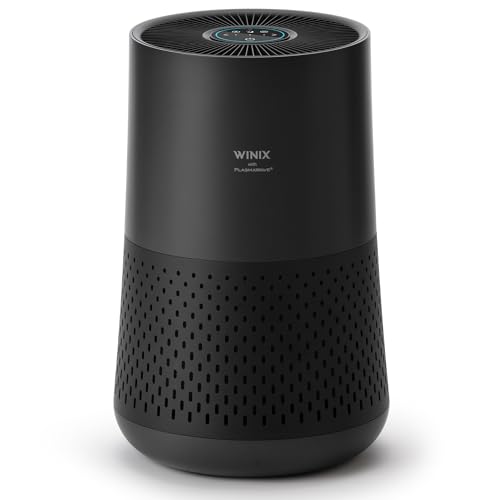
Winix A230 — Best tower as the room grows
The A230 earns its nursery place on two conditions, stated plainly at the start: its PlasmaWave stage — Winix’s optional ion-based feature — should be switched off for the whole of its nursery service, leaving the true HEPA and carbon filtration to do the work, which they do completely on their own. With that condition honoured, what remains is a slim, capable tower with an air quality monitor, auto mode and the vertical shape that fits the nursery’s scarcest resource, floor space, better than any box can.
That shape is the real argument. A tower stands in the strip beside the wardrobe or between the cot and the wall — with the safety placement this guide insists on below, cord routed out of reach and the body where it cannot be pulled — and serves a room rated by its maker up to roughly 1,110 square feet in an hour. For the larger nursery, or the combined parent-and-baby bedroom that many families actually sleep in, that capacity covers what the compact picks cannot, while auto mode keeps the fan’s behaviour gentle and self-governing through the night.
The tower also has a future the smaller picks lack. When the nursery becomes a child’s bedroom, then a homework room, the A230 simply stays, its capacity still appropriate, its sensor still useful, its format still space-thrifty. Parents buying with a five-year eye — and nursery purchases are often the first time a household buys anything with a five-year eye — will feel the sense in a machine whose second and third jobs are already visible at the moment of purchase.
Respect the conditions and the trade-offs together: the ion stage stays off in this room, the tower wants a stable, out-of-the-traffic post, and its height means the toddler-era safety check matters more here than for the low cylinders. Households comfortable with those terms gain the guide’s best bridge between the nursery years and the childhood that follows them, in a single slim column of quietly filtered air.
- Coverage hint: rooms up to about 1,110 sq ft in one hour
- Filtration: true HEPA plus carbon filter
- Sensor: air quality monitor with auto mode
- Nursery condition: PlasmaWave stage switched off
- Placement: slim tower, stable post, cord out of reach
Strengths
- Tower shape spares precious nursery floor
- Capacity covers combined sleeping rooms
- Grows with the child into later room roles
Trade-offs
- Ion stage must stay off in nursery service
- Height demands a thoughtful, stable position
- More machine than a tiny nursery needs
Best for: larger nurseries and combined parent-baby rooms.
Not suited for: anyone unwilling to manage the ion setting.
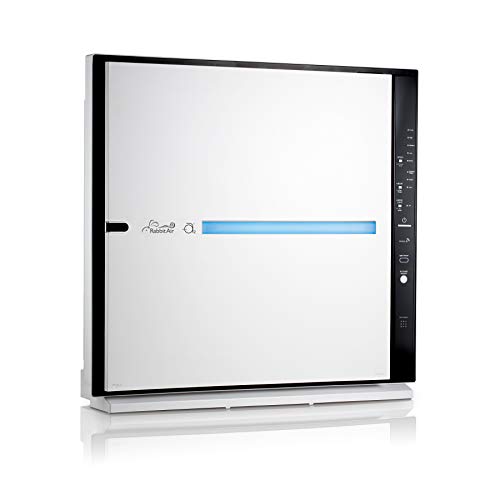
Rabbit Air MinusA2 SPA-780N — Best wall-mounted, floor-free option
The MinusA2 answers the nursery’s floor problem by abolishing it. The panel is slim enough to stand unobtrusively, but its signature move is wall mounting: fixed at adult height, the machine is out of the crawling zone, out of the tipping zone and out of the toy traffic entirely, while its HEPA filtration quietly serves the room from above the fray. For a small nursery where every floor patch is spoken for by the second month, that relocation is not a novelty; it is the difference between a purifier that fits the room’s life and one that merely visits it.
One condition applies, and this guide states it as plainly as for the Winix: the MinusA2 family offers an optional ioniser stage, and in a baby’s room that option should be left out — the unit’s HEPA filtration is complete without it, and the nursery standard in this guide is mechanical capture only. Configured that way, the machine is a study in quiet competence: famously low operating sound, a customisable filter arrangement for households that want to weight odour or allergen media, and Wi-Fi control that lets a parent adjust the room from the hallway without opening the door onto a sleeping baby.
The aesthetic deserves its sentence. The MinusA2’s front panel accepts artwork-style covers, and in a room decorated with unusual care — which nurseries often are, whatever the rest of the house looks like — a purifier that can wear a print rather than announce itself as equipment earns goodwill from both parents. It is the only pick here that visitors ask about as décor before they ask about it as an appliance, and that social invisibility helps it stay mounted, running and unremarked for years.
The costs are literal and logistical: this is the premium pick of the six, wall mounting wants a drill and a decision, and the filter customisation, while a strength, asks the buyer to think once, properly, about which media configuration their household wants. For the nursery where floor space is impossible and silence is sacred, those are fair terms — and the machine’s second life in a child’s bedroom or a study is already designed into its slim, patient shape.
- Coverage hint: bedrooms and nurseries, wall or floor placement
- Filtration: HEPA with customisable filter arrangement
- Nursery condition: optional ioniser stage left out
- Controls: Wi-Fi app and quiet automatic running
- Placement: wall-mountable panel, floor-free option
Strengths
- Wall mounting removes floor and tipping worries
- Among the quietest machines in any guide
- Artwork-style covers suit a decorated nursery
Trade-offs
- Premium pricing across the whole range
- Mounting requires tools and commitment
- Filter choices ask for one careful decision
Best for: small nurseries where the floor is fully claimed.
Not suited for: renters unable to fix anything to walls.
How do the six nursery picks compare?
Nursery comparison is really a comparison of constraints: how much floor exists, how dark the room must stay, how automated the parents need the machine to be at the exact age when their own bandwidth is smallest. The table sorts the six by the constraint each one dissolves.
Parents reading under time pressure can use a shortcut: if the floor has no free patch, the answer is the Rabbit Air or a shelf-suitable compact; if the room is ordinary and the budget is not, the answer is the Coway or the Blueair; if the whole purchase must cost as little as possible while remaining a real filter, the answer is the MOOKA. The table exists to confirm those instincts rather than overturn them.
| Model | Best room fit | Filtration approach | Standout trait |
|---|---|---|---|
| Blueair Mini Max | Tiny nurseries and box rooms | HEPASilent with washable pre-filter | Auto sensing in the smallest body |
| Levoit LV-H132 | Any small nursery | Three-stage high-efficiency filtration | Simplest night operation here |
| Coway Airmega 50 | Standard nurseries to 500 sq ft | HEPA plus deodorization pairing | Sensor guidance from the doorway |
| MOOKA B-D02L | First nurseries on a budget | Three-layer true HEPA stack | Gentlest price and lightest body |
| Winix A230 | Larger and combined rooms | True HEPA plus carbon, ion stage off | Tower capacity that grows up |
| Rabbit Air MinusA2 SPA-780N | Floor-starved nurseries | HEPA, customisable, ioniser omitted | Wall mounting and artwork covers |
What does a purifier actually add to a nursery?
Begin with what the room contains before the machine arrives: a remarkable amount of textile. Blankets, sleep sacks, muslins, soft toys, a rug for tummy time, curtains, the nursing chair’s upholstery — a nursery is a fabric warehouse with a baby in it, and fabric sheds. Every fold, shake and laundry cycle launches fibres and the dust that rides them into a small, closed volume of air. A purifier’s first gift is simply to keep harvesting that constant, gentle snowfall so it settles on the filter instead of on every surface the baby will eventually touch, mouth and crawl across.
The second gift is freshness in a room that spends its nights sealed. Nurseries run warm and closed for good reasons — temperature stability, street noise, safety — and by morning the air of any closed, occupied room tells the story. A purifier cannot ventilate, and this guide will not pretend otherwise, but steady filtration plus its carbon stages leave the room noticeably more neutral at the dawn feed, which parents experience as the difference between a room that feels slept in and a room that feels rested in.
The third gift is to the parents’ routine rather than the room at all. A machine that runs itself, quietly, on a schedule the household trusts, is one less variable in a season of life defined by variables. That is the honest scale of the promise: cleaner air in a small room, maintained without effort, while everyone concentrates on the baby. Anything grander claimed for any appliance in this room should be met with the scepticism this guide applied when choosing these six.
Which safety details matter more than specifications in here?
Start with the cord, because it is the detail most easily postponed and least forgivably so. The purifier’s cable should route behind furniture, out of the room’s crawling geography entirely, with no loop hanging where a standing toddler will eventually test it. Choose the machine’s position for the cord first and the airflow second; a slightly less perfect airflow position with an invisible cord beats the reverse arrangement on every day of the child’s first three years, and the difference in cleaning between the two positions is small enough to be theoretical.
Stability comes next. Low, wide bodies like the cylinders in this guide are inherently calm; towers and panels ask for a deliberate post — a corner where traffic does not clip them, or the wall itself in the Rabbit Air’s case, which converts the stability question into a mounting question and answers it permanently. Controls should be operable by adults and boring to children: no dangling remotes to mouth, no tempting light shows, and where a display glows, a way to darken it that this guide has verified pick by pick.
Finally, treat the filter bay as part of the safety picture. A used filter is a concentrated collection of everything the room shed for months, and changing it is an adult job done away from the baby, with hands washed after — ordinary hygiene rather than alarm, but worth the sentence. Machines whose filters change quickly, without tools or wrestling, make that job easier to do properly at the unglamorous moment it actually happens, which is usually during a nap with one ear on the monitor.
How quiet is quiet enough beside a cot?
The nursery’s acoustic standard is not silence; it is steadiness. Babies sleep through constant sounds remarkably well — it is change they notice, the click, the surge, the fan that hunts between speeds. That is why this guide judged the picks on the evenness of their low gears rather than chasing the smallest possible number, and why auto modes that modulate gradually outrank, in this room, more powerful machines whose fans leap at every passing particle event like a dog at a fence.
Parents are the second audience for the same sound. A purifier audible through the nursery wall in the parents’ room adds a thread of machine noise to a household already negotiating sleep in shifts, and the cumulative effect on parental rest is real even when each individual night seems fine. The quietest picks here — the Rabbit Air by design, the Mini Max and Airmega 50 by their small, well-mannered fans — protect both audiences at once, which is why quietness is weighted in this guide like a safety feature rather than a luxury.
Practical testing beats specification reading. During the first week, run the machine through the actual night routine and listen from both the cot’s position and the doorway: if you can locate the fan’s note without trying, it is part of the room; if you have to concentrate to hear it, it has disappeared, which is where a nursery appliance belongs. Most families find their setting within two nights and never touch it again until the seasons change the room’s needs.
Where should the machine stand in a small nursery?
The instinctive position — right beside the cot, guarding the baby at closest range — is usually wrong, for reasons of both airflow and safety. A purifier needs space around its intake to drink the room’s air rather than its own exhaust, and its outlet stream should wash across the room rather than blow directly at a sleeping infant. A position a metre or two from the cot, angled so cleaned air drifts across the sleeping zone, with the cord vanished behind furniture, serves the baby better than a bodyguard stance at the rail.
The room’s other geography matters too. The changing area generates the nursery’s odour events, the door admits the house’s air each time it opens, and the window wall carries the temperature swings. A machine placed between the door and the cot intercepts the room’s traffic; a machine near the changing end works harder on smell and less on the sleeping zone. In a small room these are differences of emphasis rather than of kind — the whole volume turns over many times a night either way — so parents can safely let the cord and the furniture arbitrate what the airflow leaves undecided.
Revisit the position as the room evolves, because the nursery is the fastest-changing room in any house. The corner that was empty in the newborn months hosts a toy kitchen by the second birthday, and the purifier’s post should migrate with the same practicality as everything else. The light picks here make that migration trivial; the wall-mounted Rabbit makes it unnecessary. Either way, placement is a living decision in this room, not a one-time installation to be perfected and forgotten.
How do you run it around feeds, naps and laundry days?
The nursery’s day has a texture the machine can be tuned to without any cleverness: bustle, then stillness, repeated. During the bustle — morning dressing, bath time, the folding of the endless small laundry — a medium gear keeps up with the fibres and activity. As the room settles toward a nap or the night, the quiet gear takes over, ideally before the baby is in the cot so the sound change never becomes part of the falling-asleep negotiations. Timer and app controls exist in this guide’s picks precisely to make those transitions happen without a parent crossing a dark room at the critical moment.
Laundry days deserve their own setting in textile-heavy nurseries. Shaking out a load of bedding and sleep sacks is the room’s weekly dust storm, and running a higher gear for the half hour of folding and bed-making harvests the storm at its source rather than letting it settle into the freshly made cot. The same logic applies after a deep clean or a visit from a much-loved, much-shedding dog: a deliberate hour of stronger running, then back to the nursery’s default hush.
Night feeds are the test of the whole arrangement, and the picks here were chosen to pass it: a display that can be dark, a fan note that does not change when the door opens, a night light only where the parents have chosen it. If any element of the machine becomes part of the 3 a.m. landscape in a bad way — a glow, a whine, a beep — change that element in the first week rather than adapting around it for a year. Nursery equipment should disappear; the moment it demands negotiation, it has failed its only real specification.
What changes as the baby becomes a toddler?
Mobility rewrites the room’s rules. The purifier that sat safely beyond a non-mobile baby’s world is now an object in a climbing frame’s extended universe, and the safety placement done at the start — cord unreachable, body stable or mounted, controls uninteresting — stops being preparation and becomes the working reality. Households that placed the machine thoughtfully at the beginning sail through this transition; households that postponed it get a weekend of rearrangement with a small supervisor undoing their work in real time.
The air’s job changes too. A toddler imports the world: garden soil on knees, playground dust in cuffs, the first colds from the first playgroups, and a new enthusiasm for opening the nursery door seventeen times an hour. The purifier’s workload shifts from the nursery’s own textiles toward the day’s imports, and its auto mode, if it has one, earns its keep in a new way — answering the door’s rhythm and the post-park shake-off without anyone remembering to ask it to.
Parents often find this is also the moment the machine’s identity changes in the family story: from nursery equipment, slightly precious, to simply the child’s room appliance, as unremarkable as the lamp. That demotion is a success. The picks in this guide were chosen to survive it — filters still stocked, bodies still stable, fans still quiet — because the correct lifespan of a nursery purifier is not the nursery year but the childhood the nursery begins.
How do filters and cleaning fit into new-parent life?
Design the maintenance for the parent you will actually be: busy, interrupted and working one-handed. The pre-filter check — a vacuum pass or a rinse, depending on the model — should attach to an existing rhythm like the weekly bedding wash, and the main filter change should be a calendar event with a spare already in the cupboard, bought during a calm week rather than hunted during a chaotic one. Every pick here changes its filter without tools, because a machine that needs a screwdriver and twenty minutes will wait three months for both.
Keep the evidence where you will see it. A note on the phone with the filter’s part number and the date it went in outperforms any indicator light, because it survives the machine being moved, lent or unplugged for a holiday. Photograph the new filter beside the old at the first change; that single image calibrates every future judgement about whether a filter looks loaded, and it turns the second change from a guess into a comparison.
And forgive the schedule its slips. A filter changed at month seven instead of month six has cost the room a little efficiency and nothing else; the rhythm matters across years, not the precision of any single interval. New parents are given enough exacting standards by the rest of the enterprise — the purifier should be the one member of the nursery staff that never makes anyone feel behind, quietly doing its work at whatever pace the household can sustain.
How do you choose between the compact picks and the larger ones?
The deciding measurement is the room’s honest size, taken with the furniture in it rather than from the estate agent’s floor plan. A standard nursery in a typical house — the box room, the smaller second bedroom — sits comfortably inside the compact picks’ design territory, and in that territory the smaller machines actually outperform larger ones in the ways this room values: they reach their working rhythm faster, their low gears are gentler, and they leave the floor’s scarce patches for the furniture of care rather than the furniture of air.
The case for stepping up rests on combination and future. A combined parent-and-baby bedroom doubles the sleepers and usually the square footage, which is the Winix tower’s argument; a household that knows the purifier will migrate to a playroom or a sibling’s larger room within two years can reasonably buy the capacity once. What rarely makes sense is buying large for a small nursery out of a general feeling that bigger is safer — the extra capacity purchases nothing the baby can use, and its cost is paid in floor space the room demonstrably does not have.
There is also a two-stage strategy that suits cautious households: begin with a compact pick on nursery duty, learn the household’s actual habits across the first year, and let that experience — not a showroom’s anxieties — decide whether a larger second machine earns a place in the family rooms later. The compact unit loses nothing in that plan; it simply continues into the child’s bedroom, where its size remains appropriate for years after the cot has been passed on.
Which nursery purifier mistakes do parents most regret?
The mistakes in this room are rarely about filtration quality; they are about fit with a life that is about to change completely. Each one below is easier to avoid before the baby arrives than to fix after.
- Buying an ioniser-led gadget for the nursery. This room’s standard is mechanical filtration you can inspect; anything whose main act is ionization belongs in a different room or a different home.
- Placing the unit within cord’s reach of the cot. Position and cable routing are safety decisions first and airflow decisions second, and they should be settled before the baby comes home.
- Choosing by maximum power for a tiny room. An oversized machine’s low gear may still be restless; a right-sized machine disappears, which is the nursery’s true requirement.
- Forgetting the display glow. A control panel that lights the room at 2 a.m. will be taped over within a week; choose a model that can go properly dark.
- Letting the filter change require two free hands and tools. Maintenance that cannot happen during a nap will not happen on schedule, and the room’s air will quietly keep the score.
- Expecting the machine to ventilate. Filtration is not fresh air; the nursery’s window and door habits still govern carbon dioxide and temperature, whatever the purifier achieves with particles.
Notice that none of these mistakes is expensive to avoid, and all of them are about attention rather than money. The parents who end up happiest with a nursery purifier are the ones who placed it safely, chose quiet over power, kept the ion options out of the room, and then forgot the machine exists — which, in a nursery, is the highest praise any appliance can earn.
One further regret appears often enough in parents’ accounts to deserve naming: buying the purifier as a last-week purchase and unboxing it in a room already occupied by a newborn. The machine itself is blameless, but the setup — cord routing, position trials, a night spent choosing the quiet gear — is far easier done in the calm before than in the beautiful chaos after, and the first-week instructions in this guide assume a room that can still be rearranged without moving a sleeping baby to do it.
Final Recommendation
For the typical small nursery, the Coway Airmega 50 is this guide’s central recommendation — sensor-guided, odour-aware, warrantied and calm — with the Blueair Mini Max as the answer when the room is truly tiny and the Levoit LV-H132 when the household wants filtration with no technology attached. The MOOKA protects the budget without embarrassing it, the Winix A230 serves the larger or combined room on its filter-only condition, and the Rabbit Air solves the impossible floor plan by leaving the floor altogether.
Whichever machine takes the corner, set it up before the baby comes home if you can: cord invisible, ion options off, dark display, quiet gear chosen, spare filter in the cupboard. Then let it join the nursery’s background staff — the nightlight, the monitor, the chair that knows the way in the dark — asking nothing, glowing nowhere, and keeping the smallest room in the house quietly, steadily fresh for the smallest person in it.
Frequently Asked Questions
Is an air purifier safe to run in a baby’s room all night?
The picks in this guide are ordinary household appliances built around mechanical filtration, and running them overnight is their intended use. The safety work is in the setup rather than the running: a stable or mounted body, a cord routed completely out of reach, a filter bay that stays closed, and any optional ion stage switched off or left out, as flagged on the relevant picks. Set up that way, the machine is as much a part of the room’s furniture as the cot itself — and, like all nursery arrangements, worth reviewing with your health visitor or paediatrician if you want personalised guidance.
Why does this guide avoid ionisers in the nursery?
Because mechanical filtration is complete on its own, verifiable at a glance, and asks nothing of the room’s chemistry. Ion-based stages vary widely in design, some ion technologies can generate traces of ozone, and a baby’s room is the wrong place for optional extras whose benefit is debatable. Where a recommended model offers such a stage as an option — the Winix and the Rabbit Air — this guide’s instruction is explicit: leave it off or leave it out, and let the HEPA filtration do the whole job.
Where exactly should the purifier go relative to the cot?
A metre or two away, with cleaned air drifting across the sleeping zone rather than blowing directly at it, the intake unobstructed, and the cord routed behind furniture where no small hand will ever find it. Avoid the floor patch a crawling route will cross, and avoid tucking the unit behind the cot where it will sip its own output and tempt investigation. In most nurseries the corner between the door and the cot, or the wall position for the Rabbit Air, satisfies every condition at once.
Will the noise disturb my baby’s sleep?
A steady, even fan note at the low gear is closer to the nursery’s existing soundscape — breathing, the house settling, distant traffic — than to a disturbance, and babies generally sleep through constant sounds while waking at changes. That is why this guide prized gradual auto modes and featureless low gears over raw silence figures. Test during the first nights from the cot’s position; the right setting is the one you have to concentrate to hear, and most families find it within two evenings.
How often will I be changing filters with a baby in the house?
Less often than you fear, provided the pre-filter gets its quick regular clean — nursery textiles load that first layer faster than in other rooms. Main filters in these compact machines typically serve across many months of nightly running, and the calendar-plus-spare method in this guide keeps the change a ten-minute job rather than a research project. If the household includes a shedding pet or the room doubles as the laundry-folding station, expect the shorter end of any interval the maker suggests.
Can a purifier replace opening the nursery window?
No — filtration and ventilation are different jobs. A purifier removes particles from the air already in the room; it does not bring in fresh air, remove carbon dioxide or govern temperature and humidity. Nurseries still need their ordinary fresh-air habits whenever weather and safety allow. Think of the purifier as the room’s housekeeper for dust and pollen, working alongside the window’s role as its lungs, each doing the half of the job the other cannot.
Related Guides
Once the nursery is settled, parents usually start asking harder questions about ratings and technologies — these guides are the natural next reads: Best Air Purifiers by CADR Rating Best Fellowes Air Purifiers Best Air Purifiers for Allergies and Sinus: Ionic vs HEPA



[…] readers branch toward the damp-room problem in Best Air Purifiers for Mold, the nursery question in Best Air Purifiers for a Baby’s Room, and the design-led corner of the market in Best Dyson Air […]
[…] room, a different format, a pet in the picture — and these guides follow those threads: Best Air Purifiers for a Baby’s Room Best Dyson Air Purifiers Best Air Purifiers for Allergies and Pet […]