What's inside
- Key Takeaways
- Quick Picks
- How Did We Choose These Bouncy Chairs for Fourth Graders?
- Wobble Stool, Chair Band, Wobble Feet or Ball: What Is the Actual Difference?
- How Tall Should a Fourth Grader’s Seat Be?
- Our Six Picks in Detail: Seats, Accessories and One Honest Cushion
- How Do the Six Compare Side by Side?
- How Should a Teacher or Parent Introduce Movement Seating?
- How Do You Keep Movement Seating Safe and Sensible?
- How Does Movement Seating Translate to the Homework Desk at Home?
- What Patterns Do Teachers Notice Across a Term?
- How Long Do These Products Survive a Real Classroom?
- What Happens When the Fourth Grader Becomes a Sixth Grader?
- How Should You Read a Listing in This Category Without Mixing Up the Kinds?
- What Mistakes Do Buyers Make with Bouncy and Wobble Seating?
- Final Recommendation
- Frequently Asked Questions
- Related Guides
As an Amazon Associate I earn from qualifying purchases. This post may contain affiliate links at no extra cost to you.
cottageverdict.com is reader-supported. When you buy through links on our site, we may earn an affiliate commission.
Where to buy: the best bouncy chairs for fourth graders below mostly link to their Amazon listings, where you can check the current price and confirm heights and pack counts against your classroom or kitchen table. One entry — the inflatable wobble cushion — is discussed without a link, because it is a whole class of accessory rather than one product.
Ask a room of fourth graders to sit perfectly still for six hours and you have not set a standard; you have scheduled a rebellion. Nine- and ten-year-olds are built at an age when the body is growing faster than the furniture budget, when legs swing because swinging is what legs are for, and when attention, paradoxically, often improves when a small, permitted movement is built into the seat itself. That is the idea behind this whole category: seating that lets a child move quietly in place — rocking, bouncing, balancing — instead of forcing the movement out through chair-tipping, desk-drumming and the legendary pencil-tap symphony.
But the category hides a confusion that this guide exists to clear up, because three different kinds of product share its vocabulary. Wobble stools are actual chairs: complete seats a child sits on. Chair bands and wobble feet are accessories: they fit onto the ordinary school chair you already own and change how that chair behaves. Ball chairs are inflatable spheres, sometimes with a base, that turn sitting into balancing. All three can be the right purchase, but they are not interchangeable, and buying an accessory when you needed a seat — or a seat when a band would have done — is the standard mistake. Every pick below is labelled with its kind, in plain words, at the top of its review.
A note on claims, because this category attracts them. These products are classroom tools for movement and comfort; teachers and parents report that many children settle and focus better with a sanctioned wiggle, and just as honestly, some children do not. Nothing in this guide promises improved grades, treats any condition, or substitutes for a teacher’s judgement or a specialist’s advice about an individual child. What we can do is explain the mechanics of each option clearly enough that the adult who knows the child can choose well — which is, in the end, how all good classroom decisions get made.
Key Takeaways
- Three kinds of product share this category: wobble stools (seats), bands and feet (accessories), and ball chairs.
- Seat height is the first specification: a fourth grader needs roughly the 17–18 inch class of stool.
- Bands and feet only make sense if your existing chairs fit their stated leg measurements.
- Ball chairs serve one child at a time and need inflation, space and a classroom agreement about bouncing.
- The right choice depends on the child: constant rockers, foot-tappers and balancers each suit different tools.
- Movement seating supports attention for many children, but it is a tool, not a treatment or a promise.
- Keep the ordinary chairs: choice between still and moving seats is the philosophy, not a failure of it.
- Judge any trial at a fortnight, when the novelty has faded and the real behaviour remains.
Quick Picks
| Pick | Badge | Why it made the list |
|---|---|---|
| GoSports 18 Inch Wobble Chair | Best Wobble Stool | A full 18-inch wobble seat from a games brand, sized for the older elementary years. |
| Studico ActiveChairs Kids Wobble Stool | Best Classroom Pedigree | A 17.75-inch flexible-seating stool listed for ages 7–12, designed specifically for school use. |
| Lewtemi Flexible Seating Ball Chairs 20 in | Best Ball Option | A four-pack of 20-inch inflatable ball chairs with an inflator, enough to seed a classroom corner. |
| Bouncyband Original Bouncy Bands for Chairs | Best Accessory for Feet | A band that stretches between a chair’s front legs, giving restless feet a silent resistance to push against. |
| Bouncyband Wiggle Wobble Chair Feet 10-Pack | Best Accessory for Rockers | Feet that convert an ordinary school chair into a gentle wobble chair, in a ten-pack for a whole class set. |
| Inflatable Wobble Cushion (generic class) | The Seat-Top Accessory | Discussed without a link as the cushion class that adds movement to any chair’s existing seat. |
How Did We Choose These Bouncy Chairs for Fourth Graders?
Classification came before judgement. We sorted every candidate into its true kind — seat, accessory or ball — and refused to rank across kinds as if they were rivals, because a chair band does not compete with a wobble stool any more than a bicycle pump competes with a bicycle. Within each kind we then asked the practical questions: Is the size right for a nine- or ten-year-old? Does the listing state its dimensions and fit ranges honestly? Is the product built for the daily punishment of a classroom rather than the gentler life of a product photograph?
Each linked product was verified against its live listing through the site’s product-checking tools, and the figures in the spec boxes — stool heights, the age range on the Studico, the band’s leg-width range, the ball chairs’ diameter and pack count — come from those listings. Classroom products get revised and re-listed, so confirm dimensions at purchase time, especially the band’s fit range, which decides whether the product works at all on your chairs.
We also listened for the sound of a product, in the only way a desk review can: by reading how it is built. Motion that depends on a hard base rolling on a hard floor has a noise budget; motion absorbed by elastic, inflation or a chair’s own legs is quieter by construction. The classroom is an acoustic instrument before it is anything else, and a product that adds a soundtrack to thirty children’s shifting will be retired by October whatever its other virtues. The six below were each, in their kind, the quiet way of achieving their effect.
The final six give a teacher or parent one strong option in each kind, plus a second wobble stool for comparison and the cushion class as the prose-only all-rounder. Fourth grade is the heartland of this category — old enough for the responsibility, young enough for the need — and the picks are weighted for that year specifically, rather than for the whole elementary span the listings sometimes claim.
Wobble Stool, Chair Band, Wobble Feet or Ball: What Is the Actual Difference?
A wobble stool is a seat with a rounded or pivoting base. The child sits on it and the stool permits a continuous, small range of rocking and swivelling motion, engaging balance in the background while the foreground does maths. It replaces the chair entirely, needs no fitting to anything, and its quality is judged by its height, its base’s manners on classroom floors, and how its seat surface treats a long morning. The GoSports and Studico below are this kind, and they are the default recommendation for a child whose whole body wants to move.
Chair bands and wobble feet start from the opposite assumption: the chair stays, its behaviour changes. A bouncy band stretches between the front legs of an ordinary chair and gives the child’s feet a springy bar to press, bounce and fidget against silently — the movement is in the feet, not the seat. Wobble feet fit under a chair’s legs and give the whole chair a gentle rocking base, converting a static chair into a mild wobble chair. Both are accessories, and both live or die by fit: the band’s listing states the chair-leg width it suits, and ignoring that range buys an expensive rubber band.
A ball chair is the third philosophy: remove the chair’s structure and let balance do everything. The child sits on an inflatable ball — the Lewtemi set below uses 20-inch balls, in a pack of four with an inflator — and staying upright is itself the activity. Ball chairs delight some children and some teachers, demand floor space and a shared understanding about bouncing, and are usually deployed as one station among several rather than as a class-wide replacement. Choosing among the three kinds is really choosing where the movement should live: in the seat, in the feet, or in the whole body.
How Tall Should a Fourth Grader’s Seat Be?
Height is the specification that decides whether any of this works, because a movement seat at the wrong height trades fidgeting for dangling. The useful test is the same one used for ordinary chairs: feet supported, knees near a right angle, and the desk or table meeting the child at elbow height. For most nine- and ten-year-olds that arithmetic lands in the 17-to-18-inch seat class, which is exactly where the two wobble stools in this guide sit — the GoSports at a stated 18 inches, the Studico at 17.75 inches for its listed 7-to-12 age span.
Children, inconsiderately, keep growing, and a fourth grader in September is a taller person by June. A stool at the top of a child’s range in autumn may be at the bottom of it by spring, which argues for choosing the taller option when a child measures between sizes, and for remembering that these products often serve siblings and classmates in sequence. Ball chairs adjust by inflation — a slightly softer ball sits lower — which is one of their quiet practical virtues in a mixed-age classroom.
Accessories inherit their height from the chair they modify, which is either their convenience or their limitation. If your classroom chairs are already the right height for your fourth graders, bands and feet preserve that fit while adding movement. If the chairs are wrong — a common inheritance in real schools — no accessory fixes the underlying geometry, and a correctly sized wobble stool is the more honest purchase. Measure the child, then the desk, then choose the kind; the order matters.
Our Six Picks in Detail: Seats, Accessories and One Honest Cushion
Each review states its kind in its first lines — seat, accessory or ball — because that label is the most important fact about it. Heights, fits and classroom manners follow.

GoSports 18 Inch Wobble Chair — Best Wobble Stool
Kind: a seat. The GoSports is a complete wobble chair — an 18-inch stool on a motion base, sold by a brand whose home territory is games and active play. That heritage shows in the design’s simplicity: no adjustments to manage, no accessories to fit, just a seat that lets a child rock and swivel within a small, controlled arc. At 18 inches it sits at the top of the fourth-grade height class, suiting taller nine-year-olds and giving shorter ones a stool to grow through rather than out of by Christmas.
Its listing frames it for classrooms and home alike, and that dual citizenship is realistic: this is the stool a family buys for homework and a teacher buys for the reading corner, and it serves both without modification. The wobble arc on such stools is deliberately modest — this is a seat that permits movement, not a ride — and children who want to rock dramatically will test its limits in the first week and then settle into the rhythm it allows. For a first wobble purchase, where the household is still learning whether movement seating suits its child, the GoSports is the straightforward place to start.
Floor behaviour is the GoSports’ quiet test, and it is worth a sentence for the home buyer in particular. A wobble base on a hard floor moves as designed; the same base on a thick carpet loses some of its arc to the pile, and on a polished surface it can travel further than a parent expects across an enthusiastic afternoon. None of this is a defect — it is physics, shared by every stool in the kind — but the room the stool will live in is part of the purchase, and a thin mat under a homework stool is a legitimate part of the setup rather than an admission of failure.
- Kind: wobble stool (complete seat)
- Seat height: 18 inches per listing
- Settings: classroom and home per listing
- Motion: rocking and swivelling base
- Fitting required: none
Strengths
- Full height suits the older elementary years
- No fitting, adjustment or accessories to manage
- Works identically at school and at home
Trade-offs
- Tallest option may overwhelm a small third grader sharing it
- Fixed height cannot adapt as the child grows
- One seat serves one child at a time
Best for: a first wobble stool for a fourth grader, at school or home. Not suited for: a whole-class rollout on a tight budget — see the accessories.
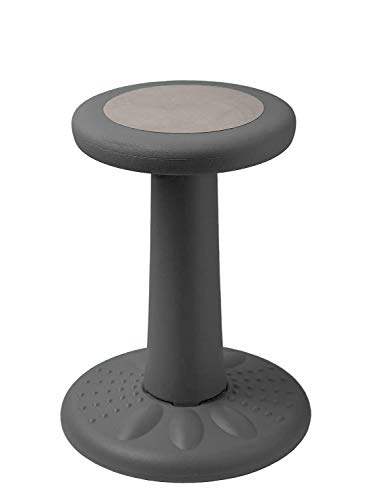
Studico ActiveChairs Kids Wobble Stool — Best Classroom Pedigree
Kind: a seat. Where the GoSports comes from the games world, the Studico comes from the classroom itself — its listing speaks the language of flexible seating, gives a specific age span of 7 to 12 years, and sizes its stool at 17.75 inches for the pre-teen band. That specificity is worth money to a teacher, because it means the dimensions were chosen for school desks and school-aged bodies rather than adapted from a generic stool. The colour shown is grey, which in a classroom is not a compromise but a strategy: it disappears among the furniture instead of advertising itself to thirty children as the special chair.
Flexible seating, the philosophy this stool belongs to, treats the classroom as a landscape of options — some children on stools, some on ordinary chairs, some at a standing table — and the Studico is built to be one strong option among them rather than a throne. Teachers introducing movement seating often start with two or three such stools in a rotation, which suits this pick’s positioning well. Its listing makes the usual category claims about focus and posture; this guide’s position, stated at the top, is that the honest claim is narrower — many children find the permitted movement genuinely settling, and a teacher’s observation over a term is the evidence that counts.
- Kind: wobble stool (complete seat)
- Seat height: 17.75 inches per listing
- Age guidance: 7–12 years per listing
- Colour shown: Grey
- Design brief: flexible classroom seating
Strengths
- Dimensions and age range specified for schools
- Quiet colour integrates with classroom furniture
- Built for the flexible-seating rotation model
Trade-offs
- Slightly lower than the GoSports for the tallest pupils
- Classroom-first design is less playful for home use
- Premium positioning within the stool kind
Best for: teachers building a flexible-seating classroom. Not suited for: a buyer wanting the tallest available stool.

Lewtemi Flexible Seating Ball Chairs 20 in — Best Ball Option
Kind: ball chairs — inflatable seats, not framed chairs. The Lewtemi set contains four 20-inch inflatable balls with an inflator included, in boho colours per the listing, aimed at elementary classrooms. Four is a considered number: it seeds a movement corner or a small-group table without committing the whole class, and it lets a teacher learn how ball seating behaves in their room before deciding whether the experiment deserves expansion. The inflator’s inclusion matters more than it sounds, because a ball chair at the wrong inflation is a different, worse product — too soft and the child sits in a pudding, too hard and it is a beach ball with ambitions.
Ball chairs ask the most of classroom management and give the most movement in return. The bounce is real, the balance is continuous, and the novelty takes a week to wear into routine. Ground rules — feet on the floor, ball stays at the desk, bouncing is for the body not the furniture next door — are part of the product, and teachers who set them early report the balls becoming unremarkable within a fortnight, which is the goal. For the child who needs the maximum permitted motion, and the classroom with the space and the agreement to host it, this set is the ball option to beat.
Parents buying for home rather than school should read the pack size as an invitation to think in siblings. Four balls is a classroom number, but it is also, in a house with two or three children and a playroom, a complete solution with a spare — and a spare ball, in a product category where punctures are a when rather than an if, is not excess inventory. It is the difference between a system that survives its first accident and a disappointed child explaining to a parent why the good chair is flat.
- Kind: inflatable ball chairs
- Size: 20-inch balls per listing
- Pack: four chairs plus inflator
- Colours: boho assortment per listing
- Height adjustment: by inflation level
Strengths
- Most movement of any option in this guide
- Four-pack seeds a classroom corner sensibly
- Inflator included for correct setup
Trade-offs
- Needs floor space and clear ground rules
- Inflation must be checked and topped up
- Not every child settles on a ball — rotation helps
Best for: movement corners and high-energy pupils in managed classrooms. Not suited for: cramped classrooms or unsupervised free-for-alls.
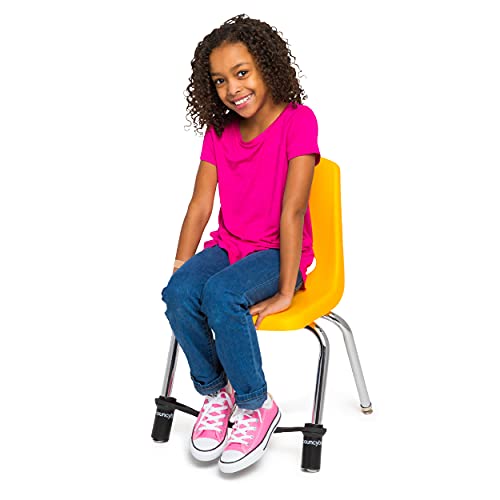
Bouncyband Original Bouncy Bands for Chairs — Best Accessory for Feet
Kind: an accessory — not a chair. The Bouncyband is a heavy elastic band that stretches between the front legs of an ordinary school chair, giving the seated child’s feet a springy, silent surface to press and bounce against. Its listing states the fit plainly: chair legs 13 to 17 inches apart, with support pipes of 1.5 inches diameter. Measure your chairs before ordering, because a band outside its range is either a trip hazard or a slingshot, and neither belongs in a classroom.
Within its fit, the band solves a specific and common problem with unusual elegance: the foot-tapper, the leg-swinger, the child whose lower half is conducting an orchestra the upper half knows nothing about. The band gives that energy a silent, seated outlet that disturbs nobody — no noise, no motion visible above the desk, no special chair to mark the child out. For teachers, the per-chair cost of bands is a fraction of a stool’s, which makes a whole row or a whole class feasible. The original in this product family, and still the reference: if your fourth grader’s movement lives in their feet, start here.
There is a dignity argument for the band that teachers raise and parents should hear. A child on a special stool is visibly on a special stool, and fourth grade is precisely the age at which visibility starts to cost. A band is invisible — under the desk, known to its user and to nobody else — and for the child whose restlessness embarrasses them, that privacy is not a detail but the whole product. The best movement seating is sometimes the kind the class never notices, and the band is the champion of that philosophy.
- Kind: accessory for an existing chair
- Fit: chair legs 13–17 inches wide per listing
- Support pipes: 1.5-inch diameter per listing
- Motion: foot bouncing and pressing, silent
- Colour shown: Black
Strengths
- Silent, invisible movement outlet for restless feet
- Lowest per-child cost of the movement options
- No change of chair, desk height or classroom layout
Trade-offs
- Useless on chairs outside the stated leg range
- Does nothing for a child whose movement is in the torso
- Bands eventually stretch and need replacing
Best for: foot-tappers and whole-class rollouts on standard chairs. Not suited for: chairs with splayed, curved or oversized legs.

Bouncyband Wiggle Wobble Chair Feet 10-Pack — Best Accessory for Rockers
Kind: an accessory — not a chair. Where the band serves the feet, these feet serve the whole chair: fitted under the legs of a standard school chair, they give it a gentle wobble base, converting yesterday’s static chair into a mild rocking seat. The pack contains ten sets, which is the classroom-scale thinking this guide appreciates — a teacher can convert a reading corner, a small-group table or a third of the class in one purchase, and learn from a real trial which children the wobble actually suits.
The conversion is deliberately gentler than a wobble stool. The chair keeps its back, its height and its familiar shape; only its stillness is negotiable. That gentleness is the point for children who would be distracted by a stool’s full motion, and for classrooms where a forest of stools is impractical. Fit, again, is the governing question: the feet are made for standard school chair legs, and the listing’s guidance should be checked against your chairs’ leg style before the ten-pack is ordered. Measured properly, this is the lowest-drama entry into movement seating that exists.
Teachers should note the sound dividend, because it is the one administrators notice. A classroom of fixed chairs on a hard floor generates a constant percussion of scrapes and bumps as thirty children shift through the day; chairs on wobble feet move with a softer vocabulary, and the room’s baseline noise drops in a way visitors remark on without knowing why. It will not appear in any listing, and it may be the benefit that gets the second ten-pack approved.
- Kind: accessory for existing chairs
- Pack: ten sets of chair feet
- Effect: converts a standard chair to a gentle wobble
- Age note: listed for children aged 3+ (classroom use decides)
- Fitting: check leg compatibility on listing
Strengths
- Ten-pack makes classroom trials affordable
- Gentlest movement conversion in this guide
- Keeps the child’s own chair, back and height
Trade-offs
- Wobble is milder than a purpose-built stool
- Depends on standard chair leg dimensions
- Feet can wander on very smooth floors if unfitted
Best for: teachers converting existing chairs in batches. Not suited for: a child who needs a stool’s full range of motion.
Inflatable Wobble Cushion (generic class) — The Seat-Top Accessory
Kind: an accessory — a cushion, not a chair. The wobble cushion is an inflatable disc, usually textured on one side, that sits on top of an ordinary chair’s seat and turns it into an unstable, gently moving surface. It is the most portable idea in this guide: the same cushion can serve the classroom chair by day and the homework chair by night, travel to a grandparent’s house in a backpack, and deflate into a drawer for the holidays. We discuss the class without a link because cushions vary enormously in diameter, texture and valve quality, and the right one is best chosen by the child’s size in hand.
Its compromises are the shadow of its portability. It adds height to the chair — an inch or two that changes the desk geometry the height section above worked so hard to get right — and it can slide on smooth seats if under-inflated. It also offers the subtlest movement of the six options, which suits the mild fidgeter and disappoints the committed rocker. As the universal spare, the loaner and the trial balloon of movement seating, though, the class earns its place: a cushion is how many families discover whether movement helps their child before committing to a stool.
- Kind: accessory cushion for any chair
- Effect: unstable, gently moving seat surface
- Portability: highest in this guide
- Tier: budget across the class
- Watch-outs: adds seat height; keep inflation firm
Strengths
- Works on any chair, anywhere, immediately
- Ideal low-cost trial of movement seating
- Travels and stores almost invisibly
Trade-offs
- Subtlest movement of the six options
- Raises seat height slightly
- Can slip on smooth seats when soft
Best for: first trials, shared use between home and school. Not suited for: children who need pronounced rocking motion.
How Do the Six Compare Side by Side?
| Pick | Kind | Key figure | Where the movement lives | Best setting |
|---|---|---|---|---|
| GoSports Wobble Chair | Seat | 18-inch stool | Whole seat | Home and classroom |
| Studico ActiveChairs Stool | Seat | 17.75-inch, ages 7–12 | Whole seat | Flexible-seating classrooms |
| Lewtemi Ball Chairs | Ball seat | 20-inch, pack of 4 | Whole body balance | Movement corners |
| Bouncyband Bands | Accessory | Fits legs 13–17 in apart | Feet | Whole-class rollout |
| Bouncyband Wobble Feet | Accessory | 10-pack | Gentle chair rock | Converting existing chairs |
| Wobble cushion (class) | Accessory | Varies | Seat surface | Trials and travel |
How Should a Teacher or Parent Introduce Movement Seating?
Introduce it as furniture, not as medicine or reward. The stool or band arrives, the class or household hears the simple rules — it stays at the desk, it is used sitting, it is swapped fairly where sharing applies — and then, crucially, everyone gets on with the ordinary day. Movement seating that is launched with ceremony becomes a novelty that children perform with; movement seating that simply appears becomes infrastructure, which is what the successful classrooms in this category all describe. A fortnight is the honest trial period: long enough for novelty to fade, short enough to change course.
Rotation is the teacher’s best instrument. Not every child suits every kind, and the child who concentrates beautifully on a wobble stool may be all at sea on a ball, while the foot-tapper needs only a band to become the stillest pupil in the row. A small stock of kinds — two stools, a set of feet, bands on the standard chairs, perhaps the Lewtemi corner — lets children find their fit by experience rather than by an adult’s theory. Keep a simple note of who settled where; next term’s seating plan will thank you.
At home, the same logic shrinks to one child and one desk. Start with the kind that matches where the movement visibly lives — feet, seat or whole body — and judge it by the homework fortnight, not the first evening. If the trial fails, the accessory kinds keep the financial damage small, which is a deliberate part of this guide’s ordering: bands, feet and cushions are the inexpensive experiments, stools and balls the considered commitments.
How Do You Keep Movement Seating Safe and Sensible?
The rules are few and mostly physical. A wobble stool is for sitting, not standing, kneeling or launching; its base is designed for a seated child’s weight shifting within a small arc. Ball chairs stay at their desks, get inflated to the maker’s guidance, and are checked for punctures the way bicycle tyres are — a slow leak changes the height and the behaviour before it announces itself. Bands and feet get a weekly glance for stretching, cracking and wandering, because accessories age quietly under thirty pairs of feet.
Supervision norms do not change because the furniture is friendly. An adult’s judgement about an individual child — including any professional advice the family or school already follows — outranks any product’s marketing, and a child who becomes less settled on movement seating should simply return to a standard chair without it becoming a verdict on anyone. These are tools in a room full of tools. The teacher’s observation across a term is the research that matters for the children actually present.
Finally, keep the standard chairs. Movement seating works as a landscape, not a coup: the ordinary chair remains the right answer for some children, some lessons and some days, including for the movement-seating devotee who is tired, unwell or simply in a still mood. A classroom where a child can choose the plain chair without comment is a classroom that has understood the philosophy — the movement is offered, never imposed.
How Does Movement Seating Translate to the Homework Desk at Home?
Home is where the category gets its second audition, and the conditions differ in one important way: there is no classroom to absorb a poor choice, but there is also no audience to perform for. A wobble stool at a homework desk faces one child, one parent’s observation, and the nightly evidence of whether the maths got finished with less warfare than usual. Families should judge it on exactly that evidence across a fortnight of real homework, not on the first evening’s enthusiasm, which every new object in a child’s life produces on schedule.
The accessory kinds travel home especially well. A band on the homework chair costs little, changes nothing about the room’s appearance, and can be removed in seconds when the chair hosts a visiting grandparent. The cushion goes further, commuting between school bag and home as the child’s own piece of continuity. Parents coordinating with a teacher will find the conversation easy when it is framed in kinds — we tried the feet at home, the band is what settled him — because the school’s landscape and the home’s single desk are dialects of the same language.
One home-specific caution deserves its sentence: the kitchen table is not a desk, and its height relative to the stool decides whether the experiment is fair. A stool perfect at a classroom desk can leave a child low at a tall farmhouse table, feet swinging in a way that manufactures the very restlessness the product was bought to absorb. Measure the home setup with the same care as the classroom one, and let the cushion — which adds an inch or two — be the peacemaker where heights almost agree.
What Patterns Do Teachers Notice Across a Term?
Talk to teachers who run flexible seating and the same patterns surface with a consistency that no single study could manufacture. The first is sorting: children distribute themselves across the kinds with more wisdom than the seating plan assumed, and the distribution is stable by half-term. The second is that the plain chair remains popular — often with the very children adults expected to choose motion — which is why this guide insists the ordinary chairs stay. Choice, it turns out, is the active ingredient as much as movement is.
The third pattern is about mornings. Movement seating earns its keep disproportionately in the long, still stretches — the wet-playtime afternoon, the test-practice hour — rather than across the whole day evenly. Teachers learn to deploy it the way they deploy everything else: the stools come out for the writing block, the balls rest during the practical lesson where thirty inflatable seats would be a hazard with a pump. Furniture with a timetable sounds fussy; in practice it is just a classroom being run by someone paying attention.
The fourth pattern is honesty about the minority. In most classrooms a few children are simply less settled on any movement option, and the mature response — theirs, eventually, as much as the teacher’s — is the plain chair chosen without stigma. A guide that promised universal benefit would be selling something. What the evidence of real classrooms supports is narrower and more useful: for a substantial share of children, in the right kind, at the right height, permitted movement and attention coexist more peacefully than enforced stillness ever managed.
How Long Do These Products Survive a Real Classroom?
Classrooms are furniture’s harshest environment this side of a rental property: thirty users, daily cleaning, floors that are swept rather than cherished, and a summer of storage in rooms that bake. Judge every kind in this guide by that calendar. A wobble stool’s base is its wear point — grit on the floor grinds at the very surface the motion depends on — so stools live longer on swept floors and die younger in rooms where the sand from the playground is a permanent resident. A weekly wipe of the base is the cheapest longevity in this entire article.
Bands age by stretching, which is honest wear with a visible schedule: a band that has gone slack announces itself and is replaced for a fraction of the original system’s cost. Wobble feet age by cracking or by wandering off during the end-of-term chair stacking, which argues for a named box in the classroom cupboard and a count in September. Ball chairs age by slow leak and by puncture, and their survival is mostly a function of the floor rules — no shoes with grit in the treads near the balls, no sharp pencils at ball height — that the introduction week established.
The budget conclusion follows from the wear patterns. Accessories are consumables with long lives; stools are capital with longer ones; balls are somewhere between, depending on the room’s discipline. A school equipping a classroom for three years should therefore not compare sticker prices but cost per settled child per term, a calculation in which the humble band performs embarrassingly well and the well-kept stool justifies itself by outliving two sets of everything else. Buy the kind your room’s floor and your children’s habits will actually sustain.
What Happens When the Fourth Grader Becomes a Sixth Grader?
Movement needs do not expire at the classroom door of fifth grade, but they change their presentation. The older child is heavier, taller and considerably more concerned with not looking different, which rearranges this guide’s recommendations in an instructive order. The conspicuous options — the ball, the brightly coloured stool — retire first, casualties of dignity rather than function. The invisible options survive: a band under a desk is private, wobble feet read as part of the chair, and a grey stool like the Studico’s, sized within its listed range up to age twelve, can pass as furniture rather than equipment.
Height becomes the hard boundary. A stool outgrown is a stool that harms the posture it was bought to help, and the honest parent checks the fit each September the way shoes are checked — feet supported, knees level, no dangling. The outgrown stool’s afterlife is respectable: a younger sibling, a classroom donation, the homework corner of a cousin. Movement seating is one of the few school purchases with a genuine hand-me-down market inside a family, because its sizing is public and its wear is visible.
The deeper continuity is the habit the child keeps. A pupil who has learned, across two years of permitted movement, what their own attention needs — when to rock, when to choose the plain chair, when to stand at the back for the long lesson — carries that self-knowledge into schools where the furniture is fixed and unkind. The products in this guide are, in that sense, training equipment for a lifetime of desks. Buy them for the fourth grader in front of you; know that you are also, quietly, equipping the student they are becoming.
How Should You Read a Listing in This Category Without Mixing Up the Kinds?
Start by finding the sentence that says what the object is, and distrust any listing where you cannot. A stool’s listing will give a seat height; an accessory’s will give a fit range for the chair it modifies; a ball set’s will give a diameter and a count. Those three numbers are the fingerprints of the three kinds, and they cannot be faked by adjectives. The picks in this guide were verified against their listings precisely so that the heights, ranges and counts quoted here are the ones the makers themselves publish.
Then read for what is included, because this category sells systems in pieces. A ball set without an inflator is a different purchase from the Lewtemi’s complete box. A ten-pack of feet equips ten chairs; a single band equips one, and the per-classroom arithmetic inverts depending on which unit the listing is counting. Photographs help least here — a band photographed on a chair looks like a chair product, which is exactly the confusion this guide was written to prevent — so let the included-contents list, not the hero image, tell you what arrives.
Finally, read the age and size guidance as the maker speaking about liability as much as design, and respect it in both directions. A stool listed for ages seven to twelve has been considered for that span; a set of feet listed for young children will still be deployed in a fourth-grade classroom by teachers exercising their own judgement, as this guide notes on that pick. The adult’s observation remains the senior authority in the room — the listing informs it, the child confirms it, and the fortnight’s trial settles it.
What Mistakes Do Buyers Make with Bouncy and Wobble Seating?
- Buying an accessory when a seat was needed. Bands and feet modify an existing chair; they are not chairs, and this guide labels them every time.
- Skipping the leg measurement for bands. The stated 13–17 inch range decides whether the product works at all.
- Guessing the stool height. A stool two inches too tall trades fidgeting for dangling feet and a worse posture than the plain chair.
- Launching with a ceremony. Novelty invites performance; quiet introduction lets the furniture become infrastructure.
- Promising outcomes. Movement seating helps many children settle; it is not a treatment, and adults should not sell it as one.
- Removing all the ordinary chairs. Choice is the philosophy — the plain chair remains a legitimate daily option.
Final Recommendation
Match the kind to the child before matching the brand to the budget. Whole-body movers belong on the GoSports or the Studico stool — the taller, simpler GoSports for home and general use, the classroom-bred Studico for flexible-seating rooms. Foot-driven fidgeters need only the Bouncyband, and classrooms converting in bulk should take the wobble feet ten-pack. The Lewtemi balls serve the movement corner and the child who needs the most motion of all, under rules agreed in advance. The cushion is everyone’s inexpensive first experiment.
A word about money, since classrooms and families both run on it. The accessories in this guide cost so little per child that a failed experiment is a rounding error, while a classroom set of stools is a budget line that should be trialled before it is multiplied. That asymmetry is a strategy: experiment with bands, feet and a cushion, commit to stools and balls where the experiment proved itself, and let evidence rather than enthusiasm allocate the money. Schools that buy in that order rarely regret either step.
Whichever you choose, introduce it quietly, watch it honestly for a fortnight, and let the child’s own settled mornings cast the deciding vote — because the best seat in a fourth-grade classroom is not the one with the boldest claims, but the one nobody, including its occupant, has to think about by October.
Frequently Asked Questions
Are bouncy bands and wobble feet actually chairs?
No, and the distinction is the spine of this guide. Bands and wobble feet are accessories that fit onto an ordinary chair you already own: the band gives the feet a springy bar between the chair’s front legs, and the feet give the chair itself a gentle rocking base. If you need a complete seat, you need a wobble stool or a ball chair. Listings blur this because the products share a category page; your purchase should not blur it.
What size wobble stool suits a fourth grader?
Most nine- and ten-year-olds land in the 17-to-18-inch seat class, which is where both stools in this guide sit — 18 inches for the GoSports, 17.75 for the Studico with its listed 7-to-12 age span. Confirm with the child’s own measurements: feet supported and knees near a right angle at their desk. A child between sizes is usually better served by the taller stool, since growth is the one certainty in this age group.
Will a wobble stool distract the rest of the class?
Properly introduced, the motion is small, silent and below desk level, and classrooms that use these stools report the novelty fading within days. The disturbance risk lives in the launch, not the furniture: stools handed out as prizes get performed with, while stools installed as ordinary furniture get used as furniture. Teachers also keep the standard chairs available, so the stool is a choice rather than a stage.
Can these products help a child with ADHD?
Many families and teachers use movement seating alongside professional guidance, and many children with restless profiles are exactly the foot-tappers and rockers these products were designed for. This guide makes no medical claims and cannot advise on an individual child; that conversation belongs with the child’s own teachers and clinicians. What we can say is mechanical: the products permit quiet movement in place, and whether that movement settles your child is a question a fortnight’s honest trial answers better than any listing.
How many should a classroom buy to start?
Start smaller than enthusiasm suggests: two wobble stools, one set of wobble feet conversions or bands across a row, and perhaps a ball corner if space allows. Keep the receipt of the experiment in a notebook rather than in memory, because the pattern of who chose what — and how their afternoons changed — is the document that justifies the second purchase to a head teacher, a governor or a sceptical spouse. A rotation reveals which children suit which kind before the budget commits to thirty of anything. The accessory packs in this guide — bands per chair, feet in a ten-pack — exist precisely because measured rollouts beat grand ones in real classrooms.
Can movement seating be shared between siblings or classmates?
Yes, with the sizing caveat that governs everything in this guide: a stool fits the child whose feet it supports, and siblings two years apart may need different heights or an accessory instead. Accessories share more gracefully — a band does not care whose feet press it — which is one more reason the kinds in this guide are complements rather than rivals. In classrooms, sharing by rotation is the standard model, and the products above were chosen partly for how well they tolerate being shared: no personal fitting, no adjustment rituals, just sit and begin.
What should a parent teacher conference actually discuss about seating?
Kinds and evidence, in that order. Tell the teacher where your child’s movement visibly lives — feet, seat or whole body — and what a fortnight at the homework desk showed, and ask what the classroom landscape already offers before proposing to add to it. Teachers field these conversations gladly when they arrive as information rather than instruction, and a child whose home trial used the same vocabulary as the school’s options can be placed correctly in a week instead of a term. The products are the easy part of that conversation; the shared observation is the part that works.
Do ball chairs need a base or ring?
Some designs use one and some, like the Lewtemi set here, are used as balls alone; the listing for any set will say what is included. A base steadies the ball when unoccupied and can help younger children, at the cost of some of the balance work that is the product’s point. Follow the maker’s setup guidance for the set you buy, keep inflation correct, and treat the ball as furniture with rules rather than as playground equipment that wandered indoors.
Related Guides
Seating questions follow a child through the whole house and beyond: Best Chairs for Big Guys covers the grown-up end of the size question, Best Captain’s Chairs for Vans takes seating into the family’s vehicle, Best Baby Yarns for Blankets supplies the materials for the quiet corner’s softest furnishing, and Best Blankets for 2-Year-Olds looks at comfort for the classroom’s much younger cousins.



[…] covers the traditional alternative to fleece, while groups furnishing a community space can look at Best Bouncy Chairs for Fourth Graders and Best Captain’s Chairs for Exercise for the seating side of the […]