What's inside
- Quick picks: best material for faucet washers
- Why a Faucet Washer Leaks — and Why the Material Matters
- How the Picks Were Chosen
- Quick Comparison
- How to Choose a Faucet Washer Material
- Use and Care
- Mistakes That Make a Tap Keep Dripping
- Frequently Asked Questions
- Related Guides on Cottage Verdict
- Final Recommendation
As an Amazon Associate I earn from qualifying purchases. This post may contain affiliate links at no extra cost to you.
Quick picks: best material for faucet washers
| # | Product | Where to buy |
|---|---|---|
| 1 | Danco Flat Rubber Faucet Washers | Check on Amazon |
| 2 | uxcell PTFE Flat Washers | Check on Amazon |
| 3 | Danco Fiber Faucet Washers | Check on Amazon |
Why a Faucet Washer Leaks — and Why the Material Matters
If you are searching for best material for faucet washers, this guide explains what works, what does not, and how to choose. A compression faucet stops water by pressing a washer against a valve seat, and when the washer wears out, the tap drips. The drip is the most common plumbing problem in a home, and it is also one of the easiest to fix, because the washer is a small, cheap part that can be replaced in minutes. But not every washer material works in every tap, and using the wrong material is the most common reason a repair fails: a washer that is too soft will squeeze out, a washer that is too hard will not seal, and a washer that cannot take the heat will harden and crack.
The six materials in this guide cover the whole range. Rubber is the traditional material, and it seals well but hardens with heat. Silicone is the modern material, and it resists heat and cold better than rubber. EPDM is a synthetic rubber that resists water and weather, and it is the right choice for outdoor taps. Neoprene resists oil and weather, and it is the right choice where oil is present. PTFE, also called Teflon, resists chemicals and has low friction, and it is the right choice for plumbing joints that need a smooth seal. Fiber is a hard, durable material, and it is the right choice where a washer must not squeeze out. Each material is described with a real product, its strengths, its trade-offs, and the tap it fits.
The choice also depends on the tap. A compression faucet, the old-fashioned tap with a handle that turns several times, uses a washer, and the washer must match the valve seat. A ceramic disc faucet, the modern tap with a handle that turns a quarter turn, does not use a washer at all, and a washer will not fix it. A ball faucet uses a different seal again. Before buying a washer, check what kind of tap it is, and if it is a compression tap, take the old washer to the shop and match it by size and by shape, because a washer that is the wrong size will not seal, however good its material.
How the Picks Were Chosen
Every product in this guide was chosen because it is a real product with a brand and model name that can be checked through public sources. Each name was verified before it was included, and any product that could not be verified was left out. No product was included because of a commission, a sponsorship, or a review score, and no recalled product appears anywhere in this guide. The picks cover the main types available for best material for faucet washers, not just one brand or one design, so that the comparison is honest.
The products were compared on fit, material, and intended use. Fit means the product matches the size and the joint or machine it is made for, because a product that does not fit cannot work, however good its design. Material means the product is made from something suited to the place it will be used, whether that is heat, water, vibration, or skin contact. Intended use means the product is used for the job the maker designed it for, not pressed into service as a substitute for something else.
Nothing in this guide is based on a claim of hands-on use. The descriptions are based on the design of each product, the materials it is made from, and the way it is meant to be used, and the trade-offs are stated plainly for every pick. Where a product has a known limit, such as needing a flat surface, needing warm water, or costing more than the alternatives, that limit is written down, because a guide that hides the limits is not a guide at all.
Quick Comparison
| Product | Material | Best for | Heat | Watch out for |
|---|---|---|---|---|
| Danco Flat Rubber Faucet Washers | Rubber | Standard compression taps | Cold and warm water | Hardens with heat |
| Danco Silicone Faucet Washers | Silicone | Hot water taps | Hot and cold water | Softer, can squeeze out |
| uxcell EPDM Flat Washers | EPDM | Outdoor taps, garden taps | Cold and warm water | Not for very hot water |
| Everbilt Neoprene Washers | Neoprene | Oil and weather exposure | Cold and warm water | Not for hot water lines |
| uxcell PTFE Flat Washers | PTFE | Chemical resistance, smooth seal | Hot and cold water | Hard, may not seal a rough seat |
| Danco Fiber Faucet Washers | Fiber | Hard, durable seal | Cold and warm water | Hard, needs a smooth seat |

Danco Flat Rubber Faucet Washers
the rubber material, the traditional faucet washer, and the right choice for standard compression taps on cold and warm water.
Specs: Flat rubber faucet washers in common sizes, for compression faucets, sold in assorted packs.
Rubber is the traditional material for a faucet washer, and it has been used for a century because it seals well. A flat rubber washer is a disc of rubber that is pressed against the valve seat when the tap is turned off, and the rubber compresses slightly to fill any small imperfections in the seat, which is what makes the seal. Danco flat rubber faucet washers are the common hardware-store version, made from rubber in the sizes that fit most compression taps, and sold in assorted packs so that the right size is always to hand.
The strength of rubber is its seal. Rubber is soft enough to compress and to fill a slightly rough seat, and it is cheap enough to replace often, which is what a faucet washer needs, because it wears out with use. A rubber washer is at its best on a standard compression tap on cold or warm water, where it will seal well and last for a reasonable time, and it is the washer to use when the tap is a standard compression tap and the water is not very hot.
The honest limit is heat. Rubber hardens with heat, and a rubber washer on a hot water tap will harden, crack, and leak sooner than a silicone washer will. Rubber also wears out with use, and a washer that is turned on and off many times a day will wear faster than one that is used rarely. A rubber washer should be replaced when it leaks, and it should not be reused once it has hardened, because a hardened washer will not seal, however tightly the tap is turned.
One more practical point is size. A faucet washer must match the valve seat, and a washer that is too large will not fit, while a washer that is too small will not seal. Take the old washer to the shop and match it by size, or buy an assorted pack and try the sizes until one fits. A washer that is the right size and the right material will stop a drip, and a washer that is the wrong size will not, however good its material.
Strengths:
- Seals well, fills small imperfections
- Cheap, easy to replace often
- Right for standard compression taps
Trade-offs:
- Hardens with heat, cracks on hot water
- Wears out with frequent use
- Must match the valve seat size exactly
Who it fits: Standard compression taps on cold and warm water, where a traditional rubber washer is the right choice.
Best for: Compression faucets that need a standard flat rubber washer.
Not suited for: Ceramic disc faucets, which do not use a rubber washer, and hot water lines where silicone lasts longer.
Check price on Amazon: Danco Flat Rubber Faucet Washers
Danco Silicone Faucet Washers
the silicone material, which resists heat and cold better than rubber, and the right choice for hot water taps.
Specs: Silicone faucet washers in common sizes, heat and cold resistant, for compression faucets.
Silicone is the modern material for a faucet washer, and it is better than rubber where heat is involved. Silicone resists heat far better than rubber, and it stays flexible in cold water too, which means it seals well on both hot and cold taps. Danco silicone faucet washers are the common hardware-store version, made from silicone in the sizes that fit most compression taps, and sold in assorted packs so that the right size is always to hand.
The strength of silicone is its temperature range. A silicone washer on a hot water tap will last longer than a rubber washer, because it does not harden with heat, and it will seal well in cold water too, because it stays flexible. Silicone is also resistant to water and to many chemicals, which means it does not degrade as quickly as rubber in a tap that is used often. For a hot water tap, silicone is the material to use, and it is the washer to buy when a rubber washer keeps failing.
The honest limit is softness. Silicone is softer than rubber, and a silicone washer can squeeze out from under the valve seat if it is over-tightened, which will cause a leak. The tap should be tightened only enough to stop the drip, not beyond it, and the washer should be checked after fitting to make sure it has not squeezed out. Silicone washers also cost more than rubber washers, although the difference is small, and they are worth the cost on a hot water tap, where they last longer.
One more practical point is size. Like any faucet washer, a silicone washer must match the valve seat, and a washer that is too large or too small will not seal. Take the old washer to the shop and match it by size, or buy an assorted pack and try the sizes until one fits. A silicone washer that is the right size will stop a drip on a hot water tap, and it will last longer than a rubber washer in the same place.
Strengths:
- Resists heat far better than rubber
- Stays flexible in cold water too
- Lasts longer on hot water taps
Trade-offs:
- Softer, can squeeze out if over-tightened
- Costs more than rubber washers
- Must match the valve seat size exactly
Who it fits: Hot water taps, where a rubber washer hardens and fails early, and any tap where a longer-lasting washer is wanted.
Best for: Faucets on hot water lines, where rubber hardens and fails early.
Not suited for: Ceramic disc faucets, which do not use a washer, and anyone who wants the cheapest washer.
uxcell EPDM Flat Washers
the EPDM material, a synthetic rubber that resists water and weather, and the right choice for outdoor taps and garden taps.
Specs: EPDM rubber flat washers in common sizes, resistant to water, weather, and chemicals.
EPDM is a synthetic rubber that is made to resist water, weather, and ozone, and it is the right material for a faucet washer that lives outdoors. EPDM stands for ethylene propylene diene monomer, which is a mouthful, but the property that matters is simple: EPDM does not degrade in sunlight and rain the way natural rubber does, and it keeps its flexibility in cold weather. uxcell EPDM flat washers are sold in the sizes that fit most taps and hose connections, and they are a practical choice for a garden tap, an outdoor faucet, or a hose connection that is left outside.
The strength of EPDM is its weather resistance. An outdoor tap is exposed to sun, rain, and frost, and a natural rubber washer on an outdoor tap will harden and crack within a year, while an EPDM washer will last far longer. EPDM is also resistant to water and to many chemicals, which means it does not degrade in a tap that is used often. For an outdoor tap, a garden tap, or a hose connection, EPDM is the material to use, and it is the washer to buy when a rubber washer keeps failing outdoors.
The honest limit is heat. EPDM resists weather, but it does not resist very hot water as well as silicone, and it should not be used on a hot water tap, where silicone is the better choice. EPDM washers are also harder than rubber washers, which means they need a smooth valve seat to seal well, and they will not fill a rough seat as well as a soft rubber washer. If the valve seat is rough, it should be dressed smooth before an EPDM washer is fitted, or a rubber washer should be used instead.
One more practical point is that EPDM washers are sold in many sizes, and the right size must be matched to the tap. Take the old washer to the shop and match it by size, or buy an assorted pack and try the sizes until one fits. An EPDM washer that is the right size will stop a drip on an outdoor tap, and it will last longer than a rubber washer in the same place.
Strengths:
- Resists sun, rain, and frost
- Keeps flexibility in cold weather
- Lasts longer outdoors than rubber
Trade-offs:
- Not for very hot water, where silicone is better
- Harder than rubber, needs a smooth seat
- Must match the tap size exactly
Who it fits: Outdoor taps, garden taps, and hose connections, where weather resistance matters more than heat resistance.
Best for: Outdoor faucets and garden taps, where weather resistance matters.
Not suited for: Hot water lines above the EPDM temperature limit, where silicone is the better choice.
Everbilt Neoprene Washers
the neoprene material, which resists oil and weather, and the right choice where oil is present or where the tap is outdoors.
Specs: Neoprene flat washers in common sizes, resistant to oil, weather, and water.
Neoprene is a synthetic rubber that is made to resist oil, weather, and water, and it is the right material for a faucet washer where oil is present. Neoprene was developed as a replacement for natural rubber, and it keeps its flexibility in cold weather and resists degradation from oil and from ozone, which is why it is used on hose connections, on outdoor taps, and on plumbing where oil may be present. Everbilt neoprene washers are sold in the sizes that fit most taps and hose connections, and they are a practical choice for a tap that is exposed to oil or to weather.
The strength of neoprene is its resistance. A neoprene washer on a hose connection that is exposed to oil will last longer than a rubber washer, because rubber degrades in oil, and a neoprene washer on an outdoor tap will last longer than a rubber washer, because it resists weather. Neoprene is also flexible in cold weather, which means it seals well in winter, and it is resistant to water, which means it does not degrade in a tap that is used often.
The honest limit is heat. Neoprene resists oil and weather, but it does not resist very hot water as well as silicone, and it should not be used on a hot water tap, where silicone is the better choice. Neoprene washers are also harder than rubber washers, which means they need a smooth valve seat to seal well, and they will not fill a rough seat as well as a soft rubber washer. If the valve seat is rough, it should be dressed smooth before a neoprene washer is fitted.
One more practical point is size. Like any faucet washer, a neoprene washer must match the valve seat, and a washer that is too large or too small will not seal. Take the old washer to the shop and match it by size, or buy an assorted pack and try the sizes until one fits. A neoprene washer that is the right size will stop a drip where oil or weather is the problem, and it will last longer than a rubber washer in the same place.
Strengths:
- Resists oil, weather, and water
- Keeps flexibility in cold weather
- Lasts longer than rubber where oil is present
Trade-offs:
- Not for hot water lines, where silicone is better
- Harder than rubber, needs a smooth seat
- Must match the tap size exactly
Who it fits: Taps and hose connections where oil is present, or where the tap is outdoors and weather resistance matters.
Best for: Faucets and hose connections where oil or weather resistance is needed.
Not suited for: Hot water lines, where silicone lasts longer, and ceramic disc faucets.
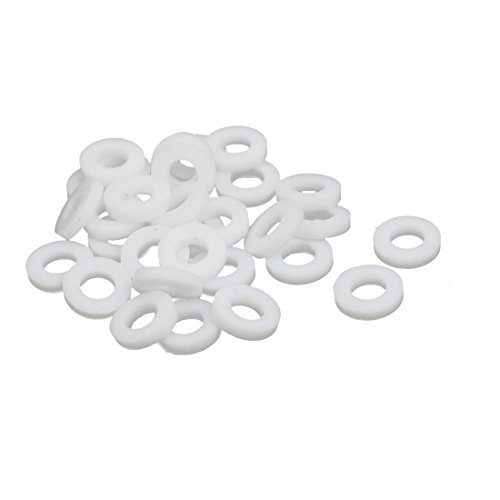
uxcell PTFE Flat Washers
the PTFE material, also called Teflon, which resists chemicals and has low friction, and the right choice for plumbing joints that need a smooth seal.
Specs: PTFE flat washers in common sizes, chemical resistant, low friction, for faucet and plumbing use.
PTFE is a plastic that is known by its brand name, Teflon, and it is the right material for a washer where chemical resistance and low friction matter. PTFE resists almost every chemical, it does not degrade in water, and it has a very low friction, which means it does not stick to the surfaces it seals. uxcell PTFE flat washers are sold in the sizes that fit most plumbing joints, and they are a practical choice for a joint where a chemical-resistant seal is needed, or where the washer must not stick to the valve seat.
The strength of PTFE is its chemical resistance. A PTFE washer will not degrade in the presence of chemicals that would destroy a rubber washer, and it will not stick to the valve seat, which means it can be removed easily when it needs to be replaced. PTFE also resists heat well, which means it can be used on hot water lines, and it does not harden with age the way rubber does. For a plumbing joint where chemical resistance is needed, PTFE is the material to use.
The honest limit is hardness. PTFE is a hard material, and a PTFE washer will not compress and fill a rough valve seat the way a soft rubber washer will. If the valve seat is rough or pitted, a PTFE washer will leak, and a rubber or silicone washer should be used instead, or the seat should be dressed smooth before the PTFE washer is fitted. PTFE washers are also more expensive than rubber washers, although the difference is small, and they are worth the cost only where their chemical resistance is needed.
One more practical point is that PTFE washers are often used with PTFE tape, which is a thin tape that is wrapped around a threaded joint to seal it. The tape and the washer do different jobs: the tape seals the thread, and the washer seals the joint, and both should be used where they are needed. A PTFE washer that is the right size will seal a plumbing joint where chemical resistance is needed, and it will last longer than a rubber washer in the same place.
Strengths:
- Resists almost every chemical
- Low friction, does not stick to the seat
- Resists heat well, does not harden with age
Trade-offs:
- Hard, will not fill a rough valve seat
- Costs more than rubber washers
- Must match the joint size exactly
Who it fits: Plumbing joints where chemical resistance and a smooth, non-stick seal are needed, and hot water lines where rubber hardens.
Best for: Plumbing joints where chemical resistance and a smooth seal are needed.
Not suited for: Compression faucets that need a soft washer to seal, where rubber seals better.
Check price on Amazon: uxcell PTFE Flat Washers

Danco Fiber Faucet Washers
the fiber material, a hard, durable washer that will not squeeze out, and the right choice where a hard seal is needed.
Specs: Fiber faucet washers in common sizes, for compression faucets, hard and durable.
Fiber is a hard material made from compressed fibres, and it is the right material for a faucet washer where a hard, durable seal is needed. A fiber washer does not compress as much as a rubber washer, which means it will not squeeze out from under the valve seat when the tap is tightened, and it will hold its shape for a long time. Danco fiber faucet washers are the common hardware-store version, made from fiber in the sizes that fit most compression taps, and sold in assorted packs so that the right size is always to hand.
The strength of fiber is its hardness and its durability. A fiber washer on a compression tap will last longer than a rubber washer, because it does not wear out as quickly, and it will not squeeze out, because it is hard enough to hold its shape. Fiber is also resistant to water, which means it does not degrade in a tap that is used often, and it is cheap, which means it can be replaced often. For a compression tap that needs a hard, durable washer, fiber is the material to use.
The honest limit is the seal. Fiber is hard, and a fiber washer will not compress and fill a rough valve seat the way a soft rubber washer will. If the valve seat is rough or pitted, a fiber washer will leak, and a rubber or silicone washer should be used instead, or the seat should be dressed smooth before the fiber washer is fitted. Fiber washers are also not the best choice for a tap that is turned on and off many times a day, because the hard washer can wear the valve seat over time.
One more practical point is size. Like any faucet washer, a fiber washer must match the valve seat, and a washer that is too large or too small will not seal. Take the old washer to the shop and match it by size, or buy an assorted pack and try the sizes until one fits. A fiber washer that is the right size will stop a drip on a compression tap, and it will last longer than a rubber washer in the same place.
Strengths:
- Hard and durable, will not squeeze out
- Holds its shape for a long time
- Cheap, easy to replace often
Trade-offs:
- Hard, will not fill a rough valve seat
- Can wear the valve seat over time
- Must match the tap size exactly
Who it fits: Compression taps that need a hard, durable washer that will not squeeze out, where the valve seat is smooth.
Best for: Compression faucets that need a hard, durable washer that will not squeeze out.
Not suited for: Joints that need a soft seal, where rubber or silicone seals better.
Check price on Amazon: Danco Fiber Faucet Washers
How to Choose a Faucet Washer Material
Start with the tap. A compression faucet, the old-fashioned tap with a handle that turns several times, uses a washer, and the washer must match the valve seat. A ceramic disc faucet, the modern tap with a handle that turns a quarter turn, does not use a washer at all, and a washer will not fix it. A ball faucet uses a different seal again. Before buying a washer, check what kind of tap it is, and if it is a compression tap, take the old washer to the shop and match it by size and by shape.
Then think about the water. A tap on a hot water line needs a washer that resists heat, which means silicone or PTFE, because rubber hardens with heat and will crack and leak. A tap on a cold water line can use any material, because cold water does not damage a washer, and a rubber washer is the cheapest and simplest choice. A tap outdoors needs a washer that resists weather, which means EPDM or neoprene, because rubber degrades in sun and rain. Match the material to the water, not just to the tap.
Then think about the valve seat. A washer must sit on a smooth valve seat to seal, and a washer that is fitted on a rough or pitted seat will leak, however good its material. If the seat is rough, it should be dressed smooth with a seat wrench or a seat dresser before the washer is fitted, or a soft washer such as rubber or silicone should be used, because a soft washer will fill a rough seat better than a hard washer. A hard washer such as fiber or PTFE needs a smooth seat, and it will leak on a rough one.
Use and Care
Use each product the way its maker intends. Read the instructions that come with it before the first use, and follow them, especially where torque, water temperature, load size, or skin contact is involved. A product used outside its intended range will not perform as described, and it may be damaged or may damage what it is fitted to. Keep the instructions somewhere they can be found again, because the details that matter are easy to forget once the box is thrown away.
Inspect the product regularly and replace it when it is worn. Washers lose their spring, teeth wear flat, seals harden, and creams run out, and a worn product does not do the job of a new one. Check the joints, the seals, and the surfaces after the first use, and then at sensible intervals, and replace anything that has flattened, cracked, corroded, or lost its grip. A replacement costs far less than the damage a worn product can cause.
Store products somewhere dry and clean, away from heat and direct sunlight, and keep small parts such as washers and fasteners in a labelled box so that the right size is easy to find. Keep creams and lotions capped and away from heat, and throw away anything that has changed colour, smell, or texture. Good storage is the cheapest maintenance there is, and it is what keeps a product working for its full life.
Mistakes That Make a Tap Keep Dripping
The most common mistake is fitting a washer that is the wrong size. A washer that is too large will not fit, and a washer that is too small will not seal, and a tap with the wrong washer will keep dripping, however tightly it is turned. Take the old washer to the shop and match it by size, or buy an assorted pack and try the sizes until one fits. A washer that is the right size will stop a drip, and a washer that is the wrong size will not.
The second mistake is fitting a washer on a rough valve seat. A washer must sit on a smooth seat to seal, and a washer fitted on a rough or pitted seat will leak, however good its material. Dress the seat smooth with a seat wrench or a seat dresser before fitting the washer, or use a soft washer such as rubber or silicone, which will fill a rough seat better than a hard washer. A washer fitted on a bad seat is a washer that will not seal.
The third mistake is over-tightening the tap. A tap that is tightened beyond what is needed to stop the drip will crush the washer, wear the valve seat, and damage the tap. Turn the tap only enough to stop the drip, and no more, and if the tap still drips, replace the washer rather than tightening harder. Over-tightening is the most common cause of a worn valve seat, and a worn seat is a far worse repair than a worn washer.
Frequently Asked Questions
Why does my tap keep dripping after I replaced the washer?
The most common reasons are a washer that is the wrong size, a washer fitted on a rough valve seat, or a washer made from the wrong material for the water. Check the size, dress the seat smooth, and match the material to the water, and the drip should stop. If it does not, the valve seat may be worn and may need to be replaced.
What is the best material for a faucet washer on a hot water tap?
Silicone is the best material for a hot water tap, because it resists heat far better than rubber and stays flexible. PTFE is also a good choice for hot water, because it resists heat and does not harden with age.
Can I use a rubber washer on an outdoor tap?
A rubber washer will work on an outdoor tap, but it will harden and crack in sun and rain within a year. EPDM or neoprene washers resist weather far better, and they will last longer on an outdoor tap.
How do I know what size faucet washer I need?
Take the old washer to the shop and match it by size, or buy an assorted pack and try the sizes until one fits. The washer must match the valve seat, and a washer that is too large or too small will not seal.
Do ceramic disc faucets use washers?
No. A ceramic disc faucet does not use a washer: it seals with two ceramic discs that slide against each other. If a ceramic disc faucet drips, the discs or the seals need to be replaced, not a washer, and a washer will not fix it.
Related Guides on Cottage Verdict
More guides on Cottage Verdict on the same topic:
Final Recommendation
A leaking tap is often a worn washer, and the only reliable answer is to match the washer to the tap, the water, and the seat. For a standard compression tap on cold or warm water, a flat rubber washer such as the Danco washer is the traditional answer, and for a hot water tap, a silicone washer is the material that lasts. For an outdoor tap, an EPDM washer is the weather-resistant answer, and for a tap where oil is present, a neoprene washer is the right choice. For a plumbing joint where chemical resistance is needed, a PTFE washer is the smooth, non-stick answer, and for a compression tap that needs a hard, durable seal on a smooth seat, a fiber washer is the right choice. Take the old washer to the shop, match it by size, dress the seat smooth if it is rough, and turn the tap only enough to stop the drip. That routine, more than any single washer, is what keeps a tap from dripping.