What's inside
- Key Takeaways
- Quick Picks
- How We Chose These Picks
- What does smart actually add to an air fryer oven?
- Comparison Table
- What happens when the smart part stops working?
- Which kind of air fryer smart ovens fits your household?
- How do you get the most from a smart oven?
- What Are the Most Common Mistakes?
- Final Recommendation
- Frequently Asked Questions
- Related Guides
As an Amazon Associate I earn from qualifying purchases. This post may contain affiliate links at no extra cost to you.
cottageverdict.com is reader-supported. When you buy through links on our site, we may earn an affiliate commission.
Smart is the most abused word in the modern kitchen, so this guide begins with a definition it intends to enforce. The best air fryer smart ovens earn the label with a real capability — an app that sets guided recipes, a thermometer that cooks to temperature, a scanner that reads a barcode and cooks accordingly, zones that synchronise their finish — and every pick below is described only in terms of the smart feature it actually has. No oven here is credited with an app it does not possess.
The six split into philosophies. Breville’s Joule and CHEF iQ connect the oven to guided cooking; Tovala builds an ecosystem around scan-to-cook and an optional meal service, which its review discusses with the price tag attached; the two Ninjas keep their intelligence on board, in a probe and in twin synchronised zones; and the Dreo ChefMaker, a compact combi fryer rather than a full oven, automates restaurant technique for small households.
Where to buy: each pick links to its Amazon listing, where you can check price on Amazon and confirm the current app, service and accessory details — connected products evolve, and the listing is the freshest source. Read the reviews for the philosophy first and the functions second, because in smart appliances the philosophy is what you will live with.
One honest warning frames the whole guide: every connected feature here rides on a company’s continuing app or service, except the Ninjas’ on-board intelligence. We note that dependency wherever it applies, because a ten-year appliance and a two-year app cycle are uneasy partners, and buyers deserve to choose their risk knowingly.
Key Takeaways
- Smart must be specific: guided apps (Joule, CHEF iQ), scan-to-cook (Tovala), probes (Ninja, Dreo), synced zones (Ninja DCT801).
- Tovala’s meal plan is an optional paid subscription — the oven works fully without it, but know the ecosystem you are joining.
- The Dreo ChefMaker is a 6-quart combi fryer, not a family oven — its smartness is automated chef technique for small dishes.
- On-board intelligence (both Ninjas) cannot be deprecated by an app shutdown; connected features can evolve or fade.
- Every smart oven here also cooks well unconnected — the Breville Joule works fully from its own panel.
- Buy the philosophy you will use weekly: guidance, decision-removal, temperature precision or timing synchrony.
Quick Picks
| Pick | Badge | Why it earns its place |
|---|---|---|
| Breville Joule Oven Air Fryer Pro BOV950 | App-guided precision flagship | Breville’s Element IQ meets the Joule app: guided recipes, remote monitoring, voice activation and thirteen smart functions in one connected oven. |
| Ninja Prestige Smart XL Air Fry Oven DT551 | Smart Cook thermometer system | Ten functions at 1800 watts with the Smart Cook thermometer — protein cooked to a target temperature in an XL family cavity. |
| Tovala Smart Oven Pro | Scan-to-cook system oven | Six functions plus barcode scan-to-cook and smartphone control — the oven built around Tovala’s optional meal service and everyday groceries alike. |
| CHEF iQ MiniOven Smart Toaster Oven Air Fryer | Connected compact powerhouse | An 11-in-1, 25-quart smart oven at 1750 watts with touchscreen controls — CHEF iQ’s connected ecosystem in a countertop format. |
| Dreo ChefMaker Combi Fryer | Combi fryer with a chef’s probe | Not a full oven but a 6-quart smart combi fryer: cook probe, water atomizer and professional modes that aim at restaurant-style results. |
| Ninja Double Oven Pro Smart XL DCT801 | Two ovens, one smart finish | A 30.2-quart double oven with DualZone cooking and Smart Finish, so two dishes on two programmes land on the table together. |
How We Chose These Picks
We admitted only ovens whose smart claim could be named in one precise sentence and verified against the maker’s own description: the Joule app’s guided recipes, Tovala’s barcode scan-to-cook and app control, CHEF iQ’s connected guided platform, the Smart Cook thermometer in the Ninja DT551, the water-atomising probe system in the Dreo ChefMaker, and DualZone Smart Finish in the Ninja DCT801. Models with a Wi-Fi badge and no capability behind it were excluded.
Each review states the dependency honestly — which features need a phone, which need an account, which ride on a paid service, and which work entirely on board. The Tovala’s meal plan is described as the optional subscription it is; the ChefMaker is labelled a combi fryer, not dressed as a family oven. A smart guide that fudges its categories would betray the readers it exists to serve.
Cooking quality remained the floor beneath the intelligence. Every pick air fries and roasts competently with its smart layer ignored, because a connected oven that cannot cook is a tablet with a heating element. The smart features were then judged on frequency: how often, in a real week, each one would actually be used.
What does smart actually add to an air fryer oven?
Used honestly, three things. Knowledge, first: a probe knows the centre of the chicken in a way no timer can, and a guided recipe knows the timings a thousand test cooks established. Delegation, second: an app that sets the oven, a scanner that reads the box, a zone that delays its own start — each removes a decision or a vigil from the cook’s evening. And memory, third: connected ovens remember your dishes, your adjustments and your favourites, so the tenth cook of a meal is better organised than the first.
What smart does not add is heat. The ovens here crisp and roast with the same fans and elements as their unconnected cousins, and a household that cooks confidently by eye and timer will find the smart layer pleasant rather than necessary. The category’s honest pitch is not better food by magic; it is the same good food with less guesswork, less hovering and fewer failures at the margins.
The margins are where households live, though. The roast that used to be sliced hopefully, the delivered meal that needed three oven stages, the two dishes that never landed together — these are weekly events in busy kitchens, and each pick here exists because it retires one of them. Smart, judged by retired frustrations rather than by features, is a much more sensible purchase.
There is also a teaching dividend. Guided systems show their working — temperatures, stages, timings — and cooks absorb technique by osmosis while dinner makes itself. Several of this guide’s picks will quietly make their owners better cooks, which no specification sheet has ever thought to claim.
Set against that, the dependencies: apps to update, accounts to keep, services that must survive. The guide’s on-board Ninjas stand as the control group in that experiment — proof that some of the most useful intelligence needs no connection at all. Weighing which kind of smart suits your household’s temperament is the real decision this page exists to support.
Finally, smart ages differently. A great cavity is great for a decade; a great app is great until it is redesigned. Buy the oven for its hardware and treat the software as a bonus with a half-life, and you will never be disappointed in the order those two things deserve.

Breville Joule Oven Air Fryer Pro BOV950 — App-guided precision flagship
The Joule Oven is what happens when the precision of Breville’s Smart Oven line is handed a phone and told to teach. The hardware will be familiar from the BOV900 in our air fryer oven guide — Element IQ managing the elements, thirteen functions, serious capacity — but the BOV950’s identity is its connection to the Joule app, which turns the oven into a guided cooking system: recipes that set the oven themselves, stage-by-stage instructions, and progress you can watch from another room.
That guidance is the honest meaning of smart here. The app does not merely remote-control a dial; it carries tested recipes whose temperatures, element patterns and timings are written for this exact cavity, including multi-stage cooks that would be tedious to programme by hand. A rack of ribs can start low and finish fierce because the recipe told the oven to, while the cook gets on with the rest of the meal.
Voice activation joins the system for the moments when hands are floury or occupied — ask for the oven to preheat or adjust, and keep working. Like all voice control it is a convenience rather than a revolution, but in a connected oven it completes the logic: the machine is addressable from the sofa, the garden or the elbow-deep moment at the sink.
The cooking underneath the connectivity deserves its reputation. Air frying is fierce and even, baking is precise in the Breville manner, and the cavity takes family quantities without complaint. Smart features layered over mediocre cooking would be a gimmick; here they are layered over the best-regarded countertop oven platform in its class, which is why the combination convinces.
Costs must be stated plainly. This is a premium appliance — check price on Amazon and expect the top of the smart category — and its intelligence depends on a phone, an app account and a home network that behaves. Households that cook happily without any of those should buy the non-connected BOV900 and lose nothing but the guidance.
There is also a longevity question that connected appliances must answer honestly: apps change, services evolve, and an oven bought for a decade will outlive several phone generations. Breville’s saving grace is that the Joule remains a complete oven from its own panel — the app enriches it, but the machine does not become a brick if the phone stays in a drawer. That fallback is the correct design, and not every smart appliance manages it.
Guided recipes suit a particular cook beautifully: the capable home cook expanding into new territory — a first brisket, a temperamental bake — who wants a tested hand on the settings while they learn. Confident cooks may find the guidance optional; ambitious learners will find it transformative, which is a fair description of good teaching generally.
Air fry performance, since the category demands it, is top-tier: fast preheat, assertive circulation, even browning across the tray. The smart layer adds timing intelligence — recipes that know when a second stage should start — rather than raw crisping power, and that distinction is the Joule in miniature: brains in service of an already strong body.
Cleaning and ownership mirror its non-smart sibling: a big cavity to wipe, quality accessories to wash, and a finish that rewards a cloth rather than a scourer. The connected features ask for one more chore — keeping the oven on the home network — which most households will do once and forget.
Against the rest of this guide, the Joule is the connoisseur’s smart oven: the one where the app exists to make a serious cook better, rather than to make a reluctant cook possible. Both missions are honourable; this one simply knows its audience.
Choose the Joule if you already cook well and want guided range, remote oversight and Breville precision in one connected flagship.
- Functions: 13 preset smart cooking functions
- App: Joule app with guided recipes
- Voice: voice activation supported
- System: Element IQ, connected controls
- Finish: brushed stainless steel
- Class: full-size countertop oven
Strengths
- Guided app recipes set the oven themselves
- Element IQ precision under the smart layer
- Works fully from its own panel offline
Trade-offs
- Premium price tops the smart category
- Intelligence leans on phone and network
- Guidance is wasted on preset-only cooks
Best for: Capable cooks who want app-guided range.
Not suited for: Households avoiding apps and accounts entirely.

Ninja Prestige Smart XL Air Fry Oven DT551 — Smart Cook thermometer system
Ninja’s idea of smart is refreshingly physical: not an app, but information. The DT551’s Smart Cook thermometer lives in the meat and talks to the oven, so the machine cooks to a temperature you choose rather than a time you hope for. In a category full of connectivity claims, that probe is the feature that changes dinner most directly — chicken that is done where done matters, beef at the blush you actually ordered, fish that leaves the heat at the right moment instead of a minute after it.
Around the probe sits a full-size, 1800-watt, ten-function oven in the Prestige line’s stainless finish: air fry, air roast, broil, bake, toast and a dedicated pizza mode among them. The XL cavity handles the family roast the thermometer was built for, with room for the tray of vegetables that makes it a meal, and the air circulation is Ninja-fierce — fast crisping, assertive browning, and the usual warning that a single layer beats a crowded pile.
The smartness being probe-led rather than app-led has practical consequences worth weighing. There is no account to create and no network to join; the intelligence works on day one, in a holiday let, for a grandparent. What you give up is remote control and recipe guidance — the oven will not set itself from your phone or walk you through a new dish. Ninja has chosen the smart that serves the roast, and roasts approve.
Controls are digital, clear and built around the thermometer’s workflow: choose the protein, choose the target, let the oven arbitrate. The learning curve is an evening for the probe and a weekend for the rest, which is proportionate — this is a machine for households that cook meat and fish several times a week and are tired of the slice-and-peek method.
Air frying, judged alone, is excellent in the Ninja manner, and the pizza mode gives the oven a family-party trick the probe cannot. Toast and bake behave like a proper countertop oven’s should. The DT551’s breadth means it can be the main oven for most households most weeks, with the thermometer as its signature rather than its only trick.
Ownership follows the big-oven pattern: accessories to wash, a cavity to wipe while warm, a probe and cable to treat gently and never submerge. Stainless shows the week’s work and cleans back to handsome with a cloth, which owners of Prestige-line appliances will recognise as the family deal.
Set against its DT251 sibling in our air fryer oven guide — offered there as a Renewed listing — the DT551 is the step to the current Prestige design with the Smart Cook System as its centrepiece. Readers choosing between them are really choosing condition, generation and price; the cooking philosophy is the same thermometer-first idea.
It is also the smart pick least vulnerable to the future. Probes do not get deprecated, apps do not shut them down, and a temperature is a temperature in any decade. In a guide about connected appliances, the least connected one may age the most gracefully — a paradox Ninja seems entirely comfortable with.
For protein-led households, this is the smart oven whose smartness you will use at almost every meal, because almost every meal has a centre that should reach a temperature. That frequency is the truest measure of a feature, and by it the thermometer beats the app hollow.
Choose the DT551 if your cooking turns on meat, fish and roasts — and if you want intelligence that lives in the food, not in the cloud.
- Functions: 10-in-1, 1800 watts
- Probe: Smart Cook thermometer included
- Modes: air fry, air roast, broil, bake, toast, pizza
- Capacity: XL family size
- Finish: stainless steel
- Model: DT551 Prestige Smart XL
Strengths
- Thermometer cooks to true doneness
- No app or account needed for its smarts
- XL cavity and 1800W suit families
Trade-offs
- No remote control or guided recipes
- Probe cable needs gentle handling
- Digital panel still takes a weekend to master
Best for: Protein-focused families who cook by temperature.
Not suited for: Cooks wanting app guidance and remote control.

Tovala Smart Oven Pro — Scan-to-cook system oven
The Tovala is the most conceptually interesting oven in this guide, and it deserves an honest explanation before a verdict. It is a six-function countertop oven — steam, toast, air fry, bake, broil, reheat — with smartphone control and a party trick with substance: scan-to-cook. Point it at the barcode of a compatible grocery item and the oven sets the time, temperature and mode the food’s maker intended, ending the era of squinting at box instructions written for three different appliances.
Then there is the meal service, and this guide will be plain about it because reviews often are not. Tovala sells an optional meal plan — chef-prepared fresh meals delivered to your door, each with a code the oven scans to cook it through a staged programme of steaming, baking and broiling that a normal oven cannot imitate. The plan is a paid subscription on top of the oven, entirely optional, and the oven works as a full smart oven without it. But the Tovala experience was designed around that ecosystem, and buyers should know which of the two products they are really shopping for.
Judged as an oven alone, the Pro is genuinely capable. The steam function is the differentiator — reheating that restores rice and bread instead of desiccating them, vegetables that cook vivid, fish that stays gentle. Air frying is competent, toast is a headline function rather than an afterthought, and the app control is clean: set, monitor and adjust from the phone, with the oven reporting back like a well-run kitchen hand.
Scan-to-cook’s value depends on your shopping. Households that buy the supported grocery brands will feel like the future arrived; households that cook from raw ingredients will use it rarely, and for them the app recipes and manual control carry the case. Either way, the feature costs nothing to ignore, which is the right way to build an ecosystem feature.
The meal-plan question deserves a household meeting rather than a reviewer’s decree. For time-poor professionals, a delivered fresh meal cooked perfectly by a scan is a legitimate service, priced like one. For cooks who enjoy cooking, the plan solves a problem they do not have. The oven accommodates both households; the subscription should be chosen, never drifted into, and Tovala’s model lets you start and stop it as life changes.
Capacity is the compact end of this guide — this is an oven for one-to-three-person households, couples’ dinners and reheating excellence, not for the family roast that the Ninja and Breville swallow. Its footprint is correspondingly kind, and in a small kitchen its steam-reheat talents may be used more than any rival’s headline function.
App dependence is real but not total: the oven has on-unit controls for its core work, while the phone unlocks the scanning, the recipes and the finer programming. Households allergic to accounts should look at the Ninja’s probe instead; households that already run their lives by phone will find the Tovala the most natural appliance in this guide.
There is a future-proofing caveat common to ecosystem ovens: the meal service and app are a company’s ongoing commitment, and the oven’s smartest tricks ride on it. The hardware functions stand alone, which softens the caveat, but buyers are reasonably asked to weigh it — as they should with every connected pick here.
What the Tovala ultimately sells is the removal of decisions. Scan, press, eat well. In a category where other smart ovens sell control, that is a genuinely different philosophy, and for the right household it is not a lesser one.
Choose the Tovala if decision-free weeknights, steam reheating and the option — never the obligation — of a meal service sound like your kitchen’s future.
- Functions: 6-in-1 — steam, toast, air fry, bake, broil, reheat
- Smart: smartphone control, scan-to-cook barcodes
- Service: works with Tovala’s optional paid meal plan
- Steam: steam cooking built in
- Class: compact countertop convection oven
- Control: app plus on-unit controls
Strengths
- Scan-to-cook ends box-instruction guesswork
- Steam reheating restores food beautifully
- Meal plan is optional, oven stands alone
Trade-offs
- Meal service is a paid subscription extra
- Compact capacity limits family roasts
- Smartest features depend on the app
Best for: Busy small households wanting decisions removed.
Not suited for: Large families and app-free cooks.

CHEF iQ MiniOven Smart Toaster Oven Air Fryer — Connected compact powerhouse
CHEF iQ built its name on a simple proposition: connect the appliance to a system that knows the food. The MiniOven brings that proposition to the countertop — an 11-in-1 smart toaster oven and air fryer with a 25-quart cavity, 1750 watts and a touchscreen front, designed to work with the brand’s app ecosystem of guided recipes and calculated cooking. Despite the Mini name, 25 quarts is a family-respectable size; the mini is relative to the category’s giants, not to your dinner.
The connected layer is the reason to buy it over a conventional oven of the same size. Guided cooking walks a dish from ingredients to timings, the app keeps the oven’s programmes honest, and the system is built for cooks who like their decisions supported by data. Where Tovala removes decisions and Breville refines them, CHEF iQ informs them — a third philosophy of smart, and the one that suits the enthusiastic learner best.
The function list is complete in the modern manner: bake, broil, air fry and dehydrate headline a bench of eleven, so the oven covers the week from toast to jerky. Air frying at 1750 watts is brisk, the cavity takes a family tray in a single layer, and the touchscreen — whatever traditionalists say — makes complex multi-part programmes easier to set than a dial ever could.
Honesty about the name is required: buyers picturing a tiny toaster oven should read the capacity twice. This is a full countertop oven that will claim real estate, and its black finish and touchscreen face give it a gadget’s presence rather than an appliance’s camouflage. Kitchens that like their technology visible will approve; kitchens that hide it will not.
The ecosystem question mirrors the Tovala’s, in a milder form. The oven cooks from its own panel, while the app adds guidance, recipes and the connected conveniences. CHEF iQ’s platform spans other smart devices, so households already in that ecosystem gain the most; households buying a standalone oven still get a capable 11-function machine, with the app as an available tutor rather than a requirement.
Dehydrating at this size is a genuine extra — trays of fruit, herbs and snacks dry evenly, extending the oven into preserving season in a way the probe-led Ninja does not attempt. Combined with air frying and baking breadth, the MiniOven makes a completeness argument: few single boxes at this footprint cover as many of a household’s cooking verbs.
Controls reward the phone-native. The touchscreen is clear, the logic is app-like, and cooks who think in menus will be fluent in an evening. Knob loyalists have the Cuisinart in our other guide; this oven makes no apology for being a screen with a cavity behind it, and its buyers will not want one.
Cleaning is the standard connected-oven story — accessories to wash, walls to wipe, a touchscreen to polish of fingerprints — plus the small discipline of keeping the oven on the network so its guidance stays current. None of it is burdensome; all of it should be bought knowingly.
Value depends on how much of the system you use. As a dumb oven it is merely good; as a guided cooking platform it is distinctive, and check price on Amazon against the guidance you will actually open. The app is free to try and the recipes will tell you within a fortnight whether you are a CHEF iQ household.
For learners who want a tutor in the kitchen and a complete oven under it, the MiniOven is the guide’s connected all-rounder — smart in the informative sense, and sized for real meals.
Choose it if guided recipes and a touchscreen feel like home — and if your household cooks widely enough to use eleven functions honestly.
- Functions: 11-in-1 including bake, broil, air fry, dehydrate
- Capacity: 25 quart
- Power: 1750 watts
- Controls: touchscreen, smart connected
- Ecosystem: CHEF iQ smart cooking platform
- Finish: black
Strengths
- Guided app cooking supports learners
- 25-quart cavity fits family trays
- Eleven functions include dehydrating
Trade-offs
- Larger than the Mini name suggests
- Best value only if you use the app
- Touchscreen panel will not suit traditionalists
Best for: Enthusiastic learners wanting guided cooking.
Not suited for: Knob-and-dial traditionalists.

Dreo ChefMaker Combi Fryer — Combi fryer with a chef’s probe
A correction before the praise, because this guide labels things honestly: the ChefMaker is not an oven in the sense of its five companions. It is a 6-quart combi fryer — a compact, single-dish smart cooker — and it belongs in this guide because its idea of smart cooking is the most ambitious per litre here. A cook probe, a water atomizer and professional cooking modes combine to imitate what a restaurant combi oven does: heat, steam and timing orchestrated so a steak or a salmon fillet emerges with a seared exterior and a precisely cooked, juicy centre.
The water atomizer is the signature. Dry air frying desiccates as it crisps; the ChefMaker mists the cooking environment so proteins keep their moisture while their surfaces brown. The difference is easiest to taste in the foods air fryers usually ruin — chicken breast, pork chops, reheated anything — and it is a genuine technological answer to the category’s oldest complaint, not a marketing synonym for a fan.
Its professional modes encode technique the home cook would otherwise supply: sear, then gentle finish; crisp, then hold juicy. Combined with the probe’s temperature readings, the machine runs a small, disciplined kitchen inside its basket, and the one-button promise — chef-style results from a single press — is closer to true here than such promises usually get, provided the portion fits its 6-quart world.
That world is the limit, stated plainly. Six quarts cooks brilliantly for one to three people and cannot cater a family roast, bake a tray of biscuits or toast a breakfast spread. The ChefMaker is a specialist instrument for the centrepiece dish, and households should buy it as one — alongside a conventional oven, not instead of one — or be a small household whose centrepiece is the meal.
The app-guided side of Dreo’s system supports the modes with programmes for specific proteins and cuts, sparing the cook the research that combi technique usually demands. It is guidance with a narrower, deeper brief than the Joule’s library: not a thousand recipes, but the perfect execution of the dishes this machine exists for.
Air frying purists should note the trade: the atomizer’s moisture, so kind to proteins, is not what a fry purist wants for maximum shattering crispness, though the machine’s dry modes handle fries respectably. Every technology chooses its excellence; the ChefMaker chose juicy over brittle, and diners who have suffered dry chicken will call it the right choice.
Ownership is compact-oven simple: a basket and probe to wash, a water reservoir to keep filled and occasionally descaled, a footprint that suits small kitchens and single cooks. It asks less counter than everything else here and gives back a capability none of them have, which is a fair exchange rate.
Against the Ninja DT551, the comparison is instructive: both cook by probe, but the Ninja is a family oven that roasts while the Dreo is a combi specialist that perfects a single dish with steam. Households choose by their centre of gravity — the shared roast or the perfect portion.
There is a restaurant logic to the whole device that home cooks find addictive: mise en place, probe in, button pressed, and a dish that tastes cheffed rather than cooked. For the solo gourmet and the couple who eat like critics, that logic is worth more than capacity.
It is the narrowest pick in this guide and, within its narrowness, possibly the cleverest. Smart, here, means technique — automated, misted, probed technique — and no other pick automates quite so much of what makes food taste professional.
Choose the ChefMaker if your household is small, your standards are high and your favourite dishes are proteins that punish dry heat.
- Format: 6 QT combi fryer, countertop
- Probe: smart cook probe included
- Technology: water atomizer for juiciness
- Modes: 3 professional cooking modes
- Promise: one-button chef-style cooking
- Class: compact smart fryer, single-dish
Strengths
- Water atomizer keeps proteins juicy
- Probe plus pro modes automate technique
- Compact footprint suits small kitchens
Trade-offs
- 6-quart capacity cannot feed a family
- Not a general-purpose oven replacement
- Moist style trades against ultra-dry crisping
Best for: Small households and solo cooks chasing chef results.
Not suited for: Families needing a full countertop oven.
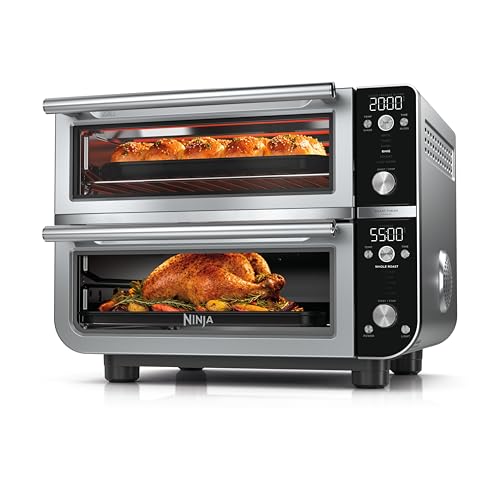
Ninja Double Oven Pro Smart XL DCT801 — Two ovens, one smart finish
The DCT801’s smartness is aimed at the oldest problem in home cooking: everything must be ready at once, and nothing cooks for the same time. This is a double countertop oven — two independent cavities in one 30.2-quart frame — running Ninja’s DualZone logic with Smart Finish, which staggers the two zones’ programmes so different dishes, cooked differently, complete together. Roast in one zone, air fry in the other, press the sync, and the oven does the arithmetic that used to require a cook, a clock and a certain amount of swearing.
Twelve functions spread across the zones, and the capacity is family-serious: the oven is rated for a 4.5 lb chicken class load, with the second zone taking the sides that make it dinner. For households whose weeknight bottleneck is sequencing — protein resting while vegetables roast, garlic bread waiting on the fries — two cavities are not a luxury but the removal of the bottleneck itself.
Smart Finish deserves its name because it solves the problem in the right direction. Rather than holding the fast dish warm and sorry, it delays the fast zone’s start so both finish fresh. Anyone who has eaten leathery green beans that waited twenty minutes for a chicken will understand that this is not a gimmick; it is the difference between a meal and a sequence of dishes.
The smartness here is coordination, not connection — like the DT551, this Ninja does its thinking on board, without an app account between you and dinner. Households that want remote control should look at the Joule or Tovala; households that want two dinners to land together should look at nothing else in this guide.
Each zone air fries, bakes and roasts with Ninja’s assertive circulation, and the zones can also run independently for a single dish when the meal is simple. That flexibility matters: the double oven must not become a machine that only makes sense on complicated nights, and in single-zone use it behaves like a perfectly good large countertop oven that happens to have a spare room.
The costs are size and price, stated plainly. Thirty quarts of double oven is the largest counter commitment in this guide, and check price on Amazon will place it in the premium tier. It also asks the cook to learn a two-zone workflow — a weekend of dinners — after which the logic becomes second nature and single-oven cooking feels oddly serial.
Cleaning doubles in the obvious way: two cavities, two sets of trays, though each is smaller than a single giant cavity and the daily zone can be kept presentable with the same wipe-while-warm discipline. Families that cook in both zones nightly should budget the minutes honestly; the meal coordination buys them back at the table.
For entertaining, the proposition compounds: starters in one zone, mains in the other, desserts warming while the table eats. Hosts who plan menus around oven traffic will recognise the liberation immediately, and it is the kind of liberation that, once tasted, reorganises how a kitchen is used.
Against its DT551 sibling, the choice is thermometer against twin cavities — precision on one dish against synchrony across two. Many households will know instantly which problem they actually have; the ones with both problems have this guide’s permission to want both machines.
It is the biggest, boldest answer in the smart category: not an oven that talks to your phone, but an oven that talks to itself, zone to zone, so dinner arrives as a meal. For busy families, that conversation is the smartest one on this page.
Choose the DCT801 if your cooking fails at timing rather than technique — two zones and a synced finish will fix the actual problem.
- Capacity: 30.2 quart total, double oven
- Functions: 12-in-1
- Smart: DualZone with Smart Finish syncing
- Fits: a 4.5 lb chicken class load
- Finish: stainless steel
- Model: DCT801 Double Oven Pro Smart XL
Strengths
- Two zones cook different dishes at once
- Smart Finish lands both dishes together
- 30.2-quart capacity suits family entertaining
Trade-offs
- Largest counter footprint in this guide
- Premium tier pricing
- Two cavities mean two to clean
Best for: Busy families whose dinners fail on timing.
Not suited for: Small kitchens and single-dish cooks.
Comparison Table
| Pick | Headline trait | Watch out for |
|---|---|---|
| Breville Joule Oven | Guided app recipes set the oven themselves | Premium price tops the smart category |
| Ninja Prestige DT551 | Thermometer cooks to true doneness | No remote control or guided recipes |
| Tovala Smart Oven Pro | Scan-to-cook ends box-instruction guesswork | Meal service is a paid subscription extra |
| CHEF iQ MiniOven | Guided app cooking supports learners | Larger than the Mini name suggests |
| Dreo ChefMaker | Water atomizer keeps proteins juicy | 6-quart capacity cannot feed a family |
| Ninja Double Oven DCT801 | Two zones cook different dishes at once | Largest counter footprint in this guide |
What happens when the smart part stops working?
It is the question every connected appliance buyer should ask in the shop, so this guide answers it in the open. If the Joule’s app vanished tomorrow, the oven would remain a flagship countertop oven worked from its panel. If Tovala’s service closed, the Pro would remain a steam-capable smart oven with manual and app-era controls diminished but a working cavity. The Ninjas, holding their intelligence on board, would notice nothing at all.
That gradient of risk is not a reason to avoid connected ovens; it is a reason to price the risk correctly. Pay for the hardware as hardware, treat the connected layer as a valuable extra with an uncertain lifespan, and the arithmetic stays honest whichever future arrives.
Practically, the resilience habits are simple: learn the panel controls during the first month, keep the manual, and do not let the app become the only person in the household who knows how dinner works. Smart ovens reward the households that use them as teachers rather than oracles.
Which kind of air fryer smart ovens fits your household?
Start with your failure mode, because each pick here retires a different one. Roasts that miss their temperature point to the probe ovens — Ninja DT551 or the Dreo for small portions. Dinners whose parts never land together point to the DCT801’s synced zones. Evenings with no decision left in you point to the Tovala. New dishes you are afraid to attempt point to the guided apps of the Joule and CHEF iQ.
Then audit your relationship with your phone. Connected ovens reward households that already run thermostats and lights by app, and mildly punish those who resent creating accounts for appliances. There is no virtue in either temperament, but buying against your own will sour a good oven, so be honest at this step.
Capacity still rules, as it does in the unconnected guide. The ChefMaker’s six quarts and the Tovala’s compact cavity serve small households beautifully and families barely; the double Ninja serves a crowd and overwhelms a bedsit counter. Smart features do not shrink an oven, and the tape measure remains the first tool of appliance buying.
Price the ecosystem, not just the oven. A meal subscription, if you will use it, belongs in the comparison as a running cost; an app you will never open makes its oven merely an oven, to be judged against unconnected rivals. Check price on Amazon for the hardware, then do the service arithmetic with your eyes open.
Consider who else cooks. Guided and scanning ovens widen the circle of people who can produce dinner — partners, teenagers, grandparents — because the knowledge lives in the system rather than in one cook’s head. Households where one person is the bottleneck should weigh that widening heavily; it may be the smartest feature of all.
Last, plan for the app to change. Favour ovens, like the Joule, that remain complete from their own panels, or intelligences, like the Ninjas’, that never needed a server. The connected extras are the seasoning; the oven must still be dinner if the seasoning runs out.
How do you get the most from a smart oven?
Invest the first week in the system, not just the oven. Install the app, run one guided recipe exactly as written, scan one barcode, cook one roast by probe — whichever smarts you bought, exercise them deliberately once, because features learned under no pressure become habits, and features never tried become regrets with a power cord.
Trust the probe’s placement. A thermometer reads where its tip sits, so aim for the thermal centre of the thickest part, away from bone and pan, and let the number — not the clock or the colour — call the finish. Rest the meat afterwards; the temperature coasts upward, and the oven’s arithmetic assumed you would.
Keep the connection boring. Put the oven on the stable home network rather than the guest one, let updates install, and keep the app signed in. Connected appliances fail socially, not technically: the household that has to hunt for a password at dinnertime stops using the features within a month.
Use guidance as tuition, then graduate. Follow the app’s recipes until their patterns — temperatures, stages, rests — become your instincts, and keep using the system for new territory. The best smart ovens make themselves progressively less necessary, which is a strange and honourable definition of success.
For the twin-zone cooks: plan the pair, not the dishes. Decide the finish time first, let Smart Finish work backwards, and resist opening zones to check — the system is timing to a closed-door assumption. Synchrony is a trust exercise, and it pays out at the table.
And keep the manual skills warm. Power cuts, app updates and holiday rentals all return you to time-and-temperature cooking eventually; the cook who learned from the smart oven, rather than leaning on it, is fluent in both worlds.
What Are the Most Common Mistakes?
Buying an app you will never open
A connected oven used only from its panel is an expensive ordinary oven. If your household will not cook by phone, the on-board Ninjas or an unconnected model serve you better and cheaper.
Drifting into a meal subscription
Tovala’s plan is optional and genuinely useful for some households — but it should be a decision with a monthly number attached, not a default discovered on a statement. Start without it; add it if the evenings demand it.
Judging the ChefMaker as a family oven
It is a 6-quart combi fryer of real brilliance and real limits. Bought as a small household’s centrepiece it delights; bought to cater for six it cannot succeed, and the failure would be the brief’s, not the machine’s.
Placing the probe carelessly
A tip touching bone or hovering in a cavity reads fiction, and the oven will cook confidently to the wrong number. Centre of the thickest part, every time.
Letting the network become the cook’s excuse
If the Wi-Fi is down, dinner is not cancelled — every oven here cooks from its panel. Households that forget this have outsourced more than their settings.
Ignoring software updates for a year
Connected features improve and occasionally break by update. Let the oven maintain itself, the way you let the phone, and the guidance stays accurate.
Final Recommendation
The Joule is this guide’s flagship for a reason: the strongest cooking platform here, wearing the most thoughtful guidance. But flags are not fleets, and the right smart oven is the one matched to your failure mode — the DT551’s probe for the protein household, the DCT801’s twin zones for the family whose dinners collide, the Tovala for the household that wants dinner decided, the CHEF iQ for the learner, and the little Dreo for the small kitchen with restaurant ambitions.
What none of them will do is make smart a substitute for appetite or attention. They remove guesswork, vigils and collisions; the cooking, and the pleasure in it, remain yours. Choose the intelligence you will actually use every week, keep the panel skills warm behind it, and your smart oven will earn its adjective the only way that counts — at the table, on a Tuesday, without drama.
Start your shortlist with the Breville Joule Oven, weigh it against the Ninja Prestige DT551, and keep the Tovala Smart Oven Pro in view before you decide.
Frequently Asked Questions
Do smart ovens need Wi-Fi to cook?
The connected models — Joule, Tovala, CHEF iQ — cook their core functions from their own panels without a network; Wi-Fi unlocks the app guidance, scanning and remote control. The two Ninjas’ intelligence is entirely on board and never needs a connection at all.
Is the Tovala meal plan required?
No. It is an optional paid subscription for delivered fresh meals that the oven cooks by scan. The oven’s six functions, app control and grocery scan-to-cook all work without it, and many owners never subscribe.
What is scan-to-cook?
The oven reads a product’s barcode and applies the time, temperature and cooking stages its maker specified, including multi-stage programmes a normal oven cannot run from one setting. It works with Tovala’s meals and a range of supported grocery items.
Can a probe really replace timing a roast?
For doneness, yes — temperature is what doneness is. Place the probe in the centre of the thickest part, set the target for the protein, and rest the meat afterwards. Timing still helps you plan the rest of the meal, but it stops being the judge.
Will the apps for these ovens be supported for years?
No reviewer can promise a company’s roadmap. The protection is structural: choose ovens that remain fully capable from their own panels, or on-board intelligence like the Ninjas’, so the hardware’s decade does not depend on the software’s cycle.
Is a combi fryer like the Dreo a real smart oven?
It is a real smart cooker of a different shape: a 6-quart combi fryer using a probe and water atomisation to execute chef technique on single dishes. It complements a household’s oven rather than replacing the family-sized machines in this guide.
Related Guides
Smart cooking sits inside the wider countertop story told by our neighbouring guides: Best Air Fryer Ovens covers the unconnected ovens these models build on, Best Backyard Pizza Ovens takes cooking outdoors where no app survives the smoke, and Best Bean to Cup Cappuccino Machines explores automation’s other kitchen stronghold, the coffee counter.



[…] Electric Ovens for compact cooking, and anyone curious about app-connected appliances can browse Best Air Fryer Smart Ovens to see what the smart label adds […]