What's inside
- Key Takeaways
- Quick Picks
- How We Chose These Picks
- The Best Affordable Gas Ranges Worth Your Money, Reviewed One by One
- How Do the Six Compare Side by Side?
- What Does Affordable Actually Mean Over Ten Years?
- Which Corners Can Be Cut, and Which Cannot?
- How Much Oven Do You Need at This Tier?
- What Is Lost Without Convection — and What Is Not?
- Why Do Fuel Options Matter Beyond the City?
- How Should You Judge Burners When Every Listing Shouts?
- What Should Installation Cost You in Attention?
- How Do You Keep an Affordable Range Young?
- How Do You Spot a False Economy on a Listing?
- What Is the Smart Order of Spending Around a Tight Budget?
- Which of These Six Suits a Rental Property Best?
- How Does an Affordable Range Handle a Growing Household?
- What Does the First Year of Ownership Usually Teach?
- How Should You Compare Two Ranges That Look Identical on Paper?
- Why Do White and Stainless Both Survive at This Tier?
- What Happens When the Range Outlives the Kitchen’s Fashion?
- How Do You Time a Replacement Before the Old Range Dies?
- What Should a First-Time Gas Cook Expect?
- How Does the Storage Drawer Earn Its Keep?
- Where Do Budget Gas Range Buyers Most Often Go Wrong?
- Final Recommendation
- Frequently Asked Questions
- Related Guides
As an Amazon Associate I earn from qualifying purchases. This post may contain affiliate links at no extra cost to you.
cottageverdict.com is reader-supported. When you buy through links on our site, we may earn an affiliate commission.
Affordable is the most honest word in appliance shopping, provided it is defined properly: not the smallest number on a listing, but the lowest cost of owning a good range for a decade. The best affordable gas ranges in this guide are judged on that definition — purchase sense, running sense, repair sense — and on the cooking itself, because a cheap range that cooks badly is the most expensive kind there is. Prices move too fast to print responsibly, so this guide talks in tiers and value, and sends you to the listings to check price on Amazon for the day’s figure.
Where to buy: all six ranges are sold through Amazon, and the pick names in the Quick Picks table and the detailed reviews link to each listing. Every model here is a 30-inch gas range; what separates them is what each maker chose to protect when the budget tightened — service networks, oven size, a modern mode, fuel flexibility, or a feature list that punches above its tier.
Six makers carry the argument, and they do not agree with each other — which is healthy. GE protects the service network, Whirlpool the size and storage, Maytag a modern mode, Magnificent Chef the right-sized oven, KOSTCH the look and the fuel choice, Kenmore the feature list. Your household’s priorities pick the winner; this guide’s job is to make the trade-offs impossible to miss.
Key Takeaways
- Affordable means total cost: a repairable range from a serviced badge beats a fragile bargain every decade.
- Oven sizes here run from a right-sized 4.0 cu. ft. to a full 5.0 — match the cavity to your household, not your hopes.
- The Kenmore PRO imports true convection and air fry into this tier; the Maytag adds air fry to a 5.0 cu. ft. oven.
- Sealed burners on the GE are the daily-living feature that matters most at this level.
- The KOSTCH offers a liquid propane path for homes off the gas main, in pro-style dress.
- Stainless is available at this tier (Whirlpool, Maytag, Magnificent Chef) — you are not sentenced to white unless you choose it.
Quick Picks
| Pick | Badge | Why it earns its place |
|---|---|---|
| GE 30 Inch Free-Standing Gas Range 4.8 Cu Ft White | Best Trusted Budget Classic | A 4.8 cu. ft. oven and sealed burners in classic white, from the badge with a service engineer in every town. |
| Whirlpool WFGS5030RS 30 Inch Freestanding Gas Range | Best Stainless at This Tier | A 5.0 cu. ft. oven with a storage drawer, in stainless steel — the mainstream upgrade look without the mainstream upgrade bill. |
| Maytag 30 Inch Gas Range with Air Fry | Best With Air Fry Included | A 5.0 cu. ft. oven with air fry and bake modes, wearing Maytag’s durability-first badge in stainless steel. |
| Magnificent Chef 30 Inch Gas Range Stainless Steel | Best Space-Saver Oven | A 4.0 cu. ft. space saver oven under two ultra-fast and two fast burners — sized for smaller households and tighter kitchens. |
| KOSTCH 30 Inch Professional Freestanding Gas Range | Best Pro-Style on a Budget | A pro-style freestanding range with five burners, specified for natural gas or liquid propane — the professional look at this tier. |
| Kenmore PRO 30 Inch Front Control Gas Range | Best Features at This Tier | Front controls, a 5.0 cu. ft. oven with true convection and air fry, and five burners — the fullest specification in this guide. |
How We Chose These Picks
We set the tier by positioning rather than by printing prices that would stale in a week: these are the models their makers aim at the value end of the 30-inch gas category. Within it, we required the fundamentals to survive the budgeting — a full oven, four or five real burners, a maker with distribution — and we marked down any model whose savings came from making the appliance harder to live with or harder to repair.
We also protected two unfashionable virtues: serviceability and honesty of specification. A range whose listing states its burner speeds plainly, like the Magnificent Chef, or whose fuel options are explicit, like the KOSTCH, earned trust that a longer feature list could not buy. At this tier, the guide’s loyalty is to the total cost of a decade, not the excitement of delivery day.
A note on what we excluded: the very cheapest listings in this category, the ones whose makers cannot be identified beyond a marketplace storefront, were left out regardless of their feature lists. A guide that recommends a decade-long appliance has to be able to name who will sell you an igniter in year eight, and where that promise fails, no purchase figure is low enough to compensate.
The Best Affordable Gas Ranges Worth Your Money, Reviewed One by One
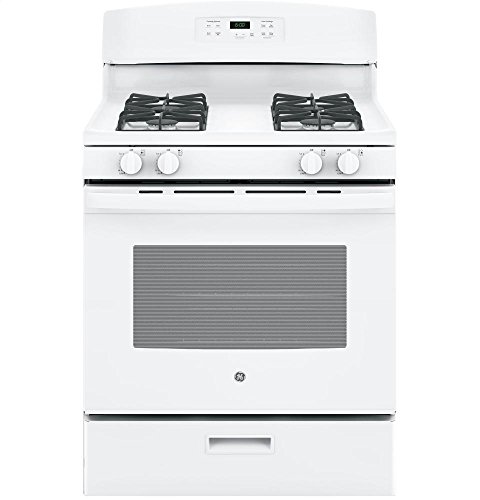
GE 30 Inch Free-Standing Gas Range 4.8 Cu Ft White — Best Trusted Budget Classic
This GE is the affordable gas range in its purest form: a 30-inch free-standing body, a 4.8 cu. ft. oven, sealed burners that keep spills where you can wipe them, and a white finish that has clothed American kitchens for generations. Nothing on it is experimental, and that is precisely the recommendation. When the budget is the brief, proven beats novel every time, because the money saved on features is not saved at all if it is spent on repairs.
Sealed burners are the detail that matters daily — a boiled-over pan pools on the surface instead of vanishing into the works — and GE’s parts and service network is the detail that matters in year nine, when an igniter tires and every independent engineer in the county has the part on the van. Affordable is not a price; it is a total. This range’s total, across a decade of ordinary cooking, is very hard to beat.
A year into ownership, the GE’s owners tend to sound almost bored, which is the highest praise this tier can earn: nothing has broken, nothing has confused a guest, and the oven has roasted everything asked of it. Boredom, in appliance terms, is reliability experienced from the inside. For a landlord, a first-time buyer or a household replacing a range mid-crisis, that dependable dullness is worth more than any feature printed in bold on a competitor’s box. Its white finish also makes it the easiest range here to touch up cosmetically after a decade of honest knocks.
- Width: 30 inches, free-standing gas range
- Oven: 4.8 cu. ft. capacity
- Burners: sealed burners for easy wiping
- Finish: classic white
- Support: the widest service network in this guide
Strengths
- Sealed burners keep cleaning simple
- Service and parts available almost everywhere
- Proven design with no experimental parts
Trade-offs
- White finish shows splashes until wiped
- Feature list is deliberately short
- Oven is mid-size beside 5.0 cu. ft. rivals
Best for: Budget buyers who define value across a decade, not a receipt.
Not suited for: Feature seekers who want air fry and convection included.
The day’s figure for the GE 30 Inch Free-Standing Gas Range 4.8 Cu Ft White lives on its listing — check price on Amazon rather than trusting any number quoted elsewhere.

Whirlpool WFGS5030RS 30 Inch Freestanding Gas Range — Best Stainless at This Tier
Whirlpool’s WFGS5030RS answers the most common affordable-range question: can the budget stretch to stainless and a full-size oven without leaving the sensible tier? Its 5.0 cu. ft. cavity is a genuine family size, the stainless finish matches the appliances most kitchens already own, and the storage drawer underneath does the unglamorous work of holding the sheet pans and lids that small kitchens have nowhere else to put.
Whirlpool’s design language is deliberately calm — controls a guest can read, an oven that behaves as expected, nothing that requires a manual’s second chapter. For a household replacing a dead range under time pressure, that calm is worth money: the range arrives, the cooking resumes, and nobody’s week is reorganised around an appliance’s learning curve. Affordable ranges should disappear into the household, and this one is engineered to disappear.
The Whirlpool’s storage drawer turns out to be its most praised feature in small kitchens, which surprises nobody who has tried to shelve sheet pans in a cupboard designed for cereal boxes. The range itself settles into family service without a learning curve — the controls read themselves, the oven behaves, the stainless wipes down after the Sunday roast. It is the appliance equivalent of a reliable car: chosen for the school run of cooking, and quietly excellent at it. Families report the oven’s size passes the holiday test with one tray rotation — the most that mainstream cooking ever asks.
- Width: 30 inches, freestanding gas range
- Model: WFGS5030RS
- Oven: 5.0 cu. ft. capacity
- Storage: drawer beneath the oven
- Finish: stainless steel
Strengths
- Full family oven size at this tier
- Stainless matches most existing kitchens
- Storage drawer earns its space daily
Trade-offs
- No convection fan for multi-rack baking
- Drawer is storage, not a warmer
- Spec sheet is honest rather than exciting
Best for: Families replacing a range quickly who want stainless and size.
Not suited for: Bakers who need convection evenness across racks.
The day’s figure for the Whirlpool WFGS5030RS 30 Inch Freestanding Gas Range lives on its listing — check price on Amazon rather than trusting any number quoted elsewhere.

Maytag 30 Inch Gas Range with Air Fry — Best With Air Fry Included
Maytag sells dependability as an identity, and this range applies it to the affordable tier with one modern flourish: air fry inside a 5.0 cu. ft. oven. The mode earns its inclusion the same way it does in pricier ranges — moving hot air crisps the breaded and the frozen without a separate countertop appliance — and the oven’s size means the tray can hold a family’s worth in a single uncrowded layer, which is where air fry succeeds or fails.
The rest of the machine is Maytagorthodoxy: sturdy-feeling construction, controls without mystery, and a brand promise built on the appliance outlasting the kitchen’s fashion. For households whose cooking includes a steady traffic of wings, chips and reheated pizza — which is to say, most households with teenagers — the air fry mode will be used weekly rather than admired annually, and a feature used weekly at this tier is a bargain by definition.
Maytag’s air fry mode survives the novelty period in households with teenagers, which is the sternest test any feature faces. The oven’s size helps: a full tray of wings in one layer crisps the way the mode promises, and the second batch is rarely needed. The rest of the week the range is simply a sturdy gas cooker with a famous name for not breaking — a combination that justifies its place in a value guide without a word of apology. Its bake mode deserves a word too: plain, even and predictable, which is what weekday baking actually requires.
- Width: 30 inches, gas range
- Oven: 5.0 cu. ft. capacity
- Modes: air fry and bake
- Finish: stainless steel
- Character: durability badge plus one modern mode
Strengths
- Air fry without a countertop appliance
- Full-size oven for family trays
- Badge built on long service life
Trade-offs
- Air fry still demands an uncrowded tray
- Fewer modes than premium feature lists
- Gas oven evenness trails convection rivals
Best for: Families whose week runs on air-fried staples.
Not suited for: Purists who want convection as the oven’s main event.
The day’s figure for the Maytag 30 Inch Gas Range with Air Fry lives on its listing — check price on Amazon rather than trusting any number quoted elsewhere.

Magnificent Chef 30 Inch Gas Range Stainless Steel — Best Space-Saver Oven
The Magnificent Chef range makes a virtue of the thing other listings apologise for: a smaller oven. At 4.0 cu. ft. its space saver cavity heats less air, preheats sooner, and matches the cooking of one- and two-person households, for whom a cavernous oven is a tax paid on every meal. On top, the burner arrangement is stated with unusual honesty — two ultra-fast and two fast burners — a top specified for people who boil, sear and simmer in the ordinary proportions.
This is a range for the smaller household that cooks properly: the couple who roast a small chicken and see no reason to heat a feast’s worth of air around it, the downsizer whose new kitchen is compact by choice. Stainless steel keeps it current in a modern scheme. Judge it by fit rather than by the class average — a range matched to its household is affordable in the only sense that compounds, every single day it is used.
The space saver oven teaches its household a pleasant economy: smaller preheats, quicker weeknight roasts, and a top whose burner speeds are matched to pans a couple actually owns. Owners upgrading later to a family-size range often keep a soft spot for it, the way drivers remember a first small car. Right-sizing is the most underrated form of affordability, because it pays its dividend at every single meal rather than once at the till. A smaller oven also suits solar-equipped and off-grid homes watching every watt and flame with intent.
- Width: 30 inches, gas range
- Oven: 4.0 cu. ft. space saver cavity
- Burners: two ultra-fast and two fast
- Finish: stainless steel
- Audience: smaller households, compact kitchens
Strengths
- Smaller oven preheats fast and wastes little
- Burner speeds stated plainly and usefully
- Right-sized for one- and two-person cooking
Trade-offs
- Oven too small for feast-scale roasts
- Lesser-known badge beside the giants here
- Four burners in standard, not pro, spirit
Best for: Couples and downsizers cooking right-sized meals.
Not suited for: Large families or holiday hosts cooking at scale.
The day’s figure for the Magnificent Chef 30 Inch Gas Range Stainless Steel lives on its listing — check price on Amazon rather than trusting any number quoted elsewhere.

KOSTCH 30 Inch Professional Freestanding Gas Range — Best Pro-Style on a Budget
KOSTCH’s proposition is the professional silhouette without the professional invoice: a freestanding pro-style body, five burners across the top, and — a detail worth its weight in rural kitchens — specification for natural gas or liquid propane, so the range serves homes the gas main never reached. Five burners at 30 inches is a crowd, as this guide has noted elsewhere, but for the household that cooks in many small pans it is a crowd with a purpose.
Expectations should be set by the tier, honestly: the pro style here is about the format and the cooking layout — the stance, the grates, the burner count — rather than the heirloom heft of the premium professional brands. Judged on those terms it delivers something real: a kitchen transformed visually, a top that handles a busy dinner, and fuel flexibility that the big badges often reserve for their expensive lines. For the renovator whose budget ended at the cabinets, this range finishes the room.
The KOSTCH transforms kitchens visually in a way its tier has no right to expect: visitors read pro style and assume a renovation budget that the cabinets know is fiction. Its five burners serve the many-small-pans household genuinely, and the propane path has made it the answer for country kitchens that the mains forgot. Keep expectations calibrated to its class — the cooking and the look are the deliverables — and it delivers both with conviction. Confirm which fuel version is in the box at delivery — the flexibility is a virtue only when the right variant arrives.
- Width: 30 inches, professional freestanding style
- Burners: five across the cooktop
- Fuel: natural gas or liquid propane versions
- Format: pro-style body and grates
- Positioning: professional look, accessible tier
Strengths
- Pro-style presence at an accessible level
- Propane option serves off-main households
- Five burners for many-small-pans cooking
Trade-offs
- Five burners crowd large pans at this width
- Finish and heft a step below premium pro brands
- Newer badge with a smaller service footprint
Best for: Renovators who want the pro look and propane flexibility.
Not suited for: Buyers expecting heirloom-grade professional heft.
The day’s figure for the KOSTCH 30 Inch Professional Freestanding Gas Range lives on its listing — check price on Amazon rather than trusting any number quoted elsewhere.

Kenmore PRO 30 Inch Front Control Gas Range — Best Features at This Tier
The Kenmore PRO is the affordable tier’s overachiever: front controls in the slide-in manner, a 5.0 cu. ft. oven carrying true convection — fan plus its own element — and air fry, over five burners. True convection at this level is the headline, because it imports the electric oven’s evenness into a gas cavity: two racks baking alike, roasts browning underneath, none of the hot-corner management that plain gas ovens demand of their owners.
Front controls complete the argument for households tired of reaching across steaming pans to adjust the oven, and they give the range a fitted look that belies its tier. Kenmore’s PRO line exists to compress premium features into accessible appliances, and this model is the clearest expression of that mission in the guide. If your budget is fixed but your standards are not, this is where the two shake hands.
The Kenmore PRO is the pick most likely to be mistaken for a range from the tier above, and not only by guests: its true convection changes the owner’s baking habits, because two racks that bake alike invite batch cooking that a plain oven discourages. Front controls complete the impersonation. For the household that cooks ambitiously on a fixed budget, it is less a compromise than a small act of arbitrage against the market’s usual pricing of features. Its air fry and true convection together make it the baker-fryer household’s single-appliance answer at this level.
- Width: 30 inches, front control gas range
- Oven: 5.0 cu. ft. with true convection and air fry
- Burners: five across the cooktop
- Controls: front panel, slide-in style
- Line: Kenmore PRO feature-forward series
Strengths
- True convection rare at this tier
- Air fry included for the weekly staples
- Front controls safer and easier to read
Trade-offs
- Front panel reachable by small children
- Feature richness means more electronics to service
- Five burners crowd the widest pans
Best for: Standards-keepers on a fixed budget who bake often.
Not suited for: Minimalists who prefer the simplest possible machine.
The day’s figure for the Kenmore PRO 30 Inch Front Control Gas Range lives on its listing — check price on Amazon rather than trusting any number quoted elsewhere.
How Do the Six Compare Side by Side?
The table holds the tier’s essentials in one view: oven size from the space saver’s 4.0 to the full 5.0 cu. ft., the GE’s sealed practicality, the Maytag’s air fry, the KOSTCH’s fuel flexibility and the Kenmore PRO’s true convection — five different answers to the same budget.
| Pick | Badge | Standout trait |
|---|---|---|
| GE 30 Inch Free-Standing Gas Range 4.8 Cu Ft White | Best Trusted Budget Classic | A 4.8 cu. ft. oven and sealed burners in classic white, from the badge with a service engineer in every town. |
| Whirlpool WFGS5030RS 30 Inch Freestanding Gas Range | Best Stainless at This Tier | A 5.0 cu. ft. oven with a storage drawer, in stainless steel — the mainstream upgrade look without the mainstream upgrade bill. |
| Maytag 30 Inch Gas Range with Air Fry | Best With Air Fry Included | A 5.0 cu. ft. oven with air fry and bake modes, wearing Maytag’s durability-first badge in stainless steel. |
| Magnificent Chef 30 Inch Gas Range Stainless Steel | Best Space-Saver Oven | A 4.0 cu. ft. space saver oven under two ultra-fast and two fast burners — sized for smaller households and tighter kitchens. |
| KOSTCH 30 Inch Professional Freestanding Gas Range | Best Pro-Style on a Budget | A pro-style freestanding range with five burners, specified for natural gas or liquid propane — the professional look at this tier. |
| Kenmore PRO 30 Inch Front Control Gas Range | Best Features at This Tier | Front controls, a 5.0 cu. ft. oven with true convection and air fry, and five burners — the fullest specification in this guide. |
What Does Affordable Actually Mean Over Ten Years?
A range’s cost arrives in instalments: the purchase, the installation, the gas it burns, the repairs it needs, and — the instalment nobody prices — the meals it cooks badly if it is badly made. A decade of ownership typically includes one or two ordinary failures: an igniter, a thermostat, a valve. On a range from GE, Whirlpool, Maytag or Kenmore, those are van-stock parts fitted in one visit. On an obscure import, the same failure can mean weeks of waiting and a repair bill that argues for replacement.
That arithmetic is why this guide’s affordable tier is populated by badges with networks. The truly expensive range is the one replaced at year four. Buy the appliance whose failures are ordinary, whose parts are stocked, and whose maker will still exist at the decade’s end — and the affordable choice makes itself, whatever the listings say on any given morning.
There is a corollary worth stating plainly for first-time buyers: the delivery, the fitting and the haul-away of the old range are part of the appliance’s cost, and a listing that looks cheaper by excluding them is not cheaper. Price the whole event — range, fitter, disposal — before comparing candidates, and the honest totals will often reorder the shortlist. Affordable shopping is accounting before it is shopping.
Which Corners Can Be Cut, and Which Cannot?
Makers economising honestly cut the garnish: fewer modes, simpler panels, plainer finishes, smaller marketing. Those cuts cost the owner little. The dishonest cuts are structural — thin enamel, vague burner engineering, an oven that cannot hold a temperature — and they tax every meal. The models in this guide were chosen for cutting garnish. The GE’s short feature list over a proven chassis is the honest pattern; a long feature list over a flimsy one is the pattern to walk away from.
One cut deserves specific respect: oven size. The Magnificent Chef’s 4.0 cu. ft. space saver is a cut that saves its owners money twice — once at purchase and again at every preheat — provided the household is genuinely small. The same cut in a family kitchen is a false economy that charges rent at every holiday. Corners are not good or bad in themselves; they are good or bad for a household, which is why this guide keeps asking who is cooking.
How Much Oven Do You Need at This Tier?
The spread here — 4.0 to 5.0 cu. ft. — maps onto households more than budgets. One or two people cooking roasts for two: the space saver is not a compromise but a fit. A family of four with a weekly roast and a baking habit: the 5.0 cu. ft. models from Whirlpool, Maytag and Kenmore are the honest size. The GE’s 4.8 sits between, the classic compromise that has served average households for decades.
Measure your largest pan before letting a number decide. A roasting pan that fits with air around it cooks better than a nominally larger oven crammed wall to wall, because roasting is airflow as much as volume. And remember the storage drawer question that travels with size: the Whirlpool’s drawer holds the pans a small kitchen cannot shelve, a cubic-foot argument of a different and very practical kind.
What Is Lost Without Convection — and What Is Not?
Five of these six ovens are conventional gas cavities, and generations of good cooking prove that is no tragedy: roasts, casseroles, braises and single trays of baking all thrive in still gas heat, with its gentle moisture suiting many dishes. What plain gas heat asks is management — rotate a tray, learn the hot corner, accept that two racks bake as cousins rather than twins.
The Kenmore PRO’s true convection removes that management, and for the household that bakes in batches it is worth real money even at this tier. The honest framing is workload, not quality: convection is a labour-saving evenness machine. If your oven’s life is roasts and reheats, save the difference; if it is tray after tray of biscuits, the Kenmore’s fan is the hardest-working bargain in this guide.
Why Do Fuel Options Matter Beyond the City?
A gas range assumes a gas supply, and much of the country cooks beyond the mains on bottled propane. Conversion is model-specific and belongs to a qualified fitter with the maker’s kit — never an improvisation — which makes the KOSTCH’s explicit natural gas or liquid propane specification a genuine feature for rural and off-main households, not a footnote. It is also, in pro-style dress, a combination the premium brands often forget to offer at accessible levels.
Urban buyers should still read the fuel line of any listing twice. Ranges ship in versions, addresses get confused, and a natural gas appliance delivered to a propane home is a project delay with a delivery crew standing in it. Confirm the variant at order, in writing, and keep the confirmation with the paperwork — the cheapest sentence in this entire guide is that one.
How Should You Judge Burners When Every Listing Shouts?
At this tier the honest signals are plain ones: burner speeds stated in words a cook can use — the Magnificent Chef’s ultra-fast and fast pairing — sealed designs that keep the works clean, and grates that sit stable under a pan. A top that simmers without scorching a white sauce has passed the test that matters more than any boil race, because dinner is mostly simmering and only occasionally a sprint.
Five-burner tops, on the KOSTCH and the Kenmore, should be read as flexibility rather than capacity: the fifth position is a home for the kettle and the resting sauce while four positions work. Households that understand that reading are delighted; households expecting five full-size stations at 30 inches are the ones writing disappointed reviews of perfectly good ranges. Expectation is a specification too — set it before the range arrives.
What Should Installation Cost You in Attention?
A gas range installation is a licensed fitter’s job: the supply, the shut-off, the connection and the leak check are not DIY territory in any jurisdiction that values its housing stock. Budget the fitter as part of the purchase, confirm the existing line’s size and position while the old range is still in place, and photograph everything behind the appliance before the swap — the wall behind a range is a decade’s archive of crumbs and surprises.
Affordable discipline applies here too, in the correct direction: the installation is the last place to economise. A range connected properly, levelled on its feet and tested burner by burner will cook evenly for years; the same range rocking on an unlevel floor spills every sauce toward the same corner for the same years. Spend the small money on the fitting, and the big appliance performs like one.
How Do You Keep an Affordable Range Young?
The care routine that extends any range’s life is cheaper than the range: wipe spills while they are recent, keep burner ports clear with a soft brush, clean the oven before its soil carbonises into geology, and check the door seal’s integrity yearly. Sealed-burner models like the GE repay the habit fastest, because their design assumes a cloth rather than a toolkit.
Keep the manual and the model plate photograph together, and note the purchase date where the household keeps its papers. When the first ordinary failure arrives — and it will, somewhere around the decade’s middle — the owner with paperwork and a clean machine gets the one-visit repair. Longevity is not a property of expensive appliances; it is a property of maintained ones, which is the most affordable idea in this entire guide.
How Do You Spot a False Economy on a Listing?
False economies announce themselves in the fine print: a feature list long on modes and silent on construction, an oven capacity quoted without interior dimensions, a warranty whose service network cannot be found. The honest listings in this category read almost plainly — burner speeds in words, capacities in numbers, fuel versions stated — because the makers are selling an appliance rather than an impression.
Reviews literacy helps too. Complaints about cooking evenness and parts availability are structural and should weigh heavily; complaints about a delivery scratch are weather. Read for the pattern across many owners, especially the ones describing year three rather than week one. An affordable range is a decade’s companion, and the evidence that matters is the evidence from deep into the companionship.
What Is the Smart Order of Spending Around a Tight Budget?
When the budget will not stretch to everything, spend in this order: the range whose chassis and network you trust, the licensed installation done properly, ventilation that at least honestly serves the top, and only then the cosmetic upgrades. A stainless finish bought instead of a proper gas fitting is the classic inversion — the kitchen photographs better and cooks worse, and the photograph is taken once while the cooking happens twice a day.
Carry the same order into the years after: maintenance before accessories, the seal and igniter before the new griddle pan. Affordable ownership is a discipline of sequence, and the households that practise it get premium decades out of value appliances. The ranges in this guide all reward that discipline; none of them can substitute for it.
Which of These Six Suits a Rental Property Best?
The rental brief is durability under indifferent care, controls a stranger can read, cleaning that forgives, and parts a local engineer stocks. The GE wins that brief in this guide, with the Whirlpool close behind for landlords whose tenants expect stainless in the photographs. Both present sealed or simple tops that wipe down between tenancies and ovens that a professional clean can restore without drama.
The models to avoid in rentals are the ones whose virtues need an owner’s care: feature-rich panels that confuse guests, finishes that punish neglect. A rental range is read by strangers at midnight, exhausted, cooking something simple — legibility is its luxury feature. Choose accordingly and the appliance stops appearing in the tenancy’s correspondence, which is the landlord’s definition of perfection.
How Does an Affordable Range Handle a Growing Household?
Households grow into ranges the way they grow into houses: gradually, then suddenly at a holiday. The 5.0 cu. ft. models absorb that growth gracefully — the first big roast, the first double batch — while the space saver announces its limit honestly and early. Neither answer is wrong; they are answers for different arcs. The buyer who expects a family should buy the family’s oven now, because the difference at purchase is small and the difference at replacement is total.
Tops age similarly. Four honest burners serve a couple indefinitely and a young family adequately; five positions, read as flexibility, stretch further. When the household finally outgrows the range, the badges in this guide hold a second life — a rental, a relative’s first kitchen, a holiday let — because serviceable appliances are currency. Affordability, fully understood, includes the exit as well as the entrance.
What Does the First Year of Ownership Usually Teach?
Owners of value-tier ranges learn the same curriculum as owners of premium ones, because cooking does not check receipts. The oven’s hot corner gets mapped, the honest simmer burner gets identified, the preheat’s true duration becomes kitchen folklore. The difference the tier makes is not in the learning but in the forgiveness: a simpler machine has fewer modes to misunderstand, and its failures, when they eventually come, are the cheap and ordinary kind.
Keep a note of what you learn where the next cook can find it — the rack for biscuits, the burner for sauces — and the range becomes the household’s rather than the manufacturer’s. That transfer of knowledge is the real warranty on any appliance, and it costs nothing but a pencil. A year in, the best affordable range is simply the one whose lessons are all learned and whose surprises are all pleasant.
How Should You Compare Two Ranges That Look Identical on Paper?
When specifications tie, interrogate the ownership: who services it within a day’s drive, are the wear parts listed and priced anywhere, does the maker’s support answer questions in public. Weigh the door’s feel and the grates’ stability if a showroom allows it — heft is not quality, but wobble is information. Read the manual’s cleaning chapter; it is the most honest pages any maker publishes, because it describes the appliance you will actually live with.
Then let your household break the tie. The family that air-fries weekly takes the Maytag or the Kenmore; the couple takes the space saver; the landlord takes the GE. Identical paper diverges the moment a real kitchen applies its own facts, and a buying decision that ends with your facts rather than the brochure’s is the one that survives the decade.
Why Do White and Stainless Both Survive at This Tier?
White enamel persists because it is genuinely good: bright in small kitchens, forgiving of its own ageing, cheap to keep handsome, and invisible in the best sense — the cooking becomes the kitchen’s colour. Its presence on the GE is not a budget confession but a design tradition older than stainless itself. Kitchens styled around colour and wood often look better with white than with a grey metal interruption.
Stainless persists because kitchens are ecosystems: when the refrigerator, dishwasher and hood are already steel, the range that matches completes the room, and the Whirlpool, Maytag and Magnificent Chef offer that completion without leaving the tier. Neither finish cooks; both furnish. Choose the one your room is asking for, and spend the saved deliberation on the food.
What Happens When the Range Outlives the Kitchen’s Fashion?
A sound affordable range will likely serve under two kitchen fashions, because ranges last longer than trends. The plain designs in this guide — the GE’s white classicism, the Whirlpool’s calm stainless — were chosen partly for that endurance: they do not date the room around them, and they accept new cabinet colours and worktops without demanding replacement. Fashion-proofing is an affordability feature, since nothing is more expensive than replacing a working appliance for looking tired.
When the range finally retires, its second life is the last dividend: a serviceable GE or Whirlpool is a gift, a rental fitting or a workshop’s kitchen waiting to happen. Appliances that can be repaired can be rehomed, and the value tier’s sturdy plainness is exactly what second lives are made of. Buy the range that can be somebody else’s bargain in twelve years, and you have understood affordability completely.
How Do You Time a Replacement Before the Old Range Dies?
The cheapest replacement is the planned one. A range telegraphs its decline — an oven that will not hold temperature, burners that light reluctantly, a door seal gone slack — usually a season before it quits outright. Replacing on your schedule rather than the appliance’s lets you choose the model calmly, book the fitter without urgency pricing, and avoid the fortnight of takeaways that a sudden death imposes on a household.
If the old range still cooks safely, its final months are the time to do this guide’s homework: measure the slot, photograph the connections, decide the household’s tier with the evidence of your actual cooking. The household that replaces in a panic buys the range that was in stock; the household that replaces on a plan buys the range in this guide that fits its life. The difference, over a decade, is the whole ballgame.
What Should a First-Time Gas Cook Expect?
Cooking with flame for the first time is a small education in responsiveness: the pan answers the dial now, not in thirty seconds, and sauces reward the cook who lowers the heat before the boil rather than after it. The oven asks its own respect — gas heat is moist and rises from below, so trays sit higher for browning and lower for gentle work, a geography learned in a fortnight of ordinary dinners.
Safety habits are simple and absolute: flames get attended, handles turn inward, the hood runs while burners run, and a pan is never left to become a story. None of this is a burden; it is the ordinary craft of cooking with fire, practised in kitchens for a century. The affordable ranges here are kind teachers — their controls are plain, their responses honest, and their forgiveness, within reason, considerable.
How Does the Storage Drawer Earn Its Keep?
It is a small thing to end on, and small things are this tier’s native country. The Whirlpool’s drawer holds the sheet pans, the roasting rack, the lids that otherwise colonise a cupboard and clatter at every opening. In a compact kitchen that drawer is not a bonus but a room — the only fitted storage in the house designed exactly for the objects that fit nowhere else.
Judge any drawer by its glide and its honesty: it is storage, not a warmer, unless the manual says otherwise, and plastics and wooden handles should live elsewhere if the oven above runs hot for hours. Used for metal bakeware, it repays its inclusion daily. Affordable design is full of such unglamorous victories, and a guide that notices them serves its readers better than one counting modes.
Where Do Budget Gas Range Buyers Most Often Go Wrong?
- Judging affordability by the listing figure alone, ignoring parts, service and the cost of early replacement.
- Buying a 4.0 cu. ft. space saver for a family that cooks feasts, or a 5.0 cu. ft. oven for a single cook.
- Expecting five burners at 30 inches to behave like five full-size stations.
- Skipping the licensed gas fitter to save money on the one job that must never be improvised.
- Assuming every listing variant matches your fuel — natural gas and propane are different deliveries.
- Letting oven soil carbonise for years, then blaming the range for what a monthly wipe prevents.
Final Recommendation
If one range must be named for the most households, it is the GE: sealed burners, a proven chassis, and a service network that makes its decade cheap to own. It is not the most exciting appliance in this guide, and affordability done right rarely is — excitement is a feature with a price, and this tier spends its money elsewhere.
Choose the Whirlpool for stainless and storage, the Maytag when air fry will genuinely be used weekly, the Magnificent Chef when the household is small enough to make right-sizing a saving, the KOSTCH for pro style or propane, and the Kenmore PRO when your standards include true convection and your budget refuses to follow them upward. Affordable, defined as a decade of good dinners at the lowest honest total, has six good answers here — pick the one that matches your household’s arithmetic.
Do the two cheap things before ordering: measure your largest pan against the oven you fancy, and get the gas fitter’s quote while the old range still stands. Affordable projects fail on surprises, not on appliances — remove the surprises, and any of these six will feed a household faithfully for years.
And keep the fitter’s invoice with the manual: the next decade’s engineer will thank you, and so will the household budget.
Good value, patiently chosen, is a household skill — and this purchase is its easiest examination.
On a tight decision deadline, compare GE 30 Inch Free-Standing Gas Range 4.8 Cu Ft White, Whirlpool WFGS5030RS 30 Inch Freestanding Gas Range, Maytag 30 Inch Gas Range with Air Fry first: the trusted classic, the stainless family size and the feature overachiever cover this tier’s whole argument.
Frequently Asked Questions
Is the cheapest gas range ever the right buy?
Almost never, once the decade is priced. A range whose igniter cannot be sourced locally, or whose maker vanishes, converts a small saving into a replacement. The affordable sweet spot — where this guide lives — is the value line of a maker with a network, bought with the installation done properly. The same logic applies to installation: the cheapest fitting is the one done once, by a licensed fitter, with the paperwork kept.
Can an affordable gas range bake well without convection?
Yes — single trays, roasts and casseroles bake beautifully in a conventional gas oven, as generations of cooks demonstrate. Convection’s gift is evenness across multiple racks and loads. If your baking is one tray at a time, you lose little; if it is batch work, the Kenmore PRO’s true convection is the tier’s answer. A sheet pan of sliced bread, toasted and compared, maps any oven’s hot spots in one batch — knowledge worth more than a badge.
What size oven suits a family of four?
The 5.0 cu. ft. class — Whirlpool, Maytag, Kenmore here — takes a family roast and its sides without choreography. The GE’s 4.8 serves nearly as well. Reserve the 4.0 cu. ft. space saver for one- and two-person households, where its faster preheat and smaller appetite are savings rather than limits. Add a countertop oven later if life changes; it is the cheapest capacity upgrade in the kitchen.
Are five burners useful on a budget 30-inch range?
As four working positions plus a flexible fifth for the kettle, a resting pan or a warming sauce — yes. As five simultaneous full-size stations — no width of 30 inches can offer that, at any price. Buy the layout for the flexibility and it will please you; buy it for capacity and it cannot. The kettle test is the honest one: if a resting kettle has a home on your current top, you will use the fifth position daily.
Should I pay extra for stainless at this tier?
Only for the look and the matching, which are legitimate reasons — a kitchen you enjoy is worth money. Stainless does not cook differently, and white enamel, the GE’s dress, hides its age gracefully and wipes just as clean. Spend the difference on the gas fitter and a good pan if the budget forces a choice. Enamel’s other virtue is repairability — chips touch up invisibly in a way coated metals cannot match.
How long should an affordable gas range last?
With ordinary maintenance, a decade to fifteen years is the fair expectation for the badges in this guide. The wear items — igniters, thermostats, seals — are inexpensive and widely stocked. Longevity at this tier is less about the purchase than the wiping: ranges die of neglect more often than of engineering. Keep the gas fitter’s number with the manual; the decade’s one urgent call is no time to start searching.
Related Guides
Budget projects rarely stop at the range — these guides cover the neighbouring purchases that share the spreadsheet. Best 48 Inch Professional Gas Ranges Best Bean to Cup Cappuccino Machines Best 30 Inch Self Cleaning Gas Range Ovens


