What's inside
- Key Takeaways
- Quick Picks
- How We Chose These Picks
- Why Is Dander Harder to Evict Than Pollen?
- Should the Pet Be Allowed in the Bedroom at All?
- How Does Dander Travel Beyond the Bedroom?
- What Changes When Shedding Season Arrives?
- How Do You Introduce a Purifier to a Nervous Pet?
- How Does Each Pick Rank Against the Other Five?
- How Do You Know the Truce Is Working?
- What Does a Year of Pet-Duty Filtration Actually Cost?
- How Do You Host Visitors Who React More Strongly Than the Family Does?
- How Do You Build the Rest of the Bedroom Truce?
- Which Mistakes Do Pet-Allergy Households Make?
- Final Recommendation
- Frequently Asked Questions
- Related Guides
As an Amazon Associate I earn from qualifying purchases. This post may contain affiliate links at no extra cost to you.
cottageverdict.com is reader-supported. When you buy through links on our site, we may earn an affiliate commission.
Where to buy: All six machines are sold through Amazon, and each linked pick opens its listing so you can check price on Amazon. Pet households go through pre-filters faster than anyone, so confirm the replacement filter’s part number while you are there.
There is a negotiation every pet-owning allergy household eventually has, usually at 2 a.m., with a cat sitting on the pillow like a small furry landlord. The animal is family. The dander is forever. Nobody is rehoming anybody — so the question becomes engineering: how do you arrange a bedroom so that a person who reacts to pet dander can sleep in the same home, ideally the same room, as the creature producing it? The best air purifiers for allergies and pet dander are the mechanical heart of that arrangement. They work because dander, for all its reputation, is a particle: tiny flakes of skin and dried saliva proteins that ride the air, settle into bedding and carpet, and rise again at every disturbance. Particles can be filtered. What a purifier cannot do is treat an allergy or make promises about health — it is an air-cleaning appliance, not a medical device, and decisions about living with an animal you react to deserve a conversation with your clinician as well as this guide. But as a way of pressing the bedroom’s dander level down, hour after hour, night after night, a well-chosen machine is the single most effective purchase available.
Dander’s personality differs from pollen’s in ways that shape the buying advice. It is lighter and stickier, clinging to fabrics and staying airborne longer after a disturbance. It is produced continuously, in every season, by a source that follows you from room to room and regards the bedroom door as a suggestion. And it accumulates in the soft architecture of a pet-friendly home — the dog bed, the cat tree, the throw over the sofa arm — from which every cuddle and every landing re-launches it. The strategy that emerges is layered: a purifier sized generously for the bedroom and run without pause, pre-filters treated as a consumable of pet ownership, and housekeeping that treats bedding and pet textiles as part of the filtration system rather than as decor.
A word about fairness before the shopping begins: the animal is not the villain of this guide, and the household that frames it that way tends to abandon the campaign by February. The pet is a beloved constant; the air is the variable. Everything below is aimed at the variable.
Key Takeaways
- Dander is a particle problem with a permanent, mobile source, so continuous running matters more here than in any other allergy category.
- Pre-filter discipline is the pet household’s core skill: hair loads the first stage fast, and a choked pre-filter quietly disables the whole machine.
- Size the bedroom machine generously, because the source resupplies the room around the clock — including from the foot of the bed.
- The bedroom-door question is a household negotiation, not a filtration spec; a purifier makes either answer more comfortable, but the closed door helps more.
- Washable pet textiles and a real bedding rhythm multiply the machine’s effect; dander lives in fabric between flights.
Quick Picks
| Pick | Badge | Why it made the list |
|---|---|---|
| Rabbit Air MinusA2 SPA-780N | Best for pet bedrooms | The pet-allergy configuration of a wall-mountable, whisper-quiet design that keeps the floor clear for the animals themselves. |
| Levoit Core 300 | Best all-round value | The widely loved pet-focused compact: AHAM-verified, quiet sleep mode, and filters priced for real life. |
| Blueair Blue Pure 511i Max | Best for light sleepers with pets | A near-silent night mode and an all-around intake that forgives the crowded floor plan of a pet’s bedroom. |
| Coway Airmega 50 | Best small-bedroom pick | A compact Coway with a dander-rated filter set, an air-quality monitor, and a gentle night light. |
| Winix A230 | Best tower for pet rooms | A slim bedroom tower with true HEPA, carbon, and auto mode that stands where a dog bed cannot knock it. |
| Medify MA-40 | Best second-room machine | Straightforward true HEPA coverage for the living room where the pets actually spend the day. |
How We Chose These Picks
Pet duty reorders the usual priorities. Filtration still starts with true HEPA or a tested equivalent — dander particles are small, and the category’s whole promise rests on capturing them — but the pre-filter graduates from accessory to headline: in a pet home it is the stage that decides whether the machine still works in month three. We favored designs whose pre-filters are easy to reach, vacuum, or wash, and whose replacement filters are priced as consumables rather than as heirloom parts, because pet households consume them on a faster clock.
Noise was judged from the pet’s perspective as well as the person’s: a machine that startles a cat with sudden fan surges will be campaigned against by the household’s smallest resident, so steady auto modes and gentle sleep settings scored well. Form factor mattered in a specifically zoological way — wall mounting, stable towers, and intakes that do not invite investigation by whiskers all earned their place. Finally, we kept the list honest about scale: these are bedroom-first machines, with one living-room workhorse, because the pet-allergy problem is won or lost in the room where the person sleeps and the animal schemes.
We also read the manufacturers’ own language for honesty. The makers represented here name pet dander in their listings because their filter sets are genuinely specified for it; we steered away from machines whose pet claims rested on a stock photograph of a dog and a filter indistinguishable from their dust model. In a category sold on love, the spec sheet is the chaperone.
Why Is Dander Harder to Evict Than Pollen?
Pollen has the decency to be seasonal and to stay where it lands until disturbed. Dander is a year-round tenant with adhesive habits. The proteins that trigger reactions ride on flakes so light that a cat merely crossing the room stirs a measurable cloud, and those flakes settle into every textile surface — where they remain potent long after the animal has left the room, the flat, or, in documented cases of secondhand furniture, the household entirely. A purifier therefore fights a different kind of war: not against an invasion with a calendar, but against a background level that the home’s fabrics keep re-emitting.
It also explains the category’s strangest shopping fact: the previous owner’s furniture problem. A secondhand sofa from a pet home carries its reservoir with it, and more than one household has traced a mysterious new sensitivity to an armchair with a past. The campaign’s tools — a deep vacuum, a wash where the fabric allows, and weeks of the machine’s patience — retire most such inheritances, but the knowing household budgets the effort when the bargain arrives.
That is why the bedroom strategy here pairs the machine with reservoir management so insistently. The purifier draws down the airborne fraction continuously; the washing rhythm drains the reservoir that refills it. Skip the machine and the air stays loaded; skip the laundry and the machine spends its life bailing a boat with a fabric leak. Together, the two shift the room’s equilibrium — the level the air returns to after every disturbance — downward week by week, which is the change occupants actually feel: not a single clean moment, but a lower normal.
The equilibrium idea explains a common disappointment: the household that runs a purifier for a weekend, feels little, and returns it. A weekend lowers the air; it does not lower the reservoirs, and the reservoirs spend the following week restoring the old normal. The campaign’s unit of time is the month. Households that grant it a month — machine running, bedding cycling, pet textiles rotating — almost always report a different room at the end of it, because they have changed the level the room returns to, not just the level it briefly visited.
Should the Pet Be Allowed in the Bedroom at All?
Honesty requires dividing this into the ideal and the actual. The ideal, from a pure air standpoint, is a pet-free bedroom: door closed, animal’s considerable charms enjoyed in the rest of the home, and the purifier defending a room whose dander load only arrives on clothing. Households that can hold that line get the largest benefit from the smallest machine, and for someone whose reactions are strong, it is the arrangement to discuss first — with their clinician, and with the family, kindly and early.
Children change the negotiation’s terms in both directions. A child’s bedroom shared with the family cat is often the household’s most defended room, because children play on the floor, bury faces in fur as a form of greeting, and keep soft toys that function as dander archives with names. The campaign there runs at full strength — machine continuous, toys washed on rotation, bedding rhythm strict — while the door policy is decided by the child’s own comfort rather than by adult theory.
The actual is that many pets regard the bedroom as their ancestral seat, and many owners, whatever their airways say at 2 a.m., would rather engineer around the animal than evict it. For those households the engineering is specific: the pet’s own bed placed away from the human bed, a washable throw over the pet’s favorite spot on the duvet, the purifier running continuously at the room’s breathing height, and bedding washed more often than pride suggests. The machines below were chosen with both households in mind — the strict and the sentimental — and the verdicts name which is which.
Whichever household yours is, decide it as a household. The worst arrangement is the undecided one, in which the animal is evicted on bad nights and readmitted on good ones, so that nobody — person or pet — ever learns the room’s rules, and the machine’s work is nightly undone by a door left open for a forgiving heart. Consistency is not coldness; it is what lets everyone, including the animal, relax.
How Does Dander Travel Beyond the Bedroom?
Dander is a commuter. It leaves the pet’s favorite chair on your clothing, rides the hallway air to the kitchen, and settles in rooms the animal never enters — which is why visitors sometimes react in the “pet-free” study and why the bedroom campaign cannot be the whole campaign. The house’s air system, such as it is, distributes the load impartially: warm air rises, doors open and close like bellows, and soft furnishings everywhere store and re-emit their share. A household serious about levels therefore thinks in gradients: the lowest load in the bedroom, a managed load in the living spaces, and no illusion that any room in a pet’s home is a cleanroom.
Even the laundry participates in the commute: clothes washed in a pet home carry a reduced but real share of the household signature, which is why the guest protocol below launders bedding fresh rather than trusting the linen cupboard’s neutrality.
The gradient is built from habits as much as machines. A washable throw on the sofa’s pet end, laundered weekly, intercepts the living room’s largest reservoir. A change of clothes — or at least a lint-roller’s pass — between the cuddle on the sofa and the bed keeps the bedroom’s import tax low. And the living-room machine, the campaign’s second front, presses the general level down so that every door opening admits less. None of this requires the pet to change its life in any way it would notice, which is the design principle of the whole truce: the humans adjust the environment; the animal keeps the routine it loves.
Cars deserve a footnote in the travelogue, because the pet household’s vehicle is a dander environment of its own — and the person who reacts at home often reacts on the motorway. The bedroom campaign cannot help there, but the same logic applies in miniature: vacuum the seats, wash the travel blanket, and crack the windows when the cargo allows. It is mentioned only to mark the boundary of this guide’s subject: the home is winnable; the car is manageable; the park, gloriously, is the animal’s.
What Changes When Shedding Season Arrives?
Twice a year, many dogs and cats renegotiate the treaty by molting. The coat that insulated winter departs in drifts, tumbleweeds of undercoat gather in the corners, and the pre-filter’s monthly rhythm becomes a fortnightly one. The households that cope best treat shedding season as a scheduled campaign rather than a surprise: grooming moves outdoors or to the room with the machine running high, the vacuum’s visits double, pet bedding washes weekly without debate, and the purifier’s speed steps up a notch for the duration — ideally a machine with headroom, so the step up is a setting rather than a strain.
It is also the season to inspect the system honestly. A filter that was “fine until spring” reveals its true age under the molt’s load; a pre-filter vacuumed back to grey instead of white is telling you the cartridge behind it has been working unprotected. Order the replacement before the season rather than during it, when every pet household in the country has the same idea. When the coat settles, step everything back down — the campaign’s rhythm, like the animal’s, is seasonal, and the machine that survives a decade of molts is the one whose owners planned for them.
New-pet households should note the corollary: the first shedding season with a young animal is the campaign’s true inauguration, whatever the calendar said when the machine was bought. Puppies and kittens shed modestly; the adult coat, arriving with the first full molt, is the load the system was actually designed for. Judge the arrangement then, not before.
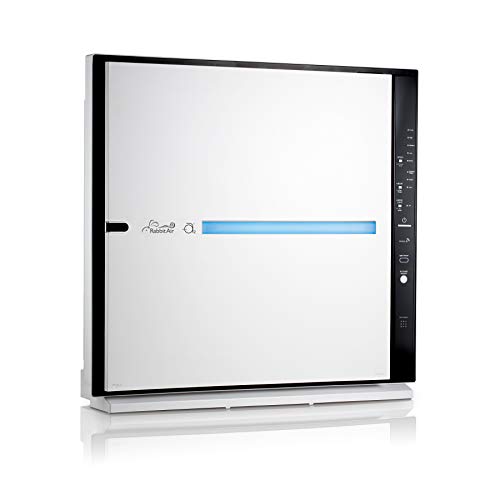
Rabbit Air MinusA2 SPA-780N — Best for pet bedrooms
The SPA-780N is the pet-allergy configuration of Rabbit Air’s MinusA2, fitted with WiFi and a filter set specified for households where the allergen has whiskers. Its defining move for this category is altitude: the slim panel can mount on the wall, out of the traffic pattern of paws and tails, drawing air at the height where dander spends its airborne hours and returning it across the bed’s stratum. In a bedroom shared with animals, floor space is contested territory, and a purifier that declines to compete for it has solved half the placement problem before filtration even begins.
Operation is famously quiet — Rabbit Air built its reputation on machines that can share a room with sleepers and, not incidentally, with noise-sensitive animals — and the layered filtration pairs its HEPA stage with stages aimed at the odor that accompanies pet life. The price is premium, the warranty long, and the design closer to wall art than to appliance, which in a bedroom is a genuine quality: equipment that looks intentional gets maintained, while equipment that looks like a compromise gets unplugged during a tidy.
For the household whose cat has won the bedroom argument, this is the machine that makes the treaty workable: continuous, quiet, out from underfoot, and specified for exactly the particle your cohabitant produces. Sentiment, engineered.
There is a final, underrated argument for the wall: cleaning. A floor unit in a pet room accumulates a skirt of hair around its base that someone must vacuum; the mounted MinusA2 lets the floor be cleaned in one pass, pet hair and all, with nothing to work around. In a house where the cleaning is the campaign, equipment that makes cleaning easier is campaign equipment.
- Filtration: layered system with HEPA, pet-allergy configuration
- Extras: WiFi enabled, wall-mountable, ultra-quiet running
- Form factor: slim panel, floor or wall placement
- Tier: premium purchase, long warranty
Strengths
- Pet-specific configuration in a proven quiet design
- Wall mounting removes it from animal traffic entirely
- Bedroom-appropriate looks encourage permanent placement
Trade-offs
- Premium pricing on unit and filter sets
- Mounting needs a drill; renters may stand it instead
- Coverage is bedroom-scale, not whole-floor
Best for: Pet-owning allergy households furnishing a permanent bedroom solution. Not suited for: Budget-led buys or very large rooms.

Levoit Core 300 — Best all-round value
The Core 300 is the machine a generation of pet owners bought first, and its listing tells you why: it names pets, hair, and allergens in its first breath, carries an AHAM-verified rating for rooms up to about 1,073 square feet, and runs a sleep mode quiet enough to share a bedroom with both a sleeper and a cat. Its 3-in-1 filter wraps pre-filter, HEPA, and carbon into one cartridge, and the pre-filter layer — the pet household’s front line — can be vacuumed between changes to keep the hair load from strangling the stages behind it.
Value here is not a euphemism for cheapness; it is a statement about the whole arrangement. The machine sits in the budget-to-mid tier, its filters are priced as consumables and stocked everywhere, and its size — a compact cylinder — fits the nightstand-adjacent corner that pet bedrooms actually have free. For a first purifier in a pet-allergy home, it lets the household learn its own patterns (how fast the pre-filter loads, which speed the night tolerates) on a machine that punishes experimentation very little.
Its limits are the familiar cartridge ones: carbon capacity is modest against a multi-pet household’s odor, and heavy-shedding homes will cycle filters faster than the box implies. But as the default answer to “we have a dog and a sneeze, where do we start,” it has earned its ubiquity honestly.
It also has the virtue of being explainable in one sentence to a skeptical partner or a visiting parent: it catches the hair and the dander, it is quiet, and the filter costs are known. Campaigns survive on equipment nobody has to be persuaded about twice, and the Core 300 is the easiest persuasion on this page.
- Filtration: 3-in-1 cartridge, HEPA with pre-filter layer
- Coverage: rated up to about 1,073 sq ft
- Extras: quiet sleep mode, compact cylinder design
- Verification: AHAM Verifide rating
Strengths
- Pet-focused design at an accessible tier
- Filters widely stocked and reasonably priced
- Quiet enough for the bedroom it will live in
Trade-offs
- Modest carbon for multi-pet odor
- Heavy shedders shorten filter intervals
- No app or sensor-driven auto mode
Best for: First purifier for a pet-allergy bedroom on a sane budget. Not suited for: Large multi-pet homes as the only machine.
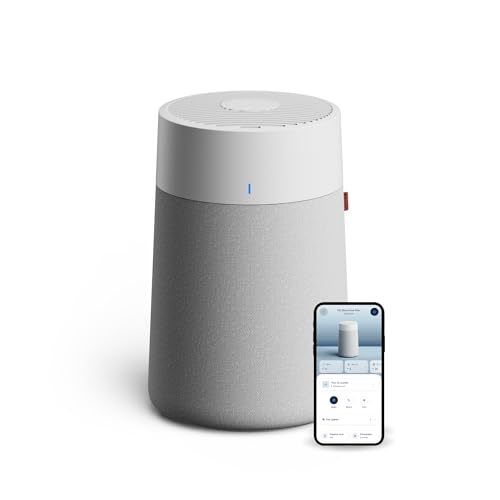
Blueair Blue Pure 511i Max — Best for light sleepers with pets
A pet bedroom has two noise critics: the person and the animal, and the animal votes with its feet — a machine that startles a cat at 3 a.m. will be investigated, batted, and ultimately campaigned against. The 511i Max’s night mode, rated around 19 decibels, passes both critics. Its HEPASilent filtration moves a generous amount of air for that hush, with coverage rated for bedrooms up to about 1,138 square feet, and its fabric pre-filter — washable, and available in colors — catches the visible hair load before the main stage ever sees it.
The 360-degree intake suits the pet bedroom’s floor plan, where the ideal corner is usually occupied by a bed, a basket, or a sunbathing dog: the machine draws from every side and forgives imperfect placement. App control and auto mode let it respond to the day’s events — the post-walk shake, the litter-box excavation — without human choreography.
The standing caveat applies: HEPASilent is a tested hybrid technology rather than a conventional true HEPA cartridge, and households committed to purely mechanical filtration should choose accordingly. For the light sleeper whose alternative is no machine at all, its quiet is not a compromise but the entire point.
Pets, for their part, tend to adopt it: the gentle warmth and the soft air movement of a running unit attract cats the way sunbeams do, and more than one owner has found the animal asleep against the intake, pre-filtering the room with its own coat. The washable fabric cover makes that arrangement hygienic rather than horrifying — one more small design decision that suggests the makers have lived with animals.
- Filtration: HEPASilent with washable fabric pre-filter
- Coverage: bedrooms up to about 1,138 sq ft
- Extras: WiFi app, auto mode, very low night noise
- Intake: 360-degree, placement-forgiving
Strengths
- Quietest night running for a pet-shared room
- Fabric pre-filter handles hair and washes clean
- Forgiving placement in crowded bedrooms
Trade-offs
- Not a traditional true HEPA cartridge design
- Brand-specific replacement filters
- Light carbon stage for pet odor
Best for: Light sleepers sharing a bedroom with a pet. Not suited for: Mechanical-filtration purists or heavy odor situations.

Coway Airmega 50 — Best small-bedroom pick
The Airmega 50 is Coway’s compact answer, sized for bedrooms up to about 500 square feet and specified — in its maker’s own listing language — for smoke, allergies, and pet dander. It carries the family traits into a smaller cabinet: an air-quality monitor with auto mode, a filter indicator, and a night light gentle enough for a child’s room or a hallway-adjacent spare bed. For the small second bedroom that hosts both a teenager and a cat, it is the machine that fits the life as lived.
Its scale is its honesty. It will not pretend to a whole flat; it will hold a small bedroom’s air down against a resident pet with the same filtration logic its larger siblings use, at a purchase and filter tier a household can extend to a second room without drama. The deodorization stage minds the litter-adjacent notes that small rooms concentrate.
Singles in studio-adjacent arrangements and grandparents furnishing a pet-friendly guest room are its natural constituency: real Coway filtration, sized and priced for the room that actually needs it, with an indicator light that tells a visiting owner at a glance that the room is being looked after.
Its night light deserves a defense: in a child’s room shared with a hamster-adjacent menagerie, or a spare room where a visiting grandparent navigates unfamiliar geography at night, a gentle glow from the machine that is already there replaces a separate lamp — and the auto mode means the room’s air is being tended while its occupants sleep, dream, and are supervised by the cat.
- Filtration: HEPA with deodorization filter
- Coverage: bedrooms up to about 500 sq ft
- Extras: AQI monitor, auto mode, night light, filter indicator
- Warranty: two-year coverage
Strengths
- Compact size for genuinely small bedrooms
- Sensor and auto mode at a modest tier
- Dander named in its design brief
Trade-offs
- Small-room coverage only
- Less headroom for large shedding dogs
- Night light may not suit every sleeper
Best for: Small bedrooms, children’s rooms, and guest rooms with pets. Not suited for: Main bedrooms of large homes or multi-pet living rooms.
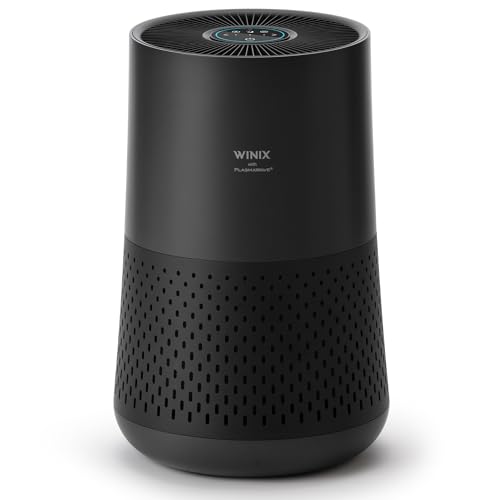
Winix A230 — Best tower for pet rooms
The A230 thinks vertically, which in a pet’s bedroom is a defensive virtue: a slim tower occupies the wall-adjacent strip that dogs circle and cats ignore, rather than the open floor where a cylinder becomes a rubbing post. Winix rates it for bedrooms up to about 1,110 square feet in an hour, with true HEPA, a carbon filter, an air-quality monitor, and an auto mode that reacts when the evening’s pet activity stirs the room.
The filtration pairing suits the brief directly — HEPA for the dander itself, carbon for the ambient pet notes — and the auto mode’s responsiveness matters in a room whose air quality is event-driven by an animal’s schedule rather than by the weather. Winix’s PlasmaWave is present in this family of machines and, consistent with the brand’s designs, the household that prefers purely mechanical cleaning should check its controls; the HEPA and carbon stages carry the pet brief regardless.
It is the pick for the bedroom where floor geometry is the binding constraint — the room with the crate, the basket, the water bowl, and no honest corner left. Standing slim against the wall, it does the room’s air without joining the room’s obstacle course.
Height helps the sensor, too: a tower reads the room’s air nearer the breathing zone than a squat cylinder sampling the floor’s layer, so its auto mode reacts to what the sleeper and the pet are actually generating between them. Small physics, real effect — the tower notices the 11 p.m. wrestling match on the bed and answers it before the room has finished stirring.
- Filtration: true HEPA with carbon filter
- Coverage: bedrooms up to about 1,110 sq ft per hour
- Extras: air-quality monitor, auto mode, tower design
- Form factor: slim vertical footprint
Strengths
- Tower shape survives pet-room floor traffic
- Responsive auto mode for event-driven air
- Generous bedroom coverage rating
Trade-offs
- Tall body needs a stable, out-of-path spot
- Carbon stage is mid-weight for odor
- Less design polish than the Rabbit Air
Best for: Crowded pet bedrooms where floor space is contested. Not suited for: Homes wanting a statement-piece appliance.

Medify MA-40 — Best second-room machine
Every pet-allergy campaign has two fronts, and the second is the room where the animals actually spend the day. The MA-40 is the sensible garrison for that front: true HEPA filtration, coverage rated around 1,793 square feet in an hour, and a plain, touch-controlled cabinet that can hold a living room’s background dander level down so the bedroom machine is not fighting the whole house’s output every night. Its listing names pets among its targets, and its no-nonsense design keeps the price in the middle tier.
What it lacks in sensors it repays in simplicity: set a speed, let it run, change the filter when the indicator says so. In a living room — a space with television noise, conversation, and a dog asleep on the rug — the absence of a delicate auto ecosystem is barely felt, while the airflow is felt constantly in the room’s freshness and in how much less the bedroom machine has to do.
Households sequencing their purchases often start here by accident of logic: the living room machine improves every room a little, teaches the family the maintenance rhythm, and reveals whether the bedroom needs the premium treatment or the value one. Either way, it remains useful forever as the campaign’s second front.
It is also the machine least likely to be resented by the animals: a steady, unhurried presence in the room they own, asking nothing, startling no one, and lowering the background level that the whole household — human and otherwise — breathes a little easier for. Campaigns need a workhorse that nobody argues with, and in the living room that is this.
- Filtration: true HEPA filter
- Coverage: rated around 1,793 sq ft per hour
- Extras: timer, filter indicator, touch controls
- Tier: mid-priced machine and filters
Strengths
- Living-room coverage at a mid-tier price
- Simple, robust operation for a busy room
- Reduces the load the bedroom machine faces
Trade-offs
- No sensor-driven auto mode
- Utilitarian appearance
- Basic carbon stage for strong pet odor
Best for: Living rooms in pet-allergy homes and phased purchases. Not suited for: Anyone wanting a fully self-managing bedroom machine.
How Do You Introduce a Purifier to a Nervous Pet?
The machine’s first week is a diplomatic mission. Place it in the room switched off for a day, so it becomes furniture before it becomes a sound; let the animal investigate, sniff, and file it under “boring.” Start it on its lowest speed during a calm, treat-adjacent hour — not during fireworks, not during the vacuum’s visit — and let the steady note become part of the room’s background over several days before using higher speeds. Most animals habituate completely within the week, because a purifier’s hum is the least interesting sound a house produces.
Humans habituate on the same schedule, incidentally: the partner who swore the fan would keep them awake is, by the second week, sleeping through its absence’s silence with more difficulty than they ever had with its presence. Plan the trial with that curve in mind before anyone issues a verdict at day two.
The exceptions are informative. A cat that remains fixated on a floor unit — batting at vents, sitting in the outlet stream like a tiny lion in a shampoo advertisement — is telling you the placement invites play; move the machine, choose a tower, or take the hint the Rabbit Air offers and put the whole question on the wall. A dog that startles at an auto mode’s sudden surge argues for a steady manual speed at night. The household that reads these reviews and adjusts ends up with a machine the pet ignores — which, in this category, is the highest praise available.
Safety, briefly and seriously: route the cord where it cannot be chewed or tripped over, keep the machine stable against an enthusiastic lean, and treat a pet that chews cables as a household emergency unrelated to air quality — cord protectors and placement solve it, but solve it first. A purifier is among the safest appliances in a pet home precisely because it has no heat, no blades within reach, and no interesting moving parts; keep it that way.
How Does Each Pick Rank Against the Other Five?
| Model | Filtration | Coverage guide | Standout trait |
|---|---|---|---|
| Rabbit Air MinusA2 SPA-780N | Layered HEPA, pet configuration | Bedroom scale | Wall-mount, pet-allergy spec |
| Levoit Core 300 | 3-in-1 HEPA cartridge | Up to ~1,073 sq ft | Value and ubiquity |
| Blueair Blue Pure 511i Max | HEPASilent | Up to ~1,138 sq ft | Quietest nights |
| Coway Airmega 50 | HEPA plus deodorization | Up to ~500 sq ft | Small-room fit |
| Winix A230 | True HEPA plus carbon | ~1,110 sq ft/hr | Slim tower defense |
| Medify MA-40 | True HEPA | ~1,793 sq ft/hr | Second-front workhorse |
How Do You Know the Truce Is Working?
The evidence arrives in household units rather than laboratory ones. The clearest is the morning report: the person who used to wake with the day already narrowed begins, over the first fortnight of continuous running, to wake unremarkably — and unremarkable mornings, in this household type, are a headline. The second is the laundry’s testimony: bedding that comes off the bed after a week carries visibly less hair embedded in the weave when the machine has been holding the air, because less was airborne to settle. The third is the pre-filter itself, whose loading slows across the first months as the room’s reservoirs are drained by the washing rhythm — the machine’s own intake keeping a diary of the campaign.
A fourth witness is the vacuum cleaner, of all things: households running the full campaign report its bag or bin filling more slowly across a season, because the purifier is retiring airborne dust that would otherwise have settled to be vacuumed later. The house’s total dust does not vanish — it is intercepted earlier, in the filter, where it stops circulating through everyone’s breathing on its way to the floor.
Calibrate expectations by season and by event. A new kitten, a visiting dog, a shedding month — each will test the system and briefly win, and the correct response is a temporary escalation of the routine rather than a verdict on it. The truce is working if the household’s baseline keeps descending across those tests: each spike lower than the last, each recovery faster. That trend, felt across a year, is what the family actually bought — not a sterile room, but a home whose air has stopped being the price of loving an animal.
What Does a Year of Pet-Duty Filtration Actually Cost?
Budget for the campaign as a branch of pet ownership, alongside food and vet visits, and it stops feeling like an appliance expense at all. The machine itself divides this list into three tiers — the Levoit and Coway at the accessible end, the Winix and Medify in the middle, the Rabbit Air in the premium tier — but the year’s rhythm is set by filters. A pet household should expect the main filter to come due at the shorter end of whatever interval the maker quotes, and should treat the pre-filter as effectively free maintenance: minutes with a vacuum, repaid in main-filter life every single time.
Electricity is the least interesting line: these machines live on low and auto speeds, and a year of nights costs less than the pet’s treats. The cost that actually varies is the cost of neglect — the cartridge replaced in a panic at full price during shedding season, the machine retired early because its pre-filter was never cleaned and its motor spent two years straining. Households that put filter dates on the same calendar as the pet’s vaccinations find the whole subject becomes boring, and boring is the goal: the truce should run on rails.
There is one more economy worth practicing: buy the filter when the household buys the machine, and store the spare where the pet cannot supervise it. A campaign with a spare on the shelf never has a gap week, and gap weeks — the machine off or choked while a delivery wanders — are when reservoirs quietly refill and the month’s progress is spent.
How Do You Host Visitors Who React More Strongly Than the Family Does?
Every pet-allergy household eventually hosts someone whose sensitivity outranks its own — the grandparent, the new partner, the friend whose messages arrive with caveats. The campaign’s guest protocol is simple and kind: the guest room’s machine starts a full day before arrival, its bedding is laundered fresh (stored guest bedding absorbs the house’s background faithfully), the pet is introduced to the arrangement that the guest room is off-duty for the visit, and the door stays closed so the room’s cleaned air is not continuously traded with the hall’s.
None of this requires apology or theater; it is the same hospitality as stocking a preferred tea. And it cuts both ways as information: if a guest sleeps comfortably in the prepared room, the household has proof its system works at a sensitivity above its own — a useful calibration when deciding whether the next purchase is a second machine or a better first one. If the guest still struggles, that too is information, of the kind that belongs in a conversation between the guest and their own clinician, with the household’s role being honesty about the home’s animal reality rather than promises no appliance can underwrite.
The guest protocol has a quiet side effect on the household itself: preparing a room properly — machine early, bedding fresh, door disciplined — demonstrates what the home’s own bedrooms could feel like at full protocol. More than one family’s permanent routine began as a performance for a visitor and stayed because the performers liked the result.
How Do You Build the Rest of the Bedroom Truce?
The machine holds the air; the household holds everything else. Begin with the pet’s own textiles, which are reservoirs with sentimental value: the dog’s bed and the cat’s favorite blanket go into the wash on the same rhythm as the human bedding, and spares rotate so the rhythm survives laundry day. The human bed gets the allergy standard — encasements where the household uses them, sheets washed regularly and hot, and a washable throw stationed where the pet actually lands, so the animal’s chosen spot is the room’s most-laundered square meter rather than its least.
Then defend the pillow specifically, because it is the point of closest contact for eight hours. A washable pillow protector under the case, the case itself changed more often than the sheets, and — for the sentimental arrangement — a designated pet cushion at the bed’s foot that gives the animal a sanctioned, launderable alternative to the pillow’s corner. Animals accept sanctioned alternatives more readily than prohibitions; the cushion becomes the favorite spot within a fortnight, and the pillow returns to its original owner.
Grooming is filtration performed at the source: a brushed dog carries less loose hair into the room’s air, and a pet wiped down after a dusty garden session imports less of the outdoors. Vacuum the bedroom with the purifier running high and give the machine an hour afterward to harvest what the vacuum launched — then leave the room in peace. Finally, keep the litter tray, where one exists, out of the bedroom’s air circuit entirely if the home allows it; some sources are simply easier to exile than to filter.
Add the entryway to the campaign map. The hall where the dog is towelled after wet walks, where the cat’s carrier lives, where shoes and leads accumulate — that small zone concentrates the household’s imports. A washable mat, a hook system that keeps pet gear off the floor’s dust, and the occasional pass of the living-room machine’s attention keep the bedroom’s border cheaper to defend. Truces, like borders, are won at the crossings.
Which Mistakes Do Pet-Allergy Households Make?
The first is arithmetic denial: buying a small machine for a room with a large, continuous, four-legged source, then concluding that purifiers do not work. Size for the source, not the room’s bare dimensions. The second is pre-filter neglect — in a shedding household the first stage can felt over in weeks, after which the expensive stages behind it are filtering a trickle. Vacuum it on the bedding rhythm. Third is the part-time treaty: running the machine on good nights and off on bad ones, exactly backwards from the logic of a source that never takes a night off.
A related misjudgment is placing the machine in the hall as a compromise between rooms. A hallway purifier serves the hallway beautifully and both bedrooms faintly; dander campaigns are won room by room, behind doors that close. Compromise placements feel fair and perform poorly — choose the room, defend it properly, and extend the campaign when the budget allows.
Fourth is expecting the purifier to settle the bedroom-door question by itself; it softens either answer but cannot make them equal, and households do better deciding the door policy deliberately — and kindly — than drifting into a nightly renegotiation. Fifth is forgetting the reservoirs: a machine can hold the air beautifully while a three-year-old dog bed in the corner re-seeds the room faster than any filter can retire it. Wash the reservoirs or replace them; the machine will handle the rest.
Sixth is buying the machine as a gesture in an argument — the appliance as a peace offering in the household’s long negotiation about the animal. Gestures get unplugged. The campaigns that last are the ones both parties helped design: the door policy agreed, the laundry rhythm shared, the machine chosen together. The pet, consulted on none of it, adapts to all of it within the week.
Final Recommendation
For the bedroom where the treaty matters most, the Rabbit Air MinusA2 SPA-780N is the considered choice — pet-specified, quiet, and out of the animals’ way — with the Levoit Core 300 as the value answer that has started a thousand successful campaigns. Light sleepers should look at the Blueair 511i Max, small rooms at the Coway Airmega 50, crowded floors at the Winix A230, and the campaign’s second front at the Medify MA-40. Whichever you choose, run it without pause, wash the reservoirs, keep the pre-filter honest — and let the cat keep the pillow’s corner cushion, in a room whose cleaner air no longer makes the whole arrangement a 2 a.m. debate.
Frequently Asked Questions
Can a purifier let someone with a pet allergy keep the pet in the bedroom?
It can make the arrangement substantially more comfortable by holding the room’s airborne dander level down, especially paired with bedding discipline. Whether the arrangement is wise for a particular person is a health question, and it belongs with their clinician — reactions vary widely, and no appliance guide can grade them. What we can say is that the households who make it work treat the machine as one part of a system, not as a permission slip. They also revisit the question honestly when life itself changes — a new baby, a second pet, a change in someone’s health — because a truce is a living agreement, not a verdict carved in stone at the moment of purchase.
How often will the pre-filter need attention with a shedding pet?
More often than the manual’s generic schedule suggests: check it every few weeks during heavy shedding and vacuum or wash it whenever it wears a visible coat. The habit takes minutes and is the difference between a machine performing as rated and one quietly suffocating behind its own success at catching hair. Make it part of an existing weekly ritual — the day the bedding is stripped is the natural trigger — and it will happen on schedule without a single reminder note stuck on the fridge.
Does pet size change which machine I should buy?
Mostly through shedding volume and room traffic rather than the animal’s own dimensions. A large double-coated dog produces a pre-filter and reservoir load several times a small short-haired cat’s, which argues for the more generous coverage and easier maintenance on this list. The dander particles themselves are similar; it is the supply rate that scales. Two animals roughly double the supply again, which is why multi-pet households should read every single coverage figure in this guide with a skeptic’s squint and size up at least a class.
Where should the purifier sit relative to the pet’s bed?
In the very same room, but not beside the pet’s bed: you want the machine drawing the room’s general air, not concentrating its work on the source’s immediate cloud while the human bed sits in untreated air. A few feet of separation, with the machine placed nearer the people’s side of the room, serves the sleeper best. If the animal insists on sleeping against the unit — some do, for the warmth — accept the arrangement and simply clean the pre-filter more often; the campaign bends around the pet’s own preferences or it does not bend at all.
Will a purifier remove pet odor as well as dander?
Partly, and increasingly with the better machines. Dander and hair are particles and are captured well; odor is a gas and depends on the carbon stage, which in most bedroom machines is modest. The Rabbit Air’s layered configuration and the Winix’s carbon give the best odor account here, but the decisive odor tools remain laundry, litter discipline, and ventilation when the weather allows. Households often find the odor improves more than the specs predict, simply because the hair and dander that carry much of it are being removed continuously.
Related Guides
The pet household’s reading continues in three directions: the technology comparison in Best Air Purifiers for Allergies and Sinus: Ionic vs HEPA for readers weighing filtration types, Best Air Purifiers for 800 Square Feet for larger pet-shared spaces, and Best Air Purifiers by CADR Rating for the numbers behind the coverage claims used throughout this guide.


