What's inside
- Key Takeaways
- Quick Picks
- How We Chose These Picks
- The Best 18 Cubic Feet Refrigerators, Reviewed One by One
- How Do the Six Compare Side by Side?
- Why Does the Top-Freezer Layout Refuse to Die?
- How Do You Measure and Plan for an 18 Cu Ft Replacement?
- How Should a Family Organise 18 Cubic Feet?
- What Should You Check in the First Week?
- How Does an 18 Cu Ft Fridge Serve Each Season of Family Life?
- What About the Garage and Second-Fridge Question?
- How Do Shelves, Bins and Crisper Drawers Change the Week?
- What Noise and Manners Should You Expect?
- How Do You Keep an 18 Cu Ft Fridge Running Sweetly for a Decade?
- What Should Renters and Landlords Choose?
- How Does This Size Handle the Holidays?
- How Do You Choose Between Black, White and Stainless?
- What Happens When the Power Goes Out?
- How Should You Load a New Fridge on Day One?
- What Does the Freezer Half of an 18 Cu Ft Machine Hold?
- How Do These Machines Suit a Cottage Kitchen?
- What Warranty and Service Sense Applies Here?
- How Will You Know the Classic Size Was Right?
- How Do You Read an Energy Label Without Fooling Yourself?
- What Should Tall and Short Cooks Each Know?
- How Does a Simple Fridge Support Serious Cooking?
- What Is the Kindest Way to Retire the Old Machine?
- How Do You Budget Honestly for This Class?
- How Should You Think About Ice in This Class?
- What Difference Does LED Lighting Really Make?
- How Do You Move an 18 Cu Ft Fridge Between Homes?
- Why Do These Machines Keep Winning the Value Argument?
- How Does the Class Serve a Home Baker or Preserver?
- What Should You Do in the First Month to Settle the Machine In?
- How Does This Class Fit a Growing Family’s Budget Over Time?
- What Is the One Accessory Worth Buying?
- What Are the Most Common Mistakes When Buying an 18 Cu Ft Refrigerator?
- Final Recommendation
- Frequently Asked Questions
- Related Guides
As an Amazon Associate I earn from qualifying purchases. This post may contain affiliate links at no extra cost to you.
cottageverdict.com is reader-supported. When you buy through links on our site, we may earn an affiliate commission.
Some refrigerator sizes become classics because they fit the most lives, and the best 18 cubic feet refrigerators occupy exactly that ground: big enough for a family’s week, small enough for ordinary kitchens, and priced by the market’s fiercest competition. Every model in this guide is a top-freezer design — the oldest layout in refrigeration, and still the efficiency and value benchmark — with true capacities from 18 to 18.2 cu ft and, where the listings state it, a 30-inch width that slips into the standard alcove most homes already have.
You can buy all six through Amazon, and the pick names in the Quick Picks table and the detailed reviews link to the listing so you can check price on Amazon and confirm the finish, the door swing options and the delivery arrangements. At this size a refrigerator is a manageable delivery, but the route through the house still deserves a tape measure before the truck is booked.
Two of the six are the same Kenmore in black and in white — we review them separately because finish is a real decision in a real kitchen, and we say plainly that the machine beneath is shared. The others bring their own claims: Frigidaire’s category-defining plainness, Amana’s stainless step-up, Verona’s reversible doors and gallon storage, and Summit’s ENERGY STAR-certified efficiency in white. This is the class where small differences in shelving and bins decide daily satisfaction, so the reviews below sweat them.
Key Takeaways
- All six are top-freezer models between 18 and 18.2 cu ft — the classic family size in its most efficient layout.
- The Kenmore appears twice, in black and in white; one machine in two finishes — 18.1 cu ft and a 30-inch width — reviewed honestly as such.
- Kenmore, Verona and Summit state a 30-inch width; that standard alcove fit is the class’s quiet superpower.
- Adjustable shelving, crisper drawers and gallon door bins on the Kenmore and Verona models are the features family life actually touches.
- Top-freezer designs remain the efficiency leaders — the Summit and Kenmore models carry ENERGY STAR certification in their listings.
- Reversible doors (Verona) and LED lighting throughout make these simple machines easier to live with than their ancestors.
Quick Picks
| Pick | Badge | Why it earns its place |
|---|---|---|
| Frigidaire 18 Cu Ft Top Freezer Refrigerator | Best Classic Benchmark | The straightforward 18 cu ft top-freezer against which the class is measured — no theatre, just the format done plainly. |
| Amana 18.2 Cu Ft Top Freezer Refrigerator ART318FFDS | Best Stainless Step-Up | The largest capacity here at 18.2 cu ft in stainless steel, for kitchens that want the classic layout with a smarter face. |
| Kenmore 18.1 Cu Ft 30 Inch Top Mount Refrigerator Black | Best Family Features — Black | Adjustable shelving, crispers, gallon bins, LED light and ENERGY STAR certification in a black 30-inch cabinet. |
| Kenmore 18.1 Cu Ft 30 Inch Top Mount Refrigerator White | Best Family Features — White | The identical Kenmore machine in white, the finish that brightens small kitchens and matches classic appliance suites. |
| Verona 30 Inch Top Freezer Refrigerator 18.1 Cu Ft | Best Flexible Doors | Reversible doors, recessed handle and gallon door storage in a black cabinet of 18.1 cu ft and 30-inch width. |
| Summit 30 Inch Top Mount Refrigerator 18 Cu Ft | Best Efficiency Pick | Summit’s 18 cu ft, 30-inch white top-mount with ENERGY STAR certification — the careful-running choice. |
How We Chose These Picks
We held the class to its name: every pick is a genuine 18 to 18.2 cu ft, verified against its own listing, in the top-freezer layout that defines this size in the market. No French door ringers, no 16 cu ft models rounded up, no 20 cu ft models rounded down. Within that honest frame we compared the things that separate near-identical boxes: shelving that adjusts, bins that hold gallons, crispers that manage humidity, lighting, certification, and the door flexibility that decides whether a refrigerator fits a kitchen’s handedness.
We also respected the class’s purpose. These are the refrigerators of first homes, family kitchens, rentals, garages-by-extension and in-law suites — machines bought to work for a decade without drama. Service networks and parts sense mattered, as did the plain question of whether a model’s listing tells you everything you need: width, swing, and what is in the box.
The Best 18 Cubic Feet Refrigerators, Reviewed One by One

Frigidaire 18 Cu Ft Top Freezer Refrigerator — Best Classic Benchmark
Frigidaire more or less invented this category’s expectations, and this top-freezer, at 18 cu ft, is the benchmark in its plainest form: a family-sized fresh compartment under a honest freezer, built by the brand whose name became a synonym for the appliance itself. There is a confidence in that plainness. Nothing here chases a trend; everything here is the format that landlords, families and first-home buyers have relied on for generations, refined rather than reinvented.
Daily life in a top-freezer is a rhythm of small kindnesses: the freezer at eye level for the things you grab frozen, the fresh food below in a wide, simple space that takes the weekly shop without choreography. At exactly 18 cu ft it is the class’s reference point — the machine to understand first, against which the extra tenths and features of the others can be priced with a clear head.
Buyers who want the stainless face should look at the Amana next; buyers who want features should study the Kenmores. Buyers who want the classic itself, from the classic maker, are home already.
- Total capacity: 18 cu ft
- Layout: top freezer
- Format: full-size family refrigerator
- Maker: Frigidaire
- Width: confirm the stated figure on the listing against your alcove
Strengths
- The benchmark machine from the benchmark brand
- Simple layout that every household member understands instantly
- Top-freezer efficiency and reliability pedigree
Trade-offs
- Plain specification beside the feature-richer Kenmore models
- Fresh food sits low; tall users bend for the crisper
- Exactly 18.0 — the class’s floor, not its ceiling
Best for: first homes, rentals and anyone who wants the proven classic without extras. Not suited for: shoppers who want stainless or feature-led storage.
The full specification and today’s pricing for the Frigidaire 18 are on its listing — check price on Amazon and note its stated dimensions for your alcove.

Amana 18.2 Cu Ft Top Freezer Refrigerator ART318FFDS — Best Stainless Step-Up
The Amana takes the class’s largest capacity — 18.2 cu ft, a small but real margin — and wraps it in stainless steel, which in this class is a genuine step up rather than a default. Kitchens that have moved their other appliances to stainless will find the ART318FFDS completes the room in a way the white and black models cannot, while the top-freezer layout keeps the running costs and the purchase honest.
Amana’s heritage is the value end of a major American appliance family, and the machine reflects it: the fundamentals attended to, the finish elevated, the gimmicks left to other badges. Two tenths of a cubic foot will not change a weekly shop, but across a decade the stainless face will be looked at ten thousand times, and that is the upgrade actually being bought.
Pair it with the class’s other virtues — eye-level freezer, simple shelving, a footprint in the standard family — and the Amana is the pick for the household that wants the classic layout to look like a choice rather than a compromise.
- Total capacity: 18.2 cu ft — largest in this guide
- Layout: top freezer
- Finish: stainless steel
- Model: ART318FFDS
- Maker: Amana
Strengths
- Stainless finish lifts the classic layout into a modern kitchen
- Class-leading capacity, honestly if narrowly
- Major-maker parts and service behind it
Trade-offs
- Stainless shows fingerprints more than white or black
- The capacity margin over rivals is small
- Feature list stays classic rather than rich
Best for: stainless kitchens that want top-freezer economy without the economy look. Not suited for: buyers who prioritise bins and shelving features over finish.
For current pricing and dimensions on the Amana ART318FFDS, check price on Amazon before deciding between finish and features.
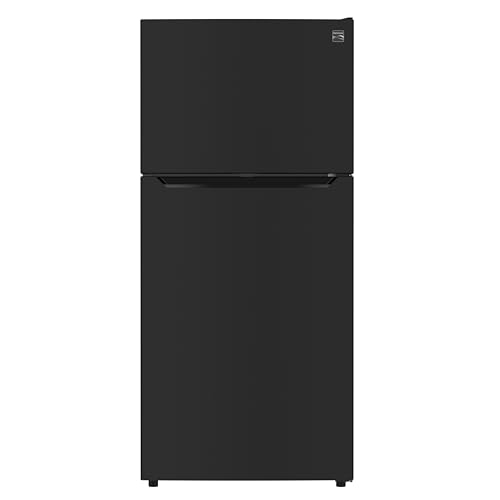
Kenmore 18.1 Cu Ft 30 Inch Top Mount Refrigerator Black — Best Family Features — Black
This is where the class grows its family features. The Kenmore — 18.1 cu ft, in a width its listing states as 30 inches — lists adjustable shelving, crisper drawers, gallon door bins, LED lighting and ENERGY STAR certification, which together describe the daily experience better than capacity does: shelves that move for the tall pot, bins that take milk gallons off the main shelves, crispers that keep the salad honest, light that shows all of it, and certification that the running is efficient.
The black finish is the modern choice of the pair: it anchors light cabinetry, hides the evidence of family traffic better than white, and reads deliberately rather than default-y in a renovated kitchen. The machine beneath is identical to the white model reviewed next, and we will not invent differences — your decision here is about your room, not about refrigeration.
For a family fitting a standard 30-inch alcove and wanting the fullest feature set in the class, this black Kenmore and its white twin are the shortlist’s centre.
- Total capacity: 18.1 cu ft
- Width: 30 inches, stated
- Layout: top mount (top freezer)
- Storage: adjustable shelving, crisper drawers, gallon door bins
- Lighting and efficiency: LED lighting, ENERGY STAR certified
- Finish: black
Strengths
- The class’s richest everyday feature set
- Gallon bins free the main shelves for food, not jugs
- Certified efficiency in a standard 30-inch fit
Trade-offs
- Black shows dust in bright kitchens
- Identical machine to the white model — finish is the only choice
- Top-freezer layout keeps fresh food low, as always
Best for: families in 30-inch alcoves who want features and a modern black finish. Not suited for: anyone hoping the colour changes the machine — it does not, and that is fine.
For current pricing and the bin layout on this black Kenmore, check price on Amazon and compare it directly with its white twin below.

Kenmore 18.1 Cu Ft 30 Inch Top Mount Refrigerator White — Best Family Features — White
Everything said about the black Kenmore applies here without amendment — the same capacity and width, the same adjustable shelving, crisper drawers, gallon door bins, LED lighting, ENERGY STAR certification — because this is the same refrigerator wearing white. We review it separately for one honest reason: in a small or north-facing kitchen, white is not the absence of a decision but the brightest one available, lifting the room and matching the classic appliance suites that most homes actually own.
White also forgives. It hides the pale dust of a country kitchen, shrugs off the small scuffs of family life, and never dates the way fashion finishes can. Rental landlords and cottage owners have chosen white for decades for exactly these reasons, and in this Kenmore they get the class’s best feature set wearing it.
Choose between the twins by standing in your kitchen at the hour you cook most and looking at the light. The refrigeration is settled; the room gets the vote.
- Total capacity: 18.1 cu ft
- Width: 30 inches, stated
- Layout: top mount (top freezer)
- Storage: adjustable shelving, crisper drawers, gallon door bins
- Lighting and efficiency: LED lighting, ENERGY STAR certified
- Finish: white
Strengths
- Full Kenmore feature set in the brightest finish
- Matches classic white appliance suites exactly
- Forgiving of dust, scuffs and changing fashions
Trade-offs
- White can read plain beside stainless neighbours
- Same machine as the black model — no feature difference to hide behind
- Shows dark spills and marks until wiped
Best for: bright kitchens, white suites, rentals and cottages wanting the class’s best features. Not suited for: a stainless-led kitchen design.
For current pricing and availability on this white Kenmore, check price on Amazon — and settle the finish question with the room, not the catalogue.

Verona 30 Inch Top Freezer Refrigerator 18.1 Cu Ft — Best Flexible Doors
The Verona’s headline is handedness: reversible doors on a 30-inch, 18.1 cu ft top-freezer in black, with a recessed handle, LED lighting, gallon door storage and an Energy Star rating in its listing. Reversibility sounds minor until a refrigerator meets a kitchen whose wall is on the wrong side — then it is the whole purchase. A door that opens toward the counter run saves a thousand steps a year; a door that opens against it taxes every single day.
The recessed handle continues the theme of fitting real rooms: nothing protrudes to catch hips in a narrow galley or to steal inches from a tight alcove’s swing. Gallon storage in the door keeps the milk where the layout wants it, and the black finish matches the Kenmore twin’s modern register while the door flexibility outpoints it.
Kitchens are rarely symmetrical, and the Verona is the pick that admits it. If your alcove’s handedness is awkward, this is your machine; if it is standard, the Kenmores’ bins and certification compete head-on.
- Total capacity: 18.1 cu ft
- Width: 30 inches, stated
- Layout: top freezer
- Doors: reversible, with recessed handle
- Storage and light: gallon door storage, LED lighting
- Finish: black (per the listing)
Strengths
- Reversible doors solve awkward kitchen handedness
- Recessed handle suits narrow spaces
- Gallon door storage plus LED light cover the daily basics
Trade-offs
- Door reversal is a one-time job that still needs doing carefully
- Feature set is practical rather than class-leading
- Black finish only, per the listing
Best for: kitchens whose layout demands a left-opening door, and narrow galleys. Not suited for: buyers who want a choice of finishes in this exact model.
For current pricing and the door-swing details on the Verona, check price on Amazon with your kitchen’s handedness in mind.

Summit 30 Inch Top Mount Refrigerator 18 Cu Ft — Best Efficiency Pick
Summit specialises in appliances for real-world spaces, and its FF18W entry here is a 30-inch, 18 cu ft top-mount in white carrying ENERGY STAR certification — the pick for households that count running costs as carefully as capacity. Summit’s catalogue serves apartments, cottages, medical and compact-living niches across the US, and that specialism shows in a machine sized exactly to the standard alcove without a wasted inch.
At exactly 18.0 cu ft it shares the class floor with the Frigidaire, and its case rests on efficiency and fit rather than features theatre. For a second home that runs the refrigerator through long empty weeks, for a landlord watching a property’s bills, for any household that simply prefers its appliances frugal, certified efficiency compounds quietly year after year.
White, standard-width, certified and sensibly made — the Summit is the class’s careful choice, and careful is a compliment in a machine bought for a decade.
- Total capacity: 18 cu ft
- Width: 30 inches, stated
- Layout: top mount (top freezer)
- Efficiency: ENERGY STAR certified
- Finish: white
- Model: FF18W
Strengths
- Certified efficiency for low running costs
- Exact standard-alcove sizing from a space specialist
- Simple white format suits rentals and second homes
Trade-offs
- Class-floor capacity at exactly 18.0
- Feature list is leaner than the Kenmore models’
- White only in this model
Best for: efficiency-first households, landlords and second homes in standard alcoves. Not suited for: feature hunters who want the richest bin and shelf set.
For current pricing and the efficiency details on the Summit FF18W, check price on Amazon before the shortlist closes.
How Do the Six Compare Side by Side?
| Pick | Capacity | Width | Finish | Standout trait |
|---|---|---|---|---|
| Frigidaire Top Freezer | 18 cu ft | Verify on listing | Classic | The benchmark |
| Amana ART318FFDS | 18.2 cu ft | Verify on listing | Stainless steel | Largest capacity, smartest face |
| Kenmore Top Mount Black | 18.1 cu ft | 30 in | Black | Gallon bins, adjustable shelves |
| Kenmore Top Mount White | 18.1 cu ft | 30 in | White | Same machine, brighter finish |
| Verona Top Freezer | 18.1 cubic feet | 30 in | Black | Reversible doors |
| Summit FF18W | 18 cu ft | 30 in | White | ENERGY STAR certified |
Six near-identical silhouettes, six different answers: benchmark, finish, features in two colours, door flexibility, and efficiency. In a class this close, the deciding facts are your alcove, your kitchen’s handedness and the finish your room asks for — in that order.
Why Does the Top-Freezer Layout Refuse to Die?
Because physics and price both vote for it. A freezer on top of a single, simple cabinet is the cheapest arrangement to build well and among the most efficient to run — cold air management is straightforward, the compressor works one honest box, and there are no drawers, dividers or second doors eating budget and volume. Every generation of refrigerator fashion declares it finished, and every generation of value shoppers quietly keeps it the best-selling layout in the land.
Its compromises are posture and glamour: fresh food lives low, and no top-freezer will ever be a design statement. Households at peace with those two facts get a decade of faithful service for the class’s most sensible money, which is why this entire guide — six for six — wears the layout proudly.
How Do You Measure and Plan for an 18 Cu Ft Replacement?
Start from the alcove you have, not the one you imagine: width at its narrowest, height under cabinets, depth to the counter’s edge. Most kitchens in this class present the standard opening that the 30-inch models here are built for, but older homes drift, and a quarter inch of drift is the difference between a slide-in and a stand-off. Measure the delivery route too — at 18 cu ft the machines are manageable, yet a tight stair turn has humbled many confident buyers.
Decide the door’s handedness while the tape is out. Which side is the counter run on? Which way will you carry shopping in? The Verona’s reversible doors forgive a late change of mind; the others ask you to order the swing your kitchen needs and live with it happily for years.
How Should a Family Organise 18 Cubic Feet?
Give the freezer a flat discipline — bags and boxes filed, a list on the door — and give the fresh side zones: dairy and deli on one shelf, raw proteins low and contained, produce in the crispers where the Kenmore and its classmates intend it, and the gallon bins carrying milk and juice so the shelves belong to food. Eighteen cubic feet is generous until it is chaotic; with zones, it stays generous.
The weekly rhythm that works: shop to the zones, cook from the front, and audit the back shelf every Sunday before the list is written. In a class famous for decade-long service, the households that love their machines are the ones whose Sunday audit takes four minutes because nothing is ever truly lost.
What Should You Check in the First Week?
Temperatures in both compartments with a cheap thermometer, once the machine has swallowed its first real shop. The door seal with the paper test at the corners. The levelling, so the door swings shut with a soft finality rather than a bounce. And the sounds — a top-freezer’s honest hum and fan are the baseline your ear should learn while everything is new and warranted.
Set the shelves once, deliberately, at the end of that week: the tall shelf where the tall things actually live, the bins loaded with the gallons they were promised. First-week arrangements become decade-long habits in this class, so make them good ones.
How Does an 18 Cu Ft Fridge Serve Each Season of Family Life?
For the couple in a first home, it is abundance — a freezer that takes the batch cooking, shelves that swallow the market run. For the young family, it becomes infrastructure: bottles, then packed lunches, then the teenage years when the door opens hourly and the gallon bins earn their keep weekly. For the empty-nesters who keep it, it becomes the calm archive of a smaller shop done well, with room for the grandchildren’s visits and the holiday bird.
Few appliances witness a household’s whole arc, and this size class is bought again and again across it — which is why the class’s virtues are reliability and familiarity rather than novelty. A machine your hands already know is a machine that never interrupts the life around it.
What About the Garage and Second-Fridge Question?
A top-freezer of this size is the classic second refrigerator — the one that graduates to the garage, utility room or cottage when the kitchen upgrades, and serves another decade there. Two cautions travel with that plan: garages swing in temperature beyond what domestic machines are designed for in harsh climates, and a second fridge’s running cost is real money across years. The certified efficiency of the Kenmore and Summit models softens the second point; the first is geography’s decision, not the machine’s.
As a primary second fridge bought on purpose — for drinks, preserves, the hunting season, the garden glut — this class is the sweet spot: full-size usefulness without full-size ceremony, in the standard width every utility room seems to have been built around.
How Do Shelves, Bins and Crisper Drawers Change the Week?
They are the difference between storage and a system. Adjustable shelves, as on the Kenmores, let the cabinet re-shape itself around the tall stockpot, the watermelon, the birthday cake — the week’s exceptions stop requiring a shelf-clearing negotiation. Gallon bins move the bulkiest daily items to the door, where they belong, and free the shelves for food that needs the cold’s best addresses. Crisper drawers with humidity control keep greens alive to the end of the week instead of the middle of it.
When you compare the six, compare these fittings first and the badges second. A family’s satisfaction with an 18 cu ft refrigerator is written almost entirely in its shelves and bins, because capacity — as this class proves — is nearly identical everywhere you look.
What Noise and Manners Should You Expect?
A modern top-freezer is a quiet citizen: a low compressor hum in cycles, a fan’s soft weather, the occasional ice-free creak of cold plastic settling. In an open-plan home you will know it is there at midnight; in a closed kitchen you will not. Placement governs most of it — level feet, clearance at the back, nothing stored on top to rattle in sympathy.
Manners matter too: a door that closes with a gentle push and seals without slamming teaches a household gentleness back. If a new machine’s door bounces, check the levelling before blaming the gasket; nine times in ten the floor is the critic and the fridge is the victim.
How Do You Keep an 18 Cu Ft Fridge Running Sweetly for a Decade?
Clean the coils yearly, wipe the gasket monthly, and keep the temperatures at ordinary food-safe settings rather than polar ones. Defrost discipline is mostly history in this frost-managed era, but the freezer still rewards a quarterly sort and a rule against mystery packages — date everything with a marker, and the archive stays honest. Keep the top of the cabinet clear; it is not a shelf, and the heat it sheds needs its road out.
Once a year, do the thermometer day: readings morning and evening in both compartments. A machine drifting from its settings announces itself there first, while the fix is still small. Decade-long service in this class is not luck; it is this page, practised.
What Should Renters and Landlords Choose?
The class is the rental market’s backbone for good reason: standard width, no plumbing, no exotic parts, and a layout every tenant already understands. Landlords should favour the certified, simply-featured models — the Summit and the Kenmore pair — and photograph the model plate into the property file at installation. Tenants inheriting one of these machines should inherit the manual’s cleaning page too; a gasket wiped monthly is a deposit protected.
For tenants buying their own for a long let, the Verona’s reversible doors are the renter’s friend, adapting to whichever handedness the kitchen presents and adapting again at the next home. Portability of fit is an underrated feature in a life stage defined by other people’s kitchens.
How Does This Size Handle the Holidays?
With planning, gracefully; without it, as a lesson. The bird rests in the fresh side’s lowest shelf, the freezer holds the advance cooking, and the door bins run a drinks service that keeps guests out of the cook’s compartments. Eighteen cubic feet is the size at which a household learns the overflow arts — the cool box for drinks, the neighbourly borrow, the menu edited by one dish — and most families find the lesson charming rather than limiting, once a year.
If your household hosts twenty every December and cooks for a week, buy the next class up and let this guide’s related links lead you there. If December is twelve people and a happy squeeze, the classic size has hosted that meal for generations.
How Do You Choose Between Black, White and Stainless?
By the room’s light and the household’s honesty. Stainless, the Amana’s offer, completes a modern appliance suite and shows every fingerprint as the price of its looks. Black — the Kenmore and the Verona — anchors pale cabinetry, forgives smudges and reads as a deliberate design act. White — the white Kenmore and the Summit — brightens dark kitchens, matches the classic suites most homes own, and never goes out of fashion because it was never in it.
There is no refrigeration difference hiding inside the colour question in this guide, and any salesperson who invents one should be smiled at and ignored. Stand in your kitchen at cooking hour, look at the wall the machine will fill, and let the room cast the only vote that matters.
What Happens When the Power Goes Out?
Hours of grace, if the doors stay shut — a full 18 cu ft cabinet is a cold reservoir, and its mass is the protection. Keep a freezer thermometer inside permanently so the first question after any outage — did it stay safe? — has a factual answer instead of a hopeful one. After long cuts, let the machine recover to temperature before restocking, and cook or discard by the thermometer’s testimony rather than by optimism.
Households with generators discover this class’s virtue quickly: a simple, single-compressor machine is easy to support in rotation with other loads, sipping where a giant cabinet gulps. In outage country, simple is a feature.
How Should You Load a New Fridge on Day One?
Let it reach temperature empty first — a few hours of patience — then load in the order of cold: freezer goods first, packed flat and dated; fresh food next, into the zones you planned; door bins last, with the gallons they were promised. Leave the vents visibly clear and the shelves a finger’s width from the back wall, because air circulation is the invisible shelf every item sits on.
Resist transferring the old machine’s chaos wholesale. Day one is the one chance to audit a household’s entire cold inventory with fresh eyes; the jars that fail the audit should meet the bin, not the new shelves. Start clean, and the system has a chance of staying clean.
What Does the Freezer Half of an 18 Cu Ft Machine Hold?
Roughly a season of a family’s frozen life: the batch cook’s dozen meals, the gardener’s beans and berries, the bulk-buyer’s meat, the baker’s butter and pastry, with room for the ice cream that justifies the whole arrangement to the younger household members. It will not hold a side of beef or a hunter’s autumn, and households with those ambitions should pair it with a chest freezer rather than blame it.
Its eye-level position is the layout’s gift — no kneeling, no digging, everything filed in view. Frozen food you can see is frozen food you use, and the freezer half of this class wastes less than grander drawers precisely because it cannot hide its contents.
How Do These Machines Suit a Cottage Kitchen?
Beautifully, because cottages run on the same standard alcoves and honest needs as the homes this class was designed for. A white Summit or Kenmore in a painted cottage kitchen looks like it grew there; the black models suit the renovated farmhouse; the Amana’s stainless serves the cottage that has gone quietly modern. Weekend duty suits the layout too — a top-freezer started on Friday morning is at temperature by lunch and undemanding all weekend.
Measure the cottage with extra care: old houses settle, floors slope, and doorways shrink by an inch of architrave at a time. The standard width is a promise about most kitchens, and the tape measure is how you learn whether yours is among them.
What Warranty and Service Sense Applies Here?
These are among the most serviced appliances in America — every town has technicians who know the top-freezer format intimately, and parts for the major makers here flow for years. That ubiquity is a genuine buying argument at this price-conscious end of the market: the exotic machine may photograph better, but the classic gets fixed on Tuesday. Register the purchase, photograph the model plate, and keep the receipt with the house papers.
Ask, before ordering, what the delivery includes — haul-away of the old machine is worth real money and more convenience — and whether door reversal, if you need it, is part of the service or a Saturday job of your own.
How Will You Know the Classic Size Was Right?
When the weekly shop disappears into it without a negotiation, when the freezer list stays short enough to hold in your head, and when the machine passes its first year without once being the subject of a household conversation. Refrigerators in this class succeed by invisibility. The Frigidaire benchmark, the Amana’s polish, the Kenmores’ features, the Verona’s flexibility, the Summit’s frugality — each is a different road to the same destination: a kitchen that simply works.
If instead the shop overflows weekly by October, the household has outgrown the classic, and the honest response is the next class up — not a second machine bought in frustration. Size honestly, and the 18 will repay you with the longest, quietest service in refrigeration.
How Do You Read an Energy Label Without Fooling Yourself?
The certification on the Kenmore and Summit listings means the machines were tested to a standard method and met a threshold — a real, comparable fact in a market of adjectives. Use it to compare within the class, not to predict your bill to the dollar: your climate, your door openings and your temperature settings move the real figure more than the label’s fine print does. A certified machine in a hot kitchen with the door opened forty times a day will still outrun an uncertified one kept cool and closed, because behaviour is the largest energy feature any refrigerator has.
The habits are free: sane settings, full-but-not-packed shelves, clean coils, and a gasket that seals. Buy the certified machine, then behave as if the label were watching.
What Should Tall and Short Cooks Each Know?
The top-freezer bargain is asymmetrical: the freezer sits at eye level, the fresh food below it. Tall cooks bend for the crisper drawer daily; shorter cooks reach the freezer’s back shelf on tiptoe. Neither is a defect, but both are facts to test with your own body before a decade of repetition. Households split between heights often find the compromise fair — each person has one easy compartment and one stretch — while a household of one tall cook with a bad back should honestly weigh the bottom-freezer classes.
Children, for completeness, can reach almost nothing in a top-freezer except the door bins, which some parents count as the layout’s finest safety feature.
How Does a Simple Fridge Support Serious Cooking?
By being predictable. A single, even cold throughout the fresh side, a freezer that freezes hard and fast, shelves that move when the menu demands a tall bowl or a resting joint — the cook’s arts need reliability more than they need a touchscreen. The adjustable shelving on the Kenmore pair is the serious cook’s feature in this guide, and the crispers that keep a week’s herbs alive are the quiet second.
Marinating, proofing, resting, chilling — the cold stages of good cooking all happen in a machine like this, at temperatures the cook verifies with a thermometer and trusts. That trust, earned over the first month, is worth more than any feature announced at a trade show.
What Is the Kindest Way to Retire the Old Machine?
Plan the succession: the new refrigerator ordered with haul-away if the old one is truly done, or with a second life arranged — the garage, a relative’s first flat, the community kitchen — if it still cools honestly. An 18 cu ft top-freezer is the most reusable appliance in the home; working examples are welcomed everywhere from rental properties to food banks’ storage rooms, subject to their rules.
Empty it a day ahead, let it dry with the doors ajar, and tape the shelves for the journey. Machines that served a decade deserve a dignified exit, and households that arrange one tend to treat the successor better from its first day.
How Do You Budget Honestly for This Class?
The machine’s figure on the listing is the start, not the sum: add delivery done properly, haul-away if needed, a thermometer, and the shelf containers that turn capacity into a system. Hold a small reserve for the surprises old alcoves keep — a socket that needs moving, a floor that needs levelling. Even fully loaded with those honest extras, this class remains the value summit of refrigeration, which is precisely why it has held the crown for generations.
What not to budget for is regret insurance — the extended everything, the feature tier above your life. The six machines here differ by intent, not by worthiness; the cheapest that fits your alcove, handedness and finish is a rational buy, and the dearest is justified only by the features your week will actually touch.
How Should You Think About Ice in This Class?
Top-freezer households divide into the tray traditionalists and the maker converts. Trays cost nothing, never break, and freeze at the pace of a quiet evening; an ice maker, where a model offers or accepts one, trades a slice of freezer room for a standing supply that entertaining households burn through gratefully. Check your finalist’s listing for what is fitted and what is merely possible, because the difference decides a plumbing conversation you either need or gloriously do not.
Either way, keep a covered container for finished ice, because loose cubes absorb the freezer’s odours with enthusiasm. It is the smallest discipline in this guide and the one guests notice without knowing why.
What Difference Does LED Lighting Really Make?
The Kenmore pair and the Verona light their interiors with LEDs, and the difference over the old single bulb is not cosmetic: light reaches the back corners and the crispers, so food stops hiding in shadow to expire unobserved. A cabinet you can see into gets closed sooner, audited faster and wasted from less. Over a decade, that visibility is worth more than the tenth-of-a-cubic-foot arguments this class is usually sold on.
LEDs also run cool and last, removing the small theatre of the fridge bulb that dies at the darkest moment of winter. It is a modest feature with an immodest effect, and one of the reasons these simple machines live better than their ancestors did.
How Do You Move an 18 Cu Ft Fridge Between Homes?
Easier than any other full-size class, which is part of its rental-era charm: two people, a proper dolly, the doors taped and the shelves secured or removed. Empty and dry it a day ahead, keep it upright where the route allows, and let it stand for some hours in the new kitchen before switching on, so the compressor’s oil resettles. Then the measuring ritual repeats — opening, swing, level — because the new kitchen is a new negotiation even for an old friend of a machine.
Photograph the model plate before the move and keep the manual with it. The households that lose manuals lose them exactly once per machine, on moving day, and regret it at the first service call of the new address.
Why Do These Machines Keep Winning the Value Argument?
Because every dollar in them buys cold, space or years, and none buys theatre. The class’s tooling was paid off decades ago; its makers compete now on bins, lights, certification and finish — the things this guide has compared — while the fundamental machine underneath is the most proven object in the kitchen. A buyer in this class is purchasing certainty at the exact size most households need, and certainty is the rarest feature in any appliance aisle.
That is the honest summary of all six reviews above: different doors, finishes and fittings, one shared promise. Keep the promise’s conditions — measure, level, maintain — and it will be kept to you for a very long time.
How Does the Class Serve a Home Baker or Preserver?
Preservers live by the freezer’s calendar: the glut of August beans, the orchard’s apples, the market’s berries at their cheapest, all arrested at their peak. An 18 cu ft top-freezer holds a household-scale harvest honestly, and its eye-level freezer makes the rotation — oldest forward, always — a glance rather than an excavation. Bakers value the fresh side’s tall shelf moments: the resting dough, the chilling pastry, the finished tart awaiting its evening.
For the serious preserving household, this class pairs with a chest freezer as the archive while the top-freezer stays the working library. That division — daily machine here, deep storage there — is how farm kitchens have run for decades, and it still beats any single giant cabinet for the purpose.
What Should You Do in the First Month to Settle the Machine In?
Week one belongs to temperatures and levelling, as the earlier section described. Weeks two to four belong to the audit habit: notice what the household actually stores, move one shelf to honour it, and write the freezer list before memory starts lying. Check the door’s closing sound against your first week’s memory; a change that early is a levelling matter, not a failing machine, and it is free to fix.
By the month’s end, register the warranty if you have not, file the manual, and put the coil-cleaning date on next year’s calendar. A refrigerator onboarded this deliberately tends to vanish into the household’s background — which, for this class, is the definition of success.
How Does This Class Fit a Growing Family’s Budget Over Time?
Run the decade’s arithmetic and the class’s case sharpens. The purchase is the market’s most contested, the running is certified-efficient at its best, the service is universal and competitively priced, and the resale or second-life value at year ten is real — a working top-freezer is always wanted somewhere. Against that, the giant feature-led classes cost more at every single line of the ledger while serving, for most households, the same weekly shop.
The exception is the household whose life genuinely exceeds the classic size — and they will know it from the overflow evidence, not from a showroom’s persuasion. For everyone else, this class is where the money stays in the food, which was the point of a refrigerator all along.
What Is the One Accessory Worth Buying?
A pair of inexpensive fridge thermometers — one per compartment — outperforms every gadget this class is ever offered. They verify the dial, expose the drifting machine, settle the outage question and teach the household where its own cabinet runs warm or cold. Everything else, from shelf liners to produce keepers, is a matter of taste; the thermometers are a matter of knowledge, and knowledge is what a decade of good service is built on.
What Are the Most Common Mistakes When Buying an 18 Cu Ft Refrigerator?
Assuming the alcove is standard without measuring it leads the list, followed by ordering the wrong door swing for the kitchen’s handedness — the mistake the Verona exists to forgive. Third is choosing by the tenth of a cubic foot: the difference between 18.0 and 18.2 is a bag of salad, while the difference between good bins and poor ones is felt every day.
Fourth comes ignoring the finish decision until delivery, when the black machine meets the white kitchen. Fifth is forgetting that top-freezer fresh food sits low — a household with a bad back should test the bend in a showroom or weigh a bottom-freezer class instead. All five are half-hour problems before the order and decade-long companions after it.
Final Recommendation
For most families, the answer is the Kenmore — in black or white as your kitchen dictates — because its adjustable shelves, gallon bins, LED light and certified efficiency are the features daily life actually touches, in a stated 30-inch fit. Kitchens with awkward handedness should take the Verona 30 Inch Top Freezer Refrigerator 18.1 Cu Ft and its reversible doors, while the stainless-minded will be happiest with the Amana. Any of the six will serve a decade; choose by alcove, handedness and finish, and this classic size will remind you weekly why it became the classic.
Frequently Asked Questions
Is 18 cu ft enough for a family of four?
For most, yes — it is the size the market built family life around, holding a full weekly shop with a sane freezer besides. Very large households, bulk buyers and serious batch cooks should look at the 21-to-25 cu ft classes instead.
What is the real difference between the two Kenmore models?
Finish only: black versus white on the same machine — 18.1 cu ft, thirty inches wide — with the same shelving, bins, lighting and certification. Choose with your kitchen’s light and other appliances, not with the specification sheet.
Are top-freezer refrigerators cheaper to run?
Generally they sit at the efficient end of refrigeration, and two models here — the Kenmore pair and the Summit — carry ENERGY STAR certification in their listings to prove the point for their specific machines.
Can the doors on these models be reversed?
The Verona lists reversible doors explicitly, with a recessed handle suited to either swing. For the other models, check the listing for swing options before ordering, and order the handedness your kitchen needs.
Will an 18 cu ft model fit a standard alcove?
The Kenmore, Verona and Summit models state a 30-inch width, which is the standard this class is built around. Still measure your opening’s narrowest point and the delivery route — standard is a description of most kitchens, not a promise about yours.
How long should a refrigerator in this class last?
Comfortably beyond a decade with clean coils, healthy gaskets and sane temperatures. The top-freezer layout’s simplicity is a longevity feature in itself: fewer systems, fewer failures, and parts knowledge everywhere.
Related Guides
If the classic size is close but not quite your answer, step up to Best 21 Cu Ft French Door Refrigerators for a wider, drawer-freezer layout, shrink down with Best 3.0 Small Refrigerators for compact spaces, or leave the kitchen’s cold side entirely for Best 30 Inch Double Wall Ovens and the hot one.



[…] way to slice the refrigerator market; capacity is another. Readers cross-shopping by size may want Best 18 Cubic Feet Refrigerators for the classic family class below this one, Best 28 Inch Top Freezer Refrigerators for genuinely […]