What's inside
- Key Takeaways
- Quick Picks
- How Did We Choose These Six?
- The Best 30 Inch Double Wall Ovens, Reviewed One by One
- How Do the Six Compare Side by Side?
- Standard, Flex Duo or Steam: What Is the Actual Difference?
- How Do You Measure a Wall Oven Cutout?
- What Electrical Supply Does a Double Wall Oven Need?
- How Does Convection Change Baking in a Double Oven?
- How Do You Plan a Big Meal Across Two Cavities?
- What Cleaning Systems Do These Ovens Offer?
- How Should You Judge Controls and Displays?
- What Should Happen at Installation?
- How Do Two Cavities Change Everyday Cooking, Not Just Feasts?
- What Should Bakers Specifically Look For?
- How Do Rack Positions and Glide Racks Change Daily Use?
- What Does the Broiler Do in a Double Oven Setup?
- How Should You Think About Finish: Stainless or Black Stainless?
- What Is the Learning Curve in the First Month?
- How Do Double Ovens Serve Small Households Differently?
- What Should You Ask About Warranty and Support for a Built-In?
- How Does a Double Oven Change a Kitchen’s Value?
- How Should You Rehearse the Oven Before Its First Feast?
- How Should You Label and Learn Your Two Timers?
- Which Mistakes Do Double Wall Oven Buyers Regret Most?
- Final Recommendation
- Frequently Asked Questions
- Related Guides
As an Amazon Associate I earn from qualifying purchases. This post may contain affiliate links at no extra cost to you.
cottageverdict.com is reader-supported. When you buy through links on our site, we may earn an affiliate commission.
A double wall oven is the kitchen’s promise that the big meal will not require military logistics. The best 30 inch double wall ovens stack two full cavities into a single standard cutout, so the roast and the sides, the bread and the pudding, the Tuesday traybake and the reheated leftovers can all cook at their own temperatures at the same time. This guide compares six 30-inch models — three Samsungs that between them map the standard, steam and flexible-divider philosophies, an LG smart convection alternative, and two value-led convection ovens from Rangaire and Forno.
Where to buy: each pick is sold through Amazon, and the names in the Quick Picks table, the review headings and the comparison table link to the listings so you can check price on Amazon and confirm the exact trim, colour and electrical specification. Because Samsung’s naming runs close together in this family, the reviews take unusual care to separate three ideas that are often confused: a standard double oven with two independent cavities, a Flex Duo model whose upper cavity divides into two zones with a removable partition, and steam cook, a feature — present on two of these picks — that adds moisture to the bake. They are not the same thing, and paying for one while expecting another is the classic mistake in this category.
Beyond the Samsung trio, the LG WDEP9423F answers with smart convection in both cavities and the service depth of a major maker, while Rangaire and Forno argue that true convection, self-cleaning and honest controls matter more than connected features at this size. Every pick here is electric, built for the standard 30-inch cabinet cutout, and aimed at kitchens that cook seriously enough to need two ovens but not often enough to justify a range and a wall oven both.
Key Takeaways
- Two independent cavities mean two temperatures at once — the entire point of the format.
- Flex Duo is a divider system inside the upper oven, not a third oven; steam cook is a moisture feature, not a layout.
- The standard Samsung NV51K7770DS offers 10.2 cu. ft. of total capacity across both cavities.
- True convection, on the Rangaire, circulates heat with a dedicated element for even multi-rack baking.
- Confirm your cutout dimensions and electrical supply before ordering any built-in oven.
- Self-cleaning cycles and steam cleaning options decide how the oven ages in a busy kitchen.
Quick Picks
| Pick | Badge | Why it earns its place |
|---|---|---|
| Samsung 30 Inch Double Wall Oven NV51K7770DS | Best Classic Double | The standard layout done fully: 10.2 cu. ft. total across two cavities with a top broiler, in stainless. |
| Samsung 30 Inch Smart Double Wall Oven NV51K6650DG | Best With Steam Cook | Steam cook for breads and roasts, Wi-Fi control and a fingerprint-resistant black stainless finish. |
| Samsung 30 Inch Smart Double Wall Oven Flex Duo | Best Flexible Divider | Flex Duo partition splits the upper oven into two zones, plus steam cook and Wi-Fi. |
| LG 30 Inch Smart Convection Double Wall Oven WDEP9423F | Best Smart Convection Alternative | LG smart convection in a stainless double oven from a maker with deep service support. |
| Rangaire 30 Inch Electric Double Wall Oven RWOD301GS | Best Value True Convection | True convection, glass touch controls and self-cleaning without the connected-feature premium. |
| Forno Vomero 30 Inch Double Wall Oven | Best Straightforward Convection | A stainless convection double oven that keeps the brief simple: two cavities, even heat, no fuss. |
How Did We Choose These Six?
Every pick had to be a true 30-inch built-in double oven — two cavities in one cutout — from a maker whose support a built-in appliance can actually reach, because a wall oven is not a countertop gadget you replace on a whim; it is wired into the kitchen for a decade. Within that fence, the shortlist was built to teach the category: the three Samsung variants exist here precisely so the standard, steam and Flex Duo ideas can be compared side by side rather than confused at the checkout.
Convection quality, cleaning method and control clarity carried the rest of the judging. A double oven earns its keep on the four or five occasions a year when both cavities run at once, and on the hundreds of single-cavity days between them, so everyday ergonomics — readable controls, racks that glide, doors that open without drama in a working kitchen — counted as heavily as the festive specifications.
The Best 30 Inch Double Wall Ovens, Reviewed One by One
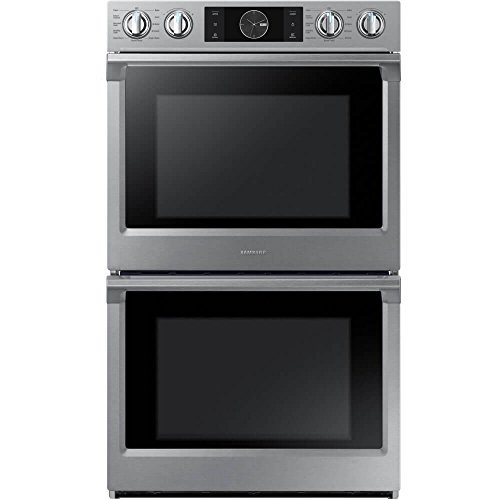
Samsung 30 Inch Double Wall Oven NV51K7770DS — Best Classic Double (Standard Model)
Start with the reference point. The NV51K7770DS is Samsung’s standard 30-inch double wall oven: two full, independent cavities totalling 10.2 cu. ft., a broiler in the top oven, and no divider tricks or steam systems — just the classic arrangement that the rest of this guide’s variants elaborate on. That clarity is its virtue. When you set the upper oven to roast and the lower to bake, each cavity is a complete oven with its own temperature, and nothing about the setup needs explaining to a guest cook or a future buyer of your home.
Capacity at 10.2 cu. ft. combined puts this among the more generous 30-inch doubles: a large bird above with room to spare, a pair of trays below, and the festive maths of Christmas or a family Sunday suddenly working without a reheating queue. The stainless finish suits the professional register most wall-oven kitchens aim for, and Samsung’s controls of this generation favour big, legible displays over novelty — welcome when your hands are floury and the timer is not.
Choose this model when your cooking wants two honest ovens and nothing more theatrical. It will not divide its upper cavity or steam your sourdough; the two picks below exist for those ambitions. What it offers instead is the format’s core promise at full size, from the maker whose variants surround it — the baseline against which every extra in this category should have to justify itself.
There is a resale-and-sanity argument for the standard model that rarely gets voiced: every future owner of your home already knows how to use it. No divider to lose in a move, no steam reservoir to descale, no account to transfer — two ovens, two dials’ worth of logic, and a manual that fits in a drawer. Appliances that explain themselves age gracefully in a kitchen’s life and in a property’s particulars, and this Samsung explains itself in one glance.
- Layout: standard double oven, two independent cavities
- Total capacity: 10.2 cu. ft.
- Standout feature: top broiler, full-size cavities
- Finish: stainless steel
- Model: NV51K7770DS
Strengths
- Full, simple two-oven logic anyone can operate.
- Generous combined capacity for festive cooking.
- No divider or steam hardware to learn or maintain.
Trade-offs
- No steam cook for bread specialists.
- Upper cavity cannot split into two temperature zones.
- Fewer connected features than its smart siblings.
Best for: households wanting the classic double oven at full capacity. Not suited for: bakers chasing steam crusts or zone flexibility.

Samsung 30 Inch Smart Double Wall Oven NV51K6650DG — Best With Steam Cook
The NV51K6650DG keeps the standard two-cavity layout of the model above and adds the feature bread bakers cross the room for: steam cook. By introducing moisture into the cavity during baking and roasting, steam changes crusts and textures in ways a dry oven cannot imitate — bread that crackles, roasts that baste themselves in a humid atmosphere, vegetables that keep their colour. It is a cooking technique built into the oven rather than a layout change, and it is important to hold that distinction: this is a standard double oven, with steam, not a Flex Duo model.
Around that headline, Samsung wraps its smart generation: Wi-Fi connectivity for preheating on the way home and timers you can interrogate from the sofa, and a fingerprint-resistant black stainless finish that suits the darker, moodier kitchens stainless sometimes chills. The two cavities remain full and independent, so the festive maths of the standard model survives intact; steam simply upgrades what each cavity can do to bread, roasts and reheated leftovers that dry out in ordinary ovens.
Buy it if your baking has a crust ambition. Sourdough bakers currently wrestling with Dutch ovens and water trays will feel steam cook as a genuine liberation, and roast cooks will use it more than they expect. Households that bake mostly casseroles and traybakes, by contrast, may never open the steam menu — for them the standard model’s simplicity, or the Flex Duo’s flexibility below, is the smarter spend.
Steam also rehabilitates the leftovers problem that dry ovens created. Yesterday’s roast, rice and bread return to the table in a moist heat that refreshes rather than desiccates, which quietly changes a household’s food economics — cooking once and eating twice becomes a pleasure rather than a penance. Owners who bought this model for sourdough routinely report that the reheating is what they would refuse to surrender, which is how features earn their keep in real kitchens.
- Layout: standard double oven, two independent cavities
- Standout feature: steam cook
- Connectivity: Wi-Fi smart controls
- Finish: fingerprint-resistant black stainless
- Model: NV51K6650DG
Strengths
- Steam transforms bread crusts and roast texture.
- Smart preheating suits commuters and planners.
- Full double capacity retained — steam is an addition, not a trade.
Trade-offs
- Steam hardware adds a reservoir routine to learn.
- No Flex Duo divider in the upper cavity.
- Black stainless commits the kitchen to a darker palette.
Best for: bread bakers and roast cooks wanting moisture control. Not suited for: households that would never use steam or apps.
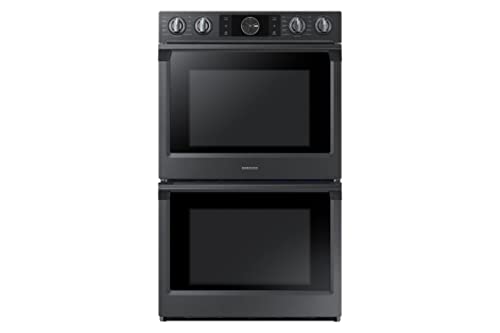
Samsung 30 Inch Smart Double Wall Oven Flex Duo — Best Flexible Divider (Flex Duo)
The Flex Duo model — NV51K7770DG — is the one whose upper oven performs the trick the others cannot. A removable partition, Samsung’s Smart Divider, slides into the upper cavity and splits it into two separately controlled zones, so a tray of biscuits can bake in the top zone while a casserole holds below it, at different temperatures, inside what is physically one oven. Remove the divider and the upper cavity returns to full size for the turkey. Counted generously, the arrangement offers three cooking spaces; counted honestly, it offers two ovens, one of which can moonlight as two small ones — and for many households that moonlighting is the most-used feature in the kitchen.
This model also carries steam cook and Wi-Fi, making it the everything specification of the Samsung trio: standard double layout, a dividable upper cavity, moisture for the bakers, and smart control for the planners. The black stainless finish matches its steam sibling. The flexibility shines brightest in smaller households, paradoxically — a couple rarely needs two full ovens, but very often wants two small zones for a two-part supper, and heating a small zone instead of a full cavity is quicker and thriftier for the everyday meal.
The honest costs are complexity and choreography. The divider must be stored somewhere when the turkey needs the full cavity, zone cooking asks you to learn which dishes suit which half, and the oven’s talents go wasted on households whose cooking is resolutely one-dish. If your suppers regularly involve two components at two temperatures, though, no other pick in this guide bends as far toward your life — this is the flexible option, and it knows it.
The divider’s subtlest benefit is thermal manners. A small zone reaches temperature quickly and holds it without the cycling swings a large cavity imposes on a small load, so a two-person gratin bakes more evenly in the divided upper oven than it ever did rattling around a full one. Flexibility, in this design, is not a party trick performed at Christmas; it is a Tuesday-night improvement that happens to also perform at Christmas.
- Layout: double oven with Flex Duo dividable upper cavity
- Standout feature: removable Smart Divider creates two upper zones
- Also includes: steam cook, Wi-Fi
- Finish: fingerprint-resistant black stainless
- Model: NV51K7770DG
Strengths
- Two zones in the upper oven transform small-meal cooking.
- Divider removes for full-size festive capacity.
- Steam and smart features complete the fullest specification here.
Trade-offs
- Divider needs storage and a learning curve.
- Zone sizes suit components, not whole second meals.
- Most complex oven in this guide to master fully.
Best for: smaller households cooking two-part meals at two temperatures. Not suited for: cooks who want two plain ovens and no systems to learn.
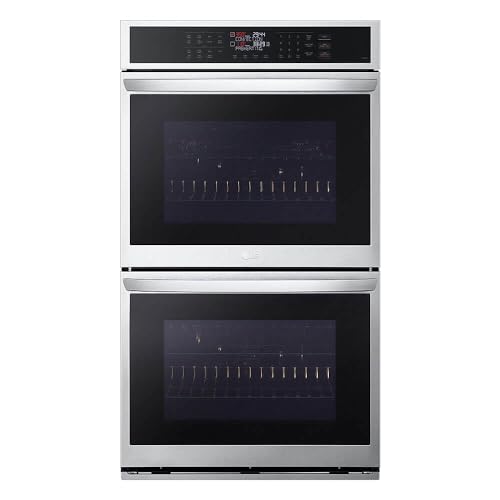
LG 30 Inch Smart Convection Double Wall Oven WDEP9423F — Best Smart Convection Alternative
LG’s WDEP9423F is the answer for buyers who like the Samsung idea but live by a different maker’s ecosystem — or who simply prefer how LG builds an oven. Its headline is smart convection in a stainless 30-inch double: fan-circulated heat in the cavities for even baking across racks, connected controls for preheating and monitoring from the phone, and the fit and finish of a flagship-line appliance. In daily use, convection is the feature that justifies itself most quietly — biscuits that brown evenly on both racks, roasts that colour without turning.
The ownership case is LG’s depth. Wall ovens are installed appliances, and when one needs a fan motor or a control board in year seven, the maker’s parts pipeline and the local engineer’s familiarity decide whether the kitchen is down for a weekend or a month. LG’s presence in the category is long and broad, and the WDEP9423F sits in the current generation of that line rather than at its experimental edge — a reassuring place for a built-in to live.
Choose it over the Samsungs if steam and dividers leave you cold but connected convection and a major maker’s backing attract you, or if your kitchen already speaks LG’s smart language through its other appliances. It does not divide its upper cavity and does not steam; its argument is even heat, smart manners and support, made in stainless. For a great many serious kitchens, that argument is enough.
LG’s smart layer deserves its fair hearing: a preheat begun from the platform or the office genuinely changes weeknight cooking, because the oven’s warm-up — the dead quarter-hour of every recipe — happens before you reach the kitchen. Used that way weekly, connectivity stops being a brochure word. The WDEP9423F’s case is that it pairs that convenience with convection substance, rather than asking the app to substitute for the engineering.
- Layout: standard double oven, two cavities
- Standout feature: smart convection
- Connectivity: Wi-Fi enabled smart controls
- Finish: stainless steel
- Model: WDEP9423F
Strengths
- Even convection baking across multiple racks.
- Major-maker parts and service depth for a built-in.
- Smart preheat and monitoring without gimmick overload.
Trade-offs
- No steam cook and no dividable cavity.
- Smart features presume a household that uses them.
- Stainless shows fingerprints in a busy kitchen.
Best for: convection bakers wanting a major maker’s smart double. Not suited for: steam bakers or Flex Duo flexibility seekers.

Rangaire 30 Inch Electric Double Wall Oven RWOD301GS — Best Value True Convection
Rangaire’s RWOD301GS strips the double oven back to the elements that decide results and keeps the change. Its headline is true convection — a fan working with a dedicated heating element, rather than a fan merely stirring the air a standard element heated — which is the configuration bakers specify when evenness across racks is the whole game. Glass touch controls keep the front clean-lined and wipeable, and self-cleaning handles the chore that most discourages keen cooks from using an oven at full enthusiasm.
The value argument is about where money goes. Nothing in this oven’s budget was spent on an app ecosystem or a divider mechanism; it was spent on heat delivery and the cavity’s daily manners. For a household replacing a tired double oven in an existing kitchen — same cutout, same cooking habits, no desire to re-platform their kitchen around a phone — that allocation reads as respect for the buyer. Stainless styling keeps it neutral among both modern and transitional cabinetry.
Judge it as the purist’s pick. It will not preheat from the train or steam a loaf, and its brand recognition trails the giants in this guide, which argues for confirming support arrangements before installation. But on the evidence of its specification — true convection, self-cleaning, clear controls, two honest cavities — it covers what most double-oven cooking actually consists of, and covers it without charging for theatre.
The glass touch front has one more practical dividend in a double oven: with two cavities’ worth of timers, temperatures and modes to display, a clean digital panel keeps the state of both ovens legible at a glance from across the room. During a big meal, that legibility is a safety feature as much as a convenience — the cook who can read both ovens from the island makes fewer desperate door-openings to check.
- Layout: standard double oven, two cavities
- Standout feature: true convection with dedicated element
- Controls: glass touch panel
- Cleaning: self-cleaning cycle
- Model: RWOD301GS
Strengths
- True convection evenness for serious multi-rack baking.
- Self-cleaning removes the format’s worst chore.
- Budget spent on heat and controls, not connectivity.
Trade-offs
- No steam, divider or smart preheating.
- Smaller brand footprint than Samsung or LG.
- Touch controls divide opinion among glove-wearing cooks.
Best for: bakers wanting true convection without connected extras. Not suited for: households wanting steam or app control.
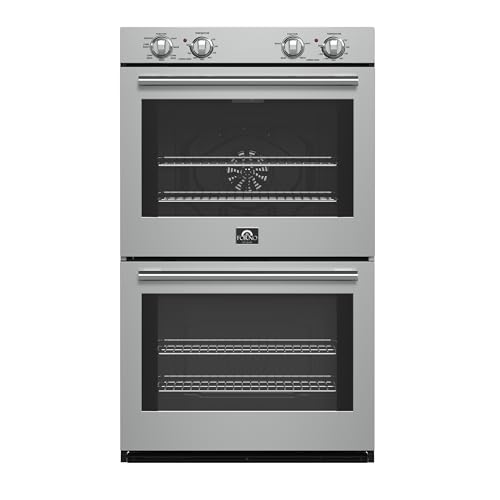
Forno Vomero 30 Inch Double Wall Oven — Best Straightforward Convection
Forno built its following on professional-looking cooking appliances at honest specifications, and the Vomero double wall oven follows the house pattern: a stainless 30-inch cabinet, two electric cavities, convection heat, and a design language borrowed from the pro kitchen — substantial, squared, uninterested in decoration. In a kitchen styled around a serious range aesthetic, the Vomero looks like it was always there, which for a built-in appliance is the highest styling compliment available.
Convection in both the specification and the brand’s philosophy is the working feature: circulated heat for even roasting and baking, two cavities for the two-temperature meals that justify the format, and controls that ask to be used rather than studied. Forno’s audience is the cook who reads a specification the way a carpenter reads a timber grade — for what it will do — and the Vomero’s sheet answers in that language without embroidery.
As with the Rangaire, the counsel is to confirm the support picture for your area before installation, since a built-in oven’s maker matters most on the rare day something fails. Households comfortable with that check gain a double oven whose money sits in steel, elements and fans. If your kitchen’s brief is “two convection ovens, stainless, no theatre,” the Vomero is the brief, built.
Forno’s audience overlap with range buyers matters at installation time too: the Vomero’s pro styling assumes a kitchen planned around cooking rather than around a television, and its presence completes that kind of room rather than apologising in it. Kitchens are increasingly either theatres of food or cupboards with appliances; this oven was designed by people who chose the theatre, for people who did the same.
- Layout: standard double oven, two cavities
- Standout feature: convection cooking in a pro-styled cabinet
- Fuel: electric
- Finish: stainless steel
- Model line: Vomero
Strengths
- Professional styling that suits range-led kitchens.
- Convection evenness across everyday roasting and baking.
- Specification-led value without connected extras.
Trade-offs
- No steam cook or dividable cavity.
- Support network thinner than the giant makers’.
- Pro styling will dominate softer, cottage-style rooms.
Best for: style-led kitchens wanting honest convection doubles. Not suited for: buyers prioritising apps, steam or dividers.
How Do the Six Compare Side by Side?
| Pick | Layout | Signature feature | Finish |
|---|---|---|---|
| Samsung NV51K7770DS | Standard double | 10.2 cu. ft. total, top broiler | Stainless |
| Samsung NV51K6650DG (Steam Cook) | Standard double | Steam cook, Wi-Fi | Black stainless |
| Samsung Flex Duo (NV51K7770DG) | Double + divider | Flex Duo zones, steam, Wi-Fi | Black stainless |
| LG WDEP9423F | Standard double | Smart convection | Stainless |
| Rangaire RWOD301GS | Standard double | True convection, self-cleaning | Stainless |
| Forno Vomero | Standard double | Pro-styled convection | Stainless |
The table’s real lesson sits in the layout column: five of these are standard doubles, differing in features, while one — the Flex Duo — changes the architecture itself. Decide first whether your cooking wants that architectural option. Then let the feature column arbitrate between steam, smart convection and true convection, which are three different answers to three different kitchens.
Standard, Flex Duo or Steam: What Is the Actual Difference?
Because these three phrases share shelf space in Samsung’s range, they deserve one clear paragraph each in plain language. A standard double oven — the NV51K7770DS, the steam model below it in this guide, and the LG, Rangaire and Forno — is two complete ovens in one cabinet, each with its own door, temperature and timer. Nothing divides further; nothing needs to. This is the layout most households mean when they say double oven, and it is the right default.
Flex Duo is a partition system inside the upper oven of one specific model. Slide the divider in and the upper cavity becomes two zones with independent temperatures — useful for two-part meals and small everyday cooking. Slide it out and the cavity is whole again. Steam cook, by contrast, is not a layout at all: it is a moisture system fitted to certain models — including the Flex Duo oven and the NV51K6650DG — that adds steam to the bake for crusts and roasts. A model can have steam without Flex Duo, and the Flex Duo model here happens to carry both. Buy each idea for its own sake, never as a synonym for the other.
How Do You Measure a Wall Oven Cutout?
Built-in ovens live or die by the cutout, so measure the cabinet opening itself — width, height and depth — rather than the old oven’s front, which overlaps and flatters. Record the position of the electrical junction box, since the new oven’s conduit must reach it without strain, and check the cabinet floor or support rails: a double oven is a heavy appliance, and its weight must land on structure rated for it, not on a decorative shelf. The makers publish cutout ranges for every model here; your measurements should sit comfortably inside the range, not at its optimistic edge.
Then measure the room’s practicalities. Oven doors open downward into the kitchen’s working space, so confirm the open door of the lower cavity clears the island or the opposite run with room for the cook holding a hot tray — the tray’s journey from rack to counter should be short, level and rehearsed in your head before installation day. If the kitchen is mid-renovation, photograph the cutout with a tape in frame and send it to the seller; built-in returns are the category’s most avoidable expense.
What Electrical Supply Does a Double Wall Oven Need?
Two cavities mean a serious circuit. Double wall ovens typically require a dedicated high-amperage supply sized to the specific model — the listing and manual state the requirement, and it is not a suggestion. Older kitchens wired for a single oven or a range may need an electrician’s visit before the new unit can run both cavities at full enthusiasm, and discovering that on installation morning is the expensive way to learn it. Budget the electrical check into the purchase, the way you would budget a flue for a stove.
While the electrician is there, confirm the junction box position suits the new model’s conduit length and that the breaker and cable match the nameplate. These are unglamorous pounds and dollars, but a double oven is a decade-long installation; the supply it deserves is the one sized for Christmas Day, when both cavities, the broiler and half the kitchen’s other appliances all report for duty at once.
How Does Convection Change Baking in a Double Oven?
Convection moves heat with a fan so the cavity’s temperature evens out, and in a double oven its gift doubles: you can fill racks in both cavities without the pale-top, dark-bottom lottery of still air. True convection, as the Rangaire specifies, adds a heating element at the fan so the circulating air arrives already hot rather than merely redistributed — the configuration that multi-rack biscuit and meringue bakers specify by name. Practical adjustments are small and learnable: many recipes want a modest temperature reduction and an earlier first check, because moving air cooks surfaces faster.
The honest limits deserve air too. Delicate soufflés and some sponges prefer still air, and most ovens here let you switch the fan off for them. Convection also dries surfaces — glorious for roast potatoes, less kind to a custard. Owning two cavities means the argument resolves itself: fan in one, still air in the other, each dish in the atmosphere it prefers, which is a luxury no single oven at any price can offer.
How Do You Plan a Big Meal Across Two Cavities?
Write the meal backwards from the serving time. The roast, with its resting period, is the anchor: it finishes early and rests happily wrapped while its cavity — now free and hot — takes the roast potatoes. The second cavity runs the supporting schedule: gratins, stuffing, the pudding that needs a gentle, unhurried heat nobody may disturb by opening the door to check the bird. Assign every dish a cavity and a time on paper the day before; the oven’s two timers then execute a plan instead of hosting an improvisation.
Temperature conflicts are the puzzle the format exists to solve, but rack conflicts remain yours. Count the racks and trays the meal truly needs, rehearse the largest tray in both cavities when the oven is new, and note which cavity swallows the big roasting pan with its handles. On the day, load the lower cavity first — bending with a heavy tray beats lifting one — and let the upper oven, at eye level, host the dishes you must watch, baste and judge by colour.
What Cleaning Systems Do These Ovens Offer?
Self-cleaning cycles, like the Rangaire’s, burn residue to ash at very high heat: effective, odorous, and best run on a day when the kitchen can be ventilated and the household is home to supervise. Steam-based cleaning options, where fitted, work at the opposite register — a shallow heat-and-moisture loosening of everyday splashes, suitable for frequent light maintenance between deep cleans. The two systems are complements rather than rivals, and the households happiest with their ovens in year five are the ones that wipe spills weekly and reserve the pyrolysis for the season’s end.
Everyday care is mostly door glass and rack discipline. Glass cleans best cool, with non-abrasive pads; racks left in during a self-clean cycle may lose their sheen, so consult the manual before the first burn. Keep the door seals free of crumbs and grease, because a double oven has two seals earning their keep, and a compromised seal taxes every roast with lost heat and uneven browning on the side that leaks.
How Should You Judge Controls and Displays?
You will operate these controls with wet, floury, hurried hands, in steam and poor light, often by memory. Judge them by that standard. Big, high-contrast displays and decisive knobs or well-spaced touch targets age better than dense menus; a timer you can set without the manual is worth more than a recipe programme you will use twice. Glass touch fronts, like the Rangaire’s, wipe clean in a second and suit cooks who hate grease in knob crevices — while physical dials suit cooks who adjust by feel without looking down.
Smart controls deserve a colder eye. Preheating from the train and a phone that announces the timer are genuine conveniences for households whose lives run that way; for everyone else they are features paid for and ignored. What matters universally is that the oven remains fully operable from its own panel when the Wi-Fi sulks — verify that, and the connected features become a bonus rather than a dependency.
What Should Happen at Installation?
A double wall oven is a two-person lift into a precise hole, wired by someone qualified, and levelled so doors hang true and trays sit flat. Watch for the unglamorous confirmations: the unit seated flush without rocking, both doors opening fully without kissing the floor or the adjacent handles, racks gliding, and the electrical connection made in the box the cutout provides for it. Run both cavities empty through a first heating cycle as the manual directs — new ovens burn off manufacturing residues with a smell you want exhausted before the first roast, not during it.
Test the features you paid for while the installers’ visit is recent: broiler in the top cavity, convection in both, the divider’s fit if you chose the Flex Duo, the steam reservoir’s fill and drain if you chose steam. Photograph the model and serial plate inside the door frame, register the warranty, and keep the manual with the house documents. An installation verified this thoroughly on day one rarely sends surprises in year three.
How Do Two Cavities Change Everyday Cooking, Not Just Feasts?
The festive case sells double ovens, but the weekday case keeps owners loyal. A single portion of leftovers reheats in one cavity while garlic bread crisps in the other; a tray of roast vegetables cooks at a fierce heat while a gentle quiche sets below, undisturbed by the opening door. Perhaps most used of all: one cavity as a plate warmer and holding oven during the ordinary chaos of getting four people and three dishes to the same table at the same temperature.
Energy habits shift too. For a small meal, heating one cavity of a double is no worse than heating a single oven, and the Flex Duo’s divided zone improves on that further by heating only half a cavity for a two-person supper. Households that feared a double oven would tax every meal discover the opposite: the right-sized space is usually available somewhere in the stack, and the big cavity is reserved, economically, for the occasions that justify it.
What Should Bakers Specifically Look For?
Bread bakers should start at the steam model and work outward: steam in the first minutes of a bake is what opens the crust, and the NV51K6650DG builds it in. Pastry and multi-rack bakers should weight convection quality — the LG’s smart convection and the Rangaire’s true convection are the two specifications written for them — and check rack positions and tray fit in both cavities, because a double oven whose lower cavity refuses your favourite sheet has halved its usefulness to you.
Temperature accuracy is the quiet specification. An oven that holds a gentle heat steadily matters to meringues, dehydrating and slow roasts more than headline maximums do. Whatever you choose, an inexpensive oven thermometer in each cavity for the first month teaches you your particular unit’s dialect — every oven has one — and that knowledge improves your baking more than any feature comparison in this guide, including the ones we have just written.
How Do Rack Positions and Glide Racks Change Daily Use?
An oven is mostly a box; the racks are where cooking actually happens, and their quality decides how brave you feel with a full, bubbling dish. Glide racks that extend smoothly on their runners let you baste, turn and test without hauling a heavy tray fully out into the room — the difference between a controlled manoeuvre and a leap of faith over an open door. When comparing these models, count the racks, note which cavities carry the gliding ones, and imagine the heaviest dish you cook at the height of its intended rack.
Rack positions matter most in the lower cavity, where the big roasting pan lives. A pan plus bird plus handles must clear the cavity roof with room for the air to work; rehearse that stack mentally against the stated interior heights before the festive season performs the experiment live. The upper cavity, at its easier height, becomes the natural home of the dishes needing judgement — gratins watched for colour, pastry checked by eye — which is why experienced double-oven cooks plan the meal by altitude as much as by temperature.
What Does the Broiler Do in a Double Oven Setup?
The broiler — the top oven’s fierce downward heat, noted in the standard Samsung’s specification — is the finishing tool of the whole stack: cheese browned on a gratin, peppers blistered, the top of a shepherd’s pie given its colour in the last three minutes. In a double oven household, broiling migrates naturally to the upper cavity, at eye level where its progress can be watched second by second, because broiling forgives nothing and rewards attention disproportionately.
Use it with the door as the manual directs and the rack at the stated distance; broiler accidents are almost always distance accidents. The quieter virtue of a dedicated broiling cavity is scheduling — the finish can happen at full ferocity above while a delicate bake continues undisturbed below, a simultaneity that single-oven cooks achieve only by serving something late or something pale.
How Should You Think About Finish: Stainless or Black Stainless?
Two of the Samsung picks wear fingerprint-resistant black stainless, the rest conventional stainless, and the choice shapes the kitchen more than any feature in this guide. Black stainless deepens a room: it suits the moody, cabinet-dark kitchens and the black-range suites that have become a genuine style rather than a phase, and its fingerprint resistance is a daily mercy in a household of cooks. Conventional stainless remains the universal donor — it matches the greatest range of existing appliances, reflects light in small kitchens, and reads as professional rather than fashionable, which is why it dates slowest.
Consider the decade, not the season. A wall oven is the least replaceable object in the room, and its finish will outlast two changes of cabinet colour. If the kitchen around it is mid-evolution, stainless is the safer long citizen; if the room’s dark scheme is settled and loved, black stainless completes it in a way stainless never quite will. Either way, choose consciously — this is the one decision in the purchase you will literally see at every meal.
What Is the Learning Curve in the First Month?
Week one is calibration: learn where your new cavities run hot or gentle with a thermometer, bake a familiar recipe in each oven, and note the results like a scientist who intends to eat the data. Week two is choreography — the first two-temperature meal, planned on paper, executed with both timers, debriefed over the eating of it. By week four, most households report the double oven has stopped being equipment and become grammar: sentences of cooking they could not previously say are now simply how dinner works.
The feature-rich models ask a little more tuition. Flex Duo owners should cook one divided meal in the first fortnight, while the manual is still open on the counter, rather than discovering the divider at Christmas. Steam owners should bake one loaf early for the same reason. Features learned in calm weeks perform in frantic ones; features first touched during a feast tend to stay untouched forever after.
How Do Double Ovens Serve Small Households Differently?
It sounds paradoxical, but couples are among the format’s happiest owners. The reason is optionality: a whole cavity for the Sunday roast, a half-divided zone for Wednesday’s two-part supper, a warming drawer substitute in the lower oven during a dinner party for four. What small households do not need is capacity theatre — which is why the Flex Duo, whose talents concentrate in small zones, suits them disproportionately, and why the standard model’s owners among couples tend to use one cavity constantly and the other as a prized reserve.
Running costs follow usage rather than architecture. Heating one cavity of a double costs what heating a single oven costs; the second cavity is not a standing charge but a standing option. The honest question for a small household is not whether two ovens are too many, but whether their cooking regularly separates into two temperatures — and for anyone who roasts while baking, grills while proving, or reheats while crisping, the answer arrives quickly.
What Should You Ask About Warranty and Support for a Built-In?
A wall oven’s failure is a kitchen event, not a gadget event, so the support questions outrank the feature questions for any maker without a national network. Ask how service is reached in your area, whether parts for the model are stocked domestically, and what the warranty covers in parts and labour respectively. Samsung and LG answer those questions with infrastructure; Rangaire and Forno buyers should ask them a little more deliberately and keep the answers with the receipt.
Register the appliance, photograph its plates, and keep the installer’s details. When a fault does occur, describe it with evidence — which cavity, which mode, what the thermometer said — because built-in diagnostics reward precision with speed. A decade-long appliance deserves a file, not a memory, and the households that keep one rarely regret the folder it lives in.
How Does a Double Oven Change a Kitchen’s Value?
Estate agents list double ovens in particulars for a reason: they signal a kitchen built for cooking rather than for photographs, and buyers who cook read the signal instantly. The effect is strongest when the installation looks native — flush fit, finish in conversation with the rest of the room, cutout joinery finished properly — and weakest when a fine oven sits in a cabinet that visibly improvises around it. If resale is anywhere in your thinking, the joinery budget is part of the oven budget, and the standard stainless models are the easiest to hand to a future owner’s taste.
For the household that never sells, the value is simpler and larger: it is paid out in meals that stopped requiring negotiation. Every cook who has held a roast hostage to a pudding’s temperature understands that a second cavity is not an indulgence but the removal of a recurring small frustration from family life. Multiplied across a decade of Sundays, that removal is the real return on the cutout.
How Should You Rehearse the Oven Before Its First Feast?
Do not let a celebration be the maiden voyage. In the weeks after installation, run one ordinary roast in the lower cavity, one bake in the upper, one two-temperature supper using both, and — if you chose them — one divided Flex Duo meal and one steam loaf. Note times and temperatures against your old oven’s habits in the manual’s margin. That quiet rehearsal season converts the feast from a test of unfamiliar equipment into a performance on an instrument you already play, and it surfaces any installation quirk while the installer’s number is still on the fridge.
How Should You Label and Learn Your Two Timers?
Two ovens mean two timers, and the feast-day error is always the same: a timer rings and nobody remembers which cavity it belongs to. Build the habit from the first week of naming the oven whenever you set its timer — upper for the gratin, lower for the roast — and, where the controls allow notes or the phone takes the second timer, assign each cavity its own alert sound. It sounds like fussiness in October. In the last frantic twenty minutes of a celebration meal, it is the difference between choreography and archaeology.
Which Mistakes Do Double Wall Oven Buyers Regret Most?
- Confusing steam cook with the Flex Duo divider and buying one while expecting the other.
- Measuring the old oven’s front instead of the cabinet cutout, then funding a joinery rescue.
- Discovering on installation day that the kitchen’s circuit cannot run both cavities.
- Ignoring open-door clearance, so the lower oven’s door meets the island with every tray.
- Paying for smart features their household never opens, while skipping the convection quality they would use daily.
- Leaving racks in during the first self-clean cycle without checking the manual.
Final Recommendation
Let your cooking’s shape choose the architecture. Most households should take the classic answer first: the Samsung NV51K7770DS, whose two full cavities and 10.2 cu. ft. handle everything from Tuesday to Christmas without a system to learn. Bakers with crust ambitions step sideways to the Samsung NV51K6650DG (Steam Cook) for its steam, while two-person households cooking two-part suppers will extract the most from the Samsung Flex Duo (NV51K7770DG) and its dividable upper oven. Whichever name lands in your cutout, measure the cabinet twice, wire it properly, and learn its temperatures with a thermometer — after that, the best 30 inch double wall ovens disappear into the background of a kitchen that simply cooks better, two temperatures at a time, for years.
Frequently Asked Questions
Is the Flex Duo a third oven?
No. Flex Duo is a removable divider that splits the upper cavity of one specific Samsung model into two temperature zones. With the divider out, that cavity is a normal full oven. The oven still has two cavities and two doors — the divider simply lets the upper one behave as two smaller spaces when a meal wants that.
Does steam cook replace a standard oven function?
No — steam is an additional mode on the models that carry it, used for breads, roasts and reheating where moisture helps. The same cavities bake, roast and broil conventionally the rest of the time. Think of it as a technique the oven can perform, not a different kind of oven.
Will a 30-inch double oven fit my existing single-oven cutout?
Not automatically. A double oven needs a taller cutout than a single, and often a stronger electrical supply. Measure the cabinet opening’s width, height and depth and compare them with the chosen model’s published cutout range before ordering; a joiner can often enlarge an opening, but that belongs in the budget from the start.
Can both cavities self-clean at once?
Follow the manual for your model — self-cleaning draws heavy power and generates serious heat, and manufacturers specify how cycles may be run. In practice, most households clean one cavity at a time, on a ventilated day, and use light steam cleaning or a wipe-down for the other in between.
Do I need convection in both cavities?
It is the more useful arrangement for bakers, since either oven can then take the multi-rack load. Roast-led households may rarely use the second fan. When comparing models, confirm whether convection applies to one cavity or both, because headline wording does not always say — the listing details for each pick here are the place to verify.
Related Guides
For the single-cavity and range-adjacent alternatives, compare Best 30 Electric Wall Ovens before committing to a double. The drinks that accompany a two-oven feast deserve their own cold storage, covered in Best 100 Bottle Wine Refrigerators, and the refrigerator shortlist continues with Best 22.2 Cu Ft Counter Depth French Door Refrigerators.


