What's inside
- Key Takeaways
- Quick Picks
- How We Chose These Picks
- The Best 30 Electric Wall Ovens, Reviewed One by One
- How Do the Six Compare Side by Side?
- What Does European Convection Actually Do Differently?
- How Should You Measure a 30-Inch Wall Oven Cutout?
- Do You Need a Dedicated Circuit for an Electric Wall Oven?
- What Can Steam Cooking Do That Dry Heat Cannot?
- How Do You Keep a Wall Oven Baking Evenly for Years?
- Which Mistakes Do Wall Oven Buyers Regret Most?
- What Size Pan Actually Fits Inside a 30-Inch Oven?
- How Do Self-Cleaning Cycles Treat Your Kitchen?
- What Should You Know About Wall Oven Noise?
- How Does a Wall Oven Change Daily Cooking Habits?
- What Do the Controls Ask of You Every Day?
- How Should You Plan the First Week With a New Wall Oven?
- Which Oven Belongs in a Baker’s Kitchen, and Which in a Roaster’s?
- How Do Running Costs Compare Across These Six Ovens?
- What Happens on Delivery Day, and What Should You Check?
- Can a Wall Oven and Cooktop Share One Cabinet Run?
- How Do You Decide Between This List and a Double Wall Oven?
- What Should Renters and Remodellers Each Prioritise?
- How Do Finishes Age in a Working Kitchen?
- What Does the Warranty Conversation Sound Like for Built-Ins?
- Final Recommendation
- Frequently Asked Questions
- Related Guides
As an Amazon Associate I earn from qualifying purchases. This post may contain affiliate links at no extra cost to you.
cottageverdict.com is reader-supported. When you buy through links on our site, we may earn an affiliate commission.
A wall oven changes how a kitchen breathes. The burners stay up on the counter where the action is, the roasting moves to eye level, and nobody has to fold themselves in half to check a tray of potatoes. Shoppers hunting for the best 30 electric wall ovens usually arrive with the same cabinet cutout and very different cooking lives, so this guide separates the six models below by temperament rather than by brochure order. Two Bosch ovens anchor the list, two Samsungs bring the connected features, and two newer names undercut the establishment with air fry and rotisserie tricks.
Where to buy: every pick here is sold through Amazon, and the names in the Quick Picks table, the review headings and the comparison table all link to the live listings so you can check price on Amazon and confirm the exact configuration before ordering. Start with the Bosch convection model if even browning is your religion, the Samsung steam model if steam cooking intrigues you, or the PioneerWorks air fry oven if sheer cavity size per pound of budget is the argument that wins in your house.
One honest framing note before the details. All six are single ovens built for a nominal 30-inch cabinet, yet they divide sharply on how the heat moves: fan-driven European convection, plain thermal baking, steam assistance, and air fry modes that are really just convection with confidence. Pick the heat behaviour first and the badge second, because you will live with the first one every single day.
Key Takeaways
- Convection is the dividing line in this set: the Bosch convection model, both Samsungs, the PioneerWorks and the touch-control oven move air, while the second Bosch bakes thermally.
- Every oven here is a single cavity for a 30-inch cutout, so the choice is about features and cooking style, not about doubling capacity.
- Steam cook appears only on the Samsung NV51K6650SG, which makes it the pick for bakers chasing better crusts and gentler reheating.
- The PioneerWorks states a 4.8 cu. ft. capacity and an air fry mode, the most family-feeding combination on the list.
- Self-cleaning appears across most of the set, but cycle style and lock-out time still differ, so read the manual before the first holiday roast.
- Wi-Fi control is a Samsung habit here; the Bosch pair and the value picks keep their counsel on physical controls.
Quick Picks
| Pick | Badge | Why it earns its place |
|---|---|---|
| Bosch 500 Series 30 Inch Single Electric Wall Oven Convection | Best European Convection | A third heating element around the fan evens out multi-rack baking in a way basic fan ovens never quite manage. |
| Bosch 500 Series 30 Inch Single Electric Wall Oven Stainless | Best No-Nonsense Thermal Oven | The same Bosch build and self-cleaning discipline without the convection premium, for cooks who bake one tray at a time. |
| Samsung 30 Inch Smart Single Wall Oven NV51T5511SG | Best Smart Simplicity | Black stainless looks, Wi-Fi monitoring and a clean control layout for households that already run their lives from a phone. |
| Samsung 30 Inch Smart Wall Oven NV51K6650SG | Best for Steam Cooking | Steam cook joins convection and app control, giving bread bakers and leftover-revivers a tool none of the rivals here offer. |
| PioneerWorks 30 Inch Electric Single Wall Oven 4.8 Cu Ft | Best Air Fry Capacity | A stated 4.8 cu. ft. cavity with true convection and an air fry mode, aimed squarely at big-batch family cooking. |
| 30 Inch Electric Single Wall Oven with Convection Fan Touch Control | Best Rotisserie Curiosity | A 360-degree rotisserie and touch controls give this unbranded oven a party trick the famous names do not attempt. |
How We Chose These Picks
Wall ovens are a ten-to-fifteen-year commitment sealed into cabinetry, so the choosing started with the unglamorous questions. Does the oven heat evenly enough that a cook can trust the back corners? Does the control panel make sense to someone with flour on their hands? Can the cavity swallow a holiday bird with room for air to circulate around it? Models that answered those questions with real engineering, rather than with a longer feature list, moved to the front of the queue.
Heat system came next. European convection, where the fan carries its own element, behaves differently from a simple fan bolted into a thermal oven, and steam assistance is a separate discipline again. We kept one honest thermal oven in the set because plenty of traditional bakers prefer it, and we kept the two value newcomers because their headline features — air fry at 4.8 cu. ft., a proper rotisserie — are things the premium brands oddly skip. Brand support networks, cutout compatibility with standard 30-inch cabinetry and self-cleaning practicality broke the remaining ties.
The Best 30 Electric Wall Ovens, Reviewed One by One

Bosch 500 Series 30 Inch Single Electric Wall Oven Convection — Best European Convection
Bosch built its oven reputation on a simple observation: a fan alone just stirs uneven air faster. European convection puts a ring element around that fan, so the air entering the cavity is already at temperature, and three racks of biscuits brown as a family instead of as rivals. In this 500 Series single oven that system sits inside a stainless cavity with self-cleaning, and the result is the most forgiving baking environment on this page for anyone who cooks in batches.
The controls stay deliberately restrained. Knobs and a modest display handle the daily work without demanding an app account, and the door action has the damped, deliberate feel that separates built-in appliances from freestanding ones. Roasting performance matches the baking: the broiler is fierce enough for cheese toppings and finishing gratins, and the cavity lighting lets you judge colour without opening the door and dumping the heat you paid to create.
- Format: built-in single oven for a 30-inch cabinet
- Heat system: European convection with a ring element around the fan
- Cleaning: self-cleaning cycle
- Finish: stainless steel
- Controls: physical controls with display, no app required
Strengths
- Multi-rack baking comes out remarkably even from top shelf to bottom.
- Build quality and door feel sit a class above the value picks here.
- Self-cleaning spares you the chemical sprays and the weekend of scrubbing.
Trade-offs
- No Wi-Fi, so remote preheating from the sofa is off the menu.
- The convection premium is real money over its own thermal sibling.
- A single cavity means holiday juggling still needs planning.
Best for: bakers who load two or three racks at once and want them to finish together.
Not suited for: cooks who want steam injection or phone-based oven control.

Bosch 500 Series 30 Inch Single Electric Wall Oven Stainless — Best No-Nonsense Thermal Oven
Strip the fan out of the recipe and you get this second Bosch: a thermal oven that heats the way ovens have heated for generations, with elements cycling to hold a set temperature and still air doing the rest. That sounds like a downgrade until you talk to cooks who bake delicate sponges, soufflés and meringues, many of whom find moving air more enemy than ally. For single-tray, one-rack-at-a-time cooking, this oven delivers the same Bosch fit, finish and self-cleaning with a smaller bill at the end.
What you give up is batch forgiveness. Load three racks of cookies into still air and the middle tray will lag while the bottom one hurries, so this model rewards cooks who work sequentially. What you keep is everything else that makes the 500 Series pleasant: a solid door, clear controls, a broiler with real intent, and a cavity that cleans itself. Households replacing a like-for-like thermal oven will feel instantly at home.
- Format: built-in single oven for a 30-inch cabinet
- Heat system: thermal bake and broil, no convection fan
- Cleaning: self-cleaning cycle
- Finish: stainless steel
- Controls: physical controls with display
Strengths
- Gentle, still-air heat suits delicate bakes that resent a fan.
- Same Bosch construction and self-cleaning as the convection model.
- Simpler system means fewer things to go wrong over a long life.
Trade-offs
- Multi-rack loads bake unevenly compared with the convection Bosch.
- Roasts benefit less from circulating air, so browning needs turning.
- No smart features of any kind on board.
Best for: traditional bakers who cook one rack at a time and value simplicity.
Not suited for: batch bakers or anyone planning three-tray cookie sessions.

Samsung 30 Inch Smart Single Wall Oven NV51T5511SG — Best Smart Simplicity
Samsung’s NV51T5511SG is the wall oven for households that already ask their phones where the car is parked. Wi-Fi monitoring lets you check a roast’s progress, adjust the temperature and get the preheat notification without hovering in the kitchen, and the black stainless finish gives the whole wall a moodier, more deliberate look than bright steel. Under the connectivity it is a straightforward large-capacity single oven with convection cooking doing the everyday work.
The daily experience is clean. A wide glass door and bright interior light make doneness checks easy, the control panel wipes down without a forest of knobs to clean around, and the cavity takes a full-size roasting pan with sensible clearance. It lacks the steam trickery of its NV51K6650SG sibling, which is precisely why it suits buyers who want the smart layer and the Samsung look without paying for cooking modes they will never open.
- Format: built-in single oven for a 30-inch cabinet
- Heat system: convection cooking
- Connectivity: Wi-Fi smart monitoring and control
- Finish: black stainless steel
- Model: NV51T5511SG/AA
Strengths
- App monitoring genuinely helps during long, unattended roasts.
- Black stainless finish hides fingerprints better than bright steel.
- Control layout is clean, modern and easy to wipe down.
Trade-offs
- No steam cook, unlike the step-up Samsung on this list.
- Smart features depend on your home network behaving itself.
- Black stainless needs matching appliances to look intentional.
Best for: connected households that want app oversight and a darker finish.
Not suited for: steam bakers or anyone avoiding app-dependent appliances.

Samsung 30 Inch Smart Wall Oven NV51K6650SG — Best for Steam Cooking
The NV51K6650SG adds the one feature bread bakers write letters about: steam. A steam cook mode introduces moisture during baking, which keeps dough surfaces supple long enough for a full rise before the crust sets, and the same gentle humidity reheats yesterday’s roast without turning it into shoe leather. Around that headline, Samsung layers convection, Wi-Fi control and a fingerprint resistant stainless finish, making this the most technically ambitious oven in the six.
Ambition brings homework. Steam systems want the reservoir filled, the cavity wiped after wet cycles and the occasional descale, and the menu depth means a learning week before the controls feel like reflexes. Cooks who bake bread weekly will call that a fair trade without blinking. Cooks who mostly reheat casseroles should look at the simpler Samsung above and keep the difference in their pocket.
- Format: built-in single oven for a 30-inch cabinet
- Heat system: convection plus steam cook mode
- Connectivity: Wi-Fi smart control
- Finish: fingerprint resistant stainless steel, black accents
- Model: NV51K6650SG/AA
Strengths
- Steam cook lifts bread crusts and rescues leftovers gracefully.
- Convection and smart control cover the everyday bases completely.
- Fingerprint resistant finish keeps the front presentable.
Trade-offs
- Steam hardware adds cleaning and descaling chores.
- Deep menus take time to learn properly.
- You pay for capability that casserole households may never use.
Best for: bread bakers and keen cooks who will actually use steam weekly.
Not suited for: set-and-forget cooks who want the shallowest possible menu.
PioneerWorks 30 Inch Electric Single Wall Oven 4.8 Cu Ft — Best Air Fry Capacity
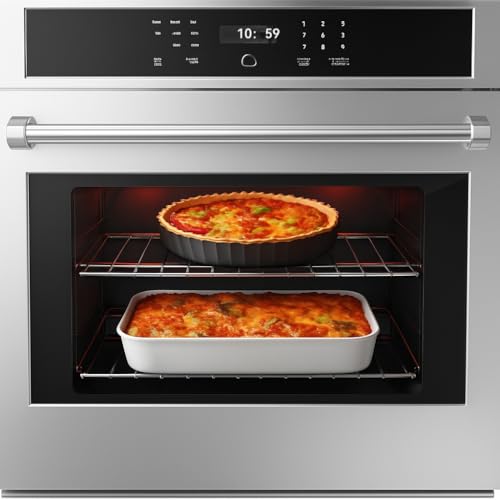
PioneerWorks arrives with a spreadsheet attitude: a stated 4.8 cu. ft. cavity, true convection, an air fry mode and self-cleaning, all in a 30-inch stainless box aimed at families who cook in volume. The air fry setting matters more than marketing usually admits, because a wall oven’s big cavity crisps a full sheet of wings or vegetables in one pass where a countertop basket needs three. For a household feeding teenagers, that single-batch capacity is the whole argument.
The trade is pedigree. PioneerWorks does not bring Bosch’s dealer network or Samsung’s app ecosystem to the relationship, so buyers should read the warranty terms carefully and keep the paperwork. Controls are front-mounted and touch-driven, the finish is plain stainless, and the oven asks to be judged on throughput: big cavity, moving hot air, food out fast. On those terms it competes hard.
- Format: single-cavity built-in, 30-inch class
- Capacity: 4.8 cu. ft. as stated by the maker
- Heat system: true convection with air fry mode
- Cleaning: self-cleaning
- Controls: front touch controls, stainless finish
Strengths
- Large stated capacity swallows family-size trays in one load.
- Air fry mode uses the big cavity better than a countertop basket.
- True convection plus self-cleaning covers the essential checklist.
Trade-offs
- Younger brand, so long-term parts support is less proven.
- No Wi-Fi or steam at this end of the market.
- Fit and finish trail the premium German and Korean models.
Best for: big households that air fry and roast in full-sheet quantities.
Not suited for: buyers who rank dealer networks above raw capacity.
30 Inch Electric Single Wall Oven with Convection Fan Touch Control — Best Rotisserie Curiosity
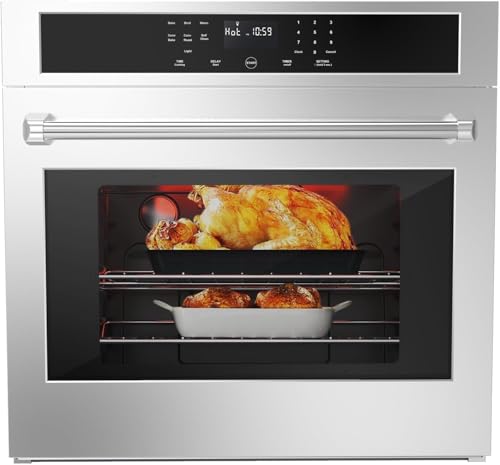
Every shortlist deserves one wildcard, and a 360-degree rotisserie makes this unbranded 30-inch oven exactly that. A turning spit roasts a chicken the way deli counters do, self-basting as it rotates, while the convection fan handles the conventional work of trays and casseroles. Touch controls and a fingerprint resistant stainless front keep the presentation modern even if the nameplate is anonymous.
Anonymous is the operative word. With no famous badge comes a greater duty to verify cutout dimensions, electrical requirements and warranty handling directly from the listing before ordering, and to keep expectations calibrated: the rotisserie is a delight for Sunday birds, yet the everyday value still rests on the convection cavity doing ordinary work competently. Buy it for the spit, enjoy it for everything else, and measure your cabinet twice.
- Format: single-cavity built-in, 30-inch class
- Heat system: convection fan cooking
- Signature feature: 360-degree rotisserie
- Controls: touch control panel
- Finish: fingerprint resistant stainless steel
Strengths
- Rotisserie roasting produces evenly bronzed, self-basted birds.
- Convection fan covers everyday baking and roasting duties.
- Touch panel and resistant finish keep the front easy to clean.
Trade-offs
- Unbranded support path demands extra homework before buying.
- Rotisserie capacity suits chickens, not oversized holiday turkeys.
- Documentation and accessories may be thinner than big-brand kits.
Best for: rotisserie fans who want the spit without a commercial range.
Not suited for: buyers who need an established national service network.
How Do the Six Compare Side by Side?
| Pick | Heat system | Signature feature | Cleaning |
|---|---|---|---|
| Bosch 500 Series 30 Inch Single Electric Wall Oven Convection | European convection | Ring element around the fan | Self-cleaning |
| Bosch 500 Series 30 Inch Single Electric Wall Oven Stainless | Thermal | Still-air traditional baking | Self-cleaning |
| Samsung 30 Inch Smart Single Wall Oven NV51T5511SG | Convection | Wi-Fi monitoring, black stainless | Steam and self-clean options by cycle |
| Samsung 30 Inch Smart Wall Oven NV51K6650SG | Convection plus steam | Steam cook mode | Self-cleaning |
| PioneerWorks 30 Inch Electric Single Wall Oven 4.8 Cu Ft | True convection | Air fry mode, 4.8 cu. ft. stated | Self-cleaning |
| 30 Inch Electric Single Wall Oven with Convection Fan Touch Control | Convection fan | 360-degree rotisserie | Check listing for cycle details |
Read the table as a personality chart. The two Boschs are the purists, split by whether air should move. The Samsungs are the technologists, split by whether steam earns its keep. The PioneerWorks and the rotisserie oven are the opportunists, offering capacity tricks and cooking theatre that the establishment ignores. None of the six is a double oven, so if two cavities at two temperatures is your true requirement, this shortlist is the wrong one and a 30-inch double deserves your attention instead.
What Does European Convection Actually Do Differently?
Ordinary convection adds a fan to a normal oven. The fan stirs air that the bake and broil elements heat, which helps, but the air arriving at the food still carries hot and cool patches from its journey around the cavity. European convection, sometimes called true convection, mounts a heating element directly around the fan itself. Every cubic inch of air gets heated at the moment it is pushed into the oven, so the third rack behaves like the first. That is why batch bakers notice the difference immediately: three trays of shortbread finish within a minute of each other instead of staging a relay.
The practical consequences reach beyond cookies. Roasting vegetables on two levels stops being a compromise, frozen items cook more predictably, and you can often drop the set temperature slightly because moving heated air transfers energy faster than still air. The Bosch convection model in this guide is the purest expression of the idea here, though the PioneerWorks also claims true convection, and both Samsungs circulate air effectively even when their brochures emphasise other talents.
How Should You Measure a 30-Inch Wall Oven Cutout?
Thirty inches is the marketing width, not the hole in your cabinet. Before ordering anything on this page, pull the installation manual for the exact model and compare three numbers against your existing cutout: width, height and depth, plus the junction box location. Ovens of the same nominal class vary by fractions of an inch, and fractions are exactly what cabinetry refuses to forgive. Measure the opening itself rather than the old oven’s trim, because trim kits happily hide gaps that the new chassis will not.
Depth deserves a second look in older kitchens. A wall oven needs room behind it for the electrical connection and for air to move, and deep cabinets built for one brand sometimes crowd another. Height matters when a cooktop sits above the oven in a single cabinet stack: the combined cutouts must both fit with the required clearances. Ten minutes with a tape measure and the manual’s diagram prevents the particular misery of a delivery crew shaking their heads at your doorway.
Do You Need a Dedicated Circuit for an Electric Wall Oven?
Almost certainly yes. A 30-inch electric wall oven is a heavy, sustained load, and installation manuals in this class call for a dedicated circuit sized to the model’s rating plate, hardwired or plugged according to local code. If your kitchen previously ran a gas oven with a token 120-volt line for the igniter, budget for an electrician alongside the appliance. The same visit can confirm the breaker, the wire gauge and the junction box position in one pass.
Treat the electrical question as part of the purchase price when comparing models, because it applies equally to all six here. Where households get caught is assuming the swap is carpentry only, then discovering the panel is full. A quick photo of your breaker panel, sent to an electrician before the oven ships, turns that surprise into a scheduled non-event.
What Can Steam Cooking Do That Dry Heat Cannot?
Steam changes the surface physics of baking. In a dry oven, a loaf’s crust sets early and caps the rise; in a humid one, the surface stays flexible while the interior expands, then dries into a crackling shell once the steam vents. That is the whole romance of the Samsung NV51K6650SG’s steam cook mode, and it extends to humbler work: reheating rice without crunchy edges, reviving roast chicken without drying the breast, and proofing dough in a warm, moist holding environment.
Steam is not magic for everything. It will not brown a tray of wings, it asks for reservoir refills and post-cycle wipe-downs, and it adds a system that can scale in hard-water homes. The honest test is your cooking diary. If bread, reheating and gentle cooking fill your week, steam earns its complexity. If the oven mostly sees frozen pizza and sheet-pan dinners, the convection-only models here will serve you just as happily.
How Do You Keep a Wall Oven Baking Evenly for Years?
Long-term evenness is mostly housekeeping. Keep the convection fan intake unobstructed, resist lining the cavity floor with foil, which reflects heat unpredictably and can damage finishes, and run the self-clean cycle before soil bakes into insulation-flavoured varnish. Door gaskets deserve an annual inspection: a gasket that leaks at one corner creates a permanent cool spot that no calibration setting can fully hide.
Calibration itself is the other quiet tool. Most ovens in this class allow a temperature offset adjustment, and an inexpensive oven thermometer tells you whether yours runs hot or cool at the temperatures you actually use. Check at two settings, note the pattern, and adjust once rather than chasing every recipe. Cooks blame ovens for years over a fifteen-degree offset that takes four minutes to correct.
Which Mistakes Do Wall Oven Buyers Regret Most?
The classic regret is ordering before measuring, covered above, but it has cousins. Buyers fall for a finish in the showroom that fights every other appliance at home. They pay for steam or smart features their cooking never touches, then resent the menus those features impose. They forget that a wall oven at eye level changes pan choices: the heavy cast-iron roaster that was fine at knee height becomes a genuine lift at chest height, especially full of hot fat.
The quieter mistake is ignoring the broiler. Wall ovens broil differently from range ovens, with elements close to the rack and fast results that punish wandering attention. If finishing gratins, charring peppers and crisping cheese tops rank high in your kitchen, weigh broiler performance as heavily as bake performance when choosing between the six here.
What Size Pan Actually Fits Inside a 30-Inch Oven?
Nominal width flatters every oven in this class. The usable question is whether your largest roasting pan, handles included, slides in with air space on both sides, because a pan that touches the walls creates scorched edges and a cold centre. Most 30-inch cavities swallow a standard half-sheet pan and a full-size roaster comfortably, yet the deepest stockpot-style Dutch ovens can foul the upper rack positions in shallower models. Measure your favourite pan before the oven arrives, not after, and compare it with the interior dimensions in the manual rather than the headline capacity figure.
Capacity numbers themselves need translating. The PioneerWorks states 4.8 cu. ft., a figure reached by measuring the whole cavity, racks and element humps included. Real cooks should think in trays: how many sheet pans stack with sensible gaps, whether a tall bird clears the top element on the lowest rack, and whether two casserole dishes sit side by side without kissing. An oven that wins the cubic-foot contest can still lose the Thanksgiving contest if its rack spacing is awkward.
How Do Self-Cleaning Cycles Treat Your Kitchen?
Pyrolytic self-cleaning is controlled incineration: the oven locks its door, climbs to temperatures far beyond cooking range and reduces spills to grey ash you wipe away afterwards. It works beautifully and it heats the kitchen noticeably, smells like a bonfire’s accountant, and should never be scheduled an hour before guests arrive. Run it on a cool morning with a window open, remove the racks if the manual asks, and keep pets and curious toddlers out of the room for the duration.
Steam-clean cycles, where offered, sit at the opposite temperament: low heat, a cup of water in the cavity floor, and a gentle loosening of light soil that you finish with a cloth. They suit monthly maintenance rather than post-holiday rescue. Whichever system a model carries, the discipline that matters is frequency in small doses. Soil cleaned quarterly wipes away; soil ignored for two years becomes a renovation project with a heating element.
What Should You Know About Wall Oven Noise?
Convection fans make sound, and open-plan kitchens amplify the subject. A fan that seems discreet in a showroom can hum noticeably against the quiet of a Sunday morning at home, particularly when cooling fans keep running after the cooking ends to protect the electronics. None of the six here is offensively loud, yet sensitive households should know that fan-driven models, which is most of this list, trade a whisper of background noise for their evenness. The thermal Bosch, with no convection fan stirring the cavity, is the quietest personality in the set during baking itself.
Cooling behaviour surprises new owners more than cooking noise does. Many built-in ovens vent warm air from the front or below the door while they cool, which can feel alarming the first time you notice it on a summer evening. It is normal, it is protecting the control board, and it is one more reason the installation clearances in the manual are not decorative suggestions.
How Does a Wall Oven Change Daily Cooking Habits?
Height rewrites ergonomics. Loading a casserole at chest level with both hands steady beats the knee-level heave of a range oven, and basting a bird no longer requires kneeling on a folded towel. Older cooks and anyone with a complaining back often describe the wall oven as the appliance that gave them roasting back. The counter above stays free for carving, the cooktop stays free for gravy, and the whole production stops competing for one hot box.
The habit that changes most is checking. A window at eye level turns doneness into something you monitor continuously rather than sample occasionally, and that alone improves results for new bakers. You will open the door less, lose less heat, and catch the exact minute a gratin turns from golden to ambitious. It is a small behavioural shift with an outsized effect on everything that comes out of the cavity.
What Do the Controls Ask of You Every Day?
Control philosophy splits this six cleanly. The Bosch pair favour physical, glove-friendly operation that a cook can use with messy hands and zero connectivity. The Samsungs move functions onto glass and into an app, gaining remote oversight and losing some tactile certainty. PioneerWorks and the rotisserie oven sit with touch panels of their own, modern to look at and dependent on clean, dry fingertips.
Neither camp is wrong; they suit different kitchens. Households with children who treat panels as pianos should value lockout features. Cooks who wear oven mitts like boxing gloves should value knobs. Anyone buying for a parent should stand in the shop, or study the listing photographs, and honestly simulate setting 180 degrees with wet hands. The best control panel is the one nobody in the house curses at 6 p.m.
How Should You Plan the First Week With a New Wall Oven?
New ovens smell. Manufacturers coat interiors with protective oils that burn off during the first high-heat run, so schedule a empty burn-in with windows open before the inaugural roast, exactly as the manual describes. Follow it with forgiving food: a tray of roast vegetables, a simple cake, something whose behaviour you know by heart. Those early cooks calibrate you as much as the oven, teaching you its hot corners and its broiler’s temper before anything important depends on them.
Register the warranty while the paperwork is still on the counter, photograph the rating plate inside the door frame, and save the manual where the household actually looks for such things. If the model is a smart Samsung, pair the app during this calm week rather than mid-holiday. A wall oven settles into a kitchen over years; the first week simply decides whether it arrives as a tool or as a project.
Which Oven Belongs in a Baker’s Kitchen, and Which in a Roaster’s?
Bakers and roasters ask different things of the same steel box, and this shortlist quietly serves both tribes. A baker lives by surface behaviour: how gently heat arrives at a sponge, whether the bottom of a tart crisps before the filling bubbles, whether three racks of meringues dry without swapping trays halfway through. For that cook, convection discipline is everything, and the Bosch with its ring element earns the first look, with the steam Samsung close behind for anyone whose baking leans toward bread. Steam transforms a lean dough’s first ten minutes, keeping the surface supple while the loaf springs, and no dry-heat trick fully imitates it.
A roaster lives by recovery and by browning. The door opens, cold air floods in, a heavy pan radiates chill, and the oven that claws its temperature back fastest wins the crackling. Here the big PioneerWorks cavity with true convection and an air fry mode argues strongly, because moving air punishes cold spots and crisps skin the way roasters dream about. The rotisserie oven speaks to the same tribe in a different dialect: a turning bird browns on every side without a single manual rotation, and the juices baste rather than pool.
Most households, honestly, are both tribes on different days. That is why the middle picks matter. The smart Samsung without steam covers weekday roasting competently while keeping an eye on dinner from another room, and the thermal Bosch serves the one-tray baker who roasts a chicken on Sundays without asking the oven to perform tricks. Choosing by tribe is not about loyalty; it is about which Sunday you are actually cooking for.
How Do Running Costs Compare Across These Six Ovens?
Electric wall ovens all convert electricity into heat with essentially total efficiency inside the cavity, so running costs diverge through behaviour rather than physics. Convection models often finish sooner or at slightly lower settings because moving air transfers heat faster, and that time saving repeats across hundreds of meals a year. Steam modes add a modest water-heating load. Self-cleaning is the glutton at the table: a pyrolytic cycle can draw heavily for hours, which is another argument for running it quarterly instead of monthly.
The honest household comparison is therefore about habits the oven encourages. A model you trust with two racks at once replaces two sequential bakes with one, halving the heated hours for batch cooking. A model with a window and light you actually use reduces door openings, and every avoided opening keeps paid-for heat inside the box. Preheating discipline matters more than any badge: most casseroles and roasts tolerate a cold start or a shorter preheat than habit suggests, while delicate baking genuinely needs the full soak of heat into the cavity walls.
Standby draw is the quiet footnote. Connected ovens sip a little power keeping their radios awake, and clocks and displays sip a little keeping themselves lit. The sums are small beside a single roast, yet households chasing every watt can prefer the unconnected Bosch temperament. For everyone else, the economics of this purchase will be decided by purchase price, longevity and how often the oven tempts you to cook at home instead of ordering in.
What Happens on Delivery Day, and What Should You Check?
A wall oven arrives as a heavy, awkward cube that wants two people and a clear path. Before it crosses the threshold, measure the doorway and the hallway turn one final time, clear the route, and protect the floor, because a laden appliance crew moves like weather: steadily and without fine steering. Keep the packaging until the oven has cooked something successfully; a unit that fails on day two travels back far more easily in its original armour.
Inspection follows a short liturgy. Photograph the rating plate, check the door closes flush on all four corners, run a bare preheat and listen for fan noises that sound like contact rather than air, and confirm every rack and accessory listed in the manual is actually in the cavity or the accessory box. Test the broiler for two minutes and the light, the lock and the timer. Small faults found in the first hour are delivery notes; the same faults found at Christmas are tragedies.
Ask the crew, or your electrician, to confirm the junction box connection is exactly as the manual specifies, and keep the signed paperwork with the warranty registration from the first-week routine. Built-in appliances become part of the house’s legal furniture in a way a toaster never does, and clean documentation pays off at resale as surely as it pays off at the first service call.
Can a Wall Oven and Cooktop Share One Cabinet Run?
The classic arrangement stacks the single oven beneath a separate cooktop in the same cabinet run, and all six ovens here are designed with that partnership in mind. The pairing works when both manuals’ cutouts, clearances and junction positions coexist, which is a drafting exercise rather than a hope. Gas cooktops above electric ovens are common and permitted in many installations, yet the gas line routing and the oven’s venting path must be planned together by someone who has done it before.
Heat management is the subtle part. A wall oven vents warm air as it cools, and a cooktop’s underside lives directly in that neighbourhood. Approved combinations account for it; improvised ones sometimes cook the cooktop’s controls or the oven’s electronics over a summer of heavy use. Choose the pair on paper first, confirm both manufacturers bless the arrangement, and let the cabinetmaker cut once with both diagrams pinned to the wall.
The ergonomic dividend of the stack is real. Sauces finish on top while the roast rests in the oven at the same workstation, plating happens within one pivot, and the cook stops commuting across the kitchen carrying hot pans. Kitchens are workflows before they are photographs, and the stacked run is popular because the workflow is genuinely better.
How Do You Decide Between This List and a Double Wall Oven?
Every model in this guide is a single oven, and the double-oven question deserves a direct answer rather than a sales nudge. Two cavities earn their cabinet space when you regularly cook two dishes at two temperatures at the same time: the holiday roast below and the gratin above, the weeknight pizza while bread proves. Households that do this monthly will feel a single oven’s limits as a weekly friction. Households that do it twice a year will feel a double oven’s extra cost, extra cleaning and smaller individual cavities as the greater burden.
Singles fight back with size and simplicity. One generous cavity takes the largest pans without negotiation, offers more rack positions for a single big cook, and halves the gaskets, elements and control systems that can age. The PioneerWorks at a stated 4.8 cu. ft. makes this case most loudly in the present company. Doubles also demand more electrical headroom and more cabinet height, which in a cottage kitchen can evict a drawer stack you actually use.
Our advice is to audit a honest month of cooking before deciding. Count the evenings two temperatures would genuinely have helped, not the evenings a second oven would merely have been nice. If the count stays in single figures, buy the best single your budget allows from lists like this one and spend the difference on pans that fit it beautifully.
What Should Renters and Remodellers Each Prioritise?
A built-in oven is a landlord-scale decision, so renters mostly meet wall ovens as inherited equipment and should prioritise understanding over upgrading: learn whether the installed unit is thermal or convection before judging its baking, find the manual online by the rating-plate model number, and test its calibration with a thermometer before blaming recipes. For a renter, the most valuable page in this guide is the one explaining why the middle rack lags in a thermal oven, because that knowledge is free and immediately improves dinner.
Remodellers face the opposite privilege and burden: the cutout is open and every choice is live. Their priority order should run services first, size second, features last. Confirm the circuit and junction position while walls are open, since adding them later costs multiples. Fix the cabinet specification around a true 30-inch class oven with a little tolerance rather than around one exact model, so a discontinued first choice does not strand the joinery. Only then argue about steam, applications and finishes, because those debates are pleasant precisely when the infrastructure beneath them is settled.
Both audiences share one trap: assuming the oven category behaves like the range category. Wall ovens concentrate money in the cavity and controls rather than spreading it across burners and oven alike, so a mid-priced wall oven often outcooks a mid-priced range’s oven handily. Judge these six against other wall ovens, not against the range you grew up with, and their pricing suddenly reads as proportionate.
How Do Finishes Age in a Working Kitchen?
Stainless steel earned its dominance honestly: it tolerates heat, shrugs off most cleaners and suits every cabinet colour from white oak to navy. Its weakness is purely cosmetic, a talent for recording fingerprints at child height and water spots near the handle. The fingerprint resistant treatments on the Samsung NV51K6650SG and the rotisserie oven genuinely reduce that housekeeping, trading a slightly softer sheen for a front that forgives a busy week. Black stainless, worn by the NV51T5511SG, hides smudges best of all and demands commitment, because it reads as a colour choice rather than a neutral and wants its neighbouring appliances to agree.
Glass control panels age differently from metal ones. They wipe clean in a second and show every wipe’s streaks under raking light, and their printed markings live safely beneath the surface where twenty years of thumbs cannot fade them. Knob-driven fronts, like the Bosch approach, collect grease in more corners yet can be detailed with a brush in minutes. None of these finishes fails functionally; they simply distribute the cleaning burden across different afternoons.
The finish that ages worst is the one that fights the room. A single black stainless oven in a sea of bright steel looks like a replacement rather than a plan, and a lone bright oven among matte black appliances reads the same way. When replacing one unit in an existing kitchen, match the family first and optimise within it, which in this list usually means choosing between the two Bosch finishes or the two Samsung temperaments by colour before by features.
What Does the Warranty Conversation Sound Like for Built-Ins?
Built-in appliances punish vague paperwork because the service visit itself is half the cost of any repair: the technician must extract the oven from cabinetry before diagnosis even begins. Read the warranty for who pays for that extraction, how long the control board is covered compared with the cosmetic parts, and whether service in your postcode is factory-run or contracted. The established names in this list, Bosch and Samsung, bring organised networks whose existence you can verify before purchase. The value brands ask you to verify harder, through the listing’s warranty statement and the seller’s responsiveness to a pre-sale question.
Keep the invoice, the registration confirmation and a photograph of the installed rating plate together, ideally in the same digital folder as the manual. When a fault appears in year four, the household that produces those three items in one email gets scheduled first and argued with least. It is unglamorous advice, and over a fifteen-year appliance life it is worth more than any single feature debated in the sections above.
Final Recommendation
Match the oven to the cooking you actually do, and this shortlist resolves itself quickly. The Bosch convection model is the safest pair of hands for serious bakers, its thermal sibling serves traditionalists with Bosch quality at a gentler price, and the Samsungs divide the connected vote between simple smart monitoring and full steam ambition. PioneerWorks wins the volume argument, and the rotisserie oven wins the dinner-party story. If forced to furnish a keen baker’s kitchen with a single choice, we would install the Bosch convection oven and never think about it again.
One last discipline before ordering any of the six: read the installation manual for your exact finalist, tape its cutout dimensions to the cabinet, and photograph your breaker panel for an electrician’s opinion. Those twenty minutes protect the entire purchase, because a wall oven that fits its hole, its circuit and its cook’s habits disappears into the kitchen’s daily life exactly as it should. Whatever you choose, measure the cutout, confirm the circuit, and then let an oven at eye level quietly improve every roast you make from the day it lands.
Frequently Asked Questions
Can a 30-inch wall oven replace a range oven entirely?
Yes, when paired with a separate cooktop, which is the standard wall oven arrangement. You gain eye-level access and a cleaner counter line, and you lose the all-in-one simplicity of a range. Households that bake and roast more than they fry usually prefer the split. The arrangement also lets you replace either half independently years later, when one wears out before the other, instead of discarding a whole range because its oven half failed.
Is convection worth paying for in a wall oven?
For multi-rack baking and faster, more even roasting, convection earns its premium quickly. Single-tray traditional bakers may never miss it, which is why this guide keeps an honest thermal Bosch in the running rather than pretending the fan is compulsory.
How long should a built-in electric wall oven last?
A well-kept wall oven commonly serves well beyond a decade, with control boards and elements the likeliest mid-life repairs. Self-clean cycles run extremely hot, so many technicians advise using them sparingly and before holidays rather than after, when a failure would hurt most.
Does a wall oven need ventilation like a cooktop?
The oven itself vents through its own front or toe-kick path as designed, and it does not need a range hood. The cooktop above or beside it is what drives hood requirements, so plan extraction around your burners rather than around the oven cavity.
Can I install a wall oven under a counter instead?
Many single wall ovens approve under-counter installation beneath a cooktop, provided the combined cutouts and clearances in both manuals are satisfied. Confirm the specific model allows it, because approval varies and the junction box positions must coexist in one cabinet.
Related Guides
Laundry and cold storage sit on either side of this kitchen decision in most renovation plans, and our companion guides cover both. If new appliances are arriving as a set, read Best 3.9 Cu Ft Front Load Washers before the laundry room gets its own surprise, compare cold capacity in Best 30 Cu Ft Refrigerators, and consider the single-door layout in Best 24 Cu Ft Bottom Freezer Refrigerators if a French door set feels like too much theatre for your kitchen.



[…] story one size up, Best 3 and 4 Door Refrigerators compares door counts across layouts, and Best 30 Electric Wall Ovens handles the hot side of a 30-inch […]
[…] the single-cavity and range-adjacent alternatives, compare Best 30 Electric Wall Ovens before committing to a double. The drinks that accompany a two-oven feast deserve their own cold […]