What's inside
- Key Takeaways
- Quick Picks
- How We Chose These Picks
- The Best 3.9 Cu Ft Front Load Washers You Can Actually Buy, Reviewed One by One
- How Do the Six Compare Side by Side?
- What Happened to the 3.9 Cu Ft Front Loader?
- Will a 4.5 Cu Ft Washer Fit Where a 3.9 Stood?
- How Much Laundry Does a Cubic Foot Really Hold?
- What Does Steam Actually Do Inside a Washer?
- How Do You Keep a Front Loader Smelling Clean?
- What Should You Check Before Ordering Any Full-Size Washer?
- Which Mistakes Do Front-Load Buyers Regret Most?
- How Does a Front Loader Treat Delicate and Bulky Loads Differently?
- What Does Installation Day Actually Involve?
- How Do the Kenmore Twins Differ From the Rest of the 4.5 Class?
- What Does the Jump From 4.5 to 5.0 Cu Ft Change at Home?
- How Should a Small Household Choose Between Compact and Standard?
- What Do Cycle Names Mean, and Which Ones Matter?
- How Does a Front Loader Fit a Cottage Laundry Room?
- What Should the First Month With a New Washer Teach You?
- How Do Front Loaders Handle a Household’s Worst Laundry Days?
- Why Does Door Swing Deserve More Respect Than Capacity?
- What Does Living With Steam Cycles Cost in Time?
- How Should You Read an Energy Star Claim on a Washer?
- When Should You Repair the Old 3.9 Instead of Replacing It?
- Final Recommendation
- Frequently Asked Questions
- Related Guides
As an Amazon Associate I earn from qualifying purchases. This post may contain affiliate links at no extra cost to you.
cottageverdict.com is reader-supported. When you buy through links on our site, we may earn an affiliate commission.
Let us start with the honest part, because it shapes everything below: a front-load washer built to exactly 3.9 cu. ft. has nearly vanished from Amazon in the United States. The size class that once filled laundry rooms has been absorbed by a slightly larger generation, and shoppers searching for the best 3.9 cu ft front load washers today are really shopping its successor class. That class is 4.5 cu. ft. — four of the six washers below live there — joined by one deliberate step up and one deliberate step down for households whose laundry room disagrees with standard dimensions.
Where to buy: all six machines are sold through Amazon, and the names in the Quick Picks table, the review headings and the comparison table link to the listings so you can check price on Amazon and confirm dimensions before ordering. The Kenmore steam washer in metallic silver represents the 4.5 mainstream at its most polished, the LG step-up model shows what an extra half cubic foot buys, and the BLACK+DECKER compact proves the class still has an answer for genuinely small spaces.
Why did 4.5 become the heir? Drum geometry, mostly. A modestly wider drum washes family loads with less tangling, handles a comforter without a wrestling match, and lets manufacturers share cabinets, motors and door assemblies across whole ranges. The good news for anyone replacing an older 3.9 machine is that the outside dimensions barely moved: most 4.5 front loaders still stand on the familiar 27-inch-wide footprint, so the successor usually slides into the space the predecessor vacated.
Key Takeaways
- True 3.9 cu. ft. front loaders have nearly disappeared from Amazon US; the living class is 4.5 cu. ft., and this guide says so rather than pretending otherwise.
- Four picks sit at 4.5 cu. ft.: two Kenmore finishes, a BLACK+DECKER and a KoolMore with an inverter motor.
- The LG WM4200HWA steps up to 5.0 cu. ft. for households washing bulky bedding weekly.
- The BLACK+DECKER 2.7 cu. ft. compact serves apartments and small laundry closets the standard class cannot enter.
- Steam treatment appears on both Kenmore models and the KoolMore, aimed at stains and freshening rather than at everyday loads.
- Every standard-size pick here shares the roughly 27-inch front-load footprint, so measure depth and door swing, not just width.
Quick Picks
| Pick | Badge | Why it earns its place |
|---|---|---|
| Kenmore 4.5 Cu Ft Front Load Washer Metallic Silver | Best Steam Stain Care | Steam treatment, an accelerated wash option and touch controls in the finish that hides laundry-room scuffs best. |
| Kenmore 4.5 in White | Best Classic White Pairing | The same steam and speed toolkit in white, for laundry rooms built around the traditional appliance colour. |
| BLACK+DECKER BFLW45M | Best Cycle Variety | Twelve cycles, an LED display and included inlet hoses make a straightforward, fully equipped 4.5 option. |
| KoolMore 27 Inch Front Load 4.5 Cu Ft Washing Machine | Best Quiet Inverter | A quiet inverter motor, steam, a water-plus option and a 20-minute quick wash for noise-sensitive homes. |
| LG WM4200HWA 5.0 | Best Step-Up Capacity | Five cubic feet, steam and an allergen-focused cycle, with smart connectivity for households that use it. |
| BLACK+DECKER 2.7 Cu Ft Compact Front Load Washer | Best Compact Fit | A genuinely smaller cabinet with 16 cycles and an LED display, built for apartments and tight closets. |
How We Chose These Picks
The choosing began with the disappearance itself. We looked for a true 3.9 cu. ft. front loader to anchor this guide and found the class effectively empty on Amazon US, so the shortlist documents the market as it is: the 4.5 cu. ft. generation that replaced it, represented by four machines with genuinely different personalities, plus the two honest edges of the size map. Anything else would have meant padding the page with machines that do not exist or mislabelling capacities, and neither serves a reader measuring a laundry room.
Within the 4.5 class we weighed the things that separate near-identical drums: steam availability for stain work, cycle speed for weekday laundry, motor type for noise, and control clarity for households where several people run the machine. The LG earned its step-up slot by adding capacity and an allergen-oriented steam cycle rather than merely adding chrome. The compact BLACK+DECKER earned its slot by being honestly small instead of standard-sized with a compact badge glued on. Energy Star certification, present across the Kenmore pair and the BLACK+DECKER full-size model, broke remaining ties. Every capacity in this guide is stated exactly as its maker states it, because a size-class guide that fudges sizes would betray its only purpose.
The Best 3.9 Cu Ft Front Load Washers You Can Actually Buy, Reviewed One by One

Kenmore 4.5 Cu Ft Front Load Washer Metallic Silver — Best Steam Stain Care
Kenmore’s 4.5 in metallic silver is the mainstream successor wearing its best suit. The headline pairing is a steam treatment aimed at stains and an accelerated wash system that compresses everyday cycles for households whose laundry bottleneck is time rather than capacity. Steam in a washer does not sterilise the drum or perform miracles; it loosens dried, set-in grime before the main wash and relaxes wrinkles, which is exactly the help grass stains, collar grime and yesterday’s forgotten load actually need.
The metallic silver finish is the practical choice for real laundry rooms, shrugging off the scuffs that baskets and detergent bottles inflict on white enamel over years. Touch controls keep the front wipe-clean, the drum takes a family load or a queen comforter without protest, and Energy Star certification keeps the utility maths respectable. Households replacing a faithful old 3.9 machine will find this the least dramatic upgrade path on the page: same footprint habits, noticeably more room inside, and a steam button that earns its keep within the first month of school clothes.
- Drum size: 4.5 cu. ft., front-loading design
- Steam: stain-removing steam treatment
- Speed: accelerated wash option for everyday loads
- Controls: touch panel
- Efficiency: ENERGY STAR certified
- Finish: metallic silver
Strengths
- Steam treatment genuinely helps with set-in stains and odours.
- Accelerated cycles suit households washing on weekday evenings.
- Metallic finish hides the scuffs laundry rooms dish out.
Trade-offs
- Touch controls divide opinion among glove-and-bucket traditionalists.
- No smart connectivity for remote monitoring.
- Steam adds cycle time when you do choose it.
Best for: families upgrading from an older mid-size washer who want steam and speed.
Not suited for: buyers who want app control or a true compact cabinet.

Kenmore 4.5 Cu Ft Front Load Washer White — Best Classic White Pairing
Underneath the colour, this is the same Kenmore argument as its silver sibling: 4.5 cu. ft. of drum, steam treatment for stubborn loads, an accelerated wash for impatient evenings and touch controls on a clean front. White is not the boring option so much as the coordinating one. Laundry rooms already holding a white dryer, white shelving and a decade of white habits will absorb this machine without a visual argument, and white enamel remains the easiest finish to touch up if a basket corner ever bites it.
Choosing between the two Kenmores is therefore a décor decision with one practical footnote: white shows detergent drips and lint dust more readily, silver shows dust less and scuffs least. The washing itself is identical twins’ work. Both machines represent the centre of the post-3.9 market honestly, and either will swallow the weekly output of a four-person household while treating the occasional stain load to steam. Pick the colour that matches the room you have, not the room in a catalogue.
- Drum size: 4.5 cu. ft., front-loading design
- Steam: stain-removing steam treatment
- Speed: accelerated wash option
- Controls: touch panel
- Efficiency: ENERGY STAR certified
- Finish: white
Strengths
- Matches existing white laundry suites without visual friction.
- Steam and speed features mirror the silver model completely.
- White enamel is straightforward to clean and touch up.
Trade-offs
- White fronts show drips and lint dust sooner than metallic finishes.
- No Wi-Fi or remote start on board.
- Identical specification means no performance reason to prefer it.
Best for: households matching an existing white dryer and laundry scheme.
Not suited for: anyone expecting a feature difference from the silver version.

BLACK+DECKER 4.5 Cu Ft Front Load Washer BFLW45M — Best Cycle Variety
BLACK+DECKER’s BFLW45M approaches the 4.5 class as an equipment exercise: twelve wash cycles, an LED display that tells you what the machine thinks it is doing, hot and cold inlet hoses in the box, and Energy Star certification on the specification sheet. The included hoses sound trivial until you price a pair separately during an installation weekend. This is the pick for buyers who read cycle lists the way other people read menus, matching soil, fabric and temperature deliberately rather than living on the normal setting.
Day to day, the machine’s appeal is its lack of theatre. The display counts down honestly, the cycle range covers delicates through heavy duty without inventing novelty programmes, and the 120-volt standard installation keeps the electrician out of the story. It lacks steam, which the stain-obsessed should note, and it lacks a famous laundry pedigree, which the brand-loyal should weigh. As a fully equipped representative of the class that replaced 3.9, it makes a calm, complete case for itself.
- Drum size: 4.5 cu. ft., front-loading design
- Cycles: 12 wash cycles
- Display: LED with cycle status
- Included: hot and cold inlet hoses
- Efficiency: ENERGY STAR certified
- Power: standard 120V connection
Strengths
- Twelve cycles cover the realistic fabric and soil range well.
- Inlet hoses included, which simplifies installation day.
- Clear LED display suits multi-user households.
Trade-offs
- No steam function for stain-focused households.
- Brand heritage in full-size laundry is shorter than rivals here.
- White is the only finish story on offer.
Best for: deliberate washers who use the full cycle dial and value complete kit.
Not suited for: steam devotees or buyers loyal to legacy laundry brands.
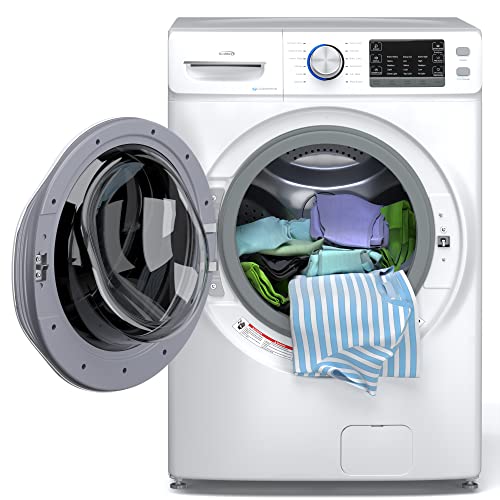
KoolMore 27 Inch Front Load 4.5 Cu Ft Washing Machine — Best Quiet Inverter
KoolMore builds its case on a component most buyers never see: an inverter motor. Inverter drive varies its speed continuously instead of banging between fixed steps, which trims noise, softens vibration and generally treats both the machine and the laundry room floor more gently. In a home where the washer lives behind a kitchen-adjacent door or under a bedroom, that quietness is not a luxury feature; it is the difference between evening laundry and forbidden laundry.
Around the motor, the specification stays competitive with the bigger names: steam for stain and freshening work, a water-plus function for loads that need a deeper fill than efficiency defaults allow, twelve cycles and a 20-minute quick wash for the gym kit emergency. The 27-inch width confirms it as a full member of the standard class. KoolMore asks you to trade a famous badge for a calmer machine, and in noise-sensitive homes that trade settles itself the first time a wash runs during a sleeping baby’s nap.
- Drum size: 4.5 cu. ft. in a 27-inch-wide cabinet
- Motor: quiet inverter drive
- Steam: steam function included
- Extras: water-plus option, 20-minute quick wash
- Cycles: 12 wash programmes
- Power: 120V
Strengths
- Inverter motor keeps noise and vibration noticeably civilised.
- Water-plus answers the front-load complaint about shallow fills.
- Quick wash handles small urgent loads in twenty minutes.
Trade-offs
- Brand recognition trails Kenmore and LG in laundry.
- No smart-home integration to report cycles to your phone.
- Service network is thinner than the legacy names.
Best for: apartments and open-plan homes where washer noise travels.
Not suited for: buyers who prioritise a national dealer network above all.

LG 5.0 Cu Ft Front Load Washer WM4200HWA — Best Step-Up Capacity
The LG WM4200HWA is where this guide steps deliberately beyond the successor class. Five cubic feet swallows king bedding, a week of towels or the muddy output of a youth sports weekend in a single drum, and LG wraps that volume in steam washing and a dedicated Allergiene cycle designed to use steam against common household allergens in fabrics. For allergy-managed households, that cycle is not decoration; it is the reason this model exists on the page.
SmartThinQ Wi-Fi connectivity completes the step-up story, bringing cycle notifications, remote glances at remaining time and downloadable specialty cycles for households that genuinely use an app. The cautions are physical rather than digital. A 5.0 drum tempts chronic overloading, which cleans worse and wears bearings faster, and the machine’s depth and door swing deserve the same tape-measure respect as any full-size unit. Buy it for bedding and allergen care, load it with discipline, and it justifies every inch of its step-up status.
- Drum size: 5.0 cu. ft., the largest here
- Steam: steam wash with Allergiene cycle
- Connectivity: SmartThinQ Wi-Fi enabled
- Controls: front panel with app support
- Finish: white
- Role in this guide: step-up from the 4.5 class
Strengths
- Largest drum here takes king bedding without a struggle.
- Allergiene steam cycle serves allergy-conscious households directly.
- Wi-Fi notifications end the forgotten-load-in-the-drum problem.
Trade-offs
- More capacity than small households will ever fill efficiently.
- Smart features need the app to deliver their full value.
- Big drums invite overloading, which undermines cleaning.
Best for: large families and bedding-heavy or allergy-managed laundry.
Not suited for: couples whose weekly wash would rattle around inside it.

BLACK+DECKER 2.7 Cu Ft Compact Front Load Washer — Best Compact Fit
Every size story needs its lower edge, and this BLACK+DECKER draws it honestly at 2.7 cu. ft. The cabinet is genuinely compact, built for apartment laundry closets, under-counter nooks and the narrow utility spaces where a 27-inch machine simply cannot go. Sixteen cycles and an LED display mean the small machine does not ask its owner to accept a stripped programme list as the price of admission, and for one or two people it covers the week’s laundry in a few modest loads.
What it cannot do is impersonate the 4.5 class. Bedding means duvet covers folded with intent and comforters sent out or washed elsewhere, and a family of five would run it daily. That is not a flaw; it is the definition of the compact category, and this guide includes the machine precisely so that small-space shoppers see a real option rather than a standard washer mislabelled as compact. Measure your closet, count your people, and the verdict writes itself either way.
- Drum size: 2.7 cu. ft. in a compact cabinet
- Cycles: 16 wash cycles
- Display: LED
- Format: compact cabinet for small laundry spaces
- Role in this guide: compact alternative below the 4.5 class
- Finish: white
Strengths
- Genuinely compact footprint fits closets standard machines cannot.
- Sixteen cycles is generous programming for the size class.
- Front-load efficiency suits apartment utility budgets.
Trade-offs
- Bulky bedding exceeds what the drum can handle well.
- Families will run it often enough to feel the small capacity.
- No steam or smart features at this size.
Best for: singles, couples and apartments with true compact laundry spaces.
Not suited for: families or anyone washing comforters at home weekly.
How Do the Six Compare Side by Side?
| Pick | Capacity | Steam | Defining trait |
|---|---|---|---|
| Kenmore 4.5 in Metallic Silver | 4.5 cu. ft. | Yes | Accelerated wash, metallic finish |
| Kenmore 4.5 in White | 4.5 cu. ft. | Yes | Same toolkit in classic white |
| BLACK+DECKER BFLW45M | 4.5 cu. ft. | No | 12 cycles, hoses included |
| KoolMore 27 Inch 4.5 | 4.5 cu. ft. | Yes | Quiet inverter motor |
| LG WM4200HWA | 5.0 cu. ft. | Yes | Allergiene cycle, Wi-Fi |
| BLACK+DECKER 2.7 Compact | 2.7 cu. ft. | No | True compact cabinet, 16 cycles |
The table tells the size story at a glance. Four machines cluster at the 4.5 capacity that inherited the market, one reaches up to 5.0 for bedding households, and one drops to 2.7 for spaces the others cannot enter. Steam divides the field three ways: present on the Kenmores, the KoolMore and the LG, absent on both BLACK+DECKER models, which answer with cycle counts and completeness instead. Nobody on this page is a 3.9, and the guide’s honesty about that is the point: buy the successor that fits your room and your loads.
What Happened to the 3.9 Cu Ft Front Loader?
Disappearing size classes rarely get an announcement. Manufacturers consolidate platforms quietly, and the 3.9 drum shared so much with its 4.5 sibling — cabinet, door, motor family — that keeping both stopped making sense on a production line. Retail listings followed the factories. A few older models lingered in warehouses and regional shops, but on Amazon US the class has effectively closed, which is why a search for it returns a page of near-misses in other capacities.
Owners of a working 3.9 machine lose nothing by this history. The class was sound, its parts ecosystem persists, and the correct response to a healthy washer is to keep washing. The disappearance only matters at replacement time, when the shopper discovers the heir is half a cubic foot larger and, usually, a little kinder to bulky loads than the machine it replaces.
Will a 4.5 Cu Ft Washer Fit Where a 3.9 Stood?
Usually, yes, and the tape measure can confirm it in minutes. Front-load platforms standardised around a 27-inch width and roughly 39-inch height years ago, and the capacity growth came mostly from drum depth and diameter inside a familiar cabinet. The dimensions that actually bite are overall depth with the door closed, the extra inches the door needs to swing, and the space behind for hoses and the drain standpipe. Measure all three against the new model’s manual rather than assuming the swap is automatic.
Stacking and pedestals change the arithmetic. A 4.5 machine under an existing dryer needs the manufacturer’s stacking kit for its own model family, and pedestals add height that can push a stack into low bulkheads in basement laundry rooms. If your old 3.9 sat in a closet, check the door trim clearance with the new machine’s door fully open, because laundry closet doors are the most common casualty of an otherwise successful upgrade.
How Much Laundry Does a Cubic Foot Really Hold?
Capacity figures describe drum volume, not a promise about any particular pile of clothes. As a working translation, a 4.5 cu. ft. drum handles a family-size load of mixed laundry or a queen comforter with room to tumble, while the LG’s 5.0 extends that comfort to king bedding. The compact’s 2.7 suits several days of one person’s clothing or a couple’s lighter rotation. The universal rule underneath the numbers is headroom: a drum filled about two-thirds washes cleanest, because the clothes need space to lift and drop rather than rotate as a single damp log.
Overloading is the quiet saboteur of front-load ownership. It defeats the wash action, traps detergent in folds, stresses bearings and suspension, and leaves the load smelling like the effort failed. If your household routinely produces loads that strain a 4.5 drum, the answer is the LG’s extra volume or a second weekly load, never a determined shove and a prayer. Machines forgive many things; physics is not among them.
What Does Steam Actually Do Inside a Washer?
Washer steam is a supporting actor. Generated in small quantities and introduced during the wash or a dedicated freshen cycle, it relaxes fabric fibres so detergent and water reach soil more easily, and it helps release the wrinkles that set during a long sit in the drum. On the Kenmore pair it is framed as stain treatment, on the KoolMore as part of the freshening toolkit, and on the LG it powers the Allergiene cycle aimed at reducing common allergens carried in bedding and clothing.
What steam does not do is replace hot water, detergent or sorting. A grass stain still wants pre-treatment, a grease mark still wants the right chemistry, and a load of whites still wants its own company. Treat steam as a ten-percent improvement across many loads rather than a miracle across a few, and the feature’s value across the four machines that carry it prices itself fairly.
How Do You Keep a Front Loader Smelling Clean?
The front loader’s one famous vice is odour, and it is a habit problem rather than a design curse. The door gasket’s folds trap moisture and lint, so wipe them after the last load of the day and leave the door and detergent drawer ajar between washes so the drum dries. Run the machine’s tub-clean cycle monthly with the cleaner or programme the manual specifies, and use detergent doses measured for high-efficiency machines, because excess suds become residue, and residue becomes smell.
Households that follow that small liturgy report years of neutral-smelling laundry. Households that close a wet drum for a fortnight between holiday loads meet the infamous musk and blame the format. The six machines here all carry the same gasket physics; the difference in outcomes will be written by the owner’s Sunday habits, not by the badge on the door.
What Should You Check Before Ordering Any Full-Size Washer?
Delivery path first: a 27-inch machine still has to pass doorways, hallway turns and possibly a staircase, and the path’s tightest inch decides whether installation day is routine or theatrical. Then services: hot and cold supply with working shutoffs, a drain that can accept the discharge height in the manual, and a standard outlet within cord reach. Front loaders also ask for a floor that does not bounce, because a drum spinning at speed will find every spring in a timber floor and announce it to the house.
Finally, decide the dryer question in the same breath. A washer bought alone should still anticipate its partner’s width, door swing and vent path, especially in closets where the pair interlock. The Kenmore twins make that planning easy by offering a matched-suite logic in two finishes, while the compact BLACK+DECKER often pairs with compact or ventless drying in small spaces. Appliances bought as strangers tend to live as strangers.
Which Mistakes Do Front-Load Buyers Regret Most?
The standing regrets are remarkably consistent. Buying capacity by headline instead of by bedding: the household that washes a king comforter monthly needs the LG, whatever the other numbers said. Ignoring door swing in a closet and discovering the laundry door no longer closes. Skipping the gasket routine until the smell arrives. And choosing a smart washer for a household that will never install the app, paying for a radio that only ever reports the time.
A newer regret belongs to this size transition specifically: hunting for months for a true 3.9 replacement while the old machine limps, when the 4.5 successor would have fitted the same alcove in the first week. The class has moved. Let it move you with it, half a cubic foot and all.
How Does a Front Loader Treat Delicate and Bulky Loads Differently?
A front loader’s tumbling action is inherently gentler than a central agitator’s twisting, which is why delicates, knitwear and modern technical fabrics generally prefer it. The drum lifts and drops clothing through water rather than dragging it around a post, so fibres keep their shape and pilling slows. Bulky items benefit from the same geometry provided they have room: a comforter in a 4.5 drum folds and unfolds as it tumbles, while the same comforter in the compact’s 2.7 drum mostly rotates in place and emerges with dry-hearted patches.
Cycle selection completes the picture. Delicate programmes slow the tumble and limit spin speeds to protect seams and elastics; bulky programmes add water and patience. The sixteen cycles on the little BLACK+DECKER and the dozen on its full-size sibling exist because fabric care is a matrix, not a single normal setting, and households that learn their machine’s two or three specialty cycles get visibly better results than households that press one button for a decade.
What Does Installation Day Actually Involve?
A front-load installation is plumbing, levelling and patience in equal thirds. The machine must sit dead level on all four feet or it will walk during spin, sometimes literally across the floor, so the installer’s spirit level matters more than any smart feature. Shipping bolts that locked the drum for transit must come out before the first wash — running a bolted drum is the one unforced error that can damage a new machine in its first hour — and the manual’s list of transit hardware should be checked off physically, bolt by bolt.
After levelling comes the test wash: an empty rinse and spin while everyone watches the hoses, the drain and the floor for the leaks that only appear under pressure. Run it before the delivery crew leaves or before the weekend ends if you installed it yourself. A washer that passes a watched test cycle and sits level will generally settle into years of unremarkable service, which is the highest praise laundry equipment ever earns.
How Do the Kenmore Twins Differ From the Rest of the 4.5 Class?
Two of the four mainstream picks wear the same surname, so the comparison deserves its own moment. The Kenmore pair stake everything on the steam-plus-speed combination: steam for the loads that arrive with evidence of the week’s activities on them, acceleration for the loads that simply need to be done before bedtime. That pairing maps neatly onto family laundry, where the twin pressures are soil and schedule. The metallic silver twin adds the finish that best survives a working laundry room; the white twin adds compatibility with the installed base of American laundry suites.
Against them, the BLACK+DECKER full-size argues completeness: more cycles on the dial, hoses in the carton, a display that explains itself, and no steam system to maintain or pay for. The KoolMore argues refinement: an inverter motor’s manners, a water-plus concession to everyone who ever peered into a front loader and doubted the puddle at the bottom, and a quick wash quick enough to matter. Four machines, one capacity, four distinct theories of what a washer owes its owner beyond a clean drum of clothes.
The practical way to choose among them is to name your household’s recurring laundry argument. If the argument is stains, buy steam and buy a Kenmore. If it is noise, buy the inverter and buy the KoolMore. If it is a household of five people sharing one machine and needing programmes everyone understands, the BLACK+DECKER’s clarity wins. If it is genuinely all three arguments in rotation, the Kenmores’ breadth makes them the safest single answer, which is why they lead this guide.
What Does the Jump From 4.5 to 5.0 Cu Ft Change at Home?
Half a cubic foot sounds like a rounding error until it is measured in laundry. In the LG’s drum it is the difference between a king comforter washing as a load and a king comforter visiting a laundromat; between a week of family towels in one cycle and the same towels in a cycle and a half; between a muddy sports weekend absorbed on Sunday night and a backlog that colonises Monday. Capacity is time, expressed in cubic feet, and households that generate laundry in bulk feel the step-up as hours returned.
The step-up charges rent for those hours. Bigger drums tempt smaller loads to rattle around inefficiently, and a household of two can find itself running a 5.0 machine half-empty most of the year, spending water-heating energy on air. The LG also asks its owner to engage with an app ecosystem to unlock its full personality, which delights some households and faintly irritates others every single week. Neither response is wrong; both are predictable, and predicting yours is the whole of the decision.
There is also the matter of the room itself. A step-up machine in a small laundry closet consumes visual and physical margin that a standard model leaves for baskets, shelving and the human being folding clothes. Measure the working space you will stand in, not merely the alcove the machine will occupy. The best washer is the one whose size improves the laundry routine of the whole room, door swings, elbows and all.
How Should a Small Household Choose Between Compact and Standard?
The compact BLACK+DECKER tempts small households with its honest dimensions, and for a true closet installation the temptation is simply correct: a standard machine that cannot fit is not a bargain at any specification. Where the space can take a 27-inch machine, though, the calculus flips. A standard 4.5 washer gives a couple growing room — guests, a dog, a baby, a winter of heavy layers — while the compact caps the household’s future at 2.7 cubic feet and a bedding workaround.
Frequency is the hidden variable. A compact run daily accumulates more cycles, more door openings and more cumulative wear than a standard machine run every other day on the same wardrobe. Singles with light laundry genuinely live the first pattern comfortably; couples with workwear, gym kits and weekend hobbies drift toward the second faster than they expect. The honest question is not how much laundry you have this month but how much the household plausibly generates on its busiest recurring week.
Stacking possibilities can settle the argument. In a closet, a compact washer under a compact dryer forms a complete laundry in the footprint of a wardrobe, which is a genuine triumph of apartment design. In a full laundry room, that same compact looks like capacity left on the table. Context, as ever in appliances, is not a detail; it is the decision.
What Do Cycle Names Mean, and Which Ones Matter?
Cycle menus inflate like restaurant wine lists, so it helps to know the courses that matter. Normal, heavy duty, delicates, quick wash and tub clean do ninety percent of a household’s work between them. Steam refresh, allergen cycles and specialty downloads serve specific, real needs for specific households and sit unused in others. The BLACK+DECKER full-size’s twelve cycles and the compact’s sixteen both cover the essential five with room to spare; the difference in count matters less than whether your machine’s version of each essential behaves sensibly.
Soil and temperature settings quietly matter more than named programmes. A normal cycle at the right temperature with the right dose outperforms a exotic cycle chosen at random, and modern machines sense load weight to set water and time accordingly. Learn your machine’s logic with three or four test loads in the first week — whites, mixed colours, delicates, towels — and you will understand it better than a year of button roulette teaches.
Quick wash deserves a special note because two picks here make a point of it. The KoolMore’s twenty-minute programme and the Kenmores’ accelerated system exist for the small, lightly soiled load that life produces at inconvenient moments: the uniform discovered at 9 p.m., the favourite shirt needed tomorrow. Used for genuinely light loads they are liberating. Used for a full drum of mud they are theatre. Cycle literacy is knowing which situation you are in.
How Does a Front Loader Fit a Cottage Laundry Room?
Cottage laundry spaces share a personality: compact, often repurposed, and plumbed with more enthusiasm than planning. A front loader suits them because it stacks, because it can slide under a counter with a folding surface on top, and because its door opens toward the room rather than demanding the vertical clearance a top loader’s lid requires. The standard 4.5 class exploits all of that in a footprint most cottage utility nooks can absorb, which is another quiet reason the class became the default.
The constraints to respect are floor and frost. Cottage floors, particularly timber ones over crawl spaces, bounce under spin loads unless the machine is levelled carefully and sometimes braced. Cottage plumbing in cold climates wants shutoff discipline in winter for seasonal properties, and a washer left full of trapped water in an unheated room is a burst pipe wearing an appliance costume. Drain the machine as the manual directs when the cottage closes for the season.
Within those disciplines, the picks divide by household rhythm. A year-round cottage home deserves the Kenmore or KoolMore treatment. A weekend cottage with two people’s light laundry may find the compact BLACK+DECKER the most honest machine on this page, sipping space in a property where every cupboard earns its keep twice over.
What Should the First Month With a New Washer Teach You?
A new washer’s first month is a calibration exercise for its owner. Run the loads you actually live with and watch the machine’s choices: how it distributes a mixed load before spinning, how long its normal cycle truly takes against the display’s optimism, how dry the spin leaves towels bound for a line versus a dryer. Front loaders reward this attention because their sensing systems adapt cycle behaviour to load weight, and loads that surprise the sensors — a single heavy bath mat among light clothes — produce the theatrical imbalances that owners misread as faults.
Detergent dosing deserves its own experiment in week one. High-efficiency machines want far less detergent than habit pours, and the symptoms of excess — lingering suds, a drum that smells faintly sweet and stale, clothes that feel coated — masquerade as machine problems. Measure with the cap, then try slightly less, and let the laundry’s cleanliness arbitrate. Most households discover their correct dose is a fraction of the one printed on a standard detergent bottle’s most generous line.
By the end of the month you should know your machine’s three honest cycles by heart, have wiped its gasket often enough that the gesture is automatic, and have registered the warranty while the receipt was still findable. Everything after that is simply laundry, which is precisely the unremarkable outcome a good washer is bought to produce.
How Do Front Loaders Handle a Household’s Worst Laundry Days?
Every household has a laundry worst case: the stomach-bug night, the mud-season weekend, the sports tournament that ends in rain. Front loaders meet those days with two virtues. The first is throughput discipline — a 4.5 drum clears family-scale emergencies in a handful of cycles rather than a day of small loads. The second is extraction: high spin speeds pull so much water out that the dryer or the line finishes quickly, which matters when the next load is already waiting its turn in the basket.
Sanitising confidence on those days comes from temperature and chemistry more than from badges. Use the hottest cycle the fabrics tolerate, dose correctly, and let steam-equipped models — the Kenmores, the KoolMore, the LG — add their assist where the load justifies it. Then clean the machine itself afterwards: a tub-clean cycle after an illness load is cheap insurance and good manners toward the next load of baby clothes.
The compact deserves its own sentence in this section because its worst day looks different. Two people’s illnesses it handles in stride; a family’s overwhelms it by arithmetic alone. That is not a criticism but a sizing truth, and it is why this guide insists on matching the drum to the household’s worst recurring week rather than its average one.
Why Does Door Swing Deserve More Respect Than Capacity?
Capacity is a number on a listing; door swing is a fact you collide with weekly. A front loader’s door opens toward the user and stays open at angles that can block a narrow laundry room’s passage, catch a closet door’s swing, or invite a child’s climb. Before ordering, stand in the room and mime the whole routine: basket down, door open, load in, door closed, basket up. The machine whose door fights that choreography will irritate its owner ten thousand times, long after the capacity debate is forgotten.
Left-swing doors are the format’s standard here, and laundry rooms are built in both mirror images. If your room’s layout puts the washer’s hinge on the wrong side for your dryer transfer — wet clothes travelling from washer door to dryer door across your body — the daily awkwardness compounds. Some households solve it by swapping the pair’s positions, which plumbing sometimes allows and sometimes firmly refuses. Decide on paper, with the room’s measurements in hand, rather than on installation day with the machine in the hall.
Pedestals and stacking rearrange the swing question again, raising the door to a friendlier height or placing it beneath a dryer’s door in a closet tower. Both arrangements appear in this class’s accessory world. The principle survives every configuration: the best washer is the one whose door, drum and controls fit the room’s human traffic, and that fitness is measurable before any money moves.
What Does Living With Steam Cycles Cost in Time?
Steam features sell themselves in the showroom and bill themselves in the laundry room, in minutes. A steam treatment extends its cycle, a freshen programme occupies the machine for a load that is not really being washed, and the household that steams everything soon notices the laundry taking longer than the old machine’s plain cycles did. Used surgically — the stained load, the allergen bedding, the shirts that sat too long — steam’s time cost is trivial against its results. Used as a default, it becomes a tax on every wash day.
The four steam carriers here let the owner choose per load, which is the correct design. Nobody’s laundry is uniformly filthy, and the Kenmores, KoolMore and LG all run perfectly respectable plain cycles when steam stays off. Judge the feature by your worst loads, enjoy it on those, and let the everyday loads run lean and quick. That discipline is the difference between steam as a tool and steam as a ritual.
How Should You Read an Energy Star Claim on a Washer?
Energy Star certification on the Kenmore pair and the full-size BLACK+DECKER means those models met a tested efficiency standard for energy and water at certification time; it is a floor of competence, not a ranking among certified machines. Within the certified field, the owner’s behaviour still writes most of the utility bill: warm and cold washes where fabrics allow, full-but-sensible loads, and spin speeds high enough that the dryer inherits damp rather than wet laundry.
The uncertified picks are not thereby wasteful — front loaders as a format use dramatically less water than the top loaders they replaced in most homes — but the certification gives a verified baseline that unlabelled claims cannot. Households replacing a fifteen-year-old machine will see the format’s savings regardless of badge; households choosing within this page can let the label break a tie, exactly as it broke ours during selection.
When Should You Repair the Old 3.9 Instead of Replacing It?
A surviving 3.9 machine with a single honest fault — a pump, a belt-era equivalent, a door switch — often deserves its repair, because the class was durable and its replacement budget buys more life per pound spent than a new machine’s first year does. The calculation turns when faults arrive in company: bearings rumbling while the board flickers while the gasket tears. At that point the washer is not broken in three places; it is finished in one long sentence, and repair money becomes a down payment on the 4.5 successor anyway.
Sentiment deserves one honest line in the ledger. A washer that has served a household through a decade of family life has earned its replacement being chosen carefully rather than desperately at a weekend breakdown. Shop this page while the old machine still turns, measure the alcove at leisure, and let the successor arrive as a planned upgrade instead of an emergency.
Final Recommendation
Accept the market’s verdict and this choice becomes refreshingly simple. The 3.9 class has retired, its 4.5 heirs are better machines for the same footprint, and the only real questions are finish, noise, steam and the two edges of the size map. The silver Kenmore is the default recommendation for a family replacing an older mid-size washer, the white Kenmore serves matching suites, the BLACK+DECKER full-size rewards cycle tinkerers, and the KoolMore quiets the whole subject down. Step up to the LG if bedding rules your laundry life, and step down to the compact if your closet, not your ambition, sets the dimensions. Whichever machine you land on, level it carefully, remove its shipping bolts before the first cycle, and give its gasket the small weekly kindness that keeps front loaders sweet. Buy the size your room and your loads actually describe, and the missing 3.9 will not be missed at all.
Frequently Asked Questions
Can I still buy a true 3.9 cu. ft. front-load washer?
On Amazon US, effectively no: the class has been absorbed by 4.5 cu. ft. models that share the old footprint. Occasional old stock appears through other channels, but the supported, warrantied successor class is the one reviewed here. The secondhand market is the only remaining source, and it sells machines without warranties, service history or any guarantee beyond the seller’s word.
Will a 4.5 cu. ft. washer use more water than my old 3.9?
Front loaders meter water by load weight and cycle, so a half-empty 4.5 drum does not drink like a full one. Matched load for load, modern 4.5 machines are generally as frugal as the class they replaced, and their Energy Star certifications reflect tested efficiency. The larger drum can even save water across a week, because loads that once needed two cycles in a smaller machine finish in one, and the household’s total heated water falls even though the machine itself grew.
Is steam worth having on a family washer?
For households fighting set-in stains, sports kit odours or allergen concerns, steam earns its place across the Kenmore, KoolMore and LG picks here. For households whose laundry is mostly light everyday wear, it is a pleasant extra rather than a necessity.
How long do front-load washers typically last?
With level installation, sensible loads and the gasket routine described above, a front loader commonly serves a household for many years. Bearings, pumps and control boards are the usual mid-life service items across every brand on this page.
Can the compact BLACK+DECKER wash a comforter?
A thin twin blanket is realistic; a plump queen or king comforter is not, because the 2.7 drum leaves no room for the item to tumble and rinse. Compact owners usually rotate bedding through a laundromat’s large machines a few times a year.
Related Guides
Washer shopping rarely travels alone, and the guides below cover the purchases that usually share the delivery truck. If agitator machines are still on your household’s table, Best Agitator Top Loader Washers argues the other format’s case, while cold storage gets its hearing in Best 12v Portable Refrigerators for the road and Best 25 Cu Ft Refrigerators for the kitchen itself.


