What's inside
- Key Takeaways
- Quick Picks
- How We Chose These Picks
- The Best American Made Washers, Reviewed One by One
- How Do the Six Compare Side by Side?
- What Does Made in USA Actually Mean on an Appliance?
- Why Does a Single Factory in Ripon Matter?
- How Do American Brands Differ From American Manufacture?
- What Practical Advantages Does Domestic Production Bring an Owner?
- How Should You Verify an Origin Claim Before Buying?
- Which Mistakes Do Origin-Focused Buyers Regret Most?
- How Does the Capacity Question Interact With the Origin Question?
- How Did Ripon Become a Laundry Town?
- What Does the American-Brand Tier Offer a Practical Buyer?
- How Long Do These Machines Serve, and What Decides It?
- What Should an Origin Buyer Ask at the Point of Purchase?
- How Does the ADA Model Change the Accessibility Conversation?
- What Happens When a Domestically Built Washer Needs a Part in Year Ten?
- How Should Families Reconcile Patriotism With a Six-Person Laundry Pile?
- What Does This Guide Refuse to Claim, and Why?
- How Do These Washers Suit Rural and Small-Town Owners?
- What Is the Resale and Hand-Me-Down Story?
- How Should a Buyer Weigh Origin Against Format?
- Final Recommendation
- Frequently Asked Questions
- Related Guides
As an Amazon Associate I earn from qualifying purchases. This post may contain affiliate links at no extra cost to you.
cottageverdict.com is reader-supported. When you buy through links on our site, we may earn an affiliate commission.
Where a washer is built decides things a spec sheet never mentions: how fast parts travel when something wears out, whose factory answers when a design flaw surfaces, and whether the machine’s maker can walk the floor where it was assembled. Shoppers searching for the best american made washers are usually buying that accountability as much as they are buying a drum and a motor. This guide takes the question seriously and answers it precisely, because the phrase American made covers several different realities, and a buyer deserves to know which one each badge on this page represents.
Where to buy: all six machines are sold through Amazon, and the names in the Quick Picks table, the review headings and the comparison table link to the listings so you can check price on Amazon and read the manufacturer’s own origin wording for the exact model. The Speed Queen TR5003WN carries this guide’s clearest origin story, the matte black Speed Queen adds accessibility and quiet to it, and the Kenmore front loader represents the large-capacity American-brand alternative discussed carefully below.
Precision first, because this category demands it. One brand in this guide earns the unqualified phrase: Speed Queen designs and builds its washers in Ripon, Wisconsin, and says so plainly, so this guide says so plainly too. The other two names here, Kenmore and Amana, are American brands whose manufacturers describe United States assembly for their laundry lines; we present them in exactly those cautious terms, as American brands with US assembly per the makers’ own statements, and we flag the distinction wherever it matters rather than blurring it into a flag-waving headline.
Key Takeaways
- Speed Queen is the one brand here we call Made in USA without qualification: its washers are built in Ripon, Wisconsin.
- Four of the six picks are Speed Queen models, spanning knob control, digital control and an ADA-focused matte black design.
- Kenmore and Amana appear as American brands with US assembly as described by their manufacturers, worded carefully rather than absolutely.
- Domestic manufacture shows up practically in parts availability, service familiarity and commercial-grade construction.
- The Kenmore is the capacity pick at 4.5 cu. ft. with steam; the Speed Queens trade drum size for build and longevity.
- Origin claims deserve model-level reading: check the exact listing and rating plate rather than trusting a brand’s general halo.
Quick Picks
| Pick | Badge | Why it earns its place |
|---|---|---|
| Speed Queen TR5003WN Top Load Washer 3.2 Cu Ft | Best Made in USA Overall | Built in Ripon, Wisconsin with a stainless tub and commercial mechanics — the complete domestic-manufacture argument. |
| Speed Queen TR3003WN Top Load Washer 3.2 Cu Ft | Best Made in USA Simplicity | The Ripon-built formula at its most elemental: knob, agitator, stainless tub, nothing else to break. |
| Speed Queen TR7003WN Top Load Washer 3.2 Cu Ft | Best Made in USA Digital | Wisconsin construction with digital controls and eight cycles for households that want precision too. |
| Speed Queen ADA 3.2 Cu Ft Top Load Washer Matte Black | Best Made in USA Accessibility | An ADA-focused, ultra-quiet Ripon-built washer in matte black, designed for reach and ease of use. |
| Kenmore 4.5 Cu Ft Front Load Washer White | Best American Brand Capacity | An American brand’s 4.5 cu. ft. steam front loader, presented with the cautious origin wording it warrants. |
| Amana NTW4516FW 3.5 Cu Ft Top Load Washer | Best American Brand Value | A long-standing American brand’s simplest agitator machine, with US assembly per the manufacturer’s statements. |
How We Chose These Picks
Origin claims were audited before features were weighed, because a guide with this title lives or dies on the honesty of its labels. We separated the field into three tiers of claim: manufacture that a brand states directly and specifically for its machines, brand heritage with assembly described by the manufacturer, and everything vaguer, which we excluded. Speed Queen’s Ripon, Wisconsin production anchors the first tier alone, and the guide’s language follows that audit exactly — unqualified where the evidence is unqualified, hedged where the honest claim is narrower.
Within that framework we chose machines the way this site always does: by the laundry they will actually do. The four Speed Queens divide by control style, accessibility and finish while sharing one factory and one construction philosophy. The Kenmore contributes the thing the Speed Queens deliberately do not: a large steam front-load drum from an American brand. The Amana contributes the budget end of the American-brand story, a simple agitator machine whose value case does not depend on embellishing its birthplace. Every pick had to wash well before its origin was allowed to matter. Where a manufacturer’s language was ambiguous, we chose the weaker description rather than the stronger one, and we recommend buyers hold every seller to the same standard.
The Best American Made Washers, Reviewed One by One

Speed Queen TR5003WN Top Load Washer 3.2 Cu Ft — Best Made in USA Overall
Start with the sentence this guide can say about no other pick: the Speed Queen TR5003WN is made in the USA, designed and built by Alliance Laundry Systems in Ripon, Wisconsin, where the company has manufactured laundry equipment for generations. That single-factory story is not a marketing garnish on this machine; it explains its character. A company that builds commercial washers for laundromats in the same Wisconsin tradition builds its domestic machines with a stainless steel tub, a commercial-style agitator and an 840 RPM spin, because those are the decisions its factory knows how to stand behind for decades.
Living with the TR5003WN means accepting its deliberate trade. The drum is 3.2 cu. ft., sized for couples and small households rather than for bedding mountains, and the knob controls offer competence without customisation. In exchange, every load runs through machinery built a few states away by a company whose service and parts culture is organised around keeping washers alive, not replacing them. For the buyer whose search began with origin, this is the machine the search was describing: American manufacture you can name to the town, wrapped around commercial laundry engineering.
- Origin: Made in USA — Ripon, Wisconsin
- Drum: 3.2 cu. ft., stainless steel tub
- Wash system: commercial-style agitator
- Spin: up to 840 RPM maximum
- Controls: knob control
- Width: 26 inches, white finish
Strengths
- The clearest, most specific American-manufacture claim in laundry.
- Commercial construction aimed at decades of service.
- Domestic parts and service culture built around repair.
Trade-offs
- Small drum excludes bulky bedding from home washing.
- Knob controls offer no cycle fine-tuning.
- Premium pricing reflects build, not capacity.
Best for: buyers who want verifiable US manufacture and commercial durability.
Not suited for: large families needing maximum drum volume.

Speed Queen TR3003WN Top Load Washer 3.2 Cu Ft — Best Made in USA Simplicity
The TR3003WN is the Ripon story told without adjectives. Same Wisconsin factory, same stainless tub and agitator philosophy, same 840 RPM extraction as its TR5003WN sibling, with the control panel reduced to the essentials a laundromat customer could operate half-asleep. For origin-focused buyers, the appeal compounds: a machine designed for simplicity, built domestically by a manufacturer that still answers for it, presents the fewest possible things to fail across a long American service life.
This is the pick for households that measure value in years per purchase and interventions per decade. Cottages, workshops, rental houses under careful ownership and couples with modest laundry all fit its brief. What it will not do is grow with a family or impress a feature enthusiast, and its price only makes sense across the long horizon its construction promises. Buyers shopping on a three-year replacement cycle should look at the Amana below and spend less; buyers shopping on a twenty-year horizon are exactly who Ripon built this for.
- Origin: Made in USA — Ripon, Wisconsin
- Drum: 3.2 cu. ft., stainless steel tub
- Wash system: commercial-style agitator
- Spin: up to 840 RPM maximum
- Controls: knob control, essential cycles
- Width: 26 inches, white finish
Strengths
- Domestic manufacture paired with the simplest possible controls.
- Few failure points across a very long intended life.
- Commercial spin performance keeps drying costs down.
Trade-offs
- No display, no customisation, no novelty cycles.
- Capacity suits small households only.
- Value case collapses if you replace machines frequently.
Best for: long-horizon owners who want American-built simplicity.
Not suited for: growing families or feature-driven shoppers.

Speed Queen TR7003WN Top Load Washer 3.2 Cu Ft — Best Made in USA Digital
Some buyers want the Wisconsin factory and the modern panel, and the TR7003WN is built for exactly that overlap. Digital controls and eight wash cycles ride on the same Ripon-made foundation as its siblings: stainless tub, commercial agitator action, 840 RPM spin. The electronics add feedback and precision — clearer cycle information, finer choices for mixed wardrobes — without asking the owner to trade away the construction that justified choosing an American-built machine in the first place.
The honest accounting includes the electronics themselves. A digital control board is one more component class than a knob machine carries, even a board built into a domestic product by a manufacturer with commercial discipline. Households that regard that as a fair price for precision will be happy here for a long time. Households that want the factory story with the absolute minimum of complexity should step one rung down to the TR5003WN or TR3003WN and enjoy the same Wisconsin steel with fewer circuits in the conversation.
- Origin: Made in USA — Ripon, Wisconsin
- Drum: 3.2 cu. ft., stainless steel tub
- Wash system: commercial-style agitator
- Spin: up to 840 RPM maximum
- Controls: digital, 8 wash cycles
- Width: 26 inches, white finish
Strengths
- US manufacture with the control precision modern households expect.
- Eight cycles handle mixed wardrobes more delicately.
- Same commercial tub and spin as the knob models.
Trade-offs
- Electronics add a repair category simpler siblings avoid.
- Drum remains a small-household 3.2 cu. ft.
- Top specification in the Speed Queen trio costs accordingly.
Best for: buyers wanting Wisconsin build quality plus digital control.
Not suited for: minimalists or large-load households.
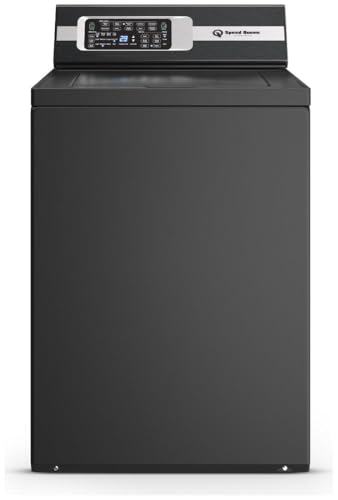
Speed Queen ADA 3.2 Cu Ft Top Load Washer Matte Black — Best Made in USA Accessibility
The fourth Speed Queen widens the origin story to include the people other washers forget. Built in the same Ripon, Wisconsin tradition, this model is designed around ADA considerations — controls and loading arranged for reach and ease — and described by its maker as ultra-quiet, a quality that matters in the smaller, shared living spaces where accessibility is usually being designed in. The matte black finish completes a machine that treats its brief with unusual dignity: accessible appliances rarely get to look this deliberate.
Its 3.2 cu. ft. drum keeps loads manageable in size as well as in reach, which suits the single-person and couple households accessibility planning usually serves. The cautions are the practical ones: confirm the control heights and door or lid clearances against the specific user and room, because ADA intent still has to meet an individual body and an individual laundry layout. For the household that needs both halves of this machine’s promise — American manufacture and accessible design — nothing else on this page, or many other pages, answers as directly.
- Origin: Made in USA — Ripon, Wisconsin
- Drum: 3.2 cu. ft. top load
- Design focus: ADA-oriented controls and access
- Noise: ultra-quiet positioning by the maker
- Finish: matte black
- Role here: accessibility-first domestic build
Strengths
- Accessible design from a US manufacturer, a rare combination.
- Ultra-quiet character suits apartments and shared spaces.
- Matte black finish looks intentional rather than institutional.
Trade-offs
- Accessibility fit must be verified against the individual user.
- Small drum limits family and bedding loads.
- Specialist model, so compare its exact specification carefully.
Best for: households designing laundry around mobility and reach needs.
Not suited for: high-volume family laundry.

Kenmore 4.5 Cu Ft Front Load Washer White — Best American Brand Capacity
Kenmore’s place in this guide needs its wording kept straight, so here it is: Kenmore is a long-standing American brand, and its manufacturer describes United States assembly for its laundry products; this guide therefore presents the machine as an American-brand washer assembled in the USA per the maker’s statements, not with the unqualified Made in USA label reserved above for Speed Queen. That distinction is not a dismissal. For many buyers, an American brand with domestic assembly, a national service footprint and a century of laundry rooms behind it is exactly the level of domestic connection they came looking for.
As a machine, it answers the Speed Queens’ deliberate limitation head-on. The 4.5 cu. ft. front-load drum takes family loads and queen bedding the 3.2 drums cannot, steam treatment works on stains and freshening, accelerated cycles keep the week moving, and touch controls present it all cleanly. Households that need capacity first and origin second — but still want that origin to be an American brand with US assembly — will find this the most complete compromise on the page. Read the listing’s own origin language for the final word, as this guide recommends for every model here.
- Origin wording: American brand; US assembly per manufacturer statements
- Drum: 4.5 cu. ft., front load
- Steam: stain-removing steam treatment
- Speed: accelerated wash option
- Controls: touch panel
- Efficiency: ENERGY STAR certified; white finish
Strengths
- Largest drum here, with steam for family laundry realities.
- American brand heritage with a broad service footprint.
- Front-load efficiency suits utility-conscious households.
Trade-offs
- Origin claim is brand-and-assembly, not the Speed Queen standard.
- Front-load format needs the gasket-care routine.
- Touch controls will not convert knob loyalists.
Best for: families wanting capacity from an American brand with US assembly.
Not suited for: buyers requiring an unqualified Made in USA label.

Amana NTW4516FW 3.5 Cu Ft Top Load Washer — Best American Brand Value
Amana closes the list with the same careful wording as the Kenmore and a very different machine. Amana is an American brand with deep roots in United States appliance manufacturing, and its maker describes US assembly for its laundry line; we describe this washer in those terms and no stronger. What the buyer gets is the traditional agitator format at its most accessible: a 3.5 cu. ft. drum, straightforward cycles, and a design language that any American technician of the last forty years would recognise on sight.
That familiarity is itself a domestic-manufacture dividend. Machines from long-running American brand lines accumulate an ecosystem — parts in regional warehouses, technicians trained on the platform, manuals and knowledge everywhere — that functions as a second warranty. The NTW4516FW will not steam, will not connect and will not swallow a king comforter, and it does not pretend otherwise on any axis, origin included. For rentals, first homes and utility rooms that want an American-brand agitator washer at the gentlest cost in this guide, its honesty is the recommendation.
- Origin wording: American brand; US assembly per manufacturer statements
- Drum: 3.5 cu. ft., top load
- Wash system: traditional central agitator
- Controls: straightforward cycle selection
- Role here: value end of the American-brand field
- Finish: white
Strengths
- Most accessible price point among these American-brand picks.
- Huge service and parts familiarity across the country.
- Simple agitator format suits rentals and utility rooms.
Trade-offs
- Origin wording is assembly-level, not unqualified manufacture.
- Smaller drum and basic feature set by design.
- No steam, speed or smart options on board.
Best for: value buyers who want an American-brand machine, plainly described.
Not suited for: buyers who need the unqualified Made in USA claim.
How Do the Six Compare Side by Side?
| Pick | Origin wording used here | Drum | Controls |
|---|---|---|---|
| Speed Queen TR5003WN | Made in USA, Ripon WI | 3.2 cu. ft. | Knob |
| Speed Queen TR3003WN | Made in USA, Ripon WI | 3.2 cu. ft. | Knob |
| Speed Queen TR7003WN | Made in USA, Ripon WI | 3.2 cu. ft. | Digital |
| Speed Queen ADA Matte Black | Made in USA, Ripon WI | 3.2 cu. ft. | ADA-focused |
| Kenmore 4.5 White | American brand, US assembly per maker | 4.5 cu. ft. | Touch |
| Amana NTW4516FW | American brand, US assembly per maker | 3.5 cu. ft. | Traditional |
The origin column is the table’s reason to exist. Four machines carry the specific, verifiable claim — built in Ripon, Wisconsin — and two carry the broader, still meaningful claim of American brands with manufacturer-described US assembly. Everything else in the table flows from that split: the Ripon machines optimise for construction and longevity at small capacity, while the brand machines optimise for capacity and value. Neither column of virtues cancels the other; they simply serve different definitions of buying American.
What Does Made in USA Actually Mean on an Appliance?
Regulators give the phrase a demanding meaning: an unqualified Made in USA claim is supposed to indicate that a product is all or virtually all made in the United States, from domestic parts and labour, with negligible foreign content. Real appliances live in a global parts economy, which is why careful brands qualify their language — designed in, assembled in, made with domestic and imported parts — and why careful guides repeat those qualifications rather than upgrading them. When this page calls Speed Queen’s washers Made in USA without qualification, it is repeating the manufacturer’s own specific claim about its Ripon-built laundry equipment.
The buyer’s practical takeaway is to read origin claims at model level. A brand may build one line domestically and import another; a halo earned by one product does not transfer automatically to its shelf-mates. The rating plate inside the door frame and the manufacturer’s statement for the exact model are the documents that count. Everything else, including this guide, is a pointer toward those documents. Sellers who answer origin questions with documents rather than adjectives are the sellers this category rewards.
Why Does a Single Factory in Ripon Matter?
Concentrated manufacture concentrates accountability. When design, engineering and production share one Wisconsin home, a recurring fault has nowhere to hide: the people who hear about it can walk to the line where it happens. Speed Queen’s parent has built laundry equipment in Ripon for well over a century in its various forms, and the domestic machines benefit from the commercial discipline that address imposes — designs stay stable for years, parts stay available across those years, and the product’s reputation is a local asset rather than a licensable logo.
There is also a resilience argument households felt keenly in recent supply-chain years. A washer built domestically, from a manufacturer whose parts pipeline is substantially domestic, is less exposed to a single container ship’s itinerary when a pump or a board needs replacing in year nine. Origin is not a guarantee of any individual machine’s behaviour, but it is a real variable in the machine’s lifetime support story, and for a twenty-year appliance that story is half the purchase.
How Do American Brands Differ From American Manufacture?
Kenmore and Amana illustrate the second tier of domestic connection. Both are American brands with long national histories, broad service networks and manufacturer-described US assembly for their laundry products. That combination delivers much of what origin shoppers practically want: accountability to a domestic company, assembly jobs in the United States, parts and technicians within national reach. What it does not deliver is the single-sentence certainty of the Ripon claim, and the honest guide keeps the two ideas in separate sentences, as this one has tried to do throughout.
Neither tier is a trick. The failure mode is only in the labelling — presenting assembly as unqualified manufacture, or letting a famous American name imply an origin its maker never claimed for that model. Buyers who read the tiers correctly can choose freely between them: pay for the strongest claim where it exists, or accept the broader claim where capacity and price argue for it, with eyes open in both directions.
What Practical Advantages Does Domestic Production Bring an Owner?
Strip the sentiment away and four concrete advantages remain. Parts travel shorter distances and through fewer customs queues, which shows up as availability in year ten rather than as a headline in year one. Technicians accumulate deeper familiarity with machines that hold a stable domestic market share across decades. Manufacturers can respond to a design issue at one factory instead of coordinating across continents. And documentation — manuals, diagrams, service literature — tends to be written by the people who built the thing, in the language of the people who will repair it.
None of those advantages guarantees a better wash on Saturday morning, and this guide has not pretended otherwise: the Speed Queens earn their places with stainless tubs and commercial mechanics, the Kenmore with capacity and steam, the Amana with serviceable simplicity. Origin strengthens the ownership story around a good machine. It does not redeem a bad one, which is why the reviews above graded the laundry first and the birthplace second in every case but the headline.
How Should You Verify an Origin Claim Before Buying?
Verification is a ten-minute habit with three steps. First, read the manufacturer’s own product page or manual for the exact model and find the origin sentence in the maker’s words, noting every qualifier. Second, check the listing’s specification details for the same model number, because marketplace pages occasionally inherit copy from a different variant. Third, when the machine arrives, read the rating plate: the model, serial and manufacturing information there are the final documents, and a mismatch with the listing is a legitimate reason to contact the seller before the first wash.
Apply the same habit beyond this page. Origin marketing expands to fill whatever vagueness buyers tolerate, in appliances as in everything else, and the discipline of asking built where, assembled where, designed where — as three separate questions — will sort most claims in a single reading. The brands rewarded by that discipline are the ones, like the Ripon operation, whose answers stay specific under questioning.
Which Mistakes Do Origin-Focused Buyers Regret Most?
The classic regret is buying the halo instead of the model: assuming a brand’s famous domestic line covers its entire catalogue, then discovering the purchased variant’s different story on the rating plate. The second is the mirror error — dismissing a good American-brand machine because its claim is assembly rather than manufacture, and ending with a fully imported alternative that serves the household worse on every practical axis. Precision cuts both ways, and this guide’s careful wording exists to prevent both mistakes rather than to sell either tier.
The third regret is letting origin outrank fit. A Ripon-built 3.2 cu. ft. washer is the wrong machine for a six-person household no matter how satisfying its birthplace is, and an accessible-design model deserves measuring against its actual user rather than applause in the abstract. Buy the claim you value, in the machine your laundry room and your loads actually describe, and origin becomes what it should be: a durable source of satisfaction layered over a sound appliance decision.
How Does the Capacity Question Interact With the Origin Question?
Honesty requires naming this page’s central tension: the strongest origin claim in American laundry currently sits on 3.2 cu. ft. drums, while the big family drums in this guide carry the broader brand-and-assembly claim. Households must therefore rank their own priorities rather than pretend both maxima coexist in one machine. A couple that will wash modest loads for twenty years can have the strongest claim and the longest-lived machine in the same purchase. A family of six must choose which value leads.
There are honourable resolutions in both directions. Capacity-first households can buy the Kenmore knowing exactly what its claim is and is not. Origin-first households can buy a Speed Queen and route king bedding to a laundromat a few times a year, a compromise many owners report forgetting about entirely by the second year. What neither household should do is blur the distinction to make the decision feel easier than it is; the machines will be in the laundry room long after the wording debate is forgotten, and they should arrive there honestly described.
How Did Ripon Become a Laundry Town?
Some factory towns make cars or steel; Ripon, Wisconsin makes laundry equipment, and has done in evolving corporate forms since the early twentieth century. Speed Queen’s parent organisation grew there from a hardware-era partnership into Alliance Laundry Systems, now one of the world’s significant commercial laundry manufacturers, and the town’s workforce carries the accumulated knowledge of that single trade across generations. A machinist in Ripon whose parent assembled washer transmissions is not a romantic detail; it is how manufacturing quality actually persists, in hands and habits rather than in slogans.
That continuity shapes the domestic machines in ways buyers can inspect. Designs change slowly because commercial customers punish novelty that breaks parts commonality. Components are specified for service access because laundromat owners refuse machines that must be destroyed to be repaired. Even the model names on this page — plain alphanumeric strings rather than lifestyle words — reflect a catalogue written for fleet buyers first. When a household buys a Ripon washer, it is buying into an industrial culture organised around uptime, and the culture, more than any single component, is the domestic product.
Contrast clarifies the value. Much of the global appliance industry optimises for annual model cycles, feature differentiation and cost engineering across contracted factories. Neither philosophy is dishonest, yet they produce different machines: one changes slowly and repairs easily, the other changes quickly and prices keenly. Origin-focused buyers are usually, underneath the flag, choosing the first philosophy. Naming Ripon is simply the most precise way to say so.
What Does the American-Brand Tier Offer a Practical Buyer?
Set the labels aside for a paragraph and inventory what Kenmore and Amana actually bring a household. National retail and service footprints mean a technician who knows the platform exists in most postcodes. Parts ecosystems built over enormous installed bases mean the pump or switch a machine needs in year eight is a stocked item rather than an archaeological quest. Documentation, community knowledge and repair videos accumulate around long-running American brand lines to a degree no newcomer can imitate, and that knowledge is a genuine ownership asset.
Capacity is the tier’s other honest advantage, and it is not trivial. The Kenmore’s 4.5 cu. ft. steam drum exists because American brands compete in the mainstream market where family capacity decides purchases, while the Ripon line’s commercial heritage holds it at 3.2. A household that needs the big drum is not making a lesser choice by taking the brand tier; it is making the only choice that fits its laundry, with a domestic connection that remains real, if differently shaped, in the form of brand accountability and manufacturer-described US assembly.
The Amana’s role in the tier is the budget door into it. Its traditional agitator platform is among the most familiar machines in American service life, and familiarity compounds: landlords stock its parts mentally, technicians quote its repairs from memory, and owners find answers to any question it can ask within one search. For a first home or a rental portfolio, that ecosystem can outweigh a stricter origin claim on a machine the owner cannot afford to buy twice.
How Long Do These Machines Serve, and What Decides It?
Service life is where the origin philosophies cash out. A commercial-bred Speed Queen is engineered against duty cycles that would consume a domestic machine’s design life in a few years, and its domestic application is, by commercial standards, a gentle retirement. That is the factual core of the brand’s longevity reputation: not magic steel, but a machine designed for a harder job doing an easier one, supported by a maker whose parts commitment is a commercial necessity rather than a courtesy.
The American-brand machines live by a different but respectable arithmetic. Their platforms are refined across huge production runs, their weak points are documented to exhaustion, and their repair economics stay favourable because parts and knowledge remain cheap and local. A Kenmore or Amana kept level, loaded sensibly and repaired promptly at first faults can serve far beyond the horizon its price suggests. In both tiers, the owner’s habits — load discipline, levelling, early attention to small faults — write more of the lifespan than the factory’s postcode does.
What shortens any of these lives is the familiar trio: chronic overloading, ignored imbalance, and small leaks left to become big corrosion. Origin cannot protect a machine from its owner. It can only ensure that when the owner does the right things, the support system behind the machine does its part too — and on that measure, the domestic stories in this guide, in both their tiers, are genuinely strong.
What Should an Origin Buyer Ask at the Point of Purchase?
Four questions sort a serious purchase from a sentimental one. Which exact model am I buying, and what does its maker say about that model’s origin, in writing? What does the warranty cover, for how long, and who performs the service in my postcode? Which wear parts will this machine plausibly need across fifteen years, and are they stocked domestically? And does the machine fit my laundry — the room’s dimensions, the household’s loads, the users’ reach — as well as it fits my values?
The last question is the one origin marketing hopes you will skip, and it is the most important. A washer is a twenty-year roommate chosen in an afternoon. The households happiest with these six machines a decade from now will be the ones that matched drum, controls and format to their actual laundry first, then chose the strongest honest origin claim available inside that fit. This guide’s ordering — Speed Queens first, because their claim is strongest, with the capacity alternatives presented in full — is an invitation to do exactly that ranking consciously.
Keep the paperwork with the same care. The invoice, the warranty registration and a photograph of the rating plate form the machine’s passport, and a domestic manufacturer’s service system works fastest for owners who can present them. Sentiment may start the purchase; documentation finishes it.
How Does the ADA Model Change the Accessibility Conversation?
Accessible laundry design usually arrives as an afterthought: a standard machine, a hopeful reach, a stool. The matte black Speed Queen in this guide starts from the other direction, with ADA considerations shaping control placement and operation from the design stage, and an ultra-quiet character that suits the compact, shared living arrangements where accessibility is most often being retrofitted. That it does so inside the strongest origin story in American laundry — built in Ripon, Wisconsin — makes it a genuinely unusual appliance rather than a compliance exercise.
Households planning around mobility should still treat fit as individual. Control heights, lid weight, the reach into a top-load drum and the laundry room’s turning space all interact with a specific body and chair, and no badge substitutes for checking the manufacturer’s dimensional drawings against the actual user. What the badge does guarantee is intent: this machine was designed for the conversation, not merely included in it.
There is a broader point worth making plainly. Domestic manufacture and accessible design share a philosophy: both treat the long term and the actual user as the design brief. A factory that expects to answer for its machines in twenty years, and a product line that expects to be operated by every kind of body, are expressions of the same seriousness. Buyers who value one tend, on reflection, to value the other.
What Happens When a Domestically Built Washer Needs a Part in Year Ten?
Picture the ordinary crisis: a pump fails in year ten, in November, with the household’s laundry accumulating. For a Ripon-built machine, the part’s journey is short and its availability is a design assumption, because the maker’s commercial customers cannot tolerate fleets standing idle and the domestic line shares that pipeline. The technician who arrives has likely fitted the same part before. The machine returns to work in days, and the incident becomes an anecdote rather than a replacement decision.
The American-brand tier tells a similar story at one remove. Enormous installed bases keep common parts in regional distribution, and the platforms’ familiarity means diagnosis is quick even when the part itself takes a few days to arrive. Where imported niche models can strand owners waiting on a component’s ocean voyage, both domestic tiers in this guide keep the machine’s support geography inside the country’s borders for the failures that actually happen.
This is the least glamorous section of the guide and, across a twenty-year ownership, possibly the most valuable. Washing performance converges among competent machines; support performance diverges. Origin, read practically rather than sentimentally, is a prediction about that divergence — and it is the prediction this page has been careful to state only as strongly as each maker’s own words allow.
How Should Families Reconcile Patriotism With a Six-Person Laundry Pile?
Start by refusing the false choice. A family that buys the Kenmore for its drum has bought an American brand’s machine with manufacturer-described US assembly, a national service story and a century of domestic laundry heritage — a defensible purchase by any origin standard short of the strictest. A family that buys a Speed Queen and laundromats its king bedding has bought the strictest claim available and a machine likely to outlast the children’s entire schooling. Both families bought American in a sense they can explain accurately at the dinner table, which is the real test of an origin purchase.
The families that err are the ones that let the label make the capacity decision. Six people’s laundry in a 3.2 drum means constant small loads, more cycles, more wear and a household quietly at war with its own washer; the strictest claim curdles into resentment by February. Equally, a couple that buys the big Kenmore purely from habit, never filling it, has spent capacity money on air while the machine that matched their values sat one shelf over. Match the machine to the laundry first. The origin tiers in this guide are close enough in honesty that fit should break the tie.
One practical middle path deserves mention: households with space sometimes pair a domestically built top loader for daily laundry with laundromat visits reserved strictly for oversized bedding. The arrangement sounds like a compromise and behaves like a specialisation, and owners who adopt it rarely report missing the giant drum they decided against.
What Does This Guide Refuse to Claim, and Why?
Three refusals, stated plainly. This guide does not call Kenmore or Amana machines Made in USA, because their makers’ own public language for these lines is the language of American brands and US assembly, and upgrading a manufacturer’s wording is how origin guides lose the right to be believed. It does not claim domestic manufacture makes any individual machine immune to faults, because factories on every continent produce both excellent and disappointing units. And it does not treat origin as a substitute for fit, capacity or format, because a washer’s first job is washing the household’s actual clothes.
Those refusals are the guide’s credential. A page willing to hedge where hedging is honest can be trusted where it speaks plainly — and it speaks plainly about Ripon. The four Speed Queen machines here are built in Wisconsin by a manufacturer that says so specifically, and that sentence, verified and unadorned, is worth more to a buyer than a paragraph of flags. Precision is not the enemy of pride in domestic manufacturing; it is the only durable form of it.
How Do These Washers Suit Rural and Small-Town Owners?
Distance changes appliance arithmetic. A household two hours from the nearest big-box service hub values a machine its regional technicians know by heart, parts that travel by ordinary freight, and designs that a competent generalist can open without factory passwords. Both domestic tiers in this guide answer that brief better than most: the Speed Queens through commercial service culture that extends into small markets via laundromat networks, the Kenmore and Amana through sheer familiarity across the country’s repair trade.
Rural power and water add their own footnotes. Well water with sediment argues for inlet screens checked seasonally on any machine here. Voltage manners on long rural lines favour mechanically simple controls, a quiet point in favour of the knob-driven Speed Queens for properties at the end of the grid. None of this is decisive alone; together it explains why the American-built and American-brand machines hold a loyalty in small-town laundry rooms that imported feature-leaders rarely earn.
What Is the Resale and Hand-Me-Down Story?
Durable domestic machines live second lives. A Speed Queen that has served a couple for a decade still has the construction to serve a cottage, a rental or a grown child’s first house, and its origin story travels with it as a legible guarantee of what it is. American-brand machines hand down nearly as well, carried by the same parts familiarity that served their first owners. In a market where many appliances are effectively disposable, a washer with a credible second decade is a different class of purchase.
That longevity also disciplines the first purchase. Buyers who know a machine may serve a second household tend to maintain it like an asset — levelled, loaded honestly, repaired early — and the machine rewards the attitude. Origin, durability and stewardship form a loop, and it is not an accident that the households who ask where a washer was made are usually the households still running one long after their neighbours have replaced theirs twice.
How Should a Buyer Weigh Origin Against Format?
Underneath the origin tiers sits a format decision this guide has quietly carried: five of these six machines are top loaders with agitators, and one, the Kenmore, is a front loader. Format shapes daily life more than birthplace does — the front loader stacks, sips water and asks for gasket care; the top loaders fill deeper, finish faster and accept a load dropped in from above by a person carrying a basket on one hip. Households should settle that question with their laundry room and their habits before the origin ranking is allowed to speak, because no factory address compensates for a format the household fights daily.
Once format is settled, the origin tiers resolve cleanly. In top-load territory the Ripon machines hold both the strongest claim and the strongest construction, and the only argument left is capacity. In front-load territory the Kenmore stands as this guide’s American-brand representative, with the assembly-level wording stated openly. The Amana waits at the value end for households whose origin interest is real but whose budget is the senior partner in the decision. Every household’s answer is in that paragraph somewhere; the work is only in knowing which sentence is yours.
Final Recommendation
If the unqualified claim is what you came for, the answer is Speed Queen, and the only remaining question is which of the four Ripon-built machines fits your household: the TR5003WN as the balanced default, the TR3003WN for the fewest possible complications, the TR7003WN for digital precision, and the matte black ADA model where accessibility and quiet lead the brief. If capacity leads and an American brand with manufacturer-described US assembly satisfies your definition, the Kenmore front loader is the complete family machine, and the Amana remains the value answer in the same honest tier. Read the origin sentence for your exact model once more before ordering, whichever way you land — and then enjoy owning a washer whose story you can tell accurately, because in this category the accurate story is the impressive one.
One practical closing note applies to all six: whichever machine you choose, photograph its rating plate on delivery day and keep that image with the invoice. It is the document every future parts order, warranty conversation and service visit will ask for first, and having it turns the domestic support advantages this guide has described from theory into a phone call that goes well.
Frequently Asked Questions
Which washers in this guide are actually made in the USA?
The four Speed Queen models, which the manufacturer builds in Ripon, Wisconsin. The Kenmore and Amana picks are American brands whose makers describe US assembly for their laundry lines, and this guide words their claims accordingly rather than upgrading them.
Is assembled in the USA the same as made in the USA?
No. Assembly describes where final production happens; an unqualified Made in USA claim carries a stricter meaning about the product’s overall domestic content. Both are real forms of domestic production, and the distinction is worth keeping precisely because both have value. Confusing the two, deliberately or carelessly, is where origin marketing earns its poor reputation.
Why do the American-made models have smaller drums?
The Ripon line descends from commercial laundry design, where fleets scale by running many standard machines rather than a few enormous ones. The 3.2 cu. ft. drum is that heritage expressed domestically: modest capacity, overbuilt everything else.
Does buying American-made guarantee better reliability?
No origin guarantees an individual machine. What domestic manufacture from a stable maker improves is the support story around the machine — parts pipelines, technician familiarity and design continuity — which is where long-term reliability is actually decided. A buyer should therefore treat origin as one strong factor among several, weighed alongside capacity, format, controls and the household’s own maintenance habits, rather than as a promise that nothing will ever wear out.
How can I confirm where a specific unit was built?
Read the manufacturer’s origin statement for the exact model, then confirm on the rating plate inside the door frame when the machine arrives. Model numbers matter: claims attach to models, not to brand logos in general. If the delivered machine’s plate tells a different story from the listing that sold it, raise the discrepancy with the seller before the first wash, while the paperwork and the packaging are still at hand.
Related Guides
Origin is one lens on the washer decision; wash action is the other, and our companion guide argues it in full. Read Best 2000psi Electric Power Washers next if the utility work continues outdoors, and cover the cold-storage side of the same renovation with Best 18 Cubic Feet Refrigerators and Best 28 Inch Top Freezer Refrigerators.


