What's inside
- Key Takeaways
- Quick Picks
- How Did We Choose These Six?
- The Best 30 Inch Wide Refrigerators, Reviewed One by One
- How Do the Six Compare Side by Side?
- How Do You Measure a 30-Inch Slot Properly?
- Why Does the Delivery Path Reject More Fridges Than the Slot?
- How Much Food Does 18 to 20 Cu. Ft. Really Hold?
- Which Layout Works Better at This Width: Top Freezer or French Door?
- How Do You Keep a Narrow Fridge Organised?
- What Does Garage Ready Actually Mean?
- How Should You Set Temperatures in a Compact Cabinet?
- What Should You Check in the First Week of Ownership?
- How Do Finishes Behave in Small Kitchens?
- What Running Costs Should You Expect at This Size?
- How Do You Move House With a 30-Inch Fridge?
- When Is a 30-Inch Fridge the Wrong Answer?
- How Do Door Swings Behave in a Galley Kitchen?
- What Should Renters and Landlords Look For?
- How Do You Defrost and Clean a Top Freezer Without Drama?
- What Noise Should a Small Kitchen Expect?
- How Should You Arrange the Freezer for a Month of Meals?
- What Does the Warranty Conversation Look Like at This Size?
- How Do You Decide Between the Two Kenmores?
- How Long Should a 30-Inch Fridge Last?
- How Should You Break In a New 30-Inch Fridge?
- Which Mistakes Do 30-Inch Buyers Regret Most?
- Final Recommendation
- Frequently Asked Questions
- Related Guides
As an Amazon Associate I earn from qualifying purchases. This post may contain affiliate links at no extra cost to you.
cottageverdict.com is reader-supported. When you buy through links on our site, we may earn an affiliate commission.
Thirty inches is the width that older kitchens were built around, and the best 30 inch wide refrigerators respect that inheritance instead of fighting it. Whether your slot sits between cottage counters, at the end of a galley run or in a rental where the landlord measured once in 1998, these six models fit the same honest footprint while offering very different interiors — top-freezer classics in three finishes, a garage-ready Frigidaire, a Summit built for efficiency, and one genuine French door cabinet that squeezes wide-shelf luxury into the narrow slot.
Where to buy: each pick is sold through Amazon, and the names in the Quick Picks table, the review headings and the comparison table link to the listings so you can check price on Amazon and confirm finish and dimensions before ordering. Width sounds like a single number, but this guide treats it as a journey — niche, doorway, hallway, swing arc — because a refrigerator that fits the slot yet cannot reach the kitchen has not actually fit anything.
Five of the six picks hold between 18 and 20 cu. ft., which is the realistic ceiling at this width; the sixth trades a little organisation for French door shelves. None of them pretends to be a 36-inch family fridge, and that honesty is the point. A well-chosen 30-inch cabinet serves a couple or small family for years without a kitchen remodel, and the reviews below concentrate on which compromises each maker chose on your behalf.
Key Takeaways
- All six picks fit a true 30-inch slot, with capacities from 18 to 20 cu. ft.
- Top-freezer layouts dominate this width because they waste the least space on door hardware.
- The Frigidaire Gallery proves French doors can work at 30 inches, with narrower shelves as the trade.
- Measure doorways and hallway turns, not just the niche — the delivery path rejects more fridges than the slot does.
- Garage-ready ratings matter if the cabinet will live outside the heated kitchen.
- Finish is a real decision at this size: metallic steel, black and white versions of similar cabinets behave differently in small rooms.
Quick Picks
| Pick | Badge | Why it earns its place |
|---|---|---|
| Kenmore 18.1 Cu Ft 30 Inch Wide Top Mount Refrigerator Metallic Steel | Best Overall 30-Inch | Adjustable shelving, crisper drawers, gallon door bins and LED lighting in a fingerprint-resistant metallic steel finish. |
| Kenmore 18.1 Cu Ft 30 Inch Top Mount Refrigerator Black | Best in Black | The same sensible Kenmore layout in black, for kitchens where a dark appliance anchors light cabinetry. |
| Verona 30 Inch Top Freezer Refrigerator White VEFTF3018RWH | Best Clean White Classic | An 18.1 cu. ft. white top-freezer from a range-cooking brand, styled to disappear into bright cottage kitchens. |
| Frigidaire 30 Inch 20 Cu Ft Top Freezer Refrigerator Gallery | Best Garage Ready | The joint-largest capacity here at 20 cu. ft., rated to keep working in garage temperatures that defeat ordinary fridges. |
| Frigidaire Gallery 30 Inch 20 Cu Ft French Door Refrigerator | Best French Door at 30 Inches | French doors and an internal water dispenser at a true 30-inch width — the luxury layout, honestly scaled. |
| Summit 30 Inch Top Mount Refrigerator 18 Cu Ft | Best Energy-Conscious Pick | An ENERGY STAR certified 18 cu. ft. cabinet from a specialist in compact and niche-size refrigeration. |
How Did We Choose These Six?
Width came first and forgave nothing: every pick had to be a genuine 30-inch cabinet, not a 33-inch model hoping your slot stretches. Beyond that, the shortlist rewards makers who spend the narrow interior wisely — gallon door bins that free the shelves, adjustable shelving that accepts a tall stockpot, crisper drawers sized for real vegetables rather than garnish. Two Kenmore finishes appear because at this width the same cabinet in steel or black genuinely serves different kitchens, and pretending otherwise would hide a real choice.
We also looked for the specialists. Summit builds its reputation on odd sizes and efficiency; Frigidaire’s garage-ready engineering solves a problem no standard fridge addresses; Verona brings a cookware brand’s restraint to a plain white box. A 30-inch buyer is usually replacing a dead fridge under time pressure, in a kitchen that cannot change — the least a guide can do is make sure every option on the page respects both facts.
The Best 30 Inch Wide Refrigerators, Reviewed One by One
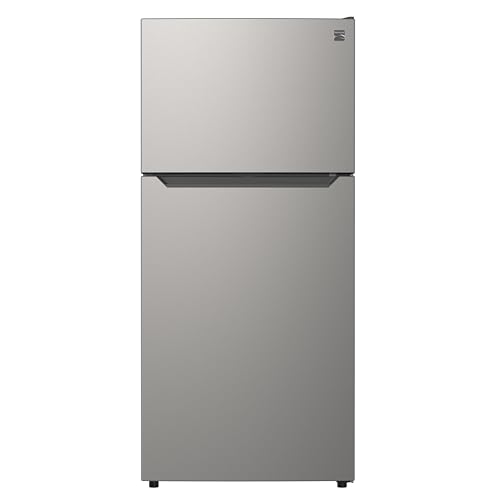
Kenmore 18.1 Cu Ft 30 Inch Wide Top Mount Refrigerator Metallic Steel — Best Overall 30-Inch
Kenmore’s top-mount in metallic steel is the 30-inch refrigerator reduced to its essentials and then polished. The layout is the classic one — freezer above, fresh below — arranged with the small mercies that decide daily satisfaction: shelving that adjusts without a wrestling match, crisper drawers that glide rather than judder, and gallon door bins that take the milk and juice cartons off the main shelves entirely. In a narrow cabinet, those bins are worth a cubic foot of ordinary shelf, because tall items are exactly what narrow shelves handle worst.
The fingerprint-resistant metallic finish matters more in a small kitchen than a large one, since a compact fridge sits within arm’s reach of every cooking splash and passing hand. LED lighting keeps the back corners honest, and the ENERGY STAR certification keeps running costs in line with the cabinet’s modest ambitions. Nothing here shouts; everything here works, which is precisely what a replacement fridge bought under pressure needs to do for the next decade.
Consider who cooks around it. The top freezer puts frozen food at standing height, sparing knees that a bottom drawer would test daily, while the fresh section’s lowest shelf asks for a bend only for the items stored at the back. Households replacing a twenty-year-old top-freezer will find every habit transfers without translation — the highest praise a working kitchen can give a new appliance.
A word about replacing like with like: households often apologise for choosing the same layout twice, as if novelty were a virtue in appliances. It is not. The metallic Kenmore succeeds precisely because nothing about Monday morning changes except that the seals grip, the light works and the shelves glide — the virtues a working kitchen actually missed while the old cabinet was dying.
- Configuration: top mount, 30-inch width
- Total capacity: 18.1 cu. ft.
- Standout features: gallon door bins, adjustable shelving
- Finish: fingerprint-resistant metallic steel
- Efficiency: ENERGY STAR certified, LED lighting
Strengths
- Door bins swallow gallon containers that defeat narrow shelves.
- Finish resists the fingerprints a small kitchen guarantees.
- Familiar layout — no relearning after a like-for-like replacement.
Trade-offs
- Top freezer means frozen food competes in one open space.
- No water dispenser or through-door ice at this size.
- Fresh section’s lowest shelf sits low for taller cooks.
Best for: like-for-like replacements in established 30-inch kitchens. Not suited for: households wanting French door shelves or dispenser features.
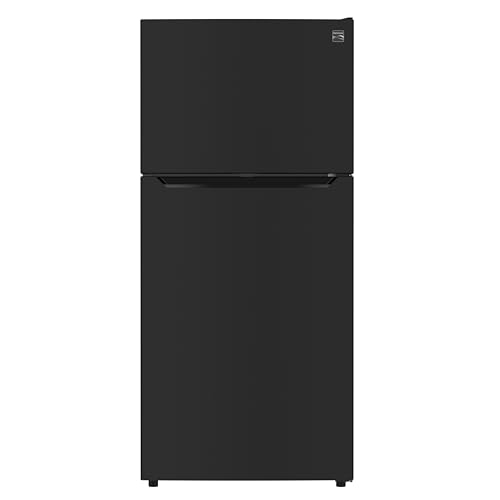
Kenmore 18.1 Cu Ft 30 Inch Top Mount Refrigerator Black — Best in Black
Take the metallic Kenmore’s sensible interior, wrap it in black, and the cabinet’s personality changes completely. In a white cottage kitchen, a black fridge reads as a deliberate anchor — the visual weight that stops pale cabinetry from floating away. In a rental with mixed dark appliances, it simply matches what is already there. The specification travels with the colour: 18.1 cu. ft., adjustable shelving, crisper drawers, gallon door bins and LED lighting, so choosing black costs you nothing in function.
Black also forgives. Where stainless records every fingerprint and white records every splash of tomato sauce, black sits between them, hiding smudges while showing only the dust that a weekly wipe removes. For a busy household that would rather cook than polish, that is a genuine quality-of-life difference measured in minutes per week. The top-mount layout keeps the same ergonomic story as its steel sibling — freezer at standing height, fresh food below, no drawers to pull against a tight galley floor.
One caution belongs to small, dark rooms: a black cabinet absorbs light and can make a narrow north-facing kitchen feel narrower. If your slot sits in a gloomy corner, the white Verona below may serve the room better even if black serves the style. Judge the finish in your own light, at the hour you cook most, rather than in a showroom’s flattering brightness.
Black appliances also age gracefully in one specific way: the small scuffs and edge wear that accumulate on a decade-old fridge read as patina on a dark finish, where the same marks on white look like damage. If you plan to keep this cabinet through a kitchen refresh or two, black is the finish most likely to still look deliberate when the room around it changes.
- Configuration: top mount, 30-inch width
- Total capacity: 18.1 cu. ft.
- Standout features: gallon door bins, crisper drawers
- Finish: black
- Lighting: LED interior
Strengths
- Black hides the smudges that small kitchens produce constantly.
- Identical practical layout to the metallic version.
- Anchors light cabinetry and matches dark appliance suites.
Trade-offs
- Can darken an already dim, narrow room.
- Dust shows pale against the dark surface.
- Same single-space freezer as any top-mount design.
Best for: light kitchens needing contrast and low-maintenance looks. Not suited for: dark galley kitchens that need every lumen they can get.

Verona 30 Inch Top Freezer Refrigerator White VEFTF3018RWH — Best Clean White Classic
Verona built its name on ranges that Italian-minded cooks take seriously, and its refrigerator takes the opposite path to attention: a plain white 30-inch top-freezer that intends to disappear. In a bright cottage kitchen — white units, pale walls, morning sun — that disappearance is the luxury. The VEFTF3018RWH holds 18.1 cu. ft. behind two doors, keeps its handles and lines quiet, and lets the room, not the appliance, carry the character.
White has practical virtues beyond blending in. It reflects light into the slot rather than drinking it, which matters when the fridge stands in the kitchen’s dimmest corner, and it telegraphs spills honestly, so a wipe happens when the jam smear is fresh instead of fossilised. The top-freezer arrangement mirrors the Kenmores’, so the daily ergonomics are familiar: frozen food at standing height, fresh shelves below, nothing exotic to relearn.
Choose the Verona when the kitchen’s story is already written and the fridge should not add a chapter. Scullery-style rooms, rental cottages aiming for a clean listing photograph, and households replacing a white fridge among white appliances will all find that this cabinet slots into the picture without demanding the eye. Its restraint is the feature; everything else is competent, standard and deliberately unremarkable.
There is a rental and resale angle to the Verona’s restraint as well. A plain white fridge photographs neutrally, offends no tenant and matches the appliances a future buyer most likely owns, which makes it the safest choice for a cottage that hosts paying guests or a home that may be sold before the fridge wears out. Character can live in the curtains; the cold box can simply be clean.
- Configuration: top freezer, 30-inch width
- Total capacity: 18.1 cu. ft.
- Standout feature: quiet white styling that recedes
- Finish: white
- Model: VEFTF3018RWH
Strengths
- Brightens the slot instead of darkening the room’s corner.
- Matches existing white appliances without a suite change.
- Spills show early, encouraging quick, easy cleaning.
Trade-offs
- White shows cooking splashes the day they happen.
- No dispenser or smart features in this straightforward cabinet.
- Styling will read plain in a kitchen built around statement appliances.
Best for: bright cottage kitchens and white appliance suites. Not suited for: cooks wanting a fridge that anchors the room visually.

Frigidaire 30 Inch 20 Cu Ft Top Freezer Refrigerator Gallery — Best Garage Ready
Two numbers define this Frigidaire: 20 cu. ft., the joint-largest capacity in this guide, and a garage-ready rating that lets it live where ordinary refrigerators sulk. Standard fridges assume a heated kitchen; park one in a garage that swings from near-freezing winters to hot summers and its thermostat, reading the cold room air, lets the freezer drift warm. Garage-ready engineering widens the operating range so both sections hold their temperatures while the room around the cabinet does whatever the season wants.
That talent serves two households at once. The first keeps its main fridge in an unheated utility or garage — common in cottages and farmhouses — and needs it to behave in January. The second wants the extra two cubic feet in the kitchen itself: at 30 inches wide, 20 cu. ft. is the ceiling of what top-freezer design can hold, and families who felt squeezed by 18 will notice those two feet every single week, in the freezer especially.
The Gallery trim brings the expected Frigidaire orderliness — bright interior, shelving that reconfigures without tools, a stainless finish that suits a main-kitchen role as readily as a garage one. If it does go to the garage, site it away from the door’s weather blast and give it the level, ventilated spot the manual asks for; garage-ready is a wide tolerance, not an invitation to neglect.
Garage siting changes shopping habits too. With a trustworthy twenty cubic feet a few steps from the kitchen, households start treating the garage cabinet as the pantry’s cold annex — drinks, bulk meat and the holiday overflow live there, while the kitchen fridge, if a smaller one exists, stays nimble. Even as the only fridge, the Gallery’s tolerance means the weekly shop no longer has to be planned around the weather forecast.
- Configuration: top freezer, 30-inch width, freestanding
- Total capacity: 20 cu. ft.
- Standout feature: garage-ready temperature tolerance
- Finish: stainless steel
- Line: Frigidaire Gallery
Strengths
- Largest top-freezer capacity available at this width here.
- Keeps temperatures in unheated garages and utilities.
- Equally at home as a main kitchen cabinet.
Trade-offs
- Garage siting still needs ventilation and a level floor.
- No French door shelving for wide trays.
- Stainless finish shows prints in a hard-working space.
Best for: unheated spaces and capacity-hungry small families. Not suited for: buyers set on French door or bottom-freezer layouts.

Frigidaire Gallery 30 Inch 20 Cu Ft French Door Refrigerator — Best French Door at 30 Inches
Conventional wisdom says French doors start at 33 inches, and this Frigidaire Gallery is the rebuttal. At a true 30 inches wide it offers the full arrangement — twin doors over a freezer drawer, fresh food at eye level, an internal water dispenser that keeps the front clean — within the same 20 cu. ft. envelope as its top-freezer sibling. For the cook who has coveted wide French door shelves in a kitchen that cannot grow, this is the only pick in the guide that answers.
Honesty about scale is required. The shelves are wide for this width, not wide in absolute terms; a full sheet tray still needs measuring, and the two narrower doors carry smaller bins than a 36-inch model’s would. The freezer drawer, though, behaves exactly like its big counterparts, gliding out to present frozen food in a single visible layer, and the eye-level fresh section ends the kneel-for-the-crisper routine that top-freezer owners accept without noticing.
The internal dispenser deserves its sentence: water lives inside the cabinet, so the exterior stays a clean stainless plane — a real aesthetic dividend in a small kitchen where the fridge front is always in view. Households choosing between this and the top-freezer Gallery are really choosing between shelf style and freezer style, because capacity, maker and width are shared. Pick the doors your cooking will thank you for.
Small kitchens gain one more subtle benefit from those narrower French doors: each door swings through a shorter arc than a single wide top-freezer door, so the person at the counter beside the fridge gets bumped less often during the breakfast rush. In a galley where two people cook together, that smaller swing is a daily courtesy, and it is a benefit no specification table will ever list.
- Configuration: French door with freezer drawer, 30-inch width
- Total capacity: 20 cu. ft.
- Standout feature: internal water dispenser
- Finish: stainless steel
- Model reference: GRFN2023AF
Strengths
- Real French door layout inside a 30-inch slot.
- Fresh food sits at eye level, ending low-shelf kneeling.
- Internal dispenser keeps the front panel clean-lined.
Trade-offs
- Shelves are narrower than 36-inch French door models.
- Door bins shrink with the narrower doors.
- Freezer drawer needs full pull-out clearance ahead of it.
Best for: cooks who want the French door experience in a fixed narrow slot. Not suited for: sheet-pan bakers who need genuinely wide shelves.

Summit 30 Inch Top Mount Refrigerator 18 Cu Ft — Best Energy-Conscious Pick
Summit spends its whole catalogue on the sizes the big brands treat as afterthoughts, and the FF18W shows what that focus buys: an 18 cu. ft. top-mount cabinet at 30 inches wide, ENERGY STAR certified, finished in white and engineered without garnish. Where the Kenmores compete on bins and finishes, the Summit competes on the electricity bill and on the quiet competence of a maker whose parts and support exist precisely for niche dimensions.
The efficiency case compounds over a fridge’s life. A refrigerator runs every hour of every day for a decade or more, so a certified cabinet’s saving is not a gesture but a steady drip of money back, largest in homes with high electricity prices or off-grid and solar setups where every watt is budgeted. Cottages on metered supplies, annexes and granny flats all feel that arithmetic more sharply than a large suburban kitchen does.
Inside, expect the honest top-mount plan without the marketing trimmings: freezer above, fresh below, shelving that does its job. Households that have owned Summit’s compact and medical-adjacent units will recognise the house style — plain controls, sensible interiors, documentation that respects the reader. If your shortlist values lifetime running cost over door-bin cleverness, this is the pick that was built for you.
Summit’s plainness extends to its documentation, which owners of niche appliances learn to value: clear clearance figures, honest capacity statements and parts lists that acknowledge the model exists. When a fridge must fit a slot nothing else fits, the maker’s long-term support matters more than a feature list, because a cabinet you cannot repair is a cabinet you must replace — at a size where replacements are scarce.
- Configuration: top mount, 30-inch width
- Total capacity: 18 cu. ft.
- Standout feature: ENERGY STAR certification
- Finish: white
- Model: FF18W
Strengths
- Certified efficiency trims a decade of running costs.
- Specialist maker with real support for niche sizes.
- Unfussy controls and interior suit second-home and annex use.
Trade-offs
- Plain white styling will not anchor a designed kitchen.
- Fewer convenience features than the Kenmore pair.
- Capacity matches, not beats, the class standard.
Best for: efficiency-first buyers, cottages and annexes on metered power. Not suited for: households wanting dispensers or statement finishes.
How Do the Six Compare Side by Side?
| Pick | Layout | Capacity | Defining trait |
|---|---|---|---|
| Kenmore 18.1 Top Mount — Metallic Steel | Top mount | 18.1 cu. ft. | Gallon bins, metallic finish |
| Kenmore 18.1 Top Mount — Black | Top mount | 18.1 cu. ft. | Black finish, same layout |
| Verona VEFTF3018RWH White | Top freezer | 18.1 cu. ft. | Quiet white styling |
| Frigidaire Gallery 20 Cu Ft Top Freezer | Top freezer | 20 cu. ft. | Garage-ready rating |
| Frigidaire Gallery 20 Cu Ft French Door | French door | 20 cu. ft. | Internal water dispenser |
| Summit FF18W 18 Cu Ft | Top mount | 18 cu. ft. | ENERGY STAR certified |
The table separates into three decisions. First, layout: top-mount simplicity against the French door’s eye-level shelves. Second, environment: a heated kitchen against a garage that needs the Frigidaire’s wider tolerance. Third, temperament: finishes and efficiency, where the two Kenmores, the Verona and the Summit divide buyers who all need exactly the same width. Settle those three and the table picks its own winner.
How Do You Measure a 30-Inch Slot Properly?
Measure the slot in three places — top, middle and bottom — because old cabinetry rarely runs parallel, and take the smallest figure as the truth. Record height from floor to the underside of any over-fridge cupboard, and depth from the wall to the counter edge, remembering that skirting boards and uneven plaster steal millimetres at floor level. A cabinet listed at thirty inches wide needs its maker’s stated clearance on top of that, usually a small air gap each side, so a slot measuring exactly thirty inches deserves a conversation with the seller before money moves.
Then measure the fridge’s own demands. Door thickness plus handle depth decides whether the closed cabinet sits proud of the counters; hinge design decides whether the door can open past ninety degrees beside a wall. If the slot touches a wall on the handle side, confirm the door swing clears it with room for fingers, because a door that opens to eighty degrees makes every shelf behind it a reach-around exercise for a decade.
Why Does the Delivery Path Reject More Fridges Than the Slot?
Ask any delivery crew: kitchens are easy, journeys are hard. A 30-inch fridge must pass the front door, turn through hallways, climb any stairs and pivot into its slot, and each of those moments has a smallest dimension. Measure every doorway’s clear width with the door open flat, note radiators and banisters that narrow the hall, and check the ceiling height where the cabinet must tilt to turn a corner. Cottages with porch doors and flagstone steps deserve particular care, since the crew needs footing as much as width.
Prepare the route like you mean it. Remove the doors from their hinges if the clearances are tight — five minutes with a screwdriver buys two inches. Take down pictures, move the shoe rack, roll the rug. Tell the seller about steps, gravel and narrow gates when you order, not when the truck is idling outside; crews arrive with the right equipment and the right number of people only when they know what waits for them.
How Much Food Does 18 to 20 Cu. Ft. Really Hold?
Translate cubic feet into shopping. Eighteen cubic feet handles a weekly supermarket trip for two adults with room for batch-cooked leftovers, provided the freezer is not asked to archive a season of produce. Twenty cubic feet — the Frigidaire pair — stretches that to a small family or a couple that entertains, with a freezer that accepts a month of meat bought on offer. The difference between the two sizes lives mostly in the freezer and the door bins, which is why the Kenmores’ gallon bins punch above their stated capacity.
What this width will not do is warehouse shopping. A whole warehouse-club run, a side of lamb from the farm shop, or a Christmas for twelve will overflow any 30-inch cabinet, and planning a small chest freezer for the overflow is a better answer than forcing a wider fridge into a remodel you did not want. Buy the cabinet for the forty-nine ordinary weeks; rent, borrow or freeze-shop your way through the exceptional three.
Which Layout Works Better at This Width: Top Freezer or French Door?
Top-freezer design wastes almost nothing. One door above, one below, no centre mullion eating shelf width, no drawer mechanism consuming depth — which is why four of these six picks use it, and why it delivers eighteen honest cubic feet where a fancier layout might deliver seventeen complicated ones. Its costs are ergonomic: fresh food’s lower shelves sit low, and the freezer’s single open space files nothing.
The Frigidaire French door answers with eye-level fresh storage and a drawer that displays frozen food in one layer, at the price of narrower bins and a centre seal. At thirty inches the honest verdict is that neither layout is wrong; the top freezer suits shoppers who freeze in quantity and bend without complaint, while the French door suits cooks who live in the fresh section and freeze in flat, labelled order. Your knees and your shopping list already know which household is yours.
How Do You Keep a Narrow Fridge Organised?
Narrow shelves punish the shove-it-in method, so give the cabinet a shallow geography. Front third for this week’s cooking, middle for staples, back for the jars and preserves that tolerate waiting. Door bins take the tall and the daily — milk, juice, sauces in use — while one shelf stays deliberately half-empty as the landing strip for leftovers and tonight’s marinade. A cabinet run at ninety percent full cools unevenly and hides food; eighty percent is the working ceiling.
In the freezer, flat is the whole religion. Freeze soups and sauces in bags pressed flat, standing them upright in a row once solid, like books on a shelf. Label with contents and month on the spine edge. In a single-space top freezer, a shallow open box creates the drawer the maker did not provide, corralling small packets that otherwise migrate to the bottom and fossilise beneath the peas.
What Does Garage Ready Actually Mean?
A standard refrigerator thermostat reads the fresh section, and in a near-freezing garage that section may need no cooling for hours — during which the freezer, sharing the same cold supply, quietly warms toward thawing. Garage-ready models counter this with sensors and heater strategies that keep the freezer honest even when the room is cold, and with compressors rated to keep working when the room turns summer-hot. It is engineering aimed at the room’s temperature swings, not the cabinet’s size.
If the Frigidaire Gallery is headed for your garage, complete the installation properly: a level slab or board, clearance for the vents, a socket that is not shared with a freezer-heavy circuit, and enough distance from the door that winter blasts do not strike the cabinet directly. Check the freezer thermometer weekly through the first cold snap. Garage-ready widens the safe range enormously, but the first season still deserves supervision rather than faith.
How Should You Set Temperatures in a Compact Cabinet?
Smaller cabinets recover temperature quickly but also swing faster when loaded with warm food, so set the fresh section to the maker’s recommended middle setting and judge it with a fridge thermometer after a full day, not by feel. The coldest corner sits near the back vent; keep milk there if your household likes it very cold, and keep salad leaves away from that same vent, where direct cold air freckles them with freeze spots overnight.
Freezers in this class hold their setting best when three-quarters full — the frozen mass itself steadies the temperature. A half-empty freezer after a big cook-up week benefits from a few bottles of water frozen in the gaps, which cost nothing, stabilise the cold, and double as ice packs for summer picnics. Resist turning dials after every shop; give any change a full day to prove itself before adjusting again.
What Should You Check in the First Week of Ownership?
Listen first. A new fridge cycles, fans breathe and ice settles, but a persistent buzz usually means the cabinet is touching a wall or standing unevenly on an old floor — adjust the feet before blaming the machine. Check the door seals with the banknote test on every side, confirm the doors self-close from a few inches open, and verify the freezer actually freezes a tray of water solid overnight rather than to a slushy promise.
Watch condensation geography too. A little moisture on the back wall of the fresh section after loading warm leftovers is normal physics; droplets on the outside of the doors or a puddle beneath the cabinet are not, and deserve a call while the delivery paperwork is still on the fridge door where you magnetised it. Register the warranty that week, photograph the serial plate, and keep the manual with the house documents rather than in the drawer of forgotten instructions.
How Do Finishes Behave in Small Kitchens?
At thirty inches wide, the fridge front is a modest panel — yet in a small kitchen it is always in view, so its finish works harder than the same finish in a big room. Metallic steel brings a professional note and hides the minor scuffs of daily traffic behind its brushed grain, though fingerprints collect at handle height. Black absorbs the visual noise of a mixed appliance collection and pairs naturally with dark worktops, while white returns light to the room and suits the pale, plant-filled cottage style that forgives a visible jam smear because everything else is calm.
Longevity argues for matching the household, not the trend. Finishes cycle in fashion every few years; a fridge stays a decade. If the rest of your appliances already agree on a colour, join them. If they disagree cheerfully, choose the finish that suits the room’s light — white for the dim corner, black for the bright wall, steel for the kitchen that cooks seriously and wipes as it goes.
What Running Costs Should You Expect at This Size?
A modern 18 to 20 cu. ft. cabinet is among the cheapest large appliances to run, precisely because its compressor is small and its insulation modern. The certified Summit makes efficiency its headline, but every pick here descends from designs that improved steadily under energy rules, so the differences between them are measured in small monthly amounts rather than in budgets. What dwarfs the model-to-model gap is behaviour: a door left ajar on a failed seal, a cabinet cooking in a hot garage corner, or a dial set to arctic all cost more than any badge saves.
Keep the coils clean, the seals wiped and the cabinet out of direct sun through the kitchen window, and a 30-inch fridge will sip rather than gulp for its whole life. Households on solar or metered cottage supplies should still favour the certified pick, because there the steady saving is not abstract — it is capacity another appliance gets to use.
How Do You Move House With a 30-Inch Fridge?
The narrow width that limits capacity pays you back on moving day: a 30-inch cabinet passes most interior doors without removing them, turns on cottage stair landings that defeat wider models, and fits the rental slots that dominate the housing stock your next home likely comes from. Measure before assuming, empty and defrost it a full day ahead, and let it stand upright for several hours after any journey that tilted it, so the compressor oil settles home.
Secure the shelves and bins with tape or remove them into a labelled box; a loose crisper drawer travels like a hammer inside a hollow cabinet. Keep the doors taped shut but not sealed airtight for a long storage spell — a folded cloth in the seal line prevents the stale, airless smell that greets fridges reopened after months in a lockup.
When Is a 30-Inch Fridge the Wrong Answer?
Sometimes the honest advice is to change the kitchen instead. A household of six that batch-cooks weekly will outgrow twenty cubic feet no matter how cleverly the bins are arranged, and years of daily frustration cost more than widening a slot during a remodel you are already planning. Likewise, keen bakers who need full sheet trays to slide in flat should measure the Frigidaire’s shelves against their largest tray before falling for its doors; enthusiasm is not a unit of measurement.
For everyone else — couples, small families, renters, cottage owners, garage-fridge seekers — the 30-inch class is not a compromise but a fit. The six picks here cover its whole personality range, and the right one will feel less like a limitation accepted and more like a kitchen that finally makes sense at the width it was built.
How Do Door Swings Behave in a Galley Kitchen?
A top-freezer door at thirty inches wide swings as one panel, and in a galley that panel’s arc decides whether the cook at the opposite counter spends the morning sidestepping. French doors halve the problem — each of the Frigidaire’s doors sweeps a shorter radius — while asking for clearance on both sides instead of one. Stand in your slot, mime both motions with a broom handle of the right length, and you will learn more in a minute than a dimension diagram teaches in an hour.
Hinges complicate the picture beside walls. A fridge slotted against a side wall needs its door to open beyond ninety degrees before the bins clear the cabinet, and not every hinge geometry allows that in a tight corner. Check the maker’s stated wall-side clearance for your chosen pick, and if the slot fails it, consider swapping the fridge to the other end of the run during the same delivery visit rather than discovering the limitation at the first weekly shop.
What Should Renters and Landlords Look For?
Rental kitchens live at thirty inches, and both sides of the tenancy have interests here. Landlords should favour the unfussy top-mounts — the Verona and the Summit especially — whose parts are ordinary, whose finishes forgive tenants, and whose efficiency keeps the property’s running costs defensible. A fridge that survives three tenancies without a service call is worth more than a fashionable one that sulks through two.
Tenants replacing a fridge with permission should photograph the slot measurements and the old cabinet’s model plate before ordering, and keep the paperwork for the deposit conversation nobody enjoys. Choose the layout your own cooking wants — you will open it ten thousand times — but keep the finish neutral enough that the next household inherits it without complaint. The black Kenmore sits exactly on that line: characterful, but ordinary in all the ways that matter.
How Do You Defrost and Clean a Top Freezer Without Drama?
Modern top freezers in this class are frost-free in daily operation, so defrosting belongs to the annual deep clean rather than the monthly chore list your grandparents knew. Pick a cool morning, move perishables into bags with ice packs, and wash shelves and bins in the sink while the cabinet air-dries with its doors open. The narrow width helps here: every part of an 18 cu. ft. interior is within arm’s reach, and the whole job fits inside an hour.
Pay attention to the drain channel at the back of the fresh section, the hidden culprit behind most mystery puddles. A cotton bud and warm water clear the crumbs and biofilm that block it. Wipe the door gasket’s inner fold at the same visit, dry it thoroughly, and close up knowing the cabinet’s least glamorous maintenance is done for another season.
What Noise Should a Small Kitchen Expect?
In a compact home the fridge is a roommate, audible from the sofa and sometimes the bedroom. Modern 30-inch cabinets run quieter than the models they replace — inverter-driven compressors hum steadily instead of clunking awake — yet a small kitchen’s hard surfaces amplify whatever sound exists. Levelling is the first fix for any buzz: a cabinet standing unevenly turns its side panels into drum skins, and a quarter-turn of a front foot often silences a noise owners were blaming on the motor.
Placement helps too. A fridge pushed hard against a plasterboard wall transmits vibration straight into the room’s largest sounding board, so honour the rear clearance gap as an acoustic measure as well as a thermal one. If the slot backs onto a bedroom wall in a cottage or flat, the quietest-running pick you can verify in person deserves a premium in your decision that no specification sheet can quantify for you.
How Should You Arrange the Freezer for a Month of Meals?
Batch cooking at this width succeeds on geometry. Freeze portions in containers of one footprint so they stack like bricks, keep a written list taped inside the freezer door, and eat from the front of each stack so rotation happens automatically. Sauces and soups frozen flat in bags file upright in a plastic crate; roasts and whole chickens, the true space-eaters, should be bought with a specific date in mind rather than as speculative storage.
The Frigidaire pair’s extra two cubic feet show up exactly here — roughly another week of family dinners held in reserve. Households that meal-prep seriously will feel that margin weekly, while light freezers will never miss it. Be honest about which household is yours before paying for volume in either direction, because an empty freezer costs money to cool and a crammed one costs food to waste.
What Does the Warranty Conversation Look Like at This Size?
Appliance warranties divide into the sealed refrigeration system, usually covered longest, and everything else — fans, controls, shelves — covered briefly. At thirty inches, the practical question is less the paperwork than the service network: can an engineer reach your cottage, and does the maker stock parts for a niche width five years from now? Summit and Frigidaire both maintain real parts operations; the value-brand cabinets lean on the retailer’s returns window instead, which argues for testing every function hard during the first fortnight.
Register the purchase, keep the receipt with the house file, and photograph the model plate inside the fresh section while the cabinet is new and legible. If a fault appears, describe it with temperatures from a cheap fridge thermometer rather than adjectives — engineers triage numbers faster than adjectives, and a cabinet still under its early coverage deserves a fast, factual claim.
How Do You Decide Between the Two Kenmores?
Since the metallic and black Kenmores share their cabinet, the decision is a design seminar in miniature. Stand in the kitchen at the hour you cook most. If the slot faces the window and the room runs bright, black gives the eye a resting point and hides the day’s smudges. If the slot sits in the room’s dim half, metallic steel returns some light and reads as the more expensive object from the doorway — the view guests get, and the one a future buyer’s photograph will carry.
Consider the handles and hardware already in the room as tiebreakers: black appliances sit happily with black taps and ironmongery, steel with chrome and brushed nickel. Either way you are choosing a finish, not a fridge, so let the room decide quickly and spend the saved deliberation on measuring the hallway twice — the part of this purchase that can actually go wrong.
How Long Should a 30-Inch Fridge Last?
Plan on a decade or more from any cabinet here, with the understanding that longevity at this size is mostly housekeeping: coils vacuumed yearly, seals kept clean and supple, doors never slammed against a full bin. The simple top-mounts carry fewer mechanisms to fail than drawer models, which is one more reason they dominate the narrow class. When a ten-year-old cabinet starts frosting oddly or cycling loudly, the fix is usually a gasket or a fan rather than a funeral — worth one engineer’s visit before the replacement conversation begins in earnest.
How Should You Break In a New 30-Inch Fridge?
Give the cabinet a gentle first week. Load it gradually rather than transferring a whole warm shop at once, let temperatures settle before judging them with a thermometer, and resist reorganising the shelves daily while you learn where this model’s cold corners live. By the second weekend the cabinet’s habits — its hum, its coldest shelf, the door bin that fits the milk best — will feel like the old fridge’s habits did, and the replacement will have completed the only transition that matters: from purchase to furniture.
Which Mistakes Do 30-Inch Buyers Regret Most?
- Measuring only the slot and discovering the hallway turn is two inches too tight on delivery morning.
- Forgetting the hinge side: a door that cannot open past the wall beside it turns every shelf into a reach-around.
- Assuming 30-inch models hold family-of-six shopping, then blaming the fridge for a capacity decision made at the desk.
- Putting a standard fridge in a freezing garage and learning about thermostat drift from thawed food.
- Choosing a finish for the showroom’s light instead of the corner where the cabinet will actually stand.
- Skipping the maker’s side clearance to gain a flush look, then paying for it in noise and warm running.
Final Recommendation
Start with the tape measure, end with the layout, and this width stops feeling like a restriction. The Kenmore 18.1 Top Mount — Metallic Steel is the default recommendation — bins, shelving and finish all chosen the way a working kitchen would choose them. If your cabinet must live in an unheated space, or you simply need the most this width can hold, the Frigidaire Gallery 20 Cu Ft Top Freezer earns its garage-ready keep, while cooks set on French doors should go straight to the Frigidaire Gallery 20 Cu Ft French Door and measure their largest tray against its shelves. Every pick here fits the same thirty inches; the winner is the one whose compromises match the compromises your household already makes happily, week after week, without ever thinking about the width at all.
Frequently Asked Questions
Will a 30-inch refrigerator fit through my front door?
Usually, yes — that is the class’s quiet superpower. Most interior and exterior doors clear thirty inches once opened fully, but measure the clear opening with the door against its stop, and remember handles and hinge barrels add depth during turns. If a doorway is marginal, removing the fridge’s own doors, a standard delivery option, buys the needed inches.
Is 18 cu. ft. enough for a family of four?
It is workable with weekly shopping and a freezer used for rotation rather than storage, but most families of four feel the 20 cu. ft. Frigidaire pair breathing easier by Wednesday. The deciding factor is shopping rhythm: little-and-often suits 18, one big weekly haul argues for 20 or a small supplementary freezer.
Can I put any of these in an unheated garage?
Only the garage-ready Frigidaire Gallery is rated for that life. Standard models risk freezer drift when the room falls near freezing, because their thermostats read the fresh section’s needs. If the garage is insulated and rarely approaches freezing, risk falls — but the rated model removes the question entirely.
Why do most 30-inch fridges use a top freezer?
Because the layout wastes the least of a narrow cabinet. Bottom drawers and French door mechanisms consume width and depth that a 30-inch model cannot spare, while a top freezer’s simple doors deliver the full stated capacity. The trade is bending for low fresh shelves, which many households accept without noticing.
How much clearance does a 30-inch fridge need around it?
Follow the maker’s figures for your model — typically a small gap at each side and a larger one above and behind for warm air to escape. Skimping on the top gap is the commonest error in slots under old cupboards, and it shows up as a hard-working, noisy compressor within the first summer.
Related Guides
If your measurements come back wider than expected, the Best 33 Inch Wide French Door Refrigerators open up the next size class. The laundry end of a narrow utility room gets the same honest measuring treatment in Best Agitator Top Loader Washers, and for the car, cabin or boat rather than the kitchen, see Best 12v Portable Refrigerators.



[…] guides cover the neighbouring refrigerator decisions. Best 24 Cu Ft Bottom Freezer Refrigerators Best 30 Inch Wide Refrigerators Best 3.9 Cu Ft Front Load […]
[…] your slot turns out narrower than these cabinets allow, our guide to Best 30 Inch Wide Refrigerators works the tighter width in detail. Laundry rooms beside the kitchen deserve the same layout […]