What's inside
- Key Takeaways
- Quick Picks
- How We Chose These Picks
- How Do the Six Sets Compare at a Glance?
- What Do Steel Grades 304 and 316 Actually Mean?
- Why Does Cladding Matter More Than the Surface Steel?
- How Do You Stop Food Sticking to Stainless?
- Which Pieces Will You Actually Use Every Week?
- How Should You Care for Stainless So It Still Shines in Ten Years?
- How Does Induction Change the Way These Pans Behave?
- Steel Lids or Glass Lids: Which Should You Choose?
- What Should You Know About Handles, Rivets and Balance?
- Can Stainless Handle Tomato Sauce, Wine and Other Acids?
- How Do You Size a Stockpot and a Skillet to Your Household?
- Set or Open Stock: Is a Set Always the Smarter Buy?
- What Should the First Week of Cooking on Steel Teach You?
- Why Do Some Stainless Pans Warp, and Can You Prevent It?
- How Does Stainless Behave in the Oven and Under the Broiler?
- What Does a Decade of Ownership Actually Cost?
- How Should You Store a Set Without Wrecking the Finish?
- How Do You Read a Cookware Listing Like a Metallurgist?
- How Do You Match a Set to Gas, Electric or Induction?
- What Mistakes Do Stainless Buyers Make Most Often?
- Final Recommendation
- Frequently Asked Questions
- Related Guides
As an Amazon Associate I earn from qualifying purchases. This post may contain affiliate links at no extra cost to you.
cottageverdict.com is reader-supported. When you buy through links on our site, we may earn an affiliate commission.
Where to buy: all six cookware sets surgical stainless steel shoppers keep circling are sold through Amazon, and their names in the Quick Picks table, the detailed reviews and the comparison table link to the matching listing, where you can check price on Amazon and confirm piece counts, induction compatibility and construction details before ordering. Before any ranking, though, this keyword needs its central phrase taken apart, because “surgical stainless steel” is doing more marketing work than metallurgical work, and a buyer who understands that will choose better than a buyer who does not.
Here is the honest version. Surgical instruments are typically made from 316-grade stainless, a steel alloyed with molybdenum for extra resistance to chlorides and bodily fluids. Almost no mainstream cookware set is made from it. The pots in this guide, like nearly every respected set on the market, are built from the 300-series food-grade family, most commonly 304, sold as 18/8 or 18/10 according to its chromium and nickel proportions. That is not a scandal and it is not inferior for cooking: 304 is the steel of commercial kitchens, brewery tanks and the sink in your own kitchen. What matters far more than the grade number is construction, meaning whether aluminium or copper is bonded into the pan to spread heat, and how much of the pan that bonding covers.
So read this guide as a translation exercise. Each review states plainly how the set is actually built, tri-ply clad throughout or aluminium disc bonded into the base, because that single fact predicts how your sauce behaves at the edge of the pan, whether the set works on induction, and how the pans will feel in the hand after a decade. The phrase on the box predicts none of those things.
Key Takeaways
- “Surgical” stainless usually signals 316-grade marketing language; most quality cookware uses 304, marked 18/8 or 18/10, and cooks beautifully.
- Construction beats grade: tri-ply clad pans spread heat up their sides, while bonded-disc bases heat evenly only across the bottom.
- Piece counts include lids and sometimes utensils, so a 30-piece box may hold fewer actual pans than a 12-piece set.
- Stainless is not nonstick; preheating, fat and patience are the technique that makes eggs and fish release.
- Induction cooktops demand a magnetic exterior layer, so check each set’s stated compatibility rather than assuming.
- Every set here is oven-capable metal with no coatings to degrade, which is the real longevity argument for steel.
Quick Picks
| Pick | Badge | Why it earns its place |
|---|---|---|
| Cuisinart MultiClad Pro 12-Piece Cookware Set | Best Tri-Ply Throughout | Tri-ply clad construction runs from base to rim, giving the most even heat in the group at a sane cost. |
| Cuisinart Chef’s Classic Stainless Cookware Set 11 pc | Best Budget Cuisinart | An aluminium-encapsulated base under classic shapes, for cooks who want steel’s durability without clad prices. |
| Tramontina Boston Tri-Ply Clad Cookware Set 10 Pc | Best Glass-Lid Tri-Ply | Full tri-ply construction paired with glass lids, so you can watch a simmer without lifting and losing heat. |
| Tramontina Signature Tri-Ply Clad Cookware Set 13 Pc | Best for Induction Owners | Tri-ply build with induction-ready bases and the broadest pan selection of the Tramontina pair. |
| Calphalon Classic Stainless Steel Cookware Set 10 Piece | Best Bonded-Base Design | An impact-bonded aluminium base, stay-cool handles and etched measurement marks for everyday practicality. |
| CAROTE Tri-Ply Stainless Steel Cookware Set 30 PCS | Best Big-Count Bundle | A tri-ply set with the largest headline count, aimed at empty kitchens that need everything at once. |
How We Chose These Picks
Construction came first, because it is the variable that actually changes dinner. The shortlist deliberately mixes the two honest architectures of stainless cookware: fully clad tri-ply, where an aluminium core is sandwiched between steel layers across the whole pan, and bonded-base designs, where an aluminium disc is fused into the bottom of a steel body. Both are legitimate. They behave differently at the pan’s edge, they weigh differently, and they suit different budgets, so the reviews grade each set against its own architecture rather than pretending one number ranks them all.
Second came the grade question, handled with a rule this guide will state once and apply everywhere: unless a listing explicitly names a steel grade, assume the set belongs to the food-grade 304 family, as the overwhelming majority of reputable sets do, and do not pay a premium for the word surgical. No pick here was chosen because of that word. Each was chosen for its construction, its pan selection, its handles and lids, and the accumulated evidence that its maker builds cookware properly.
Pan selection was the third filter. A useful set covers a small saucepan, a larger saucepan, a stockpot, a sauté pan or deep skillet, and at least one everyday frying pan, with lids that swap sensibly between them. Sets padded with tiny novelty pieces were passed over in favour of sets whose every piece earns cupboard space. Finally, every pick had to be free of coatings, so that nothing in the box can wear out, flake or forbid metal utensils, which is the founding promise of buying steel at all.

Cuisinart MultiClad Pro 12-Piece Cookware Set — Best Tri-Ply Throughout
The MultiClad Pro is the set this guide would hand to a cook who asked for one recommendation and no lecture. Its tri-ply construction, an aluminium core sealed between stainless layers, runs through the base and up the walls of every pan, and the Cuisinart MultiClad Pro 12-Piece Cookware Set therefore heats the way diagrams promise: evenly across the floor of the pan and gently up the sides, so a sauce clings and simmers at its edges instead of scorching in a ring while the middle sulks.
Details separate it from cheaper clad rivals. The rims are tapered for dripless pouring, a small thing until you have decanted soup down the outside of a straight-edged pot for the hundredth time. Lids are solid steel, sealing well and shrugging off oven heat that glass cannot follow. Handles stay comparatively cool on the stovetop and are shaped for a towel-wrapped grip when a pan comes out of the oven. The twelve pieces resolve into a working wardrobe rather than a puzzle: saucepans in two sizes, a sauté pan, a stockpot, skillets and a steamer insert, with lids counted in the total as lids always are.
On the grade question, buy this set for its cladding, not for any surgical implication. Its steel is the standard food-grade family used across serious cookware, polished to a brushed finish that hides the scratches of real use better than a mirror shine does. It works on induction, tolerates the dishwasher while preferring a wash by hand, and carries the heft of a pan that expects to be inherited. Of the six sets here, this is the one whose performance per piece is hardest to fault.
- Construction: tri-ply clad throughout, base and walls
- Pieces: 12, including lids and a steamer insert
- Lids: solid stainless steel
- Rims: tapered for cleaner pouring
- Hob compatibility: induction-ready per the listing
Strengths
- Even heat up the pan walls, not just across the base
- Dripless rims and well-sealed steel lids
- Balanced weight that feels durable without exhausting the wrist
Trade-offs
- Costs more than bonded-base sets of similar size
- Steel lids hide the food from view while it cooks
- Polished steel shows water spots without a quick dry
Best for: cooks upgrading once, properly, for the long term. Not suited for: anyone who wants to watch food through glass lids.

Cuisinart Chef’s Classic Stainless Cookware Set 11 pc — Best Budget Cuisinart
Chef’s Classic is the older, simpler Cuisinart architecture: a stainless body with an aluminium core encapsulated in the base, rather than clad up the walls. That single design decision sets its price and its personality. Across the floor of the pan, where the disc lives, heat spreads well and sauces behave. Up the sides, the steel alone runs cooler, which matters when you are reducing a pan sauce or cooking grains that climb the walls, and matters hardly at all for boiling, steaming, reheating and the hundred ordinary jobs a saucepan performs weekly.
The shapes are the traditional ones the line has sold for years, with flared rims for pouring, helper handles on the wider pieces and glass lids in this 77-11G configuration, so you can watch potatoes come to the boil without lifting anything. The Cuisinart Chef’s Classic Stainless Cookware Set 11 pc suits a first steel set, a second home, or a household replacing worn nonstick on a budget and refusing to buy another coating with a three-year fuse on it.
Judge it by the honest standard of its class. It will not sear with the evenness of the MultiClad Pro across a wide skillet, because its disc cannot help the pan’s far edges. It will boil, simmer, steam and sauté dependably for many years, ask nothing special in care, and leave money in the budget for a single excellent clad skillet later, which is how many sensible kitchens are actually built: a workmanlike set, plus one star.
- Construction: aluminium core encapsulated in the base
- Pieces: 11, including lids
- Lids: glass in this configuration
- Rims: flared for pouring
- Role: entry-level steel set from an established maker
Strengths
- Lowest entry cost into durable, coating-free cookware here
- Glass lids make everyday monitoring easy
- Even heating across the base where the disc sits
Trade-offs
- Pan walls run cooler than fully clad rivals
- Wide skillets show hotter centres over the disc edge
- Glass lids cap the oven temperature you can use
Best for: first steel sets and budget-conscious replacements for worn nonstick. Not suited for: cooks who reduce sauces daily and need clad walls.

Tramontina Boston Tri-Ply Clad Cookware Set 10 Pc — Best Glass-Lid Tri-Ply
Tramontina’s tri-ply has spent years as the cook’s answer to a famous, far pricier clad brand, and the Boston set shows why: full tri-ply construction, aluminium core running base to rim, in a ten-piece selection that covers the daily canon without filler. What distinguishes this configuration is the glass lids. Fully clad pans with see-through lids are rarer than they should be, because makers assume serious cooks want steel, yet a great deal of serious cooking is simply watching: a simmer found and held, rice steaming undisturbed, greens wilting under their own vapour.
In the hand, the Boston pieces feel dense and calm, with the slightly domed lids and long handles giving them a composed, traditional silhouette. The Tramontina Boston Tri-Ply Clad Cookware Set 10 Pc heats with the evenness clad construction promises, searing across the skillet’s whole face and holding a sauce at a bare bubble around its edges. On induction it behaves, and in the oven the pans themselves are unbothered by high heat, though the glass lids set their own lower ceiling, as glass always does.
Ten pieces is the leanest count in this guide, and the leanness is a virtue disguised as a shortage. Every piece here is a pan a cook reaches for weekly. Households that would rather own fewer, better pans and add singles later, a Dutch oven here, a bigger stockpot there, will find this set’s restraint refreshing after the arithmetic of thirty-piece bundles.
- Construction: tri-ply clad throughout
- Pieces: 10, including lids
- Lids: glass, for watching food as it cooks
- Feel: dense, traditional, well balanced
- Hob compatibility: induction-ready per the listing
Strengths
- Full clad performance with the convenience of glass lids
- Lean selection with no filler pieces
- Even searing across wide pan faces
Trade-offs
- Smallest piece count in the guide
- Glass lids limit oven use compared with steel lids
- Fewer specialty pans for banquet-scale cooking
Best for: cooks who value clad heat and like to watch a simmer. Not suited for: households needing a huge set in one box.

Tramontina Signature Tri-Ply Clad Cookware Set 13 Pc — Best for Induction Owners
The Signature is the Boston’s broader sibling: the same tri-ply clad philosophy stretched across thirteen pieces, with induction readiness stated up front in its listing. That emphasis matters because induction is where bonded cookware either proves itself or rattles, literally, on the glass. A clad pan with a proper magnetic steel exterior sits flat, couples efficiently and responds to a change in power with the speed induction owners bought their hob for. The Signature is built for exactly that dance.
Thirteen pieces buy range rather than novelty: more saucepan capacity, more skillet coverage, a stockpot that handles a family batch of soup without flirting with the rim. For a household equipping a kitchen around an induction hob from scratch, the Tramontina Signature Tri-Ply Clad Cookware Set 13 Pc is the most straightforward one-box answer in this guide, clad everywhere it counts and free of coatings that induction’s fierce heat can age prematurely.
Its trade-offs mirror the Boston’s, plus one of scale. A thirteen-piece clad set is a serious stack of metal, and small kitchens should measure a cupboard before inviting it home. The weight that signals durability on the hob becomes a consideration for cooks with limited wrist strength lifting a full stockpot. Neither point diminishes the set. They simply ask the buyer to match the tool to the kitchen, as with any professional-grade equipment.
- Construction: tri-ply clad throughout
- Pieces: 13, including lids
- Hob compatibility: induction-ready, stated in the listing
- Selection: broadest of the two Tramontina sets
- Care: coating-free, metal-utensil safe
Strengths
- Clad construction that suits induction’s speed
- Generous selection covers a from-scratch kitchen
- Even heat from base to rim in every piece
Trade-offs
- Heaviest overall commitment of cupboard space
- Full stockpot is a two-handed lift for many cooks
- Overlaps the Boston if you already own clad pans
Best for: induction households equipping a kitchen in one purchase. Not suited for: tiny kitchens with one shallow cupboard.
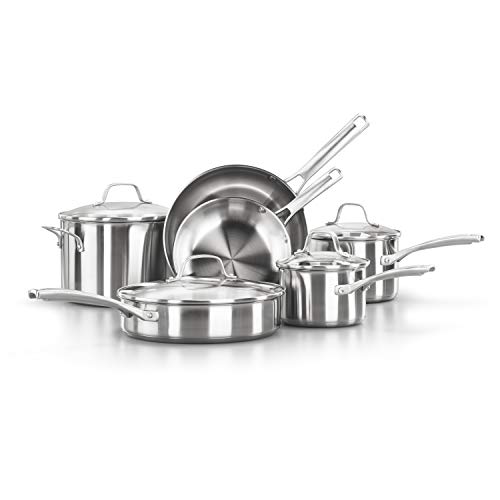
Calphalon Classic Stainless Steel Cookware Set 10 Piece — Best Bonded-Base Design
Calphalon’s Classic takes the bonded-base architecture and engineers it with unusual care. The base is impact-bonded, an aluminium disc fused to the steel under pressure, which produces a flat, stable bottom that sits honestly on the hob and spreads heat across the cooking floor. What lifts the set above generic disc-base rivals are the working details: measurement marks etched inside the pans, so a reducing sauce reports its own volume, and stay-cool long handles that genuinely stay grippable through a long simmer.
Those marks sound like a gimmick until a recipe says reduce by half and the pan simply tells you when you have arrived. The Calphalon Classic Stainless Steel Cookware Set 10 Piece is full of that species of thoughtfulness, including lids that fit snugly and pour-friendly shaping. For weekday cooking, soups, grains, pasta water and reheats, its base-led heating is entirely sufficient, and its ten pieces cover the standard map.
The familiar bonded-base caveat applies at the walls, which run cooler than a clad pan’s, and wide frying pieces will show a hotter centre. Cooks whose style leans on pan sauces and hard searing should look at the clad picks first. Cooks whose style leans on feeding a family reliably every night may find this the most likeable set in the guide, precisely because its virtues are the daily kind.
- Construction: impact-bonded aluminium base
- Pieces: 10, including lids
- Handles: stay-cool design per the listing
- Interior: etched measurement marks
- Role: practical everyday family set
Strengths
- Measurement marks genuinely help with reductions
- Flat, stable bonded base sits well on any hob
- Handles stay comfortable through long cooking
Trade-offs
- Cooler walls than fully clad construction
- Centre-weighted heat in the widest frying pan
- Fewer pieces than the largest sets here
Best for: busy family cooks who value practical details. Not suited for: sauce specialists who need clad sidewalls.

CAROTE Tri-Ply Stainless Steel Cookware Set 30 PCS — Best Big-Count Bundle
Thirty pieces demands an immediate translation, and this review will not dodge it: in set arithmetic, every lid is a piece, and large bundles commonly count utensils and accessories toward the headline number. The useful question is not whether thirty is real but what the pans themselves are, and on that point the CAROTE set has a genuine claim, because its cookware is tri-ply stainless, clad construction rather than thin single-ply steel dressed up by a big number. A first kitchen that needs pans, lids and the supporting cast in one delivery could do far worse.
For a renter equipping an empty kitchen, a young cook leaving home, or a holiday house that must go from bare cupboards to Sunday roast in a single order, that completeness is the product. The CAROTE Tri-Ply Stainless Steel Cookware Set 30 PCS also states induction compatibility, widening the hobs it can serve. Everything arrives together, matches, and stacks as a family, which has a quiet psychological value when you are building a kitchen from nothing.
The cautions are about depth rather than honesty. A bundle spread across thirty pieces cannot give every pan the heft and finish of the MultiClad Pro’s focused twelve, and cooks who already own good basics gain little from duplicates. Read the listing’s piece-by-piece breakdown before ordering, count pans rather than pieces, and buy it as what it is: a broad starter wardrobe of clad cookware, not thirty professional pans.
- Construction: tri-ply stainless per the listing
- Pieces: 30 headline count, including lids and accessories
- Hob compatibility: induction-suitable per the listing
- Role: one-delivery kitchen starter bundle
- Best read: count the actual pans in the listing breakdown
Strengths
- Clad pans at the heart of a very complete bundle
- Equips an empty kitchen in a single order
- Matching set stacks and stores as a family
Trade-offs
- Headline count flatters the number of true pans
- Individual pieces lack the heft of focused premium sets
- Duplicates waste money if you already own basics
Best for: empty kitchens, first homes and holiday houses. Not suited for: cooks upgrading an already good collection.
How Do the Six Sets Compare at a Glance?
| Pick | Badge | Distinguishing detail |
|---|---|---|
| Cuisinart MultiClad Pro 12-Piece Cookware Set | Best Tri-Ply Throughout | Tri-ply to the rim, steel lids, tapered rims |
| Cuisinart Chef’s Classic Stainless Cookware Set 11 pc | Best Budget Cuisinart | Encapsulated base, glass lids, classic shapes |
| Tramontina Boston Tri-Ply Clad Cookware Set 10 Pc | Best Glass-Lid Tri-Ply | Full clad build, glass lids, lean selection |
| Tramontina Signature Tri-Ply Clad Cookware Set 13 Pc | Best for Induction Owners | Tri-ply, induction-ready, broadest Tramontina range |
| Calphalon Classic Stainless Steel Cookware Set 10 Piece | Best Bonded-Base Design | Impact-bonded base, etched measures, stay-cool handles |
| CAROTE Tri-Ply Stainless Steel Cookware Set 30 PCS | Best Big-Count Bundle | Tri-ply pans inside a 30-piece headline bundle |
The table’s real lesson is architectural. Three families live here: clad throughout, bonded at the base, and a clad bundle. Decide which family your cooking belongs to and the ranking inside that family almost chooses itself. Cooks who sear and sauce belong with clad. Cooks who boil, simmer and feed belong happily with bonded bases. Cooks starting from bare cupboards belong with the bundle, eyes open about the counting.
What Do Steel Grades 304 and 316 Actually Mean?
Stainless steel resists rust because chromium in the alloy forms an invisible oxide skin. The numbers in 18/8 and 18/10 describe the recipe: roughly eighteen percent chromium with eight or ten percent nickel, the nickel adding corrosion resistance and that deep, slightly warm lustre. Both markings describe the same broad family, 304, which the food industry settled on generations ago because it handles acids, salts, detergents and decades of scrubbing without complaint. Your kitchen sink, your cutlery and most professional ranges are cousins of the steel in these pans.
Grade 316 adds molybdenum, which specifically resists chloride attack, the pitting that salt water and bodily fluids inflict. That is why surgeons and sailors prize it. A saucepan, rinsed after cooking and never stored in brine, gains almost nothing from the upgrade, which is why so few cookware makers pay for it and why the word surgical on a box should be read as poetry rather than specification. If a set genuinely uses 316 for its cooking surface, the listing will name the grade proudly and precisely. Vague surgical language, unaccompanied by a number, tells you the steel is the standard food-grade family wearing a white coat.
None of this makes 304 a compromise. It is the correct material for the job, chosen by industries that cannot afford failure. Judge a pan by the aluminium inside it and the hands that formed it, and let the periodic table rest.
Why Does Cladding Matter More Than the Surface Steel?
Steel is a mediocre conductor. Aluminium is an excellent one, roughly an order of magnitude better at moving heat sideways. A pan of pure steel, however noble its grade, keeps the burner’s heat where the burner put it, producing a fierce hotspot under the flame and cool territory an inch away. Cladding solves this by hiding an aluminium heart inside the steel: the surface stays stainless, non-reactive and durable, while the core smears heat across the pan and up its walls. Bonded bases apply the same trick only to the floor, which is why their walls lag behind.
You can watch the difference with a handful of flour. Dust it across a preheating skillet and the flour browns in the pattern of the heat beneath: a clad pan tans evenly to the edges, a disc-base pan draws you a portrait of its own disc, dark in the middle and pale at the rim. Neither pan is broken. One simply suits a cook who sears scallops across the whole surface, and the other suits a cook whose pans mostly hold liquids, where convection evens everything out for free.
How Do You Stop Food Sticking to Stainless?
Technique, in three movements. First, heat the empty pan over medium heat until a flick of water beads and skitters rather than sizzling flat. Second, add your oil or fat and let it shimmer. Third, add the food and then, the hard part, leave it alone. Protein bonds to steel at first and releases as its surface sears and dries; the cook who pokes and drags tears the crust, while the cook who waits is rewarded with a clean lift and a pan full of browned fond, which is not a mess but the beginning of a pan sauce, deglazed with wine, stock or even water.
Eggs and delicate fish remain the honest exceptions, and many steel devotees keep one small nonstick or seasoned pan for exactly those jobs. That is not hypocrisy. It is a kitchen arranged by task, with steel doing the ninety percent of cooking it excels at: searing, browning, boiling, braising, roasting and every sauce that ever benefited from fond.
Which Pieces Will You Actually Use Every Week?
Kitchen diaries, kept honestly, always crown the same few pans. A medium saucepan boils eggs, reheats soup, cooks rice and melts butter, sometimes all before lunch. A wide skillet or sauté pan handles weeknight dinners end to end. A stockpot earns its cupboard through pasta water, soups and the blanching of vegetables. A small saucepan, the one buyers dismiss as a duplicate, turns out to be the sauce, gravy and single-portion oatmeal hero. Lids that fit across several of these multiply their usefulness.
Measure any set against that diary before admiring its extras. A set whose sizes match your household, two people or six, will feel generous at ten pieces, while a mismatched sixteen still leaves you improvising. Note the stockpot’s capacity against your pasta habit and the skillet’s diameter against your largest burner, because a pan wider than its heat source cooks with a cool rim no cladding can fully rescue.
How Should You Care for Stainless So It Still Shines in Ten Years?
Steel asks little and forgives much. Wash it warm with ordinary detergent, dry it rather than leaving it to spot, and treat the rainbow heat-tint that appears after a fierce sear as a harmless cosmetic event that a splash of vinegar or a paste of bicarbonate lifts away. Burnt-on disasters surrender to patience: simmer water in the pan, let time loosen what force would scratch at, then wash as normal. Bar Keepers Friend and its kin exist for the occasional restoration polish, and a pan that has survived a decade of dinners usually needs only that, once or twice a year.
Dishwashers are tolerated by most of these sets and preferred by none of their makers, because detergents are harsh and racks rattle edges. Hand washing a pan takes ninety seconds while it is still warm. Storage matters more: stack with a cloth or pan protector between pieces if the mirror finish pleases you, or accept the honest scratches of a working kitchen, which affect nothing but vanity. There is no coating to protect, no seasoning to maintain, no rust to chase. That indifference to abuse is the entire point of the material.
How Does Induction Change the Way These Pans Behave?
An induction hob does not heat a pan from below so much as turn the pan’s own base into the heating element, using a magnetic field that only works on pans with a magnetic layer. Every set in this guide states induction compatibility, but the experience still differs by architecture. A fully clad pan couples across its whole base and answers a power change almost instantly, which is why induction owners who cook seriously gravitate to the Tramontina and MultiClad Pro sets. A bonded-base pan couples at its disc, heats a touch more slowly to respond, and can occasionally hum or tick at high power as its layers expand at different rates, a sound that is normal and not a defect.
Flatness becomes a genuine performance feature on induction and glass hobs alike. A base that rocks or bows leaves part of the disc hovering above the glass, wasting energy and concentrating heat where contact remains. Quality bonded and clad pans are machined flat for this reason, and a buyer can test any pan, new or old, by spinning it gently on the unlit hob: a pan that spins like a top has a warped base and a retirement conversation ahead of it. Treat pans kindly when they are hot, avoiding a plunge into cold water, and flatness tends to survive for decades.
Steel Lids or Glass Lids: Which Should You Choose?
The lid argument is really an argument about how you cook. Glass invites monitoring: the boil seen approaching, the rice left undisturbed, the sauce watched as it thickens, all without lifting and dumping the pan’s accumulated heat and steam onto your glasses. For the everyday majority of cooking, that visibility is worth more than any other lid virtue, which is why the Boston and Chef’s Classic configurations earn their followings.
Steel lids answer with range and toughness. They travel into a hot oven without a temperature ceiling worth memorising, they seal a fraction tighter, they survive being dropped onto tile, and they will outlive the kitchen around them. Braises that begin on the hob and finish under heat, and households that store lids roughly in a drawer of clattering metal, belong with steel. Many experienced cooks end up mixed, glass for the saucepans they watch and steel for the pots they bury in the oven, and a set chosen for its pans can always be supplemented by a universal lid later. What you cannot retrofit is the pan’s construction, so choose the set by its metal and let the lids be a secondary pleasure.
What Should You Know About Handles, Rivets and Balance?
A pan is a lever, and its handle decides whether a litre of soup feels manageable or alarming. Long handles with a slight upward angle keep a wrist neutral, helper handles on wide pans turn a dangerous one-handed lift into a safe two-handed carry, and stay-cool designs, like the Calphalon’s, reduce the towel-grabbing that interrupts cooking. Rivets, the two or three metal studs inside the pan where the handle attaches, collect a reputation for trapping grime that a dish brush settles in seconds; in exchange they offer a mechanical joint that will never loosen the way a neglected screw can.
Balance is the unlisted specification nobody can print. A well-balanced skillet rests level in the hand when empty and tilts predictably when loaded, while a handle-heavy pan tries to rotate out of a weak grip at the exact moment it holds hot oil. The clad sets here carry their weight in the pan body, which is where a cook wants it. If your household includes anyone with reduced grip strength, weight deserves to be a first-order criterion, ahead of piece counts and finishes, because a pan that feels risky is a pan that stops being used.
Can Stainless Handle Tomato Sauce, Wine and Other Acids?
Yes, and this is one of its founding virtues. Unlike reactive metals that discolour and flavour food, stainless forms its protective oxide layer precisely so that long-simmered tomato sauces, wine reductions, citrus and vinegar-based braises can live in the pan for hours without picking up a metallic note or damaging the surface. A tomato sugo can simmer all afternoon in any set in this guide and be stored overnight in the same pot in the fridge, something no aluminium or copper owner would dream of doing.
The only acid-adjacent caution is salt timing. Salt dropped into cold water in a stainless pot can sit on the surface and, over years of repetition, encourage tiny pitting marks where the grains dissolve against the steel. The traditional habit, salting water once it boils, exists for this reason. It is a small courtesy to the pan, costs the cook nothing, and keeps the interior smooth for the decade-long service these sets are bought for.
How Do You Size a Stockpot and a Skillet to Your Household?
Stockpots are sold by capacity, and the honest way to choose is by your largest regular job. Pasta for four wants enough water to roll freely without boiling over, which in practice means the biggest pot most two-to-four-person households need is the standard set stockpot, while households cooking for six, preserving, or boiling corn and shellfish in quantity should check the listing’s capacity carefully and consider supplementing the set with one larger pot later. A stockpot that is too large for the burner wastes time and gas; one that is too small teaches you the meaning of a starchy volcano.
Skillets should be sized to the burner and the meal together. A wide skillet over a small burner cooks in a bullseye pattern no cladding fully erases, while a small skillet crowds four chicken thighs into steaming each other instead of searing. Most home cooking for two to four people lives happily in the middle sizes the sets here provide. When in doubt, favour the pan whose base matches your most-used burner, because that pairing, repeated nightly, decides more dinners than any other specification in this guide.
Set or Open Stock: Is a Set Always the Smarter Buy?
Sets win on arithmetic and lose on tailoring. The boxed collection almost always costs less per pan than the same pieces bought singly, arrives matched, and spares a new cook twenty separate decisions. For a first kitchen or a full replacement, that is decisive. Open stock, buying pans one at a time, wins when you already know your cooking intimately: the cook who never braises gains nothing from a set’s Dutch-oven-shaped piece, and the cook who makes pan sauces nightly deserves one superb clad sauté pan more than four adequate ones.
The hybrid path is what many thoughtful kitchens actually take, and this guide quietly recommends it. Buy a set whose construction you respect, sized to your household, then let years of cooking tell you which single addition earns its place: a bigger stockpot, a beloved skillet, a saucepan in the in-between size no set ever includes. The sets gathered here were chosen to serve as that foundation, sound enough that the additions become pleasures rather than rescues.
What Should the First Week of Cooking on Steel Teach You?
Give the new pans a curriculum. Day one, boil water and cook pasta, learning how the set handles a rolling boil and how the handles feel under a full pot. Then fry an egg, expecting the first attempt to teach the preheating lesson more memorably than any paragraph here. Sear chicken thighs next, and deglaze the fond into a sauce, because that single manoeuvre converts more sceptics than any other steel party trick. Simmer a tomato sauce for an hour to prove the non-reactive claim to yourself. Finish the week with rice or grains in a lidded saucepan, the job where glass lids earn their keep.
By the end of that week you will know your set’s temperaments: which pan runs hot, which lid seals tightest, which handle wants a towel from the oven. Every cookware collection has these personalities, clad or bonded, costly or plain. Learning them deliberately, in low-stakes meals, is the difference between a cook who fights their pans for a year and one who is quietly fluent by the second Sunday.
Why Do Some Stainless Pans Warp, and Can You Prevent It?
Warping is metal remembering an insult. The classic causes are few: a fierce empty preheat on a high burner, a hot pan plunged into cold water, or a base far smaller than a raging burner ring, all of which make one part of the metal expand or contract violently while the rest refuses. Clad and bonded pans resist warping better than thin single-ply steel because their layered bases are stiffer, but no pan is immune to genuine abuse. The prevention is a set of habits rather than a product: heat pans over medium while you prepare ingredients, match pan to burner size, and let a screaming-hot pan cool on the hob for a few minutes before washing.
A slightly bowed pan is not automatically finished. On gas it may cook happily for years, since flames forgive what glass and induction cannot. On a flat hob, rocking steals contact and performance, and the honest options are demotion to oven duty or replacement. Buyers sometimes ask whether expensive pans warp less, and the fair answer is that construction and thickness help, habits decide. The sets here, treated with ordinary sense, should stay flat for the whole of their long service.
How Does Stainless Behave in the Oven and Under the Broiler?
All-metal construction pays its second dividend at the oven door. A skillet that seared chicken on the hob can carry it straight into a hot oven to finish, a sauté pan of frittata slides under the broiler without a thought for coatings or plastic handles, and a stockpot of beans can braise covered for hours. This hob-to-oven fluency is the working rhythm of restaurant cooking, and it is unavailable to pans with synthetic handles or nonstick surfaces, whose ceilings arrive quickly. Glass lids, once again, set the only real limit in these sets, and the simple workaround is a steel lid borrowed from another pan, a baking sheet, or foil for the oven leg of the journey.
Broiling deserves one caution that applies to every brand ever made: fat spatters and fierce top heat will paint the pan’s interior with polymerised marks that ordinary washing only partly lifts. They are cosmetic, they accumulate on the hardest-working pans first, and a powdered cleanser restores most of the shine when company is coming. Cooks who broil weekly often dedicate one pan to the job and let it wear its history proudly.
What Does a Decade of Ownership Actually Cost?
Run the arithmetic the way a household actually experiences it. A coating-based set on a three-to-four-year replacement rhythm asks to be bought three times in a decade, each time with the small grief of throwing away pans whose handles and bodies remain sound. A steel set from this guide asks to be bought once, washed without ceremony, and handed down still working. Even the premium clad picks amortise to a modest annual figure across that span, and the bonded-base sets, cheaper still, make the same argument with a smaller opening bid.
There are softer savings too. Steel tolerates metal utensils, so the drawer needs no special tools. It goes from hob to oven, so a household needs fewer specialty pieces. It survives the dishwasher when life demands, the bonfire of a forgotten pan, and the attentions of teenagers learning to cook. Durability is rarely the glamorous criterion in a buying guide, but across ten years it quietly becomes the only one that mattered, which is why this category’s devotees sound less like shoppers and more like people describing a good roof.
How Should You Store a Set Without Wrecking the Finish?
Cupboard geometry defeats more cookware than cooking does. Stacking pans directly on each other is space-efficient and mostly harmless to steel’s function, though the mirror-polished pieces will collect fine scratches that a brushed finish hides better. A square of felt, a paper plate or a purpose-made pan protector between stacked pieces keeps a cherished set handsome for the wedding-gift decade. Lids store best upright in a rack or file-style organiser, where they neither rattle nor swallow a shelf, and glass lids in particular repay being kept out of the pan-stack scrum.
Hanging, where a kitchen allows it, remains the professional answer: pans on hooks stay separated, dry and instantly findable, and a rail of steel cookware is honest decoration. Whatever the system, keep the set complete and together. A saucepan exiled to a high shelf is a saucepan that effectively does not exist, and sets earn their value by being reachable in the thirty seconds when dinner needs them.
How Do You Read a Cookware Listing Like a Metallurgist?
Listings reward a particular reading order. Find the construction sentence first: clad, tri-ply, encapsulated base and impact-bonded are the vocabulary that matters, and each phrase tells you where the aluminium lives. Find the piece list second and count pans, separating lids and accessories with a pencil if necessary. Find hob compatibility third, especially the induction line, and oven limits fourth, remembering that lids set them. Only then read the adjectives, surgical included, with the detachment they deserve. A listing that answers the first four questions crisply is a listing written by a maker who expects informed buyers, and that expectation is itself a quality signal worth more than any single claim on the page. A listing that answers none of them, however gleaming its photography, is asking to be bought on faith, and cookware is a poor place for faith when facts were available.
How Do You Match a Set to Gas, Electric or Induction?
Gas forgives almost everything and rewards responsiveness, which is why clad pans feel alive on it: lift the pan and the heat vanishes, lower it and the sear resumes. Smooth-coil and glass electric hobs ask for flat bases and patience, and they punish rocking pans with hotspots, so the bonded sets’ machined bottoms earn their keep there. Induction, covered earlier in this guide, adds the magnetic requirement and the speed that makes clad construction sing. The practical conclusion is that no set here is hob-specific, yet each hob has a favourite child, and a buyer who names their hob honestly in the first minute of shopping will be steered, by physics rather than by salesmanship, to the architecture their cooking deserves.
What Mistakes Do Stainless Buyers Make Most Often?
Paying for the word surgical tops the list, followed closely by counting pieces instead of pans and discovering that a thirty-piece box holds fewer cooking vessels than a focused twelve. Third comes blaming the pan for sticking, when the true fault was a cold pan, wet protein or an impatient spatula. Fourth is buying a set with no regard for the hob, then meeting an induction cooktop that rejects half the cupboard. Fifth is expecting steel to behave like nonstick for eggs at dawn and declaring the whole material a fraud by breakfast.
A quieter mistake is duplicating sizes. Two near-identical saucepans help nobody, while the missing piece, usually a wide sauté pan or a genuinely large stockpot, is improvised around for years. Read the piece list as a cast of characters, not a number, and ask what each one does that the others cannot.
Final Recommendation
Buy the MultiClad Pro if you want the single most capable set here and cook with sauces and sears in mind. Buy the Boston for the same clad virtues with glass lids and a leaner cupboard footprint, the Signature when induction and breadth lead the brief, the Chef’s Classic or the Calphalon when a bonded base and a gentler outlay fit your cooking honestly, and the CAROTE when an empty kitchen needs everything at once. Whichever box arrives, remember that the steel inside it was never really surgical, and that your dinners will be better for knowing what it actually is.
Frequently Asked Questions
Is surgical stainless steel better than ordinary stainless for cooking?
Not in any way a saucepan can detect. The surgical grades resist chloride pitting for instruments and implants. Cooking lives happily on food-grade 304, and construction, clad versus bonded, changes your results far more than the grade number.
What does 18/10 mean on a cookware listing?
It describes the steel’s recipe: about eighteen percent chromium and ten percent nickel. It signals the common 304 family with a slightly richer nickel content, associated with corrosion resistance and a good finish.
Can these sets go in the oven?
The pans themselves are all-metal and oven-capable. Lids set the limit: solid steel lids follow the pan almost anywhere, while glass lids have a lower ceiling, so check the listing for your set’s stated figure.
Why did my new stainless pan discolour after one use?
Heat tint is a thin oxide rainbow that high heat paints on steel. It is harmless, does not affect cooking, and lifts with vinegar or a gentle powdered cleanser if the sight bothers you.
What is the first meal I should cook in a new steel set?
Something forgiving and instructive: a pan of seared sausages or chicken thighs, finished in the oven, with a quick deglazed sauce. That single meal teaches preheating, release, fond and hob-to-oven transfer, the four skills steel rewards, and it forgives every beginner’s timing error along the way.
Do I still need a nonstick pan if I buy a steel set?
Many cooks keep one small one for eggs and delicate fish, and feel no shame about it. Steel handles everything else, and the small nonstick can be replaced cheaply when its coating tires.
Related Guides
Steel chosen, the neighbouring decisions get easier. Warmth for the evenings you spend away from the stove is covered in Best Electric Blankets, particle honesty for the kitchen air lives in Best Air Purifiers for Bad Smells, and the morning smoothie that follows a well-cooked dinner is the territory of Best Blenders for Smoothies and Ice.


