What's inside
- Key Takeaways
- Quick Picks
- How We Chose These Picks
- How Do the Six Sinks Compare at a Glance?
- Why Does Fireclay Weigh So Much, and What Follows From It?
- How Is an Apron Sink Cabinet Actually Prepared?
- Single Bowl or Double Bowl: Which Suits Your Cooking?
- How Do You Care for Fireclay and Black Steel Differently?
- How Do You Choose a Faucet for a Deep Apron Bowl?
- What Happens to the Garbage Disposal and the Dishwasher?
- How Does an Apron Sink Change Daily Kitchen Life?
- What Should You Verify on the Listing Before Ordering?
- How Do You Live With the Sink During the Renovation Gap?
- What Does the Apron Front Do to a Kitchen’s Style?
- How Long Will a Fireclay Sink Last, and What Can End It Early?
- How Do Children, Dogs and Real Life Treat an Apron Sink?
- What Is the Resale Story of a Farmhouse Sink?
- How Do You Decide Between the Two Miuara Sizes?
- What Should the First Week With a New Apron Sink Teach You?
- How Does Water Temperature and Glaze Care Interact Over Years?
- How Do You Budget the Whole Apron Sink Project?
- What Should You Ask an Installer Before Agreeing the Job?
- How Does an Apron Sink Age Alongside the Rest of the Kitchen?
- How Do You Plan the Delivery Day Itself?
- What Mistakes Do Farmhouse Sink Buyers Make Most Often?
- Final Recommendation
- Frequently Asked Questions
- Related Guides
As an Amazon Associate I earn from qualifying purchases. This post may contain affiliate links at no extra cost to you.
cottageverdict.com is reader-supported. When you buy through links on our site, we may earn an affiliate commission.
Where to buy: the six best farmhouse and apron kitchen sinks in this guide are sold through Amazon, and their names in the Quick Picks table, the detailed reviews and the comparison table link to the matching listing, where you can check price on Amazon and confirm bowl dimensions, weight and installation requirements before ordering. An apron-front sink is the most architectural purchase in a kitchen short of the cabinets themselves: a broad, exposed front panel, a deep single bowl, and a presence that reorganises the room around it. It is also the purchase where honesty about weight and carpentry matters most, so this guide begins there.
Fireclay, the material of five of these six picks, is ceramic fired at extreme temperature until it fuses into something dense, glassy and profoundly heavy. A thirty-three-inch fireclay sink can weigh as much as a grown adult, and it does not rest on the counter like an ordinary drop-in. It hangs from a support structure built inside the cabinet, a frame of timber that carries the load to the cabinet’s base, while the cabinet front is cut to receive the apron. That is a real renovation task, entirely achievable, and utterly unlike swapping a top-mount steel sink on a Saturday. The sixth pick, a black stainless model, exists in this guide precisely for kitchens that want the apron silhouette without the masonry, and the reviews will keep the two materials’ bargains clearly separated.
Decide, before falling for any photograph, whether your cabinet can be modified, whether your floor and cabinet base can carry the load with proper support, and who is doing the lifting, because a fireclay sink is a two-or-three-person carry from kerb to kitchen. Readers who answer those questions first get a sink that feels inevitable. Readers who answer them on delivery day get an education.
Key Takeaways
- Fireclay apron sinks are extremely heavy and need a reinforced support frame inside the cabinet, not just a cut counter.
- The cabinet front must be modified for the apron; this is carpentry, not a simple sink swap.
- Reversible fireclay models let you choose between a smooth front and a decorative fluted or framed front at installation.
- A single deep bowl swallows roasting pans and stockpots whole, at the cost of washing and soaking in the same space.
- The black stainless pick delivers the apron look at a fraction of the weight, with steel’s noise and scratch behaviour instead of ceramic’s.
- Check what the listing includes: bottom grids, strainers and drains are frequently separate purchases.
Quick Picks
| Pick | Badge | Why it earns its place |
|---|---|---|
| Miuara Farmhouse Sink 30 Inch Fireclay | Best Compact Fireclay | A reversible thirty-inch fireclay apron sink for smaller kitchens that still want the real material. |
| Miuara Farmhouse Sink 33 Inch Fireclay | Best Family-Size Fireclay | The thirty-three-inch version of the same reversible design, sized for family cooking and big pans. |
| HOMLYLINK 33 Inch Fireclay Farmhouse Sink | Best Undermount Apron | A thirty-three-inch fireclay single bowl designed for undermount apron installation and a flush counter line. |
| TUKTUK Farmhouse Sink 33 Inch Fireclay | Best Deep Bowl | A deep thirty-three-inch fireclay bowl that can install as drop-in or undermount, for serious soaking capacity. |
| Sinkology Parker 34 Inch Fireclay Farmhouse Sink | Best Double Bowl | A thirty-four-inch fireclay double bowl with a quick-fit drop-in design, for households that multitask at the sink. |
| VAPSINT 33 Inch Black Farmhouse Sink Stainless | Best Black Steel Alternative | A sixteen-gauge black stainless apron sink, dramatically lighter than fireclay and bold in a modern kitchen. |
How We Chose These Picks
Material truth came first. Five picks are genuine fireclay, because a guide to farmhouse sinks that dodged the defining material would be a guide to a silhouette. The sixth is stainless steel, included openly as the alternative it is, for kitchens whose cabinets, floors or installers cannot take on ceramic weight. Within the fireclay five, the shortlist spans the real decisions a buyer faces: thirty inches against thirty-three, single bowl against double, undermount against drop-in flexibility, and reversible fronts that let one sink serve two different kitchen styles.
Size was the second filter, and it follows the cabinets most kitchens actually have. A thirty-inch sink suits a thirty-three-inch cabinet world of smaller kitchens; the thirty-three and thirty-four-inch models assume the thirty-six-inch sink base that family kitchens are built around. Every review states its width in its name and its nature in its text, because ordering a thirty-three-inch sink for a thirty-inch cabinet is the kind of mistake that arrives on a pallet.
Finally, the guide weighed the bowl against the household. Deep single bowls dominate because the farmhouse format exists to swallow the largest objects in a kitchen, sheet pans, stockpots, roasting tins and the occasional small dog, whole and flat. The double-bowl Parker is the deliberate exception, kept for households whose cooking genuinely runs two water jobs at once, and its review explains the trade rather than hiding it.
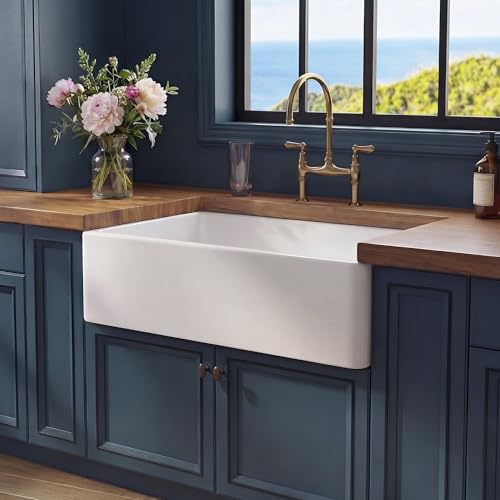
Miuara Farmhouse Sink 30 Inch Fireclay — Best Compact Fireclay
Thirty inches is where fireclay becomes possible for the smaller kitchen, and the Miuara makes the most of the format: a genuine fireclay body, a reversible design that lets the installer face a smooth side or a more detailed side outward, and a single bowl proportioned at thirty by eighteen inches. In a cottage kitchen, a narrow galley or a hard-working utility room, this is the pick that delivers the material’s deep, glassy calm without demanding a family-sized cabinet run.
Reversibility deserves a plain explanation, because listings mention it and rarely unpack it. A reversible fireclay sink is finished differently on its two long faces, so the apron that shows in your kitchen can be the flat, modern panel or the framed, traditional one, chosen on installation day and fixed forever once the sink is set. It is two sinks in one crate, and it forgives the buyer who has not fully decided the kitchen’s direction when the ordering deadline arrives.
The weight warning applies here in full despite the smaller footprint. Thirty inches of fireclay is still a two-person lift and still needs its support frame, and a smaller kitchen often means a smaller, older cabinet that needs the reinforcement conversation most of all. The Miuara Farmhouse Sink 30 Inch Fireclay rewards the buyer who prepares its home properly with a bowl that takes a roasting pan flat, a front that anchors the whole room, and a surface that shrugs off the daily chemistry of a working sink.
- Size: 30 x 18 inches per the listing
- Material: fireclay, white
- Front: reversible, two finished faces
- Bowl: single, deep apron-front
- Installation: support frame required; cabinet modification needed
Strengths
- Real fireclay in a smaller-kitchen width
- Reversible front defers the style decision to installation day
- Deep single bowl takes large pans flat
Trade-offs
- Still very heavy despite the compact width
- Thirty inches limits two-person sink teamwork
- Support carpentry is unavoidable
Best for: cottages, galleys and utility rooms wanting true fireclay. Not suited for: cabinets that cannot be reinforced.

Miuara Farmhouse Sink 33 Inch Fireclay — Best Family-Size Fireclay
Everything the thirty-inch Miuara does, this one does at family scale. Thirty-three by eighteen inches of fireclay, the same reversible-front thinking, and a bowl that accepts the largest sheet pans and stockpots a home kitchen owns without the tilt-and-wedge manoeuvre smaller sinks demand. For the standard thirty-six-inch sink base, this is the size the farmhouse idea was drawn for, and it is the natural centre of this guide: the sink a family cook would choose when the renovation is being done once and done properly.
The extra three inches change behaviour more than arithmetic suggests. Two people can work at a thirty-three-inch bowl, one washing and one rinsing or peeling, without a negotiation of elbows. A big roasting tin soaks flat while a corner of the bowl still takes the evening’s glasses. The apron front, at this width, becomes the kitchen’s visual anchor, the panel every other finish in the room quietly references.
And the weight, again, with feeling: this is the heaviest class of object most kitchens will ever host, and it arrives needing a planned route, a prepared cabinet and a support frame built before the sink leaves its crate. The Miuara Farmhouse Sink 33 Inch Fireclay is not a difficult sink to love. It is a difficult sink to carry, and the guide’s respect for that fact is the difference between a renovation story told with pride and one told with an asterisk.
- Size: 33 x 18 inches per the listing
- Material: fireclay, white
- Front: reversible, two finished faces
- Bowl: single, family scale
- Installation: support frame and cabinet modification required
Strengths
- Family-sized bowl swallows the largest pans whole
- Reversible front suits modern or traditional schemes
- Two people can work at the bowl comfortably
Trade-offs
- Among the heaviest objects a kitchen renovation involves
- Needs a thirty-six-inch class cabinet
- Single bowl means washing and soaking share one space
Best for: family kitchens renovating around a standard sink base. Not suited for: small cabinets or solo DIY installation.

HOMLYLINK 33 Inch Fireclay Farmhouse Sink — Best Undermount Apron
The HOMLYLINK’s distinction is its installation geometry: an apron-front fireclay sink designed for undermount fitting, so the counter’s edge runs clean to the bowl and crumbs, water and chopped herbs can be swept straight off the worktop into the sink without meeting a rim. That single detail changes the daily feel of a kitchen more than any finish can, because the wipe-into-the-sink motion happens a dozen times a day and a raised lip interrupts every one of them.
Undermounting a fireclay sink is also the most demanding installation in this guide, and the review will not soften it. The sink’s full weight hangs from its support structure beneath a counter that must be cut precisely, the apron must sit flush and level, and none of it forgives improvisation. This is the pick for a renovation already involving a new counter, where the templating and the support carpentry are part of the same professional conversation, rather than for a sink-only refresh in an existing kitchen.
Chosen in that context, the HOMLYLINK 33 Inch Fireclay Farmhouse Sink gives the most resolved, built-in look of the fireclay five: white ceramic, a clean counter line, and a deep single bowl doing the farmhouse job at full thirty-three-inch scale. It is the connoisseur’s installation, bought with open eyes.
- Size: 33 x 18 inches per the listing
- Material: fireclay, white
- Installation: undermount apron-front
- Bowl: single, deep
- Counter relationship: flush edge for sweep-in cleaning
Strengths
- Undermount edge makes counter cleaning effortless
- Most integrated, furniture-like finished look
- Full family-size single bowl
Trade-offs
- Most demanding installation of the six picks
- Realistically needs a new or re-cut counter
- Professional fitting strongly advised
Best for: full renovations with new counters. Not suited for: sink-only swaps in existing kitchens.

TUKTUK Farmhouse Sink 33 Inch Fireclay — Best Deep Bowl
Depth is the TUKTUK’s whole thesis. A thirty-three-inch fireclay bowl described in its listing as deep, and flexible in installation, able to serve as a drop-in or an undermount, it is built for the kitchens that soak: the stockpot left to loosen overnight, the roasting pan submerged entire, the harvest from a garden or a market day washed in one water. Shallow sinks splash; this one contains, and containment is a form of calm at the busiest station in the kitchen.
The installation flexibility is genuinely useful at renovation-planning stage, when the counter decision may still be open. A drop-in fitting forgives an existing counter and simplifies the support conversation; an undermount fitting buys the flush edge the HOMLYLINK specialises in. Owning the choice until the counter is chosen is worth money to a project whose decisions arrive in sequence rather than all at once.
Depth has one honest cost, paid by shorter cooks and by anyone with a back that files complaints: a deep bowl’s floor is further from its rim, and washing at the bottom of it is a lean-and-reach posture held for the length of the washing up. Tall households will never notice. Households of compact cooks should stand at a deep display sink somewhere and mime a washing-up session before ordering, because ergonomics, like weight, is a fact this guide refuses to let a photograph overrule.
- Size: 33 inches per the listing
- Material: fireclay, white
- Installation: drop-in or undermount flexibility
- Bowl: single, deep
- Role: maximum soaking and containment
Strengths
- Deep bowl contains splashes and huge items
- Installation choice can wait for the counter decision
- Full fireclay presence at family width
Trade-offs
- Deep floor is a long reach for shorter cooks
- Uses more water to fill for soaking
- Same heavyweight support requirements as all fireclay
Best for: tall households and serious soaking duty. Not suited for: shorter cooks wary of deep bowls.

Sinkology Parker 34 Inch Fireclay Farmhouse Sink — Best Double Bowl
The Parker argues for an older kitchen wisdom: two bowls. At thirty-four inches, the widest footprint here, it divides its fireclay into a double bowl, so washing can proceed in one side while the other holds rinsing, draining produce or the soaking pan that would otherwise evict everything else. Households that cook in parallel, one prepping while another clears, feel the benefit hourly. The listing also describes a quick-fit drop-in installation approach, which, relative to undermounting a fireclay double bowl, is the friendlier path this heavyweight category offers.
Division has a price, and the Parker pays it openly: neither bowl alone matches a single bowl’s ability to swallow the largest sheet pan or roasting tin flat. The great turkey roaster of the year may need to be washed at an angle, in stages, as double-bowl owners have always managed. The Sinkology Parker 34 Inch Fireclay Farmhouse Sink is therefore a bet about your cooking’s shape: many medium tasks at once, or occasional enormous ones. Only your own kitchen diary can settle it.
Sinkology specialises in this category, and the Parker carries the assurance of a maker whose reputation stands behind fireclay specifically. At thirty-four inches it also asks the most of the cabinet run, so the tape measure’s verdict comes first, as it does for every pick here, with the support frame conversation following immediately behind it.
- Size: 34 inches per the listing
- Material: fireclay, white
- Bowls: double bowl configuration
- Installation: quick-fit drop-in per the listing
- Role: parallel washing and soaking
Strengths
- Two bowls allow genuinely parallel work
- Widest footprint suits large cabinet runs
- Drop-in approach is the friendlier fireclay install
Trade-offs
- Each bowl is smaller than a single-bowl rival’s
- Largest cabinet requirement in the guide
- Two bowls mean two drains’ worth of hardware
Best for: two-cook kitchens with parallel workflows. Not suited for: cooks whose biggest pans must lie flat.

VAPSINT 33 Inch Black Farmhouse Sink Stainless — Best Black Steel Alternative
Now the honest exception. The VAPSINT is not fireclay and does not pretend to be: it is a thirty-three-inch apron-front sink in black stainless steel, sixteen gauge, with a deep single bowl at thirty-three by twenty by nine inches per its listing. What it offers instead of ceramic is a radically easier life: a fraction of a fireclay sink’s weight, an undermount installation a competent fitter handles without masonry, and a matte black presence that turns a modern kitchen’s sink into its boldest line.
Steel’s character must be stated as plainly as fireclay’s. It can scratch, and on a black finish scratches will announce themselves more than on brushed silver, though a bottom grid, worth checking whether the listing includes, keeps most pan traffic off the floor of the bowl. It sounds like a sink when water strikes it, where fireclay sounds like a bell muffled in velvet. It can show water spots that ceramic ignores. None of this makes it a lesser sink. It makes it a steel one, with steel’s ancient bargain of lightness and resilience against ceramic’s mass and silence.
For renters renovating with permission, for upper-floor kitchens wary of load, for modern schemes where white ceramic would be a costume, this is not the compromise pick. It is the correct pick, and the guide includes it so that the apron-front idea does not belong only to households able to rebuild a cabinet around a hundredweight of clay.
- Size: 33 x 20 x 9 inches per the listing
- Material: stainless steel, black finish, 16 gauge
- Installation: undermount apron-front
- Bowl: single, deep
- Weight: a fraction of the fireclay picks
Strengths
- Dramatically lighter and easier to install
- Black finish anchors modern kitchens
- Sixteen-gauge steel is the sturdy end of steel sinks
Trade-offs
- Scratches show more on black than on brushed steel
- Louder under running water than fireclay
- Water spots need wiping to keep the finish calm
Best for: modern kitchens and load-wary installations. Not suited for: buyers who want ceramic’s mass and silence.
How Do the Six Sinks Compare at a Glance?
| Pick | Badge | Distinguishing detail |
|---|---|---|
| Miuara Farmhouse Sink 30 Inch Fireclay | Best Compact Fireclay | 30 inch reversible fireclay, single bowl |
| Miuara Farmhouse Sink 33 Inch Fireclay | Best Family-Size Fireclay | 33 inch reversible fireclay, single bowl |
| HOMLYLINK 33 Inch Fireclay Farmhouse Sink | Best Undermount Apron | 33 inch fireclay, undermount apron |
| TUKTUK Farmhouse Sink 33 Inch Fireclay | Best Deep Bowl | 33 inch fireclay, deep, drop-in or undermount |
| Sinkology Parker 34 Inch Fireclay Farmhouse Sink | Best Double Bowl | 34 inch fireclay, double bowl, quick-fit drop-in |
| VAPSINT 33 Inch Black Farmhouse Sink Stainless | Best Black Steel Alternative | 33 inch black stainless, 16 gauge |
Choose material first, because it decides the installation, the budget of effort and the next thirty years of sound and care. Then choose width by cabinet, bowl count by cooking style, and installation style by counter. Buyers who run those four decisions in that order rarely regret the sink that arrives.
Why Does Fireclay Weigh So Much, and What Follows From It?
Fireclay begins as clay and ends as something close to stoneware’s denser cousin, fired until its particles fuse. The density that makes it shrug off thermal shock, staining and decades of scouring is the same density that makes a family-size sink a two-person lift with a planned route. Everything practical follows from that single fact: the support frame inside the cabinet, the reinforcement of older cabinet bases, the professional templating for undermounts, the advice to set the sink once and correctly because adjusting it later is a project, not a tweak.
The compensation is longevity of a different order from steel’s. A fireclay sink does not dent when a cast-iron pan slips, does not flex under a full bowl, and presents the same glassy face in its twentieth year as its first, given ordinary care. Kitchens are renovated around these sinks more often than the sinks are replaced, and that is the honest frame for the installation effort: a difficult week, amortised across decades.
How Is an Apron Sink Cabinet Actually Prepared?
The cabinet front is cut down to an opening that receives the apron, and inside, a support frame, typically timber rails and uprights built to the sink maker’s template, is constructed to carry the sink’s weight at exactly the height that puts its rim where the counter plan requires. The sink rests on that frame, not on the counter and not on hope. Plumbing is then connected within the reduced space the frame leaves, which is why slim traps and careful drain planning appear in every experienced installer’s conversation.
Two implications deserve emphasis. First, the false drawer front that decorates most sink cabinets disappears in this design, sacrificed to the apron, and households that stored the washing-up brush there need a new plan. Second, the work is essentially irreversible: a cabinet cut for an apron sink is committed, which is why the guide keeps returning to measurement and conviction. This is a marriage, not a fling, and it should be entered with the cabinet measured, the style chosen and the installer’s number already in the phone.
Single Bowl or Double Bowl: Which Suits Your Cooking?
Keep a fortnight’s honest diary of your sink. If its recurring drama is the enormous object, the roasting tin, the stockpot, the sheet pan that fits nowhere, the single bowl is your answer and the diary will say so in a week. If its recurring drama is simultaneity, vegetables draining while pans soak, two cooks working one station, a baby’s bottles quarantined from the dinner washing, the double bowl earns its division. Most modern households, armed with dishwashers that took over the daily washing, find the sink’s remaining jobs skew enormous, which is why single bowls dominate this guide and most of the market.
The dishwasher point deserves its full weight. A generation ago the double bowl was a washing system; today the machine washes, and the sink’s role has shifted to prep, soaking and the oversized. That shift is the strongest argument for the single deep bowl, and the households who still hand-wash daily, or cook in true parallel, are the honourable exception the Parker exists for.
How Do You Care for Fireclay and Black Steel Differently?
Fireclay asks for gentleness of a specific kind: its glaze is hard but its body is ceramic, so the rules are to avoid dropping heavy iron from a height into the bowl, to use a bottom grid or mat if your cooking involves daily cast iron, and to clean with non-abrasive products that respect the glaze. Stains sit on the surface rather than in it, and patience with a paste of bicarbonate lifts what haste would scratch at. Thermal shock, boiling water meeting a freezing bowl, is the one drama to avoid, and ordinary kitchen life rarely stages it.
Black stainless asks for the opposite courtesies: no abrasive pads at all, a wipe in the direction of the grain, prompt drying if water spots offend you, and a grid to keep pan bases from engraving the bowl floor. Its finish is a coating over steel, and treating it as such, rather than as the indestructible brushed steel of a restaurant, keeps it black and calm. Both materials, cared for as themselves, outlast the kitchens around them. Cared for as each other, both complain.
How Do You Choose a Faucet for a Deep Apron Bowl?
A deep bowl changes the faucet’s job description. The spout must reach far enough into the bowl that a pan can be filled and rinsed without acrobatics, and a pull-down sprayer earns its place daily, chasing debris into the drain from corners a fixed stream cannot address. Height matters in both directions: tall enough to admit a stockpot beneath it, not so tall that the fall of water into a deep, hard bowl turns every rinse into a splash event. Experienced farmhouse-sink owners tend to converge on a high-arc pull-down in a finish that argues with neither the sink nor the cabinets, and to test the pairing, at least on paper with the bowl’s depth and the faucet’s reach side by side, before either is installed.
Mounting deserves its sentence. Most apron installations put the faucet in the counter behind the sink, which means the counter’s drilling and the sink’s rear ledge, or lack of one, must agree, and that agreement is arranged at templating time, not discovered at plumbing time. A wall-mounted faucet is the elegant alternative in some kitchens and a significant plumbing relocation in all of them. Choose early, drill once.
What Happens to the Garbage Disposal and the Dishwasher?
A deep apron bowl sits lower than the sink it replaces, and everything beneath it must renegotiate. A garbage disposal hangs from the drain at a new height, and in a cabinet already housing a support frame, the disposal, the trap and the dishwasher’s drain hose compete for a smaller, more structured space. Most installations resolve this happily with planning; the ones that suffer are those where the disposal question is first asked with the sink already resting on its frame. Tell your installer about every appliance under the sink before the frame is built, and photograph the existing arrangement for reference.
The drain position itself can shift the bowl’s centre relative to the old plumbing, another templating-stage conversation. None of this is a reason to avoid an apron sink. It is a reason the category’s honest guides, this one included, keep describing the purchase as a small construction project: the bowl is the visible tenth of an iceberg made of frames, drains and decisions.
How Does an Apron Sink Change Daily Kitchen Life?
The first change is posture. An apron front lets a cook stand closer to the bowl, belly to the panel, without the cabinet front pressing at the shins and the counter edge digging at the waist, which is why the format was born in farmhouses where the sink was a workplace for hours. Washing up becomes marginally less of a lean and marginally more of a stand, and over a winter of evenings that margin is felt. The second change is capacity confidence: the cook stops pre-judging every large object, because the bowl has already answered the question.
The third change is subtler. A beautiful, permanent sink raises the kitchen’s standard of care around it; counters get wiped into it, the area stays clearer, and the room’s hardest-working station becomes its most admired. Skeptics call this sentimentality until they have lived with one. A fixture touched a hundred times a day shapes a household’s habits out of all proportion to its cost, which is the deepest argument for choosing the sink slowly and installing it properly.
What Should You Verify on the Listing Before Ordering?
Read for five facts and refuse to proceed without them. The exterior dimensions, which decide the cabinet fit. The interior bowl dimensions, which decide whether your largest pan truly fits, since exterior width flatters. The weight, which decides the crew and the frame. The installation type and the maker’s stated cabinet requirements, which decide the project plan. And the contents list, which decides whether grid, strainer and drain ride in the same crate or must be ordered alongside. A listing that states all five crisply is written by a maker who expects the sink to be installed successfully, and that expectation is contagious in the best way.
Add a sixth check for fireclay specifically: the maker’s tolerance language. Fired ceramic varies slightly in dimension from piece to piece, honestly and unavoidably, and good makers say so and instruct installers to template from the actual sink, not from the drawing. A renovation that knows this in advance builds the cabinet opening when the sink is in the building. One that learns it on installation day learns it loudly.
How Do You Live With the Sink During the Renovation Gap?
Between the old sink’s exit and the new one’s commissioning there is a gap, and in a fireclay project, with its carpentry and templating, that gap can run to days. Plan it like a camping trip you chose: a washing-up bowl in the bath or a utility sink, the kettle as the hot-water system, meals skewed toward the oven tray and the single pan, and paper plates deployed without shame for the final evening. Households that plan the gap treat it as a story. Households that discover it treat it as a grievance, and the sink, innocent throughout, absorbs the blame.
Sequence is the professional’s secret. The cabinet work, frame and counter templating can largely precede the old sink’s removal in a well-run project, compressing the waterless window to the final connection. Ask any installer quoting the job to describe their sequence in that order, and prefer the one whose answer keeps your kitchen washing up on all but one evening.
What Does the Apron Front Do to a Kitchen’s Style?
The apron is the largest uninterrupted panel at eye level in most kitchens, and it therefore becomes the room’s thesis statement. White fireclay states tradition, craft and a certain calm confidence; it suits shaker cabinets and modern schemes alike, because its whiteness is architectural rather than decorative. The fluted or framed face of a reversible model states heritage more explicitly and asks the room’s other details to meet it halfway. Black steel states modern intent and pairs its boldness with a demand for discipline elsewhere, since a black apron beside clutter reads as one more dark object rather than as a decision.
Hardware and textiles finish the sentence the apron begins. A bridge faucet and unlacquered metals lean traditional; a single clean pull-down leans modern; and the same white sink has served in both kitchens convincingly. Buyers paralysed at the reversible-front decision can take comfort: the panel is the constant, and the room’s smaller, cheaper elements carry the style’s fine print.
How Long Will a Fireclay Sink Last, and What Can End It Early?
Fireclay sinks are routinely the oldest functioning object in a renovated kitchen, outlasting the cabinets built around them and the appliances flanking them, because there is almost nothing in them to wear out. The glaze does not peel, the body does not rust, and the colour is the material’s own. The realistic early endings are accidents and abuse: a heavy iron vessel dropped from height onto an ungridded bowl, a renovation sledge swung by someone who did not know what the apron was, or a house fire’s thermal violence. Against the first, a grid is cheap insurance. Against the rest, there is only care.
Steel’s lifespan is shorter in theory and ample in practice: a sixteen-gauge sink, kept from abrasive abuse, serves for decades, with its finish’s cosmetic story accumulating faster than its structure’s. Either way, the sink is among the longest-lived purchases in the home, which returns the guide to its opening advice. A decision this permanent deserves the tape measure, the support frame and the honest installer, in that order.
How Do Children, Dogs and Real Life Treat an Apron Sink?
Family life is the farmhouse sink’s native habitat, and the format’s virtues compound there. The deep bowl bathes a baby, then a toddler’s paint equipment, then a muddy football kit, then the dog itself in many households, across a decade of service no other fixture matches. Children can stand at an apron front on a step and reach the water sooner than at a conventional cabinet, which makes hand-washing negotiations shorter. The bowl’s capacity absorbs the aftermath of baking with a six-year-old, which is to say it absorbs a category of mess that defeats lesser sinks entirely.
The cautions are the honest pair from earlier sections, restated in family dialect. Cast-iron pans and small, determined climbers both interact with ceramic best when a grid is in place and supervision is in the room, and a stool left permanently at the apron will eventually be used as a ladder to the counter. None of this diminishes the format. It merely confirms that the sink, like the farmhouse it was named for, expects to be worked in rather than looked at.
What Is the Resale Story of a Farmhouse Sink?
Kitchens sell houses, and within kitchens the sink photographs like a hearth: central, characterful and instantly legible as care. A white fireclay apron sink signals to a buyer that the renovation was done by someone who chose the permanent option, and that signal survives the decade in which trendier choices date. Estate agents know this, which is why the apron front appears in listing photographs out of proportion to its frequency in the housing stock. The black steel pick plays the same role for modern buyers, with the caveat that boldness polarises where white reassures.
None of this justifies installing a sink for a hypothetical buyer against your own cabinet’s protests. Resale value follows a successful installation in a kitchen that suits it; a fireclay sink crammed into an unreinforced cabinet is a survey finding, not a feature. Buy the sink your kitchen can honestly host and your household will honestly use, and the resale story writes itself as a by-product.
How Do You Decide Between the Two Miuara Sizes?
The thirty and the thirty-three are the same idea at two scales, so the decision is a pure measurement exercise dressed as a preference. Begin with the cabinet: a thirty-six-inch sink base takes the thirty-three with the breathing room its support frame wants, while a thirty-three-inch base points firmly at the thirty. Continue with the pans: lay your largest roasting tin and sheet pan on the counter and measure them, because the bowl that takes them flat is the bowl your cooking has been requesting. Finish with the household: two cooks at one bowl need the wider water, and a solo cook in a small kitchen will never miss it.
Regret in this category runs in one direction. Nobody with the thirty-three wishes for less bowl, while owners of the thirty in a family kitchen occasionally measure a pan and sigh. Where the cabinet genuinely allows either, and the budget stretches, the larger sink is the safer heirloom, provided its weight and frame were part of the plan from the first day rather than a surprise on the last.
What Should the First Week With a New Apron Sink Teach You?
Use the first week as a supervised introduction. Wash the largest pan you own and learn the bowl’s true geometry with your hands rather than your hopes. Run the disposal, if fitted, and listen for the new resonances a deeper bowl creates. Check beneath the sink each evening with a dry hand along every joint, because new plumbing announces its small betrayals early, and a weep caught in week one is a washer tightened, while a weep caught in month six is a cabinet floor replaced. Keep the grid in place while cast iron is around, and notice how the apron changes where you stand, because your back will file its own review by Friday.
By the week’s end the sink should have stopped being a renovation and started being the kitchen’s centre of gravity. If any part of it still feels like a stranger, a faucet reach that misses, a drain that gurgles, name it while the installer’s visit is still a courtesy call rather than a chargeable return. Fixtures this permanent deserve a fluent first month.
How Does Water Temperature and Glaze Care Interact Over Years?
Fireclay’s glaze is fired to withstand a working life, and its care over years is mostly a matter of not staging the two dramas it dislikes. The first is impact, already covered by the grid advice. The second is extreme thermal contrast: a bowl chilled by a winter window’s draught meeting a deluge of boiling water is a stress the material tolerates in youth and resents in aggregate, so the cook who drains pasta water in a hard stream does a small kindness by running the warm tap alongside, tempering the shock. It is an old ceramic-keeper’s habit, costs nothing, and belongs in the same family as not slamming an oven door.
Everyday cleaning stays deliberately boring: warm water, a soft cloth or sponge, ordinary detergent, and the occasional bicarbonate paste for the marks that hard water and hard work leave behind. Bleach-heavy and abrasive routines belong to other materials. A fireclay sink cleaned gently for twenty years looks like a fireclay sink cleaned gently for one, which is the entire luxury the material sells.
How Do You Budget the Whole Apron Sink Project?
The sink’s price is the visible fraction of its project. Around it gather the support carpentry, the cabinet modification, the counter work where the installation demands it, the faucet chosen for a deep bowl, the grid and strainer where they are sold separately, the possible disposal adjustment, and the installer’s day, or days, of skilled labour. Written down in advance, that bill is simply the cost of a permanent kitchen fixture, and spread across the decades of service this guide keeps citing, it is a modest one. Discovered line by line, mid-project, with the kitchen already dismantled, the same bill feels like an ambush. The difference between the two experiences is a single honest spreadsheet written before the crate is ordered.
There is one economy worth naming: because the sink will outlast the cabinets, it is the wrong place in a renovation to hunt for savings by choosing a lesser material. Save on the handles, the splashback tiles, the light fittings that can be upgraded in an afternoon. The object that requires construction to remove deserves to be the object you most wanted.
What Should You Ask an Installer Before Agreeing the Job?
Ask whether they have set a fireclay apron sink before, and listen for the support frame in the answer, because that phrase separates experience from optimism. Ask who templates the counter and whether they template from the delivered sink rather than its drawing. Ask how the disposal and dishwasher drain will be handled inside the reduced cabinet. Ask what the waterless window will be, in evenings, and what happens if the delivered sink’s dimensions differ slightly from the listing’s, as fired ceramic honestly can. An installer who answers all five with specifics is the installer the project wants, and their price, compared against the cost of a cracked sink or a flooded cabinet, is rarely the expensive option it first appears.
How Does an Apron Sink Age Alongside the Rest of the Kitchen?
Kitchens age unevenly. Appliances cycle in a decade, cabinet doors date by their handles, counters acquire their biographies of knife slips and hot pans. A fireclay apron sink ages slowest of all, which gives it a strange role in the room’s long story: it becomes the fixed point renovations arrange themselves around, the survivor of the second refit and the anchor of the third. Households that understand this choose its style with a longer horizon than the current scheme, favouring the smooth face and the classic proportions that will still make sense when the cabinets around it have changed twice.
That longevity also forgives the installation’s difficulty in a way this guide has perhaps not stated plainly enough. Every other element of the project, the carpentry, the templating, the plumbing, is a week of disruption purchased once. The sink repays it daily, at every washing up, for longer than the mortgage on many of the houses it is installed in. Few purchases in a home offer that exchange rate, and none of them photograph as well while doing it.
How Do You Plan the Delivery Day Itself?
A fireclay sink’s delivery is a logistics exercise disguised as a parcel. Confirm in advance whether the carrier brings the crate to the door, the kerb or the room, because the difference between those three is a staircase and a friendship. Clear the route of rugs, doors that will not stay open and the household’s smaller members, recruit the second pair of hands before the van arrives rather than during its idling, and decide where the crate will be opened and inspected, since a sink must be examined for transit damage before it is signed for and long before it meets its cabinet. Photograph any flaw in the carrier’s presence. The steel VAPSINT, arriving at a fraction of the weight, forgives nearly all of this planning, which is either its charm or its warning, depending on how much ceremony you believe a thirty-year fixture deserves.
What Mistakes Do Farmhouse Sink Buyers Make Most Often?
Underestimating the weight is the founding error, from the delivery left at the kerb to the cabinet that was never reinforced. Second comes ordering by the photograph’s width without measuring the cabinet’s interior and its door openings. Third is forgetting the accessories: the grid, strainer and drain that the listing may sell separately, discovered missing on installation morning. Fourth is choosing the reversible front’s face in haste at the kerb rather than in the kitchen against the cabinets. Fifth is treating the installation as a sink swap and booking a handyman afternoon for what is, with fireclay, a small construction project. Every one is preventable with the tape measure and the telephone, the two tools this guide recommends most.
Final Recommendation
Choose the thirty-three-inch Miuara if your family kitchen wants the classic fireclay single bowl at full scale, its smaller sibling if the kitchen is compact, the HOMLYLINK when a new counter makes undermounting natural, the TUKTUK when soaking depth rules, the Parker when two cooks work in parallel, and the black VAPSINT when weight, modern styling or an easier installation decides the matter. Build the cabinet honestly, lift with help, and the first time a whole roasting pan lies flat in that deep white bowl, the renovation’s hardest purchase will feel like its easiest decision.
Frequently Asked Questions
Can my existing cabinet take a fireclay apron sink?
Usually with modification: the front must be cut for the apron and a support frame built inside to carry the weight. An installer or experienced carpenter can judge your cabinet in one visit, and that visit should happen before ordering.
What does reversible mean on a fireclay sink?
Its two long faces are finished differently, typically one smooth and modern, one framed or fluted and traditional. You choose which faces the room at installation, and that choice is permanent once the sink is set.
Does a farmhouse sink need a special faucet?
No, but the deep bowl pairs well with a tall or pull-down faucet that can reach into it and rinse its corners. Check that your faucet’s height and reach suit a deep apron bowl before installation day.
Are the grid and strainer included?
Often they are sold separately, and listings differ. Read the contents list for your chosen sink and order any grid, strainer or drain at the same time, so installation is not delayed by a small missing part.
How much water does a deep single bowl use?
More than a divided bowl filled on one side, which is the deep single bowl’s honest running cost. Most washing in a deep bowl happens under a running tap or with a washing-up bowl nested inside it, a habit many farmhouse-sink households adopt in the first month, which restores the water economy while keeping the capacity for the days that need it.
Will a black stainless sink scratch?
Yes, over time, as all steel sinks do, and scratches show more readily on a dark finish. A bottom grid and non-abrasive cleaning keep it looking its best, and many owners accept the patina as part of a working kitchen.
Related Guides
The sink is one station of the winter kitchen. The blankets that warm the cook afterwards are gathered in Best Winter Blankets Throws, the sheet sets that suit a farmhouse bedroom are examined in Best Damask Sheet Sets, and the wake-up that starts a cooking day is the subject of Best Alarm Clocks for Hard Sleepers.



[…] kitchen-friendly washable options at room scale. And when the renovation reaches the sink itself, Best Farmhouse and Apron Kitchen Sinks covers the deep-basin designs that make washing a big glass jar a pleasure instead of a juggling […]