What's inside
- Key Takeaways
- Quick Picks
- How We Chose These Picks
- How Do the Six Openers Compare at a Glance?
- How Does a Side Cut Actually Work, and Why Is It Safer?
- Which Opener Should Hands With Arthritis or Weak Grip Choose?
- How Should a Smooth-Edge Opener Be Cleaned and Stored?
- What Can You Do With a Lid That Has No Sharp Edge?
- How Do You Open Oversized and Awkward Cans Without a Fight?
- What Should You Check on the Listing Before Ordering an Opener?
- How Does a Safe Opener Change Life With Children and Pets?
- Why Do Some Smooth-Edge Cuts Fail Halfway Round?
- How Do You Teach a New Cook the Side-Cut Motion?
- Can a Hand Opener Belong in an Emergency Kit or a Camper?
- How Do You Know When an Opener Has Reached the End?
- How Do You Open Cans Safely When One Hand Is Out of Action?
- What Mistakes Do Can Opener Buyers Make Most Often?
- Final Recommendation
- How Long Does the Learning Curve Really Last?
- Frequently Asked Questions
- Related Guides
As an Amazon Associate I earn from qualifying purchases. This post may contain affiliate links at no extra cost to you.
cottageverdict.com is reader-supported. When you buy through links on our site, we may earn an affiliate commission.
Where to buy: the six openers reviewed here are all sold on Amazon, and their names in the Quick Picks table, the review headings and the comparison table link straight to the matching listings, where you can confirm colours, care instructions and current stock. Looking for the best hand can openers used to mean choosing between cheap top-cutters that left a jagged lid and a sharp can rim. This group tells a happier story: every pick below is a smooth-edge, safety-style opener. Instead of slicing down through the top of the lid, these tools cut around the side of the rim, below the factory seal, so the lid lifts away whole and neither the lid edge nor the can edge comes away sharp enough to catch a finger, a sponge or a bin liner.
That shared mechanism does not make the six interchangeable. They differ in how the turning feels in a tired hand, in whether the opener grips and holds the lid for you, in whether it can help with ring-pull cans, and in how it wants to be washed and stored. A grandparent opening soup with arthritic knuckles, a camper opening beans at a picnic table, and a parent emptying tuna while a toddler patrols the kitchen all need the same safe cut but very different handles. The reviews below judge each opener against the hands and habits it will actually meet, because a can opener is used in the worst-lit, wettest-handed moments of cooking, and it has to work then, not just on a showroom counter.
One expectation to set early: smooth-edge openers feel different from the top-cutters many people grew up with. The wheel rides the outside of the rim, the cut is nearly invisible as it happens, and the lid stays seated until you lift it away. First-time users sometimes turn a full circle, see no dramatic opening, and assume nothing happened — then discover the lid lifts off cleanly in one piece. Give any pick here two cans to learn on before judging it.
Key Takeaways
- All six picks cut around the side of the rim, leaving lids and cans without sharp edges.
- The lid comes off whole and can be lifted away without fingers touching food.
- Turning effort and handle comfort, not cutting power, separate these six most clearly.
- Two Starfrit picks hold the lid after cutting, so it drops into the bin, not the food.
- Kuhn Rikon’s pick adds a ring-pull tool for cans whose tabs defeat fingernails.
- Smooth-edge lids can often be rested back on the can as a temporary cover.
Quick Picks
| Pick | Badge | Why it earns its place |
|---|---|---|
| OXO Good Grips Smooth Edge Can Opener | Best Overall Smooth Edge | Soft, generous handles and a calm turning action suit almost every hand. |
| Kuhn Rikon Auto Safety LidLifter Can Opener | Best With Ring-Pull Tool | Swiss side-cutter that also levers ring-pull tabs and never touches the food. |
| GoodCook Safe-Cut Can Opener | Best Easy-Turn for Seniors | An oversized easy-turn knob and ergonomic handle built for weaker grips. |
| Starfrit MightiCan Can Opener | Best Lid-Holding Grip | Grips the lid once cut and holds it until you release it over the bin. |
| Starfrit Little Beaver Can Opener | Best Compact Classic | A smaller, simpler safe opener with a comfort grip and a three-year warranty. |
| Can Opener Smooth Edge Side Cut Stainless Steel | Best Stainless Steel Build | An all-metal side-cut design for cooks who prefer steel in the hand. |
How We Chose These Picks
Every candidate had to be a manual, smooth-edge opener — no electrics, no top-cutting wheels — because the safety cut is the entire point of this category. Within that rule we weighed the turning train: how the knob, gear and cutting wheel share the work, and whether the action stays smooth when a can is slightly dented or the user’s hands are wet. An opener that demands a wrestler’s grip fails the real test of this tool, which is opening the third can of tomatoes mid-recipe with sauce already on your fingers.
Handles came next. Soft, wide grips spread pressure across the palm instead of concentrating it on two fingers, and knob size decides how much torque a weak or sore hand can comfortably deliver. Two of these picks were designed openly for seniors and arthritis-prone hands, and the reviews treat that as a serious engineering brief, not a marketing garnish. We also looked at lid management: whether the opener merely cuts, or also clamps, lifts and holds the lid so it can be carried to the bin without a fingertip ever going near the food or the rim.
Hygiene separated the thoughtful from the ordinary. Side-cut designs already win here, because the wheel works on the outside of the rim and does not dip into the food the way a top-cutter’s wheel can. Beyond that, we favoured builds without deep crevices around the gear, and we noted honestly which models prefer hand-washing. Warranty length closed the judging: two picks carry an explicit three-year warranty in their listings, a meaningful promise for a tool whose gear teeth do thousands of small jobs a year.

OXO Good Grips Smooth Edge Can Opener — Best Overall Smooth Edge
OXO built its reputation on the idea that handles are a design discipline, and this opener is that philosophy in its purest form. The soft grips are wide enough to fill the palm rather than perch in it, so the squeezing hand stabilises the tool while the other hand turns, and neither job demands fingertip force. The listing calls the design arthritis-friendly, and for once the phrase describes a physical reality you can feel: pressure spreads, the knob turns with a steady, geared calm, and the side-cutting wheel tracks the rim without the skittering that makes cheaper openers jump off mid-can.
The cut itself is the smooth-edge standard at its best. The lid separates below the seal, lifts away as a clean disc, and can be set back on the can as a loose cover for the fridge — a small, daily pleasure that top-cutters can never offer, since their lids fall into the food or brandish a serrated edge. Because the wheel never rides through the contents, it comes away from a can of tuna or tomato looking as clean as it went in, which matters for a tool that often gets rinsed rather than washed. OXO’s opener also tolerates the imperfect cans of real life, the slightly dented rim from a dropped grocery bag, better than fussier mechanisms that demand a perfect circle.
Its compromises are modest and worth naming. It is a full-size tool and will not vanish into a minimalist drawer or a backpacker’s kit. Like most smooth-edge designs it rewards a hand-wash and a proper dry rather than a dishwasher cycle, particularly around the cutting wheel. And first-time users must learn the side-cut’s quiet feedback, turning until the lid releases rather than until something looks open. None of that dents its standing: the OXO Good Grips Smooth Edge Can Opener is the pick to hand to any cook, of any age, without a word of explanation beyond “turn until it lets go.”
- Cut style: smooth-edge side cut below the rim seal
- Handles: soft, wide easy-grip handles per the listing
- Lid result: whole lid, no sharp edge on lid or can
- Designed with arthritis-prone and senior hands in mind
- Wheel contact: rides the rim’s outside, away from food
Strengths
- Palm-filling grips make the squeeze nearly effortless.
- Calm geared turning stays on track around dented rims.
- Lid lifts clean and can re-cover the can for storage.
Trade-offs
- Full-size body takes real drawer space.
- Prefers hand-washing to keep the wheel at its best.
- Side-cut action feels unfamiliar for the first two cans.
Best for: almost any household wanting one opener that suits every hand. Not suited for: ultralight camping kits or the tiniest drawers.

Kuhn Rikon Auto Safety LidLifter Can Opener — Best With Ring-Pull Tool
Kuhn Rikon’s LidLifter approaches the can as a Swiss design problem: remove the lid without touching it, without sharp edges anywhere, and without the tool contacting the food. The opener clamps onto the rim, the easy-turn handle drives the side cut, and small gripping jaws on the tool then lift the freed lid away — your fingers stay entirely out of the transaction. For cooks who open cans of pet food, tuna or chillies and dislike the archaeological dig of retrieving a lid from inside the can, that touch-free lift is not a gimmick. It is the feature they will mention to friends.
The second tool hidden in this design is the ring-pull lever. A large share of modern cans — sardines, corned beef, many soups and pet foods — close with a ring tab instead of needing an opener at all, and those tabs are notorious fingernail-breakers that resist weak hands entirely. The LidLifter’s built-in ring-pull tool hooks the tab and levers it with the handle’s length doing the work, turning a small daily humiliation into a non-event. Households with older cooks will feel this benefit weekly, not occasionally, and it is unique among the six picks here.
In red, with its tidy engineered lines, it also stores differently from the others: slimmer in the hand, more instrument than utensil. The trade-offs follow from its precision. The clamping-and-lifting sequence has one more step to learn than a basic side-cutter, and cooks who rush it sometimes lift before the cut has fully travelled the rim. It also asks for hand-washing to protect its mechanism. Accept those small disciplines and the Kuhn Rikon Auto Safety LidLifter Can Opener is the most complete answer to the whole can problem — cut, lift, and ring-pull — in a single drawer slot.
- Cut style: smooth-edge side cut with touch-free lid lifting
- Extra tool: integrated ring-pull lever for tab-top cans
- Contact: cutting mechanism stays off the food surface
- Design origin: Swiss engineered, easy-turn handle
- Lid result: lid gripped and lifted by the tool itself
Strengths
- Lid comes away in the tool’s jaws, never in your fingers.
- Ring-pull lever rescues tabs that defeat nails and knuckles.
- Slim, precise build stores neatly in crowded drawers.
Trade-offs
- Lift-off step takes a can or two of practice.
- Mechanism prefers hand-washing over dishwasher cycles.
- Slimmer handle fills large palms less than the OXO.
Best for: cooks who hate touching lids and households fighting ring-pull tabs. Not suited for: users wanting the absolute simplest one-motion opener.

GoodCook Safe-Cut Can Opener — Best Easy-Turn for Seniors
GoodCook’s Safe-Cut is the most single-minded tool in this group: it exists to make opening a can easy for hands that find it hard. The listing says so directly, naming seniors and an ergonomic handle, and the design follows through with an easy-turn knob sized and shaped to be driven by a palm-assisted grip rather than by pinched fingers. Torque is the whole battle for a sore hand. A generous knob converts weak rotation into real cutting force, and the Safe-Cut spends its design budget exactly there instead of on extra mechanisms.
The cut is the family’s standard safe cut — around the side, no sharp edges left on lid or can, and no cutting surface parading through the food. For a caregiver stocking a parent’s kitchen, that combination is the entire brief: a can of soup opened without a jagged lid to handle, without a wheel to scrub tomato out of, and without a phone call asking for help. The black handle is unfussy, the silhouette is familiar rather than futuristic, and that familiarity matters for cooks who distrust gadgets that look like puzzles. It resembles the opener they have used for decades; it simply refuses to hurt them.
What it does not do is hold your lid, lever your ring-pulls, or fold into a travel kit. The knob’s size, its chief virtue, makes the tool a committed drawer resident. And while the mechanism is simple, the side-cut learning curve still applies — one full turn, then lift. Judged on its chosen mission, though, this is the opener to buy for the kitchen where grip strength is the constraint: the GoodCook Safe-Cut Can Opener treats an easy turn not as a comfort feature but as the product itself.
- Cut style: safe side cut, no sharp edges remaining
- Knob: oversized easy-turn design for low grip strength
- Handle: ergonomic shape aimed at senior users
- Food contact: cutting surfaces stay clear of contents
- Form: full-size manual handheld opener in black
Strengths
- Big knob delivers real torque from a weak grip.
- Familiar shape reassures cooks wary of new gadgets.
- Safe cut removes the jagged-lid hazard entirely.
Trade-offs
- No lid-holding jaws or ring-pull helper on board.
- Large knob claims noticeable drawer room.
- Styling is plain beside the Swiss and steel rivals.
Best for: seniors, arthritis-prone hands and caregivers stocking a parent’s kitchen. Not suited for: buyers wanting lid-lifting extras in one tool.

Starfrit MightiCan Can Opener — Best Lid-Holding Grip
The MightiCan’s party trick is what happens after the cut. Where most openers finish their work and leave the lid balanced on the can — one nudge from sliding into the beans — Starfrit’s design holds the lid once it is cut free, so you carry the can and opener together to the bin and release the lid where it belongs. Anyone who has fished a lid out of a pot of soup with a fork, or wiped tuna juice off a counter for the third time in a week, understands immediately why a held lid is worth designing for. The blue comfort grip and non-slip knob keep the whole operation steady, and the listing backs the mechanism with a three-year warranty, a confident promise for a moving-parts tool at this level.
The cut underneath the trick is the expected smooth one: around the side, no sharp edges on lid or can, contents untouched by the wheel. In use the MightiCan feels deliberate rather than dainty — a tool that clamps, travels and grips in one continuous intention. The hold also solves a subtle hygiene problem. A lid carried in the opener never gets set down on the counter, never gets handled with food-wet fingers, and never ends up in the recycling with soup still clinging to it, because it can be released straight into the bin and rinsed under the tap while still held.
Size is the honest cost. A mechanism that grips needs a body with something to grip with, and the MightiCan is not the opener for a minimalist utensil crock. Its hold also depends on completing the full circle of the cut; stop three-quarters round and the lid is neither free nor held, which is user impatience rather than design failure, but worth knowing. For family kitchens opening several cans a day, where lids multiply like paperwork, the MightiCan’s tidy ending to every can earns its space.
- Cut style: safe smooth cut around the side of the rim
- Signature behaviour: holds the lid after cutting until released
- Grip: comfort grip handle with non-slip turning knob
- Warranty: three years according to the listing
- Colour: blue, easy to spot in a drawer
Strengths
- Held lids never fall into food or onto counters.
- Non-slip knob keeps turning steady with wet hands.
- Three-year warranty backs a mechanism with moving parts.
Trade-offs
- Full mechanism makes it one of the larger picks.
- Lid hold only works once the cut completes its circle.
- Bright colour will not match every kitchen’s palette.
Best for: busy family kitchens opening multiple cans daily. Not suited for: tiny utensil drawers or travel cooking kits.
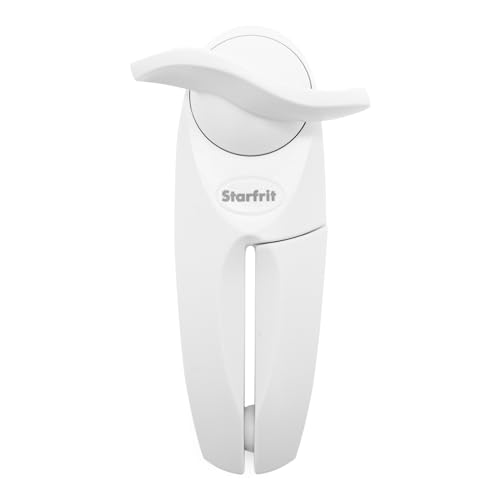
Starfrit Little Beaver Can Opener — Best Compact Classic
The Little Beaver is the MightiCan’s smaller, older sibling in spirit: a safe Starfrit opener that also holds the lid and leaves no sharp edges, but in a trimmer white body for kitchens that cannot spare the larger tool’s footprint. It has been a fixture of Canadian and American drawers for years, and its appeal is the appeal of any classic — the mechanism is proven, the comfort grip is honest, and the three-year warranty in its listing matches its bigger sibling’s. For a second opener, a caravan kitchen, a first flat or a holiday home, this scale of tool is often exactly right.
Using it feels reassuringly plain. Clamp, turn with the comfort-grip knob, feel the cut travel, and lift a lid that the opener keeps hold of rather than dropping. The white body shows every splash, which some cooks will read as a flaw and others as a feature: it gets washed promptly, and a promptly washed opener is a hygienic opener. Its smaller frame does ask slightly more of the turning hand than the MightiCan’s broader ergonomics, so households whose primary cook has serious grip limitations should still look first at the GoodCook or the OXO. For average hands, the effort difference is a shrug.
What the Little Beaver refuses to be is fancy. No ring-pull lever, no steel showpiece finish, no oversized senior knob. It is the safe cut, the held lid and the warranty, delivered in the smallest honest package in this guide. Kitchens that open a few cans a week rather than a few cans a meal will find that package sized to their actual lives, and drawers that reject every bulky gadget will finally accept a smooth-edge opener. Sometimes the best version of a tool is simply the one that fits where you live.
- Cut style: safe smooth cut, lid held after cutting
- Body: compact white form with comfort grip
- Warranty: three years per the listing
- Edges: no sharp edges left on the removed lid
- Role: space-saving primary or dependable second opener
Strengths
- Lid-holding safety in the smallest body here.
- Proven design with a matching three-year warranty.
- White finish encourages prompt, visible cleaning.
Trade-offs
- Smaller knob asks more of weak or sore hands.
- White shows splashes and tomato stains readily.
- No extras such as a ring-pull lever.
Best for: small kitchens, caravans, second openers and holiday homes. Not suited for: cooks whose grip strength is their main constraint.

Can Opener Smooth Edge Side Cut Stainless Steel — Best Stainless Steel Build
Some cooks simply trust metal. This unbranded stainless steel side-cutter is built for them: a manual opener whose body is steel rather than moulded plastic, with a turn knob driving the smooth-edge cut around the rim. The listing adds one thoughtful detail the bigger brands mostly skip — the removed lid can serve as a reusable cover, rested back on the can — which the smooth cut makes possible because the lid comes off whole, clean and safe to handle. Steel in the hand also changes the feel of the work: denser, cooler, with a sense that the tool will outlast the drawer it lives in.
Steel’s virtues are practical as much as sentimental. It does not absorb odours from a week of tuna and tomato, it shrugs off the heat of a nearby hob, and it rinses without seams or soft-grip layers to trap moisture. For cooks who have watched plastic handles crack or rubber grips go tacky in a hot kitchen, an all-metal tool is a deliberate purchase, not an aesthetic one. The side cut performs the family standard — no sharp edges on lid or can — and the knob is shaped for a straightforward, workmanlike turn.
The honest caveats concern the unknown rather than the known. An unbranded listing carries no named warranty promise like the Starfrit pair’s three years, and no decades-long brand reputation like OXO’s, so the buyer’s confidence rests on the material and the mechanism rather than on a logo. Bare steel handles also offer less cushioning than soft grips, and arthritic hands should choose accordingly. For a robust, odour-proof, dishwasher-era tool that treats the lid as a reusable part rather than rubbish, this steel side-cutter is a quietly sensible final pick.
- Cut style: smooth-edge side cut in stainless steel
- Body material: stainless steel throughout the build
- Lid behaviour: lid can be reused as a temporary cover
- Turning: manual knob drive, handheld format
- Care profile: metal rinses clean without grip layers
Strengths
- Steel body resists odours, heat and cracking.
- Reusable-lid design reduces waste on half-used cans.
- No soft-grip layers to trap moisture or degrade.
Trade-offs
- No named multi-year warranty in the listing.
- Bare metal handles cushion sore hands less.
- Brand support is thinner than the famous names here.
Best for: cooks who prefer all-metal tools and rinse-and-go care. Not suited for: hands that need padded grips and easy-turn knobs.
How Do the Six Openers Compare at a Glance?
| Pick | Badge | Distinguishing detail |
|---|---|---|
| OXO Good Grips Smooth Edge Can Opener | Best Overall Smooth Edge | Soft wide grips, arthritis-friendly turning |
| Kuhn Rikon Auto Safety LidLifter Can Opener | Best With Ring-Pull Tool | Touch-free lid lift plus ring-pull lever |
| GoodCook Safe-Cut Can Opener | Best Easy-Turn for Seniors | Oversized easy-turn knob, ergonomic handle |
| Starfrit MightiCan Can Opener | Best Lid-Holding Grip | Holds lid after cutting, non-slip knob |
| Starfrit Little Beaver Can Opener | Best Compact Classic | Compact lid-holding design, comfort grip |
| Can Opener Smooth Edge Side Cut Stainless Steel | Best Stainless Steel Build | All-steel side cut, reusable lid design |
How Does a Side Cut Actually Work, and Why Is It Safer?
A traditional opener drives its wheel down through the lid’s top, inside the rim, and the metal it shears becomes the hazard: the lid’s edge turns into a serrated disc and the can keeps a matching sharp lip. A side-cut opener turns that geometry inside out. Its wheel runs horizontally around the outside of the rim, slicing the thin fold where lid meets can, just below the factory seal. The lid then releases as the smooth disc the factory stamped, and the can’s edge is the rounded rim itself. Nothing in the system ever gets sharpened, because the cut happens in the seam rather than through a flat sheet of metal.
Two quieter benefits ride along. The wheel stays outside the food zone, so it does not emerge coated in whatever it just opened, and the lid cannot fall into the contents because it is never cut free over them — it is lifted away afterwards, by fingers, jaws or a held grip depending on the model. The trade is feedback. A top-cutter announces its progress with crunch and resistance; a side-cutter works almost silently and the lid looks unopened until the moment it lifts. Every cook in this guide’s audience learns that stillness within two cans, and most never willingly return to the jagged alternative.
Which Opener Should Hands With Arthritis or Weak Grip Choose?
Start with the physics of the task. Opening a can asks for two forces at once: a squeeze to keep the tool seated on the rim, and a rotation to drive the cut. Weak hands usually fail at one of the two, so the right opener is the one that reduces whichever force is scarce. For scarce squeeze, the OXO’s palm-filling soft grips spread the load so effectively that the tool nearly seats itself. For scarce rotation, the GoodCook’s oversized knob is the answer, because a bigger knob is a longer lever, and a longer lever turns feeble turning into sufficient torque.
Ring-pull cans deserve their own sentence in this conversation, because they ambush weak hands in a different way — no opener seems needed, until a tab snaps a nail or refuses a fingertip entirely. That is the Kuhn Rikon’s moment, its lever converting the tab’s short, vicious pull into a long, gentle one. Households buying for an older parent often end up pairing two picks from this guide: a senior-friendly side-cutter for standard cans and the LidLifter within reach for tabs. It is not extravagance; it is matching tools to the two distinct ways cans resist.
How Should a Smooth-Edge Opener Be Cleaned and Stored?
The side-cut’s hygiene advantage only survives if the wheel gets rinsed. Food rarely touches it, but rim metal, label glue and the occasional splash do, and a wheel left gummy will eventually track less smoothly around the next can. Warm water, a brush pass over the wheel and gear, and a proper dry before the drawer — that is the whole liturgy for most of these models, and it takes under a minute. Dishwasher habits vary by listing, so check your own model’s guidance rather than assuming; mechanisms with soft grips and lid-holding jaws generally live longer washed by hand.
Storage matters more than cooks expect. An opener tossed loose into a utensil drawer gets its wheel knocked by heavier tools and its knob buried under whisks, and the resulting hunt discourages use. A hook, a magnetic strip or a dedicated slot keeps the tool findable, which in a busy kitchen is half of being useful. Steel-bodied picks tolerate any of these; soft-grip models prefer not to rest with their cushioning compressed under a pile of cutlery. Treat the opener as a small machine with one moving job, and it will do that job thousands of times.
What Can You Do With a Lid That Has No Sharp Edge?
The smooth lid turns out to be a small household resource. Rested back on its can, it keeps dust off a half-used tin of beans in the fridge until tomorrow’s soup — not a seal, and never a substitute for decanting food into a proper container for longer storage, but a perfectly good overnight pause. In the recycling stream, a blunt lid is safer for the hands that sort and the bags that carry. Around children, the difference is larger still: the most common can injury in a home kitchen is a lid fished from a bin or left on a counter, and a smooth disc removes that hazard at the source.
Craft and garden uses follow naturally — lids as plant markers, paint-pot rests, candle coasters — but the deeper point is behavioural. When the by-product of opening a can is harmless, the whole task relaxes. Nobody wraps a lid in paper before binning it, nobody warns the person washing up, nobody checks a toddler’s hands after a brush with the recycling. Safety that requires no vigilance is the best kind, and it is the real product every pick in this guide is selling beneath its steel and plastic.
How Do You Open Oversized and Awkward Cans Without a Fight?
Big catering tins of tomatoes or fruit change the balance of the job. The can is heavy, the rim’s circle is long, and the hand holding the tool tires before the cut finishes. Set the can on a damp cloth so it cannot skate, keep it on the counter rather than holding it in the air, and let the opener travel while you rotate the can a quarter turn at a time with the holding hand. Smooth-edge tools cope well here because the cut does not depend on downward force; the wheel simply needs to stay seated in the seam. If your grip fades halfway round, pause with the tool still attached — a side-cutter holds its place politely — shake the hand out, and resume. Rushing the last quarter is how cuts get abandoned one inch from completion.
Small cans present the opposite geometry. A tiny tin of tomato paste or anchovies gives the opener’s body little rim to organise around, and the tool can feel oversized for the task. Slow down, seat the wheel carefully, and turn in short arcs, checking the seam as you go. The compact Little Beaver earns quiet points in this corner of the kitchen, while the full-size models simply need a steadier introduction. Either way, the reward for patience is the same clean disc of a lid, even off the smallest tin in the cupboard.
What Should You Check on the Listing Before Ordering an Opener?
Read for the cut first: the listing should describe a side or smooth-edge cut explicitly, because product photography alone cannot tell you which side of the rim a wheel works on. Then look for the lid story — whether the tool merely cuts, or also lifts and holds — since that behaviour decides your daily cleanup more than any other feature. Warranty language is worth its own pause; an explicit multi-year promise, like the three years on the Starfrit pair, tells you the maker expects the gear train to survive real service. Care instructions close the loop. If your household runs everything through the dishwasher without exception, choose a model whose listing blesses that habit rather than one you will slowly ruin with kindness.
Photographs deserve a sceptical glance too. Look at how the knob meets the hand, whether the handles close fully without pinching the palm’s heel, and whether the head’s shape suggests it will sit flat in a drawer. None of the six listings here hides its design, and comparing those details against your own drawers and hands takes two minutes that will be repaid at every can for years. An opener is a decade-long tenant of a kitchen; vet it like one.
How Does a Safe Opener Change Life With Children and Pets?
Kitchens with small children run on hazard removal, and the jagged can lid is one of the classic domestic hazards — light, sharp, easily left on a counter at adult height and toddler curiosity level. A smooth-edge opener deletes that object from the house entirely. Lids become blunt discs that can be dropped in the recycling without a thought, and the open can waiting for its contents to be spooned out has a rolled, finger-safe rim. Parents who have performed the anxious bin-wrap ritual with a serrated lid understand the emotional value of that deletion better than any specification can express it.
Pet food sharpens the point, because pet cans are opened at floor-adjacent moments, often twice a day, often with an animal underfoot urging speed. A lid that lifts away in the tool’s jaws, as the Kuhn Rikon manages, or stays held by the opener, as both Starfrit designs manage, never gets set down where a paw or a bare foot can find it. Speed plus safety is a rare combination in kitchen tools, and it is the combination this entire category exists to provide. Households with pets frequently tell us the opener upgrade paid for itself in peace of mind within the first week.
Why Do Some Smooth-Edge Cuts Fail Halfway Round?
Almost every failed side cut traces back to seating. If the wheel starts slightly off the seam — perched on the rim’s crown instead of nested in its fold — the tool will travel a few inches, wander, and stall, leaving the cook convinced the opener is broken. The fix is unglamorous: lift off, look at the rim, seat the wheel deliberately where lid meets can, and start again with a firm first quarter-turn. Dried food or label glue on the rim can cause the same wander, which is another argument for the rinse-after-use habit described earlier in this guide.
The other culprit is turning direction confusion on a new tool, especially for cooks whose muscle memory belongs to a top-cutter that turned the opposite way. Every model here rewards its intended direction with a smooth, quiet travel and punishes the reverse with resistance, so let the tool teach you: the easy direction is the right one. After two cans the motion becomes as automatic as the old one ever was, and the failures stop. What feels like a learning curve on day one is, by the end of the week, simply how cans open in your house now.
How Do You Teach a New Cook the Side-Cut Motion?
Teaching this tool takes ninety seconds and one sacrificial can of something forgiving. Show the learner where the wheel nests — outside the rim, in the seam — and let them feel the small settle as it seats. Then have them turn slowly and listen: a working side cut is nearly silent, and the can rotates gently against the holding hand. The moment of revelation is the lift, when a lid that looked untouched comes away whole. After that single demonstration, most learners, including teenagers on their first solo cooking attempts and grandparents suspicious of newfangled anything, operate the tool confidently. The motion is genuinely simpler than the top-cut it replaces; it merely starts from an unfamiliar place.
Two coaching points prevent the common stumbles. First, complete the circle — the lid releases only when the cut meets its own beginning, and stopping at seven-eighths leaves a hinge of metal that tempts dangerous tugging. Second, lift the lid away with the tool or a utensil rather than testing the edge with a fingertip out of old habit; the edge is safe, but the habit of touching lids is worth unlearning entirely. Households that teach the tool properly once rarely hear a complaint about it again, which cannot be said for most kitchen gadgets with moving parts.
Can a Hand Opener Belong in an Emergency Kit or a Camper?
Manual openers ask for no power, no batteries and no counter space, which makes them natural citizens of storm kits, caravans and camp boxes, where tinned food is the menu’s backbone. In those settings the smooth-edge cut earns an extra dividend: rubbish at a campsite or in a blackout kitchen cannot be managed with the usual care, and a blunt lid is one less sharp object in a bag of waste handled by torchlight. The compact Little Beaver suits a kit best among these six, while the steel side-cutter suits a damp camp box, where its all-metal build will not suffer from moisture the way soft grips might.
Emergency use also rewards familiarity. The worst moment to learn a side-cutter’s quiet feedback is by candlelight during a power cut, so the kit’s opener should be the same style as the kitchen’s — ideally the same model — and everyone in the household should have opened a practice can with it on an ordinary evening. Preparedness literature loves to list equipment; experience suggests the equipment only counts when the hands already know it. Choose the household’s opener with that double life in mind and one purchase quietly covers both.
How Do You Know When an Opener Has Reached the End?
Gears announce their retirement gradually. The first symptom is effort creep: cans that once took a relaxed turn now need a firmer squeeze to keep the wheel seated, or the cut begins to skip on rims it used to master. Inspect the wheel for nicks and the gear for worn teeth, and give the mechanism a proper clean before sentencing it, because dried residue imitates wear convincingly. A tool that still wanders after cleaning, or whose knob has developed play that no tightening cures, has finished its service and deserves replacement rather than increasingly forceful persuasion.
Retirement is also the moment to reconsider the household’s needs rather than automatically rebuying the same model. Hands change across a decade; the opener that suited a cook at fifty may fight them at seventy, and the senior-friendly designs in this guide exist for exactly that transition. Treat replacement as a fresh fitting, like shoes, and the new tool will feel like an upgrade rather than a reluctant necessity. The old one, if it still cuts at all, can descend to the garage or the emergency kit, where its remaining strength is plenty.
How Do You Open Cans Safely When One Hand Is Out of Action?
Injuries, slings and post-surgery weeks arrive in kitchens without asking permission, and the humble can becomes a genuine obstacle when only one hand works. The strategy begins before the opener: brace the can against a heavy object or a damp towel so the holding job needs no grip at all, then choose the opener whose squeeze is lightest to seat. Soft, wide grips earn their keep here, because the working hand must do both jobs — stabilise through the palm while the fingers turn — and a tool that seats easily frees strength for the turning. Work slowly, rest the can against the brace between arcs of the cut, and let the side-cut’s habit of staying attached do the holding that a second hand normally would.
Ring-pull cans in a one-handed week are their own trial, and this is where a lever tool stops being a luxury. Hooking a tab and pulling with a healing wrist is a bad plan; hooking it with a handle that multiplies force, while the can sits braced on the counter, is a workable one. Households that cook for someone recovering from hand or shoulder surgery often discover that the opener drawer, of all places, decides whether independent lunches are possible. If your household is planning for an operation, an ageing parent moving in, or simply the statistical certainty of a sprained wrist someday, buy for the one-handed scenario now. Tools chosen in calm weeks perform in hard ones.
There is also a dignity argument that deserves plain words. Asking for help to open a can of soup is a small request that can feel enormous to a fiercely independent person, and the right thirty-dollar tool quietly removes it from the day. That is the deepest reason the senior-focused designs in this guide matter: they are not really about cans. They are about who gets to make their own lunch, unassisted, in their own kitchen, for as many years as possible.
What Mistakes Do Can Opener Buyers Make Most Often?
The classic error is judging a smooth-edge opener after exactly one can. The first can teaches the hands a new geography — wheel outside the rim, lid quiet until it lifts — and judging before the second can is like reviewing a car during the driving lesson. The second error is forcing the tool when a rim is badly dented: ease off, reposition, and let the wheel find the seam again rather than muscling through, because gears remember abuse. Third comes washing neglect, usually discovered months later as a stiff, gummy action that a minute’s rinsing would have prevented.
Buying against the household’s hands is the subtler failure. A compact classic is a fine tool until the cook with arthritis meets it at the end of a long day; an oversized senior knob is wasted in a backpacker’s kit. Match the opener to the weakest hands that will use it regularly and everyone stronger will manage happily. Finally, many buyers keep a jagged top-cutter “just in case” and reach for it out of habit, reintroducing the sharp lid the new tool was bought to banish. Retire the old opener to the garage if you must, but let the kitchen commit.
Final Recommendation
For most kitchens the answer is the OXO: soft grips, calm turning and a lid that lifts away clean solve the everyday can completely. Buy the Kuhn Rikon instead if ring-pull tabs and touch-free lid lifting are weekly realities in your house, and buy the GoodCook when the hands doing the opening are the deciding factor, because its big knob respects weak grips like nothing else here. The Starfrit pair split the remaining ground neatly — MightiCan for high-volume family cooking where held lids keep counters sane, Little Beaver where drawer space rules — and the stainless steel side-cutter closes the list for cooks who want metal, minimalism and a lid that can cover its own can. Whichever one lands in your drawer, open two cans slowly, learn the quiet click of a finished circle, and enjoy the small ceremony of a lid that comes away like a coin instead of a weapon — dinner starts better when nothing in the first minute can cut you.
How Long Does the Learning Curve Really Last?
Honestly measured, about two cans. The first can is exploration: finding the seam, discovering the quietness, lifting a lid that looked sealed. The second can is confirmation, usually half the time of the first and accompanied by a small, private satisfaction. By the third can the motion has joined the household’s muscle memory alongside the kettle and the fridge door, and the old top-cutter’s crunch starts to sound, in memory, like unnecessary drama. If a member of your household still struggles after four or five cans, watch their seating of the wheel once — nearly every lingering difficulty is that first placement, and one corrected placement ends the apprenticeship for good.
Frequently Asked Questions
Why does the lid look unopened after I finish turning?
Because the cut happens in the seam below the rim, the lid stays seated and looks intact until you lift it. Once your turn has travelled the full circle, the lid releases as one smooth disc. That quiet finish is the signature of a side cut working correctly.
Can I put the lid back on a half-used can?
You can rest it on top as a temporary cover, which several picks here are designed to allow. For anything beyond short fridge storage, decant the food into a sealed container instead, since a rested lid keeps out dust but does not seal in freshness.
Are these openers suitable for left-handed cooks?
Side-cut openers are generally turned with the knob hand while the other hand holds the can and tool, and most cooks adapt the arrangement to either orientation. If one hand is much stronger, let it do the turning and choose a model whose grips make the holding job easy.
How do I open a can with a badly dented rim?
Start the wheel on the roundest section of rim you can find, turn gently, and reposition rather than forcing the tool across the dent. Moderate dents usually yield to patience. A rim crushed flat may defeat any manual opener, which is a can problem, not a tool failure.
Do smooth-edge openers work on every can shape?
They excel on standard round cans with a defined rim, which covers the overwhelming majority of tinned food. Very small cans and unusual shapes can be fussier, and ring-pull cans are better served by a lever tool like the Kuhn Rikon’s built-in helper.
How long should a manual opener like these last?
Years of daily service is a fair expectation when the wheel is rinsed and dried after use. Two picks here carry explicit three-year warranties in their listings, and the geared mechanisms in all six are built for thousands of cans rather than hundreds.
Related Guides
Small tools decide how a kitchen feels at the start of every recipe, and the same care applies to the rooms around it. For the bathing end of the house, Best Luxury Freestanding Bathtubs explores a very different kind of daily ritual, while bulk food storage is covered in Best Chest Freezers 5 Cu Feet, and the post-cooking cleanup of floors is handled by Best Cordless Handheld Vacuums for Pet Hair and Cars.



[…] Dishwashers next. Small-kitchen mornings run on coffee as much as clean plates, which makes Best Hand Can Openers a surprisingly practical companion read, and anyone planning a bigger cold-storage corner will find […]
[…] toolkit matters too. For the small tools that open the tins and jars around a big cook, see Best Hand Can Openers. If a chest freezer holds the joints you plan menus around, Best Chest Freezers for Garage covers […]