What's inside
- Key Takeaways
- Quick Picks
- How Did We Choose These Six Large French Door Models?
- The Best 28 Cu Ft Refrigerators, Reviewed One by One
- How Do the Six Compare Side by Side?
- Three Doors or Four: What Does the Extra Door Buy?
- How Should You Think About Ice at This Size?
- What Does Standard Depth Versus Counter Depth Mean Here?
- How Should You Measure for a Class-Size Fridge?
- How Should a Cabinet This Large Be Organised?
- What Does a Fridge This Size Do to the Energy Bill?
- Which Smart Features Actually Earn Their Keep?
- How Does Entertaining Change the Calculation?
- How Do You Care for a Matte or Treated Finish?
- What Should Installation Day Look Like at This Size?
- How Long Should a Class-Size Fridge Serve?
- What Habits Should the First Month Build?
- How Do You Choose Between the Class’s Two Philosophies of More?
- What Role Does the Freezer Drawer Play at This Size?
- Why Does This Class Belong to Renovated Kitchens?
- What Should You Ask Before the Order Is Placed?
- How Does a Big Fridge Change a Household’s Shopping?
- What Are the Most Common Mistakes When Buying in This Class?
- Final Recommendation
- Frequently Asked Questions
- Related Guides
As an Amazon Associate I earn from qualifying purchases. This post may contain affiliate links at no extra cost to you.
cottageverdict.com is reader-supported. When you buy through links on our site, we may earn an affiliate commission.
Let us start with the honest arithmetic: the best 28 cu ft refrigerators, as the market actually sells them, span 26.6 to 29.3 cu. ft. — and this guide’s six picks cover that whole real range rather than pretending the class figure is a fence. Every one of them is a 36-inch French door model, because at this size the French door format has effectively won: wide fresh-food shelves at standing height, a freezer drawer below, and door configurations that multiply from there. What separates the six is not the layout’s skeleton but its refinements — a fourth door, a matte black finish, dual ice makers, boost cooling modes, and one counter-depth cabinet hiding class-size volume in a shallower body.
Where to buy: all six are sold through Amazon, and the names in the Quick Picks table, the review headings and the comparison table link to each listing so you can check price on Amazon and confirm the current finish and configuration. At this size the delivery route deserves as much respect as the slot: these are the largest cabinets in most makers’ ranges, and their boxed dimensions defeat casual hallways.
So the question this guide answers is narrower and more useful than “which is biggest?” It is: within a single dominant layout, which refinement matches your household — the organiser’s fourth door, the designer’s matte black, the entertainer’s dual ice, the cook’s boost cooling, or the renovated kitchen’s counter-depth stance? The reviews take them one at a time, with the true capacity on every line, because at this end of the market a cubic foot is a shelf of food and honesty about it is the whole game.
Key Takeaways
- The real class range is 26.6 to 29.3 cu. ft.; the Midea tops it, the Kenmore anchors its lower end.
- All six picks are 36-inch French door models — the decision here is refinement, not layout.
- The GE Profile’s fourth door adds a flexible drawer zone between fresh food and freezer.
- The Cosmo is the design statement: 27.4 cu. ft. in matte black with recessed handles.
- The Samsung hides 27 cu. ft. in a counter-depth cabinet and makes ice in two places.
- The Sharp’s Chill-Boost and Freezer-Boost modes answer the big-shop temperature problem directly.
Quick Picks
| Pick | Badge | Why it earns its place |
|---|---|---|
| Midea 29.3 Cu Ft French Door Smart Refrigerator MRF29D6AST | Best Capacity Leader | The largest cabinet in the class at 29.3 cu. ft., a smart French door model that ends the volume argument outright. |
| GE Profile 27.6 Cu Ft 4-Door French Door Refrigerator PVD28BYNFS | Best 4-Door Layout | Four doors at 27.6 cu. ft. in fingerprint-resistant stainless, adding a flexible middle zone to the French door plan. |
| Kenmore 26.6 Cu Ft 36 Inch French Door Refrigerator | Best Lower End of the Class | The class’s entry point at 26.6 cu. ft., with an internal ice and water dispenser, Accela Chill and an ENERGY STAR badge. |
| Cosmo Vista 27.4 Cu Ft French Door Refrigerator Matte Black | Best Matte Black Statement | A 27.4 cu. ft. Vista Collection model in matte black, with a water dispenser, ice maker and recessed handles. |
| Sharp 28.9 Cu Ft French Door Refrigerator SJF2955KS | Best Cooling Technology | Near the top at 28.9 cu. ft., with an ice and water dispenser plus Advanced Cooling Plus and Chill-Boost and Freezer-Boost modes. |
| Samsung 27 Cu Ft Mega Capacity Counter Depth French Door Refrigerator | Best Counter-Depth in Class | Class volume at 27 cu. ft. in a counter-depth body, with a Dual Auto Ice Maker serving ice from two places. |
How Did We Choose These Six Large French Door Models?
First, the range had to be real. We listed the class by the capacities makers actually publish — 26.6, 27, 27.4, 27.6, 28.9 and 29.3 cu. ft. — and stated that range in the introduction rather than rounding it away, because a household choosing between the ends of it is choosing a shelf or two of food. Any model whose listing blurred its true capacity behind the class number was excluded, however handsome its doors.
Second, each pick had to argue a distinct refinement. Six near-identical French door cabinets would make a tidy table and a useless guide, so the survivors are the capacity leader, the four-door organiser, the class’s sensible entry point, the matte black design piece, the cooling technologist, and the counter-depth exception. If none of those six arguments speaks to your household, the honest conclusion is that your fridge lives in a different class — and the guide’s related links will take you there.
Third, the basics had to be in order: a published 36-inch width, a freezer drawer rather than a side column, and dispensing or ice arrangements described plainly enough to plan plumbing around. At this size, a fridge is a decade-long roommate; vagueness in the listing is a character flaw, not a marketing style.
The Best 28 Cu Ft Refrigerators, Reviewed One by One

Midea 29.3 Cu Ft French Door Smart Refrigerator MRF29D6AST — Best Capacity Leader
At 29.3 cu. ft., the Midea MRF29D6AST is not merely in this class; it is the ceiling the class is measured against, nearly a full cubic foot above the headline figure and almost three above the guide’s lower end. For the household that has run out of fridge in every previous home — the bulk shoppers, the big-family cooks, the preservers and batch freezers — this is the model that ends the negotiation between the shopping trolley and the cabinet. Everything fits, and the fitting stops being the week’s recurring puzzle.
Midea pairs the volume with its smart refrigerator platform, so the largest cabinet here also reports on itself: the connected layer suits a fridge this size, because a door left ajar in a 29 cu. ft. cabinet endangers a correspondingly large amount of food, and an alert is worth more than a smaller fridge’s silence. The French door plan keeps the fresh-food span at full width, which at this capacity means party trays, sheet pans and a whole watermelon can be in residence simultaneously.
The discipline this fridge asks in return is organisational. A cabinet that swallows everything will also hide anything, and the household that buys the ceiling of the class should adopt the inventory habits — zones, a freezer list, a weekly audit — that keep a big fridge honest. Buy it for a big shop and a system, and it is the class’s most complete answer; buy it for a small shop and no system, and it becomes a very cold, very large cupboard of mysteries.
There is a presence question, too. A 29.3 cu. ft. cabinet at 36 inches wide is a wall of stainless in the kitchen’s elevation, and in a smaller room that wall dominates. Stand back from your slot and picture it honestly. In the big family kitchen it was designed for, the Midea looks like what it is: the cold heart of the house, sized to the life lived around it.
- Capacity: 29.3 cu. ft. total — the largest in this guide
- Model: MRF29D6AST
- Width: 36 inches, standard depth
- Layout: French doors over a freezer drawer
- Platform: smart refrigerator connectivity
- Finish: stainless steel
Strengths
- Class-leading volume ends the will-it-fit question for big shops.
- Smart alerts protect a correspondingly large amount of food.
- Full-width fresh-food span takes trays, pans and melons together.
Trade-offs
- Demands organisational habits or it hides food at scale.
- Its elevation dominates a smaller kitchen’s wall.
- Well beyond a small household’s needs, at class-topping size.
Best for: large families, bulk shoppers and batch cooks who want the biggest French door cabinet in the class.
Not suited for: small households, whose groceries would rattle around in a third of it.
GE Profile 27.6 Cu Ft 4-Door French Door Refrigerator PVD28BYNFS — Best 4-Door Layout
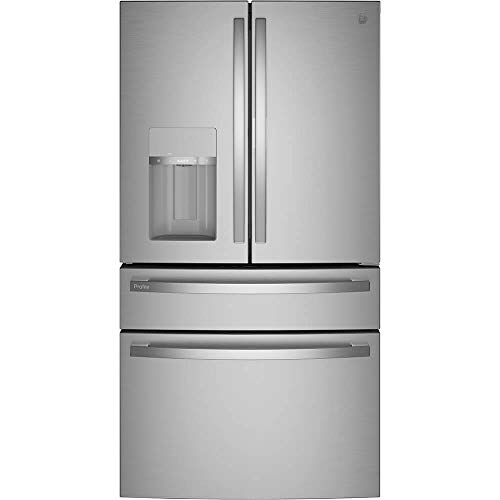
The PVD28BYNFS answers a question the standard French door plan cannot: where does the in-between food live — the cheese drawer overflow, the party platter chilling for tonight, the drinks that are neither fresh food nor frozen? Its fourth door opens a middle drawer zone between the fresh-food cabinet and the freezer, and households that entertain or cook in projects will feel the logic within a week. At 27.6 cu. ft., it gives up a little headline volume to the Midea and buys a better-organised interior with the difference.
The four-door arrangement has a subtler thermal virtue. Every door opening exposes only its own zone to the room, so the cook retrieving tonight’s platter from the middle drawer does not warm the fresh-food cabinet, and the freezer stays sealed through it all. In a busy kitchen where the fridge opens fifty times a day, that compartmental discipline is a genuine, if quiet, efficiency.
GE Profile dresses it properly: fingerprint-resistant stainless that survives a family’s hands, and the tier’s generally composed design. The honest cautions are mechanical and human — a fourth door is a fourth seal to keep clean, and a middle drawer is one more place for a household to lose track of leftovers if it shops without a system. For the organised entertainer, though, this is the most intelligently divided cabinet in the class.
It also photographs as the class’s most considered elevation: two doors, a drawer line, a freezer line — a composed stack that reads as joinery. In a kitchen designed rather than accumulated, that composure is not vanity; it is the fridge agreeing with the room.
- Capacity: 27.6 cu. ft. total
- Model: PVD28BYNFS
- Width: 36 inches
- Layout: 4-door French door with a middle drawer zone
- Finish: fingerprint-resistant stainless steel
- Tier: GE Profile
Strengths
- Middle drawer gives in-between food a home of its own.
- Zoned doors limit warm-air exposure at every opening.
- Fingerprint-resistant finish suits a much-handled family fridge.
Trade-offs
- A fourth seal and drawer add cleaning and organising duties.
- Slightly less volume than the class ceiling.
- The drawer zone rewards systems; improvisers may underuse it.
Best for: entertainers and project cooks who want the class’s most thoughtfully divided interior.
Not suited for: households that prefer one big undivided space and minimal seals to maintain.

Kenmore 26.6 Cu Ft 36 Inch French Door Refrigerator — Best Lower End of the Class
Every class has a sensible door in, and at 26.6 cu. ft. this Kenmore is this one’s. It is the smallest cabinet here by a clear margin, and the guide keeps it precisely because the lower end of the range is where many real households belong: a family of three or four, shopping weekly, will live comfortably in 26.6 cu. ft. and never meet its ceiling, while enjoying the same 36-inch French door elevation as the class’s giants.
Kenmore equips the entry point generously. The ice and water dispenser is internal, keeping the fingerprint-resistant stainless front clean while still serving both from inside the cabinet — a compromise that suits households who want dispensing without the door recess. Accela Chill speeds the cabinet’s recovery after a big load, adjustable glass shelving keeps spills honest, and ENERGY STAR certification disciplines the running costs of a cabinet that never sleeps.
Read it as the guide’s value of honesty in the downward direction. A household that buys the Midea’s ceiling “just in case” pays for that insurance in cooled air every day for a decade; a household that buys the Kenmore’s fit pays nothing for space it does not use. If your shop is a weekly trolley rather than a monthly expedition, this is very likely your fridge, and the class’s lower end is a perfectly respectable address.
Its 36-inch width also future-proofs the slot: when this fridge eventually retires, the opening it leaves is the standard the whole class is built to, so the next choice will be unconstrained. Buying the class’s entry point in the class’s standard width is the opposite of a compromise — it is the decision with the most options still alive at the end of it.
- Capacity: 26.6 cu. ft. total — the lower end of the class range
- Width: 36 inches
- Dispenser: internal ice and water
- Cooling: Accela Chill fast-cooling
- Shelving: adjustable glass shelves
- Finish: fingerprint-resistant stainless steel, ENERGY STAR certified
Strengths
- Right-sized entry to the class for weekly-shopping families.
- Internal dispenser keeps the front clean while serving ice and water.
- Certified efficiency in a cabinet that runs around the clock.
Trade-offs
- Bulk shoppers will meet its ceiling at the holidays.
- Internal dispensing means opening the door for every glass.
- Less freezer drawer volume than the class’s larger models.
Best for: families of three or four who want the class’s format at its most sensible size.
Not suited for: warehouse-scale shoppers, who should take the Midea or the Sharp instead.
Cosmo Vista 27.4 Cu Ft French Door Refrigerator Matte Black — Best Matte Black Statement
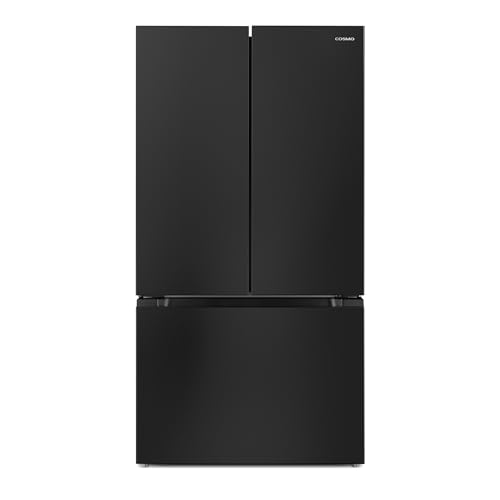
In a class where every other door is stainless, the Cosmo Vista arrives in matte black and changes the room’s whole conversation. At 27.4 cu. ft., model COS-RFFV283RBK, it is no styling exercise at the expense of substance: a water dispenser, an ice maker, a freezer drawer, digital touch temperature controls and recessed handles that keep the elevation smooth. The Vista Collection’s proposition is that a large fridge can be a design decision rather than a metallic inevitability, and in the right kitchen it is utterly convincing.
Matte black behaves differently in a working kitchen than gloss or steel. It absorbs light instead of returning it, so the big cabinet recedes visually even at class size — a genuine trick for a renovated room that wants the capacity without the gleam. Recessed handles extend the same philosophy: nothing protrudes, nothing catches a hip in a narrow pass, and the front reads as a composed dark plane that pairs naturally with black ranges and hardware.
The honest cautions are about commitment. A matte black fridge is a scheme decision: it will anchor the kitchen’s palette for a decade, and a household that later drifts back to stainless everything will find this cabinet arguing with the room. Digital touch controls, meanwhile, suit households happy to set temperatures on a panel rather than a dial. Commit with open eyes, and the Cosmo is the class’s most distinctive resident — the one guests ask about, in the good way.
It also suits the increasingly common black-appliance kitchen, where a stainless fridge is the odd one out no matter how large or capable. Matching the room’s established palette is not superficiality; a kitchen is lived in visually every day, and the fridge that belongs to its scheme gets a decade of goodwill that a clashing one must earn back weekly.
- Capacity: 27.4 cu. ft. total
- Model: COS-RFFV283RBK, Vista Collection
- Width: 36 inches
- Finish: matte black with recessed handles
- Equipment: water dispenser and ice maker
- Controls: digital touch temperature controls
Strengths
- Matte black makes a class-size cabinet visually recede.
- Recessed handles keep the elevation smooth and hip-safe.
- Full equipment — dispenser, ice maker, digital controls — behind the design.
Trade-offs
- A palette commitment the rest of the kitchen must honour.
- Matte surfaces show pale dust more than mid-tone finishes do.
- Touch controls will not suit households that prefer a simple dial.
Best for: designed kitchens and black-appliance schemes that want class capacity without the stainless gleam.
Not suited for: households whose kitchen palette is still undecided or trending back to steel.

Sharp 28.9 Cu Ft French Door Refrigerator SJF2955KS — Best Cooling Technology
Sharp’s SJF2955KS sits near the class ceiling at 28.9 cu. ft. and argues its case in the language of temperature rather than volume. Its Advanced Cooling Plus system is joined by two boost modes with names that describe real household moments: Chill-Boost for the fresh-food cabinet after a big shop has loaded it with warm groceries, and Freezer-Boost for the batch cook’s trays or the ice cream that must set hard and fast. Every large fridge faces those moments; this one has buttons for them.
The rest of the specification is the class’s expected completeness — standard-depth 36-inch cabinet, stainless finish, an ice and water dispenser serving the household’s daily traffic. What the boost modes change is recovery: the vulnerable hour after loading, when a cabinet full of room-temperature food warms its neighbours, is shortened by a system designed to pull temperature down decisively rather than eventually. For households whose cooking rhythm involves big shops and batch sessions, that recovery is the feature they will actually feel.
Choose the Sharp if your household’s fridge life is punctuated by those loading events — the Saturday market haul, the preserving weekend, the party prep. Choose it less readily if your shopping is a calm daily trickle, where boost modes will sit unused and the Midea’s extra fraction of volume or the Profile’s fourth door would serve better. Technology earns its place when the household’s habits give it work to do, and this household, if it is yours, will give it plenty.
There is also a food-safety composure to fast recovery that deserves plain statement: food spends less time in the temperature range where quality and safety decay, every single week, for the life of the fridge. It is the least photogenic benefit in this guide and possibly the most valuable one.
- Capacity: 28.9 cu. ft. total — near the class ceiling
- Model: SJF2955KS
- Width: 36 inches, standard depth
- Cooling: Advanced Cooling Plus system
- Boost modes: Chill-Boost and Freezer-Boost
- Equipment: ice and water dispenser, stainless steel finish
Strengths
- Boost modes shorten the risky warm hour after big loads.
- Near-ceiling capacity with a full dispenser specification.
- Cooling system is the class’s most deliberate temperature story.
Trade-offs
- Boost features earn little in a calm, daily-shopping household.
- Standard depth stands proud of a shallow counter run.
- Large cabinet demands the usual delivery-route respect.
Best for: batch cooks, market haulers and preserving households whose fridge life runs in big loading events.
Not suited for: light daily shoppers, who would pay for recovery power they never call on.

Samsung 27 Cu Ft Mega Capacity Counter Depth French Door Refrigerator — Best Counter-Depth in Class
The Samsung performs the class’s neatest trick: 27 cu. ft. — squarely in the class range — inside a counter-depth cabinet, so the doors sit close to the cabinet line while the interior keeps family volume. Samsung calls it Mega Capacity, and the engineering behind the name is thin-wall insulation and layout discipline: space that lesser designs spend on cabinet bulk is returned to the shelves. For a renovated kitchen that refuses to surrender its sightlines but feeds a family, this is the pick the whole guide bends toward.
Its party piece is the Dual Auto Ice Maker, which produces ice in two places — the arrangement means a household that entertains is not rationing cubes by the second round of drinks, and a freezer drawer raid does not empty the supply the door was counting on. Ice sounds like a small thing until a summer party makes it the only thing; Samsung has simply engineered for the party in advance.
The counter-depth bargain still applies, softened: shelves are shallower than a standard-depth rival’s, so the widest trays need the usual moment of planning, and the cabinet’s capacity is earned by width and height rather than depth. Households whose kitchens are deep and whose pans are wider should weigh the Sharp or the Midea. Households whose kitchens are composed and whose parties are legendary have found their fridge.
It is worth saying plainly what the counter-depth stance buys at this size, because at 27 cu. ft. it buys the most: a class-size fridge that does not interrupt the room. In an open-plan home the fridge is visible from the sofa, the table and the door; a cabinet that sits flush and calm is a daily aesthetic dividend that no capacity figure can express.
- Capacity: 27 cu. ft. total
- Model: RF27CG5100SRAA
- Depth: counter depth — the only one in this guide
- Layout: 3-door French door configuration
- Ice: Dual Auto Ice Maker, ice in two places
- Finish: stainless steel
Strengths
- Class volume without the standard-depth stance in the room.
- Dual ice production survives a party’s second round.
- Flush fit flatters renovated and open-plan kitchens daily.
Trade-offs
- Shallower shelves ask wide trays to plan ahead.
- Capacity sits mid-class; the Midea and Sharp hold more.
- Ice in two places means two mechanisms to keep maintained.
Best for: open-plan and renovated kitchens that want class capacity, a flush stance and serious ice.
Not suited for: deep kitchens with very wide pans, where standard depth serves better.
How Do the Six Compare Side by Side?
| Pick | Capacity | Doors | Signature point |
|---|---|---|---|
| Midea MRF29D6AST | 29.3 cu. ft. | 3-door French | Class ceiling, smart platform |
| GE Profile PVD28BYNFS | 27.6 cu. ft. | 4-door French | Flexible middle drawer zone |
| Kenmore French Door | 26.6 cu. ft. | 3-door French | Internal dispenser, Accela Chill, certified efficiency |
| Cosmo Vista | 27.4 cu. ft. | 3-door French | Matte black, recessed handles, touch controls |
| Sharp SJF2955KS | 28.9 cu. ft. | 3-door French | Advanced Cooling Plus, Chill-Boost, Freezer-Boost |
| Samsung Mega Capacity | 27 cu. ft. | 3-door French, counter depth | Dual Auto Ice Maker, flush fit |
The table’s lesson is that capacity is the least interesting column. Between the Kenmore’s 26.6 and the Midea’s 29.3 there is real difference, but the signature column is where households should vote: a drawer zone, a finish, a boost mode, a second ice maker, a shallower stance. Choose the signature that matches a habit you actually have, then confirm the capacity beside it can carry your shop.
Three Doors or Four: What Does the Extra Door Buy?
The standard French door plan — two doors above, one freezer drawer below — divides the cabinet by temperature. The four-door plan, represented here by the GE Profile, inserts a household’s third category: the food in transit between shopping and cooking, tonight’s platter, the drinks service, the cheese that deserves its own climate of attention. A dedicated middle zone keeps that traffic out of the main cabinet, and the main cabinet stays colder and calmer for it.
The costs are equally concrete: another seal to wipe, another drawer to organise, and a fresh-food cabinet slightly reduced to make room. Households that cook in projects and entertain in waves will call it the best idea in the class. Households that shop, shelve and cook in a straight line will call it furniture for a problem they do not have. Both are right, which is why the guide offers the choice rather than settling it.
How Should You Think About Ice at This Size?
Ice is where class-size fridges quietly differentiate, because the households buying them entertain at the scale the cabinets imply. The spectrum here runs from the Kenmore’s internal dispenser — ice and water served from inside the door, the front left clean — through the Cosmo’s and Sharp’s conventional maker-and-dispenser arrangements, to the Samsung’s dual production. The right amount of ice machinery is a function of your summers: a household that hosts monthly should weight it heavily; one that makes ice for two glasses a week should not let it outvote capacity or layout.
All of it needs the same foundation — a water line at the slot, in working order, with a shut-off that shuts. Confirm yours before the order, and if the kitchen lacks one, let that fact promote the models whose virtues do not depend on plumbing, or budget the line as part of the purchase rather than as a surprise at installation.
What Does Standard Depth Versus Counter Depth Mean Here?
Five of these six are standard-depth cabinets; the Samsung alone is counter-depth, and the comparison is the class in miniature. Standard depth gives the shelves their full reach — roasting pans lie flat without negotiation — at the cost of a cabinet that stands forward of the counter line. Counter depth returns the room’s lines and walkway, and asks the shelves to be shallower and the household to store in visible rows.
At 27 to 29 cu. ft., the depth decision is amplified, because these are the largest elevations in the kitchen. A standard-depth giant in a small room is a presence; a counter-depth one is a wall that behaves. Measure the counter run, stand where the island or the table stands, and let the room — not the brochure — arbitrate.
How Should You Measure for a Class-Size Fridge?
With more respect than for any other appliance in the house. The slot: width at three heights, since 36 nominal inches often measure less at one of them; depth to the counter’s face; height beneath the bridging cabinet, hinge caps included. The swing: French doors need their arcs on both sides, and a wall return or an island corner that clips an arc will be cursed daily. The drawer: a freezer drawer plus the cook’s body needs its floor, measured, not imagined.
Then the route, walked with a tape and a sceptical eye: front door, turns, stairs, the kitchen doorway itself. These cabinets are the largest boxes their makers ship, and the difference between the boxed dimension and the tightest turn is where delivery days are won and lost. Write the tightest figure down and check it against the listing before the order is placed.
How Should a Cabinet This Large Be Organised?
By zones with names, because at this size “somewhere in the fridge” is a place food goes to be forgotten. Give the fresh-food span a geography the whole household can recite: dairy and eggs in the coldest steady zone, raw proteins low and contained, produce in its drawers, cooked food and leftovers on one designated shelf at eye level where they are seen daily and eaten in order. The freezer drawer takes the same treatment in layers — this week’s frozen dinners above, the strategic reserve below, everything labelled with a date in marker.
The four-door Profile adds a diplomatic zone to that geography, and households that adopt one should name it too: tonight, drinks, cheese — whatever its true job is, write the job on the household’s shared understanding and defend it. A zone without a name becomes a junk drawer with refrigeration, and a class-size fridge has enough room to hide a great deal of junk.
What Does a Fridge This Size Do to the Energy Bill?
It runs a large, well-insulated box continuously, and the honest summary is that a modern class-size cabinet is far thriftier than the smaller fridge it likely replaces if that fridge is old. Certification matters at this scale — the Kenmore’s ENERGY STAR badge is the guide’s one explicit example — because small percentage differences compound across a cabinet that never switches off. Beyond the badge, the household’s habits write the rest: seals wiped and gripping, clearances honoured, and a cabinet loaded to a working fullness rather than stuffed or echoing.
Boost and fast-chill modes deserve an honest footnote here. They spend energy in a burst to protect food in the hour it is most vulnerable, which is a trade worth making every time — the cost of the burst is trivial beside the cost of a spoiled holiday shop. Use them for the events they were built for and let the cabinet’s ordinary efficiency handle the ordinary days.
Which Smart Features Actually Earn Their Keep?
The alert is the one that pays. A door left ajar in a cabinet holding a family’s week of food is an expensive accident, and the connected models here — the Midea most explicitly — can turn that accident into a phone notification within minutes. Temperature history after an outage runs a close second, converting the anxious sniff-test into a record. Beyond those two, smart value thins quickly: inventories and cameras amuse for a month and are consulted rarely thereafter.
That calculus should steer the choice cleanly. Households that travel, keep second homes, or simply have teenagers should weight the connected picks upward. Households that are always home and never open an appliance app should buy the cabinet, the layout and the finish, and let the connectivity be whatever it turns out to be. The fridge must be right with the app ignored; the app is a bonus, never the foundation.
How Does Entertaining Change the Calculation?
A class-size fridge is bought, more often than the brochures admit, for twelve evenings a year: the parties, the holidays, the weekends when the house fills. For those evenings the relevant features are suddenly the headline ones — ice production that survives a second round, a platter zone that chills tonight’s centrepiece without evicting the week, shelves that take a drinks crate whole. The Samsung’s dual ice and the Profile’s middle drawer are this guide’s two direct answers, and both were chosen with those evenings in mind.
The discipline is to weight the twelve evenings honestly against the other three hundred and fifty-three. A fridge that serves the party and annoys the Tuesday is a bad trade; a fridge that serves the Tuesday and merely manages the party is usually the wiser buy. The six here were selected to avoid that trap — each one’s party trick rides on a cabinet that works plainly the rest of the year.
How Do You Care for a Matte or Treated Finish?
Matte black, on the Cosmo, asks for a soft cloth and restraint: no abrasive pads, no aggressive chemicals, and a wipe in one direction to keep the surface’s evenness. Its reward is a finish that does not record fingerprints and does not glare under kitchen lighting. Pale dust is its one confession — in a dusty house the dark surface will show it sooner than a mid-tone one, and a weekly pass with a dry cloth is the whole of the penance.
Fingerprint-resistant stainless, worn by the Profile and the Kenmore, is the low-effort champion: the treatment hides the daily touching and asks only for a wipe with a damp cloth when the week has been busy. Plain stainless, on the Midea, the Sharp and the Samsung, wants slightly more ceremony and returns a slightly deeper shine. None of these finishes is fragile; all of them suffer more from a rotation of harsh experiments than from honest, regular, gentle cleaning.
What Should Installation Day Look Like at This Size?
It should look rehearsed. These are the largest cabinets in their makers’ ranges: confirm the slot, the swing arcs and the route in the days before, photograph the water line’s shut-off, and decide in advance which doors in the house come off their hinges. Agree with the delivery crew where the old fridge goes — out, down, or into its second career — before the new one is off the truck, because a class-size cabinet standing in a hallway is a household emergency with a door seal.
After the install, restraint: let the cabinet level and pull down, load it in stages, and give ice makers their first day unjudged. Keep the packaging until a clean week has passed. The households that speak well of their big fridges in year five are, with suspicious consistency, the ones whose first day was boring — and boring is a thing a household can arrange.
How Long Should a Class-Size Fridge Serve?
Expect a decade and more, and expect the story to be written by the small parts: door seals on two, three or four doors, drawer runners under a freezer drawer’s considerable loaded weight, dispenser valves and filters where fitted. The four-door Profile simply has one more seal in that story than the three-door models, which is maintenance arithmetic, not a warning. A household that wipes seals monthly, keeps runners clean, and changes filters on schedule will get the cabinet’s full design life.
Size itself is neutral to kind: a large cabinet’s compressor works against a well-insulated volume and cycles with thermal ballast behind it, which is gentle duty. What shortens a big fridge’s life is the same thing that shortens a small one’s — heat it cannot shed because its clearances were stolen by cabinetry. Honour the gaps the maker specifies and the class will repay the courtesy for years.
What Habits Should the First Month Build?
Three, and they are all small. First, the weekly audit: ten minutes, oldest food forward, duplicates married, the freezer drawer’s top layer restocked from its depths. Second, the door discipline: a class-size cabinet loses more cold to a lingering open door than a small one does, because there is more door and more cold — decide, then close. Third, the loading ritual after a big shop: boost mode if your pick has one, heaviest and most perishable items in first, and an hour’s patience before judging the temperature display.
Households that build those habits in the first month rarely think about their fridge again except with satisfaction, which is the highest praise an appliance can earn. The cabinet disappears into the kitchen’s routines, the parties take care of themselves, and the class’s promise — space without anxiety — quietly keeps itself.
How Do You Choose Between the Class’s Two Philosophies of More?
This guide contains two different answers to the desire for more fridge. The Midea and the Sharp answer with volume and force: bigger cabinets, stronger cooling, recovery power for the biggest shops. The Profile and the Samsung answer with structure: the same neighbourhood of volume, divided more cleverly — an extra zone, a shallower stance, ice in two places. Neither philosophy is the sophisticated one; they serve different households, and confusing them is how a family ends up with a giant, simple cabinet when what its life needed was a slightly smaller, cleverer one.
Interrogate your last month of fridge life for the verdict. If the recurring frustration was space — the shop that would not fit, the platter exiled to a neighbour’s fridge — buy volume and force. If the frustration was order — food lost, zones raided, ice gone by the party’s second hour — buy structure. The class is large enough to contain both answers honestly, and the guide’s six were chosen so that each philosophy has a worthy champion.
What Role Does the Freezer Drawer Play at This Size?
A bigger one than its share suggests, because a class-size freezer drawer is a serious piece of furniture: wide, deep, and heavy when loaded. Its virtues scale with the class — the whole frozen store presented from above, filed in layers, with room for the holiday bird and the batch cook’s trays in a way no narrow column can match. Its demands scale too: floor space to open fully, runners kept clean to glide under load, and a household willing to organise in layers rather than in piles.
Test the drawer in your imagination against your largest frozen regulars before ordering any of these six. The turkey, the sheet cake, the pizza boxes in their cardboard — if they fit the drawer’s geometry in your mind’s eye with room for the weekly staples, the format will serve. If they plainly do not, the honest move is a different layout in a different guide, not a class-size drawer and a decade of Tetris.
Why Does This Class Belong to Renovated Kitchens?
Because a 36-inch French door cabinet is usually specified, not stumbled into: it arrives with a renovation, a new build, or a deliberate kitchen refit, and it is chosen alongside the range, the hardware and the worktops. That context explains the class’s character — the design finishes, the counter-depth exception, the composed elevations. These are fridges bought as part of a room’s plan, and they reward being chosen the same way: as architecture first and appliance second.
It also means the slot is often adjustable in a way older kitchens cannot offer. If the renovation is still on paper, let the fridge be chosen early and the cabinetry drawn around its true dimensions, rather than the other way around. More class-size misery is born from a nominal 36-inch opening drawn casually than from any defect in the fridges themselves.
What Should You Ask Before the Order Is Placed?
Five questions, in the order a good retailer would welcome them. What are the cabinet’s exact dimensions — width, depth with handles, height to the top of the hinge? What clearances does the maker require at the sides, top and back? Does the configuration on this listing include the dispenser and ice equipment the photographs show? What does delivery include — stairs, door removal, haul-away of the old machine? And what is the arrangement if the cabinet does not fit the route, discovered on the day?
Ask them in writing where the platform allows it, and keep the answers with the order confirmation. A class-size fridge is among the largest purchases a kitchen ever makes, and the households that enjoy the process are the ones who treated those five questions as part of the purchase rather than as an imposition on it. Retailers answer them daily; the only bad version of each question is the one asked for the first time on the doorstep.
How Does a Big Fridge Change a Household’s Shopping?
It lengthens the rhythm. Households arriving from a mid-size cabinet typically discover that the weekly shop can become a ten-day shop, that the market’s bulk offers stop being a storage gamble, and that the preserving weekend’s output has somewhere to live. The change is pleasant and slightly dangerous: a longer rhythm means older food on average, and the household that stretches its shopping without adopting the audit habit will waste the difference.
Handled well, though, the longer rhythm is the class’s true dividend — fewer trips, better planning, a freezer that turns the garden’s glut and the market’s gluts into January’s dinners. The fridge does not create that dividend; the household’s habits do. The cabinet merely makes it possible, which at this size is contribution enough.
One last perspective for the household hesitating at the class’s threshold: the cost of choosing slightly too large is a little cooled air, paid quietly over years, while the cost of choosing slightly too small is a daily negotiation with the shopping, paid loudly every week. Households genuinely torn between this class and the one below should let that asymmetry speak — provided the slot, the swing and the route all agree, which, as this guide has insisted throughout, they must be asked first.
What Are the Most Common Mistakes When Buying in This Class?
First, trusting the class number over the exact capacity — this guide alone spans 26.6 to 29.3 cu. ft., and the difference is a family’s weekly margin. Second, buying the ceiling for a household whose shop fits the floor, and cooling empty air for a decade as the price of a hypothetical. Third, forgetting the water line while choosing a dispenser model. Fourth, measuring the slot and never the route, and meeting the largest box in the range on the doorstep.
Fifth, letting a finish decide before a layout has been chosen — matte black is a joy in the right scheme and a decade of argument in the wrong one. Sixth, ignoring door swing and drawer travel in a composed kitchen, where a clipped arc or a blocked drawer turns a flagship fridge into a daily negotiation. Every one of these mistakes is avoidable in the hour before ordering, and nearly irreversible in the hour after delivery.
Final Recommendation
Most households in this class should start with the balanced middle: the GE Profile PVD28BYNFS, whose fourth door organises a family’s real life better than raw volume does. If volume itself is the problem, the Midea MRF29D6AST ends the argument at 29.3 cu. ft.; if the kitchen is composed and the parties are serious, the Samsung counter-depth model is the class’s most elegant answer. The Kenmore serves the sensible lower end, the Cosmo serves the designed room, and the Sharp serves the household whose life arrives home in big, warm shopping loads. Measure the slot, the swing and the route, choose the refinement your habits will use weekly, and a fridge in this class stops being a purchase and becomes what it should be — the cold, calm centre of a kitchen that works, holding its temperature and its temper through a decade of family life.
And if the torn household’s kitchen is still being designed, there is a simpler resolution available: draw the slot at the class’s standard 36 inches, wire and plumb it for a dispenser model, and then choose freely among all six of these picks at ordering time. Infrastructure decided early is freedom preserved; infrastructure improvised later is where class-size purchases go to become complicated.
Frequently Asked Questions
What is the actual capacity range in this class?
The six picks here span 26.6 to 29.3 cu. ft. The Kenmore anchors the lower end, the Midea tops the range, and the rest — Samsung 27, Cosmo 27.4, GE Profile 27.6, Sharp 28.9 — fill the middle. Always compare the exact figure on the listing, not the class name.
Is the fourth door on the GE Profile worth it?
For households that entertain or cook in projects, yes: the middle drawer gives platters, drinks and in-between food a zone of their own and keeps the main cabinet sealed through a busy evening of cooking. Straight-line shoppers who never hold food in transit will use it less and may prefer the simpler three-door plans.
How can the Samsung hold 27 cu. ft. at counter depth?
By spending less of the cabinet on its own structure — thinner insulation and disciplined layout return the volume to the shelves. The trade is shelf depth: the food sits in shallower, more visible rows than in a standard-depth rival.
Which pick is best for a black-appliance kitchen?
The Cosmo Vista, and it is not close: matte black finish, recessed handles and a full equipment list at 27.4 cu. ft. It is designed to anchor a dark scheme rather than interrupt it, and its recessed handles keep that dark elevation smooth from every angle in the room.
Do all six need a water line?
Any dispenser or ice maker you intend to use does — that covers most of this class in some form, from the Kenmore’s internal dispenser to the Samsung’s dual ice makers. Confirm your kitchen’s line and shut-off before ordering, or plan the installation as part of the purchase, since discovering a missing line on delivery day turns a celebration into an emergency plumbing appointment.
Related Guides
Still deciding between sizes, or furnishing the rest of the house around the new fridge? These guides continue from here. Best 28 Inch Top Freezer Refrigerators Best Affordable Pressure Washers Best 2000psi Electric Power Washers



[…] or the project continues into the laundry room and the pet corner, these guides pick up the thread. Best 28 Cu Ft Refrigerators Best Carpet Washers for Pet Best American Made […]