What's inside
- Key Takeaways
- The Shortlist at a Glance
- How Did We Separate Radiant Glass From Induction Language?
- Side-by-Side: What Each Listing Actually States
- Is a 36-Inch Range Just a Wider 30-Inch, or a Different Tool?
- Which Electrical Supply Does a Range This Size Actually Need?
- How Do You Settle a Wide Range Into Place Without Regrets?
- Ordering Mistakes That Cost Wide-Range Buyers Real Money
- Final Recommendation
- Frequently Asked Questions
- A Second Pass Over the Six: Matching Each Range to a Real Household
- What Does Daily Life With a 36-Inch Glass Top Involve?
- How Should the Rest of the Kitchen Bend Around a Range This Wide?
- Radiant, Infrared, or Induction: What Actually Changes at the Pan?
- How Should You Sequence the Purchase, From Cart to First Bake?
- What Should You Ask About Warranty and Service Before Ordering?
- How Do You Plan Pan Layout Across Five Elements?
- Related Guides
As an Amazon Associate I earn from qualifying purchases. This post may contain affiliate links at no extra cost to you.
**cottageverdict.com is reader-supported. When you buy through links on our site, we may earn an affiliate commission.**
Ordering a range this size is not a casual click. Every pick below links to its Amazon listing, where you confirm the exact configuration, delivery terms, and current availability before paying; use the “check price on Amazon” prompts rather than expecting a fixed figure here, because wide-format appliances move between promotions and freight arrangements too often for a printed number to stay honest. If you are replacing a dead unit under time pressure, order only after you have measured the cutout and photographed the outlet or junction box behind the old range.
The best 36-inch electric ranges solve a specific frustration: a standard 30-inch cooktop crowds four pans into a space where the big stockpot always steals room from the sauté pan, and the oven below it swallows a half sheet pan only with the door half argued open. Stepping up to 36 inches buys a fifth element, wider spacing between burners, and ovens that take commercial-style trays without the sideways shuffle. What the listings do not tell you at a glance is that this width class mixes two different cooking technologies under one search term. Some of these machines are radiant smooth-tops, with elements glowing beneath ceramic glass. Others lean on infrared elements, which cycle differently and heat with a distinct pattern. True induction models exist at this width too, but they are rarer in this pool, and one well-known induction name could only be discussed in prose here because its verified listing variant did not match the configuration this roundup needed. Sorting that technology question comes before brand loyalty, because the pans you own and the way you cook decide which answer is right.
Key Takeaways
- Thirty-six inches is a cooktop-spacing upgrade first and an oven upgrade second; measure pan diameters, not just the cabinet gap.
- Radiant glass, infrared, and induction are three different heat behaviors sharing one width label, so confirm the element type on the exact listing.
- Stated oven capacity in this group runs from 5.36 to 6.1 cubic feet where titles say so, and one listing prints several capacities that need untangling before you trust any of them.
- Two of the six listings state plainly that no power cord is included, which is normal at this size but still catches buyers out.
- French-door and front-control layouts change how you reach into a hot oven as much as any heating specification does.
The Shortlist at a Glance
| Model | Why it earns its place | Oven room the title states |
|---|---|---|
| AAOBOSI 36-Inch Electric Range — Widest feature set | Five elements, nine power levels, air fry and smart control in one front-control package; check price on Amazon. | 6 cu. ft. |
| Rangaire RRE361TS — Infrared speed pick | Infrared burners with true convection and easy-reach racks for cooks who hate crouching; check price on Amazon. | Not stated in the listing title — verify with the manufacturer documentation |
| Forno Paolo 36 — No-nonsense convection choice | A clean specification with true convection and nothing you need to decode; check price on Amazon. | 5.44 cu. ft. |
| Cosmo Stellar 36 — Largest stated oven | The biggest stated capacity here, plus steam cleaning and a storage drawer; check price on Amazon. | 6.1 cu. ft. |
| Forno Galiano French Door — Doors that open sideways | Twin French doors let you stand closer to the cavity instead of leaning over a dropped door; check price on Amazon. | 5.36 cu. ft. |
| VEVOR 36-Inch Electric Range — Read-the-fine-print option | A value-route listing whose title compresses several variants, so it rewards careful reading; check price on Amazon. | Title lists 2.7/4.8/6 cu. ft. variants — confirm which one the listing sells |
How Did We Separate Radiant Glass From Induction Language?
The screening for this roundup started with the title of each listing, because that is the one text the seller fully controls and the one a buyer can hold them to. Where a title named its heating method, that method anchored the write-up. Where a title stayed silent about element type, the pick is described without a technology claim, and the spec box says so in plain words. That discipline matters at 36 inches more than at 30, because the price band is wide and the marketing vocabulary is loose: “electric” on a wide range can mean radiant coils under glass, infrared lamps, or induction fields, and each behaves differently with cast iron, with thin aluminum, and with a cook who simmers delicate sauces.
Capacity claims got the same treatment. A cubic-foot figure only appears below when the listing title prints it. One listing in this group prints three different capacities in a single title, which almost certainly reflects a family of sizes sharing one product page; treating any one of those numbers as the specification of the 36-inch variant would be a guess, so the write-up flags the ambiguity instead of laundering it into a fact. Readers comparing against gas alternatives will find the same title-first discipline in our guide to Best 30-Inch Pro Gas Kitchen Ranges, where burner claims get checked the same way.
Finally, every pick had to be a genuine freestanding or front-control 36-inch range, not a cooktop, not a wall oven, and not a 30-inch model wearing wide-range keywords. Six listings survived that filter with verified images and titles, and they divide neatly: two Forno models with different door ideas, a feature-dense AAOBOSI, an infrared Rangaire, a big-oven Cosmo, and a VEVOR that asks more questions of its buyer than the others do.

AAOBOSI 36-Inch Electric Range — Widest feature set
If your cooking leans on timed, repeatable heat — meal-prep Sundays, a sauce that must hold a bare simmer for two hours, weeknight air-fried vegetables while a casserole finishes below — this is the listing written for you. The title states five cooktop elements with nine cooking power levels and a combined 9300W figure, front controls rather than a rear panel, and a 6 cubic foot oven carrying air fry, convection, and self-clean modes. Smart control appears in the title as well, which in practical terms means app or voice interaction layered over the usual knobs and touch panel; whether you use it daily or ignore it after setup week, its presence signals where this model sits in its range.
The nine-level power structure deserves a word, because it changes how the cooktop feels compared with the infinite-dial radiant tops many people are upgrading from. Stepped levels reward cooks who write things down: level four for the oatmeal, level six for the sear, the same result next Tuesday. Cooks who nudge a dial by feel may find steps constraining at first. The front-control layout puts those settings at the front edge, which keeps sleeves away from steam but also puts them within reach of a curious toddler, so households with small children should look for the control lock in the documentation before ordering.
- Cooktop: 5 elements, 9 power levels, 9300W total stated in the title
- Oven capacity: 6 cu. ft. as printed in the listing title
- Oven modes named: air fry, convection, self clean
- Controls: front control with smart control, per the title
- Electrical: 240V; title states no power cord is included
- Before you order the AAOBOSI 36-Inch Electric Range, confirm the cord type your outlet needs, since the listing leaves that purchase to you
Strengths
- The most complete mode list in this group, with air fry and self-clean both named outright.
- Stepped power levels make repeatable simmering easier to reproduce than a free-spinning dial.
- Front controls end the reach-across-hot-pans problem that rear panels create.
Trade-offs
- No power cord in the box means an extra purchase and a possible install delay.
- Smart features add a setup step that purely mechanical cooks may never use.
- Stepped levels can feel rigid if you cook by instinct and constant small adjustments.
Best for: systematic cooks who batch, time, and repeat recipes and want air fry without a countertop appliance. Not suited for: anyone who wants to unbox and cook the same evening without sourcing a cord first.

Rangaire RRE361TS — Infrared speed pick
Rangaire builds this model around infrared stove burners, and that single word separates it from every radiant pick in this roundup. Infrared elements transmit energy directly toward the pan rather than heating the glass as an intermediary, which gives a different response curve: a fierce initial push that suits boiling and searing, with cycling behavior you learn over the first few weeks. The title pairs those burners with true convection in the oven — a fan plus a dedicated heating element, the configuration bakers ask for by name — and with easy-reach racks, a small ergonomic detail that matters every time a heavy braiser needs to come out of a hot cavity.
The timer named in the title is worth mentioning because wide ranges often bury timing in app menus. A built-in timer on the unit itself keeps the workflow in the kitchen. What the title does not state is oven capacity, and this write-up will not invent one; check the manufacturer documentation for the figure and for rack positions if you bake tall items like stacked layer cakes or a standing rib roast. The stainless finish and the RRE361TS model designation suggest a range pitched at renovators replacing a slide-in during a kitchen refresh rather than at first-time wide-range buyers, and the spec sheet restraint fits that audience: fewer headline numbers, more emphasis on the heating method itself.
- Burner type: infrared, stated directly in the listing title
- Oven: true convection, per the title
- Racks: easy-reach design named in the title
- Timer: included, per the title
- Oven capacity: the listing title gives no figure, so check the Rangaire RRE361TS documentation for the exact cavity size
- Element wattages: likewise absent from the title — the Rangaire RRE361TS rewards buyers who read the full spec sheet
Strengths
- Infrared burners offer a genuinely different, fast-responding heat from radiant glass.
- True convection is the baker-grade configuration, not a fan-only approximation.
- Easy-reach racks reduce the lean-and-lift strain of heavy dishes.
Trade-offs
- The title leaves capacity unstated, so comparison shoppers must dig one level deeper.
- Infrared cycling takes adjustment if all your instincts were built on radiant elements.
- No air fry or self-clean mode is claimed in the title, so do not assume either.
Best for: bakers and sear-focused cooks who value burner character and convection quality over headline modes. Not suited for: buyers who want every specification settled from the listing page without opening documentation.

Forno Paolo 36 — No-nonsense convection choice
Some listings read like a feature parade; the Paolo’s title reads like a spec plate. Thirty-six inches, freestanding, stainless steel, 5.44 cubic feet, true convection oven. That economy of language is itself information: Forno is selling this model to buyers who already know they want a wide electric range with proper convection and who do not need an app, an air fry badge, or a smart prefix to justify the purchase. In a kitchen remodel where the range must coordinate with other stainless appliances and simply work, that restraint is a selling point rather than a gap.
The 5.44 cubic foot cavity sits in the middle of this group’s stated capacities, large enough for the holiday pattern — turkey on the lower rack, two casseroles above — without the sheer volume that makes small weeknight bakes feel lost. True convection again means a fan working with its own heating element, evening out the top-to-bottom gradient that turns sheet-pan cookies into a rotation chore. The title does not enumerate cooktop elements or their wattages, so pan-planning specifics belong to the documentation; what can be said from the title is that this is a freestanding format, which finishes both sides of the cabinet and tolerates placement at the end of a counter run, unlike front-control slide-in styles that assume cabinetry on both flanks.
- Format: freestanding, stainless steel, per the title
- Oven capacity: 5.44 cu. ft. as printed in the listing title
- Oven: true convection, stated outright
- Cooktop element count: not enumerated in the title — the Forno Paolo 36 listing page and manual carry that detail
- Self-clean or air fry: neither is claimed in the title for the Forno Paolo 36, so budget a little elbow grease
Strengths
- An honest, compact specification that tells you exactly what the oven is.
- True convection at a mid-group capacity suits everyday family baking well.
- Freestanding finished sides give placement flexibility slide-ins cannot match.
Trade-offs
- No air fry mode is named, so crisping stays with the convection setting and a rack.
- Element layout details require a documentation check before you plan pan sizes.
- The plain presentation may undersell it next to flashier listings in the same search.
Best for: remodelers who want wide-format convection without connected features or mode clutter. Not suited for: cooks building their routine around air fry or app control.
Cosmo Stellar 36 — Largest stated oven
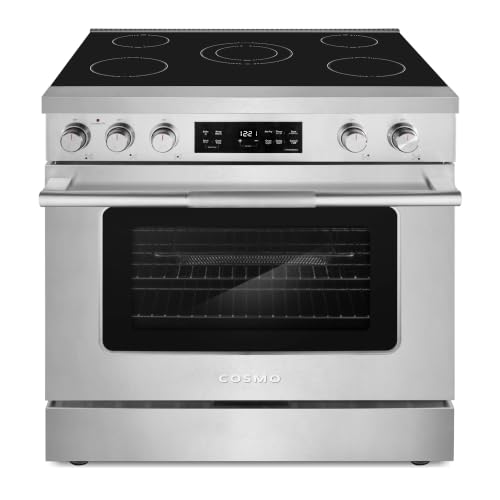
Cosmo’s Stellar entry leads this group on stated oven size at 6.1 cubic feet, and the rest of its title reads like a checklist written by someone who has cleaned a range and hated it. Ceramic glass cooktop, five burners with a dual-element burner among them, convection oven, air fry, steam clean function, and a storage drawer. The steam clean deserves emphasis: instead of a high-heat pyrolytic cycle that locks the door and heats the kitchen for hours, steam cleaning loosens everyday splatter with water and moderate heat, which suits households that wipe up weekly rather than deep-clean quarterly.
The dual-element burner is the cooktop detail to plan around. A dual element lets one position run as a small ring for a butter warmer or expand to a wide ring for a stockpot, which at 36 inches effectively gives you six heating footprints from five positions. Paired with the group’s largest stated oven, the Stellar is aimed at the cook who entertains: big pot on the expanded burner, two trays in the oven, air fry mode for the appetizer that cannot wait. The storage drawer below keeps sheet pans in the kitchen instead of in a hallway closet, a mundane virtue that wide-range buyers consistently underestimate until their old drawer’s contents need a new home.
- Oven capacity: 6.1 cu. ft., the largest figure stated in this roundup
- Cooktop: ceramic glass, 5 burners including a dual-element burner, per the title
- Modes named: air fry and convection
- Cleaning: steam clean function stated in the title — gentler than a full heat cycle
- Storage: drawer included, per the title; the Cosmo Stellar 36 keeps pans under the oven where they belong
Strengths
- Biggest stated cavity here, with room for layered holiday cooking.
- Steam cleaning fits real weekly habits better than rare scorch cycles.
- Dual-element flexibility stretches five burner positions across more pan sizes.
Trade-offs
- Steam cleaning will not rescue months of baked-on neglect in one pass.
- The feature list is long, so expect a longer first read of the manual.
- Air fry in a full-size oven still crisps differently than a small countertop basket.
Best for: hosts who cook big, clean often, and want pan storage built into the appliance. Not suited for: minimalists who prefer the shortest possible control panel.

Forno Galiano French Door — Doors that open sideways
The Galiano’s defining decision is visible from across the room: instead of one wide door that drops toward your shins, two French doors swing out to the sides. That changes the physical geometry of using the oven. You stand closer to the cavity, reach straight in rather than over a hot door panel, and keep a clearer path when a roast needs basting in place. For cooks with limited mobility, for shorter cooks, and for anyone who has ever balanced a Dutch oven on a dropped door while hunting for a trivet, the layout is not a styling flourish; it is the reason to buy this model over its own sibling elsewhere in this roundup.
Beneath the doors, the title states five elements and a 5.36 cubic foot cavity in an all-stainless build. The capacity is the smallest stated in this group, though the difference against the mid-pack is a fraction of a cubic foot — roughly one casserole dish of practical consequence, not a category change. What the title does not claim is a convection fan, and the honest reading is to treat oven performance claims as unconfirmed until the documentation says otherwise. That restraint cuts both ways: buyers who bake delicate pastries in multi-rack batches should verify the convection question carefully, while roasters and braisers, whose cooking is forgiving of gentle gradients, can weigh the door design more heavily.
- Door style: French doors, the headline feature in the title
- Cooktop: 5 elements, per the title
- Oven capacity: 5.36 cu. ft. as printed in the listing title
- Finish: all stainless steel, per the title
- Convection: not claimed in the title — anyone shortlisting the Forno Galiano French Door for multi-rack baking should confirm the fan setup in the manual first
Strengths
- Side-swinging doors remove the lean-over-a-hot-door problem entirely.
- Closer standing position makes heavy roasts safer to move.
- All-stainless construction reads as a deliberate, design-led appliance.
Trade-offs
- Smallest stated oven capacity in this group, if only by a modest margin.
- Two door seals and latches mean more hardware to keep clean and aligned.
- Convection is unconfirmed from the title, which bakers must resolve before buying.
Best for: cooks who prioritize access and ergonomics, especially with heavy roasting pans. Not suited for: production bakers who need guaranteed fan convection on every rack.
VEVOR 36-Inch Electric Range — Read-the-fine-print option
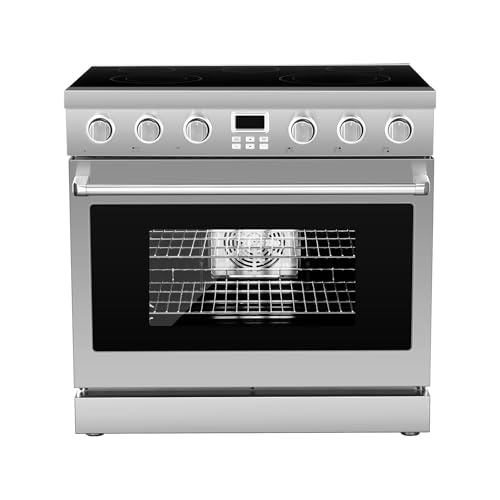
VEVOR sells across an enormous range of equipment categories, and its 36-inch electric range listing carries the brand’s characteristic compression problem: the title strings together “2.7/4.8/6 Cu. Ft.” and “4/5 Burners,” which are variant ranges, not specifications of one machine. Read generously, the title describes a product family sharing a page. Read carelessly, it promises a six-cubic-foot oven that the 36-inch variant may or may not be. This pick stays in the roundup because the underlying offer — a stainless freestanding electric range with easy-reach racks and a storage drawer at the value end of the width class — is legitimate, but it stays with an explicit instruction: pin down which capacity and burner count the 36-inch configuration carries before money moves.
The details that are stated plainly are useful ones. Easy-reach racks appear here as they did on the Rangaire, and they genuinely help with heavy cookware. A storage drawer is included. No power cord is included, matching the AAOBOSI’s caveat. The compact freestanding description in the title is slightly at war with the 36-inch width, another sign that the copy serves several sizes at once. None of this makes the range a bad purchase; it makes it a purchase for a methodical buyer who screenshots the variant selector, confirms the model number at checkout, and measures the delivered box against the order before the installer leaves.
- Format: freestanding stainless range, per the title
- Capacity: title lists 2.7, 4.8, and 6 cu. ft. across variants — which one ships with the 36-inch VEVOR 36-Inch Electric Range must be confirmed on the listing
- Burners: title lists 4 or 5 depending on variant
- Racks and storage: easy-reach racks and a storage drawer are both named
- Power cord: not included, stated in the title of the VEVOR 36-Inch Electric Range
Strengths
- Value positioning in a width class where prices climb quickly.
- Easy-reach racks and a storage drawer are practical, everyday features.
- Stainless freestanding format suits rental upgrades and workshop kitchens alike.
Trade-offs
- The variant-packed title forces extra verification no other pick here demands.
- No convection or cleaning mode is claimed in the title.
- Cord sourcing is on you, as with the AAOBOSI.
Best for: careful, budget-led buyers willing to verify the exact variant twice. Not suited for: anyone ordering on a deadline who cannot afford a configuration surprise.
Side-by-Side: What Each Listing Actually States
| Model | Heat story | Cleaning route | Watch-out |
|---|---|---|---|
| AAOBOSI 36-Inch Electric Range | 5 elements, 9 levels, 9300W stated | Self clean | Cord not included |
| Rangaire RRE361TS | Infrared burners, true convection | Not stated in the listing title — verify with the manufacturer documentation | Capacity unstated in title |
| Forno Paolo 36 | True convection oven | Not stated in the listing title — verify with the manufacturer documentation | Element details in manual |
| Cosmo Stellar 36 | Dual-element burner, convection, air fry | Steam clean | Long feature list to learn |
| Forno Galiano French Door | 5 elements, French-door access | Not stated in the listing title — verify with the manufacturer documentation | Convection unconfirmed |
| VEVOR 36-Inch Electric Range | Variant-dependent; confirm on listing | Not stated in the listing title — verify with the manufacturer documentation | Title mixes several sizes |
Read the table as a map of certainty rather than a league ladder. The AAOBOSI and Cosmo state the most, so they are the easiest to buy with confidence from the listing page alone. The Rangaire states its heating method precisely while leaving capacity to the manual, which is a fair trade if infrared heat is what you came for. The two Forno models split on a single question — door geometry versus a plain convection promise — and the VEVOR asks the most homework in exchange for its positioning. Renovation projects rarely stop at the range itself, of course; the same season that brings a new range often brings yard work, and our roundup of Best Gas Pressure Washers applies the same title-first checking to outdoor equipment.
Is a 36-Inch Range Just a Wider 30-Inch, or a Different Tool?
It is a different tool in one specific way: pan geometry. On a 30-inch cooktop, a 12-inch skillet and a stockpot negotiate for the same real estate, and one usually ends up half off its element. At 36 inches, the fifth element is less important than the breathing room — large pans sit fully on their burners, handles stop colliding, and a griddle can live on the top without exiling everything else. The oven difference is real but secondary; most stated capacities here cluster between 5.36 and 6.1 cubic feet, all of them generous, none of them double-oven flexible. If your pain point is two dishes at two temperatures, width does not solve it. If your pain point is crowding, it does.
The induction question belongs here too. This pool is dominated by radiant and infrared glass tops, and buyers who arrive expecting induction — because a friend praised it or a video made it look effortless — should pause. A well-known induction entry at this width, the ZLINE Paramount in its satin finish, circulates in the same search results; the satin variant is the same model as its other finishes, and it is discussed here in prose only because the verified listing for this roundup did not cover the configuration cleanly. The practical point stands regardless of brand: induction demands magnetic cookware and delivers instant response, radiant and infrared accept every pan you own and respond more gradually. Choose by your pan cupboard, not by fashion.
Which Electrical Supply Does a Range This Size Actually Need?
Every pick here is a 240V appliance, and the AAOBOSI states that voltage outright while also stating that no power cord is included. Treat that as the default assumption for the whole group: wide electric ranges draw serious current, they ship without cords because homes have different receptacle patterns, and the correct cord — matched to your outlet’s prong configuration and the range’s amperage requirement in its manual — is a separate, essential purchase. If your kitchen was wired for a 30-inch range decades ago, have an electrician confirm the circuit capacity before the new unit arrives, not while the delivery crew waits in the driveway.
Placement checks run alongside electrical ones. Freestanding models need a level floor and an anti-tip bracket anchored as the manual directs; front-control models need cabinet faces flush enough that the control panel overhang reads as intentional. Measure the route from the door to the kitchen as carefully as the cutout itself — a 36-inch range that cannot make the turn at the hallway is a return freight problem, and returns on freight appliances are the most expensive lesson in this category.
How Do You Settle a Wide Range Into Place Without Regrets?
Start a week early. Photograph the existing outlet and breaker panel, order the correct cord once the manual confirms it, and clear the delivery path of rugs and thresholds. On the day, level the range before connecting anything: a wide glass top shows a tilt in every saucepan, and shimming after the cord is attached risks straining the connection. Slide the unit in slowly with a spotter watching both cabinet faces, engage the anti-tip bracket, then run every element empty for a short burn-off as the manual instructs — new ovens smoke off manufacturing oils, and doing it with windows open on day one beats doing it accidentally before a dinner party.
Finish with a calibration bake. An inexpensive oven thermometer on the center rack, set against the dial at a common baking temperature, tells you whether your unit runs true; a consistent offset is normal and learnable, while wild swings are a warranty conversation best held in the first week. Holiday cooks planning a bird alongside the new range may also find our guide to Best Roaster Ovens for Turkey useful, since a countertop roaster is the classic pressure valve when one big oven must do everything.
Ordering Mistakes That Cost Wide-Range Buyers Real Money
The most common error is measuring the cabinet gap and nothing else. Depth matters — handles and door swing can push a range proud of the counter line — and so does the height of a front-control panel against a low backsplash. The second error is assuming a cord is in the box; two of these six listings say explicitly that it is not. Third comes technology confusion: ordering a radiant top while expecting induction response, then blaming the range for a mismatch the listing never promised. Fourth is trusting a variant-stuffed title, the VEVOR trap, where the capacity in the headline belongs to a different size in the same family. The last is skipping the anti-tip bracket because the range feels heavy; heavy is exactly why it must be anchored.
Final Recommendation
Match the technology to your pans and patience first. If you want the fullest stated feature set and stepped, repeatable control, the AAOBOSI is the natural lead pick. Bakers who care most about heat character should look hard at the Rangaire’s infrared burners and true convection, while entertainers who clean as they go will get the most daily value from the Cosmo Stellar’s big cavity and steam clean. Choose the Galiano when your back, your height, or your roasting habit makes door geometry the deciding factor, the Paolo when you want convection without connected extras, and the VEVOR only with variant verification in writing. A 36-inch range is a decade-long roommate, so buy the one whose daily motions — reaching, wiping, sliding a tray home — feel like they were designed around your kitchen rather than merely fitted into it.
Frequently Asked Questions
Will my existing pans work on these cooktops?
On the radiant and infrared glass tops in this roundup, yes — flat-bottomed pans of any common material work, with heavier bases spreading heat more evenly. Induction is the picky technology, and since none of these six titles claims induction, pan compatibility is one less worry here; still confirm the element type on the exact listing if that matters to you.
Does 36 inches mean I can cook two turkeys at once?
Width helps with tray space and rack width, but a single cavity still means a single temperature. Two modest birds side by side are plausible in the larger stated cavities; a bird plus a casserole at a different temperature is what a second appliance — or careful timing — is for.
Why do some listings exclude the power cord?
Because receptacles differ between homes. Sellers of 240V ranges commonly ship without a cord so the installer fits the pattern your wall actually has. Two titles in this group say so outright; assume the same for the rest and confirm before delivery day.
Is steam cleaning as effective as a self-clean cycle?
They solve different problems. Steam loosens fresh, light splatter quickly and gently, which keeps an oven pleasant week to week. A high-heat self-clean cycle, like the one the AAOBOSI names, tackles accumulated carbonized soil but takes hours and heats the room. Frequent light cleaning beats occasional heroic cleaning for most households.
What should I verify on a listing whose title lists several sizes?
The variant selector, the model number at checkout, and the capacity attached to your chosen size — in that order, with a screenshot. The VEVOR entry in this roundup is the worked example: its title spans multiple capacities and burner counts, so the 36-inch configuration must be confirmed rather than inferred from the largest number printed.
A Second Pass Over the Six: Matching Each Range to a Real Household
Specifications sort ranges into a table; households sort them into a life. Consider the AAOBOSI in a house where two adults cook from recipes on weeknights and host a dozen people monthly. The stepped power levels become a shared language — one partner can say “the sauce is at four” and the other can reproduce it — and the air fry mode absorbs the appetizer course while the oven handles the main. Its smart control, honestly assessed, will probably be used for preheating from the sofa and ignored otherwise, which is fine; the core value is the element layout and the mode depth, not the app.
The Rangaire suits a different temperament: the cook who bakes weekly and judges an oven by the evenness of a tray of scones. True convection plus infrared burners is a heat-focused specification, and its owner will likely know within a month exactly how the infrared cycling browns a cast-iron skillet of cornbread. That same owner must accept the documentation homework on capacity, because a baker planning a three-tier cake needs rack spacing figures that the title simply does not carry. The trade is deliberate — heat character first, paperwork second — and it will delight the right buyer while irritating a comparison shopper who wants every number on one page.
Forno’s Paolo fits the renovation where the range is one line item among twenty and decision fatigue is real. Its title answers the three questions that matter — size, capacity, convection — and asks nothing further. Owners of the Paolo tend to be people who chose it in an afternoon and then stopped thinking about their range entirely, which is a legitimate definition of a good appliance. The Galiano, by contrast, will be thought about daily, in the best way, by the cook whose knees or back have opinions about dropped oven doors. Every roast retrieved without the lean-and-balance maneuver quietly repays the choice, and guests unfailingly comment on the doors, which does no harm either.
The Cosmo Stellar is the entertainer’s appliance in the most literal sense: the largest stated oven, a flexible dual-element burner, steam cleaning for the morning after, and a drawer that swallows the sheet pans a party produces. Its owner hosts, cooks in volume, and cleans in short frequent passes rather than seasonal campaigns. And the VEVOR belongs to the buyer furnishing a rental, a workshop kitchen, or a first wide-range experiment on a controlled budget — someone who reads variant selectors the way pilots read checklists, confirms the configuration in writing, and accepts a plainer feature set as the honest price of the positioning. None of these six is the “best” in the abstract; each is the best answer to a different household’s actual week.
What Does Daily Life With a 36-Inch Glass Top Involve?
Glass-ceramic tops reward a specific rhythm: wipe spills while the surface is warm but not hot, lift heavy cast iron rather than sliding it, and keep a razor scraper for the sugary boil-over that will happen exactly once a year and cement itself if ignored. At 36 inches the surface is large enough that a dedicated microfiber cloth lives in the drawer beside it in most tidy households. Infrared and radiant elements both show dust and water spots more honestly than coil tops do, which is either a cleanliness prompt or a minor daily annoyance depending on your temperament. What glass gives back is a continuous work surface — a landing zone for hot trays straight from the oven, an extra counter for cooling racks — that coil and grate tops cannot offer, and in a kitchen short on counter space that bonus surface is a genuine part of the value calculation.
Oven interiors at this size share one maintenance truth: the bigger the cavity, the more tempting it is to postpone cleaning, and the worse the eventual job. The Cosmo’s steam cycle and the AAOBOSI’s self-clean represent the two philosophies — little and often versus rare and thorough — while the models whose titles stay silent on cleaning ask for manual wiping, which is entirely workable if it happens while the oven is still warm from dinner. Rack care is universal: easy-reach racks, named by both the Rangaire and the VEVOR, should still be pulled and wiped rather than left to accumulate polymerized grease at the joints.
How Should the Rest of the Kitchen Bend Around a Range This Wide?
Ventilation first. A 36-inch cooktop produces more simultaneous steam and aerosolized fat than a 30-inch, and an undersized hood will leave a film on the cabinets no range choice can prevent. Match the hood width to the range at minimum, and prefer capture depth over headline airflow numbers. Landing space second: building codes and common sense both want counter on both sides of the cooktop, and at this width that usually means stealing six inches from a neighboring cabinet run — decide that trade on paper, during design, not with the appliance on a dolly in the doorway. Third, storage: the wide oven encourages wide trays, and half-sheet pans, griddles, and roasting racks need a vertical divider cabinet or a deep drawer nearby, or they will migrate to the oven itself, which then must be emptied every time it preheats.
Lighting deserves a mention it rarely gets. Front-control models put the cook’s body between the ceiling light and the control panel at certain hours, and a strip of under-cabinet lighting aimed at the cooktop transforms evening usability more than any feature on any of these spec sheets. Finally, plan the small electrical neighborhood: a counter outlet within reach for a hand mixer or probe thermometer base, placed so cords never cross a live element. None of this is glamorous, and all of it determines whether a wide range feels like an upgrade or an imposition by February.
Can a 36-inch electric range run on the circuit my 30-inch range used?
Possibly, but do not assume it. Wider ranges with more elements often call for higher amperage, and the requirement lives in each model’s manual, not in its listing title. Compare that figure against your breaker panel, and if the numbers do not match, price the electrical work into the purchase before ordering rather than after delivery.
How long should a range in this class last?
With ordinary care — glass kept scraped and wiped, door seals intact, racks cleaned — a well-kept electric range is a long-service appliance, and the simpler models here carry fewer electronic features to age. Longevity depends far more on cleaning habits and correct installation, especially the anti-tip bracket and proper leveling, than on which of these six badges is on the front.
Radiant, Infrared, or Induction: What Actually Changes at the Pan?
The three technologies deserve a slower explanation than most listings give them, because the difference is not speed alone. A radiant element heats the glass, and the glass heats the pan; that two-step path smooths out the element’s on-off cycling, so a radiant top holds a gentle simmer with less drama but answers a turned-down dial with a lag you learn to anticipate. Cast iron loves this arrangement, since the pan’s own mass evens the pulses further. A thin, warped aluminum pan hates it, because poor contact with the glass leaves hot rings and cool centers.
Infrared elements, the Rangaire’s approach, push energy through the glass as radiation rather than relying mainly on conduction, so the pan receives heat more directly and the response at high settings feels urgent — water comes up fast, a sear sets quickly. The cycling is still there, but the pan sees it sooner. Cooks who stir constantly and adjust by eye tend to love infrared; cooks who park a pot and walk away notice less difference. Induction, absent from these six titles but present elsewhere at this width, skips the glass-heating step entirely and makes the pan itself the heating element. It is the fastest and most precise of the three, the coolest to the touch around the pan, and the only one that will reject a non-magnetic pan outright. If your cupboard is full of beloved copper or aluminum, that rejection is not a footnote — it is the decision.
One more practical distinction hides in cleaning. Radiant and infrared tops both get hot enough to carbonize spills onto the glass, so the scraper-and-cream routine applies to both. Induction glass stays cooler and wipes easier, but it concentrates its cost in the appliance and the cookware instead. There is no universal winner; there is only the technology whose daily behavior matches the way a particular household actually cooks, which is why this roundup describes heat character in every pick rather than crowning one method for everyone.
How Should You Sequence the Purchase, From Cart to First Bake?
Week one is measurement and paperwork. Measure the cutout width, depth, and the height to the underside of any over-range cabinet or hood; photograph the receptacle; find the breaker and note its rating; download the manual of your leading candidate and read the installation pages, which is where cord requirements, clearances, and anti-tip instructions live. If two models remain tied after that reading, let the tie-breaker be the feature you will touch daily — a door style, a cleaning method, a control layout — rather than a mode you might use twice a year.
Ordering week, confirm the variant, the model number, and the delivery terms in writing, and ask specifically what the delivery includes: threshold drop, room-of-choice placement, haul-away of the old unit, or none of those. Freight appliances generate most of their bad reviews in this gap between expectation and the truck’s actual instructions. Inspect the range on arrival before signing — glass tops ship well but not perfectly, and a cracked top reported at the door is a replacement, while the same crack reported next week is an argument.
Installation day follows the sequence described earlier: level, anchor, connect, burn off, calibrate. Then cook something forgiving — a tray of roasted vegetables, a sheet of cookies — before attempting the dish whose success actually matters to you. Keep the manual’s troubleshooting pages bookmarked for the first month; most early alarms on modern ranges are sensor quirks with documented resets, not failures. By the end of that month you should know your unit’s hot spots, its true simmer behavior, and whether the oven thermometer agrees with the dial — knowledge that makes every recipe written for a generic oven suddenly reproducible in yours.
What Should You Ask About Warranty and Service Before Ordering?
Wide ranges are heavy, freight-shipped, and expensive to return, so the service story matters more here than on a countertop appliance. Before ordering any of these six, read the warranty terms attached to the listing and note three things: who performs service in your area, whether the glass cooktop is covered against thermal breakage or only defects, and how a dead-on-arrival unit is exchanged rather than repaired. Smaller and import-focused brands in this roundup compete on specification and price; their parts pipelines can be slower than legacy manufacturers’, which is not a reason to avoid them but is a reason to keep the manual, the purchase record, and the model and serial numbers photographed in a folder you can find in three years.
Two habits protect every buyer regardless of brand. Register the appliance if the maker offers registration, because it anchors the purchase date without a receipt hunt. And keep the packaging until the range has cooked for a week — freight returns without original packaging range from painful to impossible. Finally, remember that delivery damage, installation errors, and product defects are three different problems with three different responsible parties; identifying which one you have, with photos, before calling anyone, turns a frustrating week into a short one. A range bought this carefully, from a listing read this closely, is very likely to become the least dramatic appliance in the house — which, for the machine at the center of every meal, is the highest praise available.
How Do You Plan Pan Layout Across Five Elements?
Bring your three largest pans to the decision. A 12-inch skillet, a stockpot, and a wide Dutch oven define whether a given five-element layout will feel generous or merely wider. The layouts in this group differ in where the largest element sits — front positions favor the cook who sears and sautés actively, while a large rear element suits stockpots that simmer unattended and keeps big boiling pots away from the front edge where sleeves and children pass. The Cosmo’s dual-element position is the flexible answer, expanding or contracting to the pan placed on it, and cooks who alternate between a small saucepan and a canning pot on the same spot will use that flexibility weekly.
Also think in pairs. Most weeknight cooking runs two elements hard and a third gently, so the honest test of a layout is not five pans at once — a scenario from advertisements, not kitchens — but whether your two favorite pans can both sit fully on appropriately sized elements while a third keeps rice warm without crowding either. Sketch the element map from the listing photographs at the scale of your own cookware before ordering; five minutes with a tape measure and a pencil has saved more buyers from a mediocre fit than any review ever written, this one included.
One last consideration belongs to households planning to age in place or cooking with younger helpers. Front controls, French doors, and easy-reach racks — features scattered across three different picks in this roundup — are all, at heart, access features, and they compound: a range you can approach closely, open without leaning, and unload without reaching is a range that stays safe to use as strength and balance change. If that horizon applies to your household, weight those ergonomic details as heavily as any wattage figure, because they are the specifications you will feel in your shoulders every single day the appliance serves you.
Budget honestly for the whole project, not the appliance alone. The cord, a possible circuit upgrade, delivery upgrades beyond threshold drop, and haul-away of the old range can add a meaningful sum on top of any of these six listings, and none of those costs appears in a product title. Buyers who plan for them in advance describe the purchase as smooth; buyers who discover them at the door describe the same purchase as a saga. The difference is rarely the range itself.
Related Guides
Still deciding between fuel types at this width? Our guide to Best 36-Inch Dual-Fuel Ranges covers the gas-top, electric-oven hybrids that compete directly with everything above, and it is the natural next read before you commit to a cutout.


