What's inside
- Key Takeaways
- Quick Picks
- How Did We Judge Strong Suction Fairly?
- How Do the Picks Compare at a Glance?
- Why Does Bag Size Decide How Strong a Vacuum Stays?
- How Should You Clean a Large Carpeted Floor Without Losing Suction?
- What Maintenance Keeps an Upright Strong for Years?
- Which Mistakes Undermine Even the Strongest Upright?
- How Do Commercial and Household Uprights Really Differ?
- What Should Landlords and Hall Committees Buy First?
- How Does Brushroll Design Change What Suction Can Do?
- What Does Cord Length Quietly Decide?
- How Should You Store a Working Upright?
- When Is an Upright the Wrong Tool Entirely?
- How Do You Break In a New Commercial Upright at Home?
- What Should a Second-Hand Buyer Check on These Machines?
- How Does Weight Change Who Can Clean?
- How Should You Clean Different Carpet Types with One Strong Upright?
- What Role Does Filtration Play in a Working Upright?
- How Do You Plan Cleaning for a Building with Multiple Cleaners?
- What Does a Spare-Parts Shelf for an Upright Look Like?
- How Should You Handle Edges, Corners and Under-Furniture Zones?
- How Does a Strong Upright Change a Weekly Routine?
- What Should You Listen for When an Upright Is Working Well?
- How Do You Decide Between One Strong Machine and Two Ordinary Ones?
- What Seasonal Jobs Suit a Strong Bagged Upright Best?
- A Note on Floors That Mix Carpet Tiles and Hard Surfaces
- How Should Beginners Build Confidence with a Powerful Machine?
- What About Homes Where the Vacuum Is Shared with Teenagers or Staff?
- A Final Word on Trying a Commercial Machine Before Buying
- Final Recommendation
- Frequently Asked Questions
- Related Guides
As an Amazon Associate I earn from qualifying purchases. This post may contain affiliate links at no extra cost to you.
cottageverdict.com is reader-supported. When you buy through links on our site, we may earn an affiliate commission.
Where to buy: the four linked uprights below are sold on Amazon, and each linked name leads to its listing, where you can check price on Amazon and confirm the bag type and cord length before ordering.
There is a particular sound a strong upright makes on carpet — a deep, settled pull, the brush beating steadily, the machine neither skating nor straining — and once you have heard it, weaker vacuums sound like they are merely visiting your floor. The best bagged upright vacuums with strong suction chase that sound deliberately. They pair serious motors with bags large enough to keep airflow honest across a whole house, and they come disproportionately from the commercial world, where a vacuum is judged by the only metric that matters at the end of a shift: whether the carpet is actually clean.
Commercial heritage explains this guide’s flavour. Three of the four linked picks were designed for hotels, offices and cleaning crews before they were ever marketed to households, and they carry that world’s values: metal where households get plastic, cords measured for corridors, bags sized for buildings, and parts catalogues that assume repair rather than replacement. The fourth, a Hoover built for homes, earns its place by bringing a high-capacity bagged design to exactly the suction question this guide asks.
Two further sections are prose-only by design. Rather than invent products, they examine the commercial contexts themselves — the janitorial crew standard and the rental-turnover pattern — because understanding why professionals still choose bagged uprights teaches a household buyer more than another listing would. If you clean a large home, a rental property, a hall or a small business, those two sections are written for you.
Judge the picks by your square footage and your carpet first. Strong suction is only useful when the brush, the bag and the cord let it work at scale, and every machine below was chosen because its whole system — not just its motor — sustains that strength from the first room to the last.
Key Takeaways
- Commercial-bred uprights dominate this category because crews replace bags, not machines, and demand suction that survives a full shift.
- The Sanitaire Tradition is the professional benchmark; the Oreck XL trades some muscle for a famously light push.
- Hoover’s high-capacity bagged upright is the household-first option with family-home manners.
- The Bissell BigGreen PowerForce brings commercial bagged cleaning to the most accessible tier here.
- Bag size is a suction feature: a large bag keeps airflow steady long after a small cup would be choking.
Quick Picks
| Pick | Badge | Why it earns its place |
|---|---|---|
| Sanitaire Tradition SC684G Upright | Professional Benchmark | The red commercial standard: a shake-out-era lineage refined into a bagged machine with a metal brushroll and a cord built for buildings. |
| Oreck Commercial XL Upright Vacuum | Lightest Strong Push | Featherweight handling with a high-speed brushroll that cleans far above its weight class on carpet and hard floors alike. |
| Hoover WindTunnel High Capacity Upright | Best for Family Homes | A household-designed bagged upright whose generous bag capacity suits big homes that generate serious weekly dust. |
| Bissell BigGreen Commercial PowerForce Bagged Upright | Commercial Value | BigGreen’s working upright: straightforward, bagged and built for premises that need cleaning without ceremony. |
| The Janitorial Crew Standard | Prose-Only Context | Why professional crews still specify bagged uprights, explained generically so you can borrow their criteria. |
| The Rental-Turnover Pattern | Prose-Only Context | How landlords and turnover cleaners use bagged uprights between tenancies, and what households can learn from the routine. |
How Did We Judge Strong Suction Fairly?
Suction claims are the easiest numbers in vacuuming to inflate and the hardest to compare, so this guide judged strength the way a crew supervisor would: by the whole working system. A strong motor behind a small, quickly clogging bag is a sprinter in a marathon. We weighted sustained pull — how the machine cleans in its twentieth room, on a bag that is half full — above any headline figure measured on a bench with everything new.
Brush design counted equally. On carpet, suction alone lifts only what the brush has loosened, so the metal and high-speed brushrolls in this guide are part of the suction story rather than decoration. Cord length and weight decided whether strength could actually be deployed across a large floor without a socket hunt or an aching shoulder. Finally, we favoured machines whose bags, belts and brush parts are stocked everywhere, because a strong vacuum awaiting an obscure part cleans nothing at all.
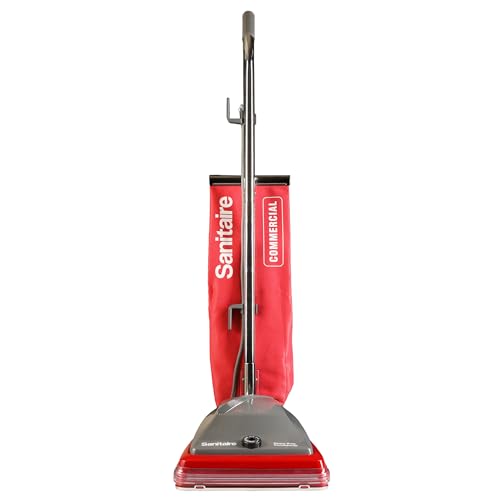
Sanitaire Tradition SC684G Upright — Professional Benchmark
Walk into the supply cupboard of a hotel, a school or a church hall and there is a fair chance a red Sanitaire is leaning in the corner, scuffed, dusty and utterly unconcerned. The Tradition line has earned that ubiquity over decades by being the vacuum equivalent of a cast-iron pan: heavy-duty motor, metal brushroll, a hood built to be bumped, and a design that any repair shop in any town can strip and rebuild. The SC684G carries that lineage in bagged form, trading the old shake-out cloth bag for disposable bags that suit modern dust expectations.
On carpet the machine simply gets on with it. The brush beats the pile open, the suction carries what rises, and the long commercial cord lets you clean a floor of rooms as one continuous job. It is not quiet, it is not styled, and it does not offer a menu of modes. It offers instead the deep professional virtue of predictability: the same strong clean on a grey Tuesday in February as on the day it arrived, provided you feed it bags and the occasional belt like every honest machine of its kind.
- Format: bagged commercial upright
- Brushroll: metal, serviceable and replaceable
- Cord: long commercial length for large floors
- Heritage: designed for professional daily use
Strengths
- Sustained carpet cleaning strength that crews stake their schedules on.
- Repairable everywhere, with parts stocked wherever commercial machines are sold.
- Long cord turns multi-room cleaning into one unbroken pass.
Trade-offs
- Working volume and utilitarian looks reflect its commercial brief.
- Fewer household conveniences than a home-first design like the Hoover.
- Heavier to carry between floors than the Oreck.
Best for: large carpeted homes, halls, rentals and anyone who wants the machine the professionals actually use. Not suited for: buyers wanting a quiet, styled, feature-rich household appliance.

Oreck Commercial XL Upright Vacuum — Lightest Strong Push
The Oreck XL performs a trick that still surprises people the first time they lift it: a full-size upright that feels closer to a broom’s weight than a vacuum’s, yet cleans carpet with a high-speed brushroll that belies its size. Hotels adopted it because housekeepers could carry it all shift without injury; households adopt it for the same reason at smaller scale. Automatic height adjustment lets it cross from carpet to hard floor without a dial, and the bag system keeps the dust sealed away in the commercial manner.
Its strength story is about efficiency rather than brute force. The fast brushroll agitates energetically, the air path is direct, and the light body means the machine actually gets used for the quick evening pass that heavier uprights get excused from. In a home where the vacuum lives upstairs, or where the person cleaning has a bad back and strong opinions, the Oreck’s combination of genuine pull and genuine lightness is unmatched in this guide.
- Format: lightweight bagged commercial upright
- Brushroll: high-speed design for energetic agitation
- Height: automatic adjustment across carpet and hard floors
- Use pattern: built for all-shift carrying in hotels
Strengths
- Remarkably light for a machine with this cleaning reach.
- Brush speed gives carpet a thorough beating despite the gentle push.
- Simple controls and automatic height keep the routine effortless.
Trade-offs
- Deep, dense pile is the Sanitaire’s stronger territory.
- Onboard tool provision is minimal beside household-first rivals.
- Premium bags are part of the Oreck ownership pattern.
Best for: multi-level homes, older owners and anyone who cleans often and values a light push. Not suited for: buyers wanting a full onboard tool kit for above-floor work.

Hoover WindTunnel High Capacity Upright — Best for Family Homes
Hoover’s entry takes the opposite route into this guide: instead of a commercial machine adopted by homes, it is a home machine engineered around the one specification busy families feel most — capacity. A high-capacity bagged design means the bag swallows weeks of the dust, crumbs and pet debris a family home manufactures, and suction stays in its strong zone far longer between changes than a small-bag rival can manage. The WindTunnel name carries Hoover’s long-standing air-channel approach to keeping debris moving rather than settling.
Around that core, the manners are domestic in the best sense. The machine is intended for the weekly whole-house clean and the midweek rescue alike, with the straightforward controls a household expects and none of the commercial starkness of the Sanitaire. For a large family home that wants bagged cleanliness and strong, sustained suction without buying into a janitorial aesthetic, this is the natural first look.
- Format: bagged household upright, high-capacity design
- Air path: WindTunnel channel design
- Bag: generous capacity for family-scale dust volume
- Audience: designed for home use first
Strengths
- Bag capacity keeps strong suction available across long family cleaning cycles.
- Household-first controls and manners suit non-professional users.
- Hoover’s parts and bag availability is broad and familiar.
Trade-offs
- Not built to the strip-and-rebuild commercial standard of the Sanitaire.
- Heavier in the push than the featherweight Oreck.
- Less suited to daily professional workloads in rental fleets.
Best for: large family homes wanting sustained bagged suction with domestic manners. Not suited for: commercial fleets needing fully serviceable professional machines.

Bissell BigGreen Commercial PowerForce Bagged Upright — Commercial Value
Bissell’s BigGreen line is the company’s commercial arm, and the PowerForce bagged upright is its straightforward working machine: an industrial-format upright that cleans premises without asking its owner to admire it. The design brief shows in the details that matter to a small business or a landlord — a bagged dust path that empties cleanly between jobs, a body light enough to move between rooms and properties, and a price tier, which you can check price on Amazon to confirm, that lets a small fleet exist at all.
For households, the appeal is honesty. This is the vacuum for the big utility clean: the rental between tenants, the hall after events, the workshop-adjacent house with more floor than fussiness. It will not pamper you with refinements, and in return it asks very little money or attention for a genuinely commercial bagged clean. Many buyers in this guide’s audience need exactly one such machine and no poetry with it.
- Format: bagged commercial upright, lightweight industrial design
- Line: Bissell BigGreen commercial range
- Use pattern: premises, rentals and utility cleaning
- Dust path: disposable bag for clean changes between jobs
Strengths
- Commercial format at the most accessible tier in this guide.
- Light enough to move between properties and premises easily.
- Bagged changes suit multi-user and multi-site working.
Trade-offs
- Refinement and quietness sit below the household-first Hoover.
- Deep-pile authority is good rather than benchmark-level.
- Tool provision is functional rather than generous.
Best for: landlords, small premises and utility-first households wanting commercial bagged value. Not suited for: buyers prioritising refinement, quiet or deep-pile specialism.
The Janitorial Crew Standard — Prose-Only Context
Professional crews are the most conservative buyers in cleaning, and their continued loyalty to bagged uprights is a data point worth understanding rather than copying blindly. A crew’s economics run on minutes: a bag change takes under a minute and restores full suction instantly, while a bagless machine’s filters and cups demand washing, drying and downtime a schedule cannot absorb. Bags also standardise hygiene across a team — whoever services the machine, the dirt leaves sealed, and no client ever watches their dust being shaken into a bin.
Durability completes the argument. A crew machine is bumped into lifts, carried down stairs and run for hours daily, so crews specify models with replaceable brushrolls, available belts and motors built for duty cycles no household approaches. The household lesson is not to buy the heaviest machine in this guide; it is to borrow the crew criteria in order — sustained suction, one-minute servicing, parts availability — and apply them at household scale. Discussed generically here, this pattern explains the Sanitaire and BigGreen picks better than any feature list could.
- Context: professional crew purchasing criteria, discussed generically
- Core values: sustained suction, one-minute bag servicing, sealed disposal
- Ownership pattern: repair and parts over replacement
- Tier positioning: a working pattern, not a product — no purchase applies
Strengths
- Explains why the commercial picks in this guide are built the way they are.
- Gives household buyers a proven checklist that outlasts marketing cycles.
- Clarifies the true cost advantage of bags at high cleaning volumes.
Trade-offs
- Crew priorities underweight quietness and styling that households may value.
- Daily-duty durability costs more than occasional-use households need.
- The pattern assumes storage for spare bags, belts and a backup machine.
Best for: readers choosing between commercial and household designs who want the professionals’ reasoning. Not suited for: readers who want a product recommendation rather than a framework.
The Rental-Turnover Pattern — Prose-Only Context
Between tenancies, a rental property gets the most honest clean of its life, and the bagged upright is the turnover cleaner’s signature tool for reasons a household can learn from. The bag is the point: whatever the previous tenancy left in the carpets leaves the property sealed inside a disposable bag, and the next clean starts from a genuinely fresh dust path. Turnover work also runs against the clock, so the pattern favours long cords, instant bag changes and machines that tolerate being carried between properties in a car boot.
Landlords who clean their own properties adopt the same pattern at smaller scale: one durable bagged upright, a box of bags, a spare belt, and a routine that treats each vacancy as a reset rather than a tidy. Households can borrow the reset idea without the property portfolio — a seasonal deep clean run like a turnover, with a fresh bag at the start and the machine serviced at the end, keeps a home’s baseline higher than any amount of casual weekly skimming. This section is deliberately generic, because the pattern matters more than any single machine that serves it.
- Context: between-tenancy cleaning practice, discussed generically
- Core values: sealed disposal, fresh bag per property, clock-friendly servicing
- Kit pattern: one durable upright plus bags and a spare belt
- Tier positioning: a working routine, not a product — no purchase applies
Strengths
- Shows the hygiene logic of bags at its clearest and most practical.
- Gives landlords a proven, minimal kit philosophy to copy.
- Offers households a seasonal reset routine worth adopting.
Trade-offs
- Turnover priorities ignore the comfort features daily home use rewards.
- The pattern assumes carpet-heavy properties; hard-floor rentals differ.
- A fresh bag per property is an operating cost small landlords must budget.
Best for: landlords, Airbnb hosts and households wanting a deep-clean reset method. Not suited for: readers seeking a specific model rather than a working approach.
How Do the Picks Compare at a Glance?
| Pick | Format | Standout trait | Ideal setting |
|---|---|---|---|
| Sanitaire Tradition SC684G Upright | Commercial bagged upright | Metal brushroll, rebuildable build | Large carpeted homes and halls |
| Oreck Commercial XL Upright Vacuum | Lightweight commercial upright | High-speed brush at broom-like weight | Multi-level homes, frequent cleans |
| Hoover WindTunnel High Capacity Upright | Household bagged upright | High-capacity bag for family dust volume | Big family homes |
| Bissell BigGreen Commercial PowerForce Bagged Upright | Commercial bagged upright | Accessible commercial value | Rentals and small premises |
| The Janitorial Crew Standard | Prose-only context | Professional purchasing criteria | Framework for choosing |
| The Rental-Turnover Pattern | Prose-only context | Sealed-disposal deep-clean routine | Landlords and reset cleans |
Why Does Bag Size Decide How Strong a Vacuum Stays?
Every upright feels strong with a fresh bag and an empty dust path. The differences emerge as the bag fills, because the machine must pull air through an ever-thicker layer of captured dust. A large bag spreads that layer across a broad surface, so the resistance rises slowly and the twentieth room cleans much like the second. A small bag concentrates the same dust into a choking plug, and the owner concludes the motor is weak when the dust path is simply full.
This is why the high-capacity Hoover belongs in a strong-suction guide despite its domestic manners, and why commercial machines treat bag volume as a headline specification. If your home produces dust at family scale — children, pets, a garden’s worth of tracked grit — bag capacity is not a convenience feature. It is the difference between suction you have and suction you merely bought.
How Should You Clean a Large Carpeted Floor Without Losing Suction?
Work the floor as a series of finished zones rather than one wandering pass. Start with a bag you know has room, because beginning a big clean on a three-quarter-full bag guarantees a weak finish. Overlap each stroke by a third, slow the pull-back stroke where the brush does its real work, and empty the room in a grid that ends at the door so the cord trails behind the cleaned area instead of across it.
Mid-clean, resist the urge to shake the bag and continue; a shaken bag redistributes its dust cake into the pores and returns weaker than it left. If suction softens noticeably before the job ends, change the bag and note how full it was — that observation calibrates your household’s real change interval better than any manual. Finish by running the edges with the hose or a crevice tool, since the strongest upright still leaves the skirting line to a narrower nozzle.
What Maintenance Keeps an Upright Strong for Years?
The strong upright’s enemies are mundane: a brushroll wound with hair, a belt stretched past its grip, a bag run into a solid brick, and a filter nobody remembered. Set a rhythm tied to bag changes, because that is the moment the machine is already open in your hands. Clear the brushroll, glance at the belt’s tension, check the hose ends for the sock or toy that explains last week’s weak room, and confirm the bag collar seated properly when the new one went in.
Commercial owners add one more habit households should steal: a log. A notebook line per bag change, belt and filter turns a machine’s history into something you can act on, and patterns — bags filling faster in shedding season, belts lasting a year — become visible. None of this requires skill, only the decision that a machine bought for strength deserves the small attentions that keep it strong.
Which Mistakes Undermine Even the Strongest Upright?
- Judging suction in the shop with an empty bag, then blaming the machine when a full bag tells the truth.
- Pushing faster as the clean goes on, giving the brush no dwell time to beat grit loose.
- Treating the bag as full only when debris reaches the inlet, long after airflow has faded.
- Ignoring a slipping belt because the machine still makes an encouraging noise.
- Choosing a featherweight model for deep commercial carpet, or a commercial tank for a small flat.
- Storing the machine with a damp bag after a wet spill pickup it was never designed for.
How Do Commercial and Household Uprights Really Differ?
Strip away the marketing and three differences remain. Commercial machines are built to be opened: brushrolls, belts and cords replace with hand tools, and parts stay catalogued for years. Their cords are longer and their bags bigger, because premises are bigger. And their controls are deliberately sparse, since a machine shared by a crew cannot depend on anyone reading a mode menu.
Household machines answer with comfort: better filtration stages, quieter tuning, onboard tools and styling a family can live with in the hall cupboard. Neither philosophy is superior in the abstract. The Sanitaire owner and the Hoover owner in this guide have simply optimised for different lives, and the wisest purchase starts by deciding which life is yours.
What Should Landlords and Hall Committees Buy First?
Buy the machine before the accessories, and buy it for the worst floor you maintain rather than the average one. A committee hall with carpet tiles and weekly events wants the Sanitaire’s durability or the BigGreen’s value across a small fleet; a landlord with two flats wants one Oreck or BigGreen that travels well and a disciplined box of bags. In both cases, standardise on one model so bags, belts and knowledge all transfer between machines and people.
Then write the routine down. Whoever cleans should know the bag-change signal, where spares live and what a slipping belt sounds like. Institutions lose more suction to missing routines than to weak machines, and the fix costs nothing but a laminated card in the cupboard.
How Does Brushroll Design Change What Suction Can Do?
A brushroll is the suction’s opening act. Its bristles and beaters strike the carpet fibres thousands of times a minute, shaking loose the grit that suction alone, pressing down on a closed pile, cannot reach. Metal rolls like the Sanitaire’s hold their shape and their bristle pattern across years of that punishment, and they can be stripped, cleaned and re-bristled rather than discarded. High-speed rolls like the Oreck’s compensate for a lighter machine by agitating more energetically per pass.
The partnership fails in predictable ways. A roll wound in hair stops beating and starts skating, and the machine’s note changes to a smoother, less useful hum that experienced ears learn to catch. A belt stretched by age slips under load precisely when the pile is deepest, so the roll turns bravely in the air and stalls on the carpet. Both faults masquerade as weak suction, and both are five-minute fixes — which is why this guide keeps returning to serviceability as a strength feature in its own right.
What Does Cord Length Quietly Decide?
Cord length never appears in anyone’s dream specification, yet it shapes every large clean. A commercial cord lets a whole floor be finished as one continuous movement, the machine’s strength applied without the rhythm-breaking hunt for sockets that fragments attention and leaves half-rooms for later. Household cords assume smaller territories and more sockets, which suits flats and frustrates halls.
Manage whatever cord you have deliberately. Work away from the socket so the cord trails over cleaned floor, keep it behind the machine rather than under the brush’s path, and never tug the machine towards you by the cord when it snags — walk back and free it, because cord strain at the entry point is the classic slow death of hard-working uprights. A cord cared for this way outlasts the machine around it.
How Should You Store a Working Upright?
Storage is maintenance performed daily. Park the machine with the handle latched upright rather than leaning its weight onto the brush housing, loop the cord loosely instead of winding it tight enough to remember the shape, and keep the cupboard dry, since a bag left damp after an over-enthusiastic spill clean will smell and weaken. A machine stored beside its spare bags and belt gets serviced; a machine stored away from them gets postponed.
Institutions should add a checkout habit: whoever returns the machine notes a full bag, a strange noise or a frayed cord on the cupboard card, so the next user inherits a ready machine instead of a mystery. Households can run the same system on a fridge note with two people and no laminated anything. The principle scales because it is about attention, not administration.
When Is an Upright the Wrong Tool Entirely?
Strength does not make an upright universal. Stairs want a hose and a compact tool or a canister’s parked body; an upright balanced on a tread is an accident rehearsing. Above-floor work — shelves, curtains, ceiling corners — belongs to machines with proper hose reach, and several picks here are deliberately floor specialists. Delicate hard floors with grit that must not be dragged deserve a parquet-headed canister rather than a spinning brush.
Recognising the boundary makes the upright better at its real job. The households that love these machines pair them with a small handheld or a hose kit for the edges of life and let the upright do what it was built for: long, strong, straight-ahead floor cleaning at a scale bagless novelties rarely sustain. Buy the specialist, supplement it cheaply, and the system outperforms any single compromise machine.
How Do You Break In a New Commercial Upright at Home?
Give the machine one honest week. Learn its bag-change signal by running the first bag to the point where suction softens, and note the date so your household’s interval becomes knowledge rather than guesswork. Find the belt’s location and the brushroll’s release before you need them mid-clean, and store the spare belt with the bags rather than in a drawer of good intentions.
Walk your regular route and mark the socket that serves it best, the doorway where the cord wants to snag, and the rug whose fringe demands a slower approach. Every strong upright has a household-specific choreography, and the owners who learn theirs in week one are the ones still praising the machine in year ten. The crews could tell you the same about their rounds; the round is learned once and then simply walked.
What Should a Second-Hand Buyer Check on These Machines?
Commercial uprights circulate second-hand in large numbers, and the good ones are bargains precisely because they were built to be rebuilt. Check the brushroll’s bristles for wear and free spinning, the belt for cracks, the bag compartment for the dust coating that betrays years of leaking substitute bags, and the cord for nicks along its length. Run the machine on carpet and listen for the settled pull this guide described at the start; a whine, a rattle or a burning note each names its own repair.
Price any needed parts before you commit, since the whole second-hand argument rests on parts being cheap and available — for the Sanitaire and BigGreen lineages they generally are. A used professional machine with a fresh bag, belt and brush service will out-clean many new household machines, and it will do so for years. That durability loop is the commercial world’s gift to patient buyers.
How Does Weight Change Who Can Clean?
Weight is an accessibility feature disguised as a specification. The Oreck’s lightness is why some owners can clean their own homes at all, and why housekeepers can work full shifts without the shoulder injuries that end careers. At the other end, the Sanitaire’s substance is the price of its rebuildable chassis, and households with stairs between floors feel that price on every carry.
Decide weight by the carry, not the push. On the flat, brush assistance and momentum hide kilograms that a staircase exposes instantly. If the machine must live on a different floor from most of its work, weigh that journey heavily — or solve it the institutional way, with one machine per floor when the building justifies it. Strength you cannot move is strength you will use less, and unused strength cleans nothing.
How Should You Clean Different Carpet Types with One Strong Upright?
Loop pile forgives almost anything and rewards speed; it is the carpet these machines were born on, and a steady overlapping pass at walking pace extracts its grit completely. Cut pile and plush demand a slower pull and attention to direction, because the fibres show every track and hold their dust deeper; work with the pile’s lay on the final pass and the room finishes looking groomed rather than harvested. Frieze and textured weaves hide dirt brilliantly, which is a warning rather than a comfort — give them the slowest passes of all, since what you cannot see is exactly what the brush must beat loose.
Height settings, where fitted, should be treated as part of the clean rather than a set-and-forget dial. Start high and lower until the machine’s note settles and the brush audibly engages; a head sunk too deep seals against the pile and strangles its own airflow, while a head riding too high skates over the surface it was meant to beat. The Oreck’s automatic adjustment makes this decision for you, which is one more reason busy households forgive its sparse tool kit.
What Role Does Filtration Play in a Working Upright?
In a bagged upright the bag is the first and largest filter, and the exhaust filtration behind it polishes what little escapes. For premises and homes alike, the practical benefit is that the air leaving the machine does not undo the cleaning by returning fine dust to the room’s surfaces. That is a statement about dust management and comfort in the cleaned space, and it is why bagged machines remain specified in buildings where many different people breathe the air across a day.
Keep the chain honest. A torn bag, a collar seated crookedly or an exhaust filter run years past its schedule each quietly demote the system, and the symptom is a fine grey film on shelves that the owner blames on the building. Inspect at bag changes, replace on schedule, and the filtration story stays as strong as the suction story — the two are, in a well-kept bagged upright, the same story told twice.
How Do You Plan Cleaning for a Building with Multiple Cleaners?
Standardisation is the whole secret. One model across the building means one bag type in the cupboard, one belt in the drawer, and one set of habits every cleaner shares. New staff learn the machine in minutes because the machine is always the same machine, and a fault reported on Monday can be diagnosed by anyone who has heard the fleet’s healthy note. Mixed fleets squander all of that on variety nobody asked for.
Assign machines to zones rather than to people, keep a simple fault card with each, and rotate a spare through servicing so no zone ever waits on a repair. Households with two floors can run the miniature version: one upright per floor if the budget allows, or one machine and a carrying routine everyone respects. The principle is identical at every scale — strength, standardised and serviced, beats novelty every single week.
What Does a Spare-Parts Shelf for an Upright Look Like?
It is smaller than people fear. A box of genuine bags, two belts, one spare brushroll or bristle set for the machine’s model, and the exhaust filter the schedule will want next. That shelf, costing less than a single service call, converts nearly every common failure from a week of waiting into ten minutes of work. Label it with the model name in large letters, because the person reaching for it may not be the person who stocked it.
Review the shelf when the seasons change. Shedding season and the muddy months consume bags faster, holiday events consume belts’ patience, and a shelf checked quarterly never surprises you mid-clean. Commercial cupboards run exactly this system with more zeros on the quantities; the household version fits in a shoebox and delivers the same peace.
How Should You Handle Edges, Corners and Under-Furniture Zones?
An upright’s head cleans a wide path beautifully and a narrow one not at all, so plan the edges as their own task. After the open floor, walk the room’s perimeter with the hose and crevice tool where one is fitted, or with a handheld companion where it is not, taking the skirting line, the corners behind doors and the shadow zone under radiators where grit migrates. The strongest floor clean still fails the white-sock test if the perimeter keeps its line of dust.
Under furniture, lower the handle as flat as the machine allows and work slowly, since the brush’s dwell matters more where traffic has packed the dust for months. Where the head cannot go, the wand tools must, and a quarterly move-the-furniture clean keeps the unreachable map small. Treat these zones as part of the standard rather than a spring-clean event, and the whole room ages evenly instead of in rings.
How Does a Strong Upright Change a Weekly Routine?
The first change is temporal: rooms finish faster because passes count. Where a weak machine needed three crossings to lift the visible grit, a strong upright with an honest brush does the work in one deliberate pass and a slower pull-back, and the saved minutes compound across a whole house into a clean that fits a weekday evening. The second change is psychological. A machine that visibly works invites use, and homes with inviting machines get cleaned more often in smaller, easier sessions.
The third change is the baseline. Grit removed weekly never gets the months it needs to grind carpet fibres down at the base, so carpets in strong-upright homes age measurably slower. That protective effect, invisible in any single clean, is the real return on buying strength — the floor coverings themselves last longer, and the machine pays part of its keep in carpet it quietly saves.
What Should You Listen for When an Upright Is Working Well?
A healthy strong upright sounds busy and settled at once: the brush’s beat regular, the motor’s note deep rather than screaming, no rattles from the housing and no high whine of air leaking past a bad seal. Changes in that chord are diagnostic. A rising pitch with falling performance suggests a filling bag or a blockage; a new rattle suggests something hard in the brush’s path; a burning smell is an instruction to stop immediately and inspect.
Teach everyone who uses the machine the healthy sound once, and faults get reported while they are still five-minute fixes. Crews run on exactly this principle — the ear is the first instrument — and it transfers to households without modification. A vacuum is one of the few appliances that narrates its own condition continuously; the strong ones simply narrate in a deeper voice.
How Do You Decide Between One Strong Machine and Two Ordinary Ones?
Large homes and small institutions face this fork often. Two ordinary machines offer coverage and redundancy; one strong machine offers depth of clean and simplicity of supplies. The deciding question is where your dirt lives. If it lives in large carpeted areas cleaned on a schedule, depth wins, because two weak passes over the same grit still leave the base of the pile dirty. If it lives in scattered small rooms across a big building, coverage wins, because a superb machine cannot be in two corridors at once.
Many owners resolve it in sequence: buy the strong machine first, learn what real suction does to the baseline, and add a second unit only if the geography still defeats one machine’s rounds. Reversing the order usually ends with two mediocre machines and a lingering suspicion that cleaning is simply hard. It is not hard; it is underpowered, which is a curable condition.
What Seasonal Jobs Suit a Strong Bagged Upright Best?
Spring’s deep clean is the obvious showcase: a fresh bag, slow passes, furniture moved in rotation, and the winter’s accumulated grit finally evicted from the pile’s base. Autumn brings the leaf-and-grit season, when hallways and entrances need the machine’s strength in short, frequent bursts. After parties and holidays, the strong upright restores order in one session instead of a weekend of skimming.
Build these events into the machine’s service rhythm. A bag change before the spring clean, a belt inspection after the holiday season, and the fleet — even a fleet of one — stays ahead of its work. Seasonal thinking is another crew habit that households profit from stealing, because dirt itself is seasonal and the machine’s calendar should admit it.
A Note on Floors That Mix Carpet Tiles and Hard Surfaces
Community halls, offices and converted spaces often lay carpet tiles in the traffic zones and leave hard flooring at the edges, and a strong bagged upright handles that hybrid gracefully when the operator respects the boundary. Run the carpet tiles with full brush engagement, ease off at the hard margins where a spinning brush can scatter grit, and finish the hard edges with the hose tools. The Oreck’s automatic height behaviour makes it the natural hybrid specialist here, while the Sanitaire rewards an operator willing to work its settings deliberately.
Whatever the mix, the bag remains the system’s quiet hero: tile dust, tracked grit and event debris all leave in the same sealed package, and the next booking inherits a floor that was cleaned rather than redistributed. Buildings that learn this stop apologising for their floors, which is the true endpoint of buying strength.
How Should Beginners Build Confidence with a Powerful Machine?
Start with the room you know best and a fresh bag, and clean it more slowly than feels natural. Watch what the brush lifts on the pull-back, listen to the machine’s settled note, and check the bag afterwards to see what your floor had been keeping. That single attentive session teaches more than a manual: the pace, the overlap, the sound of a healthy machine and the sight of real extraction.
Then set your household’s two rules — bags changed on the softening signal, brushroll cleared at every change — and let repetition do the rest. Within a month the machine’s strength will have raised your home’s baseline to a level where ordinary weeks feel easy, and you will understand why the professionals in the prose-only sections never went back to weaker tools.
What About Homes Where the Vacuum Is Shared with Teenagers or Staff?
Shared machines fail socially before they fail mechanically. The fixes are social too: one model, one bag type, a spare belt taped inside the cupboard door with the change date written on it, and a house rule that whoever feels the suction soften changes the bag rather than finishing the job weakly. Strong machines forgive beginners more than weak ones do, because their margin of power covers imperfect pace and overlap while technique is learned.
Choose for the least experienced user and the most experienced user simultaneously: controls simple enough for the first, strength and serviceability deep enough for the second. The Sanitaire and the Hoover bracket that span in this guide, and either will hold a shared household’s standard far better than a delicate machine whose modes nobody remembers.
A Final Word on Trying a Commercial Machine Before Buying
If a local janitorial supplier stocks the Sanitaire or the BigGreen, ask to push one across their showroom carpet with a handful of grit worked into the pile. Commercial dealers expect the test, and thirty seconds of real resistance teaches what pages of specifications cannot: the settle of the brush, the honesty of the pull, the weight through your own shoulders. Then check price on Amazon through the links above and order wherever the arithmetic favours, knowing your hands have already voted.
Final Recommendation
For outright, sustained carpet strength with professional repairability, the Sanitaire Tradition SC684G is this guide’s benchmark and the machine large carpeted homes should shortlist first. The Oreck Commercial XL is the pick when the cleaner is as important as the clean — its light push and fast brush make frequent cleaning genuinely sustainable. Family homes wanting domestic manners and a big honest bag should take the Hoover, while landlords and premises owners get the most commercial value from the BigGreen PowerForce.
Whichever badge you choose, protect its strength the way the crews do: bags changed before they choke, brushrolls kept clear, belts replaced on suspicion rather than evidence. Do that, and your upright will still be pulling hard on the last room of the house on the thousandth clean — long after the novelty machines have been retired to the dusty garage corner.
Frequently Asked Questions
Does a bigger motor always mean stronger cleaning?
No. Cleaning strength is suction plus airflow plus brush agitation working through an unclogged dust path, and it is the weakest of those four that sets the result on any given day. That is why a freshly serviced mid-power machine will embarrass a neglected flagship, and why this guide treats bags, belts and brushrolls as performance parts rather than consumable trivia. A modest motor with a clear path and a good brushroll out-cleans a powerful motor strangling on a full bag, which is why this guide scores whole systems rather than wattage.
How full should I let the bag get?
Change it when suction noticeably softens or the bag feels about two-thirds full, whichever arrives first. Mark the date on the new bag with a pen as you fit it; after three changes you will know your household’s true interval in different seasons, and you can stock bags to match reality instead of hope. Commercial crews change earlier than households because their schedules cannot absorb a fading machine; copying that discipline at home keeps every clean at full strength.
Are commercial uprights too loud for home use?
They are louder and prouder than household-tuned machines, and for most homes that is a ten-minute, doors-open consideration rather than a deal-breaker. If the machine will run during a baby’s naps in a small flat, weight the household-first Hoover more heavily in your decision.
Can these uprights clean hard floors too?
The Oreck crosses to hard floors automatically, and the others manage hard floors respectably, though a brushroll that cannot switch off deserves care on delicate surfaces. Homes that are mostly hard floor should look at canister or dedicated hard-floor guides rather than forcing an upright to specialise backwards.
Why do crews avoid bagless machines?
Time and hygiene. A bag change restores full suction in under a minute with the dirt sealed, while cups and filters demand emptying, washing and drying that a working schedule cannot hold. At household scale the same logic applies in softer form: bags trade a small consumable cost for consistently strong, clean-running performance.
How long will a commercial upright last in a home?
Typically far longer than a household-duty machine, because its motor, brush and chassis were specified for daily professional hours. A home asks perhaps an hour a week of a machine built for thirty hours a week of work, and that mismatch is the second-hand market’s and the buy-once household’s shared secret: professional durability, loafing at household pace, tends to outlast everything around it. Fed bags and belts and kept clear of wet pickups, a Sanitaire-class machine in a home is usually measured in decades of service rather than years.
Related Guides
Readers weighing formats should compare Best Bagged Vacuums for Bed Bug Cleanup for the containment case for bags, Best Battery-Operated Pool Vacuums for a very different kind of suction, and Best Bissell Car Vacuums for small-space cleaning. Our earlier round-up of Best Bagged Vacuums for High-Pile Carpet covers the deep-pile end of the upright question in detail.


