Our Top Picks
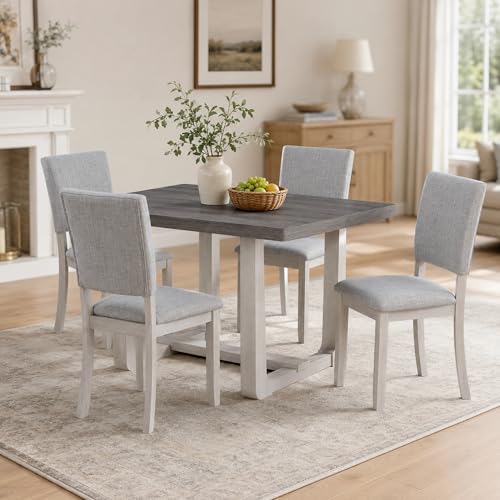 Stella Mia 5-Piece Small Dining Table and ChairsRectangular48 x 36 x 30 inches85 poundsCheck on Amazon


What's inside
- Why a trestle table changes the chair decision
- Understanding trestle geometry before you shop
- The bay: the measurement that governs everything
- Working out how many chairs fit along each side
- Side chairs: why armless usually wins along the bay
- End chairs: the case for arms, scale, and presence
- The stretcher: footrest, obstacle, and chair-leg trap
- Seat height against a thick top and apron
- Pairing a bench with chairs
- Farmhouse pairings: solid wood, ladderbacks, and Windsors
- Modern trestle tables: metal frames and Scandinavian lightness
- Chair construction: what keeps a dining chair steady for years
- Stability on uneven floors, glides, and protecting the surface beneath
- Upholstery, cushions, and the realities of meals
- Care and maintenance for wooden chairs around a working table
- Room layout, serving flow, and everyday movement
- Checklist before you order
- Check prices on Amazon
- Frequently asked questions
As an Amazon Associate I earn from qualifying purchases. This post may contain affiliate links at no extra cost to you.
Some links in this guide are affiliate links, which means this site may receive a modest commission if you choose to buy after following one, at no extra cost to you; that support helps keep these furniture guides free to read.
Why a trestle table changes the chair decision
A trestle table looks invitingly open from across the room. Two sturdy supports stand near the ends, a long top stretches between them, and the whole piece suggests generous seating along both sides. Yet people who buy chairs based only on a photograph often discover a quieter problem once everything arrives home. A chair that seemed perfectly proportioned in a showroom bumps into a support foot, refuses to slide far enough under the top, or leaves the person at the end with knees pressed against timber they never noticed in the pictures.
The difference comes from geometry rather than style. A conventional four-legged dining table puts its obstructions in the corners, leaving the long sides largely uninterrupted. A trestle design moves the structure inward and concentrates it. The supports, feet, and connecting stretcher occupy specific zones that either welcome a chair or quietly exclude it. Choosing seating for this kind of table is therefore first an exercise in measuring space, and only afterwards an exercise in taste.
This guide stays focused on the chairs themselves. The table is the fixed context, the piece you already own or have firmly decided upon. Every section that follows asks how a dining chair behaves around trestle supports: how wide it can be, where its arms end up, whether its legs clear a low stretcher, and how its seat height relates to a top that is often thicker than average. Published dimensions from chair makers, standard furniture sizing references, and recurring themes in owner feedback form the evidence base for the comparisons here.
Nothing in these pages assumes one correct look. A farmhouse room with ladderback chairs and a pared-back Scandinavian scheme with pale moulded seats can both succeed at the same table, provided the measurements cooperate. Conversely, the most beautiful chair in a catalogue will frustrate you daily if its arms collide with the underside of the top every time someone stands up. Fit first, finish second, is the ordering that saves money and temper.
It also helps to think in terms of positions rather than a single repeated purchase. The seats along the side live in a different spatial world from the seats at the ends. A household might need six chairs that behave one way and two that behave another, or a bench on one side and individual seats opposite. Treating the set as a small system, with distinct roles, produces a calmer and more comfortable result than ordering eight identical pieces and hoping for the best.
Understanding trestle geometry before you shop
Start by naming the parts, because the vocabulary makes later measuring far easier. Each trestle is an assembly near one end of the table, typically built from a vertical post or a pair of splayed legs, a foot that runs across the width of the top at floor level, and a cap or crosspiece beneath the top that carries its weight. Two such assemblies, one near each end, hold up the entire surface.
Between the two assemblies runs the stretcher, a long horizontal member that locks the trestles together and stops them from racking sideways. On some tables this stretcher sits low, only a few inches above the floor, passing roughly where diners rest their feet. On others it rides higher, closer to the underside of the top, or is shaped with a gentle arch. A few modern designs use a pair of thinner rails or a metal bar instead of a single chunky beam.
The feet deserve special attention because they project toward the people seated along the sides. A trestle foot usually extends across most of the table width, so its ends finish close to where side chairs stand. When you pull a chair in, its front legs may meet the foot before the seat reaches a comfortable distance from the table edge. That single interaction explains many complaints about feeling perched too far from a plate.
Above, the cap piece under the top creates a second hidden boundary. The clear height beneath a trestle table is not uniform. Near the ends, the structure drops lower than it does in the middle of the span. A tall chair back or a high arm placed at the wrong point can meet timber even though the same chair slides freely a foot further along. Mapping these high and low zones on your own table turns guesswork into a simple diagram.
Overhang completes the picture. The distance from the outer face of each trestle to the nearest end of the top determines whether anyone can sit at the head at all. Generous overhang invites an end chair with room for legs beneath the surface. Short overhang pushes the end diner against the trestle itself, turning the head position into a decorative spot rather than a usable seat. Measure it before falling for a grand pair of host chairs.
How trestle tables differ across styles
Refined or transitional designs slim the components down. Feet may be shaped with cutaways, posts may taper, and the stretcher may be thinner or raised. The spatial rules remain the same, but the penalties soften slightly, and a wider variety of chair silhouettes can fit. Even so, a tapered post still occupies floor space exactly where a chair leg wants to travel.
The bay: the measurement that governs everything
Furniture guides often talk about table length as if the full measurement were available for seating. With a trestle table that assumption fails. The usable length along each side is the bay, meaning the clear distance between the inner faces of the two trestle assemblies. A table that measures ninety inches overall might offer only sixty-odd inches of truly open side, once both supports and their clearances are subtracted.
Measure the bay at floor level and again just beneath the top, because the two figures can differ. Splayed or shaped supports may lean into the seating zone at one height while standing clear at another. Record the smaller of the two numbers for planning chair widths, since the chair must coexist with the structure at every height its frame occupies. Note also the depth of each trestle foot from front to back, measured along the floor.
Then measure the bay with honesty about margins. Chairs should not be planned flush against the trestles. Leave a few inches of breathing room at each end of the bay so that the outermost chairs can shift slightly without grinding against timber, and so diners can angle themselves as they sit down. People rarely slide in perfectly straight; they approach at a slight diagonal, swing a leg, and settle. Space that looks spare on paper becomes necessary in motion.
Write the bay figure down and carry it through every later decision. Chair width, count per side, bench length, and even the choice between armed and armless side chairs all trace back to this one dimension. If you are choosing chairs before a table arrives, ask the maker for the clear distance between supports rather than relying on overall length in a listing, and confirm whether the stated figure accounts for foot projection.
A simple way to record your table
Sketch the table from above on a sheet of paper, marking overall length and width, the position of each trestle, and the bay between them. Add a side view showing floor to underside height in the middle of the span and at the trestles, plus the height of the stretcher from the floor. Photograph the sketch next to the tape measure readings so the numbers stay legible. This unglamorous page will answer nearly every question a chair listing raises.
Working out how many chairs fit along each side
With the bay measured, the arithmetic of seating becomes refreshingly concrete. Comfortable dining generally allows each person a personal width of roughly twenty-four inches of table edge, with a little more for larger chairs or leisurely meals and a little less for compact seats at casual gatherings. Divide your bay by the allowance you choose and round down, always down, because a fractional guest cannot be squeezed into the remainder without everyone feeling the compromise.
Chair width interacts with that allowance in a way listings rarely explain. The stated width of a chair is its widest point, often at the top of the back or across the front rail, while the space it effectively claims includes elbow room and the small gaps neighbours need to avoid knocking frames. A set of nineteen-inch chairs does not truly dine at nineteen inches per person. Plan using the larger of the chair width plus a couple of inches, or your chosen per-person allowance.
Consider a worked example in general terms. Suppose the bay comfortably supports three positions per side at a relaxed allowance. Choosing notably wide, sculptural chairs could reduce that to two generous places with an awkward leftover gap that tempts you to force a third. Resisting that temptation matters. Two people dining in genuine comfort beat three people negotiating elbows, and the spare chair can live elsewhere until a different arrangement is needed.
Odd and even totals create different social feelings. Three chairs along a side with one at each end makes a balanced eight, a classic configuration for longer trestle tables. Two per side plus the ends gives six, often the sweet spot for family meals with occasional guests. If your bay supports only two per side, resist filling the ends automatically; sometimes the overhang is better left open so the table reads as spacious rather than crowded.
When the numbers land between two answers
Many households find their bay sits awkwardly between two clear answers, perhaps allowing either two wide chairs or three narrow ones per side. Let your actual dining habits arbitrate. Households that mostly seat four and host eight twice a year should optimise for the four, choosing comfort and keeping flexible extras in reserve. Households that genuinely gather seven or eight every week should favour the narrower chairs that make the larger group workable.
Side chairs: why armless usually wins along the bay
Along the sides of a trestle table, the armless side chair is the workhorse for sound spatial reasons. Without arms, a chair slides further under the top, presents a narrower effective profile, and lets the diner shift sideways without a frame dictating posture. Rows of armless chairs also tuck away neatly, which keeps walkways clear and gives the room a tidier outline between meals.
Arms on side chairs consume width twice over. They add physical inches to each chair, and they add behavioural inches because a person seated in an armed chair tends to occupy the full span of the armrests. In a bay that is already a fixed budget, that double cost quickly eats a whole place setting. If you love the look of arms, consider reserving them for the ends, where the spatial budget is calculated differently.
There is also the question of height collision. Side chair arms must pass beneath the tabletop and any apron or cap structure along the edge. On a trestle table the long edge is usually free of apron, which helps, but a thick top lowers the available clearance along the entire side. An arm that clears a standard table may scrape here. Armless designs sidestep the whole category of problem, which is one reason dining traditions settled on them for side positions centuries ago.
Comfort without arms depends on seat shaping and back support rather than on having somewhere to rest forearms. During a meal, forearms mostly rest on the table itself. A side chair with a gently curved back, a seat that supports the thighs without a sharp front edge, and enough depth for the sitter to lean back between courses will feel complete. Judge display models by sitting through a simulated long conversation, not a ten-second perch.
For readers drawn to upholstered side chairs, our companion guide to best choice fabric dining chairs explores fabric seating in depth, and many of the same width and clearance principles apply there. Whatever the upholstery, measure the chair at its widest point rather than trusting the seat width alone, since flared backs and splayed legs often exceed the seat dimension by a surprising margin.
Back height and silhouette along the side
Side chair backs shape the long view of the table. Low backs keep sightlines open across the room and suit tables placed in combined kitchen and living spaces. Tall backs create a more formal rhythm and offer more support for lingering meals, but they also emphasise every slight misalignment when chairs are pushed in. With tall backs, small differences in how each chair was left become visible from the doorway.
End chairs: the case for arms, scale, and presence
The head and foot of a trestle table are natural places for distinction. Historically the host sat at the end facing the room, and the end chair carried a little ceremony: broader, taller, often armed. That tradition survives because it works visually and socially. A pair of more substantial chairs closes the composition at both ends and gives the long table a sense of intention.
Spatially, end chairs answer to the overhang rather than the bay. Measure from the outer face of the trestle to the end of the top, then picture a seated person’s knees occupying the space beneath that overhang. If the overhang is shallow, an end chair becomes a place to sit upright for a short meal rather than a spot to lounge through dessert. Be honest about which experience your table can offer before investing in statement pieces.
Arms make their strongest case here. An end chair pulled up to the short edge has no neighbouring chair competing for width, so the extra inches cost nothing socially. Arms also give the person at the head a comfortable posture for conversation that faces along the table rather than across it. Check, though, that the arms clear the top’s thickness and any end apron, and that the chair can still push in far enough to look settled when unoccupied.
Scale needs care in both directions. An end chair that is too grand overwhelms a modest table and crowds the room’s circulation at its most exposed point. One that is barely larger than the side chairs looks like a mistake rather than a gesture. A useful approach is to keep the same family of design, then step up one level in width, back height, or upholstery richness, so the relationship reads as deliberate kinship instead of mismatch.
Households comparing dedicated host seating may find our guide to best chairs for head of dining table useful alongside this one, since it dwells on end positions across table types. Whichever direction you take, buy the end chairs as a considered pair even if only one end is used daily; a lone special chair at one end and a side chair at the other tends to look unfinished, and the second chair earns its keep the first time the table is fully dressed.
When to skip end chairs entirely
Skipping end chairs can also be a staging decision that you revisit later. Live with side seating for a season, notice whether gatherings strain for places or whether conversation feels better with the ends open, and then decide. Chairs are among the easiest furniture purchases to add later, especially if you recorded the model, finish, and dimensions of your side chairs while they were current.
The stretcher: footrest, obstacle, and chair-leg trap
No part of a trestle table generates more mixed feelings than the stretcher. Diners love resting their feet on a low, broad stretcher during a long meal; it offers the relaxed posture of a footrail and subtly encourages people to linger. The same beam, however, dictates where chair legs and human feet can go, and a stretcher placed at an awkward height pleases nobody, too high to step over gracefully and too low to ignore.
Begin by measuring the stretcher’s height from the floor to its top surface, and its depth from front to back. A low stretcher, roughly within the first several inches above the floor, generally behaves like a threshold: chairs stand on the near side of it, diners rest heels or toes on it, and chair legs rarely need to cross it. Problems arise when a chair must be pulled so close that its front legs would need to straddle or climb the beam. That is a sign the seating position is fighting the table’s structure.
Chair design interacts with the stretcher in specific ways. Chairs with a low front rail between their front legs can clash with a raised stretcher when pushed in, because two horizontal members compete for the same band of space. Chairs whose legs are joined by side stretchers sit differently again, their own framework defining how far they can advance. When comparing models, look at photographs from the side and imagine the chair’s lowest rails meeting your table’s beam.
Feet matter as much as furniture. In the middle of the bay, the stretcher runs directly in front of every side diner, so its position shapes legroom for the whole table. Taller people, who need to extend their legs further, notice a high stretcher most. If your household includes very tall or very short members, have them sit at a similar table if possible, or mock up the stretcher height with a length of timber and observe where feet naturally land during a meal-length sit.
Chairs that must occasionally cross the stretcher line
At the ends of the bay, the outermost chairs sometimes sit close enough to a trestle that their inner legs approach the stretcher’s end or the trestle post itself. Four individual legs cope with this better than sled bases or pedestal forms, because each leg can find its own footing around an obstruction. A continuous sled base, by contrast, either clears an obstacle entirely or not at all, and a low trestle foot usually wins that contest.
Seat height against a thick top and apron
Trestle tops are frequently thicker than the tops of leg tables, sometimes a solid slab or a built-up edge that reads as substantial from the side. Thickness changes the comfort equation because what matters is not the height of the table surface alone but the relationship between seat, surface, and the clear space beneath. A standard dining surface sits around thirty inches high, yet two tables at that height can feel quite different if one hides a deep apron or cap beneath it.
The working rule for seat height is a difference of roughly ten to twelve inches between the seat and the tabletop surface. Most dining chairs are built with seats in the seventeen-to-nineteen-inch range precisely to serve standard tables. Measure your chair candidates at the front centre of the seat, and if the seat is cushioned, account for compression: a plump cushion that measures nineteen inches unloaded may sit closer to eighteen under a person’s weight, which is usually the more honest figure for planning.
Thigh clearance is the second half of the check. Measure from the floor to the lowest obstruction beneath the top along the side, which may be the underside of the slab itself or an apron board set in from the edge. A seated person needs enough vertical room for thighs to slide in without pressing against timber, plus a margin for crossing legs or shifting during a long meal. Deep aprons paired with high seats create the classic squeeze that makes a beautiful table feel oddly unwelcoming.
Arm height, where arms exist, must be checked against that same underside measurement rather than against the tabletop. Allow a small gap so the chair can move without scraping, and remember that floors are rarely perfectly level; a chair that clears by a hair in one spot may touch in another. Felt pads added later also steal a fraction of height. Build in tolerance rather than designing to a knife-edge fit that only works on the day of measuring.
Children and shorter adults experience these dimensions differently. A seat that positions an adult perfectly may leave a shorter person’s feet dangling, which quickly becomes discomfort. Rather than lowering the whole set, keep a couple of firm cushions available and a footrest solution for smaller diners, perhaps the stretcher itself if its height cooperates. Mixed-height households benefit from chairs with a slightly lower seat within the normal range, a compromise most adults tolerate without noticing.
Counter-height and other nonstandard pairings
Pairing a bench with chairs
A bench along one side of a trestle table is the pairing most people picture first, and it solves several problems at once. A bench has no individual legs to tangle with trestle feet, it can slide deep under the top when not in use, and it seats a flexible number of people, especially children, who treat its length as negotiable territory. For casual family dining, few arrangements feel as welcoming.
Length is the bench’s bay calculation. The bench should fit within the bay with margin to spare, because a bench that must be threaded precisely between trestles will scrape and frustrate. A few inches of clearance at each end lets the bench move in and out at a slight angle, the way people actually move furniture. If the bench is intended to tuck fully beneath the top, check its height against the underside clearance and its depth against the stretcher position.
Bench construction echoes the table question in miniature. A bench on trestle-style supports repeats the table’s language handsomely, though its own feet must not collide with the table’s stretcher when pushed in. A four-legged bench offers forgiving placement, and a solid plank bench with slab ends gives the most unobstructed sliding of all. Whatever the base, a bench that wobbles under shifting weight will be abandoned to a hallway, so prioritise rigidity and check how the seat is braced along its length.
Comfort expectations should be set honestly. A bench offers no back support, which suits breakfasts, homework sessions, and lively suppers better than three-hour dinners. Many households solve this by placing the bench on the side facing a wall and adding cushions against it, or by accepting the bench as the children’s side and giving adults chairs opposite. Seat depth matters too: a very deep bench strands shorter legs, while a narrow one feels precarious. Look for a depth in the same neighbourhood as a chair seat.
Mixing a bench with chairs also changes how the table is set. Place settings on the bench side can be spaced fluidly, which helps when numbers swell, but everyday discipline helps: define each person’s territory with placemats so the bench side does not drift into crowding. For extra guests beyond the bench’s help, a small stock of folding seats, the subject of our guide to best dining room folding chairs, covers overflow without committing permanent floor space to chairs used a few times a year.
Two benches, or bench plus end chairs
Adding end chairs to a bench arrangement restores some ceremony and gives two people proper support. In that configuration, check that the end chairs do not visually crowd the bench ends; a little separation between the bench tip and the end chair keeps the composition relaxed. The overall impression should be of a table that can expand and contract with the occasion, which is precisely the spirit in which trestle tables were originally built for communal halls.
Farmhouse pairings: solid wood, ladderbacks, and Windsors
The farmhouse interpretation of the trestle table asks for chairs with visible structure and honest materials. Solid wood seats, turned legs, and backs built from horizontal slats or spindles all belong to this family. The pairing works because table and chairs share a construction language: joinery you can see, timber that shows its grain, and proportions that favour sturdiness over delicacy. When both pieces speak the same language, small differences in age or finish read as character rather than error.
Ladderback chairs are the classic side chair for this setting. Their horizontal back slats, usually two to four, curved slightly to meet the sitter’s back, echo the horizontal emphasis of the stretcher and top. Rush or woven seats soften the all-timber impression and add a textural note that suits country rooms. Check the height of the top slat relative to the table edge; a ladderback’s tall posts look best when they rise clearly above the surface rather than ending awkwardly level with it.
Windsor chairs bring a different farmhouse energy. Their spindled backs and sculpted solid seats introduce curves that relieve the trestle table’s straight lines, and their splayed legs have been negotiating floor obstacles for centuries. A Windsor’s legs rake outward, though, so measure its footprint at floor level rather than at the seat. The splay that makes the chair stable also widens its stance, and in a tight bay that stance, not the seat width, sets the true spacing.
Timber matching deserves a calm approach. Exact matches between an older table and new chairs are nearly impossible and unnecessary. Aim instead for harmony in undertone: warm with warm, cool with cool, and a deliberate step in lightness so the chairs read as companions rather than failed copies. A darker chair against a paler table grounds the setting; paler chairs against a dark, aged table lift it. Order finish samples where offered and judge them against the table in both daylight and evening light before committing to a set.
Wood species, grain, and finish in practice
Oak, pine, beech, and rubberwood dominate this category, each with a personality. Oak brings pronounced grain and considerable heft. Pine is lighter, softer, and gathers the dents of family life quickly, which some households cherish as patina and others read as damage. Beech takes stain evenly and serves painted finishes well. The practical question is how the chair timber responds to the knocks it will receive from trestle feet and stretchers, since contact between chair legs and table structure is inevitable over years of use.
Finish choice mediates that contact. A hard, smooth lacquer shows scuffs as pale marks but wipes clean easily. An oil finish hides minor abrasion by blending, at the cost of periodic renewal. Painted chairs, especially in milk-paint or chalk-style finishes, can be touched up invisibly, making them forgiving partners for a rugged table. If your trestle table has a raw or waxed surface, chairs with a similar low-sheen treatment will sit alongside it more comfortably than high-gloss pieces.
Modern trestle tables: metal frames and Scandinavian lightness
A metal trestle base under a timber or stone-effect top asks for a different chair sensibility. The base reads as engineering rather than joinery, with flat bars, welded angles, and a stretcher that may be a slender rod. Chairs that echo that precision, moulded plywood, tubular steel, or upholstered shells on slim legs, create a coherent contemporary setting. Bulky country chairs beside a crisp metal frame tend to make both pieces look like they arrived from different houses.
Clearance issues shift subtly with metal bases. A flat bar foot lies low, which is good news for chair legs passing over it, but its width can still surprise, and its hard edge is unforgiving when a chair leg drags across it. Thin stretchers mounted higher may sit exactly at the height of a chair’s front rail. The measuring routine stays identical; only the numbers change. Do not assume a modern base is automatically more permissive than a timber one.
Scandinavian-style trestle tables, often in pale oak or ash with splayed supports, pair naturally with the region’s chair traditions: wishbone-style frames, paper-cord seats, and gently curved plywood backs. These chairs are frequently wider than they look, particularly designs with arms that sweep in a continuous curve. Their elegance depends on space around them, so a Scandi scheme in a tight bay may mean fewer, better-spaced chairs rather than a full row squeezed edge to edge.
Plastic and moulded composite chairs deserve a fair hearing in this context. Quality mouldings are light, stackable, easy to clean, and their thin shells maximise the number of seats a bay can hold. Their weakness is sensory rather than spatial: they can feel cold and sound hollow against a weighty table. A seat pad and a rug beneath the table answer both objections, which is one reason the rug discussion later in this guide matters more for modern schemes than for farmhouse ones.
Mixing eras without creating a muddle
Many real homes pair a modern table with inherited chairs or the reverse. The mix succeeds when one element provides the bridge: a shared timber tone, a repeated black finish, or upholstery that picks up the table’s colour. It fails when every chair is different and the table is different again, leaving the eye no pattern to rest on. If you are mixing, mix in a system, such as identical side chairs with contrasting end chairs, rather than accumulating unrelated singles.
Chair construction: what keeps a dining chair steady for years
A dining chair leads a harder life than its still appearance suggests. It is dragged sideways, leaned back upon, stood on by the determined, and slid across floors thousands of times. Around a trestle table the stresses concentrate, because chairs are pulled at angles to clear feet and stretchers rather than drawn straight out. Construction quality therefore matters more here than in a formal dining room where chairs move rarely and ceremonially.
Look first at the joints between legs, seat rails, and back posts. Traditional mortise-and-tenon joinery, properly glued, resists the racking forces of daily sliding better than simple screwed butt joints. Corner blocks beneath the seat, small triangular reinforcements where rails meet legs, signal a maker thinking about longevity. Metal brackets can serve well in modern designs when they are substantial and fixed into solid material rather than thin board.
The back deserves scrutiny because it absorbs the force when people haul themselves up using the top rail. A back whose posts continue in one piece down to the floor, forming the rear legs, behaves more strongly than a back attached as a separate frame to the seat. Slats and spindles should sit in proper sockets, not merely against a surface. Flex is not automatically failure, some designs use controlled flex for comfort, but creaking, visible joint gaps, or movement that grows under gentle pressure are warnings.
Chair stretchers, the rails joining a chair’s own legs, play a double role at a trestle table. They strengthen the chair and give sitters a footrest, yet they also define the chair’s lowest silhouette, the part that meets the table’s feet and stretcher. An H-shaped stretcher arrangement is common and practical. Note its height if you like to tuck your feet beneath your chair; two stretchers, the chair’s and the table’s, may compete for the same ankles.
Weight is a useful clue but not a verdict. A solid timber chair with real joinery usually has reassuring heft, while an unexpectedly light chair in the same style may be hollow where it should be solid. Very heavy chairs, though, punish the person who moves them daily and can damage floors when dragged. The sweet spot is a chair one adult can lift comfortably with one hand at the back rail, heavy enough to feel planted, light enough to handle without dread.
Stability on uneven floors, glides, and protecting the surface beneath
Cottage floors, old farmhouse boards, and hand-laid tiles rarely offer the flat plane that furniture drawings assume. A four-legged chair on an uneven floor rocks because only three legs can define a plane; the fourth hovers or digs depending on the boards beneath. At a trestle table this wobble is amplified by habit, since diners shift chairs frequently to negotiate the base, landing them on a slightly different patch of floor each time.
Before blaming a new chair, check whether the wobble follows the chair or stays with the spot. Rotate chairs around the table: a chair that rocks everywhere has a leg-length or joint issue to raise with the seller, while a chair that rocks only beside the hearth has met a floor dip. Solutions differ accordingly. A warped chair goes back; a dipped floor gets a thicker glide on one leg and the matter is closed.
Glides are the small interface that solves several problems at once. Felt pads suit smooth timber and stone floors, letting chairs slide quietly without scratching, and they are cheap enough to replace whenever they compress or collect grit. Hard plastic glides tolerate rougher surfaces and glide over tile grout lines. Rubber-based feet grip rather than slide, useful for chairs that creep on polished boards but frustrating when a chair must be pulled in and out many times a day. Match the glide to the floor, not to habit.
Screw-in adjustable glides deserve special mention for uneven floors. A small threaded foot can be wound in or out to level a chair precisely, compensating for both floor variation and minor leg differences. They also raise the chair by a fraction, which occasionally rescues an arm that was grazing an apron. Keep a few spares; adjustable feet are small, easily lost during moves, and oddly specific to each chair’s thread.
Floor protection extends to the table’s own feet. Trestle feet concentrate the table’s considerable weight along two lines, and chairs sliding nearby can push grit under those feet. A rug changes this whole system, which is why our notes on best affordable dining room rugs pair naturally with chair shopping: a low, flat rug under the setting cushions sound, catches crumbs, and gives chair legs a consistent surface. If you use a rug, its edges must extend beyond the chairs’ pulled-out positions, or chair legs will catch the rug’s border every time someone sits down.
Daily habits that keep chairs tight and floors unmarked
Most chair damage around trestle tables happens in the two seconds of sitting down and standing up. Lifting slightly as you pull a chair out, rather than dragging it at full weight, preserves glides, joints, and floor finish simultaneously. Teach the habit by making it easy: chairs light enough to lift, glides that slide willingly, and enough clearance that nobody needs to wrestle a chair past a trestle foot in the first place.
Upholstery, cushions, and the realities of meals
A trestle table usually signals relaxed, food-centred gatherings, so chair fabrics meet gravy, berry juice, coffee, and the occasional artistic experiment by a toddler. Choosing upholstery for this setting is an exercise in matching material honesty to household reality. Pale linen on the side chairs of a family trestle table is a beautiful photograph and a demanding lifestyle. The same shape in a wipeable weave or with removable covers is a different, calmer proposition.
Performance fabrics, tightly woven synthetics, and treated cottons resist staining and allow blotting rather than panicking. Leather and faux leather wipe clean in seconds and age gracefully beside timber, though they can feel cool in winter and warm in summer, and genuine leather asks for occasional conditioning. Velvet brings richness to end chairs, where exposure is lower and the visual payoff is highest, a sensible place to spend the drama budget.
Seat pads and loose cushions offer upholstery’s comfort without its commitment. A pad adds softness to a wooden seat, introduces colour that can change seasonally, and goes into the wash when disaster strikes. Ensure pads have ties or a grippy underside; a pad that migrates forces diners to perform a small rearrangement ritual at every sitting. Thickness counts in your height maths as well, since a plump pad raises the effective seat and narrows thigh clearance beneath a thick top.
Full upholstered chairs, with padded backs as well as seats, suit households that linger. Around a trestle table they soften acoustics in hard-surfaced rooms and make long conversations physically easy. Their bulk, however, consumes bay width faster than wooden frames, and their backs cannot be hooked over a forearm and carried one-handed as easily. Weigh the lingering benefit against the capacity cost using your own gathering patterns as the judge.
Colour, pattern, and living with timber tones
Colour temperature ties the set together more reliably than exact shade matching. Warm-toned fabrics, creams with yellow in them, rusts, and sage greens, sit naturally with honeyed oak and pine. Cooler greys and blue-whites flatter grey-washed or black-stained trestles. When in doubt, bring a cushion or fabric swatch home and live with it against the table for several days; showroom lighting lies fluently, and your dining room’s north-facing window will tell a different story.
Care and maintenance for wooden chairs around a working table
Wooden dining chairs ask for little, but they ask regularly. Dust collects in the junctions between slats and posts, and in the carving that many farmhouse styles carry. A soft brush or the brush attachment of a cleaner reaches those junctions better than a cloth, which tends to push dust deeper. Follow with a barely damp cloth along the grain, then a dry one, because water left standing in joints is the enemy of glued furniture.
Spills should be blotted promptly, especially on woven seats and oil finishes. Sugary and acidic liquids do the most harm when allowed to dry in place. For rush and cane, vacuum gently and avoid soaking; these materials swell when wet and can loosen in their sockets if repeatedly drenched. A chair with a woven seat that has begun to sag can often be re-woven by a local craftsperson, a repair that costs far less than replacing a matched set.
Sunlight management protects both chairs and table. A set placed in a sunny window will fade unevenly, with the window-side chairs changing tone faster than their partners. Rotating chairs around the table every few months, the same habit suggested for diagnosing wobbles, evens out light exposure and wear. The chairs nearest the kitchen usually suffer the most spills and knocks; rotation shares that burden fairly across the set.
Finish renewal depends on what the maker applied. Oiled chairs benefit from a fresh coat of the appropriate oil once or twice a year, worked in thinly and buffed after it soaks. Waxed surfaces take a new wax layer when water stops beading. Lacquered chairs need only cleaning until the lacquer itself is damaged, at which point local repair is tricky and professional advice is worthwhile. Keep a note of each finish type with your table sketch so future care does not rely on memory.
Room layout, serving flow, and everyday movement
A trestle table anchors a room by its nature, and chairs mediate between the table and everything else. Leave enough space behind the chairs on the serving side for a person carrying a dish to pass a seated diner without a negotiation. In tighter rooms, put the bench on the wall side, where its occupants slide along rather than pulling out, and give chairs the side where movement matters. This single arrangement decision resolves many small daily frictions before they form.
Checklist before you order
- Bay measured between the inner faces of both trestles, at floor level and beneath the top, with the smaller figure used for planning.
- Per-person allowance chosen honestly, chair count per side rounded down, and margins left at both ends of the bay.
- Seat height checked against tabletop height, aiming for a difference of roughly ten to twelve inches after cushion compression.
- Underside clearance measured at the lowest obstruction, with thigh room and arm height both verified against it.
- Stretcher height and depth recorded, and chair front rails imagined against it before any purchase.
- Trestle foot projection noted, with chair leg positions and pulled-out depth tested using tape on the floor.
- End overhang measured before committing to armed host chairs, and arm clearance confirmed in both directions of movement.
- Bench length, if planned, kept inside the bay with sliding clearance at each end and height that tucks beneath the top.
- Widest point of each chair used for spacing, including splayed legs and flared backs, not seat width alone.
- Glide type matched to the floor surface, with spares ordered and a rotation habit planned for even wear and fading.
- Timber undertone and fabric colour judged at home in daylight and evening light before ordering a full set.
- Joinery, corner blocks, and back construction inspected, and the wobble test applied to a floor sample where possible.
Check prices on Amazon
Live listings for the shortlist in this guide are pulled from Amazon below, so prices and availability are always current at the moment you look.


Frequently asked questions
Can I use the same chairs at the ends as along the sides?
Yes, and many households prefer the calm of a uniform set. The end positions simply need the overhang check described earlier, because a side chair placed at the head still has to give its occupant legroom in front of the trestle. Uniform sets also rotate beautifully, spreading wear evenly across every chair over the years.
How much space should each person have at a trestle table?
Plan around twenty-four inches of bay length per person as a comfortable starting point, adjusting upward for wide chairs or unhurried meals and slightly downward for compact chairs at casual gatherings. The key discipline is measuring along the bay rather than the full top, since the trestles themselves host nobody.
What if my stretcher is high enough to block chair legs?
Choose chairs with open space beneath the seat at the front, avoid low front rails, and position seats so their legs never need to cross the beam. If a particular place setting still clashes, leave that spot unset rather than forcing a chair into a strained position that will damage both pieces over time.
Are Windsor chairs practical for everyday family use?
Their solid seats wipe clean, their construction tolerates daily movement well, and their splayed legs make them notably stable. The practical cautions are footprint width in a tight bay and the spindles, which dislike being used as handles by small children climbing. For most families those are manageable terms.
Should a bench and chairs match exactly?
They should relate, not replicate. Shared timber tone or a repeated finish colour is enough to make a bench feel intentional beside different chairs. Exact matching across three furniture types can look strained, because small differences in batch and age show precisely where you tried hardest to hide them.
How do I stop chairs scratching the floor near the trestle feet?
Fit the correct glides for your floor, keep them clean and replaced when worn, and lift chairs slightly as they move. Most scratching near trestle feet comes from grit trapped under a chair leg being dragged sideways, so a quick sweep of the bay area before gatherings protects the floor more than any single product choice.
Measure the bay, respect the stretcher, give the ends their own logic, and a trestle table rewards you with the most sociable seat in the house; when the chairs finally slide in without a single knock of wood on wood, supper itself seems to settle more gently around the table.