What's inside
- Key Takeaways
- Quick Picks
- How Did We Judge Six Sets of Four Without Sitting on a Single One?
- How Do the Six Sets Compare on Legs, Backs and Build?
- Metal Legs or Wooden Legs: Which Survive Your Floor Better?
- How High Should a Dining Chair Back Be?
- What Does Assembly Day Really Look Like With a Set of Four?
- How Do You Keep Beige Fabric Chairs Looking Like a Decision?
- How Many Chairs Fit Around Your Table, Honestly?
- What Should You Check in the First Week of Ownership?
- How Do Fabric Chairs Change the Sound and Feel of a Room?
- What Seat Height and Depth Suit Most Tables and Sitters?
- How Should You Care for Linen-Look and Textured Fabrics?
- When Does a Fifth and Sixth Chair Become Necessary?
- How Do You Test a Chair’s Comfort Without a Showroom?
- What Makes a Dining Chair Restaurant-Tough, and Does It Matter at Home?
- How Should You Arrange Four Chairs in a Small Dining Space?
- How Do You Match Chairs to a Table You Already Own?
- What Happens to Fabric Chairs in a House With Pets?
- How Should You Budget Time for a Whole Set’s Upkeep?
- Why Do Hosts Keep Coming Back to the Parsons Shape?
- How Do You Decide Between Two Beige Sets That Look Alike?
- What Mistakes Do Fabric Dining Chair Buyers Make Most Often?
- Final Recommendation
- Frequently Asked Questions
- Related Guides
As an Amazon Associate I earn from qualifying purchases. This post may contain affiliate links at no extra cost to you.
cottageverdict.com is reader-supported. When you buy through links on our site, we may earn an affiliate commission.
Where to buy: all six sets below are sold through Amazon, and the names in the Quick Picks table, the detailed sections and the comparison table link to their listings, so you can check price on Amazon and confirm the set size, fabric colour and assembly requirements before ordering. The best fabric dining chairs share one unglamorous truth: they are bought in sets, used daily, and judged at the table rather than in the photograph.
Every pick in this guide is sold as a set of four, which shapes everything about the decision. Four chairs must fit around your table with elbows and serving dishes in play, four sets of legs must survive the daily scrape across the floor, and four seats must shrug off the spills of ordinary meals. This guide therefore reads each listing the way a household will live with it: capacity figures where the maker states them, leg material, back shape, and the assembly the box will demand of you on arrival.
Five of the six sets wear beige fabric in one shade or another, and the sixth is a warm brown, so this is not a guide about colour adventures. It is about the differences hiding under similar upholstery: metal frames against wooden legs, high backs against curved mid-century backs, and Parsons-style silhouettes against farmhouse ones. Choose by construction first, because at the table, construction is what you actually sit on.
One more framing thought before the picks themselves: a dining chair is the most-touched furniture in most homes, handled more often than the sofa and sat in by more different people than any other seat you own. That is why this guide spends its words on legs, backs and bolts rather than on styling alone — the styling is what you notice in the first week, and the construction is what you will still be noticing, gratefully or otherwise, in the fifth year.
Key Takeaways
- All six picks are sold as sets of four; nothing here is priced or assessed as a single chair.
- Leg construction divides the field: metal frames on the VERHOPE, the brown mid-century set and the UVV; wooden legs on the DUMOS, GRUSIGN and COLAMY.
- VERHOPE states a 300 lb capacity per chair in its listing, the clearest figure in this guide.
- Beige dominates the colour options, with one brown set for darker tables and floors.
- Assembly is part of the purchase on sets like these; legs and hardware arrive for you to fit.
- Rotate the four chairs around the table every few months and light, wear and affection will be shared evenly across the whole set.
Quick Picks
| Pick | Badge | Why it earns its place |
|---|---|---|
| VERHOPE Dining Chairs Set of 4 | Best Stated Capacity | A high-back linen set on a sturdy metal frame, with a 300 lb capacity stated plainly in the listing. |
| DUMOS Dining Chairs Set of 4 | Best Farmhouse Parsons Set | A high-back Parsons-style set on farmhouse wooden legs, with a padded seat and armless profile. |
| GRUSIGN Dining Chairs Set of 4 | Best Curved-Back Set | A mid-century set with an ergonomically curved backrest, solid wood legs and a soft fabric seat. |
| Fabric Dining Chairs Mid Century Set of 4 | Best Brown Mid-Century Set | The one brown set in the guide, with thickened metal legs, textured fabric and adjustable feet. |
| UVV Dining Chairs Set of 4, Metal Kitchen Ch | Best Straightforward Metal Set | A modern beige set on a metal kitchen-chair frame, uncomplicated in design and intent. |
| COLAMY Upholstered Dining Chairs Set of 4, M | Best Farmhouse Side-Chair Set | A farmhouse fabric side-chair set with wood legs, blending mid-century lines with country warmth. |
How Did We Judge Six Sets of Four Without Sitting on a Single One?
Listings were read for the facts a dining household actually uses. Set size came first — every pick here is a set of four, and any chair sold singly was set aside, because a guide that mixes singles and sets invites a very confusing delivery. Leg material came next, since legs decide how a chair sounds, slides and ages on a given floor. Back design followed: high backs, curved backs and Parsons silhouettes support different postures across a long meal, and the differences are real even when the fabric is the same beige.
Capacity claims were recorded only where a listing states them, which in practice means the VERHOPE’s 300 lb figure is quoted and the others are left honestly blank rather than estimated. Assembly expectations were treated as a feature, not a footnote: sets of four multiply every task by four, so a design whose legs bolt on squarely and whose hardware is complete will save an evening and some temper. Fabric descriptions were kept to what the listings say — linen-style weaves, textured upholstery, padded seats — without inventing stain treatments or performance coatings no listing mentions.

VERHOPE Dining Chairs — Best Stated Capacity
The VERHOPE set makes its argument in specifications rather than styling. A high back upholstered in breathable linen-look fabric, a sturdy metal frame beneath it, and a capacity of 300 lbs stated in the listing itself — that combination suits households who seat everybody, including the uncle who has broken a dining chair before and now lowers himself onto furniture with visible caution. A stated figure is not a guarantee of immortality, but it is a maker putting a number where its reputation can reach it.
Metal legs change the daily experience in small ways that add up. They slide with a different sound, tolerate the knocks of vacuum cleaners and children’s feet without splitting, and keep the chair’s footprint slim, which the listing’s space-saving pitch reflects. Around a modest kitchen table, slim legs leave room for the fifth person’s knees when a spare chair is borrowed from elsewhere, and for the dog who considers the under-table his parlour.
The high back deserves its own word. Across a long Sunday lunch, a back that reaches the shoulder blades lets a sitter lean and talk rather than perch, and the linen-style fabric stays cooler against a shirt than vinyl or leather-look alternatives in a warm room. Beige is beige — it will record red wine and turmeric faithfully — so the practical household will keep a washable seat pad habit for curry nights, whatever chair it buys.
- Sold as a set of four chairs
- Capacity: 300 lbs stated in the listing
- Frame and legs: sturdy metal construction
- Upholstery: breathable linen fabric, beige, high back
Strengths
- Capacity figure stated openly in the listing
- Metal frame shrugs off daily knocks and scrapes
- High back supports long, lingering meals
Trade-offs
- Beige linen shows food spills readily
- Metal legs can sound sharp on hard floors
- Slim profile suits sprawling sitters less well
Best for: households seating a wide range of guests at a modest table.
Not suited for: anyone wanting wooden legs to match a farmhouse table.
Confirm the seat height on the listing against your table apron, since high backs and thick seats vary more than photographs suggest: Check price on Amazon

DUMOS Dining Chairs — Best Farmhouse Parsons Set
The DUMOS set pairs two ideas that do not always meet: the Parsons silhouette, that tall, fully upholstered profile borrowed from design hotels, and farmhouse wooden legs that ground it in a kitchen rather than a boutique. The result is a chair that looks tailored from across the room and feels domestic up close, which is roughly what most dining rooms are actually asking for.
Armless side-chair proportions matter more than the photographs convey. Without arms, four chairs tuck fully beneath the table between meals, the room breathes, and smaller dining spaces stop feeling like furniture showrooms. At the table, armless chairs also let sitters shift, turn towards conversation and squeeze a fifth place setting in at Christmas without an armrest war. The padded seat carries the comfort argument on its own, and the high back completes the posture.
Wooden legs bring the farmhouse warmth and one maintenance note: wood prefers felt pads on hard floors and a check on its fixings after the first weeks of use, when new joints settle. The beige upholstery will coordinate with nearly any table finish, which cuts both ways — it is easy to live with and easy to overlook, so households wanting their chairs to be the room’s event should look at the brown set further down this guide.
- Four chairs in the set
- Style: high-back Parsons side chair, armless
- Legs: farmhouse wooden legs as listed
- Seat: padded, beige fabric upholstery
Strengths
- Parsons profile tucks fully under the table
- Wooden legs warm up modern kitchens
- Armless design squeezes in extra place settings
Trade-offs
- No capacity figure is stated in the listing
- Wooden legs want felt pads on hard floors
- Beige fabric needs prompt attention after spills
Best for: farmhouse-leaning dining rooms that need chairs to disappear between meals.
Not suited for: sitters who rely on armrests to stand up from the table.
Check the listing for the assembled seat height and leg finish, and picture both against your own table before the set of four arrives: Check price on Amazon
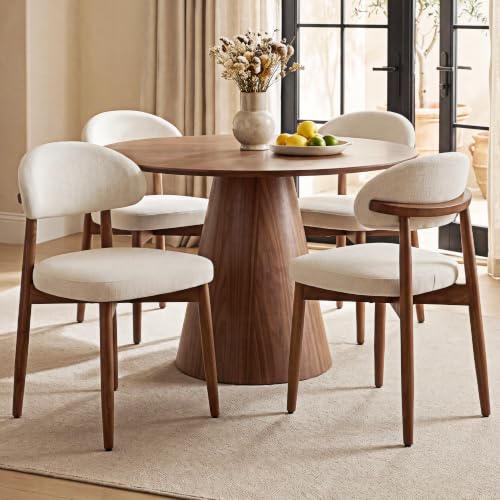
GRUSIGN Dining Chairs — Best Curved-Back Set
The GRUSIGN’s contribution to this otherwise straight-backed field is curvature. Its backrest is shaped rather than flat, following the line of a sitter’s spine instead of presenting a padded board to it, and across a two-hour dinner that shaping is the difference between a chair that is sat in and a chair that is leaned in. Mid-century design is often reduced to tapered legs and a mood, but its real inheritance is this: furniture moulded around the body at rest.
Solid wood legs carry the design’s other half. They give the set a planted, furniture-grade feel that metal frames trade away for slimness, and they suit the mid-century brief — these are chairs meant to be seen from the side, in profile, against a wall between meals. In a living-dining room where the table shares space with sofas and shelves, that profile earns its keep daily.
The soft fabric seat in beige keeps the set versatile, at the usual cost of beige’s honesty about spills. One caution belongs to curved backs generally: the shape that supports one sitter’s spine may meet another’s at the wrong point, and households with a notably tall or short regular at the table might balance one GRUSIGN set against a straighter-backed alternative at the ends of the table, where mixing chairs is a look rather than a compromise.
- Set of four, as the listing describes
- Back: curved backrest described as ergonomic in the listing
- Legs: solid wood as listed
- Style: mid-century modern, beige soft fabric seat
Strengths
- Curved back supports long dinners better than flat backs
- Solid wood legs give a planted, quality feel
- Profile looks deliberate in open-plan rooms
Trade-offs
- Curved back will not suit every spine equally
- No capacity figure is stated in the listing
- Wood legs need pads and periodic tightening checks
Best for: long, talkative dinners in open-plan living-dining rooms.
Not suited for: households wanting the slimmest possible chair footprint.
Curved backs are personal, so read the listing dimensions for back height and seat depth against the chair you currently find kindest: Check price on Amazon

Fabric Dining Chairs Mid Century — Best Brown Mid-Century Set
Colour is this set’s opening statement. In a field of beige, its brown textured fabric changes the room’s arithmetic: it warms pale floors, stands up visually to dark wood tables, and — the practical dividend nobody mentions at the showroom stage — forgives the evidence of family meals far longer between cleans. Brown dining chairs under children and curry nights are not a compromise; they are a strategy.
Beneath the fabric, the construction is metal, with thickened legs and adjustable feet named in the listing. Adjustable feet deserve more respect than they get: most dining floors are not level, most tables live on floors that slope gently towards a wall, and a chair that can be trued up in thirty seconds with its own feet will never develop the wobble that drives households to folded-cardboard remedies. On hard floors, that adjustability also helps all four feet share the load evenly, which is where stability actually comes from.
The mid-century shaping keeps the set from reading as purely practical. It will sit happily in a kitchen-diner that mixes eras, and the textured weave catches light in a way flat fabrics do not. If your table is pale oak and your room is bright, this is the set that gives the arrangement a centre of gravity; if your room is already dark, sample the colour carefully against the listing photographs first.
- Four-chair set, as listed
- Colour: brown, the darkest option in this guide
- Legs: thickened metal with adjustable feet
- Upholstery: textured fabric, mid-century modern styling
Strengths
- Brown fabric hides meal evidence between cleans
- Adjustable feet cure wobbles on uneven floors
- Thickened metal legs feel planted and durable
Trade-offs
- Brown can darken an already dim dining room
- No capacity figure is stated in the listing
- Metal feet need checking on delicate flooring
Best for: busy family tables on uneven or hard floors.
Not suited for: rooms already short on light and pale contrast.
Look closely at the brown tone in the listing photographs under different screens, because textured fabric photographs lighter than it lives: Check price on Amazon

UVV Dining Chairs — Best Straightforward Metal Set
The UVV set is the plain-spoken option in this guide: a modern fabric-upholstered dining chair on a metal frame, in beige, sold four to a box. There is no farmhouse story and no design-movement manifesto, and for a great many kitchens that restraint is exactly right. A rental kitchen, a first flat, a breakfast nook that also hosts homework and laptops — these rooms want chairs that work, match everything and ask for nothing.
Metal construction gives the set its character in use. The chairs will be light enough to move for cleaning, robust enough to be stacked aside cautiously or lined against a wall when the room turns into something else for the weekend, and indifferent to the knocks that chip wooden legs. Students and sharers, whose dining chairs lead unusually varied lives, tend to value exactly this uncomplaining quality.
What the set does not do is perform. The beige upholstery is a background fabric, the silhouette a background silhouette, and households furnishing a room they intend to love looking at may find the GRUSIGN’s curve or the COLAMY’s farmhouse profile more satisfying. But background furniture has a long and honourable history at real tables, and a set that never fights the room, the table or the budget has its own kind of elegance.
- Supplied four to a set
- Frame: metal kitchen-chair construction
- Upholstery: modern fabric, beige as listed
- Style: simple contemporary side chairs
Strengths
- Uncomplicated design matches almost any table
- Metal frame is light to move and hard to damage
- Beige fabric keeps small rooms feeling open
Trade-offs
- Plain styling will not anchor a room’s design
- No capacity figure is stated in the listing
- Lightweight chairs can feel less planted to some sitters
Best for: rentals, first flats and hard-working breakfast nooks.
Not suited for: buyers furnishing a statement dining room.
Confirm what assembly the listing describes, because a set of four multiplies every bolt and bracket by four on delivery day: Check price on Amazon

COLAMY Dining Chairs — Best Farmhouse Side-Chair Set
The COLAMY set blends the two dialects spoken throughout this guide: mid-century lines, with their tidy proportions and gentle taper, and farmhouse materials, with wood legs and a soft beige fabric that looks at home beside a scrubbed pine table. Where the DUMOS leans into the Parsons profile, the COLAMY keeps a more open side-chair shape, and the difference shows in rooms that want air around the table rather than a row of tall backs.
Side chairs with backs at this scale are the flexible citizens of the dining room. They pull up to a desk, flank a console, or stand in a hallway without protesting, and a set of four gives a household that flexibility in matching form. The listing even names restaurant use, which hints at the design’s intent: a chair that survives being sat in by strangers, daily, without drama, is a chair engineered past the needs of most homes.
Wood legs complete the farmhouse side of the bargain, with the familiar courtesies they require — pads on hard floors, a periodic check of the fixings, and a little care with the mop bucket. In return the set brings warmth that metal cannot imitate, and in beige it will sit comfortably with both the pale Scandi table and the dark inherited one, which is more versatility than most sets manage.
- Four chairs per set, per the listing
- Style: farmhouse side chairs with mid-century lines
- Legs: wood as listed
- Listing names dining room and restaurant use
Strengths
- Blends farmhouse warmth with tidy proportions
- Side-chair shape moonlights at desks and consoles
- Beige fabric pairs with pale or dark tables
Trade-offs
- No capacity figure is stated in the listing
- Wood legs ask for pads and occasional tightening
- Open back offers less lean-back support than high backs
Best for: country-leaning rooms needing flexible extra seating.
Not suited for: sitters who want a tall back to lean into after dinner.
Compare the listing’s back height with your current chairs if post-dinner leaning is a household ritual worth protecting: Check price on Amazon
How Do the Six Sets Compare on Legs, Backs and Build?
| Pick | Badge | Key detail | Best for |
|---|---|---|---|
| VERHOPE Dining Chairs | Best Stated Capacity | Sold as a set of four chairs | households seating a wide range of guests at a modest table. |
| DUMOS Dining Chairs | Best Farmhouse Parsons Set | Four chairs in the set | farmhouse-leaning dining rooms that need chairs to disappear between meals. |
| GRUSIGN Dining Chairs | Best Curved-Back Set | Set of four, as the listing describes | long, talkative dinners in open-plan living-dining rooms. |
| Fabric Dining Chairs Mid Century | Best Brown Mid-Century Set | Four-chair set, as listed | busy family tables on uneven or hard floors. |
| UVV Dining Chairs | Best Straightforward Metal Set | Supplied four to a set | rentals, first flats and hard-working breakfast nooks. |
| COLAMY Dining Chairs | Best Farmhouse Side-Chair Set | Four chairs per set, per the listing | country-leaning rooms needing flexible extra seating. |
Metal Legs or Wooden Legs: Which Survive Your Floor Better?
Legs are where dining chairs meet the reality of a floor, four times over, every day. Metal legs tolerate the scrape and the knock, keep a slim profile that suits small rooms, and on hard floors they can be fitted with pads that glide quietly. Their weakness is acoustic and aesthetic: a metal-legged chair announces itself on tile, and in a room built around warm timber it can look like it arrived from a different house. The VERHOPE, the brown mid-century set and the UVV all make the metal case in different registers.
Wooden legs answer with warmth and repairability. A wooden leg that wobbles can usually be tightened, glued or padded back into good behaviour, and the material suits farmhouse and mid-century tables as if it grew there. Wood asks for felt pads on hard floors and dislikes being dragged sideways under a full sitter’s weight, which is how legs loosen and, eventually, splay. Neither material wins outright; the floor, the table and the household’s dragging habits decide.
How High Should a Dining Chair Back Be?
Back height shapes both the room and the meal. High backs — the VERHOPE and the DUMOS in this guide — give a table a formal outline, support a sitter’s shoulders through a long evening, and screen the person opposite in a way some diners love and others find faintly boarding-school. They also raise the visual wall around the table, which in a small open-plan room can make the dining zone feel heavier than it is.
Lower and curved backs open the room up. The GRUSIGN’s shaped back supports the spine where the spine actually is, rather than reaching for the shoulders, and side chairs like the COLAMY keep sightlines clear across an open plan. The practical test is your own table life: households that linger for hours over coffee and conversation should buy support; households whose meals are brisk and whose room is shared should buy air.
What Does Assembly Day Really Look Like With a Set of Four?
Four chairs means four repetitions of everything: sixteen legs, a small constellation of bolts, and an instruction sheet that seems charmingly brief for the first chair and optimistic by the fourth. The wise household treats the first chair as the rehearsal — read fully, assemble loosely, tighten in sequence, sit, adjust — and then sets up a small production line for the remaining three, with hardware sorted into piles and a drink stationed safely out of the work zone.
Two habits save most of the grief. First, tighten fixings fully only once the chair stands on a level floor, so the frame settles square rather than being bolted into a wobble. Second, re-check every bolt after a fortnight of meals, because new joints bed in and loosen slightly, whatever the frame material. Keep the hex key the box provides; it will be wanted again, and it fits nothing else you own.
How Do You Keep Beige Fabric Chairs Looking Like a Decision?
Beige upholstery is a commitment to a routine, not a hope. The routine is small: spills blotted, never rubbed, the moment they happen; crumbs brushed off before they are ground in by the next sitter; and a rotating habit of turning seat cushions or swapping chair positions so the chair by the window and the chair by the kitchen do not age in different decades. Households with children often add washable seat pads for the messy years and remove them for guests, which is not defeat but stage management.
Position matters as much as cleaning. A beige chair in full afternoon sun will fade unevenly against its shaded siblings, and a set rotated around the table every few months fades as a family instead. None of the listings here promises stain-proof fabric, so this guide will not pretend otherwise: buy beige with a routine in mind, or buy the brown set and let the fabric do more of the forgiving.
How Many Chairs Fit Around Your Table, Honestly?
A set of four is the standard purchase, but the table decides whether four is company or a crowd. Each sitter needs roughly a forearm’s width of table edge to eat without negotiating elbows, and chairs need pull-out room behind them that does not exile the person seated against the wall. Measure the table’s long sides, count the places the pedestal or legs allow, and only then celebrate that a set of four is exactly right — or discover that your table is a three-and-a-spare household, with the fourth chair living usefully elsewhere.
Remember the borrowed-chair occasions, too. Most households host six a few times a year and four the rest, and a set of four plus two honest stand-ins from elsewhere in the house covers that rhythm without storing a permanent crowd. The side chairs in this guide, particularly the COLAMY and DUMOS designs, move to desks and hallways gracefully, which makes the set-of-four format more flexible than it first appears.
What Should You Check in the First Week of Ownership?
New chairs tell you their truths early. Sit in each of the four, because a set can hide one chair with a slightly short leg or a seat that dips oddly, and the first week is when exchanging it is painless. Rock gently, lean back, drag the chair in and out as a meal requires; listen for the creak that means a bolt wants another quarter-turn, and feel for the wobble that adjustable feet or a pad will cure in a minute.
Also check the chairs against the table as a system. Seat height against the table apron decides whether thighs and table supports argue; back height against the room decides whether the set looks settled or crowded. A week of real meals is a better review than any unboxing, and the household that pays attention during it will keep its chairs for years without a second thought.
How Do Fabric Chairs Change the Sound and Feel of a Room?
Hard chairs make hard rooms. A dining space with a wooden table, wooden floor and wooden or plastic chairs returns every sound at full volume — cutlery, chair legs, conversation — until meals feel louder and shorter than they should. Upholstered chairs absorb a surprising share of that noise. Fabric seats and backs soften the scrape of sitting down, muffle the knock of a chair against the table leg, and take the edge off a lively dinner’s acoustics, which is one reason restaurants chasing atmosphere upholster everything they can.
The effect is domestic as well as social. In open-plan homes where the dining table shares air with a television or a sleeping baby’s room beyond the wall, fabric chairs lower the household’s background clatter in a way no rug quite matches, because the chairs sit exactly where the noise is made. Households sensitive to echo — high ceilings, hard floors, minimal soft furnishings — often find that a set of fabric chairs is the single change that makes the room feel finished.
What Seat Height and Depth Suit Most Tables and Sitters?
Seat height is the dimension that decides whether dinner is comfortable, and it is the one buyers most often guess. The chair’s seat must leave a sitter’s thighs clear of the table’s apron — the board that runs beneath the tabletop — while keeping their elbows at a natural height for eating. Too low and the table feels like a counter; too high and knees meet apron in an argument that lasts the whole meal. Compare the listing’s seat height with the chair you currently use happily at your table, because your own furniture is the most honest measuring tool you own.
Seat depth runs a close second. A deep seat delights tall sitters and maroons shorter ones, whose backs never reach the backrest without a cushion’s help. Dining is more upright than lounging, so a moderate depth suits mixed households best. When a household spans a wide range of heights, chairs at the table’s ends can differ from those along the sides — hosts have mixed chair styles for centuries, and a curved-back pair as captains to a straighter set reads as design, not compromise.
How Should You Care for Linen-Look and Textured Fabrics?
Linen-look weaves, like the fabric on the VERHOPE set, earn their keep by breathing in warm rooms and by hiding minor creasing in their natural texture. Their care is mostly about speed: liquids bead briefly on a tight weave, then sink, so the blot must arrive within the minute rather than after the course is cleared. Keep a plain cloth napkin within reach of the table’s spill-prone seats and the fabric will stay ahead of family life.
Textured fabrics, like the weave on the brown mid-century set, hide crumbs and minor marks inside their pattern, which buys time but not immunity. A weekly pass with an upholstery brush lifts what the texture has caught before it works deeper. Both fabric families dislike the same two things: harsh rubbing, which roughens the weave and spreads the stain, and strong sunlight, which fades one chair of the set faster than its siblings unless the set is rotated. Gentle, regular, boring care is the whole secret.
When Does a Fifth and Sixth Chair Become Necessary?
A set of four covers the arithmetic of most households, but life stages change the count. A growing family, a grandparent moving nearby, a teenager whose friends materialise at dinner — each adds a permanent place rather than an occasional one. The side-chair designs in this guide help here, because a matching pair bought later, or two chairs redeployed from a desk and hallway, can extend the table without the room feeling furnished by committee.
The wiser purchase, when a household can already see six in its near future, is to check whether the chosen set’s listing offers the same design in a way that can be added to later, and to buy the core four now with that path open. Dining chairs live for years, and designs do get discontinued; a household certain about six should not gamble that a beloved beige will still be woven in three years’ time.
How Do You Test a Chair’s Comfort Without a Showroom?
The listing cannot be sat on, so the household must test by proxy. Start with the chair at your own table that everyone fights for, and measure it: seat height, seat depth, back height, and the angle at which its back meets its seat. Then read the candidate listings against those numbers rather than against the photographs. A new set whose dimensions shadow your favourite chair’s will feel familiar from the first meal, whatever its styling.
Posture clues hide in the descriptions, too. A curved backrest promises lumbar contact; a high Parsons back promises shoulder support; a padded seat promises forgiveness on hard chairs’ behalf across long meals. Match the promise to your household’s actual complaint about its current chairs. If nobody has ever mentioned their back but everyone shifts by dessert, the seat padding is your battleground; if shoulders ache after Sunday lunch, buy the backs.
What Makes a Dining Chair Restaurant-Tough, and Does It Matter at Home?
The COLAMY listing’s mention of restaurant use points at a real standard. A restaurant chair is sat in by strangers of every size, dragged across floors hourly, and cleaned without tenderness, so designs aimed at that life tend to overbuild their joints and choose fabrics for endurance over delicacy. At home, that toughness translates into chairs that survive children treating them as climbing frames and the daily drag in and out that domestic life requires.
It matters most in households whose chairs lead double lives — pulled up to desks, carried to gardens, borrowed for parties. A chair bought purely as dining furniture, in a house where dining is its only job, can afford finer manners. But since few households can promise their chairs so quiet a life, a design with a commercial hint in its listing is rarely a wasted virtue, provided its looks still belong in a home rather than a bistro.
How Should You Arrange Four Chairs in a Small Dining Space?
Small rooms reward chairs that tuck. Armless side chairs slide fully beneath the table between meals, returning the floor to the room, and the slim metal-legged sets in this guide claim the least visual territory while doing it. Position the table so the pull-out side faces the room’s open floor rather than a wall, and the chairs that are used most will also be the chairs with room to move.
Light plays its part as well. Beige upholstery keeps a small dining corner feeling open where dark chairs would pool shadow, which is why so many of these sets wear it. If the room is small but the household is spill-rich, the brown set remains the pragmatic exception — a slightly deeper tone in a small room is a fair trade for fabric that does not record every meal. Arrange first for movement, then for looks, and a small dining space will feel designed rather than squeezed.
How Do You Match Chairs to a Table You Already Own?
Start beneath the tabletop, where the apron and the legs decide what the chairs must negotiate. A table with a deep apron lowers the ceiling for thighs and for thick, padded seats, so measure from floor to apron’s underside and keep the chair’s seat height comfortably below it. A pedestal table forgives wide chairs and lets sitters slide in at angles; a four-legged table assigns each sitter a bay between its legs, and chairs wider than those bays will clash wood on wood at every meal.
Then match the visual weight. A heavy oak table can carry the tall Parsons backs of the DUMOS set without blinking, while a slender glass or pale-wood table looks bullied by the same chairs and happier with the COLAMY’s lighter profile. Fabric colour mediates the relationship: beige upholstery lets a dark table stay the room’s anchor, while the brown set beside a dark table makes the whole arrangement read as one deliberate, grounded group. Neither is wrong; each tells the room a different story about where the eye should rest.
What Happens to Fabric Chairs in a House With Pets?
Pets vote on dining chairs with claws and hair, and honest households plan around the ballot. Fabric seats collect hair in proportion to their texture — the brown set’s textured weave will hold more than a smooth linen-look surface, but also hide it better between brushings. A lint roller stationed in the dining room, used in the minute before guests sit, outperforms any weekly deep clean, and a washable throw across the chair the cat has claimed converts an argument into an arrangement.
Claws are the sterner test. Cats read upholstered chair backs as scratching invitations, and the defence is provision rather than outrage: a scratching post placed nearer than the chairs, and the chairs’ most tempting corner made boring by comparison. Dogs are kinder to fabric but harder on legs at floor level, where muddy paws and enthusiastic tails meet wood and metal alike — another point for metal legs in a dog-heavy house, and for pads that keep the whole arrangement quiet.
How Should You Budget Time for a Whole Set’s Upkeep?
A set of four chairs asks for upkeep in fours, and households that schedule it keep their chairs years longer. The realistic programme is small: a brush or upholstery-vacuum pass weekly for the seats that host daily meals, a bolt check across all four chairs twice a year, pads replaced when they thin, and spills handled in the moment rather than at washing-up time. Spread across a year it amounts to less than an afternoon, but it must be spread — a single annual deep clean cannot undo twelve months of ground-in crumbs.
Rotation is the cheapest item on the programme. Chairs age by position: the window chair fades, the kitchen-side chair collects splashes, the favourite chair’s seat compresses first. Moving each chair one place around the table every couple of months equalises light, wear and affection across the set, so that in five years you own four evenly aged chairs instead of one tired favourite and three strangers.
Why Do Hosts Keep Coming Back to the Parsons Shape?
The Parsons chair has survived a century of dining fashion because it solves the host’s central problem: it looks like an occasion and behaves like equipment. Its tall, fully upholstered back presents a tailored face to the room, photographs beautifully at a dressed table, and supports a guest through a long evening without a single visible joint or strut to explain itself. The DUMOS set’s version, set on farmhouse legs, domesticates the shape for kitchens that would find the full hotel manner too grand.
There is also a social geometry to a high back. Guests seated in tall chairs settle; the chair’s formality gives the meal a frame, and conversation at a table of high backs tends to run longer and lower than at a table of stools and benches. Hosts who love the lingering dinner party buy Parsons chairs knowingly or not. Households whose meals are twenty-minute refuellings between activities will get less from the shape, and the lighter side chairs further down this guide will suit their rhythm better.
How Do You Decide Between Two Beige Sets That Look Alike?
When three sets wear the same beige, the decision moves to the parts photographs flatten: legs, backs and the small print. Put the candidates side by side on those terms alone. Wooden legs for warmth and repairability, or metal for slimness and indifference to knocks? A high back for shoulder support and formality, a curved back for the spine’s long evenings, or an open side-chair back for a room that needs air? A stated capacity, as the VERHOPE listing offers, or a silence you are willing to accept from the others?
Then let the room arbitrate. The set whose legs match your floor’s needs and whose back matches your table’s weight will look right in a way that has nothing to do with the shade of beige, because harmony in furniture is mostly proportion and material agreeing with each other. If two sets still tie, choose the one whose assembly and care demands fit the household’s patience — the chair that gets maintained is the chair that lasts, and the prettiest set in the guide is no use bolted loosely in a garage of good intentions.
What Mistakes Do Fabric Dining Chair Buyers Make Most Often?
The commonest mistake is buying four chairs by photograph without measuring the table, the seat height or the pull-out space behind them. A set is a system that must fit a room in three dimensions, and the returns process for four assembled chairs is a punishment nobody needs. Tape the footprint, check the apron clearance, and count elbows before the box is ordered.
A second error is ignoring the legs because the fabric photographed well. Legs decide noise, stability and floor damage, and they are the part of the chair that cannot be changed later. Match the leg material to your floor and your table, fit pads on day one, and the chairs will repay the attention every single meal.
Finally, buyers often treat assembly as a race and bolt everything tight on a carpet, in the order the parts came to hand. The result is a set that wobbles in four slightly different ways. Assemble on a level floor, tighten in sequence, and re-check after a fortnight; twenty patient minutes at the start saves a year of folded cardboard under one leg.
A fourth mistake is forgetting the people who will sit longest. Buyers test chairs with their eyes and their budget, but the sitter who spends two hours over homework at the table, or the grandparent who needs arms or a firm seat to rise comfortably, experiences the purchase daily. Let the longest sitter’s needs veto a pretty silhouette.
Final Recommendation
For most tables, the VERHOPE Dining Chairs is the set to beat: a stated capacity, a metal frame and a high linen back add up to the most completely argued chair here. The DUMOS Dining Chairs answers farmhouse rooms with its Parsons profile and wooden legs, while the GRUSIGN Dining Chairs is the pick for households whose dinners run long and whose spines have opinions.
The brown mid-century set is the strategist’s choice where children, dark tables or uneven floors rule the room, thanks to its adjustable feet and forgiving colour. The UVV keeps things simple for rentals and first homes, and the COLAMY blends farmhouse warmth with side-chair flexibility. Every set here is four chairs, honestly described, with no per-chair arithmetic required of you.
One last encouragement: do not let the similarity of the fabrics rush you. These six sets differ where it counts — under the seat, behind the back and at the floor — and an hour spent on those differences buys years of unconsidered comfort, which is the highest praise dining furniture ever earns.
Measure the table, choose the legs for your floor, and let the back height match the length of your evenings, because a dining set chosen on those three facts will still feel right when the hundredth meal is served on it.
Frequently Asked Questions
Are these chairs sold individually or as sets?
Every pick in this guide is sold as a set of four, as its listing states. That is the format to plan around: four chairs arrive, four chairs are assembled, and the set is assessed as a set throughout this guide, with no per-chair breakdown offered or implied.
Which set states a weight capacity?
The VERHOPE listing states a capacity of 300 lbs for its chairs. The other listings in this guide do not state a comparable figure, so this guide does not estimate one for them; if capacity is decisive for your household, the VERHOPE is the transparent option, and checking the relevant product page before ordering is always worthwhile.
Will metal chair legs scratch a wooden floor?
They can, if dragged unprotected with grit underneath, and so can wooden legs. The defence is the same in both cases: fit felt or glide pads before the first meal, lift rather than drag when moving chairs, and sweep the dining area often enough that grit never gets its chance. Adjustable feet, like those on the brown mid-century set, also help each leg sit evenly.
How long does assembly usually take for a set of four?
It varies by design, but the pattern is consistent: the first chair takes the longest while you learn the sequence, and the remaining three go faster as a small production line. Building on a level floor, tightening in sequence and re-checking bolts after a fortnight of use are the habits that keep a set wobble-free.
Can beige dining chairs survive family meals?
Yes, with a routine rather than a miracle fabric. Blot spills immediately, rotate the chairs around the table so light and wear are shared, and consider washable seat pads during the messiest years. Households that know in advance they will not keep that routine often choose the brown set in this guide, whose colour forgives more between cleans.
Can these chairs be used at a desk or in a living room?
Yes — side chairs are the most portable furniture in the house. The armless designs here pull up to a desk, flank a console or serve as occasional living-room seating without looking borrowed from the table. Just keep the seat height in mind: dining chairs sit at a height that suits most desks, which is why the arrangement so often works.
Should dining chairs match each other exactly?
They do not have to. A long tradition seats the table’s ends in different chairs from its sides, and a curved-back pair used as captains alongside a straighter set reads as a deliberate arrangement. What should match is the seat height, so every sitter meets the table at the same level, and a shared fabric family, so the mixture looks chosen rather than accumulated.
Related Guides
A dining set is only the middle of the meal, and the guides below cover the cooking and the kitchen kit that surround it. Best Indoor Electric Grills Best Air Purifiers With Humidifiers Best Immersion Blenders


