What's inside
- Key Takeaways
- Quick Picks
- How Did We Sort Gliders, Rockers and Papasans Without Mixing Them Up?
- How Do the Six Chairs Compare on Motion, Footprint and Setting?
- Why Does the Motion Matter More Than the Fabric?
- Which Chair Belongs in a Nursery, and Which Does Not?
- How Much Room Does a Rocking Chair Really Need?
- What Should You Know About Rocking on Hard Floors?
- How Do You Keep a Glider Moving Smoothly for Years?
- When Is a Reclining Glider Worth Its Extra Size?
- How Should You Judge a Papasan Before It Arrives?
- What Separates a Porch Rocker From an Indoor Chair?
- How Do You Choose Between This Guide’s Two Recliners?
- How Do You Settle a Chair Into a Room Without Rearranging Everything?
- What Should Tall and Petite Sitters Each Check?
- How Does a Rocking Chair Age Across a Decade?
- What Accessories Actually Improve a Rocking Chair?
- How Should You Time a Nursery Chair Purchase?
- Why Do Some Chairs Squeak, and What Can Be Done About It?
- How Do You Move a Glider or Rocker Between Rooms Safely?
- What Role Does a Rocking Chair Play Beyond the Nursery?
- How Should Guests and Grandparents Factor Into the Choice?
- What Mistakes Do Rocking Chair Buyers Make Most Often?
- Final Recommendation
- Frequently Asked Questions
- Related Guides
As an Amazon Associate I earn from qualifying purchases. This post may contain affiliate links at no extra cost to you.
cottageverdict.com is reader-supported. When you buy through links on our site, we may earn an affiliate commission.
Where to buy: every chair below is sold through Amazon, and the names in the Quick Picks table, the detailed sections and the comparison table link straight to the listings, so you can check price on Amazon and confirm fabric, colour and assembled dimensions before ordering. The best rocking chairs are not one kind of chair at all, and treating them as if they were is where most disappointing purchases begin.
A true rocker travels on curved rails and tips the whole sitter backwards and forwards in an arc. A glider is different machinery: the seat hangs on a linkage and slides mostly level, forward and back, with far less pitch, which is why nurseries favour gliders for feeding at 3 a.m. A papasan rocker is a third animal again, a wide bowl cushion cradled in a frame that rocks as a unit. This guide keeps those three motions separate, labels every pick with the motion it actually makes, and judges each chair against chairs that move the same way.
Four of the six picks are upholstered nursery-style chairs whose glide or swivel-glide motion suits feeding, settling and long evening sits in carpeted rooms. The other two break out of the nursery entirely: an oversized papasan rocker and a cushioned lounge rocker that the listings rate for indoor and outdoor use. Read the motion labels first, the fabric second, and the footprint third, because a chair that moves beautifully but cannot fit through the nursery door helps nobody.
Key Takeaways
- Glide, rock and papasan sway are three different motions; the listings use the words loosely, so this guide labels each chair by what its base actually does.
- Four picks are upholstered nursery chairs with glide or swivel-glide bases, padded arms and high backs built for feeding and settling.
- The Evolur Raleigh and the Korser add a reclining back to the glide, which changes them from feeding chairs into genuine nap chairs.
- JEAREY’s papasan rocker and the VINGLI lounge rocker are the indoor-outdoor pair; VINGLI’s listing states a 400 lb capacity.
- Measure the door, the corner and the swing clearance before ordering, because assembled nursery gliders rarely come back apart gracefully.
Quick Picks
| Pick | Badge | Why it earns its place |
|---|---|---|
| SAETSFEG Teddy Glider Rocker | Best Cosy Glider Rocker | A teddy-upholstered glider with a high back and padded arms that suits feeding corners and reading nooks equally. |
| Delta Children Blair Glider Rocker | Best Slim Nursery Glider | A slim-profile swivel glider in cream from a nursery specialist, made for smaller rooms and tight corners. |
| Evolur Raleigh Glider Recliner | Best Glider Recliner | A manual recliner that also glides and swivels, with Greenguard Gold and FSC certification named in its listing. |
| Korser Swivel Rocker Recliner | Best Small-Space Rocker Recliner | A compact recliner combining swivel, rocking and glide language in one small-space frame for adults and nurseries. |
| JEAREY Papasan Rocking Chair | Best Papasan Rocker | An oversized papasan bowl on a smooth rocker base, listed for porch, patio, bedroom and living room alike. |
| VINGLI Outdoor Rocking Chair Cushioned | Best Indoor-Outdoor Rocker | A cushioned lounge rocker for indoor and outdoor use, with a stated 400 lb capacity in its listing. |
How Did We Sort Gliders, Rockers and Papasans Without Mixing Them Up?
Each candidate was sorted first by base mechanics. If the listing described a glider mechanism, the chair was judged as a glider: smoothness of the slide, whether the motion stays level, and whether a swivel is built into the base. If the chair genuinely travelled on rails or a rocking frame, it was judged as a rocker, where the questions are arc, stability at the ends of the stroke and noise against the floor. Papasan designs were assessed on bowl support and cushion thickness, because a papasan lives or dies by how its cushion holds a sitter across the whole bowl rather than in one compressed hollow.
Fabric and frame claims were taken only from the listings themselves: teddy upholstery on the SAETSFEG, the cream finish on the Delta Children Blair, the certifications named in the Evolur listing, and the stated 400 lb capacity on the VINGLI. Where a listing gave no weight capacity, this guide says so in the spec list instead of guessing, and no chair here is credited with a lumbar system, a power motor or an ottoman that its listing does not mention. Assembly effort, seat height and back height were weighed for the rooms each chair is aimed at, since a nursery chair and a porch chair fail in completely different ways.

SAETSFEG Teddy Glider Rocker — Best Cosy Glider Rocker
Despite the word rocking in its name, the SAETSFEG moves on a glider base, and that distinction is the kindest thing about it. The seat travels forward and back on its linkage in a near-level slide, so a sleeping baby in your arms is not tipped through an arc every time you shift your weight. For the half-asleep feeding shift, level travel beats drama, and this chair’s motion is deliberately undramatic.
The grey teddy upholstery is the other half of its appeal. The deep-pile fabric reads warm under lamplight, hides the minor scuffs of daily use better than a flat weave, and wraps a high backrest and padded seat that support a long sit without a separate cushion. It photographs as an accent chair as readily as nursery furniture, which matters once the feeding years end and the chair migrates to a bedroom corner or a small home office.
Teddy pile does ask for a little upkeep: crumbs and pet hair lodge in the texture, and a handheld vacuum pass belongs in the weekly routine. The glide mechanism also wants a reasonably level floor, because a linkage chair on a sloping board can drift towards one end of its travel. Neither point is a flaw so much as the price of the format, and both are easier to live with than a squeaking rail rocker in a flat with thin walls.
- Motion: glider linkage, level forward-and-back slide
- Upholstery: grey teddy fabric over a padded seat
- Back: high backrest with padded armrests
- Listing names nursery, living room, bedroom and office use
Strengths
- Level glide keeps a sleeping baby settled during feeds
- Teddy fabric looks like an accent chair beyond the nursery
- High back and padded arms support long evening sits
Trade-offs
- Pile fabric traps crumbs and needs regular vacuuming
- No recline function is named in the listing
- Glide travel needs a fairly level floor to feel even
Best for: parents who want a nursery glider that can retire gracefully into a reading corner.
Not suited for: anyone who wants the pronounced arc of a rail rocker or a reclining back.
Teddy pile varies a little between production runs, so confirm the grey tone shown on the listing against your room before ordering: Check price on Amazon
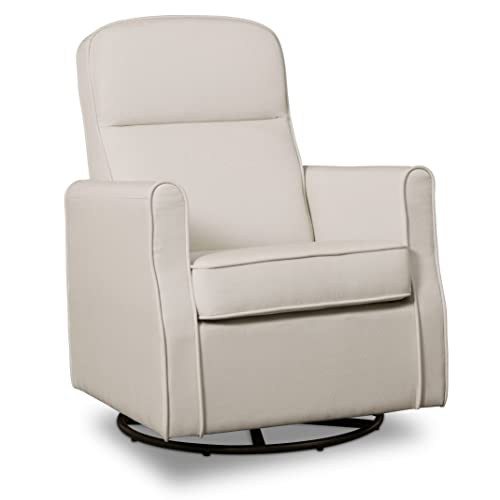
Delta Children Blair Glider Rocker — Best Slim Nursery Glider
The Blair’s defining word is slim. Delta Children built this chair for the nurseries that appear in real houses rather than showrooms: the box room, the corner of the main bedroom, the alcove beside the wardrobe. Its narrower frame slides through standard doorways more easily than the wide-arm gliders that dominate this category, and once placed it leaves floor space for the changing mat, the laundry basket and the parent pacing at midnight.
Mechanically it is a glider with a swivel, not a rocker, whatever the shorthand in its name suggests. The seat glides in the level, linkage-driven way feeding parents prefer, and the base rotates so you can turn towards the cot, the side table or the door without shuffling the whole chair across the carpet. That rotation sounds minor until the third night feed, when reaching the muslin on the table behind you becomes a daily manoeuvre.
Cream upholstery is the honest trade here. It brightens a small room and matches the pale palettes most nurseries start with, but it will record every milky spill and grubby handprint more faithfully than the grey teddy above. Budget for a washable throw over the arm you feed from, and treat marks early. In exchange you get a chair from a dedicated children’s furniture maker, with the proportions and the price discipline that specialism usually brings.
- Motion: glider with 360-degree style swivel base
- Profile: slim frame aimed at compact nurseries
- Finish: cream upholstery as listed
- Maker: Delta Children, a nursery furniture specialist
Strengths
- Slim footprint fits box rooms and bedroom corners
- Swivel base helps you reach cot and table without standing
- Cream finish brightens small, north-facing nurseries
Trade-offs
- Cream fabric shows spills sooner than darker weaves
- Slimmer seat may feel snug for broader sitters
- No recline or ottoman is included in the listing
Best for: small nurseries where a full-width glider would swallow the room.
Not suited for: tall or broad sitters who need a wide seat and a tall back.
Measure your nursery doorway and the corner you have in mind, then compare both against the assembled dimensions on the listing: Check price on Amazon
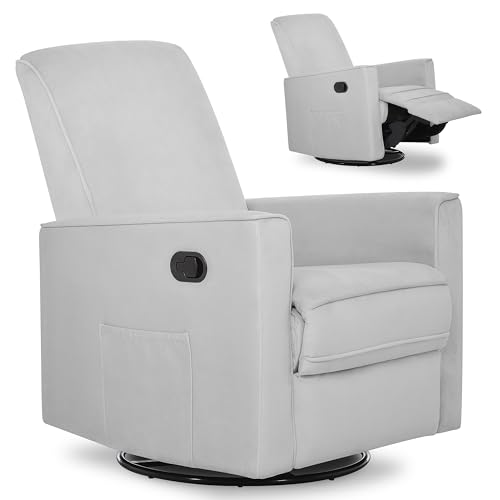
Evolur Raleigh Glider Recliner — Best Glider Recliner
The Raleigh is three chairs sharing one frame. Upright, it is a tidy grey nursery chair. Set moving, it glides and swivels through a full rotation, so settling a baby does not mean staring at the same wall for forty minutes. Lean back and work the manual recline, and it becomes the chair a parent actually sleeps in during the broken nights of the first months, which is when a recliner stops being a luxury and starts being equipment.
That versatility is managed by hand rather than by motor, and the listing’s manual mechanism is worth understanding before you buy. A manual recliner needs a firm push to open and a deliberate shove to close, which keeps the mechanism simple and removes any dependence on a nearby socket, but it also means a parent holding a sleeping newborn will plan the getting-up part carefully. Practise the close before the baby arrives; the knack arrives quickly.
Evolur names Greenguard Gold and FSC certification in the listing, and those details place the Raleigh at the considered end of this roundup. Parents furnishing a nursery from scratch often ask about material provenance, and here the maker answers in the product title itself rather than in fine print. The grey upholstery, meanwhile, is the pragmatic choice for a chair expected to survive feeding, weaning and toddlerhood in the same fabric.
- Motion: glide plus 360-degree swivel, manual recline
- Certifications named in listing: Greenguard Gold and FSC
- Upholstery: grey, nursery and living room styling
- Recline: manual mechanism, no power supply needed
Strengths
- Recline turns night feeds into genuine rest stops
- Glide and swivel keep working with the back raised
- Named certifications answer material questions up front
Trade-offs
- Manual recline takes a firm push to open and close
- Recliners need wall clearance behind the chair
- Heavier and bulkier to place than a simple glider
Best for: parents who expect to sleep in the chair during the newborn months.
Not suited for: rooms where the chair must sit flush against a wall.
Recliners grow backwards as they open, so check the fully reclined depth on the listing against the space behind your chosen spot: Check price on Amazon
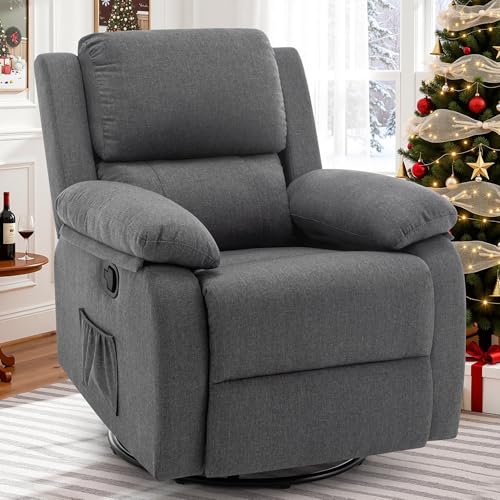
Korser Swivel Rocker Recliner — Best Small-Space Rocker Recliner
Korser’s listing throws every motion word in the catalogue at this chair — swivel, rocker, glider, recliner — and the honest reading is that it is a compact reclining chair whose base swivels and whose seat moves with a gentle rocking glide. What matters in practice is the combination: a small-space recliner that turns to face the room, shifts soothingly when upright, and stretches out when the day is done. Few chairs this size attempt all three jobs.
The small-space framing is genuine rather than marketing garnish. Recliners usually sprawl, demanding a wide footprint and a generous arc of empty floor behind them, but this one is pitched at flats, spare rooms and nurseries where the chair shares its square metres with a cot, a desk or a sofa bed. Adults in rental homes, where the living room doubles as the guest room, are exactly the audience for a recliner that behaves politely in a corner.
Compromise lives in the seat dimensions. A compact recliner fits the room by fitting the sitter more closely, and taller adults should read the listing’s seat depth and back height with care rather than assuming lounge-chair sprawl. The upholstered fabric finish keeps it nursery-appropriate, and the same chair can serve the feeding year and then graduate to television duty, which is the economic argument for buying motion and recline in one modest frame.
- Motion: 360-degree swivel with rocking glide, reclining back
- Format: compact recliner sized for small spaces
- Upholstery: fabric finish as listed
- Listing names adult and nursery use
Strengths
- Recline, swivel and gentle motion in one compact frame
- Sized for flats and spare rooms, not just large nurseries
- Graduates from feeding chair to everyday lounge chair
Trade-offs
- Compact seat dimensions suit taller sitters less well
- Motion is a gentle glide-rock, not a deep rail-rocking arc
- Wall clearance still needed when fully reclined
Best for: flat-dwellers who want one chair that feeds, turns and reclines.
Not suited for: anyone expecting the generous proportions of a full-size recliner.
Small-space recliners vary widely in seat depth, so compare the listing measurements against a chair you already sit in comfortably: Check price on Amazon

JEAREY Papasan Rocking Chair — Best Papasan Rocker
A papasan does not rock the way other chairs rock, and the JEAREY is the clearest example in this guide. The sitter sinks into a wide, thick-cushioned bowl, legs tucked or stretched, and the whole cradle moves on its rocker base in a slow, hammock-like sway. There is no upright posture on offer and no feeding-parent ergonomics; this is a chair for curling into with a novel, a blanket and no intention of answering the door.
The listing places it indoors and out — porch, patio, bedroom, living room — and the oversized egg format suits that wandering life. On a covered porch it becomes the seat everyone negotiates for; in a teenager’s bedroom it absorbs the floor-cushion role with actual back support. The brown finish keeps it visually quiet among garden furniture and indoor wood tones alike.
Bowl chairs ask two things of a room. The first is sheer diameter: an oversized papasan occupies a circle of floor that surprises people who measured only its base, so pace out the full cushion width before ordering. The second is cushion care — a thick pad that lives partly outdoors should be stored dry through wet weeks, whatever the frame tolerates, or it will hold damp and smell of it. Give it a dry corner and it will earn its footprint every lazy afternoon.
- Motion: rocker base carrying an oversized papasan bowl
- Cushion: thick pad as described in the listing
- Setting: indoor-outdoor — porch, patio, bedroom, living room
- Colour: brown as listed
Strengths
- Bowl shape supports curled-up, cross-legged lounging
- Smooth rocker base gives a slow, hammock-like sway
- Works on a covered porch or in a bedroom corner
Trade-offs
- Very wide footprint once the cushion is counted
- Not a feeding or upright reading chair in any real sense
- Thick cushion needs dry storage through wet weather
Best for: loungers who read, nap and scroll in a curled-up sprawl.
Not suited for: nursery feeding, upright desk-side sitting or tight rooms.
Pace out the full bowl diameter on your floor with tape before ordering, because papasan cushions overhang their bases considerably: Check price on Amazon

VINGLI Outdoor Rocking Chair Cushioned — Best Indoor-Outdoor Rocker
The VINGLI is the traditionalist of this group: a cushioned lounge chair that rocks, plainly and without a linkage, a swivel or a bowl in sight. Its listing is equally plain about the two facts buyers most need — it is built for indoor and outdoor use, and it supports 400 lbs. That stated capacity puts it at the sturdy end of this roundup and makes it the natural recommendation for households tired of furniture with cautious limits.
Beige cushioning on a lounge frame gives it the air of garden furniture that has been invited inside, and that is precisely its niche. It can hold a place on a patio through the summer, rock on a porch through the autumn, and spend the winter in a conservatory or spare room without looking borrowed. The rocking motion suits that life: unhurried, familiar, and easy on floors when the chair is used on decking with a mat beneath the rails.
Honesty about weather matters with any chair carrying an outdoor label. Indoor-outdoor means the frame and fabrics tolerate life outside; it does not mean a cushioned chair should winter uncovered in the rain. Bring the cushions in during wet spells, let the frame dry before covering it, and the chair will last. Treat the 400 lb figure as the listing states it — a capacity for the chair used as a chair, on level ground, with the rocking kept gentle.
- Motion: conventional rocking lounge chair
- Capacity: 400 lbs as stated in the listing
- Setting: indoor and outdoor use as listed
- Colour: beige cushions as listed
Strengths
- Stated 400 lb capacity leads this roundup for sturdiness
- Genuine rocker motion for traditionalists
- Moves between patio, porch and spare room easily
Trade-offs
- Cushions still need shelter from prolonged rain
- Rocking rails want a mat on delicate decking
- Beige upholstery shows garden dust between cleans
Best for: households wanting one sturdy rocker for porch and patio duty.
Not suited for: nursery feeding, where a level glide works better.
Confirm the assembled width on the listing against your porch door, since lounge rockers often arrive wider than expected: Check price on Amazon
How Do the Six Chairs Compare on Motion, Footprint and Setting?
| Pick | Badge | Key detail | Best for |
|---|---|---|---|
| SAETSFEG Teddy Glider Rocker | Best Cosy Glider Rocker | Motion: glider linkage, level forward-and-back slide | parents who want a nursery glider that can retire gracefully into a reading corner. |
| Delta Children Blair Glider Rocker | Best Slim Nursery Glider | Motion: glider with 360-degree style swivel base | small nurseries where a full-width glider would swallow the room. |
| Evolur Raleigh Glider Recliner | Best Glider Recliner | Motion: glide plus 360-degree swivel, manual recline | parents who expect to sleep in the chair during the newborn months. |
| Korser Swivel Rocker Recliner | Best Small-Space Rocker Recliner | Motion: 360-degree swivel with rocking glide, reclining back | flat-dwellers who want one chair that feeds, turns and reclines. |
| JEAREY Papasan Rocking Chair | Best Papasan Rocker | Motion: rocker base carrying an oversized papasan bowl | loungers who read, nap and scroll in a curled-up sprawl. |
| VINGLI Outdoor Rocking Chair Cushioned | Best Indoor-Outdoor Rocker | Motion: conventional rocking lounge chair | households wanting one sturdy rocker for porch and patio duty. |
Why Does the Motion Matter More Than the Fabric?
A rocking chair is bought for its movement, and the movement is decided by hardware you cannot change later. A glider’s linkage produces level travel that keeps drinks steady and babies asleep; a rail rocker’s arc produces the deep, familiar tip that porch sitters have loved for generations; a papasan’s sway produces neither, substituting a cradle’s drift. Choosing fabric first and motion second is how a nursery ends up with a beautiful rocker that wakes the baby at the end of every stroke.
Test your own preference honestly before ordering. If you have ever felt queasy in a deep rocker, a glider’s level slide will suit you better. If a glider has ever felt to you like sitting in a car rolling gently in traffic, you are a rail-rocker person and should buy accordingly. The six chairs here cover the spectrum deliberately, so the right answer exists — provided the motion is chosen on purpose rather than by whichever product photograph looked cosiest.
Which Chair Belongs in a Nursery, and Which Does Not?
Feeding a baby at night asks four things of a chair: a level, quiet motion; arms at a height that supports the feeding arm without a pile of cushions; a back tall enough to rest a heavy head against; and fabric that forgives milk. The SAETSFEG, the Blair and the two reclining gliders answer that brief in different sizes and budgets. The papasan and the porch rocker, charming as they are, answer a different brief entirely, and no amount of cushion arranging turns a bowl into a feeding chair.
That is not a dismissal of the loungers. The nursery years are short, and the chair that rocks a teenager through exam revision or a grandparent through a Sunday afternoon earns its place across decades. The mistake is forcing one chair to do both jobs in the same season. Households with the space often do best with a glider in the nursery now and a lounger elsewhere, letting each be good at its own work.
How Much Room Does a Rocking Chair Really Need?
Measure three things, not one. First, the footprint: the chair sitting still, including a papasan cushion’s overhang or a recliner’s full depth. Second, the travel: a glider slides its seat forward and back, a rocker needs clearance at both ends of its arc, and a recliner grows backwards as it opens, so the wall behind it is part of the measurement. Third, the journey: doorways, hallway turns and stair bends between the doorstep and the chair’s final room, because assembled nursery chairs are awkward, top-heavy parcels.
A useful trick is to tape the footprint and the travel zone on the floor with painter’s tape and live around the outline for a day. You will discover whether the arc clips the bookshelf, whether the glide path blocks the cot side you lower at night, and whether the chair crowds the door swing. Ten minutes with tape has saved more returns than any review paragraph, including the ones in this guide.
What Should You Know About Rocking on Hard Floors?
Rails concentrate the sitter’s weight along two curved lines, and on laminate, vinyl or polished boards that pressure can mark the surface over a season of evenings. A dense rug or a purpose-made rocker mat under the rails spreads the load and quietens the stroke; it also stops the slow migration across the room that smooth floors encourage, where a keen rocker can travel a surprising distance in a week. Gliders are kinder to hard floors by design, since their weight stays on a fixed base while only the seat moves.
Noise travels with motion, too. A linkage glider in good order is close to silent, which is its nursery superpower. A rail rocker on boards announces itself, gently, to the room below. Flat-dwellers rocking above a neighbour’s bedroom might weigh that as heavily as comfort, and porch users should remember that decking amplifies what carpet would swallow. None of this rules any chair out; it simply belongs in the decision before the box arrives.
How Do You Keep a Glider Moving Smoothly for Years?
A glider’s linkage is a small machine living in your living room, and it repays the little attention machines like. Keep the track and pivot points free of the dust, hair and grit that nursery floors generate, and check the fasteners after the first month of use, when new furniture settles and bolts that were snug at assembly can ease a fraction. A chair that begins to click or list is usually asking for a tightened bolt, not a replacement.
Upholstery care divides by fabric. Teddy pile wants vacuuming with an upholstery tool and prompt blotting of spills before they reach the backing. Smooth weaves in cream or beige want marks treated early and a throw stationed where feeds happen. Cushions on the indoor-outdoor chairs should be stored dry, full stop; a cushion put away damp in October will introduce itself again in April, unmistakably. Small habits, repeated, are the whole maintenance programme for every chair here.
When Is a Reclining Glider Worth Its Extra Size?
The honest answer is: when someone will sleep in it. During the newborn months, the parent on the night shift often dozes in the nursery chair between feeds, and the difference between an upright glider and a recliner at 4 a.m. is the difference between resting and merely waiting. The Raleigh and the compact Korser both answer that call, at full and small-space sizes respectively. If nights will be spent in a bed while the chair serves daytime feeds and stories, the simpler gliders do the job with less bulk and less wall clearance.
Recliners also serve readers, knitters and anyone whose evening sit lasts hours, because the raised leg rest changes how the lower back feels across a long session. Weigh that against the costs: a bigger parcel, a heavier chair to move on cleaning day, and a mechanism that asks for a firm hand. Households that will use the recline weekly should buy it without guilt; households that will use it twice should save the space.
How Should You Judge a Papasan Before It Arrives?
Judge a papasan by its cushion and its circle. The cushion is the chair — its thickness, its ability to hold a sitter spread across the bowl rather than pooled in the middle, and its behaviour after a month of evenings. The JEAREY’s listing leads with a thick cushion, which is the right priority. The circle is the floor plan question: measure the bowl’s full diameter, add the space your feet and the rocking travel need, and only then decide which corner can honestly host it.
Sitters divide sharply on papasans. People who sit cross-legged, sideways or curled will feel immediately at home; people who sit upright with both feet planted will feel perched on a nest that wants them to be someone else. If the chair is a gift, that distinction matters more than colour. For the right sitter, though, a papasan rocker becomes the most contested seat in the house, and its slow sway has a calming quality that neither gliders nor rail rockers quite reproduce.
What Separates a Porch Rocker From an Indoor Chair?
An indoor-outdoor rocker like the VINGLI is built around tolerance: materials chosen to shrug off the temperature swings, morning damp and strong light of a porch or patio. Its stated 400 lb capacity also suits the porch role, where the chair receives visitors of every size without negotiation. Indoor nursery chairs, by contrast, are built around softness and silence, and would age quickly under porch conditions — sun fades them, damp finds the padding, and the linkage prefers a clean, dry floor.
The crossover works one way. A porch rocker can come inside for the winter and serve perfectly well in a conservatory or spare room, as this one can. An upholstered glider should not be exiled to the garden in May on the strength of a dry forecast. Buy the chair for the harsher of the settings it will actually see, and let it holiday in the gentler one.
How Do You Choose Between This Guide’s Two Recliners?
Start with the room. The Evolur Raleigh is the fuller-sized chair, with the certifications named in its listing and the presence of a piece of nursery furniture bought for the long term. The Korser answers the same brief in a compact frame, for the flat or spare room where a full recliner would dominate. Both glide or rock gently, both swivel, both recline by hand; the difference is scale, and scale is a legitimate deciding factor rather than a compromise to apologise for.
Then consider the years after the nursery. The Raleigh’s grey, modern styling walks into a living room without explanation. The Korser’s modest footprint suits a guest room or a reading corner in a main bedroom. Either way, the recline function is what you are paying the premium for, so be honest about the night feeds and long reads ahead. A recliner bought for a life that includes reclining is money well spent; one bought for a fantasy is an expensive glider.
How Do You Settle a Chair Into a Room Without Rearranging Everything?
Start with the light. A rocking or gliding chair earns its evenings beside a lamp that can be reached without standing, a surface for a drink and book, and enough darkness beyond the pool of light for a baby to stay asleep or a reader to stay absorbed. Chairs placed by convenience of the delivery route rather than by the evening routine tend to migrate within a fortnight, so decide the final corner first and measure for that corner, not for the doorway.
Then consider who passes by. A rocker’s arc and a glider’s slide both claim floor that walkways should not cross, especially the route between a cot and a door at night. In a nursery, leave a clear, memorised path; a chair that catches a shin in the dark will be cursed nightly, however beautifully it glides at noon. In a living room, angle the chair towards conversation rather than the television alone, and it will be used for both.
What Should Tall and Petite Sitters Each Check?
Seat height decides whether feet rest flat, dangle, or tuck awkwardly beneath the chair, and the listings’ dimensions deserve a comparison against a chair you already love. Petite sitters feeding a baby need their feet grounded to push the glide; dangling legs tire quickly and strain the lower back across a long feed. A folded cushion behind the back can shorten a deep seat, but it is a remedy, not a plan, so buy the proportions that fit the person who will sit most.
Tall sitters should interrogate the back height and the headrest question. A high backrest, like the one the SAETSFEG listing describes, supports the shoulders, but the head still needs somewhere to rest during a doze, and many nursery chairs end at the shoulder blades. The recliners answer this by letting the whole body lengthen out. Measure, compare, and be suspicious of any chair whose back height the listing declines to state.
How Does a Rocking Chair Age Across a Decade?
The chairs that age well share a trait: their motion stays quiet. Linkages that are kept clean and tightened keep gliding silently for years, while a neglected mechanism develops the click and wobble that owners describe as the chair ‘getting old’. Rails wear where they meet the floor, which is another argument for the mat. Fabric ages by sunlight and by the specific chemistry of family life — milk, suncream, pet claws and the biro in a toddler’s fist all leave signatures, and mid-tone fabrics like the Raleigh’s grey forgive the most.
Plan for the chair’s second life while you buy its first. A nursery glider that can pass as an accent chair, as the teddy and cream designs here can, will find a bedroom or study waiting when the cot leaves. A papasan will be claimed by teenagers. A porch rocker will simply keep rocking porches. Chairs bought with a second room in mind rarely end up in the garage, and that continuity is the real economy in furniture that moves.
What Accessories Actually Improve a Rocking Chair?
Three things earn their place beside these chairs. A small side table at arm height ends the nightly juggling of bottles, glasses and paperbacks. A washable throw over the feeding arm of a nursery chair absorbs the spills that would otherwise live in the upholstery, and can be whisked into the wash while the chair stays presentable. A floor mat under rails, or under a glider in a rented room, protects boards and deposits alike.
Beyond those, restraint is wise. Cushions added to a chair whose seat was designed as a complete surface usually bunch and slide; the papasan and lounge chairs here arrive with their padding as part of the design. Footstools tempt, but a glider’s moving seat and a separate static stool disagree about where feet should be, which is why the reclining models, with their built-in leg rests, solve the problem more honestly.
How Should You Time a Nursery Chair Purchase?
Earlier than instinct suggests. A glider or recliner ordered in the final weeks may arrive after the baby, and the first fortnight is precisely when the chair works hardest. Ordering ahead also leaves time to assemble it calmly, air out new-fabric smells, tighten everything twice and learn the recline mechanism before it must be operated one-handed in the dark. The chair should feel like old furniture by the time it is needed like new equipment.
There is a second timing question at the other end of childhood. When the nursery becomes a child’s bedroom, the chair often becomes contested property — story chair, reading chair, the seat a parent still takes for the bedtime chapter. Buying a design that suits a seven-year-old’s room as well as a newborn’s, in colour and in scale, extends the chair’s first life instead of forcing a replacement nobody budgeted for.
Why Do Some Chairs Squeak, and What Can Be Done About It?
A squeak is friction announcing its address. In a glider it usually lives at a pivot or along the linkage, where dust and carpet fibre work into the joint and the metal complains once per stroke. In a rail rocker it often comes from the floor itself, or from a rail joint easing in its fixings. Either way, the cure begins with diagnosis: rock slowly, listen for where the sound sits in the stroke, and tighten or clean that point before reaching for any lubricant the maker has not suggested.
Prevention is mostly housekeeping. Vacuum around and under the base weekly in a nursery, where the floor generates a surprising amount of fluff, and keep gritty outdoor shoes away from a porch rocker’s rails. A chair that is cleaned and tightened twice a year rarely develops a voice at all, and a silent chair is not a small thing in a house where a baby’s sleep is the evening’s whole project.
How Do You Move a Glider or Rocker Between Rooms Safely?
These chairs are awkward freight: top-heavy, wider than they look, and full of moving parts that resent being used as handles. Never lift a glider by its arms alone or drag a rocker by one rail; carry from the base, keep the chair upright, and take the cushions off first so they are not crushed or dropped on the stairs. Two people make the job unremarkable, and doorways should be measured before the carrying starts, not discovered midway with a chair wedged at an angle.
Once the chair lands in its new room, give it the settling routine again: check the floor is level enough for even travel, tighten what the journey loosened, and test the full stroke or glide before a child is settled into it. Chairs often migrate at exactly the moments a household is busiest — a new baby, a guest arriving, a room swap — and the five-minute check is what separates a smooth move from a wobble nobody can later explain.
What Role Does a Rocking Chair Play Beyond the Nursery?
Rocking chairs hold a peculiar place in a house’s emotional furniture. They are where babies are fed, but also where grandparents gravitate, where a person with a bad back chooses to sit, where difficult phone calls get made and where the cat will claim squatter’s rights within the week. The gentle, repetitive motion seems to lower the temperature of whatever is happening in the chair, which is why rocking chairs appear in hospital wards, libraries and porch culture alike.
That staying power argues for buying the chair as furniture rather than as baby equipment. The designs in this guide that read as accent chairs, loungers or recliners will keep their roles as the household changes around them. A chair bought only for a six-month phase, in a fabric and scale that suit nothing else you own, is the one that ends up listed for sale by spring; a chair bought for a decade of evenings simply changes jobs.
How Should Guests and Grandparents Factor Into the Choice?
A chair bought for one sitter rarely serves only one. Grandparents arrive with their own knees, backs and opinions about rocking, and a chair that is too low, too deep or too tippy will be politely avoided while the sofa takes the strain. If older relatives will feed the baby or simply claim the chair for the evening, favour an easy seat height, arms that genuinely help a person stand, and a motion that feels secure rather than adventurous — a level glide scores well on all three counts.
Children past the toddler years test chairs differently: they rock harder, swivel faster and treat a papasan as landscape. A stated capacity, like the figure in the VINGLI listing, and a base without pinch points in reach of small fingers are worth weighing if the chair will live in shared space. None of this requires buying the sturdiest chair for every home, but the household the chair will actually meet belongs in the decision alongside the household in the photograph.
What Mistakes Do Rocking Chair Buyers Make Most Often?
Buying by photograph instead of by motion is the classic error. Listings use rocking, glider and swivel almost interchangeably, so a buyer who orders the chair that looked softest may receive a level glider when their heart was set on a deep rail-rocking arc, or the reverse. Read the mechanism, picture the movement, and only then look at fabrics.
Forgetting the recline clearance runs a close second. A glider recliner placed flush against a wall cannot open, and the discovery usually happens at midnight with a baby in one arm. Measure the fully reclined depth, leave the gap, and if the room cannot spare the gap, choose a non-reclining glider and reclaim the wall.
Finally, buyers underestimate cushions on indoor-outdoor chairs. The frame may laugh at weather, but a thick papasan or lounge cushion stored damp will mildew quietly and thoroughly. A dry storage spot is part of the purchase, as surely as the chair itself, and households without one should choose accordingly.
Ordering for the photograph of someone else’s room is a quieter mistake. A cream glider in a sunlit showroom photograph is not the same object in a north-facing box room, and a papasan that looked airy in a styled patio shot can dominate a real terrace. Trust your own tape measurements and your own light over any styled image.
Final Recommendation
If the chair is for a nursery, start with the SAETSFEG Teddy Glider Rocker for its level glide and cosy teddy finish, or the Delta Children Blair Glider Rocker when the room is small. If someone will genuinely sleep through night feeds in it, the Evolur Raleigh Glider Recliner earns its extra size, with the compact Korser as the small-room alternative.
The loungers serve a different household rhythm. The JEAREY papasan suits the curled-up reader with a generous corner to spare, while the VINGLI brings a true rocking motion and a stated 400 lb capacity to porches and patios. Neither pretends to be a feeding chair, and both are better for the honesty.
Take your time over the tape measure and the motion question, and be sceptical of any listing that will not tell you plainly how its chair moves. The six chairs here were chosen because each one answers that question honestly, and a chair whose movement suits your rooms and your rituals will still be earning its corner long after the delivery box is forgotten.
Whichever motion you choose, measure the room, the doorway and the travel of the chair before the box is on its way. A rocking chair is a decade-long companion when its movement matches the life it joins, so pick the motion first, the fabric second, and let the chair that fits your evenings carry you through them.
Frequently Asked Questions
Is a glider or a rocker better for a nursery?
For feeding, most parents prefer a glider, because the seat travels in a level slide that does not tip the baby through an arc, and the base stays silent and stationary on the floor. A rocker gives a deeper, more traditional motion that some babies love, but the arc and the moving rails are less suited to half-asleep feeds in a small room.
Can a papasan chair really be used outdoors?
The JEAREY listing places its papasan rocker on porches and patios as well as in bedrooms and living rooms. Covered outdoor use is the sensible reading of that: the frame is built for indoor-outdoor life, while the thick cushion should be stored somewhere dry during wet weather so it does not hold damp.
How much weight can the VINGLI rocking chair hold?
Its listing states a capacity of 400 lbs, the clearest figure given for any chair in this guide. Treat it as the limit for the chair used normally on level ground. Where another listing gives no capacity figure, this guide does not guess one, and checking the product page before ordering is the right move.
Do glider recliners need electricity?
Neither recliner in this guide does. The Evolur Raleigh is described as a manual glider recliner, and the Korser likewise works by hand, so both can sit anywhere in the room without a socket nearby. The trade-off is effort: a manual mechanism needs a firm push to open and to close.
Will rocking damage a laminate floor?
It can mark one over time, because rails concentrate weight along two lines and grit trapped underneath acts like sandpaper. A dense rug or rocker mat under the rails spreads the load and stops the chair migrating. Gliders are gentler on hard floors, since only the seat moves while the base stays put.
What is the difference between a swivel glider and a swivel rocker?
A swivel glider rotates on its base while its seat slides level, forward and back. A swivel rocker rotates too, but its seat tips through a rocking arc. Several listings blend the words, which is why this guide describes the motion each chair actually makes rather than repeating the shorthand in its name.
How long should a good glider or rocker last?
With its fasteners checked and its mechanism kept clean, a well-built glider or rocker should serve for many years, easily outlasting the nursery phase it may have been bought for. Upholstery usually tires before the frame or linkage does, which is why washable throws and prompt spill care repay their small effort.
Related Guides
Rocking is only one way a chair earns its keep in a busy house, and the guides below cover the seats and surfaces around it. Best Fabric Dining Chairs Best Commercial Vacuums for Hardwood Floors Best Gas Cooktops With Grills



[…] the bathroom and beyond? The seating chapter lives in Best Rocking Chairs, the washable floors in Best Machine Washable Area Rugs, and the kitchen counter companion in Best […]