Our Top Picks
 SereneLife Evaporative Air Cooler Tower with Remote39 inches10.4 x 12.6 x 39.4 inches12.13 poundsCheck on Amazon
 Portable Evaporative Air Cooler Fan with MistSmall6.77 x 4.29 x 10.04 inches2.2 poundsCheck on Amazon
 SereneLife Portable Swamp Cooler Air Conditioner19.54 x 14.75 x 34.24 inches19.54 x 14.75 x 34.24 inches20.72 poundsCheck on Amazon


What's inside
- What actually happens inside the cabinet
- Mapping your climate honestly before shopping
- Airflow is the real sizing language here
- Direct, indirect and two-stage designs
- Pad media: the heart nobody photographs
- Five evaporative archetypes worth considering
- Archetype one: the portable room cooler on casters
- Archetype two: the window-mounted direct cooler
- Archetype three: the rooftop or ducted whole-house cooler
- Archetype four: the indirect evaporative module
- Archetype five: the two-stage indirect-direct flagship
- Water: the fuel, the cost and the complication
- Placement, openings and the choreography of escape air
- Controls and the small intelligence of a simple machine
- Installation routes, from plug-in to rooftop
- Maintenance calendar for a machine that drinks
- Where evaporative cooling quietly outperforms refrigeration
- Where it loses, stated without flinching
- Mistakes that turn good machines into disappointments
- Questions dry-country households ask most
- How much cooler will the air actually feel?
- Can one machine serve a whole house?
- What does the water bill effect look like?
- Is the added indoor humidity ever a problem indoors?
- How long do pads and pumps typically last?
- Can evaporative cooling work alongside an existing refrigerated system?
- Noise, air quality and the neighbours
- Reading a specification sheet without being fooled
- Special settings: workshops, patios, rentals and greenhouses
- Costs across a decade, counted properly
- One full season, lived month by month
- Buying locally, and the second-hand question
- Check prices on Amazon
- The verdict for dry skies
As an Amazon Associate I earn from qualifying purchases. This post may contain affiliate links at no extra cost to you.
Disclosure in plain terms: this guide earns its keep when readers buy through retailer links published alongside the finished version, because a small share of that purchase returns here and pays for testing time, writing and updates. Nothing in the pages below is a shopping shortcut. Each pick is drawn as a recognisable class of equipment instead of a purchasable listing, and you should confirm capacities, dimensions and warranty terms with the seller before money changes hands.
An evaporative air conditioner cools by persuading water to change state. Dry outdoor air is pulled through wet pads, the water absorbs heat as it evaporates, and the air leaves cooler and moister than it arrived. There is no compressor squeezing refrigerant, no condenser rejecting heat into the yard, and no sealed circuit at all. The machinery is closer to a fan, a small pump and a reservoir than to conventional refrigeration, which explains both its remarkably low electricity appetite and its firm dependence on the weather outside your walls.
That dependence is the first thing to respect. Evaporation works hardest where the air begins driest, so desert towns, high plains and continental interiors with parched afternoons are natural territory. Where summers arrive already saturated, the same machine adds moisture to air that can accept very little, and the temperature drop shrinks toward disappointment. Readers living in sticky coastal or tropical conditions should study best air conditioners for humid climates before falling for the running-cost figures quoted by evaporative enthusiasts.
Within its proper climate, though, the technology is quietly magnificent. A well-matched unit can deliver a stream of air noticeably cooler than the shade temperature while drawing roughly the power of a bright lamp rather than the heavy draw of a compressor. It also ventilates as it cools, constantly introducing fresh outdoor air instead of recirculating the same indoor atmosphere, a quality that workshops, garages, patios and busy family kitchens often appreciate more than the temperature drop itself.
What actually happens inside the cabinet
Follow the air on its short journey. A fan draws outdoor air inward through panels of wetted media, usually cellulose honeycomb or shredded aspen fibre held in a frame. A pump lifts water from a sump at the base and distributes it across the top of those pads so they stay evenly soaked. As air crosses the wet surfaces, part of that water passes into the stream as vapour, drawing the energy for its change of state out of the air itself, which is why the flow leaving the pads arrives cooler.
One measurement governs the whole process: the wet-bulb temperature, a floor beneath which air cooled purely by evaporation cannot fall under the conditions of the moment. The gap between the ordinary thermometer reading and the wet-bulb reading is sometimes called the depression, and it predicts your afternoon. A wide depression on a scorching dry day means the pads have enormous cooling potential. A narrow depression on a muggy morning means physics has little left to offer, whatever the brochure promises.
Good machines are rated by how close their output comes to that theoretical floor, a figure known as saturation effectiveness. Rigid cellulose media with deep fluted channels usually achieves higher effectiveness than thin fibre pads, because air spends longer in contact with wet surface and the water film spreads more evenly. Effectiveness is not magic, however. It cannot push supply air below the wet-bulb limit, and any seller implying otherwise is selling weather rather than equipment.
Notice what is missing from the process: dehumidification. Refrigerated systems wring moisture out of indoor air as a side effect of cold coils. Evaporative systems do the opposite, deliberately adding water vapour. In a dry house that addition feels like relief for skin, sinuses, wooden furniture and static-prone fabrics. In a house already hovering at uncomfortable humidity, the same addition becomes the technology’s defining drawback.
Mapping your climate honestly before shopping
Start with afternoon humidity, not midday temperature. Look up typical summer dew points or relative humidity readings for the hottest hours in your town, because a place can be brutally hot at noon and surprisingly swampy by evening if irrigation, lakes or monsoon patterns load the air with moisture. Evaporative cooling follows the driest hours beautifully and fades during humid spells, so judge it by the conditions you actually need relief from.
Elevation quietly helps. High desert settlements pair intense sun with thin dry air, an ideal combination, while low humid basins collect moisture overnight and never fully dry out. Distance from the sea matters in the same way. Two towns sharing a latitude can sit on opposite sides of the suitability line because one receives ocean air and the other receives air that crossed a hundred miles of dry land.
Season length shapes the economics. A region with five months of dry heat can justify a ducted whole-house installation, permanent water lines and seasonal servicing. A region with three hot dry weeks may be better served by a portable unit wheeled out for the season and stored in a closet afterward. Matching the permanence of the installation to the length of the season is one of the least glamorous and most valuable decisions in this entire guide.
Also consider the building’s tolerance for moving air. Evaporative systems need an escape route for the air they supply, because they pressurise rooms gently and continuously. Windows or doors must sit partly open on the far side of the space, or dedicated vents must carry air out. Houses that owners insist on sealing tight, for security, pollen or noise reasons, fight the technology every hour it runs, and that fight should be acknowledged before purchase rather than discovered afterward.
Airflow is the real sizing language here
Refrigerated cooling speaks in BTU ratings, but evaporative equipment is honestly sized in airflow, measured in cubic feet per minute. The method is refreshingly physical: calculate the volume of the space, decide how often that volume should be exchanged, and choose a machine whose delivered airflow meets the result on the fan speed you will actually use. Hot dry rooms typically want an air change every couple of minutes, a far brisker circulation than most people expect.
Manufacturers love quoting the largest area a unit might serve under gentle assumptions, so treat coverage claims as advertising rather than engineering. A rating earned in a shaded, insulated test room says little about a west-facing workshop with a metal roof. Work from your own room volume, ceiling height included, and remember that lofts, vaulted ceilings and open-plan layouts quietly multiply the air that must be moved.
Delivered airflow is not the same as nameplate airflow. Long duct runs, clogged pads, sagging media, dirty insect screens and restrictive grilles all tax the fan, and the air that reaches your chair is what remains after those taxes. This is why experienced installers oversize modestly, not to blast occupants but to preserve honest delivery after real-world resistance. It is also why a neglected machine seems to shrink year by year even though its motor still spins.
Rooms with heavy internal heat loads deserve extra allowance. Kitchens in full production, home gyms, server corners, sunrooms and workshops full of machinery all generate warmth that the airstream must dilute as well as offset. Households cooling one generous open space may find the placement and throw discussions at best air conditioners for large rooms repay close reading, because evaporative supply air behaves like a river: it cools the banks it actually touches and leaves still eddies warm.
Direct, indirect and two-stage designs
Direct evaporation, the classic swamp cooler arrangement, sends the cooled moistened air straight into the living space. It is the simplest, cheapest and most widespread design, and in genuinely dry country it is usually the correct one. Its ceiling is set by the wet-bulb temperature, and its signature side effect is the rise in indoor humidity that occupants feel on skin and bedding.
Indirect designs insert a heat exchanger between the wet airstream and the air delivered indoors. One stream of air is evaporatively cooled and then used to chill a second stream through plates or tubes, so the supply air drops in temperature without gaining moisture. The penalty is complexity, cost and a somewhat smaller temperature drop for a given cabinet size. The reward is cooling that remains welcome on days when the air is only moderately dry.
Two-stage machines combine both tricks in sequence. An indirect stage precools incoming air without adding moisture, which lowers its wet-bulb temperature, and then a direct stage evaporates into that prepared air to reach temperatures a single direct stage could not achieve. These are the aristocrats of the category, priced accordingly, and they make the strongest sense where summers are long, electricity is expensive and the climate is dry but not desert-extreme.
Choosing among the three is mostly a humidity question wearing a budget costume. If your afternoons are reliably parched, direct cooling gives nearly all the comfort for a fraction of the purchase and running cost. If your climate hovers at the margins, with dry weeks interrupted by humid spells, indirect or two-stage equipment keeps working politely through weather that would embarrass a simple direct cooler.
Pad media: the heart nobody photographs
Cellulose rigid media looks like corrugated cardboard engineered by a perfectionist, with fluted channels that spread water into a thin film and present a huge wet surface to passing air. It lasts for years when water quality is managed, resists sagging, and delivers the high saturation effectiveness quoted in serious specifications. Its enemies are mineral scale, algae and neglect, all of which arrive through the water rather than the air.
Aspen fibre pads are the older tradition, inexpensive and widely available, woven from shredded wood wool inside a mesh frame. They cool respectably, carry a faint woody smell some owners love, and ask to be replaced far more often than rigid media. In regions with seasonal use and easy access to replacements, that trade can be perfectly rational. In a rooftop unit nobody wants to visit monthly, it becomes a chore with a ladder attached.
Synthetic fibre media occupies the middle ground, washable and tolerant of rough handling, though usually less effective per inch of thickness than good cellulose. Whatever the material, thickness matters: deeper pads give air more contact time and water more room to spread, at the cost of greater resistance the fan must overcome. A machine designed around deep media and a fan chosen for it will outperform a thin-pad design with a heroic motor.
Pad condition is visible to anyone willing to look. Dry streaks running down the face mean distribution problems above. White crusting means minerals are precipitating out of the sump water. Green or black patches mean biology has moved in. Each symptom has a remedy discussed later in this guide, and each remedy is cheaper than the replacement media that neglect eventually demands.
Five evaporative archetypes worth considering
Because the right machine depends on climate data, room volume and how permanently you want it installed, the recommendations below are archetypes rather than shopping links. Each describes a recognisable class of equipment, the households it flatters and the compromises it carries. Read them as briefs to take to a local dealer, who can match the description against stock that suits your water quality and your roofline.
Archetype one: the portable room cooler on casters
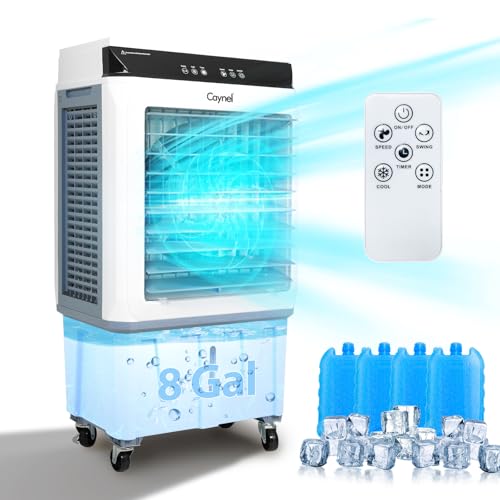
The entry point to evaporative cooling is a self-contained cabinet on wheels, with a modest tank you fill from a jug, a set of pads across the back and a fan that can double as a simple circulator on days when cooling is unnecessary. It belongs to the budget segment, asks for no installation whatsoever, and follows its owner from workshop bench to bedroom to rented patio across a single summer.
Its honest territory is one room at a time, ideally with a window cracked open behind the occupant so spent air escapes and the cooling stream keeps moving. Expectations should be set by physics: this class tempers a dry room, takes the edge off a garage workout and makes a porch evening pleasant, but it will not refrigerate a sun-baked apartment. Renters, students and anyone testing whether evaporative cooling suits their climate should start exactly here, because the lesson it teaches costs very little.
Archetype two: the window-mounted direct cooler
Mounting the cabinet in a window opening changes the machine’s character. Outdoor air is drawn directly from outside, the reservoir can be larger, and the cooled stream enters with real authority compared with a portable unit recirculating room air across its pads. This mid-range archetype suits bedrooms, small living rooms and home offices in dry towns where a permanent summer fixture in one window is an acceptable bargain.
Installation deserves care: the unit is heavy when its tank is full, the support brackets carry real load, and the seal around the cabinet decides how much unfiltered hot air sneaks past the pads. Owners in multi-storey homes should think about which window receives it, because cool moist air prefers to travel downward and outward, and a cooler serving an upper room with an escape path downstairs can condition a surprising share of the house. Compact dwellings weighing this approach against refrigerated portables will find a useful counterpoint in best 12000 btu portable air conditioners, where the competing technology’s strengths are laid out plainly.
Archetype three: the rooftop or ducted whole-house cooler
In the dry Southwest tradition, the serious installation sits on the roof or in a gable and feeds a network of ducts or a single large discharge into the heart of the home. A permanent water line, a bleed arrangement to control mineral build-up and a winter cover complete the picture. This archetype occupies the mid-range to premium segment once installation is counted, and it transforms a house rather than a room.
Whole-house evaporative design is an airflow exercise at building scale. Supply points, return paths through opened windows or up-ducts, and the balance between floors all need planning, because the machine’s generous output will find its own route if the designer does not provide one. Done properly, the result is a house that feels rinsed by a cool breeze from late morning to bedtime, at an electricity cost that makes neighbours with compressors quietly envious. Done casually, it cools the hallway magnificently and the bedrooms hardly at all.
Archetype four: the indirect evaporative module
Indirect equipment serves the households direct cooling cannot quite satisfy: those in moderately dry climates, those sensitive to added humidity, and those cooling spaces where moisture is unwelcome, such as rooms storing paper archives, musical instruments or electronics. The heat exchanger keeps the supply stream dry, so the machine behaves politely during shoulder weeks when humidity climbs but heat remains.
Expect premium pricing, larger cabinets for a given output and a specification sheet that rewards careful reading, because temperature drops are quoted against conditions that may flatter the design. The right buyer is not chasing the coldest possible air. They are buying consistency across a wider band of weather, and judged on that mission this archetype earns its cost in regions where a direct cooler would spend August sulking.
Archetype five: the two-stage indirect-direct flagship
The flagship combines an indirect first stage with a direct second stage in one cabinet, chasing supply temperatures that approach what light refrigeration delivers while keeping electricity consumption far below compressor territory. It sits firmly in the premium segment, usually appears in ducted whole-house or small commercial installations, and rewards owners who run cooling for long hours across long seasons.
Complexity is the honest price. Two water circuits or a carefully managed shared one, more exchanger surface to keep clean, and controls that decide how hard each stage works all demand an installer who genuinely understands the product. In the right climate, with that installer found, the two-stage machine is the closest evaporative technology comes to having everything: deep cooling, modest bills and fresh air delivered in a continuous gentle river.
Water: the fuel, the cost and the complication
Evaporative cooling trades electricity for water, and honest ownership means counting both. Consumption varies with heat, airflow and how parched the incoming air is, because thirstier air drinks more from the pads. Arid-region households should ask where their water comes from and what restrictions apply during drought summers, since a technology that cools cheaply but drinks conspicuously can collide with local rules exactly when it is needed most.
Mineral content decides how gracefully a machine grows old. Each litre of water that flashes off into the airstream abandons its dissolved load in the sump, so the remaining water grows saltier through the day unless the design bleeds a portion away or the owner drains and refills on a rhythm. Scale then crusts the pads, clogs distribution holes and shortens pump life. A continuous small bleed wastes some water but protects everything else, and in hard-water districts that trade is usually wise.
Standing water is also a biological invitation. Warm sumps grow algae and bacteria happily, and the airstream passes directly over that water, so hygiene is not an aesthetic preference but the core maintenance duty of this technology. Regular draining, scrubbing during the season and thorough drying before storage keep the characteristic fresh smell fresh. A cooler that smells like a pond is announcing neglected water, and no fragrance accessory fixes the underlying cause.
Freeze risk closes the seasonal loop in continental climates. Outdoor lines, rooftop sumps and exposed pumps must be drained before hard frosts, because ice splits fittings with total indifference to their cost. Winterisation is a short ritual once learned: isolate the supply, drain every low point, clean the pads or remove them, cover the cabinet against dust and nesting visitors, and note the date so spring recommissioning happens before the first heatwave rather than during it.
Placement, openings and the choreography of escape air
Supply air needs somewhere to go, and planning its exit is half the installation. The classic instruction opens windows in the rooms you want cooled, roughly in proportion to how much air each room should receive, while keeping openings closed in rooms you are happy to leave warm. The house becomes a map of gentle pressure, and the cool stream can be steered by nothing more sophisticated than a door left ajar.
Security and insects complicate the picture, because an open window at midnight is not every household’s idea of comfort. Purpose-made ceiling vents that exhaust into a vented attic, lockable window openings and screened louvres all exist to reconcile airflow with peace of mind. Budget for those fittings when pricing a whole-house scheme, since they are the difference between a system used nightly and one abandoned after the first uneasy evening.
Portable and window units obey the same law at smaller scale. A portable cooler blowing into a sealed room quickly saturates the air it works with, and its output drifts toward a warm humid sigh. Give it an open window on the far wall and the transformation is immediate, because fresh dry air keeps crossing the pads. Many disappointed reviews of small evaporative units describe, without realising it, a ventilation failure rather than a machinery failure.
Outdoor placement matters for ducted machines as well. Intakes should face away from dust sources, vehicle exhaust, compost corners and dryer vents, because whatever the yard air carries, the pads will deliver indoors with interest. Shade over the cabinet helps marginally, clean intake air helps enormously, and a service path you can actually walk with tools in hand helps every single year of the machine’s life.
Controls and the small intelligence of a simple machine
At minimum, expect separate control of fan and pump, because dry ventilation without cooling is genuinely useful on mild days and during the evening purge when outdoor air finally cools. Two or three fan speeds cover most needs. Fancy electronics add timers, remote controls and humidity sensors that can throttle the pump when indoor moisture climbs, a feature worth having in marginal climates where the line between refreshing and clammy moves through the day.
One control habit deserves emphasis: wet the pads before asking for cooling at full fan speed. A short pump-only or low-fan interval lets the media saturate evenly, so the first air delivered is properly cooled rather than a warm gust carrying dust from dry pads. Machines with a pre-wet cycle automate this courtesy. Owners of simpler units can perform it manually and will taste the difference in the first minute.
Thermostats behave differently here than in refrigerated homes. Because output depends on outdoor humidity, a set temperature cannot always be honoured, and controls that promise precision beyond physics invite frustration. Think in terms of fan hours, pad wetting and window positions, the three levers you genuinely command, and judge evenings by comfort rather than by whether a display reached an arbitrary number.
Installation routes, from plug-in to rooftop
Portable units need nothing but a socket, a water source and the discipline to position them near a partly open window. Window units need honest carpentry: a level support rated for the wet weight, sealed gaps, and drainage arranged so condensate and bleed water never travel across sills or into wall cavities. An hour spent on the mounting saves a season of drips, rattles and warped timber.
Ducted installations belong to professionals, not because any single step is mysterious but because the steps interlock. Cabinet placement, duct sizing, water supply with backflow protection, electrical work, roof penetrations flashed against weather and the balancing of supply across rooms form one system. A mistake in flashing is a ceiling stain in November; a mistake in balancing is a bedroom that never cools in July. Both are cheaper to prevent than to forgive.
Electrical demand is refreshingly modest across the category, since fans and small pumps draw a fraction of compressor loads, and many homes can add evaporative cooling without panel upgrades. Modest is not zero, though. Outdoor circuits still deserve weatherproof fittings, residual-current protection where codes require it, and switches positioned so servicing does not begin with a trip through the house in wet boots.
Commissioning a ducted cooler means measuring, not admiring. Airflow at representative outlets, water distribution observed across every pad face, bleed rate set deliberately, controls demonstrated and the winterisation procedure explained while the ladder is still up: that sequence separates an installation from a delivery. Keep the installer’s notes with your household documents, because the technician who services the machine in five years will bless that folder.
Maintenance calendar for a machine that drinks
Weekly during heavy use, glance at the sump and the pad faces. The water should look like water, the pads should glisten evenly without dry vertical stripes, and the cabinet should smell of almost nothing. Top up or drain according to your mineral strategy, clear the intake screen of fluff and seed heads, and confirm the bleed or drain path has not been blocked by the garden’s smaller residents.
Monthly, give the reservoir a proper clean. Drain it fully, wipe the biofilm from its surfaces, inspect the pump intake screen and check distribution tubing for the white pinch of scale at its holes. Pads that are merely dusty can be rinsed gently in place; pads shedding fibres, sagging or carrying stubborn crust belong on the replacement list before peak season makes them expensive and scarce.
At season’s end, the deep clean decides how the machine greets next summer. Scrub the sump, disinfect according to the maker’s guidance, dry everything thoroughly, lubricate or replace fan components as the manual directs, and store removable pads somewhere dry and dark. Machines wintered wet emerge in spring smelling of cellar and performing like it, while machines wintered dry start the season as if they remember being new.
Keep a short written log. Dates of pad changes, pump replacements, water problems and the settings that worked during the worst heatwave turn guesswork into knowledge across years. When performance fades, the log usually points at the cause faster than any diagnostic: a skipped cleaning, a new water source, a tree that grew to shade or foul the intake. Simple machines reward simple record-keeping disproportionately.
Where evaporative cooling quietly outperforms refrigeration
Fresh air is the headline. Because the process requires through-flow, an evaporative house is continuously ventilated, diluting cooking smells, indoor pollutants and the staleness that sealed refrigerated homes accumulate. Occupants often describe the result as the house feeling awake. For workshops generating dust or fumes that must be exhausted anyway, pairing the exhaust with evaporative supply is close to a free lunch.
Running cost is the second headline, and it survives scrutiny in dry regions. Fans and pumps sip where compressors gulp, and peak-demand charges that punish refrigerated homes on the hottest afternoons barely notice an evaporative load. Solar households find a particularly happy marriage here, because the hours of strongest sun, when panels produce most, are exactly the hours when dry air gives evaporation its widest temperature depression.
Simplicity compounds over a lifetime. There is no refrigerant to leak, no compressor to fail expensively, and most wear parts are accessible, understandable and replaceable by a competent owner with hand tools. In remote properties far from refrigeration technicians, that maintainability is not a minor virtue. It can be the entire argument, and generations of desert homesteads have made it successfully.
Comfort has a texture too. The moving, slightly moistened stream suits people who find refrigerated air harsh, drying or oddly still, and it rarely overcools a room into the shiver that sends someone hunting for a sweater in August. Children playing on floors, grandparents wary of chills and anyone working with their hands tends to prefer air that feels like weather from somewhere pleasant rather than air from a machine.
Where it loses, stated without flinching
Humidity is the hard boundary. When the wet-bulb temperature climbs, output temperatures climb with it, and no pad depth, fan size or marketing adjective repeals that arithmetic. Households in borderline climates should plan a refrigerated backup for the worst humid weeks or accept those weeks as the technology’s annual holiday. Pretending otherwise produces the bitter reviews that warn others away from machines that were simply sold into the wrong sky.
Water dependence is the second boundary. Drought restrictions, expensive metered water or a supply so hard it scales everything it touches can each erode the running-cost advantage. The arithmetic must be done locally, with your tariff and your water report, not borrowed from a desert town with cheap well water and soft snowmelt in its pipes.
Openings are the third. Homes that must stay sealed against wildfire smoke, heavy pollen, traffic noise or security concerns surrender the through-flow the technology depends on, and filtered refrigerated systems serve those households better. Smaller homes weighing sealed refrigeration against airy evaporation will find their trade-offs examined in best air conditioners for small homes, which treats compact floor plans as their own discipline.
Finally, cooling depth has a ceiling even in perfect conditions. Spaces demanding precise low temperatures, such as server rooms, wine storage or laboratories, belong to refrigeration. Evaporative equipment keeps people comfortable; it does not promise the controlled cold that equipment and collections sometimes require, and confusing those missions wastes money in both directions.
Mistakes that turn good machines into disappointments
Buying by coverage claims instead of room volume leads the parade. A unit flattered by a generous area rating meets a high-ceilinged living room, a dark roof and three teenagers home for summer, and the mismatch is blamed on the technology rather than the arithmetic nobody performed. Measure the space, count the air changes, and let those two numbers choose the cabinet size while the marketing department watches silently.
Running the pump in humid weather is the gentlest mistake and the most common. When a monsoon afternoon or a coastal front loads the air with moisture, switching the water off and using the machine as a fan preserves comfort, while stubbornly wetting the pads adds mugginess to heat. Owners who learn this single habit, watching the sky rather than the calendar, report a different relationship with the same equipment.
Neglecting the escape route ranks next. Closed windows, blocked ceiling vents and doors shut tight against the dog all strangle the through-flow, and the cooler responds by humidifying a sealed box. If a room feels worse after an hour of running, check the exits before condemning the pads. Air is a courteous guest: it leaves happily by the path provided and sulks visibly when every door is barred.
Letting minerals win is the slow mistake. Owners who never drain, never bleed and never glance at the sump discover in the third summer that pads have become limestone sculptures and the pump sounds like a coffee grinder. Water management feels tedious in week one and looks like genius in year three, when the neighbour’s neglected unit is being stripped on a driveway.
Expecting refrigeration manners completes the set. Judging an evaporative cooler by whether it holds a precise setpoint on the season’s worst afternoon guarantees disappointment, because the machine’s output breathes with the weather. Judge it instead by how the house feels across the whole season, by the electricity meter’s behaviour and by sleep quality on ordinary hot nights, and the verdict usually reverses.
Questions dry-country households ask most
How much cooler will the air actually feel?
On a properly dry afternoon, supply air commonly leaves the pads far enough below the outdoor reading that rooms settle into a band occupants describe as springlike, even while thermometers outside insist on desert numbers. The exact drop tracks the wet-bulb depression that day, which is why the same machine feels miraculous in a dry heatwave and merely helpful during a humid spell. Comfort also leans on movement: air crossing skin at a gentle pace feels cooler than still air at the same temperature.
Can one machine serve a whole house?
Yes, in the right building, and the ducted archetype described earlier exists precisely for that ambition. Success depends on total airflow matched to the home’s volume, a planned route for escape air from every served room and honest acceptance that the farthest bedroom will always be the test of the design. Houses with sprawling single-storey plans often suit the approach beautifully, while two-storey homes need particular care with how air travels between floors.
What does the water bill effect look like?
Expect a visible but usually modest rise during the cooling season, scaled by how hot and dry the weather runs and whether your setup bleeds continuously or recirculates with periodic draining. Households on inexpensive water barely notice. Households on metered desert water should do the arithmetic before installing a whole-house system, and should favour designs with controlled bleed or timed purge arrangements that protect the pads without sending a constant stream to the drain.
Is the added indoor humidity ever a problem indoors?
It can be, in specific rooms and seasons. Bathrooms already fighting mould, basements with cool walls where moisture condenses and storage rooms for books or instruments all deserve caution. The through-flow that defines the technology carries much of the added moisture straight outdoors again, which is why whole-house installations in dry towns rarely report trouble, but a portable unit saturating one closed bedroom overnight is a different story. Ventilation discipline is the dividing line.
How long do pads and pumps typically last?
Rigid cellulose media, kept free of scale and dried properly each winter, commonly serves for several seasons before effectiveness fades. Aspen pads live faster and are priced accordingly, often treated as a seasonal consumable. Pumps are inexpensive wear parts whose lifespan tracks water cleanliness more than brand prestige. The fan motor, asked to move air rather than fight compressor pressures, is usually the longest-lived component in the cabinet.
Can evaporative cooling work alongside an existing refrigerated system?
Gracefully, and many borderline-climate homes run exactly that partnership. The evaporative machine carries the long dry majority of the season at trivial running cost, while the refrigerated system rests until humidity or an exceptional heat spike calls it forward. The controls discipline is simple: never run both into the same space simultaneously, because the evaporative unit’s moisture raises the load the refrigerated unit must then remove, and the two machines end up wrestling rather than cooperating.
Noise, air quality and the neighbours
Sound from an evaporative cooler is mostly moving air plus a faint pump hum, a character closer to a household fan than to refrigeration machinery. Large ducted cabinets can transmit a low rush through their discharge if ductwork is undersized, which is an installation flaw rather than a technology trait. Rooftop units deserve vibration-isolating mounts so the roof structure does not become a sounding board above the bedrooms, a detail worth confirming before the crane leaves.
Air quality cuts both ways and honesty helps here. The constant fresh-air supply dilutes indoor pollutants beautifully, yet the intake also admits whatever the outdoors offers, including dust storms, pollen peaks and smoke events. Pad media catches some coarse dust as a side effect of being wet, but it is not a fine filter, and households with serious allergies should weigh smoke-season and pollen-season behaviour before committing a whole house to through-flow cooling.
Neighbours rarely feature in evaporative disputes, because there is no hot condenser blast and little mechanical noise to argue about. The one social consideration is water: bleed lines and overflow drains should discharge somewhere considerate, not across a shared path or against a neighbour’s foundations. A metre of hose routing, decided at installation, prevents the only complaint this gentle technology typically generates.
Reading a specification sheet without being fooled
Airflow figures deserve the first look and the deepest suspicion, because test conditions vary and the highest fan speed, the one behind the headline number, may be louder than you will tolerate nightly. Look for delivery figures at medium speed, pad area and depth, tank capacity or water connection arrangements, and the maker’s stated effectiveness. A sheet that lists those plainly respects your intelligence; one that lists only a room-size claim is asking to be believed rather than understood.
Water features separate thoughtful designs from cheap ones. Accessible sumps, visible drain fittings, distribution trays that lift out for cleaning and bleed arrangements you can adjust without tools all predict a machine that will still perform in its fifth summer. Sealed sumps and mystery plumbing predict the opposite, whatever the first summer feels like.
Warranty language matters most for the fan motor and the cabinet’s resistance to sun and corrosion, since rooftop and window units live hard outdoor lives. Pumps and pads are consumables in spirit even when a warranty technically covers them. Buy the cabinet and motor for a decade, budget the wet parts as maintenance, and the economics of the category stay honest.
Special settings: workshops, patios, rentals and greenhouses
Workshops may be the technology’s happiest habitat. Heat from machinery, dust that demands exhaust ventilation anyway and occupants dressed for work rather than for an office all align with a strong through-flow of cooled fresh air. A wall-mounted or ducted unit sized generously for the volume keeps benches bearable through the afternoon, and the constant air exchange carries fumes toward the exits instead of letting them pool. Woodworkers should note one nuance: the added humidity is generally kind to timber stock, reducing the cracking that parched desert air inflicts on stored boards.
Covered patios and outdoor kitchens stretch the idea further, because evaporative units do not need a sealed space to be useful, merely a stream of air directed across the people in it. A portable cabinet positioned upwind of a dining table changes what a summer evening can host. The effect fades with distance and any competing breeze, so think of outdoor evaporative cooling as a personal climate delivered at conversational range rather than a room being conditioned.
Rental properties reward the portable and window archetypes for a different reason: reversibility. Nothing is plumbed, nothing is fixed to the roof, and the tenant’s comfort leaves with the tenant. Landlords in dry towns sometimes provide window units as a middle path between a bare fan and a full refrigerated installation, and the arrangement works best when the lease conversation includes who cleans the pads and who pays for their replacement, small print that prevents the only disputes these simple machines tend to generate.
Greenhouses and animal housing deserve a mention because evaporative pads were refined in agricultural service long before they were marketed to homeowners. Growers cool entire glasshouses through pad walls with fans opposite, and poultry and livestock buildings use the same physics at scale. The residential lesson hidden in that history is reassuring: the technology is not a novelty. It is a mature, heavily worked method whose domestic versions inherit decades of hard agricultural debugging.
Costs across a decade, counted properly
Purchase prices across the archetypes span a wide range, from pocket-money portables to installed ducted systems that belong in the same budget conversation as other permanent home infrastructure. The honest comparison, though, runs across ten summers rather than one receipt. Add seasonal pads, a pump or two, water consumption, the small electricity appetite and the occasional professional service, then set that total against the purchase and running profile of refrigerated equipment delivering similar comfort hours in the same climate.
In dry regions the decade arithmetic usually favours evaporation clearly, sometimes startlingly, because the two largest refrigerated costs, compressor electricity and compressor replacement, simply have no equivalent line items. In borderline regions the arithmetic tightens, since a backup refrigerated system may sit in the same budget, and the evaporative machine must justify itself across the dry majority of hours rather than the whole season. Both calculations are legitimate; the error is borrowing the desert version of the answer for a town the desert would not recognise.
Resale and rental value add a footnote. In established swamp-cooler country, buyers expect evaporative installations and a well-kept ducted system reads as a feature, while in regions where the technology is unknown, the same cabinet can puzzle valuers. Local estate agents, who watch what purchasers actually reward, are an underused source of intelligence when a permanent installation is being weighed against a portable experiment.
One full season, lived month by month
Spring begins with recommissioning, ideally on a mild weekend before any heat arrives to hurry the work. Covers come off, winter dust is washed from pads and sumps, the water line is reopened and watched for the leaks that frost may have authored, and the fan runs dry for a few minutes while you listen for bearings complaining after their long rest. This unhurried hour is when small faults are still small, and when replacement pads can be ordered calmly instead of hunted during the first heatwave.
Early summer is the technology’s honeymoon. Afternoons are hot, the air is at its driest, and the machine delivers its widest temperature drops exactly when the household is learning its habits: which windows to open for the bedrooms, how far to crack the kitchen door, what fan speed lets conversation continue over dinner. Owners who experiment deliberately during these forgiving weeks build the instincts that carry them through the harder weather ahead.
High summer tests water discipline more than machinery. Evaporation rates peak, sumps concentrate minerals fastest, and a cleaning rhythm that felt optional in June becomes the difference between sweet air and pond air by late July. This is also when guests form their opinions, when the house either smells like a breeze or like a marsh, and the verdict almost always traces back to whether somebody drained the reservoir on schedule.
Late summer brings the season’s honest examination in borderline climates, as monsoon moisture or harvest humidity narrows the wet-bulb depression and output temperatures creep upward. Wise owners read those weeks as information rather than betrayal. They note which rooms stayed pleasant, which hours defeated the pads, and whether a small refrigerated unit for the main bedroom would complete the household’s comfort for the following year. The log written now becomes next spring’s shopping list, grounded in evidence instead of advertising.
Autumn closes the loop with the winterisation ritual described earlier, performed while the weather still makes outdoor work pleasant. Pads are cleaned or discarded, every drop of standing water is shown the drain, and the cabinet is covered against the dust and tenants of the cold months. Owners who treat this closing ceremony as part of ownership rather than an afterthought discover that evaporative equipment ages slowly and gracefully, cabinet after cabinet, summer after summer, asking little and forgiving much.
Buying locally, and the second-hand question
Regional dealers earn their place in this category because evaporative cooling is local knowledge wearing a product catalogue. A dealer in your own climate zone knows which pad media survives your water, which cabinet coatings resist your sun and which models the local technicians actually enjoy servicing. That intelligence rarely appears on national listings, and it compounds across the machine’s life every time a part or a piece of advice is needed quickly during a heatwave.
Used machines circulate widely in dry towns, and some are bargains: a rigid-media cabinet retired during a renovation, its fan and frame sound, needing only pads, a pump and a thorough disinfection. Others are mineral-crusted shells whose restoration would cost more than their value. Inspect any second-hand candidate dry and running if possible, smell the sump, flex the pads, and price the consumables it needs before agreeing on a figure, because the purchase price of a neglected cooler is merely the first instalment.
Whichever route you take, keep the paperwork habit from day one: model details, pad dimensions, pump specifications and the dealer’s advice about your water, filed where the household keeps its appliance records. Evaporative machines reward owners who know their exact pad size in February, when shelves are full and prices are calm, rather than in the first scorching week of June, when every cooler owner in the county is shopping at once.
Check prices on Amazon
Live listings for the shortlist in this guide are pulled from Amazon below, so prices and availability are always current at the moment you look.


The verdict for dry skies
None of this requires expertise so much as attention. The households happiest with evaporative cooling are rarely the ones who bought the largest cabinet; they are the ones who learned their afternoon humidity, kept a simple log, cleaned the sump before it asked to be cleaned and treated window positions as part of the machine. Their reward is a home that stays pleasant through the fiercest dry months while the electricity meter turns at a pace that would embarrass a refrigerator.
Evaporative cooling asks you to read your own weather before reading any catalogue, and households who accept that bargain gain something rare in home comfort: cooling that feels like a place rather than a process, delivered by machinery simple enough to understand completely and cheap enough to run without flinching. Choose airflow by volume, manage the water as faithfully as you would a garden, give the air a gracious exit, and a dry summer stops being a siege and becomes the season your house was quietly designed to enjoy.