What's inside
- Quick picks: best filling for quilts
- Best Filling for Quilts: Quilt Fillings Compared
- How the Picks Were Chosen for Best Filling for Quilts
- Quick Comparison
- How to Choose a Quilt filling
- How to Use and Care for Your Quilt filling
- Mistakes That Waste Money on Quilt fillings
- Related Guides
- Frequently Asked Questions
- Final Recommendation
As an Amazon Associate I earn from qualifying purchases. This post may contain affiliate links at no extra cost to you.
Quick picks: best filling for quilts
| # | Product | Where to buy |
|---|---|---|
| 1 | Quilters Dream Natural 80/20 Batting | Check on Amazon |
| 2 | Quilters Dream Poly Batting | Check on Amazon |
| 3 | Hobbs Poly-Down Batting | Check on Amazon |
| 4 | Quilters Dream Puff Batting | Check on Amazon |
Best Filling for Quilts: Quilt Fillings Compared
The best filling for quilts is a filling that matches the quilt use, because a warm filling suits a winter quilt, while a thin filling suits a summer quilt, which means the use decides the filling. This guide to the best filling for quilts compares six real quilt fillings you can buy today, so you can choose with confidence. A filling is the middle layer of the quilt sandwich, because it sits between the top and the backing, while the top is what the eye sees. A quilter who chooses a filling should match the fibre to the quilt, because a fibre that matches will feel right, and should check shrinkage, because a filling that shrinks will pull the quilt smaller. The six below cover cotton, wool, polyester and blended fillings, and the buying guide explains how to choose among them.
The first thing to understand is loft, because the loft decides how warm and how puffy the quilt feels. A high-loft batting makes a puffy quilt, which means it looks full, while a low-loft batting makes a flat quilt, which means it drapes softly. A quilter should choose the loft to match the quilt, because a loft that matches will look right, and one that does not will not. The six below cover cotton, wool, polyester and blended battings, and the buying guide explains how to choose among them.
The second thing to understand is stitch spacing, because the spacing decides how far apart the quilting can be. A batting that can be quilted up to 10 inches apart needs fewer stitches, which means the quilt is finished faster, while a batting that must be quilted every 4 inches needs more stitches, which means it takes longer. A quilter should check the spacing on the label, because a spacing that is read will show the limit, and should check shrinkage too, because a batting that shrinks will pull the quilt smaller. A quilter who checks both will not be surprised, and one who does not may be.
The six quilt fillings in this guide are the best filling for quilts that suit quilters who want the right filling for a quilt best: Warm & White Cotton Batting for a white cotton batting, Quilters Dream Natural 80/20 Batting for a no-resin 80/20 filling, Quilters Dream Dream Blend 70/30 Batting for a machine-quilting filling, Quilters Dream Poly Batting for a polyester filling, Hobbs Poly-Down Batting for a down-like polyester filling, and Quilters Dream Puff Batting for a high-loft filling. Each quilt filling below is described with its strengths, its trade-offs and the person it fits, plus a guide to choosing a quilt filling, the mistakes that waste money, and answers to the questions buyers ask most. No quilt filling here was used by us; the descriptions are based on the makers’ published specifications and on widely reported owner experience, and no prices are stated because prices vary by retailer and change often.
Before buying, measure the space and check the return policy, because a quilt filling that does not fit may need to be returned. The six below are the ones that suit quilters who want the right filling for a quilt best, and the buying guide explains how to choose among them.
How the Picks Were Chosen for Best Filling for Quilts
We chose the six quilt filling in this guide by looking for real quilt fillings that are sold now, from makers with a record of support. Each quilt filling had to be a genuine quilt filling with its key specifications published by its maker, so the details here can be checked. We did not test any quilt fillings ourselves, and nothing here claims that we did. We left out any quilt fillings whose specifications could not be verified or that duplicated another pick without adding anything different.
Quick Comparison
| Quilt filling | Type | Standout features | Best for |
|---|---|---|---|
| Warm & White Cotton Batting | white cotton batting | 100% cotton, needle-punched, bleached white | Best a white cotton batting |
| Quilters Dream Natural 80/20 Batting | 80/20 cotton polyester batting | 80% long-staple cotton 20% polyester, no scrim or resin, quilt up to 8 inches apart | Best a no-resin 80/20 filling |
| Quilters Dream Dream Blend 70/30 Batting | 70/30 cotton polyester batting | 70% cotton 30% polyester microfiber, ultralight scrim, quilt up to 12 inches apart | Best a machine-quilting filling |
| Quilters Dream Poly Batting | polyester batting | Fine denier poly microfiber, needle-punched, quilt up to 10 inches apart, 0% shrinkage | Best a polyester filling |
| Hobbs Poly-Down Batting | polyester batting | 100% polyester, down-like loft, twin 72 x 90 inches | Best a down-like polyester filling |
| Quilters Dream Puff Batting | high-loft polyester batting | Fine poly microfibers, high loft, lighter than a feather yet warmer than down | Best a high-loft filling |
Warm & White Cotton Batting
A bleached white cotton batting: the best white batting for light quilts.
Key specs: white cotton batting — 100% cotton, needle-punched, bleached white.
Warm & White Cotton Batting is a white cotton batting, and it is the white cotton batting in this guide for a buyer who wants a white cotton batting. Buyers choose it for its bleached white cotton, which gives a bright white that suits light fabrics. Its bleached white cotton gives a bright white that suits light fabrics, and its needle-punched gives a batting that holds together on the frame.
The Warm & White’s other strength is its needle-punched and its soft and flat. The soft and flat gives a quilt that lies flat and soft, which suits a buyer who wants a white cotton batting. For a buyer who wants a white cotton batting, the Warm & White is a sound choice in this guide, because its bleached white cotton sets it apart from plainer options.
The trade-offs are shrinks if not pre-washed and thin loft; not the warmest choice. It is not perfect, because shrinks if not pre-washed and thin loft; not the warmest choice. The Warm & White must be kept clean and dry, because batting that gets damp can smell and stain, and it should be checked regularly, because a product that is not checked can fail when it is needed most.
One practical note: the Warm & White Cotton Batting should be stored flat or rolled, not folded, because batting that is folded will crease, and it should be kept clean, because a product that is used every day will pick up dirt. A buyer should pre-wash it only if the maker says so, because batting that is washed wrongly can shrink. For a buyer who wants a white cotton batting, the Warm & White is a sound choice in this guide, and its needle-punched is the reason to buy it.
The Warm & White also deserves a note on fit: a buyer should check the size and the material before ordering, because a product that fits will look right, and one that does not will not. The soft and flat is the detail to check first, because a quilt that lies flat and soft, and a buyer who checks it will not be surprised.
Strengths:
- 100% cotton; bleached white
- Needle-punched; stable on the frame
- Bright white; suits light fabrics
Trade-offs:
- Shrinks if not pre-washed
- Thin loft; not the warmest choice
- White shows marks more than natural
Who it fits: quilters who want a bright white cotton filling
Best for: sleepers who want a white cotton batting. Not suited for: quilters who want the thinnest summer quilt.

Quilters Dream Natural 80/20 Batting
An 80/20 batting with no scrim or resin: the best 80/20 filling for machine quilting.
Key specs: 80/20 cotton polyester batting — 80% long-staple cotton 20% polyester, no scrim or resin, quilt up to 8 inches apart.
Quilters Dream Natural 80/20 Batting is a 80/20 cotton polyester batting, and it is the 80/20 cotton polyester batting in this guide for a buyer who wants a no-resin 80/20 filling. Buyers choose it for its 80% long-staple cotton 20% polyester, which gives a soft drape with strength. Its 80% long-staple cotton 20% polyester gives a soft drape with strength, and its no scrim, resins or binders gives a filling that suits hand quilting and sensitive skin.
The Quilters Dream Natural 80/20’s other strength is its no scrim, resins or binders and its Select loft. The Select loft gives a mid loft that drapes softly, which suits a buyer who wants a no-resin 80/20 filling. For a buyer who wants a no-resin 80/20 filling, the Quilters Dream Natural 80/20 is a sound choice in this guide, because its 80% long-staple cotton 20% polyester sets it apart from plainer options.
The trade-offs are costs more than budget 80/20 fillings and softer drape means less structure. It is not perfect, because costs more than budget 80/20 fillings and softer drape means less structure. The Quilters Dream Natural 80/20 must be kept clean and dry, because batting that gets damp can smell and stain, and it should be checked regularly, because a product that is not checked can fail when it is needed most.
One practical note: the Quilters Dream Natural 80/20 Batting should be stored flat or rolled, not folded, because batting that is folded will crease, and it should be kept clean, because a product that is used every day will pick up dirt. A buyer should pre-wash it only if the maker says so, because batting that is washed wrongly can shrink. For a buyer who wants a no-resin 80/20 filling, the Quilters Dream Natural 80/20 is a sound choice in this guide, and its no scrim, resins or binders is the reason to buy it.
The Quilters Dream Natural 80/20 also deserves a note on fit: a buyer should check the size and the material before ordering, because a product that fits will look right, and one that does not will not. The Select loft is the detail to check first, because a mid loft that drapes softly, and a buyer who checks it will not be surprised.
Strengths:
- 80/20 blend; softer drape than resin-bonded
- No scrim, resins or binders
- Quilt up to 8 inches apart
Trade-offs:
- Costs more than budget 80/20 fillings
- Softer drape means less structure
- Natural colour only
Who it fits: quilters who want a no-resin 80/20 filling
Best for: sleepers who want a no-resin 80/20 filling. Not suited for: quilters who want the thinnest summer quilt.
Check price on Amazon: Quilters Dream Natural 80/20 Batting
Quilters Dream Dream Blend 70/30 Batting
A 70/30 cotton polyester batting made for machines: the best filling for machine quilting.
Key specs: 70/30 cotton polyester batting — 70% cotton 30% polyester microfiber, ultralight scrim, quilt up to 12 inches apart.
Quilters Dream Dream Blend 70/30 Batting is a 70/30 cotton polyester batting, and it is the 70/30 cotton polyester batting in this guide for a buyer who wants a machine-quilting filling. Buyers choose it for its 70% cotton 30% polyester microfiber, which gives a filling that feeds smoothly under the needle. Its 70% cotton 30% polyester microfiber gives a filling that feeds smoothly under the needle, and its ultralight scrim gives a filling that resists creasing.
The Quilters Dream Dream Blend’s other strength is its ultralight scrim and its Select loft. The Select loft gives a mid loft with a little spring, which suits a buyer who wants a machine-quilting filling. For a buyer who wants a machine-quilting filling, the Quilters Dream Dream Blend is a sound choice in this guide, because its 70% cotton 30% polyester microfiber sets it apart from plainer options.
The trade-offs are made for machines; less ideal for hand quilting and natural colour only. It is not perfect, because made for machines; less ideal for hand quilting and natural colour only. The Quilters Dream Dream Blend must be kept clean and dry, because batting that gets damp can smell and stain, and it should be checked regularly, because a product that is not checked can fail when it is needed most.
One practical note: the Quilters Dream Dream Blend 70/30 Batting should be stored flat or rolled, not folded, because batting that is folded will crease, and it should be kept clean, because a product that is used every day will pick up dirt. A buyer should pre-wash it only if the maker says so, because batting that is washed wrongly can shrink. For a buyer who wants a machine-quilting filling, the Quilters Dream Dream Blend is a sound choice in this guide, and its ultralight scrim is the reason to buy it.
The Quilters Dream Dream Blend also deserves a note on fit: a buyer should check the size and the material before ordering, because a product that fits will look right, and one that does not will not. The Select loft is the detail to check first, because a mid loft with a little spring, and a buyer who checks it will not be surprised.
Strengths:
- 70/30 blend; made for machine quilting
- Feeds smoothly; resists creasing
- Quilt up to 12 inches apart
Trade-offs:
- Made for machines; less ideal for hand quilting
- Natural colour only
- Costs more than budget fillings
Who it fits: machine quilters who want a smooth-feeding filling
Best for: sleepers who want a machine-quilting filling. Not suited for: quilters who want the thinnest summer quilt.

Quilters Dream Poly Batting
A fine denier polyester microfiber batting: the best polyester filling for quilts.
Key specs: polyester batting — Fine denier poly microfiber, needle-punched, quilt up to 10 inches apart, 0% shrinkage.
Quilters Dream Poly Batting is a polyester batting, and it is the polyester batting in this guide for a buyer who wants a polyester filling. Buyers choose it for its fine denier poly microfiber, which gives a soft filling that will not shrink. Its fine denier poly microfiber gives a soft filling that will not shrink, and its 0% shrinkage gives a quilt that keeps its size.
The Quilters Dream Poly’s other strength is its 0% shrinkage and its needle-punched. The needle-punched gives a stable filling that is easy to handle, which suits a buyer who wants a polyester filling. For a buyer who wants a polyester filling, the Quilters Dream Poly is a sound choice in this guide, because its fine denier poly microfiber sets it apart from plainer options.
The trade-offs are polyester can feel warmer than cotton and less breathable than natural fibres. It is not perfect, because polyester can feel warmer than cotton and less breathable than natural fibres. The Quilters Dream Poly must be kept clean and dry, because batting that gets damp can smell and stain, and it should be checked regularly, because a product that is not checked can fail when it is needed most.
One practical note: the Quilters Dream Poly Batting should be stored flat or rolled, not folded, because batting that is folded will crease, and it should be kept clean, because a product that is used every day will pick up dirt. A buyer should pre-wash it only if the maker says so, because batting that is washed wrongly can shrink. For a buyer who wants a polyester filling, the Quilters Dream Poly is a sound choice in this guide, and its 0% shrinkage is the reason to buy it.
The Quilters Dream Poly also deserves a note on fit: a buyer should check the size and the material before ordering, because a product that fits will look right, and one that does not will not. The needle-punched is the detail to check first, because a stable filling that is easy to handle, and a buyer who checks it will not be surprised.
Strengths:
- Fine poly microfiber; soft and lofty
- 0% shrinkage; keeps its size
- Quilt up to 10 inches apart
Trade-offs:
- Polyester can feel warmer than cotton
- Less breathable than natural fibres
- Can pill with heavy use
Who it fits: quilters who want a no-shrink polyester filling
Best for: sleepers who want a polyester filling. Not suited for: quilters who want the thinnest summer quilt.
Check price on Amazon: Quilters Dream Poly Batting

Hobbs Poly-Down Batting
A polyester batting with a down-like feel: the best down-like polyester filling.
Key specs: polyester batting — 100% polyester, down-like loft, twin 72 x 90 inches.
Hobbs Poly-Down Batting is a polyester batting, and it is the polyester batting in this guide for a buyer who wants a down-like polyester filling. Buyers choose it for its 100% polyester, which gives a down-like loft without feathers. Its 100% polyester gives a down-like loft without feathers, and its soft and lofty gives a quilt that feels puffy.
The Hobbs Poly-Down’s other strength is its soft and lofty and its easy care. The easy care gives a filling that washes well, which suits a buyer who wants a down-like polyester filling. For a buyer who wants a down-like polyester filling, the Hobbs Poly-Down is a sound choice in this guide, because its 100% polyester sets it apart from plainer options.
The trade-offs are polyester can feel warmer than cotton and less breathable than natural fibres. It is not perfect, because polyester can feel warmer than cotton and less breathable than natural fibres. The Hobbs Poly-Down must be kept clean and dry, because batting that gets damp can smell and stain, and it should be checked regularly, because a product that is not checked can fail when it is needed most.
One practical note: the Hobbs Poly-Down Batting should be stored flat or rolled, not folded, because batting that is folded will crease, and it should be kept clean, because a product that is used every day will pick up dirt. A buyer should pre-wash it only if the maker says so, because batting that is washed wrongly can shrink. For a buyer who wants a down-like polyester filling, the Hobbs Poly-Down is a sound choice in this guide, and its soft and lofty is the reason to buy it.
The Hobbs Poly-Down also deserves a note on fit: a buyer should check the size and the material before ordering, because a product that fits will look right, and one that does not will not. The easy care is the detail to check first, because a filling that washes well, and a buyer who checks it will not be surprised.
Strengths:
- 100% polyester; down-like loft
- Soft and puffy feel
- Easy care; washes well
Trade-offs:
- Polyester can feel warmer than cotton
- Less breathable than natural fibres
- Loft can flatten over time
Who it fits: quilters who want a down-like filling without feathers
Best for: sleepers who want a down-like polyester filling. Not suited for: quilters who want the thinnest summer quilt.
Check price on Amazon: Hobbs Poly-Down Batting
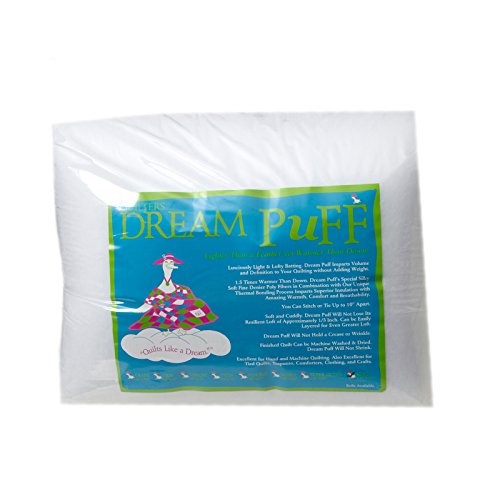
Quilters Dream Puff Batting
A high-loft polyester batting: the best high-loft filling for puffy quilts.
Key specs: high-loft polyester batting — Fine poly microfibers, high loft, lighter than a feather yet warmer than down.
Quilters Dream Puff Batting is a high-loft polyester batting, and it is the high-loft polyester batting in this guide for a buyer who wants a high-loft filling. Buyers choose it for its fine poly microfibers, which gives a high loft that stays light. Its fine poly microfibers gives a high loft that stays light, and its high loft gives a quilt that looks puffy.
The Quilters Dream Puff’s other strength is its high loft and its warm without weight. The warm without weight gives a quilt that is warm yet light, which suits a buyer who wants a high-loft filling. For a buyer who wants a high-loft filling, the Quilters Dream Puff is a sound choice in this guide, because its fine poly microfibers sets it apart from plainer options.
The trade-offs are high loft suits puffy quilts, not flat ones and polyester can feel warmer than cotton. It is not perfect, because high loft suits puffy quilts, not flat ones and polyester can feel warmer than cotton. The Quilters Dream Puff must be kept clean and dry, because batting that gets damp can smell and stain, and it should be checked regularly, because a product that is not checked can fail when it is needed most.
One practical note: the Quilters Dream Puff Batting should be stored flat or rolled, not folded, because batting that is folded will crease, and it should be kept clean, because a product that is used every day will pick up dirt. A buyer should pre-wash it only if the maker says so, because batting that is washed wrongly can shrink. For a buyer who wants a high-loft filling, the Quilters Dream Puff is a sound choice in this guide, and its high loft is the reason to buy it.
The Quilters Dream Puff also deserves a note on fit: a buyer should check the size and the material before ordering, because a product that fits will look right, and one that does not will not. The warm without weight is the detail to check first, because a quilt that is warm yet light, and a buyer who checks it will not be surprised.
Strengths:
- High loft; a puffy quilt
- Lighter than a feather yet warmer than down
- Fine poly microfibers; soft hand
Trade-offs:
- High loft suits puffy quilts, not flat ones
- Polyester can feel warmer than cotton
- Costs more than flat fillings
Who it fits: quilters who want a puffy high-loft quilt
Best for: sleepers who want a high-loft filling. Not suited for: quilters who want the thinnest summer quilt.
Check price on Amazon: Quilters Dream Puff Batting
How to Choose a Quilt filling
Choose the quilt filling by its purpose. A quilt filling that suits the purpose will do the job, which means it will be used, while one that does not will sit unused. A buyer should match the quilt filling to the need, because a quilt filling that matches will serve the buyer, and one that does not will not. Choose the filling by the quilt use. A winter quilt needs a warm filling, because wool or high-loft polyester holds heat, while a summer quilt needs a thin filling, because thin cotton is cooler. A quilter should match the filling to the season, because a filling that matches will feel right, and one that does not will not.
Choose the quilt filling by its size. A quilt filling that fits will look right, which means it will suit the room or the body, while one that does not fit will look wrong. A buyer should measure before buying, because a quilt filling that is measured will fit, and one that is bought on a guess may not. A buyer who is unsure should choose the middle size, because a middle size suits most buyers.
Check the material, because the material decides how the quilt filling feels and how it is cleaned. A quilt filling made of a material that suits the use will last, which means it will be worth the money, while one made of the wrong material will not. A buyer should read the label, because a label that lists the material will show it, and should avoid a material that cannot be cleaned, because a quilt filling that cannot be cleaned will smell.
Check the care, because a quilt filling that is used every day will pick up dirt. A buyer should choose a quilt filling that can be cleaned at home, because a quilt filling that is washed will stay fresh, and one that cannot be washed will not. A buyer should read the washing guidance, because a quilt filling that is washed as directed will last, and one that is washed wrongly will be damaged.
Check the return policy, because a quilt filling that feels wrong on the first day may feel right after a week, and a maker that allows a trial lets the buyer decide at home. A buyer should also check the warranty, because a quilt filling with a warranty is backed by its maker, and one without is not. A buyer who checks both will not be surprised, and one who does not may be.
How to Use and Care for Your Quilt filling
Use the quilt filling as its maker directs, because a quilt filling that is used as directed will last, and one that is not may fail. Place it where it belongs, because a quilt filling that is placed well will do its job, and one that is placed badly will not. Do not use a quilt filling that has worn out, because a quilt filling that has worn out will not serve the buyer, and one that is replaced will.
Care for the quilt filling by cleaning it as its maker directs, and by checking it regularly: a quilt filling that is checked will stay safe, and one that is not may fail when it is needed. Clean it on a gentle setting, because a rough clean can damage it, and air it out, because air freshens fabric and foam alike. Keep it in a dry room, and replace it when it no longer does its job, because a quilt filling that has worn out will not serve the buyer.
Store a spare quilt filling as its maker directs, because a quilt filling that is stored well will last longer than one that is left in a damp room. Do not fold a spare quilt filling for storage, because folding can crease it, and do not leave it in plastic, because plastic traps moisture. A quilt filling that is stored well will be ready when it is needed, and one that is stored badly will not.
Mistakes That Waste Money on Quilt fillings
The most common mistake is buying the wrong size. A quilt filling that is too large will not fit, and one that is too small will look lost, and a buyer who buys the wrong size will have a quilt filling that does not suit the room or the body. A buyer should measure before buying, because a quilt filling that is measured will fit, and one that is not will not.
The second mistake is buying on looks alone. A quilt filling that looks good in a listing may feel wrong in use, and a buyer who buys on looks will have a quilt filling that does not serve. A buyer should check the material and the size, because a quilt filling that is checked will suit the buyer, and one that is not may not.
The third mistake is not checking the care. A quilt filling that cannot be cleaned will smell, and a buyer who does not check will have a quilt filling that cannot be used. A buyer should read the washing guidance, because a quilt filling that is washed will stay fresh, and one that is not will smell.
The fourth mistake is keeping a quilt filling for too long. A quilt filling that has worn out will not serve the buyer, and a buyer who keeps it will be disappointed. A buyer should replace a quilt filling when it no longer does its job, because a quilt filling that is replaced will serve, and one that is kept will not.
Related Guides
More guides on this site on the same topic: Best Batting for Bed Quilts, Best Down Quilts and Best 3-Season Sleeping Quilts.
Frequently Asked Questions
What is the best filling for a warm quilt?
Wool or high-loft polyester is the best filling for a warm quilt, because wool holds heat without weight, which means the quilt is warm yet light, while high-loft polyester is also warm, which means it suits a puffy quilt. A quilter who wants warmth should choose Quilters Dream Puff for a puffy quilt, because its fine poly microfibers hold loft, and should check the stitch spacing, because a filling that must be quilted closely takes longer. A quilt filled that way will be warm, and one filled with thin cotton will be cooler.
How do I choose the right quilt filling?
Match the quilt filling to the purpose, because a quilt filling that suits the purpose will do the job, and one that does not will not. A buyer who is unsure should choose the middle size and the middle firmness, because a middle choice suits most buyers, and should check the return policy, because a quilt filling that feels wrong on the first day may feel right after a week.
Can I wash my quilt filling?
It depends on the material, because some quilt fillings can be machine washed on a gentle cycle, while others must be spot-cleaned. A buyer should read the washing label, because a quilt filling that is washed as directed will last, and should dry it fully, because damp fill will clump and smell. The cover can usually be washed, because it comes off.
How often should I replace my quilt filling?
When it no longer does its job, because a quilt filling that has worn out will not serve the buyer. A buyer should check it regularly, because a quilt filling that is checked will show wear before it fails. Most quilt fillings last one to two years of daily use, because materials break down with time.
What size quilt filling should I buy?
Match the size to the place it will be used, because a quilt filling that fits will look right, and one that does not will not. A buyer should measure the space, because a quilt filling that is measured will fit. A buyer who is unsure should choose the middle size, because a middle size suits most buyers.
Final Recommendation
The best filling for quilts depends on the use: Warm & White for a bright white cotton filling, Quilters Dream Natural 80/20 for a no-resin blend, Quilters Dream Dream Blend 70/30 for machine quilting, Quilters Dream Poly for a no-shrink filling, Hobbs Poly-Down for a down-like feel, and Quilters Dream Puff for a puffy high-loft quilt. Match the fibre to the season, check the stitch spacing, and check shrinkage before washing. A filling chosen that way will suit the quilt, and one bought on price alone may not.


