Our Top Picks


What's inside
- How to read this guide
- Four families, four different movements
- Incline angles and the resistance ladder built from body weight
- Padding, upholstery and the foot anchor
- Published weight capacities and frame construction
- Protecting the floor beneath the equipment
- Form: the technique points that decide what gets trained
- Common errors, family by family
- Neutral notes for readers with back pain
- Folding, storage and the reality of small rooms
- Assembly, adjustment ranges and fitting the equipment to the body
- Four archetypes and the readers each one suits
- Maintenance, wear points and long-term ownership
- Session structure: sets, repetitions and progression over weeks
- Stability, wobble and the pre-session safety check
- Fitting the choice to age, experience and training history
- Accessories, add-ons and what is actually worth having
- Materials, welds and reading photographs like an inspector
- How the families compare on noise, neighbours and time of day
- Warranty, returns and the first fortnight
- What the trunk muscles are actually doing, in plain terms
- Two sample weeks, described neutrally
- Check prices on Amazon
- A closing checklist before choosing
As an Amazon Associate I earn from qualifying purchases. This post may contain affiliate links at no extra cost to you.
How to read this guide
This site is reader-supported through the Amazon Associates Program, meaning purchases made via links here may earn it a commission at no additional cost to the buyer. That is the complete disclosure, offered before anything else so the comparisons below can be judged on their own terms. Those comparisons rest on published manufacturer specifications: stated weight capacities, frame dimensions, incline ranges, padding materials and assembly documents, read against one another rather than repeated from listing headlines.
Sit up machines is a broad phrase sheltering at least four distinct kinds of equipment. The sit-up bench anchors the feet and lets the trunk work against gravity at a chosen angle. The ab roller turns the movement into a rolling plank that punishes any sag in the midsection. Core coasters and sliders shift the friction under hands or feet to load the abdominals through a sliding path. Framed crunch devices with neck and head support guide the movement for users who find the floor version strains the neck more than the stomach. Each family trains the trunk differently, and choosing between them is a decision about movement pattern first and product second.
No device in this guide flattens anything by itself, and none of the sections below promise visible results on a timetable. What equipment can honestly offer is leverage, resistance progression, comfort and consistency: a setup that lets a person practise trunk flexion or anti-extension work at an appropriate difficulty, repeatedly, without dreading the session. Judged on those terms, the specification sheets in this category contain real differences worth understanding before a purchase.
Four families, four different movements
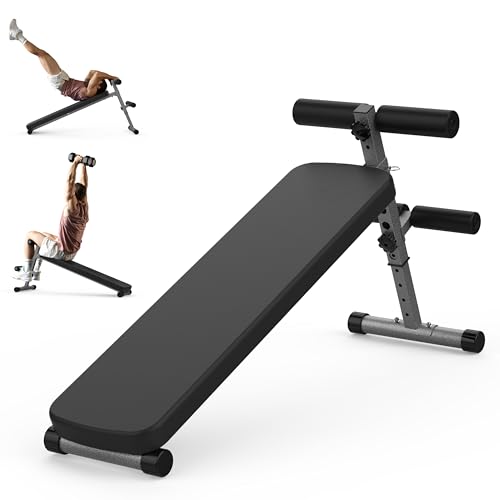
The sit-up bench is the oldest design here. A padded board, flat or inclined, carries the user’s back while a roller or bar at the lower end secures the feet or ankles. Raising the trunk from the board works the rectus abdominis and, as the hips flex beyond the first portion of the movement, the hip flexors take a growing share. Decline versions tilt the board so the head sits lower than the feet, increasing the load through a longer arc; flat benches and simple floor pads sit at the gentler end of the same family.
The ab roller reduces the equipment to a wheel, an axle and two handles, yet the exercise it creates is among the hardest in this guide. From kneeling, the user rolls the wheel forward while keeping the trunk rigid, then pulls it back using the abdominals and lats rather than the arms alone. The demand is anti-extension: the muscles work to prevent the lower back from arching as the body lengthens. Double-wheel and wide-wheel variants trade some of that difficulty for stability, and spring-assisted return models soften the hardest portion of the return for beginners.
Core coasters and sliders take yet another route. A wheeled coaster under each hand, or low-friction discs under hands or feet, lets the user slide into extended positions and draw the body back, working the trunk through a long, controlled range. Because the supporting surface moves, balance and shoulder stability join the abdominal demand, and the exercises scale from cautious short slides to demanding full extensions. The category includes gliding discs meant for carpet or hard floors, wheeled platforms with handles, and track-based designs that constrain the path for users who prefer guidance.
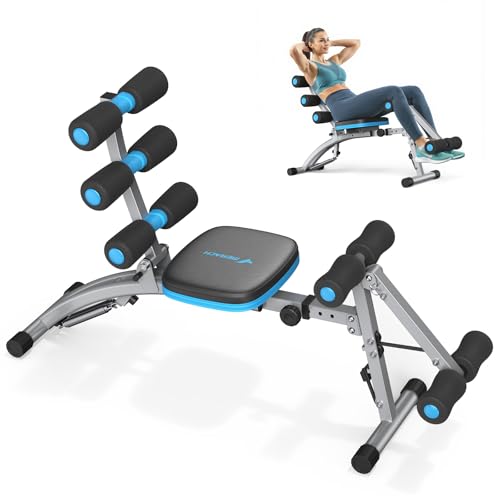
Framed crunch machines, the fourth family, place the user seated or reclined against a padded support while a frame with a headrest and elbow or hand grips guides the crunch. The head support is the defining feature: it carries the weight of the head so the neck flexors stop dominating the movement, a limitation many beginners report with floor crunches. Resistance on these frames comes from the user’s body weight, sometimes supplemented by weight posts, and the movement arc is fixed by the frame’s pivot rather than chosen freely.
Incline angles and the resistance ladder built from body weight
On a bench, gravity is the resistance and the incline dial is the weight stack. Lying flat, the trunk works against its own mass through a moderate arc. Raising the foot end, or lowering the head end on a decline bench, lengthens the arc and increases the portion of it where the trunk hangs against gravity, so the same body becomes a heavier load. Published incline ranges on adjustable archetypes commonly run from flat through several stepped positions to a steep decline, and the number of distinct positions matters less than whether the smallest step is small enough to progress in comfort.
That progression logic deserves spelling out, because it governs months of use. A bench offering only flat and one steep decline gives the user two difficulties with a chasm between them; a bench with four or five indexed positions lets the difficulty climb in increments the trunk can actually adapt to. Buyers should look for the angle figures or the number of locking positions in the specification, and should be wary of listings that describe adjustability in adjectives rather than positions or degrees.
Rollers and sliders have no dial, so their resistance ladder is built from technique. Shortening the rollout, pausing partway, slowing the return, moving from knees to a partial standing position and eventually to a full standing rollout form a staircase of difficulty that experienced users climb over months. Spring-return rollers insert an extra rung at the bottom of that staircase. Documentation that maps out such progressions honestly, rather than implying the hardest variation is a starting point, signals a manufacturer who understands the product being sold.
Framed crunch devices sit between the two systems. Their arc is fixed, but some accept added plates on a rear post, converting body-weight resistance into something incrementally loadable. Where a frame offers no added load, progression comes from repetitions, slower tempos and pauses at the hardest point of the arc. Buyers comparing a frame against a bench should therefore ask a different question of each: the bench about its angles, the frame about its ceiling, meaning the point at which a stronger user outgrows what the machine can demand.
Padding, upholstery and the foot anchor
Padding decides whether a bench gets used daily or avoided by Thursday. The back board’s foam must be dense enough that the spine’s bony points do not press through to the board beneath during a set, yet not so thick and soft that the user sinks and the board’s support disappears. Published foam thickness figures, where given, cluster around a couple of inches on mid-range archetypes, but density matters more than depth and is harder to extract from listings; a board described by its foam type and its vinyl covering tells the buyer more than one described only by a thickness number.
Upholstery takes the sweat, the friction and the cleaning. Stitched vinyl with sealed seams wipes down quickly and resists absorbing moisture, while perforated or fabric covers breathe better and degrade faster under daily use. Split boards, with a gap or narrower section where the spine rests, appear on some archetypes and divide opinion: some users find the channel relieves pressure on the vertebrae, others find the edges of the gap dig in. Either way, the stitching at board edges is the first failure point, so double-stitched seams are a detail worth confirming in photographs or documentation.
The foot anchor carries more force than buyers expect. During a decline sit-up the anchored feet effectively hold the entire rotating mass of the body, and the rollers or bar transferring that force must be padded thickly enough to spare the front of the ankle and the top of the foot. Twin roller pairs, one above and one below the ankle line, distribute the load better than a single bar. Adjustability of the anchor’s height or position matters for households with users of different leg lengths, because an anchor set wrong turns every repetition into a negotiation with sliding feet.
Handles and grips deserve a brief mention. Some benches add handles beside the head or at the sides for mounting and dismounting, which older users and anyone training at a steep decline will appreciate more than they expect. On rollers, handle diameter and grip material decide whether the wrists stay comfortable through a set; foam grips compress and perish, while textured rubber or bare contoured plastic lasts longer and cleans more easily.
Published weight capacities and frame construction
Every bench and frame in this category publishes a maximum user weight, and the honest way to read that figure is as a ceiling with a margin, not a target. Capacities on domestic archetypes commonly fall somewhere in the band between roughly two hundred and fifty and four hundred pounds, with heavy-duty frames publishing figures above that band. A user near the stated ceiling should favour the next class up, because dynamic loading during a vigorous set exceeds static body weight, and because capacity figures assume the equipment is assembled correctly on a level floor.
Frame tubing tells the story behind the number. Rectangular or oval steel tube with a stated gauge, joined by welds that run continuously around the joint, supports load more predictably than thin round tube joined by bolts alone at every corner. That said, bolted frames dominate the folding end of the market for practical reasons, and their real weakness is loosening over time rather than outright failure. A monthly check with the assembly wrench, which several manuals recommend outright, keeps a bolted frame honest.
Feet and end caps are the frame’s interface with the room. Wide end caps spread the load, stop the frame rocking on slightly uneven floors and protect both the floor and the frame’s paint. Rubberised caps grip; hard plastic caps skate. On decline benches, the raised end concentrates force on a small footprint, and buyers with delicate flooring should examine the cap design at that end with particular care, since it carries a shifting load every repetition.
Readers planning a fuller home training corner often compare benches with vertical knee-raise stations, and that neighbouring equipment family is covered in best captain chairs for exercise for those weighing the two against the same floor space.
Protecting the floor beneath the equipment
Floor protection begins with the equipment’s own feet but rarely ends there. A dense mat under a bench absorbs the small impacts of mounting, dismounting and dropped accessories, and it prevents the slow migration across the room that repeated sets cause on smooth floors. Mat thickness and density matter more than mat area: thin foam compresses to nothing under a frame foot, while high-density rubber or PVC mats in the range used under heavier gym equipment keep the frame planted and the flooring unmarked.
Rollers and sliders interact with floors more intimately. An ab roller’s wheel can leave tracks in soft vinyl and will rattle across tile grout lines, which is why many users roll on a mat or a strip of low-pile carpet regardless of the wheel’s material. Gliding discs are sold in floor-specific versions: felt-bottomed discs for hard floors, smooth plastic for carpet, and using the wrong pairing either scratches the surface or refuses to slide at all. Coasters with wheels sit between the two, rolling acceptably on most surfaces but wandering on thick carpet pile.
Sweat is the floor’s other enemy in this category, because trunk training produces plenty of it and it lands exactly where the equipment stands. A mat that can be wiped or hosed down, rather than one that absorbs and harbours odour, keeps the training corner pleasant across a summer. Households training on pale carpet should treat a washable barrier layer as part of the purchase rather than an optional extra discovered after the first stained patch appears.
Form: the technique points that decide what gets trained
On a bench, the first decision is range. Rising only through the initial portion of the movement, until the shoulder blades clear the board, loads the abdominals most directly; continuing until the torso approaches the thighs brings the hip flexors increasingly into the work. Neither is wrong, but they are different exercises wearing the same name, and a user whose goal is abdominal work should know which portion of the arc delivers it. Exhaling during the rise, keeping the chin neither jammed to the chest nor thrown back, and lowering under control rather than dropping onto the board complete the standard picture most instruction sheets draw.
Hands are the most misused variable in floor and bench work alike. Pulling on the head or neck with clasped hands converts abdominal effort into neck strain and is the error framed crunch machines were invented to prevent. Arms crossed on the chest, fingertips resting lightly at the temples, or arms extended overhead form a ladder of difficulty that costs nothing to climb, and honest documentation presents it that way instead of selling an accessory for the purpose.
Roller technique hinges on the pelvis. Before the wheel moves, the user tucks the pelvis slightly and firms the trunk, and that set position must survive the entire rollout; the moment the lower back sags into an arch, the load has shifted from the abdominals to the spine’s passive structures. Shortening the rollout, using a wall as a distance stop, and practising from the knees with a pad beneath them are the standard progressions, and they exist because the full movement is a genuinely advanced exercise that marketing photography persistently presents as a starting point.
Slider and coaster work rewards slowness above all. The sliding surface removes the friction that would otherwise help, so any jerk or momentum lets the body travel further than the muscles can retrieve. Controlled departures, a pause at the furthest comfortable point and a deliberate return define good repetitions here, and sessions built from few, careful repetitions outperform sessions built from many sloppy ones by every measure the instruction literature uses.
Common errors, family by family
Bench users most often err through speed and anchoring. Bouncing off the board at the bottom borrows elastic energy and returns it as spinal jolt rather than muscular work, while feet anchored too loosely let the body shift until the board’s edge presses into the mid-back. A third error is holding the breath through the hardest portion, which spikes internal pressure and leaves users dizzy at the top of a set; the published guidance across manuals is consistent about exhaling on effort for this equipment.
Roller users err through ambition. Rollouts attempted beyond current strength end in an uncontrolled collapse onto forearms or face, and the standard defences are unglamorous: a wall to limit distance, a thick knee pad, and the discipline to end a set when the pelvis can no longer hold its tuck. Wrist discomfort is the quieter problem, arising when the handles force the wrist into extension under load; neutral-grip variants and wider wheels reduce that angle, and users with wrist history should weigh those designs more heavily than wheel colour or bundled extras.
Slider users err through range. Sliding to a distance the shoulders cannot stabilise turns an abdominal exercise into a shoulder strain, and the discs’ willingness to travel in any direction means a moment’s inattention can split the hands wider than intended. Track-guided coasters exist precisely to remove that failure mode, and beginners training alone may reasonably prefer the constraint. Framed-machine users, finally, err through the headrest itself: pushing the head hard into the support reintroduces the neck as the prime mover the frame was meant to bypass, so the rest should cradle rather than be driven against.
Neutral notes for readers with back pain
Back pain and trunk training have a complicated relationship, and a buying guide’s honest contribution is to describe the considerations rather than prescribe. Repeated loaded spinal flexion, which is what a full sit-up involves, is the movement some clinicians advise particular patients to limit, especially where disc problems form part of the picture. Other patients are actively encouraged to strengthen the trunk. The same bench can therefore be appropriate for one reader and inadvisable for another with a superficially similar ache, which is why anyone with a diagnosed back condition, radiating leg symptoms, numbness or a history of spinal surgery should take individual professional advice before choosing equipment in this category.
Within that caution, the families differ in ways worth knowing. Rollers and sliders emphasise anti-extension and controlled movement more than repeated flexion, and some users with flexion-sensitive backs tolerate them better, while others find the loaded extended positions provocative in their own right. Partial-range bench work, stopping where the shoulder blades clear the board, reduces the flexion depth involved. Framed devices control the arc most tightly of all. None of those observations is a recommendation; they are the vocabulary a reader needs for a useful conversation with a physiotherapist who knows their history.
Certain experiences during training are signals to stop rather than adjust. Pain that travels into the leg, new numbness or weakness, or back pain that worsens steadily across days rather than easing are all reasons to set the equipment aside and seek assessment. Ordinary muscular effort, mild next-day soreness in the abdominal wall and the general fatigue of a hard set belong to a different category, and learning to tell the two apart is part of training responsibly with any equipment in this guide.
Households researching supportive equipment for a larger-framed user with back considerations sometimes look at powered seating in parallel, and best massage chairs for big and tall addresses that separate category’s sizing questions directly.
Folding, storage and the reality of small rooms
Most sit-up benches sold for home use fold, and the mechanism decides whether that feature is a pleasure or a ritual resented daily. The commonest design removes or releases a locking pin and lets the board fold down against the legs, halving the footprint for storage against a wall or under a bed. Buyers should check three published figures: the folded dimensions, the product’s weight, and whether the folded unit stands upright unaided or must lean. A bench that folds flat but weighs enough to make moving it a workout of its own will, in practice, live unfolded in the middle of the room.
Pin mechanisms deserve scrutiny. A simple pull-pin with a positive lock is quick and honest; spring-loaded knobs are quicker still but can sit half-engaged if the user is careless, and the manual’s warning to verify engagement before training should be read as engineering fact rather than legal padding. Hinges that fold the legs rather than the board keep the padding uncreased, a small point that matters across years of daily folding, since creased vinyl eventually cracks along the fold line.
Rollers and sliders barely trouble the storage question at all, which is a large part of their appeal in flats and shared houses. A roller occupies a shoebox of space, discs slide into a drawer, and coasters stack. Framed crunch machines sit at the opposite extreme: most do not fold, their footprint is fixed, and buyers should measure the room, the doorway and the turning space on any stairs before ordering, using the assembled dimensions in the specification rather than the dimensions of the shipping box.
Wall storage suits benches in garages and utility rooms, using hooks rated for the unit’s weight and mounted into studs or masonry rather than plasterboard alone. Wherever equipment is stored, padding should not bear the unit’s weight through a single narrow edge for months at a time, because foam takes a permanent set under sustained point loads and the board will carry a dent into every future session.
Assembly, adjustment ranges and fitting the equipment to the body
Assembly demands in this category range from none at all, for rollers and discs, to an hour of bolting for framed machines. Bench manuals typically list a parts count, two wrench sizes and a sequence that matters: frames assembled loosely first and tightened once square sit flatter than frames torqued down joint by joint. A unit that rocks after assembly is usually a unit tightened out of sequence, and the remedy of loosening, settling the frame on a hard floor and re-tightening appears in troubleshooting sections often enough to count as standard knowledge.
Fit adjustments extend beyond the incline dial. Board length determines whether taller users find their head supported or hanging past the board’s end at full decline, and published board dimensions allow that check before purchase. Anchor position, where adjustable, should place the rollers across the ankle rather than the shin or the instep. Framed machines add seat or backrest positions and headrest height, and the correct setup leaves the frame’s pivot roughly aligned with the user’s own trunk pivot at the hips, a point the better manuals illustrate rather than merely assert.
Households with two users of different heights should time a full changeover before committing to a shared unit. If swapping the incline, anchor and headrest settings takes under a minute with positive clicks at each step, sharing works; if it involves tools and guesswork, the second user’s sessions will quietly stop happening. Indexed adjustments with visible numbers beat friction sliders here for the same reason they did on the incline: yesterday’s setting must be findable today.
Four archetypes and the readers each one suits
The first archetype is the adjustable decline bench with multiple locking positions, twin ankle rollers and a folding frame. It suits the reader who wants the classic sit-up progression with room to grow, has the floor space for a board-length footprint, and is comfortable managing technique without guidance from the equipment. Within the archetype, the deciding details are the fineness of the incline steps, the anchor’s padding and the folded dimensions, in that order.
The second archetype is the wide-wheel roller, often with a knee pad included and sometimes with a spring return. It suits the reader short on space and money who accepts a steep learning curve in exchange for the most demanding trunk exercise in this guide. Readers with wrist or shoulder history should approach it cautiously and consider the spring-assisted variants, which lower the entry difficulty without changing the movement’s character. Its ceiling is high enough that few home users ever reach it.
The third archetype is the coaster or slider set, bought as wheeled platforms, discs or a guided track. It suits the reader who wants variety, since the same tools serve pikes, knee tucks, body saws and oblique variations, and who trains on a floor surface matching the chosen design. Its weakness is the absence of any built-in progression scale, so readers who like their difficulty numbered may find the bench’s dial more satisfying to follow across a season.
The fourth archetype is the framed crunch device with head support, aimed squarely at readers whose floor crunches have always been a neck exercise in disguise. It suits beginners, older users and anyone returning to training who values a guided arc and a supported head over progression range. Its ceiling arrives sooner than a bench’s, and its footprint never folds away, so it suits a dedicated corner rather than a multipurpose room. Readers comparing powered relaxation seating for the same corner can consult best commercial massage chairs for the commercial-grade end of that unrelated category.
Maintenance, wear points and long-term ownership
Trunk equipment fails quietly and at predictable places. Vinyl splits first where it wraps board edges and where stitching carries tension; foam compresses permanently beneath the shoulder blades and the tailbone; anchor rollers crack their foam covers and then begin chewing at socks and skin. A monthly once-over covering those points, plus bolt tightness on folding frames and wheel bearings on rollers and coasters, catches nearly every failure while it is still an annoyance rather than an accident.
Cleaning is simple but not optional. Vinyl and plastic surfaces wipe down with a damp cloth and mild detergent, and should be dried rather than left wet, because moisture trapped under a folded board breeds the stale smell that eventually permeates padding. Fabric-covered boards and grips need airing and occasional vacuuming, and should never be soaked. Rollers used on outdoor patios or garage floors pick up grit that grinds bearings, so a rinse and spin-dry after such sessions extends their life disproportionately.
Replacement parts separate the durable purchases from the disposable ones. Anchor rollers, end caps, locking pins and wheel assemblies are all small, orderable items on well-supported product lines, and their absence from a manufacturer’s catalogue is a forecast: the first worn roller ends the product’s useful life. Buyers planning to train for years should confirm spare availability with the same seriousness they apply to the capacity figure, because the frame will almost certainly outlast its foam and fittings.
Gym corners accumulate equipment across categories over time, and readers who end up comparing electronic seating for recovery days will find that territory mapped in best electronic massage chairs rather than in these pages.
Session structure: sets, repetitions and progression over weeks
Published guidance for trunk training converges on modest numbers. Beginners are usually directed toward a small number of sets of controlled repetitions, performed on non-consecutive days, with the difficulty set so the final repetitions of each set are demanding yet clean. That last condition is the governing rule of the whole category: a repetition performed with bouncing, breath-holding or neck-pulling is not a harder repetition but a different and worse one, and programmes that build in rest days recognise that the abdominal wall, like any muscle group, adapts between sessions rather than during them.
Progression on a bench follows the incline. A typical published pattern holds a user at one angle until the top of the repetition range feels manageable across all sets, then moves a single position steeper and accepts fewer repetitions while strength rebuilds. Adding load comes later and cautiously: a plate held at the chest, then a plate held further from the body, multiplies the demand faster than intuition suggests, and manuals that publish guidance on added load consistently advise small increments and an unanchored observer’s eye on form during the first sessions at any new load.
Roller progression is measured in distance before repetitions. Marking the floor, or rolling toward a wall set a measured distance away, turns an impressionistic exercise into a recordable one, and the record is what makes weekly progress visible. Slider work progresses by range and by tempo in the same spirit: a slower return is a harder repetition without any change in equipment. Framed machines progress by repetitions and by pauses inserted at the arc’s hardest point, and their fixed geometry makes those pauses the main honest lever once repetitions climb comfortably.
Plateaus arrive in trunk training as reliably as in any other kind. The literature’s standard responses are unglamorous and effective: vary the exercise within the family, adjust tempo before load, check that sleep and general fatigue are not masquerading as stalled strength, and confirm that the equipment has not quietly changed, through a loosened hinge or a compressed pad, underneath an unchanged routine. Chasing novelty by buying a second device is the one response the evidence in the manuals never seems to recommend first.
Stability, wobble and the pre-session safety check
A bench under a moving body is a dynamic structure, and its stability depends on details buyers can assess from specifications and photographs. The stance width of the feet, the length of the floor rails and the position of the board’s pivot relative to the base decide whether a unit feels planted or theatrical during a vigorous set. Long floor rails with wide end caps resist the fore-and-aft rocking that decline work provokes, while short, narrow feet save storage space at the price of that planted feel. Neither is a defect; they are different bargains, and the specification’s dimension figures reveal which bargain a given product offers.
The pre-session check takes under a minute and deserves to become ritual. Confirm the incline pin is fully engaged, the anchor rollers spin freely and sit where the last session left them, the frame’s feet are flat on the floor rather than bridged across a mat’s edge or a rug’s fringe, and the board’s padding shows no new split that could catch skin or clothing. On rollers, spin the wheel and squeeze the handles; on sliders, check the gliding surface for grit; on frames, confirm the headrest and pivot move through their arc without a new grinding note. Equipment announces its failures in advance to anyone who looks, and these categories announce them cheaply.
Children and pets change the safety calculation in ways manuals state plainly. A folded bench leaning against a wall is a climbing invitation and a falling hazard, and should be stored flat or secured. Rollers and discs left on the floor are trip and slip hazards respectively, the discs especially, since a gliding disc under an unsuspecting heel behaves exactly as designed. Households with small children should treat storage of the smallest equipment in this guide with the same seriousness as storage of the largest.
Fitting the choice to age, experience and training history
Older beginners are the readership most poorly served by this category’s marketing, which photographs every device under a young athlete. The practical questions for an older user are about mounting and dismounting, neck comfort, and the ability to make the exercise easier without embarrassment. Framed devices and flat or mildly inclined benches with side handles answer those questions best; steep declines and full rollouts answer them worst, whatever their other virtues. Grip strength matters too, because several adjustments and folding mechanisms assume it, and a user who cannot operate the pin cannot safely use the bench.
Experienced users face the opposite mismatch: ceilings. A frame with body-weight resistance only may be outgrown within a season, while a bench’s steepest decline plus a held plate, or a standing rollout, can occupy years. Readers who already train seriously should therefore read each archetype’s ceiling as carefully as its entry point, and should be suspicious of any product whose documentation refuses to describe its hardest variation, since that silence usually means the hardest variation is not very hard.
Returning users, coming back after illness, injury or a long sedentary stretch, sit between those poles and are best served by equipment with the widest honest range: a bench that works flat as readily as declined, a roller with spring assistance that can later be ignored, or sliders whose range is whatever the user chooses that morning. The common thread is reversibility, the ability to step the difficulty down on a bad day without changing equipment, which keeps the habit alive through the fluctuations that end most home training programmes.
Accessories, add-ons and what is actually worth having
The accessory market around trunk equipment mixes the genuinely useful with the decorative. A dense mat earns its place under almost every family in this guide. A thick knee pad transforms the roller’s comfort. A simple wall-mounted storage hook suits folding benches in garages. Beyond those, value thins quickly: resistance bands can add load to bench and frame work and cost little, but their resistance curve rises through the movement in a way that suits some exercises and distorts others, and their condition needs inspecting for nicks before every use, since a band failing under load fails suddenly.
Weighted add-ons deserve the caution already given to plates: they multiply difficulty faster than their modest mass suggests because they move the load away from the pivot. Ankle weights, sometimes marketed for bench work, mostly increase the hip flexors’ share and the anchor’s burden rather than the abdominals’, and buyers should understand that trade before paying for it. Counters, timers and phone mounts bundled with frames are conveniences, not training features, and should be valued accordingly when two otherwise similar products are compared.
Spare covers and replacement grip sets, where offered, belong in the worth-having column for any household expecting years of use, for the reasons the maintenance section set out. Buying the spare roller or cover alongside the original purchase, while the product line is current, is a small hedge against the discontinuation that eventually overtakes every model in this category.
Materials, welds and reading photographs like an inspector
Most buyers will never handle these products before ordering, so the listing photographs become the inspection. Welds should appear as continuous, even beads rather than spot tacks with gaps; powder coating should cover joints completely, since coating holidays at welds are where rust begins; and the ends of tubes should be capped, both for safety and to keep moisture out of the frame’s interior. Plastic components deserve the same reading: thick, matte, slightly textured mouldings age better than thin, glossy shells, and visible mould lines are normal while visible flex in a photographed joint is not.
Steel gauge is sometimes published and frequently not. Where it is, a lower gauge number means thicker metal, a convention that inverts most buyers’ intuition and is worth stating plainly. Where it is not, the product’s own weight is a rough proxy: two benches of similar dimensions with a substantial weight difference are telling the buyer something about their frames, though weight alone cannot distinguish honest steel from heavy, weak castings in the feet and fittings. The capacity figure, the weight and the dimensions read together triangulate the truth better than any one of them alone.
Foam and vinyl specifications occasionally include density or a firmness description, and buyers should reward the listings that provide them. High-resilience foam recovers its shape between sessions; cheap foam takes a set within months and leaves the board feeling like the board. Vinyl described by thickness or by a marine or commercial grade designation is claiming resistance to the sweat, friction and cleaning this category guarantees, and such claims can at least be compared between products, unlike the universal assertion that padding is comfortable.
How the families compare on noise, neighbours and time of day
A consideration almost never printed on a specification sheet is sound. Rollers rumble on hard floors, coasters click at the ends of their travel, folding benches clank when their pins drop in, and framed machines creak at their pivots in proportion to how dry those pivots have become. In a detached house none of this matters; in a flat with neighbours below, an early-morning roller session on a thin floor is a social act as much as a fitness one. Mats damp most of it, carpeted rooms absorb more, and the choice of a slider over a wheeled coaster can be the difference between training at dawn and training never.
Time of day interacts with equipment choice in a second way: setup friction. A device that must be unfolded, pinned and adjusted stands a real chance of being skipped on the mornings when training would do the most good, while a roller lifted from a shelf asks nothing. Households honest about their own routines often conclude that the best programme is the one attached to the least ceremony, and that conclusion, reached before purchase, is worth more than any single specification this guide has discussed. Framed machines, permanently assembled in their corner, remove setup entirely at the cost of the corner itself, which is why their buyers should measure the room twice and their own commitment three times.
Warranty, returns and the first fortnight
Warranty structures in this category typically separate the frame from everything attached to it, covering steel for years while limiting padding, rollers and grips to a much shorter period. That split is an honest map of what wears out, and buyers should read it as such rather than as fine print. What matters practically is whether wear parts are orderable after their short coverage lapses, and whether the warranty is honoured by the seller in the buyer’s own country without returning a bench-sized object at the buyer’s expense.
Returns deserve equal realism. A bench is a bulky return, and some sellers’ policies reflect that with collection arrangements while others leave the logistics to the buyer. Establishing the position before ordering, particularly for framed machines, protects against the expensive discovery that a device does not fit the room, the doorway or the user’s body. The first fortnight of use should be treated as an evaluation window in any case: settings explored, changeovers timed, padding judged after real sessions rather than first impressions, and any wobble or grinding investigated while the paperwork is still close at hand.
Keeping the assembly instructions, the receipt and a note of the settings each household member uses, in one envelope near the equipment, sounds like housekeeping and functions as insurance. When a pin is lost in month eight, the instructions name its size; when a second user asks how the bench was set last Tuesday, the note answers. Small systems like that are what separate equipment that stays in service for years from equipment that migrates, piece by piece, into the category of household clutter.
What the trunk muscles are actually doing, in plain terms
A short anatomy primer sharpens every decision in this guide. The rectus abdominis, the segmented muscle running down the front of the trunk, flexes the spine, drawing ribs and pelvis toward each other; it is the primary target of crunches and the first portion of any sit-up. The obliques, layered along the sides, rotate and side-bend the trunk, and they join flexion work whenever a movement twists or whenever the body must resist twisting. The hip flexors, crossing from the spine and pelvis to the thigh, take over an increasing share as a sit-up continues past the point where the shoulder blades leave the board, which is why full sit-ups feel increasingly like a leg exercise at their top.
Anti-extension work, the roller’s territory, recruits the same abdominal wall for the opposite purpose: preventing movement rather than creating it. The deep stabilising muscles of the trunk and the lats join that effort, which is why rollouts fatigue the whole torso rather than one strip of it. Neither pattern is superior in the abstract; they train different capacities, and a complete trunk programme in the published literature usually contains both flexion and anti-extension elements across a week, sequenced so that heavy work of one kind does not sabotage the next day’s session of the other.
Breathing ties the patterns together. Exhaling during the effort phase of a crunch or the return phase of a rollout firms the abdominal wall at the moment it is most needed, while holding the breath bloats internal pressure and degrades control. Manuals across all four families repeat that instruction because it is the cheapest performance improvement available: it costs no money, requires no accessory and changes the feel of every repetition from the first session onward. Users who learn it early progress faster on identical equipment than users who never do, a fact worth remembering whenever a listing implies that progress is something purchased rather than practised.
Understanding these basics also inoculates buyers against the category’s recurring exaggerations. No bench isolates a single muscle completely, no roller trains only the stomach, and no frame removes the hip flexors from a movement built on hip flexion. Equipment shapes the proportions of the work; it does not rewrite anatomy. Listings that promise otherwise are telling the buyer, in advance, how much weight their other claims deserve.
Two sample weeks, described neutrally
To make the progression principles concrete, consider how published routines typically arrange a fortnight for a healthy beginner on a bench. The first week spreads three short sessions across non-consecutive days at the flattest setting, each built from a few sets of unhurried repetitions stopped well short of exhaustion, with the deliberate aim of learning the board, the anchor and the breathing pattern. The second week repeats that shape with one variable nudged: a few more repetitions per set, or a single incline step for the final set only, so the user can attribute any change in difficulty to a known cause.
A roller beginner’s fortnight looks different in every detail except its caution. Sessions begin with rollouts toward a wall placed close enough that every repetition succeeds, and the week’s work is measured in total controlled repetitions rather than distance records. Only when the pelvis holds its position through every repetition does the wall move a hand’s width further away. Slider routines follow the same grammar with range in place of distance, and framed-machine routines with repetitions in place of both. The shared lesson across families is that progression is a dial turned slowly by the user’s record, not a leap demanded by the calendar, and any programme promising transformation inside a fortnight is selling the calendar rather than the training.
One further habit separates satisfied long-term owners from the rest, and it costs nothing: a brief training note kept with the equipment. Recording the date, the incline or rollout distance, the sets completed and any joint or back response the following morning turns vague impressions into evidence. When progress stalls, the note shows whether the difficulty has genuinely stopped rising or merely felt that way during a tiring week; when something aches, the note identifies which change preceded it; and when a second household member asks where to begin, the note offers a starting point grounded in the family’s own experience rather than in a stranger’s programme. Manufacturers’ manuals rarely insist on the habit, yet every experienced coach treats the log as part of the equipment, and home users who adopt it consistently report the same discovery: the trunk responds to whatever is recorded and repeated, and quietly ignores whatever is only intended.
Photographs of the assembled unit, taken during the first week, are a surprisingly practical companion to that note. They capture the anchor position, the incline setting and the mat arrangement exactly as they were when a session felt right, and they settle arguments with memory months later when a hinge has been moved or a roller swapped. Stored with the receipt and the manual, they complete a small ownership file that makes servicing, sharing and eventual replacement straightforward rather than archaeological.
Check prices on Amazon
Live listings for the shortlist in this guide are pulled from Amazon below, so prices and availability are always current at the moment you look.


A closing checklist before choosing
Choose the movement before the product: repeated trunk flexion on a bench, anti-extension with a roller, sliding control with coasters or discs, or a guided, head-supported crunch from a frame. Then interrogate the specification in the order this guide has used: published capacity against the user’s weight with margin to spare, incline positions or progression route, padding and anchor quality, folded and assembled dimensions against the room that must hold them, and floor pairing for anything that rolls or slides.
Read the back-pain notes again if they apply, take professional advice where a diagnosis exists, and start whichever family is chosen at its gentlest setting with technique as the first project. The equipment that earns its place in a home is rarely the most elaborate on the page; it is the one whose difficulty can be raised in small, honest steps, whose padding survives daily contact, and whose folded shape disappears into the room until the next session calls it back.