Our Top Picks
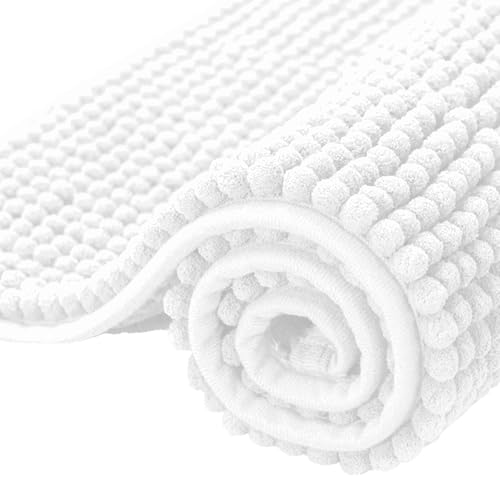 SUBRTEX Bathroom Rugs Chenille Bath Rug Soft Short18" x 24" (Rectangular)24 x 16 x 0.04 inches0.7 poundsCheck on Amazon
 Ruggnovea Chenille Bathroom Rugs 32x20 Absorbent Soft Non32" X 20"(Bathroom Rug)32 x 20 x 1.18 inches1.48 poundsCheck on Amazon
 Amazon Basics Premium 100% Cotton Absorbent Soft Bath20 x 30 inches (Pack of 6)30 x 20 x 0.04 inches4.6 poundsCheck on Amazon


What's inside
- White is a colour decision and a softness decision at once
- Long-staple cotton: the traditional route to a plush white mat
- Microfiber mats: fine strands, fast surface feel, different compromises
- Memory foam mats with removable white covers
- The three-way trade: softness, absorbency, drying speed
- Sizing a white soft mat to the room and the routine
- Backings and grip: the underside decides safety and wash life
- Washing and care: where white mats are won or lost
- Boundaries: towels, bath sheets, and decorative mats are different purchases
- Matching material to household patterns
- Costs of ownership that never appear on a label
- Pulling the decision together
- Hard water, soft water, and the slow greying of white fibres
- Edges, bindings, and the places mats actually fail
- Odour: what it signals and what actually prevents it
- Seasonal shifts in how a mat performs
- What to check in the first week of ownership
- Check prices on Amazon
- A short word on pairing mats with bathroom floors
As an Amazon Associate I earn from qualifying purchases. This post may contain affiliate links at no extra cost to you.
Links on this page can earn this site a commission when a reader buys through them. The amount you pay does not rise because of that arrangement, and no maker pays to appear here.
White is a colour decision and a softness decision at once
Most bath mat guides treat colour as decoration and softness as comfort, then rank everything together. A white mat chosen specifically for softness deserves a narrower lens, because the two requirements pull against each other in daily use. White shows every footprint, hair, and splash of tinted shampoo, so it enters the wash far more often than a patterned mat in the same household. Each wash cycle changes the surface a little, and the plush feeling that sold the mat in a shop gradually flattens, stiffens, or separates from its backing depending on construction. Judging white mats only by their first touch therefore misleads; the fair comparison is how each material holds softness after repeated laundering.
That framing shapes everything below. The contenders here are floor mats placed outside a bath or shower for wet feet to land on, made in plain white, and selected because cushioning underfoot matters to the buyer. They are not towels, not bath sheets, and not the coloured or printed mats bought mainly to anchor a scheme. A household that wants a navy runner for pattern or a stone slab for speed should look elsewhere, because those products solve different problems and would distort a softness ranking.
How this guide compares without handling the products
Every claim in these pages rests on published material specifications, care labels released by makers, and patterns in posted owner feedback. When a manufacturer publishes pile height, fibre composition, backing type, and washing limits, those figures can be compared directly across brands. When owners report that a mat stayed plush through a winter of weekly washes or began shedding by spring, that recurring pattern carries weight even though individual bathrooms differ. Nothing here depends on anyone in an office stepping onto samples, and readers should distrust any guide that implies otherwise without describing a method.
Softness itself needs unpacking before materials enter the discussion. A mat can feel soft because its fibres are fine, because its pile stands tall, because a foam core yields under weight, or because a woven surface gives slightly rather than resisting. Those sensations diverge once water arrives. Fine fibres may feel silky when dry yet collapse into a thin layer when saturated, while a springy foam core keeps its loft under a wet heel. Throughout this guide, softness means the combined impression of surface texture and underlying give, judged in the wet conditions a bath mat actually faces.
Long-staple cotton: the traditional route to a plush white mat
Cotton mats built from longer fibres occupy the classic end of this category. Staple length describes how long each individual cotton fibre runs before spinning, and longer staples produce yarns with fewer exposed ends. Fewer ends mean a smoother hand, less early pilling, and loops that keep their rounded profile through more washes than short-staple equivalents. Makers who use premium cotton usually publish that fact prominently, sometimes naming a regional variety, because the raw material costs more and justifies shelf position.
The structure beneath the yarn matters as much as the fibre. Looped pile, where yarn rises and returns into the base without being cut, tends to endure longer and shed less, while cut pile feels plusher on day one because every tuft end is exposed. A dense looped cotton mat can feel almost springy once broken in, whereas a lofty cut-pile version may win a showroom touch test and then mat down along the traffic line between tub and door. Published weight per square metre helps separate these builds: heavier cotton mats generally carry more fibre, though weight alone cannot reveal loop quality.
Absorbency is cotton at its strongest. The fibre itself takes water into its structure rather than merely holding droplets between strands, so a cotton mat pulls moisture from soles instead of smearing it across the surface. Owners consistently describe cotton mats as feeling dry again sooner underfoot than their appearance suggests, because water migrates downward into the pile instead of pooling on top. For households where several people shower in sequence, that downward movement keeps the landing zone comfortable for the second and third bather.
Drying speed is the counterweight. A saturated cotton mat holds a notable amount of water, and that water must evaporate or be machine dried before the mat feels fresh again. In a ventilated bathroom with a heated floor, the delay barely registers. In a small internal bathroom without a window, a thick cotton mat can still feel cool and heavy the following morning, and repeated slow drying invites the stale odour owners mention when they hang mats over the tub edge to compensate. Thin cotton mats dry faster but surrender much of the cushion that justified choosing cotton.
Keeping long-staple cotton white
Cotton offers the strongest whitening options in this category, and that advantage deserves emphasis. Maker care guidance for plain white cotton commonly permits warm or hot washing, and many labels allow oxygen-based whitening agents; some tolerate diluted chlorine bleach, though labels vary and the printed instruction for a specific mat always governs. That tolerance matters because white cotton gradually greys from body oils, hard-water minerals, and detergent residue even when no dramatic stain occurs. A material that accepts an occasional restorative wash can return close to its original brightness, while a material restricted to gentle cold cycles slowly accumulates dullness it can never shed.
Bleach tolerance should never be assumed from fibre alone. Backings, binding threads, and decorative stitching on a cotton mat may react differently from the pile, and a backing that yellows or cracks after bleaching ruins an otherwise successful wash. Reading the full care label, including backing composition, is the only reliable route. Owners who rotate two white cotton mats, washing one while the other serves, report the easiest upkeep rhythm, since neither mat stays down long enough to grind soil deep into the base.
best machine washable bath mats
Readers whose first priority is a mat that tolerates frequent machine washing above all else will find a broader wash-focused comparison in our companion guide, which ranks constructions by laundering behaviour rather than by colour or softness.
Microfiber mats: fine strands, fast surface feel, different compromises
Microfiber mats use synthetic filaments split into extremely fine strands, creating a surface with far more fibre ends per square centimetre than ordinary woven cloth. That density explains the category’s signature first impression: a smooth, almost suede-like glide under a dry foot, with no loop texture interrupting contact. For buyers who dislike the nubby feel of cotton loops, microfiber delivers softness as smoothness rather than as pile, and the distinction is personal rather than hierarchical.
Water handling follows a different mechanism. Synthetic filaments do not absorb into the fibre body the way cotton does; instead, the split structure traps water in the narrow channels between strands through capillary action. A good microfiber mat therefore picks up surface water quickly and can feel impressively effective during the first steps out of a shower. Its total capacity, however, is often lower than a thick cotton mat of similar footprint, so a long shower followed by dripping hair and a second bather can saturate it sooner. Owners in busy family bathrooms describe exactly that ceiling, while single occupants rarely encounter it.
Drying behaviour flips the cotton comparison. Because water sits between fibres rather than inside them, and because synthetic material releases moisture readily, microfiber mats generally dry faster in still air. Hung over a rail after use, a microfiber mat may be ready again by evening where a heavy cotton equivalent would still feel damp at its core. Households without tumble dryers, or bathrooms that stay humid after showers, often value that turnaround more than maximum absorbency, and their posted feedback reflects a deliberate trade rather than a compromise accepted reluctantly.
Softness retention over time follows its own pattern. Microfiber does not pill in the cotton sense, yet repeated hot washing can damage the split structure that creates its texture, which is why maker guidance for these mats typically specifies cool or warm water and forbids fabric softener that coats the filaments. Owners who ignore softener warnings commonly report a mat that looks unchanged but suddenly smears water instead of lifting it, a failure of function disguised as cosmetic survival. White microfiber also resists bleach poorly compared with cotton; strong whitening agents can yellow the fibres or weaken them, so whiteness must be maintained through frequent gentle washing rather than occasional aggressive restoration.
Backings on microfiber mats deserve separate scrutiny
Many microfiber mats bond their surface to a thin foam or rubberised layer that supplies both cushion and grip. That laminate construction explains why two mats with identical surface descriptions can age very differently. Heat in washing or drying can separate the layers at the edges, producing bubbles or curling corners that no amount of flattening persuades to lie down again. Care labels that permit machine washing may still require line drying for precisely this reason, and a buyer who needs a mat that survives the dryer should confirm both halves of the routine before purchase rather than discovering the restriction afterward.
Memory foam mats with removable white covers
The third family in this guide builds softness from structure rather than fibre. A slab of viscoelastic foam forms the core, compressing slowly under a heel and recovering its shape after the foot lifts. Standing on such a mat feels less like standing on cloth and more like standing on a firm cushion that remembers the outline of each step for a few seconds. For people whose feet ache on hard tile, or who stand at a basin after bathing, that slow yield is the entire appeal, and no woven surface reproduces it.
Construction splits into two camps with sharply different upkeep. Sealed foam mats enclose the core in a fixed synthetic skin that wipes clean but cannot enter a washing machine; the foam itself must never be soaked, because its open cells drink water and release it over days rather than hours. Removable-cover designs solve that problem by zipping or slipping a washable white textile shell over the core, letting the part that touches feet and collects soil go through a normal laundry cycle while the foam stays dry indoors. For a white mat, which needs washing most, the removable cover is close to a requirement rather than a refinement.
Even with a washable cover, whiteness management differs fundamentally from cotton. The cover fabric may tolerate warm washing, yet the foam core tolerates neither bleach nor soaking nor machine agitation, and maker instructions state those prohibitions plainly. A spill that penetrates the cover before it can be removed may leave a permanent mark inside the core, hidden yet sometimes visible through a thin white shell as a shadow. Owners who choose foam therefore accept a ceiling on restoration: the cover can be refreshed, the core cannot, and the mat’s service life ends when the core stains, crumbles, or loses resilience.
Absorbency also belongs entirely to the cover. The foam beneath contributes nothing to water uptake, and a thin cover saturates quickly, after which wet feet press moisture through onto the foam surface. In practice, foam mats suit a single bather stepping out, drying off while standing in place, and then leaving the mat to recover. They suit a relay of children splashing out of a shared bath far less, because each successive pair of feet meets a cover that has not yet dried. Published cover thickness and fabric weight are the figures to compare here, since a substantial cotton-rich cover behaves noticeably better than a whisper-thin polyester one.
Drying speed presents a split verdict. The cover alone, removed and hung, dries quickly because it holds little water. The assembled mat, left flat on the floor after a soaking, dries slowly because air cannot reach the interface between cover and core. Owners who lift and drape the whole mat after showers report fewer musty episodes than owners who leave it in place all week, and that habit difference explains much of the disagreement in feedback about whether foam mats smell. The design rewards a small daily routine and punishes complete neglect more than woven mats do.
Foam thickness, density, and the standing-still test
Makers publish foam thickness readily and density less often, yet density predicts longevity better. A thick, low-density slab feels luxurious initially and then bottoms out, letting a heel sense the tile beneath within months of daily use. A moderately thick, higher-density core feels firmer in a shop but keeps its character longer, which matters for a product bought for comfort rather than appearance. Because a buyer cannot interrogate foam through a sealed cover in a showroom, the published density figure, when offered, and the pattern of owner comments about flattening after six months are the practical evidence available.
best memory foam bathroom rugs
Households leaning toward foam construction can compare core thicknesses, cover fabrics, and room-size pairings in greater depth in the dedicated foam guide linked here, which covers coloured versions outside this guide’s white-only scope.
The three-way trade: softness, absorbency, drying speed
No material in this category leads on all three measures, and pretending otherwise would flatten the decision into a slogan. Cotton couples strong absorbency with durable softness but dries slowest in thick builds. Microfiber dries fastest and feels smoothest dry, yet saturates sooner and loses function when washed carelessly. Foam delivers the deepest cushion while contributing no absorbency of its own and demanding the most protective handling. The right ranking therefore depends on which constraint binds hardest in a particular bathroom: ventilation, bather count, laundry access, or sensitivity to hard floors.
Consider a guest bathroom used twice a week. Drying speed barely matters because the mat rests for days between showers, absorbency demands are modest, and the visual payoff of a pristine white cotton mat is high. Foam also performs well there, since its cover rarely needs washing and its cushion impresses visitors. Now consider the only bathroom in a flat shared by three adults on staggered shifts. The mat may never fully dry, absorbency is consumed by midday, and laundering must be quick and forgiving; microfiber’s turnaround or a thinner cotton build suddenly outranks the plush heavyweight that won the guest-room comparison.
Climate quietly steers the same calculation. In arid regions or homes with strong heating, cotton’s drying penalty shrinks toward irrelevance. In coastal humidity or unheated older houses, that penalty grows, and owners in such settings post the most frustrated accounts of heavy mats that never feel fresh. Published specifications cannot capture local air, so readers should weigh their own bathroom’s mirrors: if the mirror stays fogged an hour after a shower, drying speed deserves promotion in the ranking regardless of material preference.
Sizing a white soft mat to the room and the routine
Mat dimensions are published precisely, yet buyers routinely misjudge them because showroom floors lack tubs. The useful measurement begins at the bath or shower exit: the mat should extend far enough that a person stepping out lands fully on it with both feet, without a heel catching the edge and folding it. For a standard tub side, that usually means a mat noticeably longer than the bather’s stance is wide, positioned parallel to the tub with its long edge close to the base. A mat that is too short forces a half-on, half-off landing that feels unstable and wears one corner prematurely.
Width interacts with door swing and cabinet clearance in ways catalogues ignore. A deep mat in a narrow bathroom may creep under a door that then drags across its pile at every opening, flattening a visible track and grinding dust into white fibres. Measuring the door’s arc before choosing the largest size prevents that slow damage. Similarly, a mat tucked against a vanity plinth collects splashes from handwashing as well as bathing, doubling its soil load; pulling it a few centimetres clear of the plinth keeps the white surface cleaner between washes.
Runner formats deserve mention for double-ended tubs and long shower enclosures. A single long runner serves two exit points and avoids the visual clutter of paired small mats, but it also concentrates all soiling onto one item that then needs washing as a whole. Two smaller mats allow rotation, with one in the wash and one in service, at the cost of a seam in the layout where feet may land between them. Owner feedback suggests rotation wins for white mats specifically, because whiteness is maintained by washing frequency, and rotation makes frequent washing painless rather than a gap in floor coverage.
Thickness belongs to sizing as well. A tall cotton pile or thick foam core raises the foot noticeably above surrounding tile, which most adults enjoy and some older relatives find unsettling when stepping sideways in the dark. Mats that sit beside a tub used by anyone with balance concerns should favour moderate height and bevelled or tapered edges where offered, so a shuffling step meets a ramp rather than a cliff. Published thickness figures let buyers compare that aspect directly instead of discovering it on the first night.
Backings and grip: the underside decides safety and wash life
A bath mat’s underside rarely appears in marketing photographs, yet it governs both stability and longevity. The main families are natural or synthetic rubber coatings, thermoplastic elastomer layers, silicone dot patterns, woven cotton bases with no coating at all, and the smooth foam undersides of cushioned mats. Each grips tile differently, reacts differently to heat and bleach, and fails in its own characteristic way, so the backing deserves the same scrutiny as the plush surface facing upward.
Continuous rubber coatings grip smooth tile most assertively when both surfaces are clean and dry. Their weakness is ageing: heat from repeated hot washing or tumble drying can crack the coating into flakes that shed across the bathroom floor, and owners often report that a mat’s pile outlived its backing by a wide margin. Once cracking begins, grip declines unevenly, with the mat holding at one corner and sliding at another, a pattern more disconcerting than uniform slipperiness because it surprises the foot mid-step.
Dot and lattice patterns trade a little absolute grip for flexibility and wash tolerance. Because the coating is discontinuous, the mat folds and drapes more naturally, water escapes from beneath more readily, and the backing survives bending in a washing machine drum without creasing into permanent ridges. On textured or matte stone floors, dotted backings can outperform continuous ones, since individual dots settle into surface irregularities rather than bridging across them. Buyers with riven slate or tumbled marble should weight that detail heavily, because a rigid coating on uneven stone contacts only the high points.
Unbacked woven cotton mats rely on weight and friction alone. When dry, a heavy cotton mat stays put adequately on most floors; when the floor beneath becomes wet, the whole mat can skate, particularly on polished porcelain. Households choosing unbacked cotton for its superior wash tolerance often place it over a separate thin grip layer, accepting an extra item to launder in exchange for a mat with nothing to crack or peel. That two-piece approach appears frequently in long-term owner accounts precisely because each component ages at its own replaceable pace.
Stability deserves its own deep comparison for homes where a slipping mat is the primary worry, and the linked guide examines backing compounds, floor pairings, and suction designs without the colour restriction applied here.
Wet floors change every grip claim
Published grip descriptions assume a dry floor beneath the mat, an assumption bathrooms violate daily. Water migrates under a mat from splashes that run off its edges, from condensation, and from the mat’s own saturated base after heavy use. A mat that grips superbly at the start of a shower can float on a thin water film by its end if its backing seals against the tile and traps liquid beneath. Lifting a corner after bathing to check for trapped water is a revealing habit; persistent pooling argues for a more breathable backing or a daily lift-and-drape routine, whatever the surface material.
Washing and care: where white mats are won or lost
Care routines decide whether a white mat still looks white in its second year, and the routine must fit the household’s actual laundry habits rather than an idealised version of them. Cotton asks for the least special handling: shake outside, wash warm with similar colours or alone, avoid softener that coats absorbent fibres, and dry thoroughly before returning it to the floor. Its forgiveness is a genuine feature. A missed instruction rarely destroys a cotton mat outright, though chronic under-drying will dull it and chronic overdrying in fierce heat will shorten its pile life.
Microfiber asks for precision instead. Cool or warm water, no softener, no bleach, no high dryer heat, and separation from lint-shedding cotton items that would clog its fine channels. Followed faithfully, that routine preserves function for a long service life; ignored casually, it produces the puzzling decline described earlier, where appearance survives and performance quietly leaves. Households that wash everything together on one hot programme should be honest about that habit when choosing, because microfiber will be the casualty of an unchangeable routine.
Foam-cover care divides into two objects with two rulebooks. The cover follows its fabric’s instructions, usually a gentle machine wash and low-heat or line drying to protect zips and seams. The core follows almost no washing instructions at all, because it should not be washed; spot cleaning with a barely damp cloth and complete air drying is the limit makers describe. A household with young children or pets, where deep soiling of floor items is a when rather than an if, should weigh that limit seriously, since a penetrated core cannot be restored by any amount of surface attention.
How softness fades, honestly stated
Every material in this guide loses some softness with washing, and maker care literature acknowledges that trajectory in qualitative terms even when marketing language does not. Cotton loops flatten where feet land most, and their spring returns only partly after each dry. Microfiber strands can stiffen if exposed to heat or coating detergents. Foam cores compress permanently along the standing zone over months of daily loading. None of this makes the products poor; it makes the first-touch impression an unreliable oracle. The better question is the slope of decline, and on that measure dense cotton and higher-density foam generally decline more gradually than lofty cut pile or thin foam, judging by the pattern of long-term owner reports.
Washing frequency accelerates or slows that slope more than any other variable. White mats invite frequent washing for appearance, which is precisely why their softness fades faster than the same construction in grey or beige in the same home. Accepting that exchange consciously is the mature way to buy white: the brightness is maintained by laundering, laundering costs softness gradually, and rotation between two mats halves the cost borne by each. A single white mat washed twice weekly will age roughly twice as fast as each member of a rotated pair washed weekly, all else being equal.
Boundaries: towels, bath sheets, and decorative mats are different purchases
Confusion at the category edges wastes more money than any material choice. A bath sheet is a large towel, held in the hands and used to dry the body; it is not designed to live on a floor, lacks any grip backing, and becomes a slipping hazard if repurposed as a mat. Plush towels draped on the floor in hotels work because staff replace them after every use, a laundry tempo no home sustains. Readers comparing the generous cotton of a bath sheet with a mat’s pile should remember that the mat’s base, backing, and dimensional stability are engineered for horizontal service and foot traffic, not for wrapping shoulders.
Colour-led shopping follows different rules again: patterned and dyed mats hide soil between washes and suit rooms built around a palette, and the linked colour guide covers that territory for readers whose priorities turn out to be decorative after all.
Within the white category itself, hotel-style flat woven mats occupy a distinct niche. They are thin, unbacked, intensely washable, and chosen by establishments that launder after every guest. Their softness is modest, closer to a folded towel than to a cushion, yet some home buyers prefer exactly that profile because it dries on a rail within hours and tolerates the hottest wash in the house. Including them in a softness ranking without flagging the difference would mislead; they are the durability extreme of the white family, not its comfort extreme, and a buyer seeking plushness should pass them by while a buyer seeking hygiene above all should shortlist them.
Matching material to household patterns
Patterns of use sort buyers more reliably than abstract rankings. A couple in a well-ventilated ensuite, showering once daily each, will extract years of pleasure from a heavy looped cotton mat rotated with a twin. A family running a bath for children every evening, with water escaping in quantities adults never manage, needs absorbency headroom and a backing that tolerates weekly hot washes, which points toward substantial cotton without delicate coatings. A renter in a bedsit bathroom with no window and no dryer needs turnaround speed above all, which points toward microfiber or a slim cotton build hung faithfully after use.
Standing time matters too. People who apply treatments, dry hair, or supervise children while standing on the mat accumulate far more minutes of loading than people who step, dry, and leave. Extended standing exposes foam’s advantage, because woven pile compresses fully within the first minute and then offers only its base, while a foam core continues to distribute weight across the whole foot. Conversely, brief-contact users gain little from foam and inherit its care restrictions for nothing, a mismatch visible in owner feedback where identical mats receive opposite verdicts from households with different routines.
Allergies and sensitivities enter some decisions. Cotton can be washed hotter than synthetics, which suits households that prioritise high-temperature laundering of floor textiles. Synthetic surfaces shed fewer loose fibres than new cotton, which can release lint for its first several washes. Foam cores are enclosed and contribute nothing airborne in normal use, though their covers vary. None of these points amounts to medical guidance; they are laundry and material facts that households with existing routines can map onto their own requirements without specialist advice.
Reading a specification sheet like a sceptic
Specification sheets reward slow reading. Fibre percentages should add up, and a mat described as cotton that proves to be a minority-cotton blend will behave like its majority fibre instead. Dimensions should state whether they include fringe or binding. Pile height and total thickness are different numbers, and a thick foam-backed mat may have almost no pile at all. Washing symbols should be legible in the listing photographs; when a seller hides the care label, owner questions and answers often reveal the restrictions the marketing omitted, particularly around bleach and dryer heat.
Weight deserves a second look as well. Two mats of identical size can differ twofold in mass, and the heavier one usually carries more working material, whether fibre or foam density. Freight-conscious sellers sometimes celebrate lightness as a feature, which it genuinely is for laundering and hanging, but lightness in a softness product usually records an absence: less pile to compress, less capacity to fill, less substance to age slowly. Neither direction is automatically correct, yet the number should be a conscious choice rather than a surprise on delivery day.
Costs of ownership that never appear on a label
The purchase is the smallest expense attached to a white mat. Laundering consumes water, energy, and time weekly for years, and a mat requiring its own gentle cycle costs more to run than one that joins a general hot wash. Replacement cadence differs by material and routine; a mat retired after eighteen months because its backing cracked may prove dearer over a decade than a heavier mat that served five years, even before counting the inconvenience of disposal. Thinking in cost per year of satisfactory service, rather than ticket comparisons this guide deliberately avoids, produces calmer decisions.
Storage is a quieter cost. Rotation pairs need somewhere clean and dry to wait, bulky foam mats resist folding without creasing, and out-of-season spares in a damp cupboard emerge smelling of their storage rather than their bathroom. Linen cupboards in older houses are often less dry than their owners assume, so a spare white mat benefits from the same airing discipline as the one in service. None of this should deter rotation, which remains the strongest single strategy for white mats, but the spare’s home deserves a thought before the pair is ordered.
Environmental accounting follows similar lines. Natural fibre, synthetic fibre, and foam each carry different production and disposal profiles, and a durable example of any of them generally outperforms a short-lived example of another. The most defensible choice available to a buyer is the mat they will keep longest, maintained by a routine they will actually follow, in a size they measured rather than guessed. Longevity is the variable under the buyer’s control after purchase, and it outweighs most label claims about greener composition.
Pulling the decision together
Start with the bathroom, not the catalogue. Note whether the room dries quickly, how many bathers the mat must serve in sequence, whether a dryer exists, and whether anyone stands on the mat for long stretches. Those four answers narrow the material field before softness preferences even enter. Then read care labels as contracts: a mat whose whitening route is forbidden by its own label will grey on a schedule no surface quality can outrun, while a mat whose routine matches the household’s existing laundry will still look deliberate years later.
Within the surviving options, choose construction over adjectives. Dense looped cotton for absorbency and restorative washing, microfiber for smoothness and turnaround, removable-cover foam for cushioning that woven surfaces cannot imitate. Check the backing against the actual floor, measure the door swing, and plan rotation if whiteness matters enough to wash often. A white soft mat rewards that methodical approach disproportionately, because its two defining qualities, brightness and plushness, are both maintained by habits rather than guaranteed by purchase.
For the household that measures its doorway, rotates a matched pair, and washes with the grain of the material rather than against it, a white mat stays what it was bought to be: the calm, bright, forgiving square of floor that makes stepping out of warm water feel like arriving somewhere considered rather than merely getting dry.
Hard water, soft water, and the slow greying of white fibres
Water chemistry writes itself into a white mat over months, and households in hard-water districts fight a version of upkeep that soft-water households never meet. Dissolved minerals deposit inside cotton loops during washing and drying, stiffening the pile and lending a faint grey or yellow cast that ordinary detergent does not reverse. Owners in such areas describe mats that feel board-like despite careful laundering, and the cause sits in the rinse water rather than in any failure of the fibre. A final rinse additive approved for the material, or an occasional descaling wash following maker guidance, can restore much of the original hand where the label permits it.
Microfiber responds to mineral load differently. Its fine channels trap deposits that blunt capillary action, so absorbency fades while the surface still looks clean and white. Because strong descaling agents and bleach sit outside most microfiber care labels, prevention matters more than cure: thorough rinsing, avoidance of excess detergent, and prompt drying preserve the channels better than any later rescue attempt. Foam covers inherit the behaviour of whatever textile forms them, which is another reason to read a cover’s composition rather than assuming it behaves like the mat’s marketing category.
Detergent residue deserves equal blame in both water types. Floor textiles are dense, rinse poorly in crowded drums, and emerge carrying soap that attracts soil once back in service. A white mat washed with an overloaded machine may look brighter for a day and then grey faster than before, because the residue acts as adhesive for every subsequent footprint. Washing a white mat in a modest load, with an extra rinse where the machine offers one, is unglamorous advice that long-term owners repeat with unusual consistency.
Edges, bindings, and the places mats actually fail
Failure rarely begins in the centre of a mat. It begins at corners that curl, bindings that fray, and seams that open where the mat is repeatedly folded for washing or hung by one corner to dry. A bound edge with dense stitching protects a cotton pile from unravelling and gives the mat a finished outline that stays rectangular, while a raw or thinly overlocked edge on a cheaper build starts shedding loops within months. Photographs in listings usually show edges clearly, and a buyer who zooms into corners learns more than one who studies the centre of the pile.
Curling deserves particular attention on foam and laminated mats. Differential shrinkage between layers pulls corners upward after washing or slow drying near heat, and a curled corner is both a trip point and a soil trap, since it lifts the backing away from the floor and admits grit underneath. Makers who bevel or weight their edges are solving a real problem rather than styling one. Owners sometimes respond to curl by placing the mat upside down overnight under books, which works temporarily and signals that the construction has already lost its internal balance.
Hanging habits shape edge life as well. A heavy wet cotton mat draped over a narrow rail concentrates its entire saturated weight along one fold line, stretching that line over repeated cycles until a visible crease band forms across the middle. Wider rails, tub edges, or folding the mat in alternating directions between washes distribute that strain. Microfiber and foam-cover mats weigh less when wet and suffer less from hanging, one more small way in which total ownership experience diverges from the single number on a specification sheet.
Odour: what it signals and what actually prevents it
A bath mat that develops a stale smell is reporting a drying failure, not a character flaw. Moisture held deep in pile, backing, or foam interfaces feeds the familiar sour note, and fragranced detergent merely perfumes the symptom for a wash or two. The durable remedies are structural: complete drying between uses, airflow beneath the mat rather than permanent contact with a cold floor, and washing hot enough, where the label allows, to clear accumulated residues from the base of the pile. Owners who solve odour almost always describe changing one of those three conditions rather than discovering a miracle product.
White mats enjoy one odour advantage over coloured equivalents: discoloration that accompanies residue build-up remains visible, prompting intervention before smell becomes entrenched. A dark mat can hide the same accumulation until the odour announces it, by which point several restorative washes may be needed. In that narrow sense the demanding colour is also the honest one, showing its maintenance state at a glance to anyone who looks down while brushing their teeth.
Bathroom layout decides how achievable complete drying is. A mat that fits only in the splash zone, hemmed in by tub, vanity, and door, may never receive moving air, while the same mat in a room with a window cracked after showers dries without any special effort. Heated towel rails double as excellent mat dryers during the hour after bathing, provided the mat’s backing tolerates gentle warmth, which labels state. Where no rail exists, draping over the tub edge with the pile facing outward exposes the maximum surface to the room and beats leaving the mat flat in almost every owner account.
Seasonal shifts in how a mat performs
Winter changes the equation in heated homes. Warm indoor air dries mats faster, yet bathers take longer, hotter showers that saturate them more deeply, and closed windows trap the humidity those showers release. Cotton’s slow drying matters less when radiators run all day, and its absorbency advantage grows as showers lengthen, which is why some households rotate a heavier cotton mat into service for winter and a lighter synthetic one for summer. That seasonal pairing sounds indulgent until compared with the common alternative of one compromised mat performing adequately in neither season.
Summer brings the opposite pressures in homes without cooling. Ambient humidity slows evaporation to a crawl, bathrooms stay damp between uses, and mats that dried overnight in April may still feel heavy in August. Microfiber’s faster release and foam covers’ quick line drying gain value, while thick cotton demands either a dryer or disciplined outdoor airing. Households in humid climates that ignore this seasonal reality tend to blame materials for what is fundamentally an evaporation problem shared by every textile in the room.
Guest use versus daily family use
A mat bought for a guest bathroom lives a sheltered life: occasional saturation, long recovery intervals, and an audience that notices appearance more than performance. Almost any well-made white mat thrives there, and the deciding factors can safely be looks and first-touch softness. The main bathroom of a working household is a different assignment entirely, closer to commercial duty than to occasional service, and it should be bought with the scepticism appropriate to equipment. Confusing those two assignments, buying a guest-grade mat for family duty or an industrial build for a rarely used ensuite, accounts for a surprising share of disappointed reviews across every material family in this guide.
Children alter the duty cycle in specific ways worth naming. Bath time for children ejects more water than showering adults, involves toys landing on the mat, and ends with small feet that run rather than step onto the landing zone. Absorbency headroom and grip under a shifting, hurried load matter more than meditative softness, and a mat that can be washed hot without negotiation earns its place. Foam mats, whose covers saturate quickly and whose cores must stay dry, face their hardest test in this setting and should be chosen for a children’s bathroom only with eyes open about that mismatch.
For a white mat that survives its first year looking intentional rather than apologetic, the formula that emerges from every section above is unglamorous and repeatable: pick the material whose weaknesses your bathroom can forgive, respect its care label as an operating manual, dry it completely and often, and let a second mat carry the load while the first one recovers in the wash.
What to check in the first week of ownership
The first week with a new mat reveals information no listing can supply, and attentive owners use it deliberately. Note how the mat behaves after the longest shower in the household’s routine: whether the surface still accepts water at the end, whether moisture has reached the floor beneath, and how the room smells the following morning. Note also how the mat emerges from its first wash, since early shedding, edge curl, or backing stiffness at that stage tends to forecast the ageing pattern rather than improve with time. A mat that misbehaves in week one rarely settles into virtue by month three.
First impressions of softness deserve the same scepticism applied in reverse. New cotton often carries a finishing dressing that makes it feel silkier in the shop than after its first laundering, while foam covers may feel stiff until the textile relaxes through a few cycles. Judging a purchase before it has been washed once is judging the packaging rather than the product. The fair moment for a verdict is after the third wash, when dressing has left, fibres have settled, and the mat has met the household’s real water, real heat, and real floor.
Returns windows make that patience practical. A buyer who washes promptly, rotates the mat through genuine use, and records the few observations above can still act within most sellers’ timeframes if the construction proves wrong for the room. The household that leaves a new mat folded in a cupboard for a month has spent its window without gathering any evidence, and then owns the mismatch permanently. Treat the early weeks as an evaluation the purchase price already paid for, and let the mat earn its permanent place beside the tub rather than inheriting it by default on delivery day.
Check prices on Amazon
Live listings for the shortlist in this guide are pulled from Amazon below, so prices and availability are always current at the moment you look.


A short word on pairing mats with bathroom floors
Floor material quietly referees every claim made above. Polished porcelain offers backings the least natural friction and shows trapped moisture as visible tide marks around a mat’s edges. Honed stone grips better yet can stain if a damp mat sits undisturbed for days, because moisture migrates into the surface and carries soil with it. Vinyl and sealed timber tolerate mats well but dislike continuous rubber coatings left in one place for months, a pairing some flooring makers warn against because plasticiser migration can mark the surface beneath. Lifting any mat weekly to let the floor beneath dry fully protects the expensive surface under the inexpensive textile, whatever combination a household owns, and that single habit prevents the saddest category of owner report in this entire field: the mat that performed beautifully while quietly damaging the floor it was bought to stand on.
That weekly lift also gives the household its earliest warning of every other problem discussed in this guide. Backing cracks show first at the corners during that inspection, mineral stiffness announces itself when the mat no longer drapes over a hand, and a foam cover that has begun to thin lets light through at the standing zone when held up to a window. Catching any of those signals early converts a sudden failure into a planned replacement, bought calmly in the right size and material instead of urgently on a wet weekend. White mats, precisely because they display their condition so openly, reward owners who look at them properly once in a while, and they punish almost nobody who does.
Look once, wash with the label, dry without exception, and the plainest object in the bathroom becomes the one that quietly proves the whole room was planned by somebody who pays attention.
None of that attention needs to feel like labour once the rhythm settles into the ordinary choreography of bathing, because the mat asks for seconds at moments when hands are already free: a lift while the bath empties, a drape while teeth are brushed, a glance while the mirror clears, and then nothing more until the next wash day arrives.