What's inside
- Key Takeaways
- Quick Picks
- How Did We Shortlist These Pedestal Sinks?
- How Do the Six Pedestals Compare Directly?
- How Much Space Does a Pedestal Really Save?
- What Should You Know About Exposed Plumbing and Faucet Holes?
- How Do You Clean Around a Pedestal Without Resenting It?
- Which Mistakes Do Pedestal Buyers Most Regret?
- How Should You Plan Storage Around a Pedestal?
- What Does Installation Day Actually Involve?
- How Do Pedestals Suit Period Homes and Modern Homes Differently?
- What Should Renters and Landlords Know About Pedestals?
- How Do You Choose Between Two Finalist Pedestals?
- What About Water Pressure, Splash, and Basin Depth?
- How Long Should a Pedestal Last, and What Maintenance Keeps It Young?
- What Should You Ask Before the Old Vanity Comes Out?
- How Does a Pedestal Change a Bathroom’s Light and Mood?
- What Accessories Complete a Pedestal Without Recreating the Vanity?
- How Should You Photograph and Measure Your Room Before Ordering?
- What Do Guests Notice About a Pedestal Powder Room?
- Final Recommendation
- Frequently Asked Questions
- Related Guides
As an Amazon Associate I earn from qualifying purchases. This post may contain affiliate links at no extra cost to you.
cottageverdict.com is reader-supported. When you buy through links on our site, we may earn an affiliate commission.
Where to buy: Each pedestal sink below is sold through Amazon; follow a linked name to its listing, check price on Amazon, and verify the faucet-hole configuration and overall dimensions there before committing.
A pedestal sink is the oldest space trick in the bathroom and still one of the best. By replacing a boxy vanity with a basin held up by a slender column, the best pedestal bathroom sinks give a small room back its floor, its light, and its sense of air, while keeping a full, honest place to wash. Shoppers considering them are usually renovating a compact bathroom, a powder room, or a period home where a modern cabinet would look like an intruder, and their questions are practical: how much floor will I really see, where does the plumbing go, which faucet fits those holes, and how awkward is cleaning behind that column?
This guide answers with six verified pedestal models, four from Kohler’s long-running families, one from American Standard, and one compact Fine Fixtures design for genuinely tight rooms. Their differences live in footprint, in faucet drilling, in silhouette, and in how much basin ledge they offer for the soap dish and the toothbrush glass. None of them offers storage, and this guide will not pretend otherwise; the pedestal bargain trades cupboards for space and elegance, and it suits households honest enough to store their clutter elsewhere.
Measure before you fall in love. The distance from the wall to your existing drain, the swing of the door, the position of the skirting, and the spread of your intended faucet all belong in the decision, and each review below flags the measurement that matters most for that model. A pedestal sink is a ten-year fixture bought in an afternoon, so the afternoon deserves a tape measure.
Key Takeaways
- Pedestals free visible floor and make small bathrooms feel larger without moving a single wall.
- Faucet-hole configuration, single, 4-inch centreset, or 8-inch widespread, must match your chosen faucet exactly.
- Exposed plumbing behind the column looks best when valves and traps are chosen as visible hardware, not leftovers.
- Basin width and ledge space vary more than photographs suggest, so compare dimensions, not silhouettes alone.
- Cleaning around a pedestal is easy weekly and awkward only when the gap behind the column is ignored for months.
- Storage must live elsewhere, on shelves or in cabinets, because a pedestal offers none and never will.
Quick Picks
| Pick | Badge | Why it made the list |
|---|---|---|
| KOHLER Cimarron Pedestal Sink | Best all-round pedestal | A balanced, comfortable basin on a clean column that suits most family bathrooms and powder rooms. |
| Kohler Memoirs Pedestal Lavatory | Best traditional styling | Classic architectural lines with 4-inch centres, made for period homes and formal powder rooms. |
| Kohler Veer Pedestal Sink | Best compact modern | A 21-inch basin with 8-inch widespread drilling that keeps a small footprint feeling contemporary. |
| Kohler Archer Pedestal Sink | Best wide basin feel | A 24-inch rectangular basin whose ledges and lines flatter larger small bathrooms and ensuites. |
| American Standard Pedestal Sink | Best straightforward value | An uncomplicated white pedestal from a plumbing staple, easy to specify and easy to live with. |
| Fine Fixtures Roosevelt Pedestal Sink | Best for tiny rooms | An 18-inch vitreous china design with a 4-inch three-hole drilling for the tightest footprints. |
How Did We Shortlist These Pedestal Sinks?
Only pedestal models with verified listings and clearly identified configurations were considered, because a sink bought with the wrong faucet drilling is a sculpture, not a fixture. Each pick had to state, or allow a buyer to confirm, its hole pattern, its material, and its intended scale, and the six survivors were then spread deliberately across the decision space: traditional against modern, compact against generous, centreset against widespread, so that comparison teaches rather than merely lists.
Brand depth mattered for a fixture expected to serve for a decade. Kohler and American Standard bring long parts histories and faucets designed around their own drillings, which lowers the risk of a renovation surprise. Fine Fixtures earned its place by serving the genuinely small rooms the big brands sometimes overlook, with an 18-inch footprint that fits where a 24-inch basin simply cannot.
Throughout, this guide treats dimensions and drillings from the listings as the facts and everything else, elegance, presence, period charm, as judgement clearly labelled as such. A pedestal sink is plumbing before it is decoration, and the order of those priorities is respected in every review below.

KOHLER Cimarron Pedestal Sink — Best all-round pedestal
The Cimarron is the pedestal for households that want the space dividend without a design argument. Its basin is generously rounded and comfortable for real washing, face, hands, a child’s hair in an emergency, while the column below keeps a clean, unfussy profile that disappears politely against most tiles. In a family bathroom it reads as calm infrastructure; in a powder room it reads as good manners. That versatility is why it leads the guide: most buyers are not restoring a period house or squeezing a cloakroom, they are improving an ordinary small bathroom, and the Cimarron improves exactly that.
Confirm the drilling on the listing before pairing a faucet, since pedestal families are produced in more than one configuration across their lives, and the Cimarron name covers a broader Kohler range of bathroom fixtures whose parts are widely stocked. The basin’s ledge gives a soap dish and a glass a home without crowding the washing space, a small mercy that vanity refugees appreciate daily, because the first lesson of pedestal ownership is that every flat centimetre must earn its place.
Cleaning around its column follows the standard pedestal rhythm: a weekly wipe of the basin, a monthly pass behind the pedestal with a slim brush or cloth where dust gathers against the wall. Nothing about its shape makes that chore harder than average, and its smooth glazing keeps toothpaste and soap from gaining a foothold. As an all-rounder, it asks little and returns space, light, and calm.
- Model noted: KOHLER K-2362-8-0
- Colourway highlighted: white
- Style: rounded basin, clean column
- Faucet drilling: confirm on listing
- Setting: family baths and powder rooms
Strengths
- Comfortable basin for everyday washing
- Neutral looks suit most decors
- Brand support and parts depth
Trade-offs
- No storage, like every pedestal
- Ledge space is finite for couples
- Design is calm rather than striking
Best for: ordinary small bathrooms wanting space and calm without a styling gamble.
Not suited for: households needing counter territory for extensive grooming routines.

Kohler Memoirs Pedestal Lavatory — Best traditional styling
The Memoirs lavatory is architecture in miniature. Its listing specifies 4-inch centres and a classic design, and the basin carries the stepped, moulded detailing of traditional sanitaryware, the kind that belongs in a period home, a formal powder room, or any bathroom where the fixtures are expected to have manners. Where modern pedestals try to vanish, the Memoirs is content to be seen, and in the right room that presence is the entire point.
The 4-inch centreset drilling simplifies faucet shopping in one direction, since centreset faucets are plentiful and often kinder to budgets, while closing the door on the widespread look of separated handles. Decide which faucet silhouette your room wants before ordering, because with the Memoirs the drilling and the design language are a matched pair: traditional basin, traditional faucet, no apologies either way. Its ledges, shaped by the classic styling, offer respectable room for a soap dish and guest amenities.
Powder rooms are its natural stage. Guests encounter it at close quarters, its detailing rewards that attention, and the absence of storage hardly matters in a room whose duties are brief. In a hard-working family bathroom its formality can feel like a guest who never leaves, so place it where ceremony is welcome and let plainer models do the weekday labour elsewhere.
- Model noted: Kohler K-2238-4-0
- Faucet drilling: 4-inch centres
- Colourway highlighted: white
- Style: classic, architectural detailing
- Setting: period homes, formal powder rooms
Strengths
- Authentic traditional detailing
- Centreset faucets are widely available
- Memorable presence in guest spaces
Trade-offs
- Styling commits the room’s direction
- No widespread faucet option here
- Formality may overwhelm casual baths
Best for: period renovations and powder rooms where fixtures are meant to be admired.
Not suited for: minimalist remodels or anyone set on separated widespread handles.
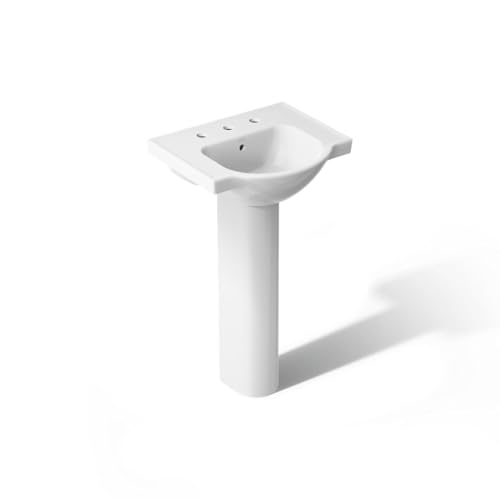
Kohler Veer Pedestal Sink — Best compact modern
The Veer proves that compact and contemporary can share a pedestal. Listed as a 21-inch basin with 8-inch widespread faucet holes, it brings the grown-up faucet look, separate handles standing apart like a proper vanity’s, into rooms whose floor area would normally forbid it. Its lines are smoother and more modern than the Memoirs, all softened geometry, so it suits the small ensuite of a new flat as naturally as a renovated cottage bathroom that wants its one fixture to feel current.
Twenty-one inches is a considered compromise. It is wide enough for comfortable hand and face washing, narrow enough to let a door swing and a bather pass without the hip-check a deeper basin imposes in tight quarters. The widespread drilling does ask for a faucet budget with three pieces to buy and install, and the plumber’s time to match, so compactness here saves space rather than money, a distinction worth understanding before the quote arrives.
Its basin ledge is modest, as compact basins’ ledges are, so plan a wall-mounted soap solution or a narrow shelf above, and the Veer’s whole proposition snaps into focus: a small, modern, properly plumbed washing station that respects both the room’s floor and its owner’s taste.
- Model noted: Kohler 5265-8-0
- Basin size noted: 21 inches
- Faucet drilling: 8-inch widespread
- Colourway highlighted: white
- Style: smooth, contemporary
Strengths
- Modern look in a compact footprint
- Widespread faucet pairing available
- Comfortable size for daily washing
Trade-offs
- Three-piece faucet raises install cost
- Ledge room is deliberately modest
- Too small for splash-heavy families
Best for: modern small ensuites and flats wanting a grown-up faucet on a compact basin.
Not suited for: budget remodels hoping a single-hole faucet will suffice.

Kohler Archer Pedestal Sink — Best wide basin feel
At 24 inches and rectangular, the Archer is the pedestal for people who love the idea and fear the basin. Its listing specifies a rectangle with 8-inch widespread faucet holes, and that geometry buys the two things round compact basins ration: elbow room across the front and flat ledge territory at the back and sides where a glass, a razor, and a soap dish can coexist without diplomacy. In a larger small bathroom, say a principal ensuite that lost its vanity to a bigger shower, the Archer restores a sense of basin generosity while keeping the floor visibly free.
The rectangular language also modernises the pedestal idea without abandoning it. Paired with a widespread faucet in a contemporary finish, the Archer can hold its own beside walk-in showers and large-format tiles, proving that pedestal does not have to mean cottage. Its column remains comparatively discreet, so the room reads as open even though the basin itself is the widest in this guide.
Check your door swing and your passing width with particular care here, because 24 inches of basin in a room planned for 21 will announce itself to hips daily. Where the room can absorb it, though, the Archer is the answer to the commonest pedestal hesitation, the fear of washing in a thimble, delivered with Kohler’s usual parts support behind it.
- Model noted: KOHLER K-2359-8-0
- Basin size noted: 24 inches, rectangular
- Faucet drilling: 8-inch widespread
- Colourway highlighted: white
- Style: linear, transitional
Strengths
- Most generous washing and ledge space
- Rectangular lines suit modern rooms
- Widespread faucet pairing available
Trade-offs
- Widest footprint in this guide
- Needs passing room around it
- Widespread faucet adds install cost
Best for: larger small bathrooms and ensuites wanting basin room without a vanity.
Not suited for: the tightest cloakrooms where every inch is already spoken for.
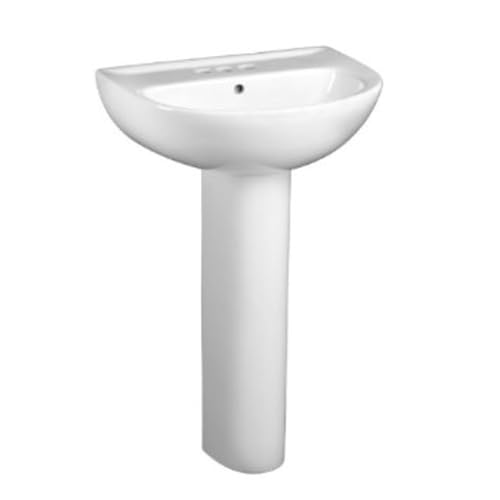
American Standard Pedestal Sink — Best straightforward value
Some renovations need a sink the way a sentence needs a verb: correctly, promptly, and without a design seminar. The American Standard pedestal, a white model from one of plumbing’s most established names, is that fixture. Its styling is clean and unpretentious, its brand brings a deep ecosystem of faucets and parts that any plumber in the country will recognise on sight, and its presence in a bathroom says simply that the room works, which in rentals, first homes, and pragmatic remodels is a complete aesthetic statement.
Verify the specific drilling and dimensions on the listing for the configuration you order, since staple models are offered in variants, and pair it with a faucet from the same broad ecosystem to keep the installation boring in the best possible way. Boring plumbing is a compliment: standard connections, available spares, and no bespoke part hunting in year seven when a cartridge needs attention.
Choose this sink when the budget and the timeline belong to the whole bathroom rather than to one fixture, and when the room’s character will come from tile, mirror, and light instead of from sanitaryware sculpture. It will not be the photograph’s hero, and it will never be the renovation’s regret, a trade many experienced renovators have learned to value.
- Model noted: American Standard 0467.400.020
- Colourway highlighted: white
- Style: clean, unpretentious
- Faucet drilling: confirm variant on listing
- Setting: rentals, first homes, pragmatic remodels
Strengths
- Plumber-friendly brand ecosystem
- Unfussy looks fit anywhere
- Sensible route for tight budgets
Trade-offs
- Design presence is deliberately quiet
- Variant details need careful checking
- Ledge space is ordinary, not generous
Best for: pragmatic renovators who want correct, serviceable, and calm at a fair effort.
Not suited for: statement bathrooms built around a hero fixture.

Fine Fixtures Roosevelt Pedestal Sink — Best for tiny rooms
Eighteen inches changes what is possible. The Roosevelt, described in its listing as a small pedestal sink in durable vitreous china with a 4-inch, three-hole faucet configuration, fits the cloakroom under the stairs, the converted cupboard ensuite, the narrow powder room where a standard basin would leave the door scraping knees. In such rooms the choice is rarely between pedestal models; it is between a small pedestal and no comfortable sink at all, and the Roosevelt wins that argument by existing at the right scale.
Vitreous china is the correct material at this size, hard-glazed, stain-resistant, and easy to wipe, because a small basin works harder per inch than a large one and shows neglect sooner. The 4-inch three-hole drilling pairs with the plentiful world of centreset faucets, keeping the faucet purchase proportionate to the room. Its modern styling, noted in the listing, keeps the smallness feeling intentional rather than apologetic, a distinction guests register even if they cannot name it.
Accept the physics: this is a hand-washing and teeth-brushing station, not a hair-washing or bucket-filling one, and its ledge is a suggestion rather than a shelf. Add a wall-mounted dispenser and a tiny shelf, and the Roosevelt’s room becomes a complete, charming miniature instead of a compromise with plumbing.
- Basin size noted: 18 inches
- Material: vitreous china ceramic
- Faucet drilling: 4-inch, three-hole
- Colourway highlighted: white
- Style: modern, compact
Strengths
- Fits rooms no other pick can serve
- Hard, easy-clean glazed surface
- Centreset faucets keep costs sane
Trade-offs
- Hand-washing scale only
- Minimal ledge for toiletries
- Splash discipline required from users
Best for: cloakrooms, tiny ensuites, and powder rooms measured in inches of mercy.
Not suited for: family bathrooms needing a basin for hair washing and heavy daily use.
How Do the Six Pedestals Compare Directly?
| Pick | Scale | Drilling noted | Character |
|---|---|---|---|
| KOHLER Cimarron Pedestal Sink | Standard | Confirm on listing | Calm all-rounder |
| Kohler Memoirs Pedestal Lavatory | Standard | 4-inch centres | Traditional |
| Kohler Veer Pedestal Sink | 21-inch | 8-inch widespread | Modern compact |
| Kohler Archer Pedestal Sink | 24-inch | 8-inch widespread | Wide rectangular |
| American Standard Pedestal Sink | Standard | Confirm variant | Pragmatic staple |
| Fine Fixtures Roosevelt Pedestal Sink | 18-inch | 4-inch three-hole | Tiny-room modern |
Two decisions organise the table: how much basin your room can hold, and which faucet family you intend to buy. Answer those and the six collapse into one or two finalists, with styling left to cast the deciding vote it deserves.
How Much Space Does a Pedestal Really Save?
The honest answer is visual first and physical second. A vanity occupies its full rectangle of floor and reads as furniture; a pedestal occupies a basin’s width at the top and a column’s narrow footprint at the bottom, returning the floor between to sight and to light. In a small bathroom that returned floor changes everything the eye reports: the room reads as its true dimensions rather than as the gap between cabinets, cleaning reaches corners that vanities hid, and a bath mat can finally lie flat in front of the basin.
Physically, the saving shows in movement. Knees gain room where a cabinet’s doors once dictated posture, a child’s step stool slides into the column’s alcove, and the door’s swing often clears where it previously clipped a vanity corner. Measure your own room’s tightest moment, usually the pass between basin and tub or door, and compare it against the basin widths in this guide, from the Roosevelt’s 18 inches to the Archer’s 24, because that single number predicts daily comfort more than any styling choice.
The cost side must stay in the sentence: every cubic inch of vanity storage vanishes. Toothbrushes, cleaning bottles, spare rolls, and the hairdryer all need new homes, on wall shelves, in a mirrored cabinet, in a nearby linen cupboard, or in a slim rolling cart that parks beside the pedestal. Renovators who plan that storage migration before the vanity leaves keep the pedestal’s dividend; those who improvise it afterwards spend months with clutter colonising the basin ledge, which makes the room feel smaller than the vanity ever did.
Powder rooms pay almost nothing for the trade, since their storage needs were always trivial, which is why pedestals remain the default answer there. Family bathrooms should enter the bargain with open eyes and a storage plan drawn to scale.
What Should You Know About Exposed Plumbing and Faucet Holes?
A pedestal does not hide plumbing inside a cabinet; it stages it. The supply valves, the trap, and the drain tailpiece all live in the open behind and beneath the column, visible from the doorway in many layouts and certainly visible to anyone sitting down nearby. Treat those parts as hardware worth choosing: neat chrome or matching-finish valves and a tidy bottle or P-trap turn necessity into detail, while corroded leftovers from the old vanity will undermine a new sink’s whole effect. Budget for fresh trim pieces when you budget for the sink.
Faucet holes are the compatibility law of this category. A basin drilled for 4-inch centres accepts centreset faucets, whose handles and spout share one base, and many single-unit designs. A basin drilled for 8-inch widespread accepts three separate pieces and forbids the centreset units. A single-hole basin, none of the headline picks here, takes monobloc faucets only. The Memoirs and Roosevelt speak centreset; the Veer and Archer speak widespread; the Cimarron and American Standard require a listing check for the exact variant, and that check is not bureaucracy, it is the difference between a weekend installation and a return shipment.
Also confirm the drain’s position against your wall plumbing before ordering, especially in older homes where rough-in heights wandered. A pedestal column offers some concealment but little adjustability, and the trap must meet the wall outlet within the column’s modest shadow. Your plumber, shown the listing’s specification sheet in advance, can confirm compatibility in minutes, and that short conversation is the cheapest insurance in the entire renovation.
Overflow channels, pop-up drains, and grid drains are smaller print worth one question each. Many pedestal basins pair with standard pop-up assemblies, while a grid drain suits basins without overflow; the listing and the faucet’s included drain usually settle it, provided somebody actually reads both before installation day.
How Do You Clean Around a Pedestal Without Resenting It?
Weekly life is simple: the glazed basin wipes clean with a soft cloth and a mild cleaner, the column takes the same cloth on the way down, and the floor around the base mops more easily than the floor around any cabinet, because there are no plinth corners or door gaps to negotiate. Owners consistently report the pedestal zone among the fastest parts of the bathroom to clean, a fact that surprises people who feared the opposite.
The one honest awkwardness is the shadow gap, the few inches between the column’s back and the wall, where dust, hair, and the occasional dropped cotton bud gather in darkness. A slim flexible duster, a bottle brush, or the crevice tool of a vacuum reaches it in seconds once a month, and the trick is calendaring that monthly pass rather than discovering the gap annually. Some owners park a small hand towel roll or nothing at all in that space, deliberately keeping it empty so the monthly pass stays effortless.
Hard water asks for the same vigilance as anywhere: wipe splashes from the glaze rather than letting them dry into scale, keep metal polish away from the ceramic, and never lean abrasive pads on a surface whose smoothness is its own protection. Vitreous china and Kohler’s glazed finishes reward gentle treatment with decades of shine, while scouring buys a moment’s cleanliness at the price of a permanently duller basin.
Finally, keep the floor joint neat. A tidy bead of sanitary sealant where column meets floor, renewed when it tires, stops mop water from creeping beneath the base and keeps the whole installation looking intentional, which, in a room this exposed, is most of what cleanliness means visually.
Which Mistakes Do Pedestal Buyers Most Regret?
Ordering the faucet and basin from different assumptions tops the list, a widespread faucet arriving for a centreset basin, or the reverse, discovered by a plumber standing in a dismantled bathroom. Read both specifications, twice, and let the drilling dictate the faucet family before taste is consulted. Second is ignoring the door: a basin chosen for its width without checking the swing, so the door kisses the ceramic daily, an annoyance with a soundtrack.
Third is forgetting that people own things. The pedestal photograph shows a basin, a faucet, and one elegant soap dish; your household owns fourteen objects that previously lived in the vanity. Plan their migration, shelves, cabinet, cart, before demolition day. Fourth is neglecting the visible plumbing, reusing tired valves behind a gleaming new column, a saving that photographs badly and can leak expensively. Fifth is choosing the smallest basin for a family bathroom out of space anxiety, then living with splash and crowding that a mid-size model would have prevented.
None of these errors is exotic, and that is the good news: a tape measure, a specification check, a storage sketch, and a plumber’s five-minute opinion prevent all five, leaving the pedestal to deliver the spacious, calm room it promised in the first place.
How Should You Plan Storage Around a Pedestal?
Think vertically, because the wall above and beside a pedestal is the storage the vanity used to provide, folded flat. A mirrored cabinet above the basin restores the medicine-and-toothbrush territory with interest, adding light-bouncing glass to a small room. Open shelves beside the basin, kept ruthlessly edited, hold the daily few: soap, glass, one plant for morale. Anything beyond the daily few belongs outside the room, in a linen cupboard or hall cabinet, and accepting that boundary is what keeps a pedestal bathroom serene instead of besieged.
Hooks and rails handle towels better than a vanity’s side ever did, and a slim rolling cart, parked in the column’s neighbourhood or wheeled to a nearby closet, can hold cleaning supplies and spares without pretending to be furniture. Baskets beneath a wall-hung shelf give children a reachable home for their bath things, keeping the basin ledge clear for its proper tenants. The discipline is categorical: if an object is used weekly rather than daily, it does not live in this room.
Guests clarify the standard. A powder room with a pedestal needs a spare roll within sight, a hand towel on a ring, and soap that does not require a cupboard key, and nothing else. Arrange those three kindnesses and the room feels complete; omit them and even the Memoirs’ elegance cannot save the impression of a beautiful room that forgot its purpose.
What Does Installation Day Actually Involve?
A pedestal arrives as two ceramic pieces, basin and column, and installation is an exercise in alignment rather than force. The basin is levelled and secured to the wall, often with a bracket or bolts into sound fixing, the column slides beneath to carry and conceal, and the faucet and drain are connected with the trap meeting the wall outlet inside the column’s shadow. In a well-prepared room with standard plumbing, a professional completes the work in a few hours; in an old room with wandering pipework, the preparation, not the sink, consumes the day.
Preparation deserves its own paragraph because it decides the result. The wall behind a pedestal must hold fixings, since the basin hangs much of its weight there, so rotten plaster or a void where a stud should be needs attention before the sink arrives. The floor must be level enough for the column to stand without rocking, and the water supply should have working shut-off valves, which installation day is the perfect occasion to renew if yours are of archaeological vintage. A plumber who inspects the site before ordering can confirm all three in one short visit.
Protect the ceramic throughout. Basins chip when tools drop and crack when fixings are overtightened with enthusiasm, so the work rewards patience and padding. Once installed, test beyond the first cheerful flow: fill the basin, check the overflow, run the faucet hard, and inspect every joint with a dry hand before anyone declares victory, because a weep discovered on day one is a washer, while a weep discovered in month three is a floor.
Keep the paperwork, model numbers, and a photograph of the plumbing before the column closed over it. Future maintenance, a cartridge, a trap, a reseal, becomes dramatically easier when the next pair of hands knows exactly what lives behind the ceramic, and that small archive is a gift to your future self.
How Do Pedestals Suit Period Homes and Modern Homes Differently?
In a period home, a pedestal is often a restoration rather than a choice, returning a bathroom to the fixture its architecture expected before vanities became default. The Memoirs speaks that language fluently, and pairing it with a centreset faucet in a traditional finish, honest tiles, and a simple mirror produces rooms that feel inevitable rather than decorated. Period renovators should still verify modern plumbing compatibility behind the nostalgia, because charm does not exempt anyone from trap alignment.
Modern homes use pedestals as minimalism with plumbing: smooth basins like the Veer, rectangular ones like the Archer, wall-mounted taps where the drilling allows planning, and nothing else competing for the floor’s attention. In new-build ensuites, where rooms are compact by design, that minimalism reads as intention, and the pedestal’s lack of storage is solved by the mirrored cabinets modern bathrooms already favour.
Transitional rooms, the majority of real homes, can borrow from both: a calm basin like the Cimarron, a faucet chosen for the room’s dominant finish, and accessories that lean whichever way the household’s taste is travelling. The pedestal’s century of service across styles is precisely its credential; few fixtures can sit in a Victorian terrace and a new flat with equal conviction.
What Should Renters and Landlords Know About Pedestals?
Tenants cannot usually swap fixtures, but they can absolutely improve life around an existing pedestal: a mirrored cabinet mounted with permission, a rolling cart that leaves with them, a fresh trap cover or a tidy sealant bead agreed with the landlord. Renters shopping for a home should read a pedestal bathroom as a storage puzzle to solve with furniture they own, not as a defect, because the room’s light and floor space are real compensations.
Landlords favour pedestals for unglamorous, excellent reasons. There is no cabinet to swell, stain, or be kicked apart by successive tenants, cleaning between tenancies is fast and complete, leaks announce themselves visibly instead of rotting a vanity from inside, and replacement parts for staple models like the American Standard are available everywhere. A pedestal bathroom, properly shelved, photographs as bright and spacious in listings, which does the letting no harm either.
Both parties benefit from the same small investments: neat exposed plumbing, a working extractor, and a shelf or cabinet that answers the storage question before it becomes a complaint. Fixtures set the room’s bones; those modest additions decide whether the bones feel like a home.
How Do You Choose Between Two Finalist Pedestals?
When measurements and drillings leave two candidates standing, let the room’s daily choreography decide. Watch a normal morning at the old sink and count the objects that land on its edges, the seconds spent waiting for basin room, and the times someone squeezes past. A basin that answers the counted needs, ledge for the counted objects, width for the counted squeezes, is the correct finalist, whatever the showroom preferred. Renovation decisions made from observed mornings age far better than those made from admired photographs.
Then consult the mirror’s future. The basin will share a wall with it for a decade, so hold the two finalists’ silhouettes against your intended mirror and lighting, at least in imagination, at least in a phone photograph of the room with the listing open beside it. Rectangular basins befriend rectangular mirrors; rounded basins forgive older, ornate frames. These harmonies are soft factors, but soft factors are what a room feels like after the plumbing has been forgotten, which happens by the second week.
Finally, price the whole installation, not the ceramic alone: faucet family, trap and valves in a visible finish, any wall repair, and the plumber’s time for that configuration. A basin that looks cheaper can cost more through its widespread drilling, and a dearer basin on a centreset can win the total. Compare totals, choose calmly, and the fixture will feel inevitable by the time the sealant cures.
What About Water Pressure, Splash, and Basin Depth?
Basin comfort is a triangle of spout reach, bowl depth, and water pressure, and pedestal shoppers should think in triangles because no cabinet will hide a mismatch. A high-pressure supply through a tall spout into a shallow basin manufactures splash with industrial reliability, while a modest flow into a deeper bowl feels luxurious and stays dry. When you choose the faucet, choose its aerator and flow character for the basin it will serve, and prefer models whose spout lands the stream near the bowl’s centre rather than against its back wall.
Depth also decides what the basin can moonlight as. Shallow pedestal bowls wash hands and faces beautifully and refuse buckets, hand-washing of delicates, and hair rinsing with equal firmness. Households that use a bathroom sink as a utility sink should choose the most generous bowl their room accepts, which in this guide points toward the Cimarron or Archer, and should hear the Roosevelt’s smallness as the honest limitation it declares itself to be.
Children recalibrate the triangle again, since a step stool raises them to a basin whose faucet may then aim at their foreheads. A faucet with an adjustable aerator angle, or simply a household agreement about tap gentleness, solves what hardware alone cannot. Fixtures serve families, not specifications, and the best installation is the one adjusted to its actual users during its first week.
How Long Should a Pedestal Last, and What Maintenance Keeps It Young?
A glazed ceramic pedestal has no natural lifespan problem: the material does not rot, rust, or fade, and sinks from these manufacturers routinely serve for decades when their plumbing is maintained. What ages is everything attached to the ceramic, faucet cartridges, flexible supplies, trap washers, and sealant, and a wise owner treats those as consumables on a calm schedule rather than as surprises. Inspect the visible joints twice a year with a dry hand, renew sealant when it lifts or darkens, and address a slow drip in the week it appears, because water is patient and floors are not.
The glaze itself asks only for gentleness. Non-abrasive cleaners, soft cloths, and prompt attention to hard-water scale keep the surface’s shine, which is also its hygiene, since a smooth glaze gives grime nothing to grip. Avoid dropping heavy glass or metal into the bowl from height, the one accident ceramic genuinely fears, and consider a small tray for the objects that live above the basin, so their inevitable falls land on something forgiving.
Keep the column’s base dry after mopping, check that the floor beneath has not been quietly drinking a weep, and your pedestal will outlast the bathroom’s next two redecorations, adapting to each with nothing more than a new faucet’s company. Few purchases in a home offer that ratio of service to attention, and it is the deepest argument for choosing a well-made model from a supported range in the first place.
What Should You Ask Before the Old Vanity Comes Out?
Ask where everything in the vanity will live on demolition night, and do not accept a gesture toward the hallway as an answer. Ask whether the wall and floor finishes extend behind and beneath the old cabinet, because vanities often hide unfinished patches that a pedestal will proudly expose, and flooring or tiling repairs belong in the budget before they belong in the emergency. Ask whether the shut-off valves work, whether the trap’s wall entry sits at a height the new column can conceal, and whether the door, the mat, and the laundry basket have all been consulted about the new basin’s width.
Ask, finally, whether the household’s storage plan is a plan or a hope, and promote it to a plan with named shelves and a named cabinet. Renovations fail socially more often than they fail technically, and a pedestal installed into a storage hope will be blamed for clutter it did not create. Answer those questions on paper, however briefly, and demolition day becomes the start of a calm project rather than the start of an argument with a tape measure.
How Does a Pedestal Change a Bathroom’s Light and Mood?
Removing a vanity returns wall and floor to the room’s lighting plan, and the effect is disproportionate to the carpentry involved. Light that used to die against a cabinet now reaches the floor and bounces, mirrors seem larger because their reflections run uninterrupted to the skirting, and pale tiles perform the brightening they were chosen for. In north-facing small bathrooms, that reclaimed light can be the difference between a room that feels like a cupboard and one that feels like a morning.
Mood follows the floor’s visibility. A room whose floor can be seen reads as calm and ordered even when life is busy, because the eye interprets open ground as space to breathe. The pedestal’s column, especially in white against a considered floor, becomes a small piece of architecture rather than an appliance, and guests in powder rooms respond to that composure without analysing it. Choosing the basin’s silhouette is therefore partly lighting design: rounded forms soften, rectangular forms sharpen, and traditional detailing adds ceremony to the light’s performance.
Protect the effect with restraint above the basin. A mirror sized generously, lighting that flatters faces rather than ceilings, and accessories edited to the daily few will let the pedestal’s openness remain the room’s headline. Crowd the ledge and the shelves, and the eye reads clutter at a new address; the fixture gave you air, and what you do with air is a decorating decision renewed every morning.
What Accessories Complete a Pedestal Without Recreating the Vanity?
Choose accessories that hang, hook, or stand slim, because the pedestal’s gift was floor, and floor should not be re-spent on furniture wearing accessories’ clothing. A wall-mounted soap dispenser clears the ledge’s most contested inch. A small tray that corrals the toothbrush glass and one bottle turns scattered objects into a composition. A hook rail for hand towels, a ring within the basin’s reach, and a lidded bin that tucks beside the column complete the working set without a single cabinet door among them.
Resist the pedestal shelf gadgets that clamp storage onto the column itself unless your room is truly desperate, because most add visual clutter at exactly the point the design worked to clear, and many wobble in ways that end with bottles in the basin. If more storage is genuinely needed, a proper wall cabinet will always outperform a clamp-on compromise, aesthetically and mechanically, and it preserves the column’s clean line that made the room feel larger in the first place.
Finish with one living thing if light allows, a small plant on the shelf or sill, because greenery against white ceramic is the oldest stylist’s trick in this category and it costs almost nothing. The room will look finished, the pedestal will look intentional, and nobody will ask where the vanity went.
How Should You Photograph and Measure Your Room Before Ordering?
Stand in the doorway and take the photograph a stranger would judge the room by, then measure the five numbers that decide this purchase: the wall width available, the projection you can tolerate from that wall, the door’s swing arc, the drain’s height and distance from the wall, and the clear pass between the basin’s future front edge and whatever faces it. Write those numbers on the photograph itself, in your phone’s editor or on paper, and shop with that annotated image open beside every listing, because listings are persuasive and numbers are immune to persuasion.
Compare each candidate’s stated width against your pass measurement with the bather included in the arithmetic: a person needs their own inches in front of the basin, not merely a basin-shaped vacancy. If two models both fit, prefer the one that leaves the pass generous, since nobody ever regretted an extra inch of turning room at 6 a.m., while the reverse regret is a daily hip-check with a soundtrack of apologies.
Send the annotated photograph to your plumber before ordering if the plumbing’s age or position is at all unusual. Five minutes of a professional’s attention at that stage routinely saves a return shipment, a rescheduled installation, and a weekend of washing in the kitchen sink, none of which appear in any product’s price.
One more encouragement for the hesitant: a pedestal is among the most reversible of renovations in spirit, because the plumbing it needs is the plumbing every sink needs, and a future owner who craves a vanity can install one over the same connections. You are choosing a decade of spacious mornings, not signing a treaty, and that lightness should make the measuring, checking, and ordering feel like the pleasant afternoon’s work it actually is.
What Do Guests Notice About a Pedestal Powder Room?
Guests judge a powder room in about four seconds, and what they register is not the basin’s brand but its composure: a clear ledge with soap that looks usable, a hand towel that is actually dry, a mirror lit kindly, and floor that can be seen. A pedestal supports every element of that impression by refusing to collect clutter at ankle height, which is why hosts who entertain often defend pedestals more passionately than renovators do. Keep the spare roll visible, the bin lidded and small, and one fresh detail, a plant, a framed print, a good hand lotion, in the ledge’s economy, and the smallest room in the house becomes the one visitors mention.
Bring the tape measure to that guest test, too, because a powder room that charms visitors and bruises its owner has only half succeeded, and the right basin, neither the widest nor the narrowest by default, is the one whose daily pass and nightly impression both pass inspection.
Keep the annotated photograph and the five measurements together in the renovation folder after installation, too, because the next project in the room, a mirror, a cabinet, a new faucet in five years, will ask the same questions, and the household that can answer them from a folder rather than from a ladder will feel quietly smug, and entirely justified.
Final Recommendation
Most small bathrooms should start with the Cimarron’s calm competence, then move only for a reason: the Memoirs for period character and centreset simplicity, the Veer for modern compactness with a widespread faucet, the Archer when the room can afford the widest basin, the American Standard when pragmatism governs the whole renovation, and the Roosevelt when inches are genuinely scarce. Measure the door, confirm the drilling, plan the storage, and dress the exposed plumbing like you mean it. Do those four things and a pedestal will repay you every morning with a room that feels larger than the walls insist it is.
Frequently Asked Questions
Can a pedestal sink work in a family bathroom?
Yes, provided storage migrates to shelves, a mirrored cabinet, or a nearby cupboard, and the basin is sized for real washing. The Cimarron and Archer suit family duty best in this lineup.
What faucet fits a 4-inch centres basin?
A centreset faucet, whose spout and handles share a base spaced for those holes. The Memoirs and the Roosevelt are drilled this way, and centreset models are widely available at most budgets.
Do I need a plumber to install a pedestal?
Most households should use one, because the basin and column must be levelled, secured, and connected with the trap aligned to the wall outlet. Confident renovators with standard plumbing sometimes manage, but the fixture’s weight and exposure punish improvisation.
How do I stop splashes overwhelming a small basin?
Choose a faucet whose spout height and reach suit the basin, aim the stream toward the bowl’s centre, and moderate the flow. In the smallest basins, like the Roosevelt, technique matters as much as hardware.
Are pedestal sinks out of fashion?
They cycle in and out of trend photographs while never leaving real bathrooms, because the problem they solve, small rooms, never leaves either. Their current rectangular and modern variants, like the Archer and Veer, sit comfortably in contemporary schemes.
What goes behind the pedestal?
The water supply valves and the drain trap live there, partly shadowed by the column. Replacing them with neat, matching-finish parts during installation keeps the exposed view tidy for years.
Related Guides
Continue the remodel with Best Bathroom Sinks by Verified Ratings for a shopper’s method of judging basins, size the storage in Best 48-Inch Bathroom Vanities for rooms that keep a cabinet after all, wake the household with Best Alarm Clocks for Dorm Rooms when students share the sink at dawn, and freshen the air with Best Air Purifiers for Apartments in compact homes where every fixture earns its footprint.



[…] this shortlist with Best Pedestal Bathroom Sinks if the room around the towels is also being upgraded, weigh storage in Best Bathroom Vanities with […]
[…] disposal is one half of the sink’s story; the visible half is covered in Best Pedestal Bathroom Sinks for the bathroom counterpart of fixture shopping. When the kitchen work is done and the house is […]