What's inside
- Key Takeaways
- Quick Picks
- How Did We Choose These Small Microwaves?
- How Do the Six Compare on Size, Power and Manners?
- How Do You Convert Cooking Times for 700 Watts?
- What Actually Fits Inside a 0.7 Cubic Foot Cavity?
- Where Does a Small Microwave Earn Its Keep Best?
- How Do You Keep a Compact Microwave Clean and Safe?
- How Do Presets and Express Cook Change Daily Use?
- What Should a Small Office Look For in a Break-Room Microwave?
- How Do You Reheat a Full Dinner Plate Evenly at Low Wattage?
- When Should You Skip the Small Class Entirely?
- What Do the Finishes Mean for a Visible Counter Machine?
- How Do You Defrost Properly in a Compact Microwave?
- What Is the Real Difference Between 0.7, 0.9 and 1.2 Cubic Feet?
- How Should You Set Up a Small Microwave on Day One?
- Why Do Owners Keep a Compact Microwave Longer Than Expected?
- What Mistakes Do Small Microwave Buyers Make Most Often?
- Final Recommendation
- Frequently Asked Questions
- Related Guides
As an Amazon Associate I earn from qualifying purchases. This post may contain affiliate links at no extra cost to you.
cottageverdict.com is reader-supported. When you buy through links on our site, we may earn an affiliate commission.
Where to buy: all six microwaves below are sold through Amazon, and their names in the Quick Picks table, the detailed sections and the comparison table link to their listings so you can check price on Amazon and confirm wattage, cavity size and turntable diameter before ordering. The best small countertop microwave ovens live in the 0.7 cubic foot class, and this guide begins with the honest fact that defines them: at 700 watts they cook more slowly than the big family machines, by a noticeable margin on dense foods. That is not a defect to apologise for — it is the physics of a small, economical cavity — but buyers who understand it choose well and stay happy, while buyers who expect full-size speed from a dorm-size box blame a machine that never promised it.
What the small class offers in return is placement freedom. A 0.7 cubic foot microwave fits the counter corner of a studio kitchen, the shelf of a dorm room, the break-room counter of a small office, the galley of a boat or RV, and the spare surface in an elderly parent’s kitchen where a large machine would loom. The first three picks here are true members of that class — 0.7 cubic feet, 700 watts — differing in controls, finish and small kindnesses like mute buttons and eco modes. The next two picks step up modestly to 0.9 cubic feet and 900 watts, the size many buyers graduate to when the counter allows, and the final pick is labelled clearly as what it is: a 1.2 cubic foot, 1000-watt step-up for people who discover their “small” microwave does family duty after all.
Wattage deserves a paragraph of its own before the picks, because it governs every recipe conversion you will ever do. Packaged foods print their times for the common 1000-to-1200-watt machines; at 700 watts the same item needs roughly a third again as long, and the difference between a steaming mug and a lukewarm one is usually that missing third. Experienced small-microwave owners develop the reflex automatically — add time, let the food stand, stir or turn halfway — and the sections after the picks include a practical conversion approach so the reflex comes faster.
Size has a second meaning beyond the box: the cavity and its turntable decide what physically fits. A 0.7 cubic foot interior takes a standard dinner plate in most models, a large mug, a medium mixing bowl — but not a family casserole or a tall meal-prep container. The 0.9 models add breathing room and a larger plate, and the 1.2 step-up swallows the family dishes outright. Measure your most-used plate and your tallest reheating container before choosing, because a microwave that cannot take your plate is the wrong microwave at any wattage.
Controls and noise close the introduction. Small microwaves live close to people — beside the bed in a dorm, on the desk-side counter in an office — so the mute functions and sound controls that appear on several listings here are real features, not garnish. Child locks matter in family kitchens where the small microwave is the one a child can reach. Read on for six machines that cover the small class honestly, from the purest 700-watt compacts to the step-up that ends the search for buyers who need more.
Key Takeaways
- The true small class here is 0.7 cubic feet at 700 watts, and it cooks roughly a third slower than full-size machines — plan times accordingly.
- Two picks step up to 0.9 cubic feet and 900 watts, and the Toshiba 1.2 cubic foot model is labelled a step-up wherever it appears.
- Turntable diameter decides whether your dinner plate fits; check it against your largest everyday plate before ordering.
- Mute buttons and sound controls, offered by the COMFEE, Chefman and Toshiba models, matter in dorms, offices and open-plan homes.
- Child safety locks appear across this guide and are worth prioritising in family kitchens.
- Standing time and a halfway stir close most of the gap between 700 watts and the big machines.
Quick Picks
| Pick | Badge | Why it earns its place |
|---|---|---|
| COMFEE 0.7 Microwave | Best Compact All-Rounder | A 700W dorm-and-office favourite with an eco mode, sound control and one-touch buttons in black. |
| Chefman 0.7 Microwave | Best Preset Selection | Six cooking presets and express cook at the same 700W size, with a mute button for quiet rooms. |
| BLACK+DECKER 0.7 Stainless | Best Stainless Compact | The 0.7 class in a stainless finish with a push-button door and a removable turntable. |
| BLACK+DECKER 0.9 900W | Best Mid-Size Step | 900 watts and 0.9 cubic feet — the graduation size when the counter allows a little more. |
| TOSHIBA 0.9 900W | Best 0.9 for Quiet Homes | A black stainless 0.9 with six auto menus, a mute function and a 10.6-inch turntable. |
| TOSHIBA 1.2 1000W Step-Up | Step-Up Pick: Family Duty | Labelled honestly as a step-up: 1.2 cubic feet, 1000 watts and a humidity sensor for real cooking. |
How Did We Choose These Small Microwaves?
We anchored the guide in the class its title promises: compact countertop machines around 0.7 cubic feet. Three picks sit exactly there, and the two 0.9 cubic foot models were included because they are the size small-microwave shoppers most commonly cross-shop when a little more counter is available. The single 1.2 cubic foot Toshiba is labelled a step-up in its badge, its section and the comparison table, because smuggling a family-size machine into a small-microwave guide would betray the reader who came here for a dorm or office box.
Within the class we verified the facts that decide daily satisfaction from each listing: wattage, cavity size, turntable provision, power levels, preset menus and the small features — mute, eco mode, child lock — that loom large in small spaces. We weighted control clarity heavily, because a compact microwave is often shared by a dorm floor, an office or a family, and a panel that a stranger can operate without instructions is worth more than an exotic programme nobody finds.
We also judged the class by its real jobs. Small microwaves reheat single portions, cook mugs and bowls of convenience food, defrost modest amounts, soften butter and warm drinks; they are rarely asked to cook a family casserole from raw. Picks earned credit for doing those jobs gracefully — even heating at low wattage, sensible presets for popcorn and beverages, doors that open without dragging the light body across the counter — rather than for headline features borrowed from larger machines.
Finally, finish and footprint mattered because these machines live visibly in small rooms. Black, stainless and black stainless options run through the six so a buyer can match a dorm shelf, an office counter or a designed kitchen corner. The six below are the listings that balanced honest sizing, verified wattage, usable controls and small-space manners most convincingly.

COMFEE 0.7 Microwave — Best Compact All-Rounder
The COMFEE 0.7 is the compact class drawn to its essentials and then given two thoughtful extras. The essentials: 0.7 cubic feet, 700 watts, one-touch buttons for the everyday jobs, in a black body sized for a dorm, apartment or office — exactly as its listing describes. The extras are an eco mode, which trims the standby draw of a machine that sits plugged in all day in a small room, and sound on/off control, which silences the beeps that make a midnight reheat in a shared space an antisocial act. Small features, correctly aimed at the rooms this machine actually lives in.
Cooking behaviour is the honest 700-watt pattern: beverages, noodle pots, single portions and leftovers all heat through reliably with the class’s standard adjustments — a little more time than the packet suggests, a stir or turn halfway, a minute of standing at the end. The cavity takes a dinner plate and a tall mug, the two vessels a small microwave is truly judged by, and the one-touch layout means a housemate can operate it at first encounter. A child safety lock completes a specification that reads like it was written by someone who has lived in a dormitory.
Its limits are the class’s limits, stated rather than hidden: dense family dishes cook slowly, and a household reheating four plates in sequence will queue at its door. For the single portion rhythm it was built for, that queue never forms. Check price on Amazon to confirm the black finish and current specification.
- Capacity: 0.7 cubic feet
- Power: 700 watts — expect slower cooking than full-size machines
- Extras: ECO mode, sound on/off, one-touch buttons
- Safety: child safety lock
- Finish: black
Strengths
- Eco mode and mute answer the real conditions of dorms and offices.
- One-touch controls a stranger can use without a manual.
- True compact footprint for the tightest counters and shelves.
Trade-offs
- 700 watts means packaged-food times need extending by about a third.
- Cavity excludes family casseroles and very tall containers.
- Black finish is the only look this model offers.
Best for: dorm residents, small offices and single cooks who value quiet, economical running. Not suited for: families reheating several full plates in sequence.

Chefman 0.7 Microwave — Best Preset Selection
The Chefman matches the COMFEE’s class credentials — 0.7 cubic feet, 700 watts, black — and competes on the control panel: ten power levels, six cooking presets with one-touch express cook, a child safety lock and a mute button. The presets are the argument. In a small microwave, where the jobs are repetitive — popcorn, a beverage, a plate of leftovers, a frozen snack — a well-judged preset is worth more than raw power, because it encodes the extra time and power cycling that 700 watts needs better than a hurried user’s guess does. Express cook, which starts the machine at full power with a single touch for a set burst, is the button real owners press most.
Ten power levels at 700 watts might sound like dividing a small pie, but the low end earns its existence: softening butter without melting it to oil, warming baby food gently, defrosting a single chicken breast without cooking its edges. Those low-power tasks are where compact microwaves quietly outperform the stove in small kitchens, and the Chefman’s range gives them room. The mute button repeats the class’s social awareness — this is a machine designed for rooms where other people sleep, study and work within earshot.
Choose between this and the COMFEE on the extras you will actually touch: presets and express cook here, eco mode there. Both cook at the same honest 700-watt pace, both take the same plates and mugs, and both ask the same modest square of counter. Check price on Amazon for the current Chefman listing details.
- Capacity: 0.7 cubic feet
- Power: 700 watts — allow extra time over packet instructions
- Controls: 10 power levels, 6 presets, one-touch express cook
- Extras: mute button, child safety lock
- Finish: black
Strengths
- Presets tuned to the repetitive jobs a compact microwave actually does.
- Express cook is the fastest route from door-open to heating.
- Full low-power range for gentle tasks like softening and defrosting.
Trade-offs
- Same 700-watt pace as every true compact — presets help, physics rules.
- No eco standby mode for the energy-conscious.
- Preset quality varies by food; some jobs still want manual timing.
Best for: snack-and-reheat households that will live on the preset buttons. Not suited for: buyers who want the absolute simplest two-button machine.
BLACK+DECKER 0.7 Stainless — Best Stainless Compact
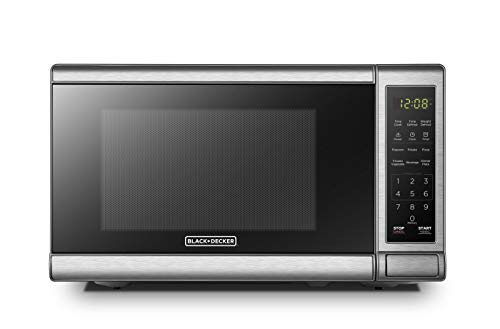
BLACK+DECKER’s 0.7 takes the same compact formula — 0.7 cubic feet, 700 watts — and dresses it in stainless steel, which changes the machine’s life in a designed kitchen more than any specification could. Where black compacts disappear into dorm shelves, a stainless compact sits comfortably beside full-size stainless appliances, letting a small household keep a coherent kitchen while using a microwave sized to its actual needs. For the couple in a smart apartment whose cooking is mostly for two, that visual citizenship is a legitimate reason to choose this model over its black siblings.
The working details are sound and conventional: digital controls with ten power levels, a push-button door release — which matters on a light machine, since a pull handle can drag the whole unit forward on a smooth counter — a removable turntable that lifts out for washing after the inevitable soup overflow, and a child safety lock. The push-button door deserves its sentence of praise: on compact microwaves it is the difference between a door that opens and a machine that travels, and experienced small-kitchen owners rank it alongside wattage when choosing.
Cooking pace is the class standard 700 watts, with all the adjustments that implies, and the cavity handles the dinner-plate-and-mug test the class is judged by. What this model does not offer is the mute or eco garnish of the COMFEE and Chefman; its case is finish, door design and a trusted badge. Check price on Amazon to confirm the stainless listing.
- Capacity: 0.7 cubic feet
- Power: 700 watts — the compact class pace
- Door: push-button release, kind to light machines
- Controls: digital, 10 power levels, removable turntable
- Finish: stainless steel
Strengths
- Stainless finish belongs in a designed kitchen among full-size appliances.
- Push-button door opens without dragging the light body.
- Removable turntable makes the inevitable spills a one-minute cleanup.
Trade-offs
- No mute function for late-night reheating in shared spaces.
- Stainless shows fingerprints more readily than black finishes.
- Same 700-watt cooking pace as the rest of the class.
Best for: style-conscious small households and apartment kitchens with stainless suites. Not suited for: dorm residents who need silent operation at night.
BLACK+DECKER 0.9 900W — Best Mid-Size Step
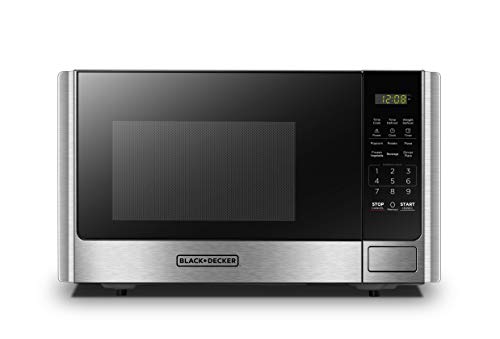
The 0.9 cubic foot BLACK+DECKER is where this guide’s centre of gravity shifts: 900 watts instead of 700, a fifth more cavity, six auto cook presets, ten power levels, a push-button door and a child lock, in the same stainless finish as its smaller sibling. Those numbers translate into the two improvements small-microwave owners ask for when they outgrow the 0.7 class — food that heats at something closer to packet times, and a cavity that takes a larger plate and a taller bowl without negotiation. For many buyers this is not a compromise size at all; it is the destination.
The honest framing is that 0.9 cubic feet is the top of “small” rather than its heart. The external footprint grows with the cavity, so the dorm shelf and the narrowest counter corners that welcome a 0.7 may refuse this machine; measure before assuming. In return, the 900-watt pace narrows the conversion gap on packaged foods to a small adjustment, reheats a full dinner plate evenly, and handles a modest casserole — the dish that defines the boundary between compact and family machines — without apology.
Households graduating from a 0.7 because a partner moved in, a baby arrived or the home office became permanent will find this the natural landing spot: same brand logic, same door and control manners, meaningfully more room and speed. Check price on Amazon and compare its listed dimensions against your counter run.
- Capacity: 0.9 cubic feet
- Power: 900 watts — noticeably closer to packet times
- Controls: 10 power levels, 6 auto cook presets
- Door: push-button release, child safety lock
- Finish: stainless steel
Strengths
- 900 watts removes most of the small-microwave time penalty.
- Cavity takes larger plates and modest casseroles.
- Same friendly controls and door design as the 0.7 model.
Trade-offs
- Footprint outgrows the tightest shelves and dorm corners.
- Still not a family machine for multi-plate queues.
- No mute function on this model.
Best for: couples and home workers graduating from the smallest class. Not suited for: the very tightest spaces, where the 0.7 models remain correct.

TOSHIBA 0.9 900W — Best 0.9 for Quiet Homes
Toshiba’s 0.9 matches the BLACK+DECKER’s size and wattage — 0.9 cubic feet, 900 watts — and differentiates itself with the quiet-home toolkit: a mute function for the beeps, six auto menus, a child lock, and a 10.6-inch removable turntable, finished in black stainless steel. That turntable diameter is worth pausing on, because it is the dimension that decides the dinner-plate question: at 10.6 inches it accepts the standard large plate that smaller compacts make you tilt and shuffle, and in daily reheating that easy fit is felt more often than any programme.
The black stainless finish gives the machine a contemporary, slightly softer look than bright stainless — it sits well in modern kitchens and shows fewer fingerprints than its shinier rivals. The mute function completes the household case: a 0.9 machine is often the family microwave, positioned in an open-plan kitchen where a baby naps nearby and a partner works at the table, and silencing the end-of-cycle chorus is a courtesy the whole room notices. Six auto menus cover the standard reheating repertoire without menu sprawl.
Against the BLACK+DECKER 0.9, the choice is temperamental: bright stainless and push-button familiarity there, black stainless, a specified turntable and silence here. Cooking pace and capacity are effectively matched, so let finish, noise and the plate test decide. Check price on Amazon to confirm the black stainless listing.
- Capacity: 0.9 cubic feet
- Power: 900 watts
- Turntable: 10.6-inch removable — fits standard large plates
- Extras: mute function, 6 auto menus, child lock
- Finish: black stainless steel
Strengths
- Mute function suits open-plan homes and nap-time reheating.
- Generous turntable ends the plate-tilting ritual.
- Black stainless hides fingerprints and suits modern kitchens.
Trade-offs
- Same footprint caveat as every 0.9 — measure tight shelves first.
- Six menus is a modest set beside the step-up Toshiba’s twelve.
- Not the cheapest route into the 0.9 size.
Best for: families and open-plan homes that want 0.9 capacity without the noise. Not suited for: buyers who need full family capacity — see the step-up below.

TOSHIBA 1.2 1000W Step-Up — Step-Up Pick: Family Duty
This pick carries its label openly: at 1.2 cubic feet and 1000 watts, the Toshiba EM131A5C is a step-up beyond the small class, included for the substantial group of shoppers who arrive asking for “small” and discover, measuring plate and counter, that their real life needs a compact family machine. Its specification justifies the detour — a smart humidity sensor that judges reheating by the steam the food gives off rather than by a timer’s guess, twelve auto menus, a mute function, an eco mode and an easy-clean interior, in stainless steel. Sensor reheating is the feature owners praise longest, because it rescues leftovers from the dried edges and cold centres of timed reheating.
At 1000 watts, packet instructions work as printed, family plates reheat in sequence without a queue forming, and the cavity swallows the casserole dishes and large bowls that define family cooking. This is, in truth, the microwave most households would choose if counter space were free — which is precisely why it must be labelled honestly in a small-microwave guide: its footprint is a family footprint, and a dorm shelf or narrow galley that fits the 0.7 models will not fit it.
Buy it if your “small” requirement was really about not wanting an enormous machine, rather than about a hard physical limit. The easy-clean interior and eco mode keep its manners compact even if its body is not, and the sensor gives it the best reheating judgement in this guide. Check price on Amazon and measure twice — this is the pick where dimensions decide.
- Capacity: 1.2 cubic feet — STEP-UP beyond the small class
- Power: 1000 watts — packet times work as printed
- Sensor: smart humidity sensor for reheating
- Extras: 12 auto menus, mute function, ECO mode, easy-clean interior
- Finish: stainless steel
Strengths
- Humidity sensor reheats leftovers better than any timer in this guide.
- Full family capacity and wattage end the small-microwave compromises.
- Mute and eco modes keep its manners small-space friendly.
Trade-offs
- Not a true compact — footprint excludes dorm shelves and tight galleys.
- More machine than a single-portion household will ever use.
- Its excellence can make the honest 0.7 picks look plain by comparison.
Best for: small families whose counter allows a compact family machine. Not suited for: hard size limits — dorms, boats and narrow shelves should stay with the 0.7 class.
How Do the Six Compare on Size, Power and Manners?
| Pick | Cavity | Power | Defining extra | Finish |
|---|---|---|---|---|
| COMFEE 0.7 Microwave | 0.7 cu ft | 700W | ECO mode, sound on/off | Black |
| Chefman 0.7 Microwave | 0.7 cu ft | 700W | 6 presets, express cook, mute | Black |
| BLACK+DECKER 0.7 Stainless | 0.7 cu ft | 700W | Push-button door, removable turntable | Stainless |
| BLACK+DECKER 0.9 900W | 0.9 cu ft | 900W | 6 auto cook presets | Stainless |
| TOSHIBA 0.9 900W | 0.9 cu ft | 900W | Mute, 10.6-inch turntable | Black stainless |
| TOSHIBA 1.2 1000W Step-Up | 1.2 cu ft | 1000W | Humidity sensor, 12 menus | Stainless |
How Do You Convert Cooking Times for 700 Watts?
The working rule is simple: a 700-watt machine needs roughly forty percent more time than the 1000-to-1100-watt machine most packets assume. A meal marked at five minutes wants about seven; a mug of soup marked at two wants closer to three. Rather than multiplying precisely at the counter, owners of the 0.7 class learn to add a third, check, and add a little more — microwaves forgive incremental cooking and punish the single heroic blast that leaves edges rubbery and the centre cold. Standing time is part of the conversion, not an afterthought: two minutes under a cover lets heat equalise through the food and regularly saves a second cooking round.
Technique closes the remaining gap. Stir or turn the food halfway through, arrange ring-shaped foods with the thickest parts outward, cover with a vented lid so steam helps the surface, and let dense items like a baked potato rest wrapped after cooking so the centre finishes on stored heat. Defrosting at low power in short bursts with rests between them beats one long low-power run. None of this is a workaround for a broken promise — it is how microwave cooking works at every wattage, merely more visible at 700. Master it in a fortnight and the small machine stops feeling slow and starts feeling sized correctly.
One conversion deserves its own line because it is the most common in student and office life: the instant noodle pot and the ready meal for one are both portioned for exactly this class of machine, and their printed times are usually written for mid-power microwaves, so they land closer to true at 700 watts than family-pack instructions do. The single-portion economy, in other words, already speaks this machine’s language — it is the family foods that need translating.
What Actually Fits Inside a 0.7 Cubic Foot Cavity?
Think in vessels rather than volume. The 0.7 cavity comfortably hosts a standard dinner plate in the models here, a cereal bowl, a large mug, a one-litre jug and the medium containers of meal-prep life. It refuses, with varying degrees of indignity, the family casserole, the large mixing bowl, the tall stockpot-style container and the oversized serving platter. The turntable’s diameter is the binding constraint — the plate must not only enter but rotate — so the pre-purchase ritual is to measure your everyday plate and compare it with the turntable figure in the listing, a check the Toshiba 0.9 makes easy by stating its 10.6 inches.
Height is the second constraint, and the one that surprises buyers of meal-prep containers with tall lids. A container that fits the width may foul the cavity roof once its lid is on, and microwaving with a lid ajar is a recipe for a redecorated interior. Keep one microwave-safe plate cover in the small kitchen and reheat on plates and bowls rather than in storage tubs; the food heats more evenly and the machine stays cleaner. If your household’s reheating life genuinely revolves around large containers, that is the market telling you to buy the 0.9 or the step-up 1.2, and this guide has labelled both honestly for exactly that moment.
Where Does a Small Microwave Earn Its Keep Best?
The dorm room is the classic placement, and the listings here court it openly: a compact footprint on a shelf, a child lock against corridor mischief, a mute button against thin walls. The small office is the second home — a break counter where six people reheat lunches in rotation values presets, express cook and a door that opens without drama, and where an eco mode trims the standby cost of a machine that works twenty minutes a day. The third placement is the family kitchen’s second microwave: a small unit in a utility corner or a teenager’s den that absorbs the snack traffic and keeps the main machine free at dinner time.
Two further placements deserve mention. In an elderly parent’s kitchen, a compact machine at a comfortable height, with simple one-touch controls, is safer and more usable than a large built-in at head height hauling heavy dishes in and out. And in the RV, boat or tiny home, the 0.7 class is often the only microwave that fits the galley’s dimensions and power budget at all. In each of these rooms the small microwave is not a compromise appliance — it is the correctly sized one, and the larger machine would be the mistake.
A note on power supply, since several placements in this guide are unconventional: these are ordinary countertop appliances for standard household outlets, and the compact class’s modest wattage makes it gentler on older wiring and shared circuits than a full-size machine. In an RV or boat, confirm your inverter or shore-power arrangement against the wattage of the model you choose — the 700-watt class exists comfortably in places a 1200-watt machine would strain — and secure the machine against travel movement, because a microwave that fits the galley must also stay in the galley when the road or the water moves.
There is also the spare-room and guest-suite placement, quieter than the others but beloved by hosts: a small microwave where guests stay turns a visit into independence, because a guest who can warm milk, tea or a midnight snack without descending to a dark kitchen feels housed rather than hosted. Hosts report that the little machine in the guest corner is commented on more warmly than furniture costing ten times as much, which tells you something about what travellers and grandparents actually value at ten in the evening — autonomy, warmth and a door that opens without instructions from the household’s manual. It also frees the main kitchen after hours, so a houseful of guests and a houseful of hosts can keep different hours without negotiating over a single humming box downstairs in the dark.
How Do You Keep a Compact Microwave Clean and Safe?
Cleaning is a steam trick: fill a microwave-safe bowl with water and a slice of lemon or a splash of vinegar, run it until the cavity steams, wait two minutes, and wipe — the dried splashes that looked permanent surrender without scrubbing. The removable turntables on several picks here lift out for a proper wash, and the glass tray should be a weekly habit in a busy small kitchen. Wipe the door seal and the latch area as you go, because a clean seal is also a safe seal, and never run the machine empty, which stresses it at any size.
Safety in this class is mostly placement and supervision. Give the vents the clearance the manual specifies — small machines in tight shelves still need to breathe — and keep the cord off the hot zone of any nearby hob. The child locks across these listings exist for kitchens where the microwave sits at curious-toddler height; engage them, because a compact at counter height in a small flat is reachable earlier than parents expect. Use microwave-safe vessels only, pierce films and skins, and treat metal as the absolute exclusion it is. None of this differs from full-size practice; it simply matters more in rooms where the machine is close to beds, desks and children.
How Do Presets and Express Cook Change Daily Use?
It is tempting to dismiss presets as decoration, and on large machines with exotic programmes that is often fair. On a compact, the preset row is the machine’s memory of its own wattage. A popcorn setting on a 700-watt model encodes the longer, pulsed pattern that small power needs to pop a bag without scorching it; a beverage setting knows the mug takes longer here than in a family machine; a reheat setting cycles power so the plate warms through rather than erupting at the edges. Owners who use the presets on the Chefman or the auto menus on the Toshibas are not being lazy — they are borrowing the manufacturer’s own conversion work.
Express cook deserves separate respect because it matches how people actually behave at a microwave: door open, food in, one button, walk away. A control scheme that demands four presses for a thirty-second blast will be circumvented by frustrated users adding minutes they do not need, which is how small machines acquire a reputation for ruining snacks. When you compare the panels in this guide, count the presses between a cold plate and a heating one. The machines that minimise that count are the machines their owners describe as easy, and in shared kitchens — dorms, offices, family homes — easy is the feature that survives contact with other people’s habits.
What Should a Small Office Look For in a Break-Room Microwave?
Office duty is harder than home duty in specific ways. The machine is used by many hands, cleaned by nobody in particular, and asked to reheat a queue of lunches inside a forty-minute window. Priorities reorder accordingly: presets and express cook matter because colleagues will not read instructions; a push-button door matters because it survives hurried use better than a yanked handle; a removable turntable matters because Friday’s soup incident must be cleanable by Monday’s first user in under a minute. The 0.9 models earn a serious look here, because the queue moves at 900-watt pace and the cavity takes the larger lunch containers offices accumulate.
The COMFEE’s eco mode speaks directly to office economics — a machine drawing standby power around the clock for twenty minutes of daily work is a small but real waste, multiplied across every branch and floor. Sound control matters in the open-plan era, when the break counter may sit metres from desks. And the child lock, irrelevant to the office itself, signals a panel designed for public use. If the office is tiny — two or three people — the 0.7 class suffices and saves counter for the kettle and the coffee things; if the lunch queue is a genuine institution, step up without regret.
How Do You Reheat a Full Dinner Plate Evenly at Low Wattage?
The dinner plate is the compact microwave’s examination, and it is passed with arrangement rather than power. Spread the food in a ring with the centre shallow, because microwaves penetrate from the edges and a mounded middle is the last place heat reaches. Put the densest items — the meat, the thick sauce — at the rim and the quick-cooking vegetables toward the centre. Cover with a vented plate cover so steam works the surface, and stop halfway to rotate the plate and stir what can be stirred. Then, the step everyone skips: let the plate stand, covered, for two full minutes while the temperatures inside it negotiate their way to even.
Sequencing helps a household plate too. If the meal includes something that reheats poorly — a crisp skin, a fried coating — accept that the microwave’s job is the mash, the vegetables and the sauce, and give the crisp element two minutes in a dry pan or the oven while the plate stands. Small-microwave mastery is mostly this kind of honesty: use the machine for the ninety percent of reheating it does beautifully, and stop asking it to perform the one trick — re-crisping — that no microwave at any wattage has ever learned.
When Should You Skip the Small Class Entirely?
Three households should not buy from the compact heart of this guide, and naming them is a service. The first reheats in volume: families of four or more eating together nightly, where plates queue and a 700-watt door becomes a bottleneck with a beep. The second cooks in the microwave — casseroles from raw, large vegetables, batch meal prep — work that needs cavity and wattage together. The third owns the big vessels: the 33-centimetre plates, the tall prep tubs, the family lasagne dish that defines Sunday. For all three, the honest purchase is the step-up Toshiba or a full family machine, and the compact would be returned within the month.
There is a fourth, subtler case: the buyer whose counter is generous but whose instinct says small. Instinct deserves a hearing — a smaller machine leaves room for the kettle, the board, the fruit bowl, and kitchens are lived in, not merely equipped. If your reheating life is genuinely single portions and mugs, the 0.7 class on a spacious counter is not under-buying; it is buying the kitchen you want to stand in. The mistake is only ever the mismatch, in either direction, between the machine’s honest capacity and the household’s honest week.
What Do the Finishes Mean for a Visible Counter Machine?
A compact microwave is furniture as much as appliance: it occupies the eyeline of the smallest rooms in the house, and its finish decides whether it reads as equipment or as clutter. The black models — COMFEE and Chefman — recede; they suit shelves, dorms and offices where the machine should disappear between uses. Bright stainless, on the BLACK+DECKER pair, asserts itself and earns its place only where other stainless appliances give it company. Black stainless, the Toshiba 0.9’s finish, splits the difference: present but softened, modern without glare, and kinder about fingerprints than either extreme.
Fingerprints deserve their honest sentence. A microwave door is touched constantly, often with buttery hands, and bright stainless records every touch until wiped. Households bothered by that record should choose black or black stainless and spend their wiping budget on the turntable instead. Households who wipe appliances as a pleasure can ignore the whole question. Either way, choose the finish for the room the machine will actually live in — photographed kitchens in listings are lit to forgive everything, and yours will not be.
How Do You Defrost Properly in a Compact Microwave?
Defrosting is the low-power art, and it is where the ten power levels on these panels justify themselves. The method is patience in instalments: use the defrost setting or a low power level, work in short bursts, and separate and turn the pieces as soon as they allow it, so the thawed outer parts stop shielding the frozen core. A single chicken breast or a portion of mince for tonight’s dinner defrosts beautifully this way in a 0.7 machine; a whole frozen chicken does not belong in the compact class at all and should thaw in the fridge overnight like it always has.
Standing time is again half the technique — a defrosted-looking portion left to stand for five minutes equalises, while one rushed straight into the pan cooks at the edges before its centre has finished thawing. Cook defrosted food promptly, and treat the microwave as a thawing tool for today’s meal rather than a way to rescue a forgotten freezer item at the last minute for a crowd. Small machines reward the household that plans one portion ahead, which is, not coincidentally, the household they were designed for.
What Is the Real Difference Between 0.7, 0.9 and 1.2 Cubic Feet?
Strip the numbers to their lived meaning. The 0.7 class is a one-person appliance: a plate, a bowl, a mug, in rotation. The 0.9 class is a two-person appliance with headroom: the bigger plate fits without tilting, two mugs can warm in sequence without a queue forming, and a modest casserole crosses the threshold from impossible to easy. The 1.2 step-up is a family appliance in a compact coat: it takes the family’s dishes as a matter of routine and reheats in parallel with the life of a household of three or four.
Wattage travels with size in this guide — 700, 900, 1000 — and the pairing is not accidental: bigger cavities need more power to heat their larger loads in reasonable times, and the manufacturers have matched them sensibly. The buyer’s task is to locate their household on that single sliding scale honestly. Most regret in this category comes from placing yourself one step too low out of thrift or counter anxiety; the step costs little counter, as the dimensions in the listings show, and pays out at every single meal. Measure the space, measure the plate, count the people — the scale will tell you where you stand.
How Should You Set Up a Small Microwave on Day One?
Unbox onto the intended surface and check the clearances before the first mug: the vents — usually at the side and rear — need the breathing room the manual states, and a compact pushed flush into a corner shelf will run hot and unhappy. Level the machine so the turntable runs true, seat the roller ring and plate properly, and run the inaugural steam-clean with a bowl of water so the cavity starts life fresh and you learn the panel’s basic grammar on a task that cannot be ruined.
Then set the two preferences that personalise the machine: silence the beeps if your model offers mute and your household keeps quiet hours, and set the clock, because a blinking unset display in a small room is a permanent small irritation. Cook one familiar item — your usual mug of soup, your standard leftover plate — using the converted time for its wattage, and note the adjustment that worked on a sticky note inside a cupboard door. That single calibration, done on day one, converts the machine from a stranger into your machine faster than a week of guessing.
Why Do Owners Keep a Compact Microwave Longer Than Expected?
There is a pattern in small-appliance ownership worth naming: the compact microwave bought as a stopgap — for the dorm year, the first flat, the renovation — is still in service a decade later, long after its supposed replacement was affordable. The reasons are structural. Its jobs never changed, because reheating a portion and warming a mug are eternal tasks; its simplicity left little to break; and its smallness, once adapted to, turned out to be a virtue in kitchens that filled up with other things. The stopgap became the fixture.
That longevity reframes the purchase. A machine that will plausibly serve ten years should be chosen on the qualities that matter across ten years — a door mechanism that feels solid, a panel that strangers can read, a finish that suits more than one kitchen, since the machine may move house with you twice. The few extra minutes spent comparing the six honest options in this guide, rather than grabbing the first small box on offer, are repaid across thousands of unremarkable, perfectly heated mugs — which is, in the end, the entire point of the appliance.
What Mistakes Do Small Microwave Buyers Make Most Often?
The first is buying wattage-blind: ordering a 700-watt compact and expecting the packet’s five minutes to be true, then reviewing the machine as faulty. The second is measuring the counter but not the plate — a microwave that cannot rotate your dinner plate fails its main job daily. Third is placing a compact in a sealed shelf or against a wall vent, then wondering at the heat and the shortened tempers of everyone nearby.
Fourth, buyers underrate the door: a pull-handle on a light machine drags it across the counter with every use, which is why the push-button models earn their praise here. Fifth, dorm and office buyers forget the noise question until the first midnight reheat announces itself to the whole corridor — a mute button is a small line in a listing and a large mercy in a shared building. Finally, some buyers who genuinely need family capacity buy the 0.7 class for its price and queue four plates through it nightly; if that is your life, the step-up Toshiba exists, labelled plainly, to save you from the queue.
Final Recommendation
For the true compact brief — dorm, office, studio, single cook — the COMFEE 0.7 Microwave is our default: honest 700-watt cooking, an eco mode, silenced beeps and one-touch manners in the smallest footprint here. Preset lovers should take the Chefman twin instead, and kitchens that care about appearances the stainless BLACK+DECKER. When the counter allows a little more, the TOSHIBA 0.9 900W is the graduation pick, with its plate-friendly turntable and mute. And if measuring your plates tells you the truth — that your small microwave is really a family machine — choose the step-up TOSHIBA 1.2 1000W Step-Up without a flicker of guilt, and enjoy the sensor doing your reheating thinking for years to come, every single day, without a second thought.
Frequently Asked Questions
Is 700 watts enough for everyday cooking?
For the compact class’s real jobs — reheating single portions, beverages, noodle pots, snacks, defrosting modest amounts — yes, provided you add roughly a third to packet times and use standing time properly. It is not the right wattage for cooking family meals from raw, and no honest guide would claim otherwise. Judge it instead by how gracefully it handles the mug, the bowl and the single plate, because those three vessels are its whole working life and it handles them well.
Will a standard dinner plate fit in a 0.7 cubic foot microwave?
In the models in this guide, generally yes — but the turntable diameter is the deciding figure, so check your largest everyday plate against the listing before ordering. If your plates are oversized or your containers tall, the 0.9 models, particularly the Toshiba with its 10.6-inch turntable, remove the doubt.
What does a mute function actually silence?
The button beeps and the end-of-cycle alerts. The machine’s operating hum remains — no microwave is silent — but in dorms, offices and open-plan homes it is the beeps that carry through walls and wake babies, so the function earns its place on a listing.
Can I put a small microwave in a dorm room or RV?
That is the class’s home territory, subject to your institution’s or vehicle’s rules. Check the permitted wattage and the available space, confirm the shelf can take the weight and ventilation clearance, and the 0.7 models here are built for exactly those placements.
Is the 1.2 cubic foot Toshiba really a “small” microwave?
No — and this guide labels it a step-up in its badge, its section and the comparison table for that reason. It is included because many shoppers who search for a small microwave discover their true need is a compact family machine; if your space limit is hard, stay with the 0.7 and 0.9 picks.
How long should a compact microwave last?
With the steam-clean routine, clear vents and sensible use, a compact microwave should serve for years of daily work. The class’s simplicity helps it: fewer exotic parts, modest power, and a duty cycle of short jobs rather than marathon cooking sessions.
Related Guides
Small kitchens reward coordinated choices, so pair this guide with Best Small Retro Microwaves if style is steering your shortlist, soften the room with Best Bedroom Runner Rugs, and complete the counter with Best Nonstick Cookware Sets for Flat Cooktops for the hob side of a compact kitchen.


