What's inside
- Key Takeaways
- Quick Picks
- How We Chose These Picks
- Which of the Best Canister Vacuums for Large Particles Fits Your Routine?
- How Do the Six Compare at a Glance?
- What Counts as a Large Particle, and Why Do Household Vacuums Hate Them?
- Wet, Dry and Blow: What Does a 3-in-1 Utility Vac Actually Do?
- Why Does Fine Dust Defeat a Standard Utility Filter?
- How Should You Choose Tank Size Without Buying a Swimming Pool?
- What Does a Cyclone Pre-Separator Change in a Workshop?
- When Does a Backpack Canister Beat Every Tank in This List?
- How Do You Empty a Utility Tank Without Re-Distributing the Mess?
- What Maintenance Keeps a Wet Dry Vac Honest for Years?
- How Loud Is a Utility Vac, and How Do You Live With One?
- What Can a Blower Function Replace Around a House and Garden?
- How Do You Handle Ash, Drywall Dust and Other Fine Villains Safely?
- What Accessories Actually Earn Their Storage Space?
- How Should You Run a Utility Vac From a Generator or Long Extension?
- When Should a Workshop Stop Vacuuming and Start Extracting at Source?
- How Do You Match a Utility Vac to a Vehicle Fleet of One Family Car?
- Why Do Workshops Need Both a Utility Vac and a Broom?
- How Should You Winterise a Utility Vac That Lives in a Cold Garage?
- How Do You Clean a Car Interior With a Utility Vac Like a Professional?
- What Safety Habits Separate a Workshop Vac’s Owner From Its Casualty?
- How Should You Store Hoses and Attachments So They Survive the Machine?
- Why Is the Cheapest Utility Vac Often the Most Expensive per Year?
- How Do You Clear a Garage Floor After a Winter in One Session?
- Why Does Every Workshop Need a Wet Plan Before It Needs One?
- How Do You Decide Between Two Mid-Size Tanks on the Same Shelf?
- What Is the Final Question to Ask a Utility Vac Before It Earns the Garage?
- What Mistakes Do Buyers Make Most Often?
- Final Recommendation
- Frequently Asked Questions
- Related Guides
As an Amazon Associate I earn from qualifying purchases. This post may contain affiliate links at no extra cost to you.
cottageverdict.com is reader-supported. When you buy through links on our site, we may earn an affiliate commission.
Where to buy: the six machines below are sold on Amazon, linked from the Quick Picks table, the review headings and the comparison table, where you can check price on Amazon and confirm tank size, motor figures and included accessories. The best canister vacuums for large particles are, honestly described, wet and dry utility machines, built to swallow gravel, chips and spills that would choke a household canister, and this guide grades them as utility tools rather than dressing them as indoor appliances.
That honesty runs both ways. These machines are magnificent at coarse debris and, on standard filtration, poor at fine dust, a limitation stated in every review and answered with the upgrades or designs that address it. One pick, a professional backpack, is included for mobility rather than wet duty, and is labelled as such without apology.
Key Takeaways
- This category means wet dry utility vacs, not household canisters with bigger claims.
- Standard utility filtration passes fine dust; upgrades or a separator fix that honestly.
- Tank size should match the largest ordinary job and the cupboard it must live in.
- A full wet tank weighs a kilogram per litre; plan the emptying route in advance.
- The PEMEDOR’s pre-separator keeps suction honest through coarse workshop loads.
- The Atrix backpack trades wet duty and capacity for professional mobility.
Quick Picks
| Pick | Badge | Why it earns its place |
|---|---|---|
| STANLEY 5 Gallon Wet Dry Vac | Best All-Round Utility Size | A 5 gallon 4 HP stainless wet dry vac with blower function, 85CFM airflow and 15ft reach in its listing. |
| Stanley 6 Gallon Wet Dry Vac | Best Extra Gallon Capacity | A 6 gallon 4 horsepower wet dry Stanley, the step-up tank for longer jobs between emptyings. |
| Armor All 2.5 Gal Utility Vac | Best Compact Car and Bench Vac | A 2.5 gallon 2 peak HP wet dry utility vac in orange and black, sized for cars and small messes. |
| STANLEY 3 Gallon Stainless Vac | Best Portable Stainless 3-in-1 | A 3 gallon stainless wet dry vac with a 4 peak HP motor, blower function and portable 3-in-1 brief. |
| PEMEDOR 9 Gallon Dust Extractor Vac | Best for Wood Chips and Coarse Debris | A 9 gallon 1400W extractor with dual cyclone pre-separator, HEPA filter and anti-static hose, per its listing. |
| Atrix Ergo Backpack Canister | Best Professional Backpack | An Ergo backpack canister in a premium bundle, worn rather than trailed, for professional and residential use. |
How We Chose These Picks
The field was defined by debris, not by marketing: every pick had to swallow coarse material that defeats household machines, whether by tank, hose and utility construction or, in the backpack’s case, by reaching furnished and stair-ruled spaces where debris accumulates beyond a trailed machine’s range. Tank sizes were spread deliberately from 2.5 to 9 gallons so the list maps real households rather than one workshop repeated six times.
Filtration honesty was the second filter. Standard utility setups are described as motor guards, fine-dust upgrades are named as the owner’s responsibility where the platform requires them, and the one design that builds separation and HEPA staging in is credited for exactly that engineering. No dust collector or fixed workshop extraction unit belongs in a portable category, and none appears here.
Which of the Best Canister Vacuums for Large Particles Fits Your Routine?

STANLEY 5 Gallon Wet Dry Vac — Best All-Round Utility Size
The five-gallon Stanley is the size most garages actually need: a stainless tank on a 4 HP wet dry platform, listed with an 85CFM airflow figure, a blower function and a 15ft reach across its accessories. Large particles are its native language, gravel from the boot tray, screws from the workbench shadow, leaves that colonised the porch corner, all swallowed without the throat-clearing that stops a household canister. The three-in-one brief, wet, dry and blow, makes it a yard tool as much as a floor tool.
Fine dust is where honesty must enter. A utility vac’s standard filtration is built to protect the motor and pass the big material, not to polish exhaust air, so drywall dust, ash and fine sawdust call for the finer bags or filters the maker offers for the platform, bought and fitted deliberately. Used with that understanding, the five-gallon size hits the utility sweet spot: large enough for a renovation corner, light enough to carry to the car, and stainless where plastic tanks crack in cold garages.
- Tank: 5 gallon, stainless steel
- Motor: 4 HP, per the listing
- Airflow: 85CFM, per the listing
- Functions: wet, dry and blower
- Reach: 15ft with accessories, per listing
- Territory: garage, workshop, jobsite
Strengths
- Swallows debris that stops household machines
- Blower clears leaves and bench dust
- Stainless tank survives cold garages
Trade-offs
- Fine dust needs upgraded bags or filters
- Utility noise exceeds household manners
- Tank empties by hand, no sealed bag
After each workshop session, knock this Stanley’s filter clean outdoors before the machine goes back to its corner. Thirty seconds then prevents the slow blinding that owners misdiagnose as a motor ageing, when the motor was only ever breathing through a wall of yesterday’s dust.
Best for: garages and workshops wanting one mid-size wet dry machine for everything
Not suited for: indoor households expecting polished filtration from a utility platform

Stanley 6 Gallon Wet Dry Vac — Best Extra Gallon Capacity
One gallon sounds like nothing until the job is a flooded corner, a season of leaves or a workshop floor after a build, when the sixth gallon is the difference between finishing and stopping to empty. This Stanley pairs that larger tank with the same 4 horsepower class as its five-gallon sibling, so the gain is endurance rather than force, a distinction buyers should hold clearly: suction character stays familiar, while the interval between interruptions stretches.
The larger tank asks for storage room and a stronger lift when it is full of water, which weighs what water always weighs. Plan the emptying route before the flood, not during it. For dry large particles, cereal spills of workshop life, offcuts, grit, pet food by the sack-load accident, the capacity is pure convenience. Fine dust carries the platform’s standing caveat: fit the finer filtration the maker specifies before asking a utility vac to behave like a dust extractor, because tank size does nothing for exhaust quality.
- Tank: 6 gallon capacity
- Motor: 4 horsepower, per listing
- Functions: wet and dry pickup
- Brand line: Stanley SL18116P model
- Territory: garage and workshop jobs
- Handling: larger tank, plan the lift
Strengths
- Extra gallon stretches long jobs
- Familiar 4 HP suction character
- Capacity suits floods and leaf seasons
Trade-offs
- Full wet tank is a heavy lift
- Needs more storage room than siblings
- Fine dust still needs filtration upgrades
The sixth gallon earns its keep in autumn, when leaves arrive faster than any household schedule. Park this tank by the porch door for the season rather than in the workshop’s far corner, and its capacity will be used at the moment the mess happens.
Best for: workshops and garages with long jobs and room to store a larger tank
Not suited for: smaller spaces where a full wet tank would be unmanageable
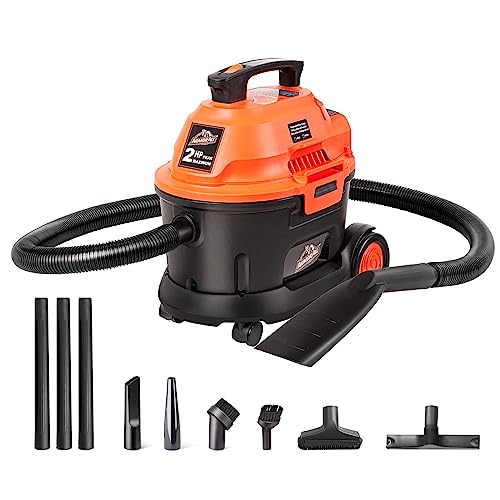
Armor All 2.5 Gal Utility Vac — Best Compact Car and Bench Vac
The Armor All is the sprinter of this six: 2.5 gallons, 2 peak HP, orange and black, built for the car footwell, the workbench’s shadow and the porch step rather than for a flooded garage. Large particles in its world are crisps, gravel, pet kibble and the grit that lives under car mats, and at that scale its compact tank is a virtue, because the machine lives within arm’s reach of the messes it serves instead of in a garage corner that requires an expedition.
Small tanks fill quickly, which is the honest trade, and a household that buys this as its only utility vac will learn the route to the bin by heart. Wet duty is genuine but modest, a spilled bottle or a defrosting freezer’s puddle rather than a burst pipe. Fine dust obeys the same rule as its larger siblings, with standard utility filtration asking for upgrades before fine work. Judged as a dedicated car and bench instrument that happens to live indoors happily, it earns its place without pretending to be a workshop machine.
- Tank: 2.5 gallon, compact
- Motor: 2 peak HP, per listing
- Functions: wet and dry utility pickup
- Colour: orange and black
- Territory: cars, benches, small messes
- Storage: arm’s-reach indoor size
Strengths
- Lives beside the messes it serves
- Ideal scale for cars and benches
- Light enough for anyone to deploy
Trade-offs
- Small tank fills quickly on big jobs
- Wet capacity suits spills, not floods
- Not a whole-workshop machine
Keep the Armor All’s small filter on a replacement rhythm of its own, because a compact machine’s little element loads faster than a big tank’s and its owner, spoiled by the machine’s convenience, is the most likely in this list to forget that filtration exists at all.
Best for: car owners and bench workers wanting a compact utility vac indoors
Not suited for: anyone needing flood capacity or workshop endurance

STANLEY 3 Gallon Stainless Vac — Best Portable Stainless 3-in-1
Three gallons in stainless with a 4 peak HP motor is a deliberate mismatch, and a good one: a small tank that empties easily, driven harder than its size suggests, in a material that shrugs off the dents and cold that age plastic. The listing’s 3-in-1 wording adds the blower to wet and dry duty, so this compact Stanley clears the bench it just vacuumed, a sequence full-size machines perform with more ceremony than a small job deserves.
Portability is the design’s centre. This is the vac that travels to the boat, the rental, the upstairs spill, because its owner can carry it in one hand and store it on a shelf. The standing utility caveats apply undiluted: standard filtration for coarse work, finer bags or filters before fine dust, and a tank that will fill twice on a job its six-gallon sibling finishes in one visit. Buy it for frequency and reach, and its smallness becomes the reason it is used daily while larger machines wait for occasions.
- Tank: 3 gallon, stainless steel
- Motor: 4 peak HP, per the listing
- Functions: wet, dry and blower 3-in-1
- Build note: portable, per the listing
- Territory: spills, benches, travel jobs
- Storage: shelf-sized footprint
Strengths
- Strong motor in a one-hand package
- Stainless shrugs dents and cold
- Blower finishes small jobs completely
Trade-offs
- Tank fills twice on large jobs
- Fine dust needs filtration upgrades
- Small footprint tips if hose is yanked
A stainless tank should be dried after wet work with the lid off, in the garage’s air, because even steel prefers not to store a damp interior against next month. The habit takes no time, only the decision not to close the lid at the end of a wet day.
Best for: households wanting a portable stainless utility vac for frequent small jobs
Not suited for: workshops needing tank endurance for builds and floods

PEMEDOR 9 Gallon Dust Extractor Vac — Best for Wood Chips and Coarse Debris
The PEMEDOR is the specialist in a list of generalists: a 9 gallon, 1400W wet dry machine whose listing specifies a dual cyclone pre-separator, a HEPA filter and an 8.2ft anti-static hose, aimed squarely at wood chips, shavings and coarse debris. The pre-separator is the engineering to understand, because it spins the heavy fraction out of the airstream before the filter is asked anything, which is exactly how a machine can eat a workshop’s coarse output all day without its filtration choking by lunch.
Its stated suction figure, 19KPA in the listing, and the anti-static hose both speak the language of tool-connected work, where dust extraction is a process rather than a tidy-up. Nine gallons of capacity suits that process, and the wet dry range covers the workshop’s liquid accidents too. This is not a household canister and should not be bought as one; it is the machine for a maker whose floor produces chips by the bucket, and whose fine dust, handled by its HEPA stage after the cyclone has taken the weight, is a by-product of work rather than of living.
- Tank: 9 gallon capacity
- Power: 1400W, 19KPA per listing
- Separation: dual cyclone pre-separator
- Filtration: HEPA filter, per the listing
- Hose: 8.2ft anti-static, per listing
- Territory: wood chips, shavings, coarse debris
Strengths
- Pre-separator protects filtration all day
- Built for tool-connected workshop work
- Nine gallons between emptyings
Trade-offs
- Overkill for ordinary household messes
- Workshop scale needs workshop storage
- Process machine, not a quiet indoor tool
Log the PEMEDOR’s separator emptyings for the first month of workshop use. The rhythm it reveals, per project, per timber, per tool, becomes the maintenance calendar that keeps its suction honest without a single guess for the rest of its service.
Best for: makers and workshops producing chips and coarse debris daily
Not suited for: households wanting a polite indoor canister for crumbs and dust

Atrix Ergo Backpack Canister — Best Professional Backpack
The Atrix breaks this list’s pattern deliberately, and its difference must be stated plainly: it is a backpack canister, worn on the operator’s body, sold in a premium bundle with attachments for professional and residential cleaning. It is not a wet dry utility vac, and it does not drink floods or swallow gravel by the scoop. Its large-particle talent is mobility: in theatres, offices, stairwells and furnished rooms where a trailed tank cannot follow, a worn canister keeps working through debris that stops wheeled machines at the door.
Professional context is the listing’s own framing, and it fits: operators who clean for a living trade tank capacity for range and speed, wearing the machine up stairs and between seats without a cord-and-body negotiation at every row. Residential buyers should adopt it only with that trade understood, as a specialist for awkward architecture and frequent whole-house circuits. Filtration and bag details belong to its listing and bundle, which should be read closely before purchase, since a professional platform’s consumables are part of its working system.
- Format: backpack canister, worn
- Bundle: premium, attachments included
- Use: professional and residential, per listing
- Mobility: stairs and furnished spaces
- Duty: dry canister cleaning platform
- Consumables: read bundle listing closely
Strengths
- Goes where trailed tanks cannot follow
- Professional pace across stairs and rows
- Premium bundle arrives work-ready
Trade-offs
- Not a wet dry utility machine
- Capacity traded for mobility
- Worn weight is not for every operator
The backpack’s straps are its ergonomics, and they deserve the fitting time a rucksack gets: load shared at the hips, hose routed to the working hand, attachments placed where the free hand falls. Ten minutes of fitting at the start is what makes the format feel professional by lunch.
Best for: professionals and awkward-architecture homes needing a worn canister
Not suited for: anyone needing wet pickup or bulk debris capacity
How Do the Six Compare at a Glance?
| Model | Form | Key trait | Signature strength |
|---|---|---|---|
| STANLEY 5 Gallon Wet Dry Vac | Wet dry utility | 5 gallon stainless tank | All-round utility balance |
| Stanley 6 Gallon Wet Dry Vac | Wet dry utility | 6 gallon tank | Endurance over force |
| Armor All 2.5 Gal Utility Vac | Wet dry utility | 2.5 gallon compact | Car and bench sprinter |
| STANLEY 3 Gallon Stainless Vac | Wet dry utility | 3 gallon stainless | Portable power mismatch |
| PEMEDOR 9 Gallon Dust Extractor Vac | Dust extractor | Cyclone pre-separator | Workshop process power |
| Atrix Ergo Backpack Canister | Backpack canister | Worn professional format | Mobility over capacity |
What Counts as a Large Particle, and Why Do Household Vacuums Hate Them?
Anything with edges and ambition: gravel, screws, cereal, kibble, leaf fragments, wood offcuts, the grit that pours from a boot tray. Household canisters are plumbed for dust, with narrow hoses, delicate fans and filters placed early in the airstream, so a screw can jam a bend, a scoop of gravel can sandblast a fan, and a handful of chips can blind a filter in a single pass. The machine does not fail from weakness; it fails from being asked to eat outside its design.
Utility vacs invert the plumbing. Wide hoses, a tank that is the first and largest separation stage, and a motor protected by distance rather than by fine filtration let debris arrive at speed and simply fall into the drum. That inversion is why this guide’s category exists, and why the honest first question is never which utility vac is strongest, but whether your mess is coarse enough to need one at all.
Wet, Dry and Blow: What Does a 3-in-1 Utility Vac Actually Do?
Wet means the tank and float system tolerate liquids, from a defrost puddle to a flooded corner, with the filter arrangement changed as the maker directs, because a paper element that drinks water is finished. Dry means the ordinary coarse pickup the platform exists for. Blow reverses the exhaust into a hose-fed gust that clears leaves from a porch, dust from a bench and water from a crevice, turning the machine from a collector into a mover.
The sequence matters in real work. Blow first to gather a scattered mess into a governable pile, vacuum second to remove it, and keep wet duty for its own session with its own setup. Owners who treat the three functions as one continuous mode end with a tank of mud and a filter like felt. Owners who separate them own three tools that share a motor, which is the bargain the 3-in-1 wording actually offers.
Why Does Fine Dust Defeat a Standard Utility Filter?
Because the standard filter is a motor guard, not an air polisher. Its pores pass the finest fraction, drywall dust, ash, cold stove residue, fine sanding flour, straight through to the exhaust, where the machine re-delivers it to the room as a visible plume that settles on everything the cleaning was meant to improve. The tank captures the coarse majority beautifully and the fine minority not at all, which is why a utility vac can leave a workshop looking cleaner and measuring dirtier.
The remedy is deliberate, not automatic: finer filter bags or upgraded elements made for the platform, fitted before fine work begins, and emptied or replaced on the schedule their loading demands. The PEMEDOR in this list builds the answer into its design with a pre-separator and HEPA stage. The Stanleys and the Armor All ask their owners to specify it. Either route works; the only failing route is assuming the standard setup already handles dust it was never built to catch.
How Should You Choose Tank Size Without Buying a Swimming Pool?
By the largest ordinary job, not the largest imaginable one. A car and bench household lives inside 2.5 to 3 gallons and gains daily ease from the smallness. A garage and garden household belongs at 5 gallons, the size that finishes a season’s corner without a mid-job empty. Flood-prone or build-heavy workshops earn 6 to 9 gallons, where endurance outweighs the lift of a full wet tank, which should be pictured honestly: water weighs a kilogram a litre, and a full large tank is a two-handed, planned event.
Storage casts the deciding vote in small homes. A tank that lives in the workshop gets used; a tank exiled to a loft becomes a rumour. Measure the cupboard before the capacity, choose the largest size that will actually reside beside its work, and let frequency, the true measure of a utility machine, settle the rest.
What Does a Cyclone Pre-Separator Change in a Workshop?
It changes who meets the debris first. In a conventional utility vac the filter meets everything, and coarse loads blind it progressively, so suction fades through the very jobs that need it most. A pre-separator spins the airstream so the heavy fraction, chips, shavings, grit, falls into the tank by physics before the filter is consulted, leaving the filter to judge only the fine remainder. Suction stays honest for hours instead of minutes.
That is why the PEMEDOR’s dual cyclone wording matters more than its wattage, and why tool-connected makers, whose machines run alongside saws and sanders for whole sessions, treat separation as the headline specification. A household buying for weekend tidying will never notice the difference. A workshop buying for process work will notice nothing else by the second day.
When Does a Backpack Canister Beat Every Tank in This List?
When the building, not the debris, is the obstacle. Stairwells, raked seating, furnished offices and houses with a flight between every two rooms punish a trailed tank at every transition, and a worn canister simply walks through, cleaning as it goes. The Atrix in this list exists for that geography, and professionals buy it because minutes saved per row compound into hours per week.
The trade is capacity and wet duty, both surrendered to mobility, and households should accept the trade only when their architecture truly imposes it. A backpack worn to clean one flat floor is theatre; a backpack worn through a split-level, stair-ruled house is the first machine that has ever fit the building. Match the format to the map, and the odd one out of this list becomes its most logical member.
How Do You Empty a Utility Tank Without Re-Distributing the Mess?
Outside, downwind, and low. Carry the tank to the bin or the garden boundary rather than tipping it indoors, keep the opening near the receiving surface so debris falls instead of billowing, and let the coarse load slide as a single mass where the job allows. Filters should be tapped clean outdoors with the same discipline, never blown back into the workshop’s air with the machine’s own blower, a temptation whose irony becomes visible in the light through a door.
Wet loads deserve a drain plan made while the tank is still empty: a floor drain, a garden corner that welcomes grey water from a spill clean-up, a bucket relay for the last litre. Gloves are not fussiness with workshop debris, which files its nails and screws among the dust. A two-minute emptying ritual, performed in the right place, is what separates a utility vac’s owner from its victim.
What Maintenance Keeps a Wet Dry Vac Honest for Years?
Rinse and dry the tank after wet duty, every time, because a sealed damp tank grows a smell that colonises the next dry job. Inspect the float that guards the motor against overfilled liquid, since a stuck float converts a flood clean into a motor replacement. Check hoses for the partial blockages, the sock, the offcut, the knot of leaves at a bend, that present as mysterious weakness in a machine whose motor is blameless.
Filters follow the work: standard elements brushed or tapped after coarse sessions, fine bags replaced on loading rather than on hope, and any element that has been soaked against its design retired without debate. Store the machine dry, hose drained, cord loose. Utility vacs are the most forgiving machines in this entire series of guides, and the small routine above is all they ask in exchange for eating what nothing else in the house can swallow.
How Loud Is a Utility Vac, and How Do You Live With One?
Honestly loud, in a register household machines avoid: a utility motor is cooled and housed for work, not for conversation, and its note carries across a garden and through a workshop door. Plan its sessions the way you would plan a saw’s, in the hours when the household and the neighbours have agreed, tacitly or otherwise, that work is happening. Hearing protection for long sessions is not drama; it is the same respect you would give any other power tool of similar voice.
Short sessions change the calculation. A two-minute car clean or a spill’s rescue is over before the noise becomes a burden, which is another argument for the compact machines in this list living within reach: their brevity is their politeness. The large tanks earn their noise across long jobs where no quieter tool could do the work at all, and judged by the job rather than by the decibel, their owners rarely complain.
What Can a Blower Function Replace Around a House and Garden?
More than its novelty suggests. It clears a porch without a broom’s dust-raising, dries a washed car panel’s seams, empties a gutter’s reachable section of its leaves, cleans a bench and a tool’s own vents, and gathers a scattered dry mess into the pile the vacuum then removes. In autumn it becomes the first half of every outdoor clean, and in a workshop it is the difference between dust moved and dust managed.
Its limit is aim. A blower relocates; it does not remove, and used without a plan it redistributes a mess across a wider and more annoyed area. Work from the far edge toward the collection point, in still air where possible, and let the vacuum finish every job the blower starts. The pairing, gather then remove, is the whole craft, and a 3-in-1 machine exists to keep both halves in one pair of hands.
How Do You Handle Ash, Drywall Dust and Other Fine Villains Safely?
Slowly, and with the filtration upgraded before the machine starts. Cold ash only, never warm, with fine bags fitted and the tank emptied outdoors into a container that can be closed. Drywall and sanding dust follow the same rule, with the added discipline of short sessions and frequent filter checks, because fine loads blind even upgraded elements faster than any coarse job in this guide. A mask for the operator is ordinary workshop sense during such work, stated here as workshop practice.
Some fine jobs belong to other tools entirely, and recognising them is part of the craft. A household bagged canister with sealed filtration often handles a room’s settled fine dust more honestly than a utility vac at full voice, once the coarse source has been removed. Use each machine inside its competence and the house gets the benefit of both, instead of the plume of one asked to be the other.
What Accessories Actually Earn Their Storage Space?
The crevice tool, first, because every tank’s territory is edged with gaps a wide nozzle cannot enter: car seat rails, bench joints, the porch door’s track. A wide wet nozzle earns its place wherever water is a realistic visitor. A brush nozzle for benches and car interiors converts suction into agitation where crumbs hide in texture. Extension wands that bring the floor to the operator’s height save more backs than any motor feature in this category.
Beyond those, accessories should justify themselves against your own messes rather than a kit’s completeness. A gutter tool is priceless to one house and dead weight to another. Buy the machine for its tank, motor and filtration path; let the accessory drawer grow by evidence, one earned tool at a time, and it will never become the museum of attachments that large kits so often turn into.
How Should You Run a Utility Vac From a Generator or Long Extension?
With respect for the cable as part of the machine. A long or light extension starves a strong motor of the voltage it expects, and a starved motor runs hot and weak, the worst of both conditions. Use the shortest, heaviest-gauge lead the job allows, uncoil it fully so its own heat can escape, and let the machine reach full voice before asking it to work. On a generator, confirm the machine’s demand sits comfortably inside the set’s honest output rather than at its headline.
Site work adds water to the electrical question, and the discipline is absolute: connections dry, off the ground where puddles gather, and never handled with wet hands mid-job. A utility vac is built to be near messes, which is exactly why its power supply deserves more ceremony than its tank does. The machine forgives debris; electricity forgives nothing.
When Should a Workshop Stop Vacuuming and Start Extracting at Source?
When the same dust is being cleaned for the third time. Floor-level vacuuming is recovery; extraction at the tool is prevention, capturing chips and dust at the moment of creation before they become the floor’s problem and the air’s. A machine like the PEMEDOR, with its separator, anti-static hose and process capacity, exists to make that jump, connected to the saw or sander and running with the work rather than after it.
The economics favour prevention wherever work is regular. Recovery costs a session after every project; extraction costs a hose connection during it, and the workshop’s surfaces, lungs of its machines and patience of its owner all stay cleaner between projects. Occasional makers can recover happily for years. Daily makers should read the third identical clean-up as the invoice for the upgrade they have been postponing.
How Do You Match a Utility Vac to a Vehicle Fleet of One Family Car?
A family car produces a specific debris: gravel in the footwells, crumbs fossilised under child seats, sand after every beach within a hundred miles, and a boot that alternates between shopping, sports kit and the occasional Christmas tree. A compact utility vac with a crevice tool answers that list in minutes at the kerb, where a household machine’s hose, filtration delicacy and indoor manners all argue against the job. The car’s mess is coarse, dry or spilled, and close to the ground: utility territory in miniature.
Run the car session as a ritual with a place: the drive, an extension lead kept for the purpose, the small vac stored where the ritual starts. Mats out and beaten first, footwells second, boot last, and the crevice tool along every rail and seam where gravel retires. A car cleaned monthly in twelve minutes never becomes the archaeological dig that a quarterly car becomes, and the compact machines in this list exist to make monthly the path of least resistance.
Why Do Workshops Need Both a Utility Vac and a Broom?
Because they answer different physics. A broom moves dry debris across a floor faster than any hose over open ground, gathering a wide field into a governable pile with no cord, no noise and no filter to blind. A utility vac removes, seals the result into a tank, handles the wet and the fine-adjacent work a broom only redistributes, and reaches the corners, benches and machine bases where a broom’s head is a rumour. The craft is in the sequence: broom for the field, vac for the finish, and neither apologising for the other.
Shops that abandon the broom clean more slowly and blind more filters; shops that abandon the vac live inside a permanent low level of settled grit that no sweeping quite retires. Keep both by the same door, maintained with the same seriousness, and the workshop’s floor becomes a solved problem instead of a weekly negotiation between two half-tools.
How Should You Winterise a Utility Vac That Lives in a Cold Garage?
Dry is the whole doctrine. A tank put away wet in a freezing garage stores ice where water sat, stresses its seals, and greets spring with a smell that colonises the season’s first jobs. Empty, rinse if the last work demands it, and dry with the lid open before the cold sets in. Filters come indoors for the deepest winter if the maker allows removal, because a damp element in a frozen shed ages faster than the same element on a shelf.
Check the hose for the water that hides in its low bends, drain it in a loop toward the floor, and store the cord loosely rather than in the tight coil that cold makes permanent. A machine winterised in ten dry minutes starts its spring at full voice; a machine stored wet spends its spring being forgiven, and utility vacs, for all their toughness, keep score of exactly this kind of neglect.
How Do You Clean a Car Interior With a Utility Vac Like a Professional?
In the professional order: everything out, then dry, then detailed. Mats, boot liners and loose evidence leave the car first and are beaten or vacuumed on the ground where their debris belongs. The vac then takes the footwells from the pedals backward, the seat rails with the crevice tool, and the boot last, because debris migrates forward in a car and the clean should travel against the migration. Seats get the brush nozzle, whose agitation lifts what suction alone leaves in the weave.
Wet accidents get their own pass with the wet setup, after the dry work, never interleaved, because a damp filter asked to then eat a footwell of gravel becomes a paste factory. Finish with the blower, where fitted, along the door shuts and seams, blowing the last grit out of the architecture rather than into it. Twelve disciplined minutes in that order outperform an hour of random enthusiasm, and the car stays in the monthly rhythm that keeps it from ever needing a rescue.
What Safety Habits Separate a Workshop Vac’s Owner From Its Casualty?
Three, and none of them are optional. Electricity and water are introduced to each other only through the machine’s designed path, never through a hand, a cable or a connection standing in the wet it is cleaning. The tank is emptied with gloves where debris is workshop-born, because screws and splinters file themselves invisibly into every load. And the machine is never, ever used for anything warm, flammable or smouldering, because a tank of debris and a draught of air is a recipe that needs no imagination to complete.
Add a fourth for longevity rather than safety: the float and the filter are checked before wet work, not after a failure. These habits sound like a lecture because workshops teach them by incident when they are not taught by reading. A utility vac is a forgiving machine about dirt and an unforgiving one about physics, and respecting the second fact is what makes the first one useful for years.
How Should You Store Hoses and Attachments So They Survive the Machine?
Loosely, dry and off the floor’s traffic. A hose stored in a tight coil takes the coil as its permanent opinion and fights its owner at every bend thereafter; a hose hung in one generous loop keeps its neutrality for a decade. Attachments belong in a single crate or on a single board near the machine, because a crevice tool in a different building is a crevice tool that does not exist at the moment the car seat rail needs it.
Dry everything before storage after wet work, including the attachments that merely watched, because a closed crate of damp plastic grows the smell that greets the next session like an accusation. Ten minutes of air before the crate closes is the entire cost. Utility equipment dies of storage more often than of work, and the households in this guide that store loosely, dryly and together are the ones whose machines reach old age still at full voice.
Why Is the Cheapest Utility Vac Often the Most Expensive per Year?
Because its costs arrive as replacements rather than as maintenance. A tank that cracks in its second cold winter, a hose that splits at a cuff, a motor whose bearings were never meant for a workshop’s hours: each converts a saving into a second purchase, and the second purchase is usually the machine that should have been bought first, making the cheap one a pure toll on the road to it. The arithmetic is visible only across years, which is why it surprises buyers who shop by the season.
Judge by the parts that fail: tank material, hose cuffs, switch gear, filter availability. Stainless and well-made plastic, replaceable filters that actually exist in the market, and a brand whose parts can be ordered are the signatures of a machine priced by its decade rather than by its discount. In utility equipment, as in the canisters inside the house, the relationship is the product, and the receipt is only its first page.
How Do You Clear a Garage Floor After a Winter in One Session?
In zones, dry first, with the tank as the session’s clock. Start at the far wall and work toward the door, taking the bench shadows and the storage edges with the crevice tool before the open field, because the field is where the machine is fastest and the edges are where winter actually lives: grit from every boot, leaves that entered one storm at a time, the salt and sand that roads donated to every tyre. The blower, where fitted, gathers each zone’s scatter into the vac’s path rather than across the border into the finished territory behind you.
Empty the tank at the session’s midpoint if the load demands it, outdoors and downwind, rather than nursing a full drum through the final zone at fading strength. Finish with the door track and the threshold, the garage’s own grout line, where a winter’s grit compacts into a ridge that eventually argues with the door itself. A garage cleared in that order stays cleared longer, because its edges, the reservoirs from which fields re-dirty themselves, were emptied rather than decorated.
Why Does Every Workshop Need a Wet Plan Before It Needs One?
Because water arrives on its own schedule: the freezer that defrosts itself overnight, the pipe that chooses a holiday, the roof that admits one storm in ten years. A workshop with a wet plan owns a machine whose wet setup is known, whose filter change for liquid work has been rehearsed in daylight, and whose emptying route leads somewhere water is welcome. A workshop without one meets its flood with a dry paper filter, a full tank of last month’s shavings and a decision to make at the worst possible hour.
Rehearse the wet setup once, in the dry, in ten unhurried minutes: fit what the maker directs for liquid, find the float, plan the drain. That rehearsal is the cheapest insurance in this entire guide, costing nothing but attention, and it converts the flood from an emergency with a machine into a job with a machine, which is the whole difference between the two experiences.
How Do You Decide Between Two Mid-Size Tanks on the Same Shelf?
By the work between emptyings and the walk to the bin, not by the gallon printed largest. A five-gallon tank that lives beside its work and empties in one comfortable carry will outserve a six-gallon tank that must be hauled through a house at the weight of its contents, because the machine that is easy to empty gets emptied on time, and a machine emptied on time keeps its suction, its filter and its owner’s goodwill. Picture the fullest, wettest version of your ordinary job and rehearse its ending honestly before choosing.
Then read the rest of the specification for the differences a gallon cannot show: the hose’s length against your largest space, the blower’s presence against your autumn, the filter’s upgrade path against your dust. Tanks are the headline of this category and its least interesting number, and the buyers who choose by the whole machine are the ones still praising it in its fifth winter, when the gallon has long stopped being the point.
What Is the Final Question to Ask a Utility Vac Before It Earns the Garage?
Ask what it will eat in its worst ordinary week, and answer with your own debris rather than with the showroom’s imagination: the boot tray’s gravel in February, the bench’s offcuts after a build, the porch’s leaves in the first storm, the freezer’s puddle on the hottest night. A machine chosen against that week, with its tank, its hose and its filtration path all matched to the evidence, has no surprises left to offer except endurance.
Then give it its home before its first job, a place beside the work with its hose loose and its attachments together, because a utility vac’s career is decided by its address as much as by its motor. The machine that lives where the mess happens becomes the household’s first answer; the machine that must be fetched becomes its last resort, and debris, like every other problem in this series of guides, rewards the tool that is already there.
What Mistakes Do Buyers Make Most Often?
Asking a household canister to eat workshop debris is the mirror-image mistake that creates this category, jamming hoses and sandblasting fans. Within the category, the champion error is trusting standard filtration with fine dust, then blaming the machine for a plume its filter was never built to stop. Third comes buying tank capacity for an imaginary flood and storing the result somewhere unusable.
Fourth, running wet duty through a dry paper filter and retiring the element in one session. Fifth, emptying a tank indoors at height, re-distributing in seconds what an hour collected. Finally, mistaking the backpack for a wet vac, or a utility vac for a quiet indoor appliance, when each format’s listing describes its true territory plainly.
Final Recommendation
Take the STANLEY 5 Gallon Wet Dry Vac as the all-round utility answer, the Armor All 2.5 Gal Utility Vac for cars and benches, and the PEMEDOR 9 Gallon Dust Extractor Vac where chips and coarse debris are a daily process, fitting finer filtration before any of them meets fine dust.
Feed a utility vac the debris it was plumbed for, and it will outwork every polite machine in the house without ever asking to be thanked.
Frequently Asked Questions
Can these machines replace my household vacuum indoors?
Not comfortably. They are louder, their standard filtration passes fine dust, and their hoses and heads are built for garages rather than skirting boards. Keep a household canister for indoor floors and let the utility machine own the coarse, wet and outdoor work it was designed for.
Will a wet dry vac pick up water from a flooded corner?
Yes, within its tank capacity and with the maker’s wet setup followed, including the correct filter arrangement. Remember that a full tank is heavy, a kilogram per litre, so plan where the water will be emptied before the tank is full and the corner is still wet.
How do I stop my utility vac blowing fine dust everywhere?
Fit the finer bags or filter elements the maker offers for the platform before fine work, and maintain them on loading rather than on a calendar. Standard utility filters guard the motor only. The PEMEDOR in this list addresses the problem by design with its pre-separator and HEPA stage.
Is the Atrix backpack a wet dry vac like the others?
No, and the distinction matters. It is a professional backpack canister for dry cleaning in spaces a trailed tank cannot work, trading wet duty and bulk capacity for mobility. Buy it for stairs, rows and furnished rooms, not for floods or gravel.
What size tank suits a car and a workbench?
The compact end of this list, 2.5 to 3 gallons, which lives within reach and deploys in seconds. Larger tanks earn their size in garages, gardens and workshops. The right size is the largest that will actually be stored beside its work, because an exiled machine is rarely used.
Related Guides
Utility muscle in the garage connects back to the gentler filtration questions inside the house. Start with Best 36 Inch Refrigerators, continue to Best Dishwashers With Sanitize Cycle, and finish with Best Dutch Ovens That Are Not Cast Iron.



[…] to the larger particles and utility cleaning in the next guide’s territory. Start with Best Canister Vacuums for Large Particles, continue to Best Air Purifiers for 1500 Sq Ft, and finish with Best Manual Milk […]