What's inside
- Key Takeaways
- Quick Picks
- How Did We Choose Folding Probe Thermometers for This Shortlist?
- How Do the Six Folding Thermometers Compare Side by Side?
- How Do You Check a Thermometer With Ice Water in Three Minutes?
- Where Exactly Is the Thermal Centre of a Chicken, a Steak and a Roast?
- Claimed Seconds: What Read Speed Means at a Hot Grill?
- How Should a Folding Thermometer Be Washed, Stored and Carried?
- Which Jobs Beyond Meat Justify Keeping One in the Drawer?
- How Do You Grill for a Crowd With One Thermometer?
- When Should a Thermometer Be Replaced Rather Than Recalibrated?
- How Do You Read Doneness in Poultry Without Drying It Out?
- What Temperatures Should Live on the Fridge Door?
- How Does Resting Change the Reading You Should Aim For?
- Can One Thermometer Serve the Smoker’s Long, Slow Work?
- How Do You Probe Frozen, Chilled and Room-Temperature Meat Fairly?
- What Should You Do When Two Thermometers Disagree?
- How Does Altitude Change the Boiling-Point Check?
- How Do You Teach a New Cook to Trust the Probe?
- What Part Does the Backlight Play After Dark?
- How Should Batteries Be Managed Across a Drawer of Instruments?
- How Do You Probe Delicate Foods Without Wrecking Them?
- What Records Turn a Season of Grilling Into Knowledge?
- How Do You Handle a Thermometer at a Shared or Public Grill?
- What Is the Difference Between a Thermometer and a Timer Cook?
- How Should Leftovers and Reheating Be Verified?
- Why Do Cheap Thermometers Die in the Drawer?
- One Final Cook: The Mixed Grill as Examination
- What Mistakes Do Folding Thermometer Buyers Make Most Often?
- Final Recommendation
- Frequently Asked Questions
- Related Guides
As an Amazon Associate I earn from qualifying purchases. This post may contain affiliate links at no extra cost to you.
cottageverdict.com is reader-supported. When you buy through links on our site, we may earn an affiliate commission.
Where to buy: all six thermometers below are sold through Amazon, and their names in the Quick Picks table, the detailed reviews and the comparison table link to the matching listing, where you can check price on Amazon and confirm probe length, range and battery details before ordering. A folding probe is the safest shape a fast thermometer takes, and the differences that matter are in the claims behind the fold.
Choosing among the best meat thermometers with folding probe is really choosing among claims, because the hardware across this shortlist looks reassuringly similar: a handle, a steel probe that swings out for work and folds away for the drawer, a backlit screen. What separates them is what each listing is willing to state. Some name a response time, some name an accuracy figure, one names its temperature range, and several name a waterproof rating. This guide quotes those statements as claims, in the makers’ own terms, and refuses to upgrade any of them into laboratory fact.
That restraint matters because a thermometer is a trust instrument. The cook who folds a probe into a chicken thigh at the grill is making a decision about dinner and about the household’s evening, and deserves to know which numbers on the box are specifications, which are marketing’s rounding, and which are absent altogether. Where a listing states an accuracy, the review prints it attributed. Where it does not, the review says the figure is not stated, and the calibration sections explain how any owner can check a thermometer against ice water at home.
All six fold, and the fold is not a gimmick: it protects the probe tip in the drawer, protects the cook’s hand and the drawer liner from the tip, and on several models wakes or sleeps the display as it opens and closes. Beyond the fold, the six divide by temperament — the generalist, the accuracy-stated TempPro pair, the value model with spare batteries, the gift-ready Alpha Grillers, and the Taylor from a maker whose name has been on kitchen scales and thermometers for generations.
Key Takeaways
- Read speeds in these listings are the makers’ claims; treat a claimed one second as a promise about the sensor’s response, not a stopwatch result from this guide.
- Only one listing here states an accuracy figure, the TempPro’s 0.9°F; where accuracy is unstated, an ice-water check at home is the owner’s verification.
- The fold protects the tip, the drawer and the cook, and on motion-activated models it doubles as the on-off switch.
- Waterproof wording varies from a general claim to the Alpha Grillers’ stated IP67; either way, no folding thermometer wants to live in the dishwasher.
- Probe length and stated range decide the odd jobs: the Taylor prints its range as -40 to 450 degrees F, and deep-frying and candy work need range headroom.
- Calibration, offered on the first pick, is the feature that keeps a thermometer honest across years of drawer knocks.
Quick Picks
| Pick | Badge | Why it earns its place |
|---|---|---|
| Professional Folding Probe Thermometer | Best All-Purpose Kitchen Pick | The generalist: waterproof, backlit, with calibration in its brief, aimed at every job from grill to deep fryer. |
| TempPro TempSwift 1 Sec | Best Stated Accuracy | The one listing that states its accuracy, 0.9°F, on a 3.9-inch probe with a claimed one-second read. |
| Folding Probe Thermometer 1-2 Sec | Best Spare-Battery Value | A claimed 1-2 second read with two batteries in the box, the practical spare for a second cook or a second home. |
| Alpha Grillers Instant Read | Best for Gifting Grillers | Pre-calibrated and ready to use out of the box, IP67 in its listing, and packaged by its maker as the griller’s gift. |
| Taylor Waterproof Folding Thermometer | Best Heritage Maker | Taylor’s long kitchen heritage, a printed -40 to 450 degrees F range and a blue backlight for evening grilling. |
| TempPro TP19H Auto-Rotating | Best Display Handling | An auto-rotating display that reads upright in either hand, motion-activated, from the same TempSwift family as its sibling. |
How Did We Choose Folding Probe Thermometers for This Shortlist?
Claims discipline came first, because this category’s marketing runs ahead of its physics. A listing had to state its virtues in checkable language: a response time presented as the maker’s claim, an accuracy figure where one exists, a range, a waterproof rating. Models whose descriptions offered only adjectives were set aside. The six that remain each put at least one concrete, attributable statement on the table, and the reviews hold every one of those statements at arm’s length, attributed to its listing.
Kitchen reality came second. A folding thermometer is bought for the grill and then conscripted for everything: frying oil, candy, bread dough, reheating soup, the baby bath’s borderland of not-too-hot. The shortlist therefore favours probes long enough to keep knuckles off the heat, displays readable in sun and in dusk, and bodies that rinse clean under the tap after a raw-chicken encounter. Gift-readiness counted too, honestly labelled where it appears, because half the thermometers in this category are bought for someone else.
No certification has been invented for any pick. Where a maker’s listing does not claim a standards pedigree, this guide does not supply one, and the accuracy conversation is kept to what is printed: one stated figure, several unstated ones, and the ice-point method by which any cook can establish the truth of the instrument in their own hand. That is the most useful honesty a thermometer guide can offer.

Professional Folding Probe Thermometer — Best All-Purpose Kitchen Pick
The word professional in a listing usually earns an eyebrow, but this model’s brief is built from the right nouns: waterproof, backlight, calibration, and a stated fast read across grilling, deep frying, cooking and liquids. Calibration is the headline for a thinking cook, because a thermometer that can be checked and adjusted against a known point stays trustworthy after the drawer has knocked it around for a year, which is when lesser instruments quietly begin to lie.
The folding form serves the whole brief. Open, it is a working probe for the grill; closed, it is a smooth lozenge that shares a drawer with the peelers without stabbing anything. The Professional Folding Probe Thermometer is positioned by its maker as a chef’s gift, and for once the gift framing and the working specification point the same way: this is the one to hand a serious cook.
Its listing does not state an accuracy figure in the text supplied, so this review does not invent one; the calibration feature is the maker’s answer to that question, letting the owner establish accuracy rather than admire it on a box. Cooks who want a number printed before purchase should compare the TempPro below, and cooks who want to verify in their own kitchen will find this model’s approach the more durable honesty.
- Form: folding probe, waterproof per listing
- Display: backlit
- Calibration: included in the listing’s brief
- Jobs named: BBQ, grill, deep fry, liquids
- Accuracy: not stated in the listing text
- Positioning: professional and gift
Strengths
- Calibration keeps it honest for years
- One instrument for grill, fryer and pan
- Folds safely into a working drawer
Trade-offs
- No accuracy figure stated to compare
- Professional label invites scepticism
- Backlight discipline still needed in sun
Best for: serious home cooks who will calibrate yearly. Not suited for: buyers who want accuracy printed on the box.

TempPro TempSwift 1 Sec — Best Stated Accuracy
This TempPro makes the boldest checkable statement in the guide: an accuracy of 0.9°F, printed in its listing alongside a 3.9-inch probe, waterproof construction, a backlight and a claimed one-second read. The accuracy figure is the differentiator, because it can be tested by the owner against ice water and held against the maker, and a brand willing to print it has accepted a standard the adjective-only listings decline.
About that claimed second: read speeds in this category are the makers’ claims, describing the sensor’s response under favourable conditions, and real life adds the time for the probe to find the thermal centre and for the cook to read the screen. Expect this TempPro to feel fast in the hand, which is what the claim honestly amounts to at the grill, and judge it by the steadiness of its reading rather than by a stopwatch. The TempPro TempSwift 1 Sec suits the cook who grills by number and wants the number defended.
The probe length deserves its sentence: at 3.9 inches it reaches the centre of a serious chicken or a small roast without the handle visiting the heat, while remaining short enough to control precisely in a steak. Waterproof wording lets it rinse after raw work. For the specification-led buyer, this is the shortlist’s most arguable case, in the best sense: its claims can be argued with, because they exist.
- Probe: 3.9 inches per the listing
- Accuracy stated: 0.9°F
- Read claim: 1 second, maker’s claim
- Body: waterproof with backlight
- Jobs named: oil, frying, candy, baking, BBQ
- Family: TempPro TempSwift line
Strengths
- Accuracy printed and therefore testable
- Probe length suits poultry and roasts
- Fast claimed response at the grill
Trade-offs
- Claimed speed is still a claim
- One figure must be verified at home
- Less gift-packaged than some rivals
Best for: number-led grillers who verify with ice water. Not suited for: cooks who never check anything and want magic.
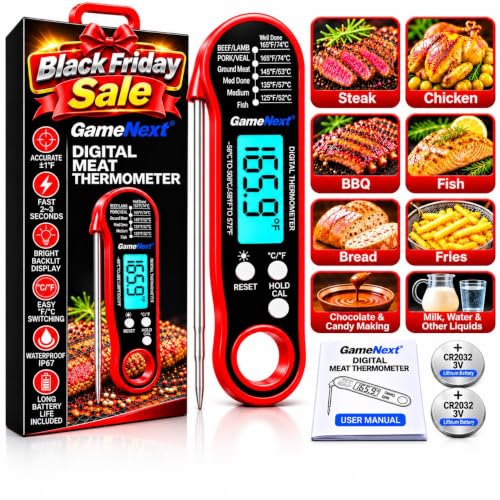
Folding Probe Thermometer 1-2 Sec — Best Spare-Battery Value
Some thermometers are bought as the household’s second instrument, and this one is honest about the role: a claimed one-to-two second read, a waterproof body, a backlit display, and two batteries in the box so the spare drawer is stocked from day one. The listing’s job list is the widest here, running from steak and chicken through fish, bread and candy to fries and hot water, which is another way of saying it expects to live in the kitchen rather than at the grill alone.
Two batteries sound like a trivial bullet until the Sunday a thermometer dies mid-roast in a house with no spare, at which point it becomes the wisest line in the listing. The Folding Probe Thermometer 1-2 Sec is the pragmatic purchase: for the cottage, the caravan, the second cook, or the main kitchen whose first thermometer has begun to wander in its readings.
Its listing does not state an accuracy figure, and the review follows the guide’s rule: the number is not supplied, so it is not invented. The ice-point check described later in this guide costs three minutes and a glass of ice, and owners of this model should perform it on arrival and make a household habit of it, as they should with every pick here whose accuracy arrives unstated.
- Read claim: 1-2 seconds, maker’s claim
- Batteries: 2 included per the listing
- Body: waterproof, backlit display
- Jobs named: steak, chicken, fish, bread, candy, liquids
- Accuracy: not stated in the listing text
- Role: second and spare instrument
Strengths
- Spare battery included from day one
- Widest job list in the guide
- Sensible price-position temperament
Trade-offs
- Accuracy figure not stated
- Brand carries no heritage premium
- Display described plainly, no rotation tricks
Best for: second kitchens and pragmatic spares. Not suited for: buyers comparing printed accuracy figures.

Alpha Grillers Instant Read — Best for Gifting Grillers
Alpha Grillers sells this thermometer as a gift so openly that the listing names stocking stuffers, and the useful surprise is that the specification survives the marketing: a claimed one-to-two second response, a bright backlit display, waterproofing stated as IP67, and pre-calibrated readiness out of the box. IP67 is a defined rating, dust-tight and immersion-resistant within its stated limits, and its presence gives the rinsing question a firmer answer than the category’s usual vague splash-proof language.
Pre-calibrated matters for a gift in particular, because the recipient’s first use should be a success rather than a science project. The Alpha Grillers Instant Read opens, reads and folds away, and a griller who has been guessing doneness by prodding will feel the upgrade in the first cook. Its maker has built a small empire on exactly this conversion experience, and the polish shows in the details a recipient notices.
Serious cooks should still run the ice-point check on arrival, since pre-calibrated is a claim like any other, and the thermometer that verifies in three minutes earns a decade of trust. Treat the gift wrapping as the bonus it is: underneath it sits a properly specified instrument, and the rare present that improves both the giver’s reputation and the recipient’s brisket.
- Read claim: 1-2 seconds, maker’s claim
- Waterproof rating stated: IP67
- Calibration: pre-calibrated, ready to use
- Display: bright backlit
- Positioning: gifts for grillers
- Accuracy: not stated in the listing text
Strengths
- IP67 gives rinsing a defined answer
- Ready to use out of the box
- Gift presentation with real specification
Trade-offs
- Gift framing may undersell it to pros
- Accuracy figure not stated
- IP67 is not a dishwasher invitation
Best for: gifts that will actually be used. Not suited for: buyers who need accuracy printed before purchase.
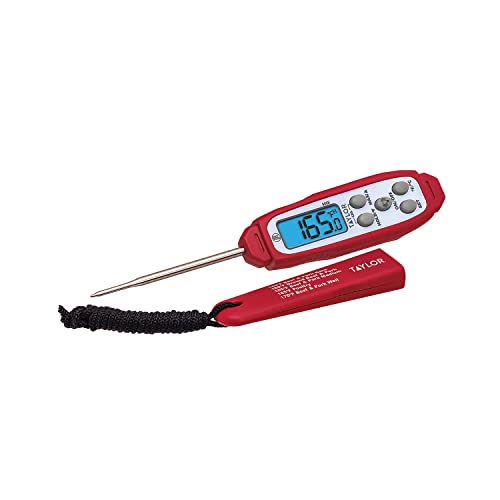
Taylor Waterproof Folding Thermometer — Best Heritage Maker
Taylor is the name in this guide that predates the category’s marketing entirely, a maker long associated with kitchen measurement, and its folding model behaves like it: the listing states its range outright, -40 to 450 degrees F, includes the batteries, and specifies a blue backlight. A printed range is a quietly serious thing. It tells the candy maker and the fryer cook that their temperatures live inside the instrument’s brief, and it tells everyone else where the instrument’s world ends.
The blue backlight is a small, considered touch for the evening grill, legible without the glare of a white screen, and the waterproof wording in its name covers the rinsing reality of raw-meat work. The Taylor Waterproof Folding Thermometer suits the cook who buys tools the way their grandparents did, by the maker’s name and the printed specification, and expects to hand the thing down the bench rather than replace it yearly.
Range has its trade: an instrument spanning -40 to 450 is a generalist, and specialists chasing the last decimal of accuracy should look at the stated figure on the TempPro. But for the breadth of a real kitchen’s week, roasts, frying, baking and the occasional frozen check, the Taylor’s stated span and steady temperament make it the shortlist’s elder statesman, and often its wisest buy.
- Range stated: -40 to 450 degrees F
- Display: blue backlight
- Batteries: included per the listing
- Body: waterproof in the model’s name
- Maker: Taylor, long-standing measurement brand
- Accuracy: not stated in the listing text
Strengths
- Printed range covers frying and candy
- Heritage maker, steady specification
- Blue backlight suits evening grilling
Trade-offs
- Generalist span, not a specialist tool
- Accuracy figure not stated
- Design is sober beside gift models
Best for: traditional cooks buying for the long term. Not suited for: decimal-chasers comparing accuracy claims.

TempPro TP19H Auto-Rotating — Best Display Handling
The TP19H’s party trick is genuinely useful: a display that rotates to read upright whichever hand holds it and whichever way the probe angles into the meat, motion-activated so that picking it up and opening it brings it to life. Left-handed grillers, and right-handed grillers reaching across a hot grill from the awkward side, discover within one cook that a fixed display is a small daily tax they had stopped noticing.
Beneath the trick sits the TempSwift brief shared with its sibling: a claimed one-second read in the model’s name, waterproof construction and a backlight, aimed at grill and candy work alike. The motion activation removes the fumbling button-press with greasy fingers, a detail that sounds minor in a listing and feels major at a grill full of sausages. The TempPro TP19H Auto-Rotating is the handling pick, the thermometer for cooks whose hands are the bottleneck.
Its listing, in the text supplied, does not repeat the accuracy figure its sibling prints, so this review does not borrow the number across; the two are different models and claims do not transfer by family resemblance. Verify this one by ice water like the others. Buyers choosing between the TempPros are choosing between a stated figure and a rotating screen, and either choice is defensible, which is what a good shortlist is for.
- Display: auto-rotating, backlit
- Activation: motion-activated per the listing
- Read claim: 1 second in the model name
- Body: waterproof
- Jobs named: BBQ, grill, candy
- Accuracy: not stated for this model
Strengths
- Display reads upright in either hand
- Motion activation suits greasy hands
- Fast claimed response, TempSwift family
Trade-offs
- Sibling’s accuracy figure does not transfer
- Rotation is wasted on some cooks
- More electronics to keep dry-minded
Best for: left-handers and busy grill-side cooks. Not suited for: buyers who want the printed accuracy figure instead.
How Do the Six Folding Thermometers Compare Side by Side?
The table keeps every figure attributed to its listing, and marks the unstated as unstated, because a comparison that filled its blanks with guesses would betray the only thing a thermometer guide sells, which is trust.
| Pick | Read claim | Accuracy | Notable stated spec | Temperament |
|---|---|---|---|---|
| Professional Folding Probe Thermometer | Fast read claimed | Not stated | Calibration included | Generalist |
| TempPro TempSwift 1 Sec | 1 second claimed | 0.9°F stated | 3.9-inch probe | Specification-led |
| Folding Probe Thermometer 1-2 Sec | 1-2 seconds claimed | Not stated | 2 batteries included | Pragmatic spare |
| Alpha Grillers Instant Read | 1-2 seconds claimed | Not stated | IP67 stated | Gift-ready |
| Taylor Waterproof Folding Thermometer | Instant read | Not stated | -40 to 450°F range | Heritage |
| TempPro TP19H Auto-Rotating | 1 second claimed | Not stated | Auto-rotating display | Handling |
How Do You Check a Thermometer With Ice Water in Three Minutes?
Fill a glass with crushed ice, add just enough cold water to fill the gaps, and stir. Wait a minute for the mixture to settle at the freezing point, then hold the probe in the centre of the slurry without touching the glass. A truthful thermometer settles at or very near 32 degrees F, 0 degrees C, and stays there. Note the reading, and you have established your instrument’s character at the one temperature every kitchen can reproduce exactly.
A small deviation is information, not disaster: a thermometer that reads a degree high at ice point will likely read about a degree high at chicken temperatures, and the cook can compensate knowingly, or use the calibration feature where the model offers one. A wild deviation, or a reading that wanders and never settles, is a return or a replacement. Boiling water offers the second check, adjusted for altitude, but ice is the kitchen’s reliable witness and the one this guide recommends making a habit.
Where Exactly Is the Thermal Centre of a Chicken, a Steak and a Roast?
The probe measures where its tip rests, so placement is the cook’s half of accuracy. In a whole chicken, the target is the thickest part of the thigh, slid in until the tip sits in the meat’s deep centre without touching bone, because bone conducts heat and flatters the reading. Take a second reading in the breast’s thickest part; the two together describe the bird more honestly than either alone.
In a steak, come in from the side, horizontally, so the tip reaches the centre of the cut rather than skewering through it, and in a roast, aim for the geometric centre and be patient while the number settles. Thin foods, burgers and fish fillets, reward the side approach and a steady hand. Every thermometer in this guide is fast enough claimed to make two readings a cheap habit, and two readings are the difference between measuring and guessing with equipment.
Claimed Seconds: What Read Speed Means at a Hot Grill?
A maker’s claimed one or two seconds describes the sensor reaching its reading under the conditions the maker chose, and this guide repeats those figures strictly as claims. At the grill, the lived experience includes finding the thermal centre, waiting for the number to stop climbing, and reading a backlit screen through steam and sun. A thermometer whose claim is honest will feel decisive; one whose claim is theatre will hunt and drift, and the cook learns the difference in a single session.
Speed’s real value is not the seconds saved but the lid kept closed and the hand kept out of the heat. Every extra ten seconds of probing is heat lost from the grill and comfort lost from the cook. That is why the category chases response time at all, and why a steady, settling reading at a claimed two seconds beats a twitchy one at a claimed one. Judge by steadiness when the number lands; it is the quality your hand can verify.
How Should a Folding Thermometer Be Washed, Stored and Carried?
The probe has met raw meat, so washing is not optional decoration: hot soapy water on the probe after every use, a rinse for waterproof bodies under the tap within their stated limits, and a dry fold before the drawer. IP67 on the Alpha Grillers is a defined resistance, not a licence to dishwasher the electronics, and no pick here should be submerged beyond its wording or left soaking in the sink’s archaeology.
Storage is where the fold earns its keep: closed, the probe cannot stab the hand that rummages, score the drawer or bend its own tip against the cutlery. Several cooks keep a magnetic spot on the fridge or the grill’s side shelf for the working instrument. Carried to a picnic or a holiday kitchen, a folded thermometer travels in a wash bag without ceremony, which is more than can be said for the fixed-probe instruments it replaces.
Which Jobs Beyond Meat Justify Keeping One in the Drawer?
The listings themselves make the case, naming oil, candy, bread, liquids and hot water among them. Frying oil wants a number because its moods are invisible; candy and jam live or die by degrees; bread dough proofs best in water of a known warmth; a reheated soup for an elderly relative deserves a verified heat rather than a hopeful simmer. A fast folding probe serves all of them with the same three-second gesture.
The Taylor’s printed range to 450 degrees F speaks directly to the frying and candy end of that list, while the generalist picks cover the middle ground where most kitchens live. Households that buy the thermometer for the grill and discover the drawer jobs usually report the second life as the more valuable one, because grilling is weekly and the other jobs are daily.
How Do You Grill for a Crowd With One Thermometer?
Sequence is the whole method. Cook in batches whose doneness windows overlap kindly, rest finished pieces where they hold warmth without racing ahead, and probe in a fixed order so no piece is checked twice while another goes unmeasured. The thermometer’s claimed speed matters here in aggregate: a decisive reading keeps the queue moving and the cook at the grill instead of in the kitchen washing a probe between every piece.
Wipe the probe between raw and cooked checks, and between species, with a clean cloth kept at the grill for the purpose; a rinse station is better still where the setup allows. Crowds forgive a slower service more readily than an uneven one, and the thermometer, used systematically, is what makes the twentieth steak match the second. That consistency, not any single reading, is the instrument’s real gift to the host.
When Should a Thermometer Be Replaced Rather Than Recalibrated?
Calibration corrects an offset; it cannot repair a failing sensor, a cracked housing that admits water, a display losing its segments or a hinge gone slack enough to change the probe’s angle under its own weight. A thermometer that settles slowly where it once settled crisply, or that disagrees with its ice-water self by a wandering margin, is announcing its retirement in the only language it has.
Replacement is cheap insurance in this category, and the guide’s spare-pick logic applies: the household that owns a second instrument never faces the announcement on the day of the big cook. Retire the failing thermometer to the compost-temperature and bathwater duties where its errors cost nothing, label it so the next hand knows, and let the new instrument start its life with an ice-point check and a note of the date.
How Do You Read Doneness in Poultry Without Drying It Out?
Poultry punishes both errors: undercooked is a hazard, overcooked is a penance, and the window between them is where the thermometer earns its price. Probe the thigh’s thickest part for the safety reading and the breast for the quality reading, and pull the bird when the thigh is satisfied and the breast is close, because resting under foil carries the temperatures upward while the juices redistribute. The cook who trusts that carryover gains the moist breast that timing alone rarely delivers.
Pieces cook less evenly than whole birds, and a tray of thighs deserves two or three spot checks across its geography, the centre pieces against the edge pieces. A fast folding probe makes that sweep a ten-second habit. Without it, cooks judge the whole tray by its brownest resident, which is precisely the piece that needed the least time.
What Temperatures Should Live on the Fridge Door?
A short, handwritten card beats a memory under pressure: the household’s target temperatures for chicken, for burgers, for pork, for the steak preferences of the people actually at the table, and for reheating leftovers. Write the card from a reliable source the household trusts, pin it inside the cupboard nearest the grill door, and let the thermometer’s readings be judged against ink rather than against a number half-remembered from a cookery programme.
The card also settles households. Where two cooks disagree about pork or about how red a burger may be, the card is the treaty, written in a calm moment and honoured in hot ones. Thermometers end arguments only when the target is agreed; otherwise they merely give both sides a more precise number to argue with.
How Does Resting Change the Reading You Should Aim For?
Meat continues to cook after it leaves the heat, its centre rising as the surface’s stored energy equalises inward, and it loses juice if cut before the fibres relax. The practical consequence is that the probe’s job is to call the pull, not the final state: remove the meat a few degrees shy of the target on the fridge card, rest it under loose foil for the minutes its size deserves, and let the thermometer verify the settled temperature before carving if certainty is wanted.
Thin cuts rest briefly and rise little; a large roast rests long and rises more, and the experienced cook scales the shy margin to the joint. None of this is guesswork once the household has done it twice with the readings written down. Keep a notebook by the grill for a season and the margins become personal knowledge, calibrated to your grill, your meat supplier and your family’s preferences.
Can One Thermometer Serve the Smoker’s Long, Slow Work?
Low-and-slow cooking asks different things of an instrument: spot checks across a brisket’s flat and point, verification of the stall’s end, and readings taken through a briefly opened door with the cook’s hand in moving heat. A folding instant-read serves these checks well, arguably better than it serves the grill, because the smoker’s cook has time and the readings punctuate hours rather than interrupt seconds.
What it cannot do is watch continuously, and the smoker who wants a graph of the cook needs a leave-in instrument alongside. The mature setup pairs the two: the leave-in keeps the vigil, the folding probe arbitrates at the moments of decision, wrapping, resting and slicing. Each instrument covers the other’s blindness, and the pair together cost less than one ruined brisket.
How Do You Probe Frozen, Chilled and Room-Temperature Meat Fairly?
A thermometer reports the temperature of the meat it touches, and meat that began frozen in the middle will cook as two different pieces sharing a surface. The fair method is prevention, thawing fully and evenly before cooking, because no probing pattern redeems a roast whose centre is still winter. Where time has defeated thawing, cook gently, probe more often, and expect the readings across the piece to disagree until late in the cook.
Room-temperature resting before grilling divides cooks, but its effect on probing is simple: a piece that starts even finishes even, and its centre reading represents the whole more honestly. Whatever the household’s doctrine, consistency matters more than the doctrine itself, because the notebook margins and pull temperatures the cook has learned assume the starting state they were learned on.
What Should You Do When Two Thermometers Disagree?
Disagreement is a gift if it is investigated and a hazard if it is averaged. Put both probes in the same ice slurry, side by side, and read them settled: the one at the freezing point is the witness, and the other’s deviation is now a known quantity. Check again in the same piece of meat at the same spot before concluding anything from a grill-side discrepancy, since placement differences masquerade as instrument differences with great conviction.
A thermometer that proves itself the liar goes to the low-stakes duties or to the bin, marked either way, because an unmarked unreliable instrument will be picked up by another cook and believed. Households with a calibrating model, like this guide’s first pick, can correct a small honest offset and keep a good instrument in service, which is the quiet economic case for that feature.
How Does Altitude Change the Boiling-Point Check?
Water boils cooler as altitude rises, which is why this guide builds its verification ritual on ice rather than on steam. A mountain kitchen that checks a thermometer against boiling water without adjusting for its elevation will convict a truthful instrument, while the ice point holds at every altitude a kitchen is likely to occupy. Keep the second check for sea-level households and the curious; let the ice carry the authority everywhere.
Altitude also lengthens cooking itself and dries the air the grill works in, which makes the thermometer more valuable, not less: timings borrowed from sea-level recipes drift, while the centre of the meat keeps its own counsel and reports it faithfully to any probe that asks. High kitchens learn to cook by number earlier than lowland ones, and their thermometers show the wear of honest work.
How Do You Teach a New Cook to Trust the Probe?
Start with a food whose lesson is visible: a chicken breast cooked to the card’s number, rested and sliced, its juiciness arguing the case better than any lecture. Then a steak pulled shy and rested, against the memory of the same cut cooked by prodding. Two demonstrations convert most sceptics, because the thermometer’s promise is not abstract accuracy but better eating, demonstrable on a plate.
Teach placement with the same care as the number, since a new cook’s errors are usually geography rather than arithmetic. Supervise the first few probes, side entry on the steak, thigh before breast on the bird, and let the habit form before the crowd cook arrives. The instrument then becomes what it should be, the household’s shared sense, rather than one cook’s private gadget.
What Part Does the Backlight Play After Dark?
Grilling runs past sunset for much of the year, and the last hour of a barbecue is cooked in the light of the kitchen window and the grill’s own glow. A backlit display is the difference between a reading and a squint, and the Taylor’s blue variant makes its case on glare: legible to the cook, invisible to the diners at the table. Screens that must be shaded or carried indoors to be read will, in practice, not be read at the moment they matter.
Judge a backlight by its discipline as much as its brightness. A display that lights on opening, as the motion-activated models arrange, and sleeps on folding, spends its battery on readings rather than on the drawer’s darkness. The household that grills year-round should weigh the backlight as a working feature, not a garnish, and test it on the first evening cook rather than discovering its character at a December barbecue.
How Should Batteries Be Managed Across a Drawer of Instruments?
The two-battery inclusion in one listing here points at a general discipline: standardise where you can, stock the spare where the instrument lives, and write the change date on a slip inside the drawer. A thermometer that fades mid-cook usually fades honestly, its display dimming before its sensor lies, but a household that waits for the fade will eventually meet it during the Christmas roast.
Motion-activated and auto-rotating models spend their batteries on convenience, fairly, and their owners should expect a shorter interval between changes than the plainest instrument’s. The cost is pennies a year and the benefit is a screen that greets the hand. What no owner should accept is a thermometer with a battery sealed beyond replacement; when its day comes the whole instrument is waste, and buyers who care can check that detail on the listing before the purchase rather than after.
How Do You Probe Delicate Foods Without Wrecking Them?
Fish, soft cheeses in the making, custards and doughs each punish a clumsy probe differently: the fillet flakes, the curd breaks, the loaf wears a hole the neighbours can see. The technique is gentleness with intent. Come in from the side of a fillet at its thickest point, withdraw slowly, and accept the second reading from the twin fillet rather than a third hole in the first. For doughs and custards, the centre reading is quick and the hole closes behind the probe like water.
A thinner, well-kept tip helps, which is one more argument for storing the thermometer folded and protected rather than rattling in the cutlery. The cook who probes delicately keeps both the number and the presentation, and discovers that most foods forgive a single, decisive puncture made with confidence. Hesitation, sawing and repeated stabs are what food actually objects to.
What Records Turn a Season of Grilling Into Knowledge?
The notebook mentioned earlier deserves its method: date, cut, weight, starting state, grill temperature if known, pull reading, rest, and one line of verdict at the table. Six entries teach the household its margins; a season of entries teaches it the supplier’s habits, the grill’s hot corner and the difference between the cook’s intention and the guests’ preference. No application is required, only a pencil that lives where the thermometer does.
Review the notebook when a cook disappoints, before blaming the instrument or the meat. The pattern usually confesses itself, a rushed rest, a new supplier, a wind the cook forgot. Thermometers make cooking measurable; notebooks make it cumulative, and the pair together are how a household’s grilling quietly becomes the best on its street.
How Do You Handle a Thermometer at a Shared or Public Grill?
Parks, campsites and holiday cottages provide grills of unknown temperament and, often, a communal audience of other cooks. The folding thermometer is the traveller’s answer to that uncertainty, because it replaces the strange grill’s dial, which may lie by a generation, with a reading taken in the meat itself. Probe more often than at home, since unfamiliar heat punishes assumptions, and expect the first cook on any borrowed grill to be a reconnaissance.
Hygiene travels too: the probe wipe between raw and cooked, unremarkable at home, becomes the mark of the competent stranger at a shared grill. Pack the thermometer in the food bag rather than the tool roll, folded, so it arrives clean and findable, and bring the spare battery if the trip is long. The cook who measures is welcome at every campsite; the cook who guesses loudly is entertainment.
What Is the Difference Between a Thermometer and a Timer Cook?
Two tribes divide the grilling world: those who cook by the clock and those who cook by the number, and each regards the other with affectionate pity. The honest reconciliation is that time predicts and temperature decides. A timer tells the cook when to look; the thermometer tells the cook what is true when they look, and a piece of meat that has never read the recipe will follow its own schedule regardless of either tribe’s confidence.
Households convert gradually, usually after the thermometer rescues one expensive cut the clock would have ruined. The mature method keeps both instruments in their places, the timer managing the cook’s attention across a whole meal, the probe arbitrating the moments of decision. This guide’s six candidates are all ambassadors for the second tribe, priced and sized to be tried without commitment to the philosophy.
How Should Leftovers and Reheating Be Verified?
The second cooking of food deserves the same respect as the first, and it is where a fast probe quietly prevents both waste and risk. Reheated dishes should be steaming throughout rather than warm at the edges, and the centre reading of a pie, a casserole or a portioned roast settles the question the bubbling rim cannot. Soups and sauces want the probe in their middle, stirred, since a liquid’s surface lies about its depths.
Cooling deserves a mention alongside reheating: food left to drift slowly through the warm hours on a counter is a risk no later reheating fully redeems, and the thermometer can monitor a cooling joint’s progress toward the fridge as faithfully as it monitored the roast. The instrument’s job is the household’s temperature conscience in both directions, and the drawer it lives in should be on the route between cooker and table.
Why Do Cheap Thermometers Die in the Drawer?
The drawer is a violent neighbourhood: cutlery avalanches, hinges stressed by rummaging, batteries leaking through long summers, and probes bent by the weight of the utensil crock. Folding models survive it better than fixed ones precisely because the probe retires into the handle’s protection, and the survivors share habits of ownership, a magnetic home, a divider, a pouch, anything that converts the drawer from a quarry into a parking place.
When a cheap thermometer dies, it usually dies lying, its readings drifting as its sensor or its contacts fail, which is the dangerous failure mode this guide’s ice-check ritual exists to catch. A thermometer that fails dead is an inconvenience; one that fails plausible is a hazard with a display. Check on a rhythm, yearly at least and after any drop onto tile, and the drawer can hold whatever it likes.
One Final Cook: The Mixed Grill as Examination
Set the six picks their examination in imagination: a mixed grill for six, sausages, chicken pieces, steaks at two donenesses, and a halloumi that waits for no one. The calibrating generalist and the stated-accuracy TempPro anchor the serious end; the auto-rotating TP19H serves the cook reaching across the crowded grate; the Taylor checks the oil for the accompanying chips; the gift-ready Alpha Grillers rides in a second cook’s apron; and the two-battery spare covers the moment one instrument is dropped, dunked or simply left indoors.
No household needs all six, and the examination’s point is the opposite: any one of them, verified against ice and used with the placement habits this guide teaches, passes the mixed grill with honours. The differences that remain are temperament and trust, which is why the guide has spent its length on claims and checks rather than on crowning a single winner for every hand.
What Mistakes Do Folding Thermometer Buyers Make Most Often?
The first is believing a claimed read time is a measured fact about the unit in the box; it is the maker’s claim, to be enjoyed if the instrument feels decisive and questioned if it hunts. The second is treating an unstated accuracy as a stated one, or borrowing a figure from a sibling model, as this guide declined to do for the TP19H. The third is probing once, in the wrong place, against the bone, and calling the number dinner’s verdict.
Care mistakes follow: the thermometer left in the oven door’s heat, washed in the dishwasher against its wording, or stored open in the drawer until its tip bends. And the quietest mistake is never performing the ice-water check, the three minutes that convert a purchase into a verified instrument. Every error on this list is free to avoid, which is the best that can be said of any list of mistakes.
Final Recommendation
Choose by the claim you most want kept. The cook who wants accuracy in writing takes the TempPro with its stated figure; the cook who wants to establish accuracy personally takes the calibrating generalist or the Taylor and a glass of ice. The Alpha Grillers is the gift that survives its wrapping, the two-battery model is the spare every kitchen eventually needs, and the TP19H is the handling upgrade for cooks whose hands are full and whose grill is hot.
Whichever folds its way into your drawer, run the ice-water check on its first day and write the result on the box. A thermometer you have personally verified stops being a gadget and becomes a witness, and dinner, from that evening on, is cooked on evidence rather than on hope.
Frequently Asked Questions
Is a claimed one-second read literally one second?
It is the maker’s claim for the sensor’s response, quoted in this guide as a claim. In the hand, add the time to place the probe at the thermal centre and for the display to settle. A good instrument feels decisive within a few seconds; that decisiveness, not the stopwatch, is what to judge at the grill.
How accurate are these thermometers?
Only one listing here states a figure, the TempPro TempSwift’s 0.9°F, and this guide prints it attributed. The others do not state accuracy in their listing text, so the honest verification is the ice-water check described above, which establishes any individual unit’s behaviour at a known temperature in three minutes.
Can I leave the probe in the meat while it cooks?
No. These are instant-read instruments for spot checks, not leave-in probes; their handles and electronics are not built for oven or grill residence. Open, read, fold away. A cook who wants continuous monitoring needs a different instrument class with a heat-rated cable.
Is it safe to wash a waterproof thermometer under the tap?
Within its stated wording, yes: rinse the probe and body as the maker directs, with the Alpha Grillers’ IP67 offering the most defined resistance here. Waterproof has never meant dishwasher-proof for electronics, and soaking beyond the listing’s terms is how good instruments die young.
Why does my reading change when I move the probe slightly?
Because temperature inside a cooking piece of meat is a landscape, not a number: hotter near the surface and the bone, cooler at the centre. The movement is information. Seek the coolest reading at the thermal centre, since that is the point doneness and safety are judged by.
Does the folding mechanism wear out?
A hinge cycled twice a cook, most days, accumulates thousands of folds across years, and quality hinges are built for that arithmetic. Treat a hinge that develops play or a probe that will not stay folded as end-of-life signs, as the replacement section describes, rather than as quirks to live with.
Related Guides
Keep the kitchen’s numbers honest with our guides to Best Nespresso Machines for Lattes Best Washing Machines for Comforters Best HEPA Bagged Canister Vacuums


