What's inside
- Key Takeaways
- Quick Picks
- How Did We Judge Washers Against a Comforter’s Real Demands?
- How Do the Six Washers Compare for Bedding?
- How Can You Tell Whether Your Comforter Fits a Washer?
- Which Cycle Should a Comforter Actually Get?
- How Should You Load a Comforter So It Washes Evenly?
- How Do You Dry a Comforter After a Home Wash?
- How Often Should Comforters Be Washed, and How Do You Care for the Machine?
- What Do the Different Comforter Sizes Actually Demand?
- How Should You Wash Down, Down-Alternative and Cotton Comforters Differently?
- What Should You Check About Your Laundry Space Before Choosing?
- When Is the Laundromat Still the Right Answer?
- How Do You Keep a Large Washer Healthy Under Bedding Duty?
- How Does a Duvet Cover Change the Whole Problem?
- What Should You Do the First Time You Wash a Comforter in a New Machine?
- What Mistakes Ruin Comforter Washing at Home?
- Final Recommendation
- Frequently Asked Questions
- Related Guides
As an Amazon Associate I earn from qualifying purchases. This post may contain affiliate links at no extra cost to you.
cottageverdict.com is reader-supported. When you buy through links on our site, we may earn an affiliate commission.
Where to buy: all six washers below are sold through Amazon, and every name in this guide links to its listing, where you can confirm the stated capacity in cubic feet and the cycles named for bulky bedding before you commit to a machine.
The best washing machines for comforters are chosen on one bad Saturday: the day a king comforter, muddy at the edges and too big for every machine you have ever owned, meets a laundromat queue you refuse to join. Comforters are the bulkiest thing a household washes, light for their size but enormous in volume, and a washer that handles weekly laundry beautifully can still defeat one by leaving it half-wrapped around the drum with a dry, unwashed heart. The six machines here were chosen for drum volume first, with capacities from 5.5 cubic feet down to one honest step-down at 4.5.
Capacity needs translating, because cubic feet are a drum measurement and a comforter is a volume problem wearing a weight disguise. As a working guide, a king comforter wants roughly 4.5 cubic feet or more to tumble freely, a queen sits comfortably in the high fours, and anything much below that asks the bedding to fold rather than flow, which is where poor washing begins. That is guidance, not a guarantee: a very lofty down-alternative king can challenge a 5.0 drum, while a slim summer king may wash happily in the 4.5 step-down pick, which is labelled as a step-down throughout this guide rather than dressed up as an equal.
Format is the second decision. The top loaders here offer wide, easy loading for a bulky armful and no door seal to maintain, while the front loaders offer steam cycles and stackability, with drums that tumble bedding through water rather than stirring it. Both families can wash a comforter well at these capacities. The reviews below keep the two honest, and the sections after them explain how to load, which cycle to choose, and how to tell whether your particular comforter fits your particular machine.
A note on what this guide will not do: it will not promise that a given comforter fits a given drum on the strength of the word king alone. Bedding labels describe the bed, not the laundry problem, and two comforters sold for the same bed can be entirely different loads. Where a pick’s suitability depends on your comforter’s loft, the review says so in plain terms, because a washer bought on a flattering generalisation is a washer returned, or worse, kept and resented for a decade.
Key Takeaways
- Drum volume in cubic feet is the headline number; a king comforter wants about 4.5 or more.
- Loft matters as much as size: a puffy king can defeat a drum a slim king fits easily.
- The Samsung 4.5 in this guide is a step-down pick for queens and slim kings, not a peer of the 5.5s.
- Bulky and bedding cycles exist to move a comforter slowly and soak it thoroughly.
- Top loaders load a bulky armful easily; front loaders add steam and stacking.
- A comforter must tumble, not merely fit: if it cannot move, it cannot wash.
Quick Picks
| Pick | Badge | Why it earns a place |
|---|---|---|
| Samsung 5.5 Top Load | Best Extra-Large Top Loader at 5.5 Cu Ft | Samsung’s extra-large 5.5 cubic foot top loader in brushed black, with Super Speed Wash named on the listing. |
| LG WT8400 5.5 | Best LG Top Loader With EasyUnload Design | LG’s 5.5 mega capacity smart top loader in white, with the EasyUnload design named in the listing. |
| LG 5.2 Front Load Steam | Best Front Loader With Steam at 5.2 Cu Ft | A stackable 5.2 cubic foot front loader in black steel, with steam and TurboWash named on the listing. |
| LG WM4200 5.0 Front Load | Best 5.0 Front Loader With Steam and Allergiene Cycle | A 5.0 cubic foot front loader in white with steam wash, the Allergiene cycle and Wi-Fi named on the listing. |
| LG 5.0 Top Load Alpine | Best 5.0 Top Loader With AI Sensing | A 5.0 cubic foot smart top loader in alpine white with TurboWash, EasyUnload and AI sensing on the listing. |
| Samsung 4.5 Step-Down | STEP-DOWN Pick for Queens and Slim Kings at 4.5 Cu Ft | Samsung’s 4.5 cubic foot white top loader, included honestly as the step-down option of this guide. |
How Did We Judge Washers Against a Comforter’s Real Demands?
We started with stated capacity, because it is the only honest proxy a listing gives for drum volume, and we set the guide’s centre of gravity at 5.0 cubic feet and above. Five of the six picks sit in that territory or at its summit, the two 5.5 machines. The sixth, at 4.5, was included deliberately and labelled a step-down, because some households wash queens and double comforters, or a slim king, and are better served by a smaller, simpler machine than by capacity they will never use, provided nobody pretends it is the equal of its bigger rivals.
The second filter was the cycle menu as the listings describe it. A comforter does not want the violence of a normal cycle or the brevity of a quick one; it wants time, water and a motion that keeps repositioning it. Machines whose listings name speed, steam or sensing features were read for what those features do for bedding specifically, and the reviews say so in those terms rather than reciting feature lists that belong to a general washer guide.
Finally we considered the household mechanics: loading height, door or lid swing, stackability where a laundry space is vertical, and the finish’s tolerance for a utility room’s life. A washer for comforters is bought rarely and used for everything, so the guide weighs the daily virtues too, while never letting them outrank the one job in the title.
Listings were also read for what they chose not to claim. None of these machines is presented by its maker as a comforter specialist, because no such category exists in the appliance aisle; they are large washers whose drums happen to answer the bedding question. This guide therefore builds its case from capacity, format and named cycles rather than from any marketing about bedding, and it treats a seller’s silence about a feature as the absence of that feature, not as a detail to be generously assumed.

Samsung 5.5 Top Load Washer — Best Extra-Large Top Loader at 5.5 Cu Ft
This Samsung sits at the top of the capacity table alongside the LG WT8400, and 5.5 cubic feet in a top-load drum is the most forgiving geometry a comforter can meet. The wide mouth takes a king comforter in one gathered armful without the stuffing and persuading a smaller drum demands, and once inside, the bedding has room to unfold, which is the precondition for water and detergent reaching its middle rather than polishing its outer layer.
The listing names Super Speed Wash, a feature worth interpreting for bedding rather than merely repeating. Speed cycles earn their keep on the household’s ordinary loads, the school uniforms and work shirts that fill most of the week. For the comforter itself you will choose the machine’s longer, bulkier programme, and the honest way to read this model is as a big drum that also hurries the everyday work, not as a promise that a king comforter should be washed quickly.
The brushed black finish suits a laundry room that is seen by guests, and top-load format spares you the front loader’s door-seal housekeeping. Choose this Samsung where the household’s bedding is genuinely king-sized and frequent, and where the person loading prefers to drop laundry in from above rather than crouch to a door. Its size is its argument, and at 5.5 cubic feet the argument is a strong one.
- Format: top load washer
- Capacity: 5.5 cu ft extra-large, per the listing
- Cycle named on listing: Super Speed Wash
- Model: WA55CG7100AVUS in the listing
- Colour listed: brushed black
Strengths
- Joint-largest drum here, kindest to king comforters
- Top-load mouth swallows a bulky armful easily
- Speed feature serves the everyday laundry week
Trade-offs
- Comforters still want the long bulky programme, not speed
- Tall drum can be a deep reach for shorter users
- Dark finish shows lint and detergent dust
Best for: households washing king comforters at home regularly
Not suited for: anyone whose largest bedding is a double or twin
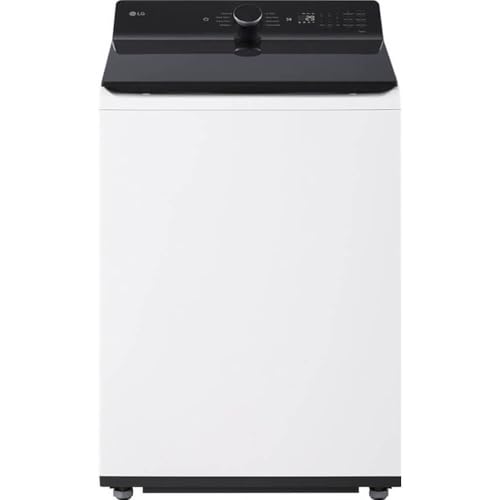
LG WT8400 5.5 Mega Capacity — Best LG Top Loader With EasyUnload Design
LG’s WT8400 matches the Samsung’s 5.5 cubic feet and adds a design idea aimed at the other end of the wash: getting the laundry out. The listing names EasyUnload, which addresses the familiar top-loader complaint that the last wet sock lives at the bottom of a deep drum beyond a shorter arm’s reach. With comforters the unloading problem is larger and wetter, a heavy, saturated mass that must be lifted clear, so any design that eases the drum’s geometry deserves its mention here.
As a smart top loader, the WT8400 belongs to the connected generation of machines, but for bedding the relevant virtues remain physical: drum volume, a wash motion that keeps a bulky load repositioning, and capacity that lets a king comforter move rather than pack. At 5.5 cubic feet it shares the guide’s top tier, and a queen comforter in this drum has the luxurious problem of too much room, which is the problem you want.
In white, it is the conventional laundry-room citizen, easier to keep looking clean in a bright utility space than a dark finish. Choose it over the Samsung where unloading comfort matters, where the household prefers LG’s approach, or where white suits the room. Between the two 5.5 top loaders, the honest verdict is that the comforter will be equally well served, and the human’s back and habits should cast the deciding vote.
- Format: smart top load washer
- Capacity: 5.5 cu ft mega capacity, per the listing
- Design named on listing: EasyUnload
- Model: WT8400CW in the listing
- Colour listed: white
Strengths
- Top-tier 5.5 drum for the largest comforters
- EasyUnload design eases the wettest lift of the week
- White finish suits bright utility rooms
Trade-offs
- Deep drum still asks a stretch from shorter users
- Smart features are secondary for bedding duty
- No steam cycle named on this listing
Best for: king-comforter households that dread the unloading lift
Not suited for: small households washing only light bedding

LG 5.2 Front Load Black Steel Steam — Best Front Loader With Steam at 5.2 Cu Ft
This LG is the front-load flagship of the guide: 5.2 cubic feet, a black steel finish, steam, and TurboWash technology named on the listing, in a stackable body. For comforters, the front-load action has a genuine claim: the drum lifts the bedding and drops it through the water repeatedly, a motion that works a bulky, buoyant load through its wash without needing to submerge it, and 5.2 cubic feet gives a king comforter room to make that journey without folding itself into a plug.
Steam is the feature to understand rather than merely admire. On bedding, a steam phase helps the wash penetrate a thick, layered fill and refreshes the fibres in a way water alone does more slowly, which is valuable for a comforter that may carry a season of dust. TurboWash, by contrast, belongs to the household’s hurried weekday loads. Read the listing’s features with that division in mind and you have the machine’s true character: gentle thoroughness for the bedding, speed for the shirts.
Stackability is the quiet third argument. A laundry closet or a narrow utility wall often has height but no width, and a stackable front loader lets the dryer live above the washer, freeing floor for the laundry basket and the human. Choose this LG where the household wants front-load washing, values steam for its bedding, and needs the vertical option, and it is the most complete package in the guide.
- Format: stackable smart front load washer
- Capacity: 5.2 cu ft, per the listing
- Features named: steam and TurboWash technology
- Finish listed: black steel
- Action: tumbling front-load drum
Strengths
- Steam phase suits thick, layered comforter fills
- 5.2 drum gives a king room to tumble
- Stackable body fits vertical laundry spaces
Trade-offs
- Door seal needs the front loader’s wiping routine
- Black steel shows scratches and lint
- Premium feature set is wasted on tiny households
Best for: households wanting steam and a stackable front loader
Not suited for: anyone who dislikes crouching to load a door

LG WM4200 5.0 Front Load Steam — Best 5.0 Front Loader With Steam and Allergiene Cycle
The WM4200 is the slightly smaller, white-finished sibling in LG’s front-load line here: 5.0 cubic feet, steam wash, and two named details on its listing, the Allergiene cycle and SmartThinQ Wi-Fi. For comforters, 5.0 cubic feet remains a serious drum. A queen comforter tumbles in it with room to spare, and most king comforters, other than the very loftiest down-alternative designs, will wash properly provided they are loaded loosely and given the machine’s bedding-appropriate programme.
The Allergiene cycle is a steam-based programme whose name the listing gives, aimed at bedding and similar loads, and we describe it as exactly that: a named cycle on this model, useful to households that wash bedding frequently and want a dedicated steam treatment in the menu. The Wi-Fi connection, meanwhile, is the kind of feature that sounds frivolous until a comforter’s long cycle can be monitored from the kitchen rather than by trips to the utility room to peer at a timer.
Choose the WM4200 where 5.0 cubic feet matches your largest bedding honestly, where white suits the room, and where a slightly smaller machine than the 5.2 makes the laundry layout work. It gives up little to its bigger sibling for the majority of households, whose king comforters are ordinary rather than expedition-grade, and it keeps the steam that makes front-load bedding care distinctive.
- Format: front load washer
- Capacity: 5.0 cu ft, per the listing
- Cycles named: steam wash and Allergiene cycle
- Connectivity: SmartThinQ Wi-Fi enabled, per the listing
- Model: WM4200HWA; colour listed white
Strengths
- Steam and a named bedding-oriented cycle
- 5.0 drum covers queens and most kings
- Wi-Fi monitoring suits long bedding cycles
Trade-offs
- Very lofty king comforters may still crowd it
- Front-load seal needs routine wiping
- White finish is plainer than black steel
Best for: households with queen and standard king bedding
Not suited for: owners of the loftiest oversized king comforters

LG 5.0 Top Load TurboWash Alpine — Best 5.0 Top Loader With AI Sensing
LG’s second top loader in this guide drops half a cubic foot from the flagship pair and adds the listing’s most modern vocabulary: TurboWash, EasyUnload and AI sensing, in an alpine white finish. At 5.0 cubic feet it remains a comforter machine in the full sense, with a drum that handles queens easily and kings respectably, and the top-load format keeps loading and unloading at standing height, which matters more with a wet comforter than with any other load in the house.
AI sensing, as the listing names it, is the machine judging the load and adjusting its behaviour, and bedding is precisely where such sensing earns its place. A comforter is an eccentric load: light for its bulk, prone to bunching, and capable of unbalancing a drum that treats it like a pile of towels. A machine that senses and adapts its motion is addressing the comforter’s actual misbehaviour rather than a theoretical one, though the owner should still load the bedding evenly around the drum as the sections below describe.
TurboWash belongs, as elsewhere, to the weekday wardrobe rather than the bedding. Read whole, this is the top loader for a household that wants modern load management and standing-height loading at a capacity a half-step below the giants. If your king comforter is slim or your largest bedding is a queen, the half cubic foot will never be missed, and the sensing may be enjoyed weekly.
- Format: smart top load washer
- Capacity: 5.0 cu ft, per the listing
- Features named: TurboWash, EasyUnload, AI sensing
- Colour listed: alpine white
- Action: top-load drum with sensing
Strengths
- AI sensing addresses bunching, eccentric bedding loads
- EasyUnload helps with the heavy wet lift
- Standing-height loading suits bulky armfuls
Trade-offs
- Half a cubic foot below the two flagships
- Loftiest kings will prefer the 5.5 drums
- TurboWash is for clothes, not for comforters
Best for: households wanting sensing in a top loader at 5.0
Not suited for: owners of maximum-loft king comforters
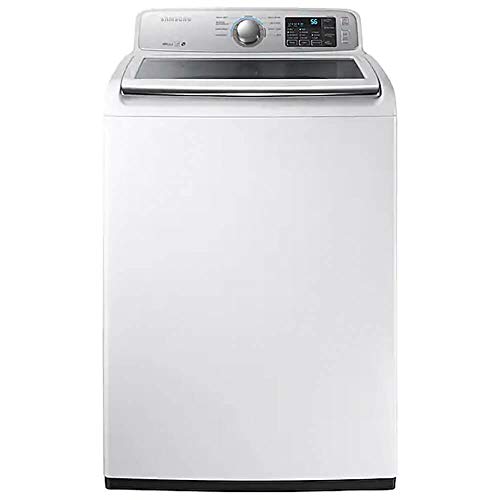
Samsung WA50R5200 4.5 Step-Down — STEP-DOWN Pick for Queens and Slim Kings at 4.5 Cu Ft
This pick carries its warning in its badge, and the review will not soften it: at 4.5 cubic feet, this Samsung is the step-down machine of the guide, a full cubic foot below the two flagships. It is here because not every household washes a king comforter. For double and queen bedding, for a slim summer king, and for households whose comforter washing is occasional, 4.5 cubic feet of top-load drum is a legitimate, simpler and usually easier-to-place answer, provided the buyer chooses it with open eyes.
What it should not be asked to do is swallow a lofty king comforter and wash it well. A drum can physically contain a comforter while denying it the movement washing requires, and the result, a load that emerges with its centre barely wetted, is worse than an honest trip to the laundromat’s big machine. The sections below give the fit test to apply: if your king is thick, choose from the five machines above this one, and let this Samsung serve the households it actually fits.
Within its honest territory it has real virtues. It is a straightforward white top loader from a major maker, easier to accommodate in a modest laundry space, and entirely sufficient for the bedding of a couple or a small family. Bought as a step-down on purpose, it is a sensible machine. Bought by mistake for a king-sized job, it would be the only disappointment in this guide, which is why its label is written in capital letters.
- Format: top load washer
- Capacity: 4.5 cu ft, per the listing — STEP-DOWN in this guide
- Model: WA50R5200AW in the listing
- Colour listed: white
- Role: queens, doubles and slim kings only
Strengths
- Honest capacity for queen and double bedding
- Simpler machine, easier to place in small laundry rooms
- Top-load loading at standing height
Trade-offs
- A full cubic foot below the flagship pair
- Lofty king comforters will not wash properly
- Easy to buy by mistake if the badge is ignored
Best for: households whose largest bedding is a queen or slim king
Not suited for: anyone washing thick king comforters at home
One last practical habit separates households that love their big washer from households that merely own it: a bedding day, scheduled rather than improvised. When every bed’s comforter is washed on a known rotation, loads stay solo, drying gets its full afternoon, and no one discovers at bedtime that the only king comforter is still wet. The machines in this guide make that rhythm possible; the calendar is the part the owner supplies, and it costs nothing but a decision.
How Do the Six Washers Compare for Bedding?
Capacity leads the table because it leads the decision, with format and the listing’s named features arranged around it.
| Pick | Format | Capacity note | Standout trait |
|---|---|---|---|
| Samsung 5.5 Top Load | Top load | 5.5 cu ft | Super Speed Wash on listing |
| LG WT8400 5.5 | Top load | 5.5 cu ft | EasyUnload design |
| LG 5.2 Front Load Steam | Front load, stackable | 5.2 cu ft | Steam and TurboWash |
| LG WM4200 5.0 Front Load | Front load | 5.0 cu ft | Steam, Allergiene cycle |
| LG 5.0 Top Load Alpine | Top load | 5.0 cu ft | TurboWash, AI sensing |
| Samsung 4.5 Step-Down | Top load, STEP-DOWN | 4.5 cu ft | Queens and slim kings |
The table sorts itself into three tiers. The 5.5 pair are the no-compromise king machines. The 5.0 to 5.2 trio are the right answer for the great majority of households, whose kings are ordinary and whose queens are frequent. The 4.5 Samsung stands alone in the step-down tier, included for smaller bedding and smaller rooms, and labelled so that nobody drifts into it by sorting on anything but capacity.
Format then divides each tier by taste: top loaders for standing-height loading and simple upkeep, front loaders for steam and stacking. A household that works through those two questions in that order, capacity honestly assessed, then format by preference, will land on the right machine in this list without further agonising.
How Can You Tell Whether Your Comforter Fits a Washer?
Use the tumble test rather than the stuff test. A comforter fits a washer when it sits in the drum loosely, with visible air around it and room to change position as the drum moves. If you must compress it with both hands and hold it down while closing the lid or door, it does not fit in any sense that matters, because the wash will treat it as a single solid object and clean only its weather-facing surfaces.
A practical rehearsal helps before a machine is bought. Take the comforter to the drum dimensions you are considering by measuring a current machine or a laundromat washer that handled it well, and note that washer’s capacity if it is marked. Households often discover their comforter washed beautifully for years in a friend’s or a laundromat’s large machine, and that machine’s size, not the comforter’s label, is the number to shop by.
Loft is the variable labels hide. Two king comforters can differ threefold in puffiness, and the loftier one is a bigger washing problem than a slim comforter a size up. When in doubt between two capacities in this guide, the loftier your bedding, the stronger the argument for the larger drum, because air space is what the wash spends.
Which Cycle Should a Comforter Actually Get?
Choose the machine’s bulkiest, gentlest long programme: the cycle named for bedding, bulky items or heavy duty with a long soak, depending on the maker’s vocabulary. A comforter needs time for water to penetrate layered fill, time for detergent to work through it, and a motion that repositions it without wringing it into a rope. Short and violent are the two qualities to avoid, and most normal cycles are one or the other.
Water level and load sensing deserve a thought in top loaders. A comforter floats and fools, so if the machine allows a deep fill or a bedding setting that fills generously, use it; a bulky load washed in too little water comes out with detergent still in its depths. Front loaders manage water by weight and tumbling, and their bedding programmes are calibrated accordingly, which is one of the format’s quiet strengths for this job.
Spin with judgement. A thorough spin halves the drying burden of a heavy wet comforter, but a load that has bunched to one side should be stopped, redistributed and spun again rather than allowed to shake the machine across the floor. Every washer in this guide will protect itself against a wild imbalance in its own way, and the owner’s redistribution is faster than the machine’s complaint.
How Should You Load a Comforter So It Washes Evenly?
Load it as a loose ring or a soft fold, never as a rolled sausage or a wadded ball. In a top loader, arrange the comforter evenly around the drum’s perimeter so the weight is balanced from the start. In a front loader, feed it in gradually, letting it settle in folds rather than forcing it into a plug, and leave the door’s worth of air space the tumble test demands.
Wash a comforter alone. It is tempting to add towels to fill the drum, but the comforter needs the whole volume for movement, and mixed loads wrap themselves around it and unbalance the spin. The exception is a small item or two added to a front loader to help balance a spin, and even that should be a judgement call rather than a habit.
Check on the load once, early. Five minutes in, pause and look: the comforter should be fully wet and moving, changing shape as the drum works. If it is riding as a dry-topped island or has twisted into a knot, stop, rearrange it wetter and looser, and restart. That single early check rescues more comforter washes than any feature printed on a control panel.
How Do You Dry a Comforter After a Home Wash?
A comforter leaves the washer holding surprising water, so give the spin its full course before moving it, and carry it in a basket rather than against your clothes. In a tumble dryer, the comforter needs a drum as generous as the washer’s, a low to medium heat, and time measured in the plural of hours for a thick fill. Crowding it into a small dryer undoes the wash’s good work by baking the outside while the core stays damp.
Interrupt the drying to redistribute. A comforter dries the way it washes, unevenly when left to itself, so pause the dryer every half hour or so, pull the bedding out, shake it loose and return it in a different arrangement. Wool dryer balls or clean tennis balls, if the household uses them, help break up clumped fill during those sessions, particularly in down and down-alternative comforters whose filling migrates into corners.
Air finishing is the patient alternative and a fine partner to machine drying. A comforter draped over a line, a door or a drying rack in moving air will finish honestly, and a half-dried comforter from the dryer often does best with an hour of air to equalise its last damp pockets. Never store a comforter that feels even faintly cool and damp at its centre; that centre is where mildew keeps its calendar.
How Often Should Comforters Be Washed, and How Do You Care for the Machine?
A comforter under a duvet cover can go a season between washes, since the cover takes the weekly soil and washes easily in any machine. A comforter used uncovered earns a wash every month or two in a busy household, and always after illness, spills or a pet’s accident. The machines in this guide make that schedule a home task rather than a laundromat expedition, which is the entire point of owning the capacity.
Machine care scales with bedding duty. Comforters shed lint and fill dust, so clean the lint filter path your machine offers, wipe a front loader’s door seal after bedding days, and leave lids and doors ajar between washes so the drum dries. A machine that washes bedding for a household is doing the heaviest work in the laundry, and these small rituals are its maintenance contract.
Finally, wash the comforter before storing it for a season, dry it completely, and store it loosely rather than vacuum-compressed unless the maker advises otherwise. A clean, dry, lofted comforter stored in a breathable bag returns in autumn as a pleasure; a compressed, faintly damp one returns as a project.
What Do the Different Comforter Sizes Actually Demand?
Work through the bed sizes in order and the capacity ladder in this guide explains itself. A twin or double comforter is a modest load that any full-size washer handles, and even the step-down 4.5 gives it room to move. A queen is the first size that sorts machines: it wants the high fours to tumble properly, which is why the 5.0 trio and above are this guide’s centre of gravity, and why the 4.5 is described as sufficient for queens rather than generous to them.
A standard king is where the 5.5 pair earn their existence, because the extra half cubic foot over a 5.0 is spent entirely on air, and air is what lets a king unfold. An oversized or California king, or a king with expedition loft, sits at the edge of home laundry altogether: the biggest drums here will wash many of them, and the honest household tests theirs with the tumble check before retiring the laundromat’s number from the phone.
Children’s bedding rewrites the problem in the opposite direction. Small comforters wash anywhere, but they arrive frequently and in multiples, so the household with three young children may value the big drum less for one huge load than for two small comforters and a mattress protector washed together without crowding. Capacity serves frequency as well as size, which is worth remembering when the step-down pick tempts a family it would serve only briefly.
How Should You Wash Down, Down-Alternative and Cotton Comforters Differently?
Down asks for gentleness and room above all. Its clusters are light, buoyant and easily crushed into corners, so the comforter should be loaded loosely, washed on the long gentle programme, and checked early to confirm it has wetted through, since dry down floats on wash water like a raft. Down also repays a second rinse where the machine offers one, because detergent held in the clusters is weight, clumping and odour waiting for a warm night.
Down-alternative fills, usually polyester in some engineered form, are the forgiving middle: heavier when wet, less prone to migrate, and tolerant of a normal bedding cycle’s full length. Their characteristic fault is bunching into lumps if spun while wrapped around themselves, which the loose loading and early check described in this guide are designed to prevent. Cotton comforters and quilts are the heaviest when saturated and the simplest in temperament; give them water, time and a thorough spin, and mind the machine’s balance as they gather their wet weight.
Weighted blankets deserve a warning of their own, because they are not comforters in the washer’s eyes. Their concentrated weight can exceed what a domestic drum, its suspension and its bearings are built to spin, whatever the cubic feet suggest. Check the blanket maker’s washing guidance and the washer’s weight limits before treating one as bedding, and let the laundromat’s reinforced machines take any blanket whose weight is in doubt.
What Should You Check About Your Laundry Space Before Choosing?
Measure the route, not just the room. A 5.5 cubic foot washer is a large box, and it must travel from the street through your doors, halls and turns to reach its place, which is why delivery veterans measure the narrowest door and the tightest corner before they measure the laundry wall. A machine that fits its alcove perfectly and cannot reach the alcove is a special kind of heartbreak, and it is entirely preventable with a tape measure and ten honest minutes.
Then measure the working clearances. A top loader needs its lid’s full swing plus the head of the person loading it; a front loader needs its door’s swing plus the crouch room in front, and if it is to be stacked, the controls of the upper machine must sit within the reach of the household’s shorter adults. Water supply, drainage and a floor that can take a spinning, comforter-loaded machine without drumming through the house complete the survey.
Finally, consider the floor’s level and the room’s ventilation. A big drum with an eccentric bedding load will find any slope in the floor and walk on it, so adjustable feet and a level are part of bedding ownership. Ventilation matters because comforters finish their drying in the room’s air as often as in a dryer, and a laundry space that can move air will shorten every bedding day the machine creates.
When Is the Laundromat Still the Right Answer?
Honesty requires the paragraph: some bedding belongs to the laundromat’s largest machines even in a house that owns a 5.5. The comforter that fails the tumble test in the biggest home drum, the heirloom too fragile for any machine’s full programme, and the household that washes a king twice a year and would rather rent capacity than own it, are all legitimate cases. A guide that cannot name its own limits is selling, not advising.
The arithmetic is worth doing plainly. Count your comforter washes in a year, price the laundromat trips honestly including the travel and the waiting, and set that against the share of a large washer’s cost you would assign to bedding, remembering the machine also washes everything else you own. For most households with king bedding, the home machine wins by the second year. For the twice-a-year household with queens, the step-down pick or even the laundromat may be the rational answer.
There is also a hybrid worth knowing: wash at home, dry at the laundromat, or the reverse, according to which of your machines is the smaller. Many households discover their washer is generous and their dryer is not, and a comforter dried in a commercial drum while its wash happened at home is a perfectly honourable compromise that this guide endorses without a blush.
How Do You Keep a Large Washer Healthy Under Bedding Duty?
Bedding is the heaviest regular work a washer does, so its small maintenances matter more, not less. Run the machine’s own cleaning cycle on the maker’s schedule, because a drum that washes comforters collects lint, fill dust and detergent residue in places the eye cannot reach. Leave the door or lid open between washes so the drum dries; a closed, damp drum is where the musty smell that owners blame on their bedding is actually born.
Respect the suspension. A comforter load that has bunched should be stopped and redistributed rather than allowed to finish its protest, because repeated violent imbalance is what ages bearings and dampers. The machines here sense and respond in their own ways, and the owner’s early check remains the cheapest protection any of them can be given, cheaper than any extended warranty’s fine print.
Keep the filters and the water path in the same routine. Clean what the maker makes cleanable, check hoses yearly for the bulges that precede a flood, and confirm the machine still sits level after a season of bedding work. A large washer is a decade-long appliance when these minutes are spent, and the comforter, the load that tests it hardest, is the reason to spend them.
How Does a Duvet Cover Change the Whole Problem?
The cheapest capacity upgrade in this guide is not a machine at all. A comforter used inside a duvet cover lives a protected life: the cover takes the skin contact, the spills and the weekly soil, and the cover itself, being flat and light, washes in any machine a household owns. Households that adopt covers find their comforter washes drop from monthly to seasonal, and the drum size they need drops with them, which can honestly move a family from the 5.5 tier to the 5.0s.
Covers change the wash itself when the comforter does go in. An uncovered comforter arrives at the drum with its full surface exposed, while a covered one’s insert has been kept cleaner and needs a refresh more than a rescue. Either way, wash the insert and the cover separately, because together they form exactly the wrapped, unbalanced mass this guide keeps warning against, and the cover alone in a hot wash is the easiest load in the laundry.
None of this argues a household out of the machine it wants. It argues for buying the machine for the life you actually live: covers on, and the 5.0 drums are generous; covers off and kings in constant rotation, and the 5.5 pair justify themselves. The listings will not ask you that question, so the guide asks it here, before the capacity decision hardens into a purchase.
What Should You Do the First Time You Wash a Comforter in a New Machine?
Treat the first wash as a rehearsal rather than a performance. Choose the household’s second-best comforter if one exists, load it loosely, select the longest bedding programme, and stay within earshot for the first cycle. Listen for the machine’s opinion: a drum that settles into a steady rhythm has accepted the load, while repeated rebalancing pauses are the machine reporting that the comforter wants rearranging or, at the limit, a larger drum.
Inspect the result with a sceptic’s hands. The comforter should be uniformly wet through its centre, its fill distributed as it was, and its smell simply clean rather than perfumed over a sour core. Dry it fully by the staged method described earlier, and note the total time the whole operation took, because that number, not the programme’s display, is the true cost of a bedding day in your house.
Write down what worked: the programme’s name, the loading arrangement, the drying stages. A household washes comforters rarely enough that the knowledge evaporates between sessions, and the note on the laundry wall turns the second wash into a routine instead of a second experiment. Machines reward owners who learn them once, deliberately, rather than approximately forever.
What Mistakes Ruin Comforter Washing at Home?
The expensive mistake is buying on price or features while ignoring capacity, then discovering on the first cold night that the king comforter fits the drum the way a cork fits a bottle. Measure your bedding’s ambition in cubic feet first; the step-down pick in this guide exists precisely so that smaller households can save honestly rather than accidentally.
A second mistake is trusting the normal cycle. Owners wash a comforter on the everyday programme, find its centre dry and faintly sour, and blame the machine. The bedding programme’s length and soak are the feature; use them, and add the early rearrangement check for insurance.
Third, comforters get overloaded with company. Towels and sheets thrown in to fill the drum wrap the comforter, stall its movement and unbalance the spin. A comforter is a solo load by design, and the machine’s capacity figures in this guide assume it travels alone.
Finally, drying gets rushed. A comforter folded away with a damp core will announce the fact within a week. Dry it in stages, redistribute it, air it, and store it only when its centre feels as dry as its edges, because bedding forgives almost everything except being put away wet.
Final Recommendation
For most households, the sweet spot is the LG 5.2 Front Load Black Steel Steam if a front loader suits the room, or the LG WT8400 5.5 Mega Capacity if standing-height loading is preferred, with the Samsung 5.5 Top Load Washer as its equal in the top tier. The Samsung WA50R5200 4.5 Step-Down serves smaller bedding honestly, as its label insists.
Between those poles, the two 5.0 LGs divide the format question by taste: steam and a named bedding cycle in the front loader, sensing and EasyUnload in the top loader. Every machine here will wash a queen comforter well. The kings are where honesty matters, and this guide has tried to be exact about which drums a king should trust.
It is also fair to note what owning the right capacity changes beyond the bedding itself. Sheets, towels and the weekly family wash all move faster through a generous drum, guests’ bedding stops being a logistics problem, and the seasonal turn, when every bed in the house is stripped on the same weekend, becomes a day’s work instead of a week’s negotiation. The comforter is the reason for the purchase, but it is rarely the only beneficiary.
Measure your comforter’s loft against the drum, give it the long cycle and the room to move, and the Saturday laundromat queue becomes a place other people stand.
Frequently Asked Questions
Will a 4.5 cubic foot washer wash a king comforter?
A slim one, sometimes; a lofty one, no, and this guide labels the 4.5 Samsung a step-down for exactly that reason. The tumble test decides: if the comforter sits loosely with air around it, it will wash; if it must be compressed to close the lid, it will emerge with an unwashed centre. Thick king bedding belongs in the 5.0 drums and above, ideally the 5.5 pair.
Is a front loader or a top loader better for comforters?
Both wash bedding well at these capacities, with different manners. A front loader tumbles the comforter through water and offers steam on the models here, but asks you to load at a crouch and wipe its seal. A top loader takes a bulky armful at standing height and is simpler to keep, but needs its load arranged evenly around the drum. Choose by your back, your room and whether stacking matters.
What does a steam cycle do for a comforter?
On the LG front loaders here, steam is a phase that helps the wash penetrate thick, layered fill and refresh a comforter that has stored a season of dust. It is a bedding virtue rather than a daily one: the same machines’ faster features serve the weekday clothes, while steam serves the loads whose thickness defeats water alone. It is a reason to choose those models, not a requirement for washing a comforter well.
How full should the drum be with a comforter in it?
Loosely full at most, and visibly not packed. The comforter should occupy the drum with folds and air pockets, never as a compressed mass, because the wash works by moving it. If the load touches the door or lid under pressure, take it out and accept that this comforter wants a larger drum, which in this guide means stepping up a tier rather than forcing the issue.
Can I wash two pillows with the comforter?
It is better not to build a mixed load around a comforter. Pillows and towels wrap into the bedding, stall its movement and throw the spin off balance. Wash the comforter alone, then give the pillows their own load, where they can be paired symmetrically, which spinners prefer. The few minutes saved by combining are repaid in rearranged loads and interrupted cycles.
Why does my comforter come out with dry patches?
Because it was washed as a solid object: too large for the drum, too tightly loaded, or on too short a cycle for water to reach its centre. Remedy it in that order. Rearrange it loosely, choose the longest bedding programme, pause early to check it is fully wet and moving, and if dry patches persist in a 5.0 drum, accept the verdict and use a 5.5 or a laundromat machine for that particular comforter.
Related Guides
Clean bedding deserves clean linen to match, so you may also enjoy our guides to oversized luxury bath towels, canister vacuums built for large debris, and air purifiers sized for big rooms: Best Luxury Oversized Bath Towels Best Canister Vacuums for Large Particles Best Air Purifiers for 1500 Sq Ft.


