What's inside
- Key Takeaways
- Quick Picks
- How Did We Choose Slippers Worth Putting on a Child?
- How Do the Six Children’s Pairs Compare?
- How Should You Measure a Child’s Foot for Slippers?
- What Makes a Slipper Stay On a Small Foot?
- How Do You Keep Children’s Slippers Clean and Safe?
- What Mistakes Do Parents Make Buying Children’s Slippers?
- Which Slipper Suits Which Stage of Childhood?
- How Do Children’s Slippers Behave at Grandparents’ Houses and Sleepovers?
- What Should You Do When a Child Refuses to Wear Slippers?
- How Do You Judge Value in a Pair They Will Outgrow?
- Why Do Hard Floors Change Everything for Small Feet?
- How Should Slippers Fit Into the Morning Routine?
- Final Recommendation
- Frequently Asked Questions
- Related Guides
As an Amazon Associate I earn from qualifying purchases. This post may contain affiliate links at no extra cost to you.
cottageverdict.com is reader-supported. When you buy through links on our site, we may earn an affiliate commission.
Where to buy: All six pairs below are sold on Amazon, and each linked name opens the listing so you can check price on Amazon and — most importantly — read that listing’s own size chart before ordering. If you are comparing the best children slippers under time pressure, start with the IceUnicorn Kids Slippers for the broadest age range, the Fadezar Toddler Bunny Slipper for the youngest walkers, and the Kids Checkered Slippers for school-age children who want a grown-up loafer shape.
Safety comes before style in this guide, so it comes first here too. Children slippers are supervised footwear: they belong on feet that an adult can see, on floors an adult has checked, for the waking hours of the day. They are not sleepwear, and no loose footwear should ever be worn in a cot or bed. On hard floors — wood, tile, laminate — a non-slip sole is not a nice extra but the entire point, because small children run first and calculate later. Every pick below was chosen with that frame in mind: gripping soles, shapes that stay on, and sizing honest enough for a parent to act on. Nothing in this guide makes medical promises; these are house shoes, judged on warmth, grip, fit, and how cheerfully a child will actually keep them on.
With that frame set, the pleasures of the category can be enjoyed properly, because children slippers are also one of childhood’s small joys. The right pair ends the morning negotiations — a child who loves the bunny pair or the dinosaur pair puts them on without a summit meeting — and it protects the floors of grandparents, the socks of the household laundry, and the dignity of everyone’s bare feet on cold mornings. The six picks span the whole arc of childhood: two toddler designs with heels that stay put, and four pairs for little and big kids who want warmth, softness, and a shape that looks like it belongs to them rather than to a baby.
Sizing is the battlefield where children slippers are won and lost, so a word before the picks. Children’s feet grow in ambushes, sizes differ wildly between brands, and a listing’s age suggestion is a weaker guide than its centimetre measurement. Every review below notes how its pair is sized — toddler sizes, little-kid and big-kid ranges, or a length-based option — and the buying advice is constant throughout: measure the foot, in the evening, standing, and buy the size whose stated length leaves a thumb’s width of growing room, no more. Too big is not a kindness in a slipper; a loose heel on a staircase is a hazard wearing a friendly face.
Materials matter differently for children than for adults. Linings should be warm without being sweaty, uppers should survive being worn to build a cushion fort, and the whole pair should tolerate the washing that childhood guarantees — mud at the door, juice at the table, the mysterious stickiness of a Tuesday. Several picks here ride on memory foam, which children love for its softness; the reviews note where a firmer or harder sole serves a young walker better. And because children outgrow before they wear out, each review is honest about which pair justifies its place as the good pair and which serves best as the everyday workhorse.
Key Takeaways
- Supervised wear only: slippers are for waking, watched hours — never for sleeping in a cot or bed.
- On hard floors the sole is the safety feature; every pick here grips rather than glides.
- Measure feet in centimetres and buy by the listing’s length, leaving a thumb’s width — not a hand’s — of growing room.
- Toddlers need heel coverage that stays on; older children need warmth they will actually keep on.
- Memory foam delights children, but young walkers also benefit from a sole with some structure beneath it.
- Expect to replace for growth before wear — buy the pair that suits this winter, not the next one.
Quick Picks
| Pick | Badge | Why it made the list |
|---|---|---|
| Kids Checkered Slippers | Checkered loafer for school-age kids | A corduroy loafer with fleece lining and memory foam that spans toddler to big-kid sizes in one grown-up check. |
| Besroad Kids Fuzzy House Slippers | Fuzzy slip-on for big kids | Maximum fluff in a slip-on sandal shape, with memory foam underfoot for children who live in their slippers. |
| IceUnicorn Kids Slippers | Colourful non-slip all-rounder | Plush warmth and a non-slip sole across a wide span of children’s sizes, in colours children choose for themselves. |
| Fadezar Toddler Bunny Slipper | Toddler bunny with heel cover | A half-cover heel and rubber sole built for toddlers, wrapped in a bunny design that ends the morning argument. |
| JACKSHIBO Toddler Dinosaur Bunny Slippers | Character pair with hard sole | Dinosaur and bunny charm over a non-slip hard sole, for toddlers who are walked as much outdoors as in. |
| GIWONET Kids Slippers Faux Fur | Faux-fur bedroom slides for kids | A plush slide with memory foam for older children who want the spa-slipper feeling in their own bedroom. |
How Did We Choose Slippers Worth Putting on a Child?
We started where the introduction starts: with the sole. Each pick had to describe a non-slip or rubber sole in its listing, because the children who wear these will run on hard floors no matter what any adult says. Beyond grip, we looked at how the slipper stays on — a heel cup, a half-cover heel, or a loafer shape that holds the foot — since a slipper that flies off mid-run teaches a child to go barefoot, which defeats the purchase entirely. Toddler picks were held to the strictest standard here, because the youngest feet are the least able to keep a loose shoe on.
Second came sizing honesty. We favoured listings that present their sizes in recognisable children’s terms — toddler, little kid, big kid, or a foot length — and we note each pair’s system in its review so a parent can translate. A listing that hides its sizing behind a single vague range asked more trust than we were willing to extend. Where a pair spans several age bands, we say so, because a design bought for a four-year-old and re-bought at seven is a different value story from a one-winter pair.
Warmth and washability formed the third filter. Fleece, faux fur, and plush linings all appear below, chosen for softness a child will accept against bare skin — an itchy lining is a lining worn once. And because childhood is sticky, we preferred constructions that can be cleaned without heroics, and we say plainly where a pair should be treated as a gentle-wash or spot-clean citizen. Comfort claims were read as comfort only: nothing here promises anything about growing feet beyond a sensible, supervised fit.
We also read the listings the way a parent reads them at midnight — quickly, and hunting for the three facts that decide everything: the size system, the sole material, and how the heel is built. Listings that answered those questions in plain terms earned trust; listings that spent their words on adjectives while hiding their sizes were set aside, however charming their photographs. A guide for children has a duty to be boring about exactly the things that keep children upright, and interesting about everything else.
Finally, we admitted delight as a legitimate criterion. A slipper a child loves gets worn; a slipper a child tolerates gets hidden under the sofa by Thursday. Bunnies, dinosaurs, checks, and colours are not decoration on this list — they are compliance technology, and the reviews treat them with the seriousness they deserve in a household that has negotiated with a three-year-old at dawn.

Kids Checkered Slippers — Checkered loafer for school-age kids
The checkered loafer is the pair for the child who has opinions. Its corduroy upper carries a black check that reads as fashion rather than costume, its shape is a proper loafer rather than a novelty shoe, and inside it is all warmth — fleece lining over a memory foam bed. The listing spans an unusually wide arc of childhood, from toddler sizes through little kids to big kids, which makes this the design a family can return to as feet grow, re-buying the same trusted shape in the next size up instead of starting the search again.
That continuity matters more than it first appears. Children are conservative creatures about the things that touch them, and a slipper shape that has already been accepted — already been worn without negotiation — is worth real money to a parent at seven in the morning. The slip-on loafer shape also teaches a small independence: no straps, no fastenings, nothing to adjust, just a shoe a child can manage alone and feel quietly grown-up managing. The memory foam bed suits the school-age pattern of wear — long evenings of homework, reading, and kitchen hovering — better than a bare traditional sole would.
Supervision notes are the standard ones and bear repeating for this pair because its grown-up looks can disguise them: it is a house slipper for waking hours, its sole is made for indoor floors, and its loafer shape, while it holds the foot well in ordinary play, is not a heel-strapped toddler shoe. For the youngest sizes in its range, an adult eye remains the safety system, as with every pick here. For the big-kid end of the range, it is simply the most handsome warm slipper in this guide.
Choose the checkered loafer for the style-conscious child, the family that likes re-buying a known shape, or the grandparent gift that must look like a real present rather than a joke. It is the pair most likely to be worn to the door to greet visitors — and to still be on the child’s feet when the visitors leave.
- Upper: corduroy, black check
- Lining: warm fleece
- Footbed: soft memory foam
- Shape: slip-on bedroom loafer
- Sizing span: toddler, little kid, and big kid
Strengths
- Grown-up check design that older children actually want to wear.
- Wide size span lets families re-buy the same shape as feet grow.
- Fleece and foam make it the cosiest loafer here for long evenings.
Trade-offs
- Loafer shape holds less firmly than the heel-covered toddler picks.
- Corduroy shows crumbs and craft glitter enthusiastically.
- Memory foam bed is soft rather than structured underfoot.
Best for: school-age children with taste, and families who re-buy trusted shapes. Not suited for: the very youngest toddlers, who need the heel coverage below.
The fashion-forward pair — check price on Amazon and match the size chart.

Besroad Kids Fuzzy House Slippers — Fuzzy slip-on for big kids
The Besroad is engineered around a single insight: big kids wear slippers the way adults wear them, which is to say constantly, and what they want is fluff. This is a slip-on in a sandal-like open shape, piled with faux fur, over a memory foam bed, sized for the big-kid end of childhood — the listing shown runs to a big kid’s largest sizes in a warm tan. For the child who has graduated from characters and wants pure softness, this is the pair that treats them as the near-teenager they believe themselves to be.
The open slip-on shape has real practical virtues for this age group. It goes on at the speed of a child’s patience, which is none; it airs between wears better than a closed slipper, which matters for feet that are beginning to perspire like adult feet; and it works across the whole evening economy of homework, snacks, and sofa without ever feeling like a shoe. The memory foam bed carries a bigger child’s weight more kindly than the thin soles of toddler designs, and the tan colour forgives the evidence of that economy — the crumbs, the garden dash, the dog — better than paler fluff would.
Its limits are the shape’s own. An open slip-on is the least secure design here on stairs and in chase games, and households with firm rules about running will enforce them with this pair in mind. It is also unapologetically a bedroom-and-living-room slipper; the sole is for floors, not for the driveway. None of that diminishes it for its actual brief — the big kid at home in the evening — which it fulfils with the most generous pile in this guide.
Pick the Besroad for the older child who wants maximum softness and minimum fuss, for sleepover duty where a slip-on is social currency, or as the second pair that lives by the sofa. It is the comfort extremist of the children’s list, and children of a certain age will defend it accordingly.
- Upper: faux fur, tan
- Shape: open slip-on, sandal style
- Footbed: memory foam
- Sizing shown: big kid sizes
- Best setting: bedroom and living room
Strengths
- Deepest fluff here — the softness big kids actually ask for.
- Open shape airs between wears and goes on instantly.
- Foam bed sized for a bigger child’s weight and long evenings.
Trade-offs
- Least secure shape in this guide for stairs and chasing.
- Bedroom sole — not built for driveways or gardens.
- Faux fur collects crumbs and needs regular shaking out.
Best for: big kids who live in their slippers at home. Not suited for: toddlers, stair-heavy houses, or outdoor errands.
Maximum fluff this way — check price on Amazon.

IceUnicorn Kids Slippers — Colourful non-slip all-rounder
If one pair in this guide deserves the word all-rounder, it is the IceUnicorn. The design is a plush, closed house slipper with a non-slip sole and a memory foam bed, offered across a wide span of children’s sizes — the listing shown covers the smaller sizes in a blue and red colourway — and intended plainly for indoor and outdoor pottering alike. It lacks a single dramatic feature, and that is its strength: warmth, grip, softness, and colours children pick for themselves, in the pair most likely to satisfy the median child in the median house.
The non-slip sole deserves its headline place in the review because it is doing safety work on the floors where children actually fall — kitchen tile, bathroom thresholds, the polished hall. A plush slipper on a smooth sole is a small skating rink; this one’s sole is specified against slipping, which, combined with a shape that encloses the foot, makes it the pair we would hand a lively child in a hard-floored house without a second thought. Supervision still applies, as it does to everything in this guide, but the equipment is doing its share.
Colour is the other quiet feature. Children who choose their own colour defend the resulting slipper like a flag, and the blue-red option shown is the kind of cheerful combination that gets worn rather than negotiated. The plush warmth suits the colder half of the year best; in high summer the same child will go barefoot and the pair will wait, unbothered, for September. Expect to size up across a growth spurt rather than to wear this design out — the usual children’s arithmetic.
Choose the IceUnicorn when you want one sensible, grippy, cheerful pair without a specialist brief — the default recommendation of this guide, and the safest gift when the giver knows the size but not the child’s current obsessions.
- Upper: plush textile, blue and red
- Lining: warm plush
- Footbed: memory foam
- Outsole: non-slip, indoor and outdoor
- Sizing span: wide children’s range
Strengths
- Non-slip sole specified for the hard floors where children fall.
- Enclosed shape stays on lively feet better than open designs.
- Colours children choose themselves — and therefore keep wearing.
Trade-offs
- Plush warmth is a winter weight; too much for high summer.
- No single standout feature for a child with a specific demand.
- Foam bed flattens under a heavy big kid sooner than firm soles.
Best for: the general-purpose family pair on hard floors. Not suited for: summer wear, or a child set on a character design.
The sensible default — check price on Amazon.

Fadezar Toddler Bunny Slipper — Toddler bunny with heel cover
Toddler slippers live or die by one question: do they stay on? The Fadezar bunny is designed around the correct answer. Its heel is half-covered — the back of the slipper rises to cup the heel instead of leaving it open like a mule — so the pair stays with the foot through the toddling, climbing, and sudden sitting that define the age. Underneath sits a non-slip rubber sole, the right foundation for a small person learning the geography of hard floors, and over the top sits a pink bunny, because a toddler’s cooperation is a design material too.
The safety frame for this age deserves its own plain words. These are slippers for supervised, waking hours — playroom, kitchen, the supervised run of the house — and not for cots, beds, or any sleeping surface. A toddler wearing them should be where an adult can see the stairs, the thresholds, and the tempting chair that will absolutely be climbed. Within that frame, the Fadezar’s equipment is well chosen: grip below, coverage behind, plush warmth around, and nothing small or detachable in the design’s description to give a parent pause.
Sizing is in toddler sizes — the listing shown is a toddler eight to nine — and toddler sizing is the least forgiving in this guide, because the feet are small, the growth is fast, and a loose heel on a new walker is a trip being scheduled. Measure the foot standing, buy the size that matches with modest room, and expect the pair to be outgrown in a season rather than worn out. That is not a defect of the pair; it is the economics of the age, and a modest, well-fitting pair bought twice serves a toddler better than an expensive pair bought big.
Choose the Fadezar for the youngest walkers in the house, for the pink-bunny enthusiast whose enthusiasm can be harnessed, and for grandparents’ houses with hard floors. It is the most carefully toddler-shaped design here, and its bunny earns its place as surely as its sole does.
- Upper: plush bunny design, pink
- Heel: half-cover, stays on toddler feet
- Outsole: non-slip rubber
- Sizing shown: toddler eight to nine
- Use frame: supervised waking hours
Strengths
- Half-cover heel solves the toddler problem of slippers that escape.
- Rubber sole grips the hard floors toddlers learn on.
- Bunny design converts morning dressing from negotiation to game.
Trade-offs
- Toddler sizes are outgrown within a season or two.
- Pink bunny will not transfer to every sibling or taste.
- Plush upper wants gentle cleaning after toddler-grade messes.
Best for: toddlers in supervised homes with hard floors. Not suited for: sleeping, unsupervised play, or children beyond toddler sizing.
For the youngest walkers — check price on Amazon and measure first.
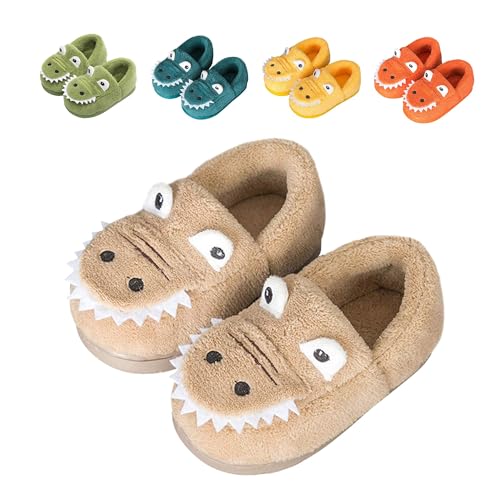
JACKSHIBO Toddler Dinosaur Bunny Slippers — Character pair with hard sole
The JACKSHIBO makes the opposite bet from the Fadezar on one point and agrees on all the others. Where the bunny pair is a soft house shoe, this pair stands on a non-slip hard sole — a firmer platform that suits the toddler whose day includes the garden path, the driveway, and the walk to the car as well as the playroom floor. The characters divide the listing’s charms between dinosaur and bunny designs, plush and fuzzy, aimed squarely at the little-kid imagination that decides what gets worn in real households.
A hard sole on a toddler slipper deserves a balanced word. It protects against stones and cold ground, it keeps its grip pattern longer than a soft sole, and it gives a new walker a stable, predictable platform. It is also firmer underfoot than the plush nests elsewhere in this guide, and a toddler doing long indoor hours may prefer the softer Fadezar. The sensible division of labour: the JACKSHIBO for the child whose slippers commute outdoors daily, the bunny pair for the child whose kingdom is the carpet and the kitchen.
The supervision frame is identical and non-negotiable: waking hours, watched play, no sleeping in them, and an adult’s eye on stairs regardless of how good the sole is. Character slippers carry one more household truth — the beloved pair will be demanded at inappropriate moments, including outdoors in rain and at the table — and the hard sole at least makes the outdoor demands survivable. Expect the same toddler sizing economics as the Fadezar: measure, buy close, re-buy as growth ambushes.
Pick the JACKSHIBO for the outdoor-commuting toddler, the dinosaur devotee, or the household that wants one pair to cover playroom and path. It is the sturdiest small slipper in this guide, and its characters are pulling genuine weight in the wearing department.
- Upper: plush character designs, dinosaur and bunny
- Outsole: non-slip hard sole
- Fit: toddler and little-kid house shoe
- Best setting: indoor floors plus paths and drives
- Use frame: supervised waking hours
Strengths
- Hard sole handles the toddler’s outdoor commuting without complaint.
- Character designs deliver the cooperation every parent needs at dawn.
- Stable platform suits new walkers on mixed surfaces.
Trade-offs
- Firmer underfoot than the plush toddler alternative.
- Hard sole is louder on wooden floors at nap-adjacent hours.
- Character appeal may date before the pair is outgrown.
Best for: toddlers whose slippers go outdoors daily. Not suited for: long indoor-only hours where softness matters more, or sleeping.
Sturdiest for small feet — check price on Amazon.

GIWONET Kids Slippers Faux Fur — Faux-fur bedroom slides for kids
The GIWONET closes the list at the pampered end: a bedroom slide in faux fur over a memory foam bed, made for the child whose slipper life is upholstered — bedroom, bathroom, the soft circuit of a carpeted upstairs. Where the Besroad piles its fluff into a sandal shape for big kids downstairs, the GIWONET’s slide is a more contained, slipper-proper design in brown, with the plush running through the lining and the foot wrapped rather than merely rested on softness.
Slides teach their own small discipline. A backless pair asks the foot to hold it, which older children manage without thinking and younger ones manage by shuffling — the reason this pair sits at the guide’s older end and why its review repeats the household rule: slides are for the flat and the calm, and stairs in a slide deserve a hand on the rail and no running, ever. Within those rules, the GIWONET is a delight: instant on, instant off, warm without socks, and soft enough to make a child feel that bedtime has been upgraded.
The memory foam bed suits the slide’s evening economy — homework at a desk, reading in bed with feet on the cover, the bathroom trip — where standing is brief and comfort is constant. Faux fur will shed its factory freshness into a lived-in softness across the season, and a regular shake outside keeps it presentable. Brown is the grown-up choice among the colours children are offered, and the child who picks it is usually the child who has started raiding a parent’s slipper shelf; this pair gives them a shelf of their own.
Choose the GIWONET for the older child in a carpeted, calm house, for the spa-day birthday present, or as the upstairs pair in a two-pair household. It is the most indulgent design here, and indulgence, at bedtime, is a legitimate specification.
- Shape: bedroom slide, backless
- Upper and lining: faux fur, brown
- Footbed: memory foam
- Best setting: carpeted bedrooms and bathrooms
- Fit note: suits older children who walk calmly
Strengths
- Pampering faux fur through the whole lining, not just a trim.
- Slide convenience for the bedroom-to-bathroom circuit.
- Brown reads grown-up for the child raiding parental shelves.
Trade-offs
- Backless shape is the least stair-friendly here — rail and no running.
- Bedroom brief only; not a driveway or garden pair.
- Faux fur needs shaking out to stay fresh-looking.
Best for: older children in calm, carpeted houses. Not suited for: toddlers, lively stair play, or outdoor use.
The bedtime upgrade — check price on Amazon.
How Do the Six Children’s Pairs Compare?
| Pick | Age focus | Shape | Sole | Signature feature |
|---|---|---|---|---|
| Kids Checkered Slippers | Toddler to big kid | Loafer | House sole | Check corduroy style |
| Besroad Kids Fuzzy House Slippers | Big kid | Open slip-on | House sole | Deepest fluff |
| IceUnicorn Kids Slippers | Wide children’s range | Enclosed | Non-slip | All-round grip and colour |
| Fadezar Toddler Bunny Slipper | Toddler | Heel-cover slipper | Non-slip rubber | Stays on small feet |
| JACKSHIBO Toddler Dinosaur Bunny Slippers | Toddler and little kid | Character slipper | Non-slip hard sole | Outdoor-ready platform |
| GIWONET Kids Slippers Faux Fur | Older children | Slide | Bedroom sole | Full faux-fur lining |
How Should You Measure a Child’s Foot for Slippers?
Measure the child, not the shoe they are outgrowing, and measure in the conditions of wear: standing, in the evening, in the socks the slippers will meet. Have the child stand on a sheet of paper against a wall, mark heel and longest toe, and measure the line in centimetres. Do both feet — most children, like most adults, have one foot slightly longer — and buy for the longer one. Then use the listing’s own chart, because a size eight in one brand’s toddler system is a rumour in another’s, and the centimetre column is the only honest translator between them.
Growing room is where good intentions go wrong. A thumb’s width beyond the longest toe — roughly a centimetre — is the allowance that serves a season of growth while keeping the heel where it belongs. Two centimetres is not thrift; it is a loose shoe that folds under a running child, catches on stair edges, and teaches the toes to grip in a way no one wants practised. If the perfect size sits between two listed options in a toddler pair, choose the heel-covered design in the larger, and in an open design choose the smaller that still clears the toe.
Re-measure on a rhythm, because growth does not send announcements. Every couple of months for toddlers, each school term for older children, and whenever the child starts the telltale shuffle of a foot negotiating with its shoe. The slippers in this guide are bought for a season’s fit; a parent who measures on schedule will always know which season they are in.
What Makes a Slipper Stay On a Small Foot?
Retention is a geometry problem before it is a materials one. A slipper stays on when the heel cannot lift free: a cupped heel, a half-cover back like the Fadezar’s, or a loafer throat that grips the midfoot. Open backs stay on only by toe-gripping, which is why slides in this guide are assigned to older children whose walking is settled and whose houses are calm. When you watch a child in a new pair, watch the heel, not the smile — a heel that stays seated through a run, a stop, and a turn is a fit you can trust on the stairs.
Socks change the geometry in both directions. A ribbed sock adds friction that helps a marginal heel hold; a silky sock turns the same pair into an ejection system. If a beloved pair runs loose, try the sock drawer before the returns label. Conversely, a pair that fits beautifully barefoot in September may bind over winter socks in December, which is one more reason the evening, socked measurement in the section above is the one that counts.
And teach the donning, because small hands pull slippers on by whatever part presents itself. A child taught to hold the heel and slide will keep a pair’s shape for a season; a child who stamps into the toes will fold the heel counter down and convert a good slipper into a mule by half-term. Thirty seconds of teaching at the first wearing is the cheapest durability upgrade in this entire guide.
How Do You Keep Children’s Slippers Clean and Safe?
Children’s slippers collect the house: crumbs, craft glue, garden soil, and the occasional mysterious leaf. The maintenance rhythm that works is mostly dry — shake them outside weekly, brush soles before the grit reaches the beds, and spot-clean marks while they are still rumours. When a wash is earned, keep it gentle and cool, reshape the pair while damp, and dry away from radiators, because heat is what makes plush linings wiry and foam beds reluctant. A pair that goes into the wash shaped like a slipper should come out of the drying shaped like one too.
Safety checks belong in the same routine. Run a thumb over the sole monthly: tread that has gone smooth on a hard-floored house is a retirement notice, not a detail. Check heel counters for collapse, seams for the first loosening, and character features for anything working free. A slipper is small, cheap, and load-bearing in a child’s day; the two-minute monthly inspection is the entire quality department, and it is enough.
Storage finishes the system. Slippers kept in the open by the child’s own door get worn, aired, and found; slippers buried in a toy box get neither. A small basket or a low shelf at child height turns the morning routine into something the child owns — which, as every parent learns, is the difference between a rule and a habit.
What Mistakes Do Parents Make Buying Children’s Slippers?
Buying big for growth is the evergreen error, and it is an error with a safety edge: the loose heel that was meant to save money is the one that folds on the stairs. Buy the season’s size and accept the re-buy; the arithmetic of a fall is worse than the arithmetic of a second pair. The second error is shopping by age label alone, when children’s feet at the same age differ by several sizes — measure, always, and let the centimetres overrule the birthday.
Third is choosing for the photograph over the floor. A cloud of plush on a slick sole is adorable and treacherous in a tiled kitchen; read the sole line of the listing before the colour name. Fourth is forgetting the child’s veto. A technically perfect pair that the child refuses is a donation with tags on; where possible, let the child choose between two parent-approved options — the bunny or the dinosaur, the check or the colour — and the chosen pair will be worn with the loyalty children reserve for their own decisions.
Finally, parents keep slippers in service past their grip. A beloved pair worn smooth is kept because it is beloved, long after its sole has retired. Honour the attachment, photograph it, and replace it — ideally with the next size of the same design, which is why the re-buyable shapes in this guide earn their places. Sentiment is a fine reason to keep a slipper in a memory box and a poor reason to keep it on a staircase.
Which Slipper Suits Which Stage of Childhood?
The new walker needs the least shoe that still counts as one: a staying-on heel, a gripping sole, and nothing that changes how the foot meets the floor more than necessary. That is the Fadezar’s parish, and the JACKSHIBO’s for the outdoor-going equivalent. At this stage the parent’s eye is part of the equipment, and the slipper’s job is warmth and traction while balance is still being negotiated daily. Anything heavier, taller, or looser is working against the lesson the feet are trying to learn.
The preschool and early-school child is a different athlete entirely — faster, stair-confident, and committed to being wherever the action is. Enclosed shapes and honest soles matter most here, because this is the age of the kitchen sprint and the hallway slide performed deliberately for applause. The IceUnicorn was chosen with this child in mind, and the checkered loafer begins its long service at the top of this band, for the child who has started caring how things look in the mirror.
The older child, finally, is shopping for comfort and identity in roughly equal measure, and the guide’s last three picks divide that vote: fluff for the lounger, checks for the stylist, the faux-fur slide for the child building a bedroom that feels like a retreat. At this age fit still matters — growing feet in foam that has moulded to a smaller shape will complain — but supervision relaxes into ordinary household awareness, and the child’s own report becomes the most reliable fitting tool a parent has.
How Do Children’s Slippers Behave at Grandparents’ Houses and Sleepovers?
Every family knows the cold-floored grandparents’ house, where the floors are beautiful, hard, and maintained at a temperature that suggests the heating is a rumour. A pair of slippers that travels is the difference between a child who roams the house happily and a child who migrates from rug to rug like a cat. The enclosed, grippy picks travel best — IceUnicorn for the general case, the toddler pairs for the small — and a named pair that lives permanently at the grandparents’ saves the packing failure that every parent has committed at least once.
Sleepovers raise the social stakes. A child’s slipper at a friend’s house is a small ambassador: it should be clean, intact, and — for the child’s sake — not the embarrassing pair. This is the big-kid Besroad’s finest hour and the checkered loafer’s too, since both read as chosen rather than assigned. Parents packing for a sleepover should apply the same sole check as at home, because an unfamiliar house has unfamiliar stairs, and the first night is exactly when a smooth sole would choose to matter.
There is also the return journey to plan for: slippers are among the most-forgotten items in the sleepover economy, rivalled only by phone chargers and one sock. A bright colour or a character design is, among its other virtues, findable — in a hallway pile, in a photograph, in a host parent’s description over the phone. The IceUnicorn’s colours earn their keep here in a way no specification sheet would ever record.
What Should You Do When a Child Refuses to Wear Slippers?
Start by believing the refusal, because it usually contains data. A pair that is refused may be hot, tight across the toes, loose at the heel, or scratchy at a seam — all fixable, none visible from adult height. Put the pair on your own hand, feel the lining’s seams, check where the upper meets the toes, and ask the child to point at the problem; even a three-year-old can point. Half of all refusals end at a size exchange, and most of the rest end at a lining the child likes better, which is why this guide spreads its bets across fleece, plush, and faux fur.
The other half of the answer is agency. A child who chose the bunny defends the bunny. Offer the choice inside a parent-approved shortlist — two or three pairs from this guide, differing in character rather than in safety — and let the child’s preference do the enforcement work that no rule can. The same principle scales: the school-age child who picks the check over the colour has picked a side, and sides get worn.
If refusal survives fit, lining, and choice, look at the house rather than the child. Warm floors may simply not need slippers for much of the year, and a child who goes barefoot on carpet in July is making a reasonable decision in unreasonable company. Keep the pair for the cold months and the hard-floored rooms, and let the seasons arbitrate. The goal was never slippers at all costs; it was warm, safe feet, and sometimes the feet are already both.
How Do You Judge Value in a Pair They Will Outgrow?
Children’s slippers invert adult value maths. Durability past a season is wasted engineering, because the foot will leave before the shoe fails; what matters is whether the pair is right for the whole of its short service — grip unworn, heel unstretched, lining still lofty at the moment the toes reach the end. A modest pair replaced on schedule outperforms a premium pair bought big and worn wrong for twice as long, in safety, in comfort, and usually in total spent.
The exception is the re-buyable design. A shape offered across many sizes — the checkered loafer’s span is the example here — converts each purchase into a known quantity, removing the fitting gamble that is the real cost of children’s footwear. Families pay for that certainty gladly, and should: the second and third pairs of a trusted shape are the cheapest slippers a child will ever own, measured in mornings saved.
Handing down is the other honest economy, with the caveat from the questions below: soles and foam remember their first owner. A lightly worn enclosed pair with grip intact passes to a sibling as a genuine saving; a moulded, flattened pair passes down only a shape. Judge the pair in the hand, not the label in the cupboard, and the household’s slipper drawer will stay both thrifty and safe.
Why Do Hard Floors Change Everything for Small Feet?
Adults forget how much of a child’s day happens at floor level and at floor speed. A child crosses the kitchen a hundred times a day, usually accelerating, often carrying something precious and breakable, and the floor’s temperature and grip are the terms of every crossing. Cold tile steals heat from small feet faster than from adult ones — there is simply less child between the floor and the rest of them — and a smooth sole on that tile turns each crossing into a negotiation. This is why the guide treats grip and insulation as one feature rather than two: the warm pair that slips and the grippy pair that freezes both fail the same kitchen.
Rugs redraw the map without repealing it. A house layered with rugs gives children warm islands, but the crossings between islands are exactly where pace is highest and attention lowest. Slippers that grip the bare stretches and sit quietly on the pile — every enclosed and toddler pick here — smooth the whole route. When you assess a new pair, walk the child’s actual route at the child’s actual speed, in imagination if not in fact: door to table, table to stairs, stairs to the bathroom’s cold tile. The pair that suits the route is the pair that will still be on at bedtime.
How Should Slippers Fit Into the Morning Routine?
The families who win the slipper battle make it a station, not a search. Slippers live in one place — the basket by the door, the shelf by the bed — and putting them on is attached to an existing anchor: after socks, before breakfast, with the dressing gown. A routine that depends on a parent remembering is a routine that fails on the busiest mornings, which are the coldest ones; a routine attached to a place and a sequence runs itself by half-term.
Let the child own the station. A low basket they can reach, a hook at their height, the pair placed toes-out the night before by their own hands — these small sovereignties are the machinery of compliance, far stronger than reminders. The character and colour choices in this guide exist to be chosen, and the routine exists to be kept; together they turn the daily question from whether slippers happen into merely which pair, which is a question children enjoy answering.
Final Recommendation
For most families, start with the IceUnicorn: grippy, enclosed, cheerful, and sized across childhood. For toddlers, choose by territory — the Fadezar’s staying-on heel for indoor kingdoms, the JACKSHIBO’s hard sole for little commuters. Older children divide by temperament: the checkered loafer for the stylist, the Besroad for the fluff maximalist, the GIWONET for the bedroom connoisseur. Every one of them is supervised footwear for waking hours, and every one will be outgrown before it is worn out, so buy the fit of this season and enjoy it completely.
Childhood is measured in small shoes left by doors, each pair outgrown a little faster than a parent is ready for. Choose the pair that grips your floors and delights your child, and let this winter’s small shoes do their brief, warm work well.
Frequently Asked Questions
Should children wear slippers all day at home?
Slippers are for the waking, supervised hours — floors that are cold, hard, or slippery are their natural shift. Barefoot time indoors is perfectly ordinary for children too, and many families alternate by room and season. What slippers should never do is go to bed or into a cot; they come off with the day clothes, as a matter of simple household routine.
How much growing room should I leave?
About a thumb’s width — roughly a centimetre — beyond the longest toe, measured standing in the evening. More than that loosens the heel and creates the trip hazard the allowance was meant to avoid. Toddlers grow fastest, so check the fit every couple of months rather than trusting the calendar.
Are character slippers a gimmick?
The character is the delivery system, not the product. Underneath the bunny and the dinosaur in this guide sit a rubber sole, a hard sole, and heels designed to stay on — the safety equipment is real. The character simply ensures the equipment gets worn, which in a toddler household is half the battle and nothing to apologise for.
What sole is safest for a kitchen floor?
A specified non-slip rubber sole, like the toddler picks here, or the IceUnicorn’s non-slip unit for older children. Smooth foam and worn-smooth soles are the ones to avoid on tile. Whatever the pair, check the tread monthly and retire the pair when the grip pattern has polished away.
Can siblings share or inherit slippers?
Hand-me-downs work when the fit is re-measured on the new child and the sole still grips — foam beds mould to the first wearer’s foot, so a heavily used memory foam pair gives its second owner a stranger’s footprint. Lightly worn pairs pass down happily; be honest about which kind you are holding.
Should slippers match siblings’ pairs?
Matching is harmless fun and occasionally useful — identical pairs in different sizes photograph beautifully and confuse nobody, since the size difference is obvious in the hand. What siblings should not share is a single pair passed back and forth in the same season; feet, foam, and hygiene all prefer one owner per pair, and the second child’s own pair is the cheapest peace treaty in the house.
How do I stop slippers being kicked off and lost?
Fit first — most kicking-off is a loose heel announcing itself. Shape second: heel-covered and enclosed designs stay on far better than slides for young children. And habit third: a basket or shelf by the door that belongs to the slippers gives them a home the child can manage, which ends most of the under-sofa archaeology.
Related Guides
Complete the family’s footing and the rooms they run through with these companions. Move on to Best Clog Slippers when the grown-ups want a shaped, stay-put pair of their own, glance at Best Aggressive Climbing Slippers for the household’s most specialised footwear of all, and warm up with Best Après-Ski Slippers before a family winter trip. For the floors and play spaces beneath small feet, read Best Educational Rugs for Baby and Kids.



[…] out the household’s warm-weather footing with these companions. Begin with Best Children’s Slippers if smaller feet need summer pairs of their own, compare Best Affordable Men’s Slippers when […]