What's inside
- Key Takeaways
- Quick Picks
- How Did We Choose Boot Slippers That Earn Their Height?
- How Do the Six Boot Slippers Compare Side by Side?
- How High Should a Boot Slipper Rise, and Why Does It Matter?
- What Should You Wear Boot Slippers With, and Where Should They Go?
- How Do You Wash Boot Slippers Without Wrecking the Lining?
- What Mistakes Do Boot Slipper Shoppers Keep Making?
- How Do Boot Slippers Behave on Different Winter Floors?
- Which Boot Slipper Suits Which Kind of Winter Morning?
- When Should Boot Slippers Be Replaced, and What Wears Out First?
- How Do You Keep Boot Slippers by the Right Door?
- Final Recommendation
- Frequently Asked Questions
- Related Guides
As an Amazon Associate I earn from qualifying purchases. This post may contain affiliate links at no extra cost to you.
cottageverdict.com is reader-supported. When you buy through links on our site, we may earn an affiliate commission.
Where to buy: All six booties below are sold on Amazon, and the linked names open each listing so you can check price on Amazon and confirm your size before ordering. If you want the short version, the LongBay Women Slipper Boots Black cover the most winter situations, the Zizor Women Bootie Slippers Brown bring the firmest sole of the group, and the Obtaom Women Fur Lining Slipper Boots look most like a real mini boot at the door.
The best boot slippers for women solve a problem that ordinary mules and scuffs quietly ignore: cold does not stop at the ankle. On a January morning the gap between a low slipper’s collar and the hem of your pyjamas is exactly where the chill gets in, and it is why a bootie that climbs over the ankle bone feels warmer out of all proportion to the extra fabric involved. This guide compares six women’s boot slippers that wrap the ankle, line it with fleece or faux fur, and stand on soles sturdy enough for the doorstep, the mailbox run, and the cold tiles of a bathroom at midnight.
Height is the first thing to understand about the style. A boot slipper is not simply a tall slipper; the shaft changes how the whole shoe behaves. It holds the heel in place so the foot cannot slide forward and crush the toe lining, it keeps the slipper on when you hurry downstairs with your hands full of laundry, and it turns a draughty hallway from an obstacle into a non-event. Women who have spent years shuffling in backless mules, gripping with their toes to keep them on, tend to describe the first week in booties as a small revelation: the footwear simply stays where it was put.
Warmth, though, is only half the brief. The other half is the sole, because a bootie tall enough for winter will inevitably be worn to the places winter touches — the porch for a parcel, the bin at the end of the drive, the garden path to let the dog out. Every pick in this guide has a closed, textured outsole rated by its maker for indoor and outdoor use, but they are not equal: some are thin and quiet, made for carpet and wood, while others are properly hard-bottomed and shrug off wet concrete. The reviews below say plainly which is which, because buying a delicate sole for a doorstep life is the commonest disappointment in this category.
Fit deserves a word before the picks, because boot slippers size differently from the shoes in your hall. The shaft means your usual size is usually right — there is no open back for the foot to escape through — but thick winter socks change the arithmetic, and memory foam insoles compress during the first fortnight, opening up room that was not there on day one. Several of these listings sell in size ranges rather than single sizes, which suits some feet and frustrates others. Each review notes the sizing pattern its listing uses, so you can match the pick to the way your feet actually behave in winter.
Finally, a note on who this guide is not for. If your winters are mild and your floors are warm, a tall fleece bootie will feel like wearing a duvet on each foot, and a lighter ankle bootie such as the MIXIN below is as far as you need to go. If, on the other hand, your house has stone flags, single glazing, or a wood burner that leaves the far rooms cold, the taller and plusher picks here will earn their place by the door within a week. Read for your own house, not for an imagined average one.
Key Takeaways
- Ankle coverage is the whole point: a shaft that clears the ankle bone stops the draught that defeats low slippers.
- Sole stiffness splits this list — hard bottoms suit doorsteps and drives, softer soles stay quieter on wood floors.
- Memory foam beds down over the first two weeks, so a snug first fit is normal and usually correct.
- Chenille, knit, and faux suede uppers breathe differently; plush faux fur is warmest and slowest to dry after a wash.
- Range sizing (two sizes per option) is common here — measure against the listing’s own chart, not your shoe size alone.
- Every pick is a slip-on with no laces or fasteners, which matters at 2 a.m. with a crying baby or a restless dog.
Quick Picks
| Pick | Badge | Why it made the list |
|---|---|---|
| LongBay Women Slipper Boots Black | Tall chenille all-rounder | A chenille velvet shaft over a fuzzy fleece interior, on a non-slip outsole built for house and doorstep alike. |
| Zizor Women Bootie Slippers Brown | Hard-bottom memory foam bootie | The firmest sole in this guide under a memory foam insole, for women who actually walk places in their slippers. |
| FamilyFairy Women Bootie Slippers Camel | Fold-over knit gift pick | A folding knit collar that wears up or down, plush fleece inside, and the most presentable box-to-feet story here. |
| MIXIN Women Ankle Bootie Slippers | Featherlight faux-fleece ankle bootie | The lowest, lightest shaft in the group — ankle warmth without the full winter commitment. |
| GPOS Women Knit Bootie Slippers | Quilted knit with gripper sole | A quilted faux-cashmere knit over cotton lining, finished with gripper dots for polished floors. |
| Obtaom Women Fur Lining Slipper Boots | Faux-suede mini boot with button detail | A faux suede shell and resin button that read as a mini boot, with fur lining doing the winter work. |
How Did We Choose Boot Slippers That Earn Their Height?
We began with the shaft, because a boot slipper that stops below the ankle bone is a mule wearing a costume. Every pick here rises over the ankle or folds down from a height that does, and each listing describes its lining in terms we could evaluate — fleece, faux fur, chenille, knit — rather than hiding behind the word warm. Where a maker named its insole material, we recorded it; where the listing stayed vague, the pick had to justify itself on construction we could see, such as a stitched hard sole or a gripper tread.
Soles were the second filter, and the strictest. A winter bootie will be worn outside whatever the product page intends, so each pick needed a closed outsole with real texture, described by its maker for indoor and outdoor use. Within that bar, we deliberately kept a spread: two genuinely hard bottoms for women who fetch wood and post letters in their slippers, quieter flexible soles for flats and wooden floors, and one gripper-dot design for polished stone and tile. A guide that ranked six identical soles would help nobody choose.
Third came the honesty check on warmth claims. Fleece and faux fur trap air, and trapped air is what insulates; the depth and density of the pile matter more than any adjective. We favoured listings that described their lining’s material and construction over listings that merely promised cosiness, and we treated gift language — several of these booties are sold as presents — as neutral: a pretty box says nothing about the insole, so we read past it to the foam, the stitching, and the sole.
We also paid attention to how each pair gets on and off, a detail that listings bury and wearers feel ten times a day. A bootie is pulled on by its shaft or its heel loop dozens of times a week, so we looked for shafts with enough body to take that handling without collapsing into a sock-like puddle at the ankle. The structured pairs here hold their shape beside the bed overnight, ready to step into; the softest pair, the MIXIN, trades that readiness for packability, and we have judged it on those terms rather than marking it down for failing a test it never sat.
Lastly, we balanced the six across the real ways women use boot slippers. There is a tall all-rounder, a hard-soled walker, a fold-down knit for women who run warm, a low ankle bootie for mild houses, a quilted knit for quiet floors, and a faux-suede mini boot for anyone who answers the door in them and would like to look dressed. If your winter matches one of those lives, your pick is below; the reviews are written so you can recognise yourself in them quickly.
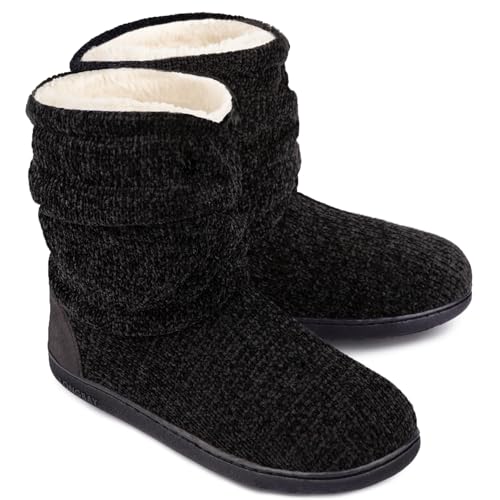
LongBay Women Slipper Boots Black — Tall chenille all-rounder
LongBay builds this bootie around a chenille velvet upper, and that choice sets its character: chenille has a soft, slightly crushed pile that looks richer than flat fleece and hides the scuffs and lint that show cruelly on plain fabrics. Underneath sits a fuzzy fleece interior that wraps the foot and climbs the ankle, and beneath that a cushioned insole the maker describes as cloud-like. In black, the whole thing reads less like sleepwear and more like a soft winter boot, which is why it tops this list as the pair most women will simply live in from November to March.
The outsole is a proper non-slip unit rated for indoor and outdoor use, with enough substance to cross a frosty porch or stand on a cold kitchen slate without the chill striking through. That matters more in a bootie than in a summer slide, because the whole purchase is a promise about cold floors. The shaft height is the tallest-feeling of the six in ordinary wear: it covers the ankle fully and stays up rather than slumping, helped by the chenille’s slight body. Women with slender ankles sometimes find tall booties baggy; this one’s fleece interior takes up much of that slack.
Sizing runs in ranges, and the sensible approach is to choose by your winter-sock self rather than your barefoot self. The insole’s cushioning compresses gently over the first weeks, so a pair that feels merely snug on day one tends to feel tailored by day fourteen. Washing is best kept occasional and gentle — fleece interiors forgive a cool wash but reward air drying, since heat is what makes pile go wiry over time.
Choose the LongBay if you want one pair that answers every winter question the house asks: the early feed, the school run to the gate, the evening on the sofa with your feet up. It is not the lightest pick here, nor the firmest underfoot, but it is the one with no obvious weakness, and in a category bought for comfort, the absence of weakness is the strongest recommendation going.
One more practical note belongs to this pair, because it is the one most likely to be bought as a gift: black chenille is close to a universal language. It suits every pyjama, legging, and dressing gown it will ever meet, it does not date the way novelty colours do, and it hides the evidence of a busy household between washes. Gift-givers who know a size range but nothing else about the recipient’s taste will rarely go wrong starting here.
- Upper: chenille velvet
- Lining: fuzzy fleece throughout, including the shaft
- Insole: cushioned, cloud-style padding
- Outsole: non-slip, indoor and outdoor
- Colour shown: black
Strengths
- Full ankle coverage that stays up instead of slumping into a cuff.
- Chenille upper shrugs off lint and looks presentable at the door.
- Sole has genuine doorstep substance without feeling clunky indoors.
Trade-offs
- Too warm for mild houses once spring arrives.
- Range sizing can leave between-sizes feet choosing a compromise.
- Black fleece shows pale pet hair at a glance.
Best for: cold houses, draughty halls, and anyone replacing low slippers that never kept ankles warm. Not suited for: warm-climate wear or women who dislike any height around the ankle.
Tempted? Check price on Amazon and pick your size range.

Zizor Women Bootie Slippers Brown — Hard-bottom memory foam bootie
Zizor’s bootie is the workhorse of this group, and its defining feature sits underneath: a hard bottom that behaves more like a shoe sole than a slipper pad. Plenty of booties claim indoor-outdoor duty on the strength of a few moulded bumps; this one has a genuinely firm platform, which changes what you can do in it. Gravel drives, damp grass on the way to the compost, the long stand at a cold back door while the dog decides — the Zizor takes all of it without the foot feeling every stone.
Above that platform sits a memory foam insole, and the pairing is smarter than it first sounds. A hard sole alone can feel plank-like on tile; the foam restores the softness at the exact interface where your weight lands, while the platform keeps its shape month after month instead of packing down into a sad felt pancake. The upper is fuzzy inside and out in a warm brown that hides garden-path dust far better than black or cream, a small mercy anyone who wears slippers to the greenhouse will appreciate.
The trade for that substance is weight and a slightly firmer step on wooden floors — you will hear yourself coming down the hall more than in the GPOS below. The bootie shape is a touch lower and snugger than the LongBay, suiting women who want the ankle covered but not swaddled. Sizing is by single sizes in this listing, which between-feet shoppers may prefer to ranges.
Pick the Zizor if your slippers lead an outdoor double life and your current pair dies from the sole up. It is the bootie here most likely to still be going, sole intact, when next winter arrives — and the one to choose if you stand a lot while you cook, because that firm platform keeps its support at the end of a long evening in a way pure foam cannot.
- Upper: fuzzy textile, brown
- Lining: fuzzy pile throughout
- Insole: memory foam
- Outsole: hard bottom, indoor and outdoor
- Fit note: single sizes in this listing
Strengths
- Firmest sole here — genuinely suited to drives, paths, and garden trips.
- Memory foam over a hard platform keeps its shape far longer than foam alone.
- Brown upper conceals the dust that outdoor duty inevitably brings in.
Trade-offs
- Heavier and louder on bare wooden floors than the soft-soled picks.
- Firm platform feels less plush on first wear than pure-foam rivals.
- Shaft sits a little lower than the tallest booties in this guide.
Best for: women whose slippers regularly leave the house and who stand for long stretches. Not suited for: light sleepers’ households where a quiet tread matters, or anyone wanting a cloud-soft step.
For sole-first shoppers, check price on Amazon on this one first.

FamilyFairy Women Bootie Slippers Camel — Fold-over knit gift pick
FamilyFairy’s bootie does something none of the others here attempt: its knit collar folds. Worn up, it is a proper bootie covering the ankle in a soft knitted shaft; folded down, it becomes a cuffed ankle slipper that runs noticeably cooler and looks, in camel, rather like a knitted shoe. That adjustability sounds like a gimmick until you live with a house whose temperature swings — stone-cold at dawn, wood-burner warm by eight in the evening — at which point a slipper with two heights becomes the one you reach for in both halves of the day.
The lining is plush fleece, the insole is memory foam, and the sole is a non-slip unit intended for indoor and outdoor use, though it sits at the lighter end of that spectrum: fine for the porch and the post, less at home on a long gravel drive than the Zizor. The knit upper has give, which makes this the most forgiving fit in the guide for feet that swell by evening or for anyone who wears their thickest socks indoors. Camel is also the most giftable colour here, warm and neutral, and the listing leans into birthdays and holidays for good reason.
Knits ask for a little care in return. The folding collar will stretch if it is yanked on by the top edge every morning, so pull the bootie on by the heel. And because the upper breathes through its knit, this is not the pair for standing in wet grass; the fleece inside will take a long afternoon to dry. Treat it as a house bootie with doorstep privileges rather than a garden shoe and it will serve beautifully.
Choose the FamilyFairy if your warmth needs change through the day, if your feet swell, or if the pair is a present for someone whose taste you know is cosy but not twee. The fold is a real feature, honestly executed, and it earns this bootie a place that six identical plush shafts could not.
- Upper: folding knit collar, camel
- Lining: plush fleece
- Insole: memory foam
- Outsole: non-slip, light indoor-outdoor duty
- Fit note: stretch knit forgives evening swelling
Strengths
- Two heights in one pair — full bootie or folded cuff as the room demands.
- Stretch knit is the kindest fit here for wide or swelling feet.
- Camel knit looks genuinely pretty, which is rare in this category.
Trade-offs
- Knit upper breathes, so it is not the warmest in a truly cold house.
- Sole is porch-grade rather than drive-grade.
- Wet grass will soak through and dry slowly.
Best for: changeable houses, gift-giving, and feet that need a forgiving fit. Not suited for: heavy outdoor use or the coldest stone-floored homes.
Two heights, one pair — check price on Amazon to see the camel knit up close.

MIXIN Women Ankle Bootie Slippers — Featherlight faux-fleece ankle bootie
Not every woman wants a boot; some want the idea of a boot, lightly held. The MIXIN is the lowest and lightest pick in this guide, an ankle bootie in faux fleece with a plush lining that covers the ankle bone and then stops, asking nothing more of the leg. In a heated flat, a mild climate, or the shoulder months when the tall booties feel like overkill, this is the pair that gets worn while the others sit in the cupboard being theoretically warmer.
The construction is simple and honest: a slip-on faux-fleece upper, plush inside, on an anti-slip sole meant for indoor and light outdoor use. There is less structure here than in the LongBay or Zizor, and that is precisely the appeal — the MIXIN folds into a weekend bag, weighs almost nothing in a hospital bag, and slips on in the dark without a thought. Women recovering from foot surgery, travelling to stay with grandchildren, or simply living in a warm house will find its lightness a feature rather than a compromise.
Its limits follow from the same design. The sole is a house sole; the doorstep is fine, the long wet path is not its country. The shallow shaft, while it covers the ankle, will not seal out a serious draught in a stone cottage, and the plush lining flattens sooner than the memory foam insoles elsewhere in this guide. None of that is a flaw — it is a bootie built for gentle duty, priced and weighted accordingly, and judged against the winters it was made for, it succeeds completely.
Reach for the MIXIN if your home is warm, your winters are short, or you want a second, lighter pair for travel and guests. It is also the easiest entry point in this guide for a woman who has never worn boot slippers and suspects she might find the tall ones claustrophobic: start low, and let the ankle coverage win you over gradually.
- Upper: faux fleece
- Lining: plush pile
- Insole: cushioned house insole
- Outsole: anti-slip, indoor and light outdoor
- Profile: lowest shaft in this guide
Strengths
- Lightest pair here — packs flat and travels without complaint.
- Low shaft gives ankle warmth without any sense of wearing a boot.
- Slips on instantly, which suits night-time and hospital-bag duty.
Trade-offs
- Not built for long outdoor walks or wet paths.
- Plush lining compresses faster than memory foam rivals.
- Serious draughts will find the gap above its low collar.
Best for: warm homes, travellers, and boot-sceptics wanting a gentle start. Not suited for: unheated stone houses or regular garden duty.
Lightest of the six — check price on Amazon if gentle duty is your brief.

GPOS Women Knit Bootie Slippers — Quilted knit with gripper sole
The GPOS approaches the bootie from the bedroom outward. Its upper is a quilted knit the maker compares to faux cashmere, lined in cotton rather than fleece, and that lining choice changes the feel in a way worth understanding: cotton against the skin runs cooler and less clammy than synthetic pile, so this is the bootie for women who want ankle coverage without the sauna effect, or who wear their booties for long reading evenings rather than dashes through a cold house.
Underneath, instead of a moulded tread, the sole carries non-slip grippers — the dotted grip familiar from hospital socks, scaled up for a proper slipper. On polished wood, marble, and the treacherous gloss tiles of modern bathrooms, grippers bite in a way smooth rubber does not, and they are silent: no tread slap on the stairs at midnight. The insole is memory foam, lightly built, keeping the whole slipper low and close to the floor, which some women strongly prefer to the platform feel of the Zizor.
The same gripper sole sets the boundary of its world. Grippers are a floor technology, not a path technology; grit and wet leaves defeat them, and they will wear smooth if asked to commute to the bins daily. Keep the GPOS indoors and on the doorstep, wash it gently to protect the knit quilting, and it will do its quiet, grippy work for seasons. The beige colourway is calm and bedroom-appropriate, and the quilted finish looks more made than most slippers at any price.
Choose the GPOS if your floors are polished and treacherous, if you run warm, or if you simply prefer your footwear quiet. It is the most bedroom-minded pick in this guide, and for the woman whose main winter journey is bed to bathroom to book, it may be the most exactly right.
- Upper: quilted knit, faux-cashmere hand
- Lining: cotton, cooler than fleece
- Insole: lightweight memory foam
- Outsole: non-slip gripper dots
- Colour shown: beige
Strengths
- Gripper sole excels on polished wood and glossy tile, silently.
- Cotton lining avoids the clammy feel fleece can give warm feet.
- Quilted knit looks finished enough for slow weekend mornings with visitors.
Trade-offs
- Grippers are not made for gravel, grit, or wet leaves.
- Coolest lining here — cold-house shoppers should look up the list.
- Knit quilting wants gentle washing to keep its shape.
Best for: polished floors, warm sleepers, and quiet treaders. Not suited for: outdoor errands beyond the doorstep or very cold rooms.
For silent grip on shiny floors, check price on Amazon.

Obtaom Women Fur Lining Slipper Boots — Faux-suede mini boot with button detail
The Obtaom is the pick for the woman who answers her own front door in her slippers and would prefer the caller to be none the wiser. Its shell is faux suede cut like a classic mini boot, finished with a decorative resin button at the ankle, and in beige it passes at conversational distance for a soft winter boot. Inside, a full fur lining does the actual work — this is a house shoe wearing a boot’s clothes, and it wears them convincingly.
That fur lining is deep and genuinely warm, the plushest interior in this guide, and it extends up the shaft so the ankle sits in the same warmth as the toes. The classic mini-boot shape also gives this pair the most structured heel of the six: the foot sits in a defined cup rather than a fleece nest, which women who dislike the sliding-around feel of soft booties will appreciate. The sole is a house-and-doorstep unit; treat it as you would a light boot’s sole, not a wellington’s.
Faux suede asks for the same respect as the real thing in one respect: water marks it. A wet doorstep is fine, a rainy garden is not, and a soft brush revives the nap when dust dulls it. The button is decorative, not a fastening, so fit comes from the shape alone — the listing shown is a single size, so read its measurements with care, because a structured bootie forgives a wrong size less than a stretchy knit does.
Pick the Obtaom if appearances at the door matter, if you love the mini-boot look but live in slippers, or if deep fur lining is your whole reason for shopping. It closes this guide as its most dressed-up option, proof that the warmest thing in the house does not have to look like it belongs under the bed.
- Upper: faux suede, mini-boot cut
- Lining: full faux fur, including the shaft
- Detail: decorative resin button at the ankle
- Outsole: house and doorstep duty
- Colour shown: beige
Strengths
- Deepest fur lining here — the warmest interior of the six.
- Mini-boot styling passes at the front door without apology.
- Structured heel cup keeps the foot placed, not swimming.
Trade-offs
- Faux suede marks in wet weather; keep it out of rain.
- Button is decorative only — no adjustment for fit.
- Single-size listing demands careful measurement before ordering.
Best for: door-answerers, mini-boot lovers, and the coldest feet in the house. Not suited for: wet-weather outdoor use or shoppers between sizes who need stretch.
Most dressed-up of the six — check price on Amazon to inspect the button detail.
How Do the Six Boot Slippers Compare Side by Side?
| Pick | Upper | Lining | Sole character | Best setting |
|---|---|---|---|---|
| LongBay Women Slipper Boots Black | Chenille velvet | Fuzzy fleece | Non-slip, all-round | Cold houses, mixed duty |
| Zizor Women Bootie Slippers Brown | Fuzzy textile | Fuzzy pile | Hard bottom | Drives, gardens, long standing |
| FamilyFairy Women Bootie Slippers Camel | Folding knit | Plush fleece | Non-slip, light | Changeable temperatures, gifts |
| MIXIN Women Ankle Bootie Slippers | Faux fleece | Plush pile | Anti-slip house sole | Warm homes, travel |
| GPOS Women Knit Bootie Slippers | Quilted knit | Cotton | Gripper dots | Polished floors, quiet wear |
| Obtaom Women Fur Lining Slipper Boots | Faux suede | Faux fur | House and doorstep | Door-answering, coldest feet |
How High Should a Boot Slipper Rise, and Why Does It Matter?
Height decides three things at once: warmth, security, and how the slipper behaves on stairs. A shaft that clears the ankle bone seals the gap where draughts enter, and it also anchors the slipper so the heel cannot lift out on each step — the quiet mechanical reason bootie wearers stop gripping with their toes. On stairs, that anchor matters more than any tread pattern, because a slipper that stays on the foot is a slipper whose sole stays under the foot, where the grip belongs.
Taller is not automatically better, though. A high, stiff shaft can rub the front of the shin on women with sensitive skin, and in a warm house it simply stores heat nobody asked for. The honest scale runs from the MIXIN’s low ankle cover, through the folding FamilyFairy that lets you choose daily, up to the full coverage of the LongBay and Obtaom. Match the height to your coldest ordinary moment — the unheated bathroom at dawn, not the once-a-year freeze — and the pair will feel right on the other three hundred mornings too.
There is also a circulation courtesy to observe: a bootie collar should hug, not squeeze. If the shaft leaves a deep mark on the leg after an evening’s wear, the fit is wrong for you regardless of how warm it feels, and a knit or fleece shaft with more give — the FamilyFairy or LongBay here — is the kinder choice. Comfort that leaves marks is a debt the feet collect later.
What Should You Wear Boot Slippers With, and Where Should They Go?
Boot slippers live in the borderland between sleepwear and clothing, and dressing them well is mostly about respecting that border. With pyjamas and leggings they are invisible logic; with jeans rolled once at the ankle they look deliberate, especially the faux-suede Obtaom and the chenille LongBay. The school-gate and corner-shop runs that every household actually makes sit comfortably within a hard or mid sole’s ability, and nobody at the bakery counter has ever audited a neighbour’s footwear.
Where they should not go is equally plain. Wet grass soaks knit and fleece shafts and takes hours to forgive; mud cakes tread and then dries onto your hall floor; and a bootie worn as an all-day outdoor shoe will die the death of a thousand flexes in a sole built for gentler mileage. Keep a pair of real shoes by the door for weather, and let the booties own the house, the porch, and the dry path. That division of labour is what makes a good pair last three winters instead of one.
There is a middle path worth naming for the undecided: wear the booties barefoot at home for the first week, then with your usual socks for the second, and notice which version your feet ask for by evening. Feet that run dry and cold usually prefer bare skin against fleece, where the pile traps warmth directly; feet that perspire prefer the sock barrier, which keeps the lining fresher and the warmth drier. Neither answer is wrong, but knowing yours settles the sizing question for every pair you buy afterward.
Socks deserve a sentence of their own. Thin cotton socks inside fleece booties keep the lining fresher between washes and suit women who find pile itchy; thick wool socks turn any pick here into expedition equipment but demand a size with room to spare. Decide which wearer you are before you order, because the same bootie is a different size in each life.
How Do You Wash Boot Slippers Without Wrecking the Lining?
Most bootie deaths are laundry deaths. Fleece and faux fur go wiry under heat, memory foam drinks water and dries reluctantly, and knit shafts stretch if they are hung by their tops to drip. The safe ritual for every pick in this guide is unglamorous: shake and brush them outside weekly, spot-clean marks as they happen, and when a full wash is unavoidable, use a cool, gentle cycle or hand water, then stuff the toes with a tea towel and dry them slowly away from radiators and direct sun.
Between washes, air is the lining’s best friend. Booties stored warm and sealed in a cupboard straight off the feet will smell like it within a month; booties left to breathe overnight by the door stay sweet far longer. A light shake of bicarbonate inside, left overnight and tipped out in the morning, handles the rest without wetting anything. Do that monthly and most pairs will need only two or three true washes a year, which is how the pile survives to see a third winter.
What Mistakes Do Boot Slipper Shoppers Keep Making?
The classic error is buying for the photograph instead of the floor. A cloud of faux fur on a thin sole delights for a week in a carpeted flat and disappoints for a year on cold stone; the sole, the shaft, and your actual floors should outrank any picture. The second error is sizing by hope — ordering a range’s lower half while planning to wear expedition socks — when every listing here rewards honest measurement. Between-sizes shoppers should favour stretch knits or structured singles, not optimism.
Third comes the one-pair fallacy: expecting a single bootie to be a bedroom slipper, a garden shoe, and a travel companion, then blaming it for failing at the job it was never built for. This guide deliberately spans soft to hard soles so you can choose your primary battlefield and, if your life genuinely has two, own two pairs at different weights — the MIXIN for travel, the Zizor for the garden — rather than one compromise that serves neither.
Finally, shoppers forget the stairs test. However warm and lovely a bootie feels standing at the mirror, walk stairs in it during the returns window, hands carrying something, the way real life loads you. A shaft that holds and a sole that grips will announce themselves at once; a pair that shifts on the foot will announce itself too, and that is the moment to send it back rather than the icy morning three months later.
How Do Boot Slippers Behave on Different Winter Floors?
Stone and tile are the floors that justify this entire category. Both pull heat from the foot by conduction, and both are commonest exactly where booties are worn most — kitchens, bathrooms, and hallways. On stone, sole thickness is your insulation: the Zizor’s hard platform and the LongBay’s substantial unit keep a real barrier between fleece and flagstone, while thin soles let the cold arrive within minutes no matter how plush the lining above them. If your house has stone anywhere on the morning route, buy the sole first and the lining second.
Wood is a kinder surface but a louder one. Treaded rubber announces itself on boards, especially in flats and in houses where someone sleeps late; the GPOS grippers and the MIXIN’s light sole are the considerate choices there. Carpet reverses every priority — grip barely matters, warmth is half provided by the floor itself, and the tallest, plushest shafts come into their own because nothing underfoot is fighting them. Laminate sits between wood and tile: cold like tile, smooth like polished wood, and the surface where a genuinely non-slip sole earns its name on the way to the kettle.
Rugs and runners complicate the picture in one specific way: the step up from bare floor to rug edge is where loose slippers trip their wearers. A bootie’s anchored heel rides that edge far more safely than a mule, which is a quiet argument for the style in older houses with layered rugs. Whichever pick you choose, walk your own morning route in them during the first days — kitchen stone, hall wood, bathroom tile — and let the floors vote. A pair that suits all three is the pair you will still be wearing in February.
Which Boot Slipper Suits Which Kind of Winter Morning?
The dawn riser in an unheated house needs maximum coverage and minimum fuss: the LongBay or the fur-lined Obtaom, pulled on in the dark, warm before the kettle boils. There is no fastening to fumble and no decision to make, and that simplicity at the coldest, sleepiest moment of the day is worth more than any single material advantage. For this wearer, keep the pair at the bedside, not the door — booties stored downstairs do no good at all at six in the morning.
The home worker’s morning runs differently: hours at a desk where feet sit still and cool quietly under the table, broken by doorstep deliveries and a lunchtime walk to the bins. Still feet run colder than walking feet, so a deep lining matters, but the sole must also handle the doorstep without a shoe change. The Zizor and LongBay split this life between them — foam and fleece for the desk hours, substance underneath for the door. Anyone who has answered the door in socks on wet concrete understands the brief instantly.
The evening wearer — the woman whose booties come out after work, for cooking, sofas, and the last dog walk to the gate — should weight comfort over coverage and choose by lining feel: cotton-lined GPOS for long, warm evenings indoors, the folding FamilyFairy for houses that cool as the night deepens. And the weekend host, moving between kitchen, door, and garden path with guests arriving, is the Obtaom’s natural owner, the one wearer for whom looking dressed in her slippers is a genuine feature rather than a vanity.
When Should Boot Slippers Be Replaced, and What Wears Out First?
The lining usually retires before the sole on soft pairs, and the sole before the lining on hard ones. Fleece and faux fur lose their loft in stages: first the heel patch flattens, then the whole insole area packs down, and warmth fades with the trapped air the pile once held. You can test a pair honestly by pressing the lining at the heel — if your fingers reach the insole board with no spring left, the insulation there is mostly memory. Shaking, brushing, and air-drying restore surface life, but compressed pile at the heel is wear, not dirt.
Soles announce their age differently. Tread smooths at the ball of the foot, gripper dots wear to a shine, and hard platforms develop a polished patch that slips on wet tile long before it looks worn. Check yours on the bathroom floor after a shower, when the surface is damp and honest. A bootie that skates there has given its service, however beloved the upper, because grip is the one virtue that cannot be argued with or restored by washing.
The uppers, by contrast, are survivors: chenille, knit, and faux suede in this guide will all outlast the parts beneath them if they are kept out of hot washes and wet gardens. That is the real argument for buying the sole and lining well the first time. The visible bootie is the last thing to fail, so judge replacements by what your feet report — cold at the heel, slip on damp tile — and not by how the pair still photographs on the mat.
How Do You Keep Boot Slippers by the Right Door?
Placement sounds trivial until you count how many winter errands begin at two different doors. Most houses live through the back door — bins, garden, dog, wood store — while slippers wait politely at the front. The households that get full value from boot slippers keep them where the day actually starts: bedside for the dawn risers, back door for the garden commuters. A pair that must be fetched is a pair that gets skipped, and a skipped pair warms nobody. If your budget stretches to two, the pattern that works is one plush pair living upstairs and one hard-soled pair living downstairs, each exactly where its job begins.
Storage matters in smaller ways too. Booties left in a heap inside a warm cupboard hold the day’s moisture against their linings; booties stood upright on a mat, shafts open, dry by morning and smell like it. A boot tray under them catches the grit that even careful wearers bring in from the path, and keeps that grit off the hall floor where bare feet will find it later. None of this costs anything, and together it is the difference between a pair that stays pleasant for three winters and a pair that turns faintly feral by the second January.
Guests deserve a closing word here, because winter visitors arrive in wet shoes and leave puddles of obligation behind them. A spare light pair — the MIXIN is built for exactly this — kept clean in a basket by the door turns a shoeless-house rule from an awkward request into a small hospitality. It is the sort of detail guests remember, and it protects your floors and your own booties, which otherwise end up lent, stretched, and mysteriously relocated to the wrong end of the house.
Final Recommendation
For most women, the LongBay is the pair to buy first: full ankle coverage, a chenille upper that stays presentable, and a sole with no obvious weakness indoors or out. If your slippers work outdoors daily, step up to the Zizor’s hard bottom; if your house changes temperature by the hour, the FamilyFairy’s folding knit is the cleverest design here. The MIXIN, GPOS, and Obtaom each own a narrower brief — light travel, polished floors, and door-worthy looks — and own it completely.
Whichever you choose, choose it for your coldest ordinary morning and your real floors, and the pair will disappear into your routine the way good winter tools do. Cold ankles are a solved problem; these six are simply six different handwritings of the same warm answer, and the right one is the one your house has been asking for.
Frequently Asked Questions
Are boot slippers too warm for sleeping in?
They are footwear, not bedding, and most women kick them off at the bedside. If your feet stay cold in bed, socks are the right tool; booties earn their keep on floors, stairs, and doorsteps, where their soles and shafts do work socks cannot.
How do I pick between range sizes?
Measure your foot in the socks you will actually wear, late in the day when feet are at their largest, and choose the range that contains that measurement without sitting at its very edge. Memory foam insoles relax over the first fortnight, so a firm first fit usually settles better than a roomy one.
Can boot slippers be worn outside every day?
Doorstep and dry-path duty, yes — that is what the hard and mid soles here are built for. Daily outdoor mileage, wet grass, and mud will shorten any pair’s life sharply, because the uppers and linings are textiles made for the house. Keep outdoor shoes for weather and the booties will last seasons.
Why does one ankle still feel cold in tall booties?
Usually the collar fit: a shaft that gaps at the back lets air pump in and out as you walk. A fleece-lined or knit shaft that hugs the leg, like the LongBay or FamilyFairy here, seals better than a stiff shaft standing away from the ankle. Thick socks that fill the gap solve it in structured pairs.
How long should a good pair last?
With indoor-led duty and gentle washing, two to three winters is a fair expectation; the sole and the lining’s loft are what age first. A hard-bottomed pair like the Zizor generally outlasts soft soles, while plush linings kept out of hot washes keep their warmth longest.
Do boot slippers stretch out over time?
Knit and fleece shafts relax a little — that is the bedding-in that makes a firm first fit feel tailored — while structured faux suede holds its shape almost exactly. What should not happen is the heel slipping as you walk; if a pair loosens to that point within the returns window, exchange the size rather than hoping socks will rescue it, because shafts only ever move in one direction.
Are boot slippers safe on stairs?
A well-fitting bootie is among the safer house shoes on stairs, because the shaft keeps the sole under the foot instead of letting it flap like a mule. The conditions are honest fit and a grippy sole; a loose pair worn over socks on polished wood deserves the same caution as any footwear.
Related Guides
Warm feet pair naturally with the rest of a considered house. For cooler evenings on hard floors, continue to Best Breathable Indoor Slippers for Men if you are shopping for a partner who runs hot, browse Best Acorn Slippers for Women for another women’s shortlist built around suede and fleece, and see Best Animal Slippers when the brief is pure fun. For the layer that finishes a winter bed, read Best Alpaca Blankets.


