What's inside
- Key Takeaways
- Quick Picks
- How Did We Choose These Cork Footbed Pairs?
- The Six Cork Footbed Slippers in Detail
- How Do the Six Cork Footbed Pairs Compare?
- How Does Cork Actually Mould to a Foot?
- How Should Cork Footbed Slippers Fit?
- What Mistakes Do Cork Buyers Make?
- Caring for Cork: Sealant, Dryness, and Time
- Wool, Suede, Leather: The Upper Chooses the Life
- The Second Pair Effect: Rotation Among Cork Owners
- Cork Across the Day: Standing, Cooking, and the Desk
- Gifts From the Cork Shelf: A Considered Present
- The History in the Bed: Why Cork, Why Now
- When Cork Is the Wrong Purchase
- The Footprint in the Bed: Reading a Used Cork Pair
- Seasons on Cork: Summer’s Case Against the Wool Pair
- The Workshop, the Studio, and the Standing Trades at Home
- What to Wear While the Bed Is Learning: The Fortnight’s Wardrobe
- The Price Question, Answered in Years
- A Final Distinction: Cork Beds and Cork Looks
- The Pair by the Door, Revisited
- One More Household: The Caravan, the Boat, and the Small Footprint Life
- The Verdict the Foot Delivers at Year One
- A Closing Note on Patience as a Specification
- The Cobbler’s View: Repair, Resoling, and the Long Game
- The Socks Question, Settled for Cork
- Final Recommendation
- Frequently Asked Questions
- Related Guides
As an Amazon Associate I earn from qualifying purchases. This post may contain affiliate links at no extra cost to you.
cottageverdict.com is reader-supported. When you buy through links on our site, we may earn an affiliate commission.
Where to buy: Amazon lists all six pairs under the names linked below — check price on Amazon there, and read the width notes carefully, because a cork footbed must match the foot’s width as exactly as its length.
The best cork footbed slippers are built around the oldest idea in this entire batch of guides: that a bed of cork and latex, shaped with an arch, a heel cup, and a toe grip, will mould itself to the individual foot across the first weeks of wear and then hold that shape for years. Where the clog article in this batch was about a silhouette, this one is about a material and its philosophy — cork as the foot’s long-term negotiating partner, whether it arrives under a wool clog, a suede mule, or a purpose-built house shoe.
The six picks divide by upper and by intent. The Fulton is the dedicated house shoe, cork-bedded and built for indoor life. The Stegmann 108 is the heritage wool clog, the design that defined the category in felted wool over a cork-latex bed. The Haflinger Grizzly brings the grizzliest outsole of the set to the same architecture. The KIDMI and ODOLY are the suede clogs at accessible positions — the cork idea in its most democratic form — and the PROJECT CLOUD closes the shelf in leather, the premium upper over the classic bed.
Every pick shares the cork contract, and it deserves stating at the door: the first fortnight is a fitting, conducted by the foot itself, and the pair that feels merely firm in week one feels personal by week six. Buyers who want softness on the first evening should take the bedroom shelf instead; buyers who want a bed that becomes theirs should read on.
Key Takeaways
- Cork-latex beds mould to the individual foot across the first weeks, then hold the shape for years — the opposite ageing curve to foam.
- The Stegmann 108 and Haflinger Grizzly are the heritage wool-clog expressions of the idea; the Fulton is its dedicated house shoe.
- Suede clogs (KIDMI, ODOLY) deliver the same bed at accessible prices; PROJECT CLOUD adds a leather upper.
- Width matters as much as length: the bed’s arch and cup are placed for a specific foot geography.
- Keep cork dry and seal its exposed edges when they pale — the bed will outlast the upper above it.
- The break-in is real and worth it; judge the pair at week three, not at the door.
Quick Picks
| Pick | Badge | Why it earns its place |
|---|---|---|
| Fulton House Shoe Cork Women | The dedicated house shoe | A women’s house shoe built around its cork bed — the idea in its purest indoor form. |
| Stegmann Original 108 Wool Clogs | The heritage original | Felted wool over a cork-latex bed — the design the category has measured itself against for decades. |
| HAFLINGER Grizzly Zigzag Cork Clogs | The grippy heritage | Wool clog architecture with the Grizzly outsole — cork comfort that handles the doorstep. |
| KIDMI Suede Clogs Cork Footbed | The accessible suede | A suede clog on a cork bed at a democratic price — the idea’s easiest entry. |
| ODOLY Suede Clogs Cork Footbed | The second suede route | Another suede-and-cork combination, differing in fit and finish — try the one that suits your foot. |
| PROJECT CLOUD Leather Cork Clogs Women | The leather premium | Leather over cork for the women’s line — the bed’s longest-lived upper. |
How Did We Choose These Cork Footbed Pairs?
The screening began with the bed itself, because in this category the bed is the product and the upper is its clothing: the cork content had to be real — a cork-latex footbed with genuine arch geography, not a cork-look insole over foam — and the construction had to let the bed do its slow work, which means an upper that holds the foot in the bed’s geography without fighting it. Pairs with decorative cork veneers over flat foam failed at the first question, however handsome.
The second screen was the upper’s honesty about its station: wool for the house and the dry doorstep, suede for the same with more polish, leather for the longest service, and no upper pretending to weather it cannot handle. We also weighted the replaceable and the repairable — cork beds outlast uppers, and the brands that acknowledge that with their construction earned their places.
What survived is a shelf with one idea at six prices and in four materials, which is exactly what a material-led category should look like. The reviews differ in everything except the bed’s promise, and the promise is the same in all six: give it three weeks, and it will fit you like nothing bought off a shelf has any right to.
The Six Cork Footbed Slippers in Detail

Fulton House Shoe Cork Women — The dedicated house shoe
The Fulton is the cork idea with the house as its whole brief: a women’s house shoe designed from the bed outward, without the clog’s outdoor ambitions or the heritage brands’ history to honour. That focus shows in the details a house shoe lives by — an upper shaped for the indoor day, a sole with floors rather than pavements in mind, and the cork bed given the starring role the category promises. For the buyer who wants the moulding, the support, and the longevity without the clog’s silhouette, this is the guide’s most direct answer.
Its modernity is also its difference from the heritage picks: where Stegmann sells a tradition, Fulton sells a specification. The bed’s work is the same — the slow personalisation, the plateau of fit that follows — and a buyer choosing between them is choosing between a story and a spec sheet, both wrapped around the same honest material.
- Bed: cork footbed, house-shoe design
- Brief: dedicated indoor wear
- Character: the idea without the clog
- Best room: whole house, hard floors
- Fit: women’s size run
Strengths
- Cork’s full promise in a pure house shoe
- No outdoor pretensions to pay for
- Modern fit and finish
Trade-offs
- Less heritage and hand-feel than the wool classics
- Indoor brief — doorsteps are its limit
- The break-in weeks apply as with all cork
Best for: women wanting cork’s benefits in a house shoe. Not suited for: buyers wanting the classic wool clog.

Stegmann Original 108 Wool Clogs — The heritage original
The Stegmann 108 is the closest thing this category has to a founding document: a seamless felted wool upper — warm, breathable, and shaped by a process older than the brand’s current owners — over the anatomical cork-latex bed that the design has carried for decades. Everything about it is the argument that a house shoe can be a lifetime object rather than a seasonal one: the wool that felts tighter with wear, the bed that personalises, the construction that cobblers can still argue about repairing.
Its comfort is the heritage kind — firm, warm, and increasingly personal — and its demands are the heritage kind too: keep it dry, keep it indoors or near it, and give the bed its weeks. Owners measure these in years and replacements in decades, and the 108’s presence at the head of so many cork conversations is simply the record of a design that has been right for a very long time.
- Upper: felted wool, seamless
- Bed: anatomical cork-latex
- Character: the heritage original
- Best room: houses, dry doorsteps
- Service: measured in years
Strengths
- The category’s benchmark design
- Wool warmth that breathes in both seasons
- Built to a multi-year standard
Trade-offs
- Wool fears wet weather entirely
- Heritage pricing
- Firm break-in, honestly signalled
Best for: buyers who keep things for years. Not suited for: wet climates’ doorsteps or softness-first feet.

HAFLINGER Grizzly Zigzag Cork Footbed Clogs — The grippy heritage
The Haflinger Grizzly takes the same wool-and-cork architecture as its Austrian-German cousin and adds the family’s signature: a Grizzly outsole with real tread, under a zigzag-patterned wool upper that announces itself cheerfully. The tread changes the clog’s map — the doorstep, the garden path, the garage, and the wet porch all come inside the pair’s competence — while the cork bed does its slow work undisturbed by the expanded itinerary.
Between the two heritage picks, the choice is terrain and temperament: the Stegmann for the purist’s house, the Haflinger for the house with a garden attached and an owner who refuses to change shoes for it. Both beds mould identically; both wools warm identically; the Grizzly simply walks further on its way to the same evening.
- Upper: wool, zigzag pattern
- Bed: cork footbed
- Sole: Grizzly treaded outsole
- Character: heritage with range
- Best terrain: house, garden, doorstep
Strengths
- Cork comfort with outdoor-capable grip
- Wool warmth and breathability
- A pattern with genuine cheer
Trade-offs
- Wool still fears sustained wet
- The zigzag is a look commitment
- Heritage pricing applies
Best for: house-and-garden wearers. Not suited for: minimalists of pattern or wet-weather use.
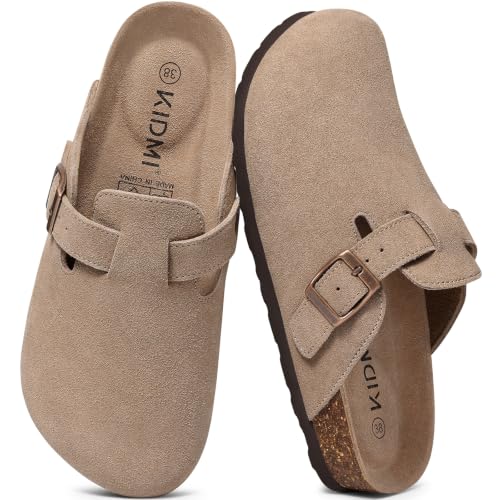
KIDMI Suede Clogs Cork Footbed — The accessible suede
The KIDMI brings the cork bed down the price ladder in a suede clog, and its importance to the category is democratic: the moulding bed, the arch geography, and the long plateau of personal fit, at a price that lets a curious buyer test the philosophy without funding it like a heritage purchase. The suede upper is the clog form’s most popular modern dress — soft, matte, and forgiving of the house’s scuffs — and the whole reads as the cork idea’s invitation to the unconvinced.
The honest differences from the heritage end are in the fine materials and the finishing rather than in the bed’s behaviour: expect the same three-week courtship and the same personal fit, in a shoe whose upper will age on a shorter clock than the Stegmann’s wool. As an entry to the material — or as the second pair that rests the first — it is exactly right.
- Upper: suede clog
- Bed: cork footbed
- Character: the democratic entry
- Best room: house and doorstep
- Role: first cork pair, or the rotation pair
Strengths
- The cork promise at an accessible price
- Suede’s soft, forgiving finish
- Full clog versatility
Trade-offs
- Upper ages faster than heritage wool or leather
- Finishing is good, not benchmark
- Suede wants dry weather and a brush
Best for: first-time cork buyers. Not suited for: anyone wanting a decade-long upper.

ODOLY Suede Clogs Cork Footbed — The second suede route
The ODOLY is the shelf’s second suede route to the same bed, and a guide that kept only one of the pair would be hiding how this end of the market works: two honest suede clogs, near in specification, differing in the fit’s fine geography — the toe’s room, the instep’s height, the suede’s hand — in ways that decide purchases for individual feet more than any headline feature can. The ODOLY’s fit will suit some feet the KIDMI’s does not, and vice versa, and the correct response to that symmetry is to try the one whose description matches your foot’s known preferences.
Its bed makes the same cork promise on the same schedule, and its suede asks the same dry care. What it adds to the guide is choice at the exact point where choice matters most — the entry price — and a second data point for the proposition that the cork idea no longer belongs to the premium shelf alone.
- Upper: suede clog
- Bed: cork footbed
- Character: the alternative fit
- Best room: house and doorstep
- Role: entry pair, fit-dependent
Strengths
- Same cork promise, different fit geography
- Accessible pricing
- Suede finish that suits most houses
Trade-offs
- Overlaps the KIDMI closely — choose by fit
- Upper longevity is the accessible tier’s
- Dry care required
Best for: buyers whose feet prefer its fit. Not suited for: anyone wanting maximum upper lifespan.

PROJECT CLOUD Leather Cork Footbed Clogs Women — The leather premium
The PROJECT CLOUD closes the shelf by clothing the cork bed in leather, the upper material with the longest service record of the four on offer, in a women’s clog that aims at the buyer who has already converted to the bed and now wants the version that will not need replacing. Leather’s biography on a clog is the mirror of cork’s: it stiffens, then supples, then polishes into a personal finish, scuffing and recovering across years that wool and suede spend differently.
The pairing is philosophically neat — the two slowest, most personal materials in footwear, bed and upper ageing together — and the clog that results is the shelf’s longest-keeping object. Its price sits accordingly, and its buyer is not experimenting: she is settling, in the best sense, and the guide gives her the pair built for the settling.
- Upper: leather clog, women’s
- Bed: cork footbed
- Character: the long-service premium
- Best room: house, doorstep, garden path
- Service: the shelf’s longest
Strengths
- Leather and cork ageing together, personally
- The longest-lived upper here
- A settled buyer’s clog
Trade-offs
- Premium pricing
- Leather wants conditioning care
- Break-in applies to upper and bed alike
Best for: converted cork wearers buying for years. Not suited for: first-time experimenters.
How Do the Six Cork Footbed Pairs Compare?
| Pick | Upper | Bed | Range | Best for |
|---|---|---|---|---|
| Fulton | House shoe upper | Cork | Indoor | Pure house wear |
| Stegmann 108 | Felted wool | Cork-latex | House, dry doorstep | Heritage keepers |
| Haflinger Grizzly | Wool zigzag | Cork | House and garden | Garden-door households |
| KIDMI | Suede | Cork | House, doorstep | First cork pair |
| ODOLY | Suede | Cork | House, doorstep | The alternative fit |
| PROJECT CLOUD | Leather | Cork | House and path | Long-service buyers |
One bed, four uppers, six prices: the table is the category’s whole structure, and it makes the buying decision unusually clean — choose the upper for your terrain and your keeping habits, and the bed will do the same work in any of them.
How Does Cork Actually Mould to a Foot?
Cork is a cellular material — a honeycomb of tiny air pockets in a resilient bark matrix — blended here with latex into a footbed that yields under pressure and heat without collapsing. Across the first weeks, the standing foot presses its own map into that matrix: the heel’s weight deepens its cup, the arch’s contact persuades the rise to meet it exactly, the toes print their grip at the front. The result is not a softening but a fitting — the bed’s geography becomes the foot’s geography, recorded in a material that then holds the recording for years because cork, unlike foam, does not keep compressing toward flat.
That is the material’s whole argument, and it inverts the economics of comfort: a foam bed’s best day is its first, while a cork bed’s first day is its worst, and every week after is an improvement the owner can feel. Buyers should therefore distrust their first impression of any pair in this guide with a discipline they bring to no other category — the shop’s verdict is the least reliable evidence in the entire purchase.
How Should Cork Footbed Slippers Fit?
Fit is geography before it is comfort: standing in the evening, the heel should sit inside the cup with the cup’s rim behind it, the arch’s rise should meet the arch’s highest point rather than pressing ahead of or behind it, and the toes should reach the toe grip — the small raised bar the bed provides — without curling over the front edge. Width is not a secondary detail in this category but half the fitting: a narrow bed under a wide foot relocates every feature the buyer is paying for, and the brands’ width options should be used without hesitation.
Between sizes, take the one whose geography matches, even if it is not your usual number — cork sizes its beds by the map, and a familiar number with a misplaced arch is a worse purchase than an unfamiliar number with the map in place. Then give the fitting its three weeks before judging the result, in socks of the season’s ordinary thickness.
What Mistakes Do Cork Buyers Make?
Judging at the door leads, as the previous section warned: the cork bed is the only product in this batch whose first impression is evidence against itself, and the returns it suffers in week one are the category’s standing tragedy. Second is drowning it — cork kept dry lasts years; cork soaked, dried on radiators, and soaked again crumbles at the edges and takes the bed’s geography with it. Third is buying the look without the bed: the clog silhouette in a foam shoe, chosen for the photograph, which delivers neither the clog’s virtues nor the bedroom’s.
The quiet mistake is the wrong upper for the terrain — wool for the wet garden, suede for the flour-dusted kitchen of a baker — because the bed will outlast the upper’s mistakes and the pair will be retired for its clothing while its heart is still personal and perfect. Choose the upper for the life, and the bed for the foot, in that order.
Caring for Cork: Sealant, Dryness, and Time
Cork care is three habits, none of them weekly. Keep the bed dry in spirit: if the pair is soaked, let it dry at room temperature, open, away from radiators, and never wear it again until it has — damp cork under load is cork being spent. Watch the bed’s exposed edges, where the cork meets the air at the sides: when they begin to look pale and dry, a coat of cork sealant — the small pot the sandal world sells for exactly this — restores the surface and prevents the crumbling that shortens a bed’s life. And rest the pair: a day off between long wears lets the material recover its temper, as it does for every natural bed in this batch.
Uppers take their own care — wool brushed and aired, suede brushed and kept dry, leather conditioned occasionally — and the household that gives both halves their modest due will find the pair’s service measured in the plural of years. Neglect, correspondingly, is the only real enemy: cork does not wear out so much as it is allowed to dry, soak, and crumble, all three of which are choices.
Wool, Suede, Leather: The Upper Chooses the Life
Since the bed is constant across this shelf, the upper is where the pair’s life is actually decided, and each of the four materials writes a different contract with the house. Wool is the thermal diplomat — warm in January, breathable in June, and felting itself denser and more personal with wear — at the price of a total intolerance for wet. Suede is the social material: soft, matte, presentable at the door, and scuffed by exactly the life that wool shrugs off, wanting a brush and dry days. Leather is the archivist: slowest to yield, longest to last, polishing its biography into its surface and asking for conditioner the way the bed asks for sealant.
The Fulton’s house upper makes the fourth contract — modern, indoor, and unpretentious — and suits the buyer who wants the bed without a material philosophy attached. None of the four is the correct choice in the abstract; each is correct for a house, a climate, and a temperament, and the guide’s six picks exist so the matching can be done by description rather than by disappointment.
A useful tiebreak, when two uppers both suit: choose by the household’s wettest habit. The dog’s dawn garden, the bins in the rain, the bathroom’s splash zone — the upper that survives the wettest thing the pair will actually meet is the upper that will not be the pair’s obituary.
The Second Pair Effect: Rotation Among Cork Owners
Cork owners converge, independently and with suspicious regularity, on owning two pairs — and their reasoning is the material’s own. A cork bed recovers between wears; a pair rested a day returns to the foot with its geography refreshed, and two pairs alternating will each outlast the same two pairs worn in sequence by a margin that pays for the system. The second pair is usually bought in a different upper — the wool for winter, the suede or leather for the shoulder seasons — so the rotation is seasonal as well as mechanical, and the household ends up with a small, complete wardrobe built on one bed.
The accessible suede pairs find their noblest role here: the rotation partner for a heritage first pair, absorbing the wet-season doorsteps and the heavy weeks, and proving the bed’s philosophy a second time at a third of the price. A category that inspires systems rather than replacements is a category that has earned its owners, and cork’s owners are, by the evidence of their shelves, the most systematic in this entire batch.
Cork Across the Day: Standing, Cooking, and the Desk
A cork pair’s day divides into the same three shifts as the house’s, and the bed serves each differently. The standing shift — cooking, laundry, the workshop’s edge — is where the moulded geography earns its reputation: a bed that has recorded the foot distributes the standing load across the whole recorded map, and the kitchen hour ends without the negotiation a flat pair starts. The walking shift — the house’s circuits, the garden door, the stairs — grades the upper’s hold and the sole’s manners, and it is where the Haflinger’s tread and the leather clog’s structure collect their premiums.
The sitting shift is the bed’s quietest test and the one foam partisans forget to run: a tucked, crossed, desk-bound foot in a cork clog is a foot in a shaped cradle rather than on a cushion, and wearers divide honestly — some find the geography a comfort even at rest, others kick the pair off under the desk and resume barefoot. Neither verdict is wrong; they are the two temperaments of feet, and the cork buyer should know theirs before the fortnight does the teaching.
Across all three shifts, the bed’s constancy is the point: it does not tire at four, flatten by Friday, or forget the foot over a holiday. In a house of foam objects on their various declines, the cork pair is the one whose hundredth day resembles its fiftieth, and for many owners that steadiness — more than the arch, more than the materials — is the conversion.
Gifts From the Cork Shelf: A Considered Present
A cork pair is a confident gift and a slightly demanding one: confident because the object is handsome, durable, and self-explanatory; demanding because its sizing is geography and its first fortnight is a fitting the recipient must be warned about. The card therefore matters as much as the size — one sentence (“they feel firm for two weeks, then they become yours”) converts the bed’s only liability into the present’s story, and a giver who writes it has understood the category completely.
Recipient by recipient, the shelf sorts itself: the Stegmann for the traditionalist who keeps things for decades, the Haflinger for the gardener, the leather PROJECT CLOUD for the woman whose standards are family legend, the suede pairs for the curious who would never fund their own experiment, and the Fulton for the modernist whose house has no wool in it. Each is a sentence about its recipient written in cork, which is what the best gifts are — and few objects at any price will still be making the sentence, personally fitted, five winters later.
The History in the Bed: Why Cork, Why Now
Cork footbeds are not a trend that arrived but a tradition that persisted: Central European house shoes and sandals have been built on cork-latex beds for the better part of a century, through every foam revolution the footwear industry has staged, because the material’s proposition never stopped being true. Foam improved at being soft; it never learned to be personal across years. The current shelf — heritage Austrian wool, American house shoes, accessible suede from global makers — is the tradition at its widest distribution ever, which is another way of saying the experiment has concluded and the bed won.
The modern buyer’s context adds one new argument the tradition never needed: waste. A pair kept for five years, its bed sealed twice and its upper brushed back to life, is a small refusal of the seasonal-consumable model that fills the rest of the footwear shelf — and the cork category’s owners, rotating their two pairs across a decade, are quietly the most sustainable footwear consumers in this entire batch without ever having used the word.
None of that history is required to justify a purchase; the fortnight’s fitting justifies it alone. But a buyer choosing the bed is joining a long queue of feet that made the same discovery, and there is comfort — the word again — in the queue’s length.
When Cork Is the Wrong Purchase
The category’s edges, stated plainly as every guide in this batch has stated its own: cork is the wrong purchase for the foot that wants softness above all — the bed will never sink, and a plush partisan will spend the fortnight resenting a philosophy rather than enjoying a fit. It is the wrong purchase for a wet life — the riverside cottage, the perpetually rained-on doorstep, the dog’s three daily gardens in November — because the material’s one commandment is dryness and the household that cannot keep it should buy the moulded, washable end of the wider shelf instead. And it is the wrong purchase for the impatient: a buyer who needs the pair to be perfect on the first evening is buying a promise this material does not make, and both parties will be disappointed on schedule.
It is also, honestly, the wrong purchase as a first slipper for a child or a guest — anyone whose feet or stay will not outlast the fitting. Cork is a commitment device disguised as a clog, and it rewards exactly the buyers who treat it as one.
The Footprint in the Bed: Reading a Used Cork Pair
A used cork bed is a document: the darkened map where the foot has lived, the heel’s polished cup, the toes’ printed grip. Owners read it the way sailors read a logbook, and it carries two practical lessons for buyers. The first is diagnostic — a bed whose map sits crooked, worn hard at one edge, is reporting a stride worth knowing about, and the next pair’s width or size can be chosen with the document open. The second is about value: that map is personal in the strict sense, which is why cork pairs do not hand down, lend, or share the way foam pairs do. A cork slipper is fitted equipment, and the footprint is the fitting’s certificate.
It is also, not incidentally, why the category’s owners describe their pairs in the possessive with unusual feeling. Plenty of objects in a house are used daily; very few carry the user’s own shape inside them, updated nightly, for years. The bed is a portrait that happens to be footwear, and the guide sees no reason to pretend otherwise in its final topical section.
Seasons on Cork: Summer’s Case Against the Wool Pair
The cork bed is season-blind — the same geography in January as in July — but the uppers above it keep the calendar, and a one-pair household will feel the year’s turning at the ankle. Wool’s diplomacy covers more of the year than any rival, breathing enough for all but the hottest weeks; suede runs a close second and dresses better for summer evenings; leather, the archivist, is happiest in the middle seasons and can feel like commitment in a heatwave. The two-pair rotation described earlier is, for most owners, less a system than the calendar made visible: the wool pair and the suede pair changing guard as the house’s temperature crosses its thresholds.
The bed itself asks one seasonal favour: in the damp months, its drying discipline matters most, because a house’s air is wettest exactly when its floors are coldest and its doorsteps are at their most tempting. Seal the edges before the wet season, rest the pair by the room’s driest wall, and the geography will come through the winter with its map intact — ready, as ever, for the foot it now knows by heart.
The Workshop, the Studio, and the Standing Trades at Home
A growing class of cork owners never bought the pair for the house at all: the home potter, the luthier, the baker, the painter — the standing trades practised at home, whose practitioners spend their days on concrete or tile in one room and learned what the kitchen test teaches at professional length. For them the cork clog is workshop equipment with a domestic passport: the bed’s geography across a six-hour standing day, the upper’s protection against the dropped and the splashed, the sole’s composure on a hard floor that gives nothing back. The Haflinger’s tread and the leather clog’s durability collect this public in particular, and their workshops are where the category’s word of mouth is manufactured.
The home trades also run the category’s hardest durability experiment — daily professional hours rather than evening ones — and the beds pass it on the same terms as everywhere else: dryness kept, edges sealed, rest days honoured. A material that serves the workshop’s year will not be troubled by the living room’s, and buyers on the fence about longevity can take the potters’ testimony as the shelf’s strongest evidence.
What to Wear While the Bed Is Learning: The Fortnight’s Wardrobe
The break-in fortnight deserves a practical protocol, since more cork pairs are abandoned in it than in any year that follows. Wear the new pair for the day’s standing hours first — the kitchen, the circuits — where the bed’s work is the point, and keep the old soft pair for the sofa, where it is not. Build the hours across the week rather than enduring a single heroic day, and wear the season’s ordinary sock, because the bed is learning the foot it will actually serve. By the second weekend the geography will have begun its personalisation in earnest, and the old pair’s role shrinks to the sitting treaty this batch keeps arriving at: shaped for the standings, soft for the sittings, each in its hours.
Two warnings complete the protocol. Do not wet the bed to hurry it — an old myth with a crumbling ending — and do not judge it by a single evening, however eloquent. The fortnight is a fitting conducted at the speed of cork, and the only way to fail it is to leave early.
The Price Question, Answered in Years
Cork’s prices frighten only when they are read in the wrong unit. Read in years — the heritage pair across five or more, the accessible suede across two or three, the bed outlasting the upper in every case — the category’s arithmetic inverts: the premium pair becomes the cheapest per winter on the shelf, and the cheap foam pair it replaces, renewed annually, becomes the expensive habit. This is not a counsel to buy the dearest; it is a counsel to buy at the keeping-length you actually intend. The experimenter should buy the suede entry without a pang, the settler should buy the heritage or the leather without one either, and both should distrust the middle purchase that is too dear to be an experiment and too light to be a settlement.
The resale and hand-down markets, incidentally, have already run this calculation: used heritage clogs in good order change hands at prices that would embarrass most new footwear, because a bed with years left in it and an upper with a biography is an asset in a way a used foam slipper simply is not. Buy the pair as the asset it is, keep it as one, and the price becomes the least interesting thing about it.
A Final Distinction: Cork Beds and Cork Looks
The category’s popularity has produced its imitators, and the guide closes its topical sections with the distinction that protects the buyer: a cork bed is a structure — cork and latex, thick enough to hold a geography, shaped before it is ever worn — while a cork look is a photograph printed on foam, or a veneer of cork dust over a flat insole, delivering the colour and none of the contract. The tests are simple and can be run from a listing: is the footbed described as cork-latex with an arch and a heel cup, is it visibly thick and contoured in the photographs, and does the maker’s name belong to the bed-making tradition this guide has described? Three yeses are a bed; anything less is a costume.
Every pick in this guide passes the three tests, which is why the guide can be short about the distinction — but the reader shopping beyond this shelf, in the wider market the category’s success has filled, should carry the tests with them. The bed is the product. Everything else is clothing, and clothing, however beautiful, cannot do the bed’s work.
The Pair by the Door, Revisited
End where the batch’s other shaped guide ended: with the pair’s address in the house. Cork pairs live at thresholds — by the door, at the kitchen’s edge, at the foot of the stairs — because their indoor-outdoor ambiguity makes them the footwear of transitions, and a house’s transitions are where its hours accumulate. Shoes off, cork on; the garden calls, the treaded pair answers; the evening settles, and the bed that knows the foot is still holding it. A product worn for every threshold of every day is not an accessory to the house’s life but one of its load-bearing habits, and the bed’s slow, plateau-style ageing is exactly the ageing such a life requires.
That is the deepest reason the category converts: it is not bought for an occasion but installed into a routine, and routines are the strongest force in any house. Choose the upper for the routine’s terrain, fit the bed to the routine’s foot, and the installation will hold for years — which is all this guide has ever claimed, in six pairs and one material, from its first paragraph to this one.
One More Household: The Caravan, the Boat, and the Small Footprint Life
Small homes grade footwear by storage as much as by comfort, and the cork pair earns its single slot in a caravan or a boat’s locker the way the expedition bootie earned its corner of the rucksack in an earlier guide: by doing several jobs in one object. It is the morning pair, the site-path pair, the village-errand pair in dry weather, and the evening pair, in a footprint no larger than itself — and its bed, indifferent to the small home’s hard, thin floors, is arguably more valuable where the floor gives least. The van-life and narrowboat publics discovered the clog a generation ago and never gave it back, and their testimony — years of service in forty square feet — is the category’s most compressed durability report.
The small life adds one care note: ventilation is scarcer in a small home, and the bed’s drying discipline becomes the pair’s whole religion. Kept dry in a small space, a cork pair will outlast the van’s curtains; kept damp, it will announce itself to the entire address at once. The material’s commandment scales down with the home, and so does its reward.
The Verdict the Foot Delivers at Year One
Ask a cork owner at the one-year mark what they bought and the answer is never the specification — it is the relationship: the pair is theirs in a way no other footwear in the house is, fitted by their own weight and warmth into a bed that would fit no one else, and the knowledge changes how the object is treated. It gets the dry corner, the sealant, the rest day; it is maintained the way tools are maintained by people who expect to use them for a decade. That care, freely given, is the category’s final economic argument: objects that are kept are objects that last, and objects that last are the only kind whose price ever truly comes down.
The guide’s six pairs are six doors into that relationship, at six prices, in four materials, on one bed. Choose the door that suits your house, walk through it for a fortnight, and the foot will deliver the same verdict it has delivered for a century of thresholds: this one fits, because it was fitted — by you, standing in it, day after day.
A Closing Note on Patience as a Specification
Every category in this batch has asked its buyer for something — an adjustment, a discipline, a system — but cork is the only one whose price of admission is time itself, paid in advance, on trust. The guide has tried to make that trust rational: the material’s mechanism is understood, the tradition’s record is long, and the plateau on the far side of the fortnight is as close to a guaranteed outcome as footwear offers. What remains is the buyer’s part, which no guide can perform for them: to stand in the pair on the ordinary days, in the ordinary rooms, while the bed learns. Patience is rarely listed as a specification. In this category it is the first one, and the six pairs above are where it is best spent.
The Cobbler’s View: Repair, Resoling, and the Long Game
Ask a cobbler about this shelf and a hierarchy emerges that the listings never mention: the heritage pairs can be resoled, re-edged, and in some cases re-bedded, because they were assembled rather than merely bonded; the accessible pairs can be kept but not truly rebuilt, their service ending when their construction does. Neither fact is a criticism — they are the two honest economies of the category, priced accordingly — but the buyer choosing between them should know which economy they are joining. A pair that can be repaired is a subscription to a craft; a pair that cannot is a purchase with a term, and both are respectable as long as the term was understood at the till.
The bed itself, in the repairable tier, can outlive two uppers in professional hands, which is the final form of the material’s argument: cork does not merely last, it accumulates — fit, care, and history — in a way that makes replacement feel less like shopping and more like losing a tool. Buy the tier your keeping habits justify, and keep it at that tier’s standard.
The Socks Question, Settled for Cork
Every shaped category in this batch has met the sock question, and cork’s version has a wrinkle of its own: the bed learns the foot through whatever the foot wears, so the sock of the fitting becomes part of the fitting. Wear the pair barefoot and the map is a barefoot map, precise to the toes; wear it in the winter’s thick sock and the map allows for the sock, generously and permanently. Households in cold climates, whose cork pairs live their whole lives over wool socks, should fit and break in over those socks from the first evening — the bed will record the combination faithfully, and a barefoot July evening in the same pair will simply feel like a slightly roomier version of home. The material does not judge; it records, and the recording should be of the life the pair will actually live.
Final Recommendation
Choose the upper for your life and let the bed do its work: the Fulton for the pure house shoe, the Stegmann for heritage, the Haflinger for the garden door, the KIDMI or ODOLY for the accessible first pair, and the PROJECT CLOUD for the long settling. Fit the geography, survive the fortnight, and the pair will fit you for years. The batch’s circle closes where it began, with the sheets the whole house rests on: Best Cotton Sheet Sets (Full Size).
Frequently Asked Questions
How long does a cork footbed take to break in?
Expect the fitting to take two to three weeks of regular wear: the bed firms its geography around your foot progressively, and the pair judged at week three is a different — and personal — product from the one that arrived.
Is cork comfortable for people who like soft slippers?
Cork’s comfort is support rather than softness: a shaped, personal fit instead of a sinking one. Softness-first wearers usually prefer the bedroom shelf’s foam pairs; cork converts the wearer who wants to feel met rather than cushioned.
Can cork footbed slippers get wet?
A splash is survivable; a soaking is a debt. Dry any wet pair slowly at room temperature, never on a radiator, and keep wool and suede uppers out of wet weather entirely — the bed’s longevity depends on dryness more than on any other habit.
What is cork sealant and do I need it?
It is a thin protective coating for the bed’s exposed cork edges. When the edges look pale and dry — typically after many months — one coat prevents crumbling and extends the bed’s life by years. It is cheap, quick, and the category’s best maintenance bargain.
How long will a cork pair last?
The bed commonly outlasts the upper: years of service from the cork, with the upper’s material setting the pair’s realistic life — leather longest, wool next with dry care, suede the most delicate of the three.
Are these the same as the clog slippers in the other guide?
They share the silhouette in several cases, but this guide is organised by the bed: every pick here has a genuine cork footbed as its defining feature, chosen for the moulding fit. The clog guide is organised by the clog form itself, whatever its bed.
Do cork slippers suit wide feet?
Yes, if the width is bought correctly — the bed’s geography must match the foot’s width as exactly as its length. Use the brands’ width options, and fit by the arch’s placement rather than by your usual number.
Can I wear cork footbed slippers outside?
The treaded Haflinger and the leather PROJECT CLOUD handle doorsteps and garden paths in dry weather; the wool Stegmann and the house-focused Fulton should stay at or inside the threshold. None of the six is a wet-weather shoe.
Related Guides
The circle’s other natural materials: Best Alternatives to UGG Slippers covers the sheepskin-adjacent shelf, Best Ballet Slippers is the soft-shoe end of the footwear map, and Best Area Rugs for Bamboo Floors pairs the natural bed with the natural floor it so often stands on.



[…] Buy before term, dry them nightly, and choose by your bathroom: the AYYDMY for the standard shared-shower brief, the clootess for the all-purpose corridor life, the Xomiboe for the feet the standard sizes forgot, the DANORKE or Kattmas for the specialist’s corridor, and the STQ if your feet want their geometry everywhere. Then go and be a student; the floor is handled. Your first pair of grown-up house slippers is waiting in Best Cork Footbed Slippers. […]