What's inside
- Key Takeaways
- Quick Picks: The Best Ballet Slippers at a Glance
- How Did We Choose These Ballet Slippers?
- How Do the Best Ballet Slippers Compare Side by Side?
- Should You Choose a Split Sole or a Full Sole?
- Canvas or Leather: Which Upper Suits Your Classes?
- How Should Ballet Slippers Actually Fit?
- What Mistakes Do People Make When Buying Ballet Slippers?
- How Do You Convert Street Shoe Sizes into Ballet Sizes?
- What Should Children Wear Differently from Adults?
- How Do You Sew Elastics and Care for the Shoes Between Classes?
- Which Ballet Slippers Suit Which Studio Floors?
- What Changes When Exams and Performances Approach?
- How Many Pairs Should a Dancer Own at Once?
- Are Expensive Ballet Slippers Worth It for a Hobbyist?
- Should You Buy Online or Visit a Fitting Shop?
- Final Recommendation
- Frequently Asked Questions
- Related Guides
As an Amazon Associate I earn from qualifying purchases. This post may contain affiliate links at no extra cost to you.
cottageverdict.com is reader-supported. When you buy through links on our site, we may earn an affiliate commission.
Where to buy: each of the six ballet shoes below links to its Amazon listing, where you can check price on Amazon and confirm your converted size, width and colour before ordering. Ballet footwear is bought by fit first and everything else second, so treat the listing’s size chart as part of the product itself.
The best ballet slippers are not house shoes with ribbons glued on, and anyone shopping for a first class quickly learns why. A ballet slipper is a working tool: a thin, close layer between foot and floor that has to let a dancer feel the boards, point fully, turn without catching, and still protect skin through an hour of barre work. The six shoes gathered here cover the main honest choices a student or parent faces — canvas against leather, split sole against full sole, budget stretch fabrics against the long-established studio brands. None of them will make a beginner dance better by Friday. All of them, chosen in the right size and material, will stop footwear being the thing that hurts, slips or distracts during class.
Sizing deserves a warning before any names appear. Ballet shoes almost never match street shoe sizing directly. Most dancers go down one to two sizes from their everyday shoes in leather, and canvas often converts differently again, with width letters mattering as much as length. A slipper should fit like a sock with a sole: no spare room at the toes when standing flat, yet no curled toes either, because both faults change how the foot works. Every pick below therefore has to be ordered against the maker’s own chart, ideally measured in centimetres late in the day when feet are at their largest, and ideally after a teacher has said which colour and style the studio expects.
Key Takeaways
- Convert from street size using each brand’s own chart; guessing across brands is the single biggest cause of returns in this category.
- Split soles free the arch for a fuller point, while full soles give beginners resistance that helps build foot strength.
- Canvas breathes, washes and costs less; leather moulds to the foot, lasts longer and grips polished floors differently.
- Pre-sewn elastics save a frustrating evening with a needle, but hand-sewn elastics can be placed exactly where your ankle wants them.
- Ask the teacher about colour and ribbon rules before buying, because some studios insist on a specific shade of pink or on ribbons from a certain level upward.
- A shoe that feels merely snug in the shop often feels right after three classes, whereas a comfortable roomy shoe only gets sloppier.
Quick Picks: The Best Ballet Slippers at a Glance
| Pick | Badge | Why it earns its place |
|---|---|---|
| Bloch Performa Ballet Shoe | Best overall studio shoe | Stretch canvas that hugs the arch and disappears on the foot during centre work. |
| Capezio Hanami Canvas Ballet Shoe | Best for a clean line | Four-way stretch canvas and a sculpted fit that flatters the point without bunching. |
| Bloch Dansoft Full Sole Leather Ballet Slipper | Best for beginners | A full leather sole that makes young feet work honestly through every tendu. |
| Danzcue Canvas Leather Ballet Shoes Split Sole | Best value pair | Canvas upper with leather split sole patches at a price that suits a trial term. |
| Stelle Stretch Canvas Ballet Shoes | Best for growing feet | Pre-sewn wide elastics and a forgiving stretch fit for children still changing sizes. |
| So Danca Stretch Canvas Ballet Shoes | Best for adult returners | A soft, low-profile split sole shoe that feels welcoming after years away from class. |
How Did We Choose These Ballet Slippers?
We started from what teachers actually ask for. Studios tend to specify three things: a flat slipper rather than a demi-pointe or anything with a shank, a colour that blends with tights or skin tone under stage light, and elastics rather than ribbons until a student is older. Any shoe that ignored those basics was set aside, however pretty its product photo looked. What remained was judged on the upper material, the sole construction, how the drawstring or binding behaves at the toes, and whether the sizing information a buyer receives is detailed enough to order without a fitting room.
Material choice split the field naturally. Canvas shoes dominate adult classes now because they are light, washable and cheap enough to replace when the toes wear through, and four of the six picks reflect that reality. Leather still earned two places: a full sole for beginners whose feet need resistance, and leather sole patches on the budget Danzcue, where they give the ball and heel a more durable contact patch than suede alone would. We also weighted pre-sewn elastics heavily for children’s shoes, since a parent sewing elastics at midnight before the first class is a rite of passage nobody actually enjoys.
Finally, we checked that each shoe is a genuine dance product from a dance maker or a dance-focused label, sold in dance sizing with width options where the brand offers them. Fashion ballet flats, yoga socks and gymnastic shoes were excluded entirely; they share a silhouette with a ballet slipper and almost nothing else. The result is a short list where the real decision is not good against bad, but which construction suits the dancer standing in front of you.
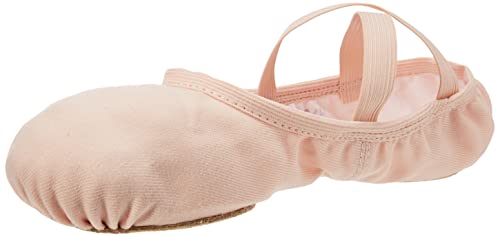
Bloch Performa Ballet Shoe — Best overall studio shoe
The Performa is the shoe many adult students end up in after their first cheap pair disappoints them, and the reason is the arch. Bloch built it from stretch canvas that pulls in under the midfoot, so when you point, the fabric follows instead of folding into a lump behind the toes. In class that translates to a cleaner line and, just as usefully, no pause to tug a wrinkled shoe straight before an exercise. The split sole uses suede patches at ball and heel, leaving the arch free, and the cotton lining keeps the inside from feeling clammy during a long summer session.
Fit is where buyers must slow down. Bloch’s conversion typically puts women about two sizes below street shoes, and the width letters genuinely change the shoe: a narrow foot in a wide Performa will swim no matter how tight the drawstring is pulled. The elastic is pre-sewn in a single cross, which most teachers accept happily. There is no ribbon, correctly for a flat shoe, and the theatrical pink is the classic studio shade, though dancers who need a skin-tone match should check the listing’s colour range rather than assuming pink is the only option.
- Upper: stretch canvas with cotton lining
- Sole: split sole, suede ball and heel patches
- Closure: pre-sewn crossed elastic, adjustable drawstring
- Fit notes: dance sizing, multiple widths, converts down from street size
- Colour on this listing: theatrical pink
Strengths
- Canvas hugs the arch so the shoe shows the foot’s shape honestly.
- Pre-sewn elastic means it can be worn to class the day it arrives.
- Light enough that quick petit allegro footwork never feels clumsy.
Trade-offs
- Canvas toes wear through faster than leather on rough studio floors.
- Sizing down feels alarming to first-time buyers and causes exchanges.
- The snug stretch fit shows every lump of a thick sock underneath.
Best for: adult students and committed teens who want one dependable class shoe. Not suited for: very young beginners whose teacher asks for a full sole.
See the current listing to check price on Amazon and match your centimetre measurement to Bloch’s chart.

Capezio Hanami Canvas Ballet Shoe — Best for a clean line
Capezio’s Hanami takes the same stretch-canvas idea as the Performa and pushes it further toward invisibility. The fabric is a four-way stretch that sits almost like a second skin, the seams are placed to avoid rubbing the toes, and the sole patches are shaped so the shoe does not fight the metatarsals when you roll through the foot. Dancers with a high arch tend to love it because the shoe displays that arch instead of flattening it, and photographers of classwork quietly love it for the same reason.
The Hanami’s party trick is comfort at the heel. A slightly padded, contoured heel cup reduces the digging that some split soles cause at the Achilles during relevé, and the elastic drawstring-free binding on many versions keeps the top line smooth. Sizing again runs small against street shoes, and Capezio’s wide fittings are genuinely wide, which is a blessing for dancers who spent years cramming broad feet into medium shoes. Buy the width your foot actually is, not the width you wish it were.
- Upper: four-way stretch canvas
- Sole: split sole with shaped suede patches
- Closure: pre-sewn elastic, smooth binding at the opening
- Fit notes: dance sizing in narrow through wide fittings
- Colour on this listing: light pink
Strengths
- Exceptionally smooth profile with almost no bunching at the toes.
- Heel shaping spares the Achilles during repeated rises.
- Wide fittings that genuinely accommodate a broad forefoot.
Trade-offs
- The minimal structure offers little resistance for building strength.
- Light pink shows studio floor grime quickly between washes.
- Dancers who prefer a firm, traditional feel may find it too soft.
Best for: intermediate dancers who care about line and have a defined arch. Not suited for: exam classes where a teacher specifies a traditional leather shoe.
Confirm your width letter when you check price on Amazon, because exchanges here are usually about width, not length.

Bloch Dansoft Full Sole Leather Ballet Slipper — Best for beginners
The Dansoft is the traditional starting point: soft leather, one continuous sole from toe to heel, and enough resistance that a beginner’s foot has to work to point. Teachers like full soles for young students precisely because of that resistance. Every tendu becomes small strength training, and the leather upper moulds over the first months into a shape that is unmistakably the wearer’s own foot. It is also the most forgiving shoe here for a parent buying for a child, since leather tolerates a fraction more growing room than stretch canvas does before it becomes sloppy.
Expect a break-in period. New leather creaks a little and feels stiff across the toes for the first few classes, then softens where the foot bends it. The drawstring ties in a small bow at the front; tuck the ends in, because a flapping bow is both untidy and a tripping nuisance in travelling steps. Elastics on this model traditionally need sewing, which is worth doing carefully: cross them over the instep, sew them where the shoe’s side seams sit, and test the tension standing flat before trimming the spare elastic.
- Upper: soft full-grain-feel leather
- Sole: full sole in leather for resistance
- Closure: drawstring front, elastics to be sewn by the buyer
- Fit notes: classic dance sizing, suits narrow to medium feet
- Colour on this listing: pink
Strengths
- Full sole builds foot strength in beginners with every exercise.
- Leather outlasts canvas for children who drag their toes.
- Moulds to the individual foot instead of forcing a generic shape.
Trade-offs
- Elastics arrive unsewn, so the first wear needs preparation.
- Stiff for the first few classes before the leather relaxes.
- The full sole limits how dramatically the arch can show.
Best for: children and adult beginners in their first two years of classes. Not suited for: advanced dancers who want maximum arch freedom in centre work.
Order early enough to sew the elastics before term starts when you check price on Amazon.

Danzcue Canvas Leather Ballet Shoes Split Sole — Best value pair
Not every enrolment deserves an expensive shoe. A child trying one term, an adult sampling a lunchtime class, a school production needing twenty pairs — these are Danzcue situations. The design pairs a plain canvas upper with leather at the sole contact points, which is a sensible place to spend the limited budget: the parts that meet the floor are the durable material, while the upper stays light and breathable. The split sole lets the foot point properly, and the white version listed here suits boys’ and men’s classes and some character work where pink is not wanted.
Honesty about limits matters with budget shoes. The canvas is thinner than Bloch or Capezio fabric, the finishing is plainer, and the sizing can feel less consistent between pairs, so measure and order with return time to spare. The drawstring does real work on this shoe rather than being decorative, and the elastics may need firmer sewing than the factory stitching suggests. Treated as a one-or-two-term shoe rather than an heirloom, it is entirely fit for purpose, and for a hesitant beginner that is exactly the right level of commitment.
- Upper: breathable canvas
- Sole: split sole with leather patches
- Closure: working drawstring, attached elastic
- Fit notes: adult sizing on this listing, medium width focus
- Colour on this listing: white
Strengths
- Sensible price for a trial term or a school production run.
- Leather contact patches grip better than all-suede budget soles.
- White colourway serves classes where pink is not required.
Trade-offs
- Thinner canvas scuffs and frays sooner than premium shoes.
- Fit consistency between pairs is less refined than big brands.
- Factory elastic stitching benefits from a reinforcing pass at home.
Best for: trial terms, school shows and cautious first purchases. Not suited for: daily multi-class schedules that punish thin canvas.
Leave exchange time in your calendar when you check price on Amazon for this one.

Stelle Stretch Canvas Ballet Shoes — Best for growing feet
Stelle has built its name on children’s dancewear that parents can actually manage, and this shoe shows the thinking. The elastics arrive pre-sewn and wide, so there is no sewing homework and no thin band cutting into a small ankle. The stretch canvas is cotton lined, which feels kinder against skin that has spent all day in school socks, and the suede split sole gives enough grip for a child to trust a glide without sliding into the splits unintentionally. For families juggling three activities and a growth spurt, removing friction from the purchase is a genuine feature.
The stretch that makes the shoe forgiving also defines its ceiling. A serious older student will find the support vague compared with the sculpted fit of the Bloch or Capezio shoes, and the fabric gives enough that a child between sizes may end up with a shoe that fits for a shorter window than expected. Buy close to the start of term rather than ahead of it. The ballet pink shade matches the tights most children’s studios sell, which quietly saves a second shopping trip.
- Upper: stretch canvas, cotton lined
- Sole: split sole in suede
- Closure: pre-sewn wide elastics
- Fit notes: sizes span girls, boys and adult women on the listing
- Colour on this listing: ballet pink
Strengths
- Pre-sewn wide elastics spare parents any needlework entirely.
- Cotton lining feels gentle on young, sensitive skin.
- Stretch fit tolerates the small weekly changes of growing feet.
Trade-offs
- Too unstructured for advanced students refining technique.
- Generous stretch shortens the useful window between sizes.
- Not the shoe an exam board photograph would call traditional.
Best for: children in recreational classes and their relieved parents. Not suited for: vocational-track students whose school specifies exact models.
The listing’s size run is broad, so double-check which range you are in as you check price on Amazon.

So Danca Stretch Canvas Ballet Shoes — Best for adult returners
Coming back to ballet after fifteen years away is brave enough without footwear that punishes you. So Danca’s stretch canvas shoe is built low and soft, with a split sole that lets a rusty foot remember what pointing felt like, and an upper that does not demand the precise fitting rituals of the more sculpted models. The brand has deep roots in dance, so the basics are right: the toe shape follows a real foot, the sole patches sit where the weight actually travels, and the light pink reads correctly under studio lighting rather than glowing orange.
Returners should still respect the conversion chart, because adult feet change — arches settle, toes spread, and the size you wore at seventeen is a memory, not a measurement. The medium width on this listing suits most, and the elastic arrangement keeps the shoe secure through barre without ribbons. What this shoe will not do is support a foot through pointe preparation or heavy allegro schedules; it is a class shoe for rebuilding strength and confidence, and judged on those terms it is a kind and competent one.
- Upper: stretch canvas
- Sole: split sole for flexibility
- Closure: elastic straps, neat front profile
- Fit notes: adult numeric sizing, medium width on this listing
- Colour on this listing: light pink
Strengths
- Soft, low profile welcomes feet returning after long breaks.
- Dance-brand construction keeps sole placement anatomically sensible.
- Forgiving fit reduces the intimidation of buying again.
Trade-offs
- Limited structure for dancers progressing toward advanced work.
- Canvas lifespan is measured in terms, not years.
- Fewer width choices than the Bloch and Capezio ranges offer.
Best for: adult beginners and returners rebuilding a weekly class habit. Not suited for: pre-pointe programmes with prescribed footwear lists.
Measure both feet before ordering and check price on Amazon against the larger measurement.
How Do the Best Ballet Slippers Compare Side by Side?
| Pick | Upper | Sole | Sewing needed? | Suits most |
|---|---|---|---|---|
| Bloch Performa Ballet Shoe | Stretch canvas | Split, suede | No | Regular adult classes |
| Capezio Hanami Canvas Ballet Shoe | Four-way stretch canvas | Split, shaped | No | Line-conscious intermediates |
| Bloch Dansoft Full Sole Leather Ballet Slipper | Leather | Full, leather | Yes, elastics | Beginners building strength |
| Danzcue Canvas Leather Ballet Shoes Split Sole | Canvas | Split, leather patches | Minimal | Trial terms and shows |
| Stelle Stretch Canvas Ballet Shoes | Stretch canvas, lined | Split, suede | No | Children in weekly classes |
| So Danca Stretch Canvas Ballet Shoes | Stretch canvas | Split | No | Adult returners |
Should You Choose a Split Sole or a Full Sole?
This is the decision teachers have opinions about, so ask yours first; the reasoning below explains what the argument is actually about. A full sole runs in one piece under the whole foot. It resists the pointing action slightly, and that resistance is training: the small muscles of the foot and calf work harder through every exercise. For children and beginners, whose technique is being built from nothing, that quiet extra work is valuable, and the shoe also tends to last longer because there is more material between foot and floor.
A split sole removes the material under the arch. The foot can point further and show its shape more dramatically, turns feel less hindered, and experienced dancers generally prefer the freedom. The compromise is that nothing helps you: a weak foot in a split sole looks weaker, not stronger, and the exposed arch area means the shoe depends entirely on the upper for its hold. A sensible path for many students is full sole for the first years, split sole once the teacher agrees the feet are ready — and no shame in either stage, since professionals still warm up in both.
Canvas or Leather: Which Upper Suits Your Classes?
Canvas is the modern default for good reasons. It is lighter, it breathes through a sweaty class, it can be hand washed when it starts to smell like a gym bag, and it costs less to replace when the big toe eventually pokes through — which it will, because canvas wears at the toes first. Dancers who take several classes a week often keep two canvas pairs in rotation so each can dry fully between wears, extending the life of both.
Leather plays a longer game. It stretches and shines where your foot presses, resists scuffing when a step drags, and on some polished floors its grip feels more predictable than suede-patched canvas. It cannot be tossed in a wash as casually, it costs more upfront, and it asks for that break-in patience described in the Dansoft review. If your studio floor is old, splinter-adjacent or shared with tap classes, leather’s toughness is a practical argument, not a traditionalist one.
How Should Ballet Slippers Actually Fit?
Stand in the shoe, feet flat and parallel, weight even. Your toes should lie flat and just reach the end; if they curl, the shoe is too small, and if you can pinch a fold of fabric at the heel, it is too big. Rise onto demi-pointe: the shoe should stay with the heel rather than slipping off, and the drawstring or binding should not saw into the Achilles. Then point fully and look at the arch — canvas should smooth along it, not bag. A fit that passes all three checks in a shop will usually still be right after the shoe softens, while a fit that only passes standing still will betray you by the third exercise.
Measure in the afternoon, in the tights or socks you will dance in, and measure both feet; most people have one foot half a size longer, and the larger foot decides. Between sizes in stretch canvas, experienced fitters usually choose the smaller, because the fabric relaxes; in leather they often choose the snugger too, but with slightly more caution. When buying for a child, resist the parental instinct to buy growing room — a ballet shoe with growing room teaches a foot to grip and claw inside it, which is the opposite of what class is for. Budget for replacement instead; it is cheaper than unlearning a habit.
What Mistakes Do People Make When Buying Ballet Slippers?
The classic error is ordering your street size and hoping. Ballet sizing is its own system for every brand on this page, and a shoe that arrives two sizes too large will be exchanged or, worse, danced in badly for a term. Second comes buying ribbons and sewing them onto flat shoes for a young child because they look the part in photographs; ribbons belong to pointe work and older students, and on flats they mostly unravel and trail. Third is choosing colour by preference instead of by studio rule, which matters more than outsiders expect: teachers choreograph lines of identically dressed feet, and the odd pair out is genuinely distracting.
Two quieter mistakes deserve mention. Dancers wear new shoes for the first time at an exam or performance, when an untested elastic or an unfamiliar sole can undo months of preparation — break shoes in during ordinary classes for at least two weeks. And adults buy the most advanced, minimal shoe on the shelf believing it signals seriousness, when their feet would progress faster in a structured beginner shoe. The shoe is equipment, not a badge of rank.
How Do You Convert Street Shoe Sizes into Ballet Sizes?
Conversion charts look simple — find your street size, read across, order — yet the number of exchanged ballet shoes suggests the simplicity is deceptive. The first complication is that each brand builds on a different last, so a dancer who is one size in Bloch may be a different size in Capezio, and the Stelle that fits a child perfectly tells you nothing about the So Danca an adult needs. Treat every brand change as a fresh fitting, even if you have danced for years. The second complication is width: two shoes of identical length in narrow and wide can feel like different sizes entirely, because the wide version holds more volume everywhere, including over the toes where precision matters.
The reliable method is unglamorous. Trace both feet on paper while standing, measure the longer trace in centimetres from heel to longest toe, and match that number to the brand’s centimetre column rather than its size column. Centimetres do not care about national sizing systems, children’s ranges that overlap adult ranges, or the optimism of marketing departments. If your measurement falls between two sizes, the tie-breakers are material and level: stretch canvas rewards the smaller choice, leather rewards the smaller choice slightly less confidently, and a full sole for a growing child rewards whichever choice the teacher nods at when the child stands in them at the barre.
Men and boys face an extra wrinkle, since several of these ranges were designed around women’s lasts and converted upward. The Danzcue listing here, in white, is a common solution for male dancers in mixed classes, but the honest advice is the same centimetre measurement plus patience with exchanges. A male dancer’s foot is often wider at the same length, so a shoe that converts correctly on paper can still strangle the forefoot; width, again, is the silent variable. Studios with a uniform list will usually name the exact model they expect male students to buy, which removes the guesswork entirely — another reason the teacher’s list outranks any guide, including this one.
What Should Children Wear Differently from Adults?
Children’s ballet footwear is a negotiation between three adults: the teacher who wants correct training, the parent who wants value, and the child who wants whatever the girl at the next barre position is wearing. The teacher should win on construction — full sole or split sole, leather or canvas, pink or a skin-tone shade — because those choices shape how small feet learn to work. The parent should win on timing: buy close to term, buy the current size, and accept that a fast-growing eight-year-old may need two pairs in a year. That is not waste; it is the cost of a shoe that must fit like a glove to do its job.
The child, meanwhile, gets a vote on comfort that adults should respect more than they sometimes do. A shoe a child dreads putting on will quietly shorten their enthusiasm for the whole activity, and blisters at the heel or a drawstring that bites are legitimate complaints, not fussiness. Check inside the shoe with your fingers for rough seams, watch the first class from the door if the studio allows it, and ask afterwards where it pinched. The Stelle pick in this list exists for exactly this stage of life: pre-sewn, lined, forgiving, and cheap enough in spirit that replacing it mid-year is an errand rather than a financial event.
Adults have the opposite problem — they keep shoes too long. An adult’s size is stable, so a canvas shoe gets worn until the toe is through and the elastic has the tension of old string, long past the point where it supports tidy footwork. Set a personal rule: when you can see sock through the canvas at the big toe, or the heel slips during pirouette preparation, the shoe is done. Your feet are the instrument; the consumable that touches the floor deserves a replacement budget just as rosin and hairpins do.
How Do You Sew Elastics and Care for the Shoes Between Classes?
Only the Dansoft in this selection asks you to sew, but the skill transfers to any shoe whose factory elastic eventually tires. Use the elastic supplied, fold the heel of the shoe forward to find where it naturally creases at the sides, and pin the elastic ends at those crease points, angled slightly toward the toes. Try the shoe on, rise and point several times, and adjust until the elastic holds the heel without denting the ankle. Sew with small, firm stitches through the binding only — never through the outer canvas or leather where the needle holes will tear — and knot securely inside. A crossed pair of elastics suits most dancers; a single loop around the ankle is an older style some teachers still request, which is one more detail the studio list settles.
Care between classes is mostly about air. Ballet shoes absorb a remarkable amount of moisture in an hour, and sealing them in a plastic bag inside a kit bag is how they acquire their notorious smell. Tip them out at home, loosen the drawstring, and let them dry overnight in open air; stuffing them loosely with newspaper speeds the process in winter. Canvas pairs can be hand washed occasionally, as the FAQ below covers, but daily care is ventilation, not washing. Leather pairs benefit from being kept away from radiators, which dry the material into cracks, and from a soft brush to lift studio dust out of the grain before it works in permanently.
Storage at the studio end matters too. Shoes that live permanently in a locker or car boot age faster than shoes that travel home, partly from damp and partly because nobody notices the wear creeping up. Inspect the sole patches monthly: suede that has polished to a shine can be roughed gently with a wire brush to restore grip, while leather patches worn thin at the ball mean the shoe is entering its final weeks. Retiring a shoe on your own schedule, with a replacement already broken in, beats having it fail during the class before an exam.
Which Ballet Slippers Suit Which Studio Floors?
Dancers talk about floors the way gardeners talk about soil, because the surface changes what the same shoe does. Modern studios usually lay sprung wood or a vinyl performance surface often called marley. On marley, suede split sole patches behave beautifully: enough slide for glissades, enough grab for turns to stop where you intend. On old polished wood, that same suede can feel treacherously fast during travelling steps, and this is one situation where the leather full sole of the Dansoft earns its keep, offering a steadier, more predictable contact that nervous beginners appreciate.
Concrete and tile appear in community halls and school gyms pressed into service as studios. Neither forgives anything. Thin canvas split soles transmit every pebble of texture through to the metatarsals, and an hour of jumps on an unsprung surface is hard on shins regardless of footwear. If your class meets on such a floor, choose the shoe with the most substance under the ball of the foot from this list, keep jumps modest, and raise the surface with the teacher if landing starts to hurt — no slipper ever made can substitute for a sprung floor, and pretending otherwise helps nobody.
Outdoor performances and examinations in unfamiliar halls introduce a third variable: the unknown floor. Dancers cope by arriving early, testing a turn and a slide in the actual space, and roughing suede soles with a brush if the surface feels slick. Rosin is for pointe shoe boxes and specific floor traditions, not a general fix for flat slippers, and most studios ban it on their own floors. The practical takeaway for buyers is simpler than the folklore: if you dance in several venues, the mid-grip options — leather patches or a full leather sole — adapt across more surfaces than the slickest suede split soles do.
What Changes When Exams and Performances Approach?
Exam syllabuses treat footwear as uniform. The examining bodies publish dress requirements that specify flat shoes of an approved style and colour, elastics rather than ribbons at the lower grades, and hair and presentation rules that make a class look like a cohort rather than a crowd. A shoe that has served happily all year may still be wrong for the exam room if its colour has faded unevenly or its canvas has gone grey at the toes. Experienced families buy the exam pair a half term ahead, wear it for the final few classes so it is broken in but still clean, and keep the old pair for rehearsals.
Performances add stage lighting, which is less forgiving than studio light. Pink shoes that look soft in a mirrored room can appear almost white under stage lights, while a skin-tone shoe that matches the dancer reads as an extension of the leg — one reason more studios now permit or prefer shades matched to the dancer rather than a single compulsory pink. Choreographers also think about noise: leather soles on a wooden stage are audible in quiet passages in a way canvas is not, and a musical director may have a preference nobody mentioned until the dress rehearsal. Ask early, in writing if the production is large, and write the answer on the kit list.
For adult students, exams and performances are optional joys rather than obligations, but the footwear logic is identical. A second pair, kept clean and reserved, removes a whole category of pre-event panic. Given that even the premium shoes in this guide cost less than a month of classes in most towns, the reserved pair is one of the cheapest forms of peace of mind a dancer can buy. Keep it in its own cloth bag, try it on monthly, and let it earn its keep on the days when looking down at tidy feet steadies the nerves.
How Many Pairs Should a Dancer Own at Once?
One pair is the honest minimum and, for a once-a-week child, entirely sufficient. Two pairs become sensible the moment classes multiply: alternating days lets each pair dry completely, and drying is the main defence against both odour and premature rot of the lining. Dancers in daily training often run three — a soft pair for barre and technique, a cleaner reserved pair, and an older pair for rehearsals where floors are dirty or choreography involves kneeling and floorwork that would ruin good canvas in a week.
Rotation also reveals fit problems early. If the newer pair suddenly feels dramatically better than the older one, the older pair has stretched beyond usefulness, however intact it looks. Conversely, if both pairs hurt in the same place, the issue is the model or size, not wear, and the next purchase should change something — width first, then brand. Keeping a short note in the kit bag with purchase dates sounds fussy until the morning you are deciding which pair deserves to survive a clear-out; dates end arguments that memory would lose.
Are Expensive Ballet Slippers Worth It for a Hobbyist?
The price ladder in this category is unusually honest. Money buys three things: better fabric that holds its shape longer, more careful construction around the toes and heel, and a sizing system with enough widths to fit real feet precisely. It does not buy talent, turnout or a teacher’s approval, and the most expensive shoe in the wrong width is still the wrong shoe. A hobbyist dancing twice a week will feel the difference between the Danzcue and the Hanami mainly in the arch — the pricier shoe simply disappears more completely — and in how the pair looks after four months of classes.
Where the budget choice genuinely wins is uncertainty. A dancer unsure whether ballet will survive contact with a busy job, a sceptical teenager, a child whose feet grow monthly: for all of them, the cheaper shoe converts a large commitment into a small experiment, and an experiment that fails costs little. Where the premium choice wins is frequency. Cost per class is the fairest arithmetic in this whole guide — divide the price by the classes the shoe will serve, and the sculpted canvas models often come out cheaper than a budget pair replaced twice. Buy for the schedule you actually keep, not the schedule you intend in January.
One more consideration separates the tiers, and it is resale and hand-me-down reality. Children’s outgrown leather shoes in good condition pass between siblings and studio friends constantly, because leather survives and sizes are guessable. Stretched canvas, moulded to one foot and thinned at the toes, rarely deserves a second owner. Families with younger siblings in the pipeline may find the Dansoft’s durability quietly economical even though its ticket price is not the lowest on this page.
Should You Buy Online or Visit a Fitting Shop?
A good dance shop fitting is worth experiencing at least once. A fitter watches you stand, rise and point, spots the heel slipping that you cannot feel yet, and hands you the width you would never have ordered. For a first pair, for pointe-adjacent decisions, and for feet that are unusually narrow, wide or different from each other, that expertise prevents expensive mistakes. Many dancers take their first fitting in a shop, learn their sizes in two or three brands, and then reorder confidently online for years afterwards.
Online buying, which is how every shoe in this guide is sold, works well when you respect its one demand: measurement. Use the centimetre method, order a single pair first when trying a new brand, and keep the packaging until the shoe has survived a class, not just a carpet try-on. Buy midweek rather than the night before term starts, so an exchange is an inconvenience instead of a crisis. Parents should also photograph the size label of a successful pair; when the next growth spurt arrives at the worst possible moment, that photograph turns reordering into a two-minute task.
There is also a middle path that experienced families use quietly: the studio’s own second-hand rail or swap box. Outgrown leather shoes, worn for a single term by a child whose feet sprinted ahead, change hands for very little and are often barely broken in. Inspect the sole patches, check the elastics still pull, and wash or air the pair thoroughly before it meets a new foot. For canvas, be pickier — a shoe already moulded to another dancer’s arch rarely sits correctly on yours.
Whichever route you choose, the teacher remains the final authority, and a quick message to the studio before spending money is the cheapest step in this entire process. Studios have seen every buying mistake catalogued in this guide, usually twice a term, and most would far rather answer a sizing question on Tuesday than watch a child claw at the floor inside oversized shoes for twelve weeks.
Final Recommendation
For most students walking into a weekly class, the Bloch Performa Ballet Shoe is the pair to start from: honest construction, no sewing, and an arch-hugging fit that flatters without cheating. Dancers who prize line above all should look at the Capezio Hanami Canvas Ballet Shoe, while a true beginner, especially a young one, belongs in the Bloch Dansoft Full Sole Leather Ballet Slipper until a teacher says otherwise. Buy the size the chart demands, not the size your trainers claim, and let the first term in correctly fitted shoes teach your feet what all the fuss was about.
Frequently Asked Questions
Do ballet slippers stretch out over time?
Yes, both materials relax with wear. Canvas gives across the width and at the toes, leather moulds more gradually and holds its new shape more permanently. This is why fitters aim for a snug first fit: a shoe that starts comfortable usually ends up loose, while one that starts close usually ends up perfect around the fourth or fifth class.
When should a dancer switch from full sole to split sole?
When a teacher judges that the feet are strong enough to point without the sole’s resistance helping them — often after a few years of regular classes, though adult beginners sometimes start in split soles for comfort. There is no exam grade that automatically triggers the change, and switching back for strength work is perfectly normal.
Can ballet slippers be washed?
Canvas pairs can be hand washed in cool water with mild soap and air dried away from radiators, which will also slightly re-tighten a stretched shoe. Leather should be wiped clean and dried slowly at room temperature; soaking leather or machine drying any ballet shoe shortens its life and can crack the sole patches.
Why do some studios require a specific colour?
Uniform colour lets a teacher read the line of a whole class at a glance and check feet without visual noise. It also prepares students for exam and stage conventions, where footwear is part of the dress code. Always check the studio’s list before ordering, particularly for boys, whose required colour is often black or white rather than pink.
Do flat ballet slippers ever need ribbons?
Almost never at beginner level. Ribbons belong primarily to pointe shoes, where they help secure a structured shoe to the ankle, and some schools ask senior students to add them to flats for performances so the class presents a uniform, traditional picture. If your studio does ask, sew the ribbons where the elastics would sit, angled slightly forward, and practise tying a flat knot that tucks away neatly. If nobody has asked, skip them: on an ordinary flat shoe ribbons add fuss, come undone during class, and can hide a poorly fitted heel that elastics would have revealed.
What socks or tights should be worn inside ballet slippers?
Most dancers wear the shoe against tights or bare skin, because any sock thick enough to notice changes the size you need and dulls the feel of the floor that the thin sole is designed to preserve. Convertible tights, with a hole in the sole, let dancers pull the foot out for toe tape or a quick plaster without undressing. If a shoe rubs one predictable spot, a small piece of dancer’s tape or a gel toe cap solves it more precisely than a sock does, and keeps the fit you measured when you bought the shoe.
How long should one pair last?
A child in one class a week may outgrow a pair before wearing it out. An adult dancing three times a week can expect canvas toes to thin within a few months, while leather full soles often survive a year of the same schedule. Rotate two pairs if you dance often; rested shoes recover shape and dry fully, which slows the wear considerably.
Can men and boys wear the same models listed here?
Yes, with sizing care. Ballet footwear is fundamentally unisex in construction; what changes is the colour convention of the class and the conversion used to reach the right size. Several listings in this guide, the Danzcue in white among them, are bought routinely by male dancers, and the canvas models size up through adult ranges that cover most men’s feet. A male dancer should measure in centimetres, expect to choose a different labelled size than a woman with the same foot length, and check the studio’s colour requirement, which for men is commonly black or white rather than pink.
What should a first pair cost a family, realistically?
Expect the budget end of this list to cover a trial term for the price of a couple of classes, and the established studio brands to cost roughly double that while lasting noticeably longer in daily use. The hidden costs are small but real: a spare pair of elastics, a cloth shoe bag, and eventually the second pair that rotation demands. None of it rivals the cost of the classes themselves, which is the healthiest way to view the purchase — the shoe is a small, replaceable part of a much larger investment in the dancer’s time.
Related Guides
Footwear is only one corner of a well-run home dance or dressing space. Readers setting up practice corners may also enjoy Best Barefoot Slippers for Men for off-duty foot comfort, Best Breathable Indoor Slippers for Men for warm-weather house wear, Best Acorn Slippers for Women for suede-soled rest days, and Best Area Rugs for Toy Rooms when the practice space doubles as a family room.



[…] broader roundup of Best Ballet Slippers covers the full field beyond the beginner brief, and the natural next step after class is rest, […]