What's inside
- Key Takeaways
- Quick Picks
- How Did We Choose These Griddles for Glass Top Ranges?
- How Do the Six Griddle Options Compare Side by Side?
- Why Is Glass Less Forgiving Than Gas Grates?
- How Do You Tell Radiant Glass, Coil and Induction Apart?
- What Does a Glass Lid Actually Add to a Griddle?
- How Should You Heat a Griddle on a Glass Top Without Damage?
- Flat Top Conversion or Two-Burner Plate — Which Format Fits Your Cooking?
- How Do You Clean a Glass Top After Griddle Sessions?
- How Do You Protect Glass When Storing Griddles?
- What Breakfasts Suit a Glass-Top Griddle Best?
- Should Renters Cook on a Landlord’s Glass Top at All?
- How Do You Keep Pancake Batter From Reaching the Glass?
- Electric Griddle or Stovetop Plate — How Should a Household Decide?
- What Should You Do the Day a New Griddle Arrives?
- What Mistakes Do Glass Top Griddle Buyers Make Most Often?
- Final Recommendation
- Frequently Asked Questions
- Related Guides
As an Amazon Associate I earn from qualifying purchases. This post may contain affiliate links at no extra cost to you.
cottageverdict.com is reader-supported. When you buy through links on our site, we may earn an affiliate commission.
Where to buy: all six picks below are sold through Amazon, and their names in the Quick Picks table, the detailed sections and the comparison table link to their listings so you can check price on Amazon and confirm dimensions and cooktop compatibility before ordering. Choosing the best griddle to use on glass top ranges is an exercise in protecting two investments at once: the breakfast you want to cook and the smooth ceramic surface you absolutely do not want to scratch, crack or stain.
Glass tops change the griddle rules completely. Cast iron — the hero of gas cooking — becomes a liability here: heavy, rough-based and prone to being dragged, it can scar a ceramic surface in one careless slide. The picks in this guide therefore favour flat, smooth bases in lighter materials, full-coverage flat tops designed for standard ranges, and one honest wildcard that sidesteps the glass altogether.
That wildcard deserves its flag early: the Chefman pick is an electric countertop griddle that plugs in and never touches your range at all. It is included deliberately, because for some glass-top owners the correct answer to a fragile cooktop is to cook beside it. It is presented as an electric alternative throughout this guide — never as a stovetop plate — and readers who want strictly on-range cooking should shortlist the other five.
The on-range picks split by ambition. Two are full flat tops sized for standard 30-inch ranges, converting the whole cooktop into a griddle station; three are two-burner plates, lighter and easier to store, with the Vayepro pair designed and titled specifically for glass cooktops and arriving with glass lids that most griddles never offer.
One compatibility warning applies to the whole category: induction cooktops play by magnetic rules, and at least one pick here states plainly that it is not for induction. Read your range’s type before reading the picks — radiant glass, coil and induction are three different surfaces wearing similar black glass costumes, and the right griddle for each is not interchangeable.
Think of the glass top itself as a member of the household with standing: it was expensive, it is photographed by every guest who leans on it with a wine glass, and it records every careless pan in permanent handwriting. The picks below were chosen by cooks who respect that standing — every design decision, from aluminium bodies to lidded plates to the electric escape route, exists because the surface underneath the breakfast deserves a vote in how breakfast gets cooked.
Budget honesty belongs in this guide too, stated without figures: the picks span from light plates that cost little more than a good frying pan to a range-size conversion that should be bought like furniture — measured, deliberate and expected to serve for years. Spending correctly here means matching the format to your breakfast frequency, not buying the largest surface the cupboard can be forced to accept.
Key Takeaways
- Smooth, flat bases only: rough cast iron can scar ceramic glass, so this guide favours lighter plates and range-size flat tops.
- The Chefman pick is an electric countertop griddle — it never sits on the range and is labelled as the electric alternative throughout.
- Stanbroil’s flat top fits 30-inch gas, radiant glass ceramic and coil ranges — and states it is not for induction.
- Both Vayepro plates are titled for glass cooktops and include glass lids, a rarity among griddles.
- Two-burner plates store easily; full flat tops convert the whole range for batch cooking.
- Lift, never drag, any griddle across glass — sliding is how scratches happen.
Quick Picks
| Pick | Badge | Why it earns its place |
|---|---|---|
| Stanbroil Flat Top Griddle | Best Full-Size Flat Top | A full flat top for standard 30-inch ranges, spanning gas, radiant glass ceramic and coil models. |
| Vayepro Griddle Pan With Lid | Best With Glass Lid | A two-burner aluminium plate with a glass lid, titled for glass stove tops. |
| Vayepro Griddle for Glass Cooktops | Best Built for Glass Cooktops | Vayepro’s second glass-cooktop plate — 22 inches long with lid, for gas and glass surfaces. |
| Stove Top Griddle 17 Inch | Best Lightweight Aluminium | A 17-inch warp-resistant aluminium griddle with ceramic nonstick for lighter daily duty. |
| Flat Top Griddle for Coil Ranges | Best for Coil Ranges | A flat top built for 30-inch electric coil ranges, spatula set included. |
| Chefman Electric Griddle | Best Electric Alternative | Chefman’s XL electric countertop griddle — plugs in beside the range, never on it. |
How Did We Choose These Griddles for Glass Top Ranges?
Glass safety was the first filter, applied without nostalgia. Any plate whose base could plausibly scar ceramic glass — rough sand-cast bottoms, warped profiles, extreme weight — was excluded, however good its sear. The survivors have smooth, flat contact faces and weights a cook can place down gently rather than drop the last centimetre.
Stated compatibility was read from the listings themselves. The Stanbroil names the range types it fits and the one it excludes; the Vayepro plates carry glass cooktops in their titles; the coil-range flat top names its home surface. Where a listing is silent, the sections below say what is known and advise checking your range manual, rather than inventing reassurance.
The electric alternative was included on purpose and labelled relentlessly. Some glass-top owners — renters, the cautious, households with a cracked corner already — are better served by a countertop appliance that removes the cooktop from the equation. Pretending otherwise would make this guide tidier and less honest, so the Chefman stands in the open with its plug showing.
We also weighed the morning-after test: how a griddle treats the glass when the cooking is done and the cook is tired. Plates that cool where they sit without staining, bases that wipe clean before they are stored, lids that catch the grease that would otherwise bake onto ceramic — these unglamorous behaviours decide whether a glass top still looks new in year three. The shortlist favours designs whose cleanup story protects the surface as carefully as their cooking story does.

Stanbroil Flat Top Griddle — Best Full-Size Flat Top
Stanbroil’s flat top is the maximalist answer: a griddle surface sized for standard 30-inch ranges that turns the entire cooktop into one cooking plane. The listing is unusually precise about fit — 30-inch gas, radiant glass ceramic and electric coil ranges are in; induction and in-counter cooktops are out — and it includes drip trays, the detail that separates a designed flat top from a big sheet of metal.
On a radiant glass range, that full-coverage format has a protective side effect: the flat top takes the spatula scrapes, the bacon splatter and the pancake drips that would otherwise land on your ceramic surface, and its smooth underside spreads contact evenly instead of concentrating it on grate-sized points. Batch cooking is the obvious win — a full breakfast runs at once — but the shielding may be the longer-lasting one.
Commitment is the cost. A range-size flat top is a semi-permanent resident: it needs a storage plan for the days you want four open burners, and its span demands that your range actually be the standard 30-inch format it names. Measure, confirm your range type against the listing’s list, and this becomes the most capable on-range pick in the guide.
A detail worth dwelling on is the drip tray arrangement, because full flat tops generate serious volumes of bacon fat and pancake butter runoff. Channelled drainage into removable trays keeps that fat off the glass entirely — no greasy tide creeping under the plate to bake onto the ceramic while you cook. After service the trays go to the sink, the top wipes down, and the range underneath emerges from a full breakfast production looking almost unreasonably innocent. There is a hosting dimension to a range-size flat top that smaller plates cannot imitate: guests gather around it. A cook working a full flat top at a kitchen island range becomes the entertainment, pancakes landing in rows while coffee circulates — the teppanyaki effect at domestic scale. If your household entertains at the cooker rather than at the table, this format is not an appliance purchase; it is a stage.
- Format: flat top griddle for standard 30-inch ranges
- Fits: gas, radiant glass ceramic and electric coil
- Excludes: induction and in-counter cooktops per listing
- Extras: drip trays included per the listing
- Placement: sits on the range surface
Strengths
- Full-range surface runs entire breakfasts at once
- Shields the glass beneath from scrapes and splatter
- Compatibility and exclusions stated precisely on the listing
Trade-offs
- Semi-permanent footprint needs a storage plan
- Only suits the standard 30-inch range format
- Not an option for induction owners
Best for: 30-inch radiant glass or coil ranges cooking big batches.
Not suited for: induction cooktops or non-standard range sizes.
Vayepro Griddle Pan With Lid — Best With Glass Lid
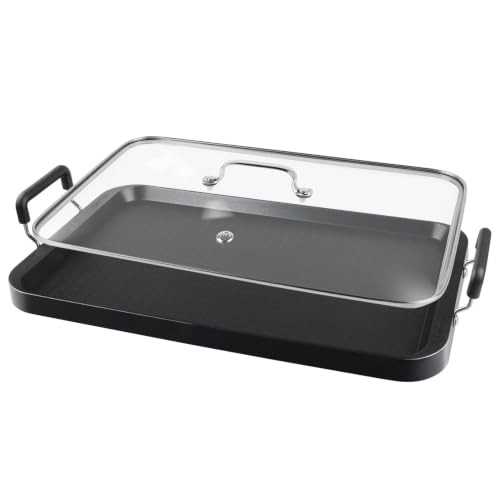
Vayepro’s two-burner plate with glass lid is titled directly at this guide’s problem: a stove top flat for glass stove tops, in aluminium with a non-stick surface. Aluminium is the glass-friendly metal — light enough to set down softly, smooth enough to slide a little without drama, and quick to heat across two burners for the pancake-and-egg shift.
The glass lid is the feature rival griddles rarely match. It traps heat to finish thick pancakes and melt cheese over burgers, it tames bacon splatter that would otherwise freckle your ceramic surface, and it lets you watch the food without lifting. Between the light plate and the lid, the whole design reads as though someone listed a glass-top owner’s anxieties and answered them one by one.
Aluminium’s trade-offs are thermal: it holds less heat than iron, so a crowd of cold burgers dips its temperature further, and thin aluminium can warp if overheated empty — cook at moderate settings and let the lid do the finishing work. Treated that way, this is the most glass-considerate two-burner plate in the guide.
Breakfast sandwiches are this plate’s signature dish, and the lid is why: bread toasting on the aluminium while egg sets beside it, then cheese laid over and the lid dropped for twenty seconds to melt it into the folds. That small choreography, repeated across a family’s mornings, is where a lidded griddle stops being a pan with an accessory and becomes a system. Glass owners additionally notice what is not happening — no splatter freckles appearing on the ceramic behind the cooker. The lid also rehabilitates frozen foods that bare griddles handle badly: frozen hash patties and breakfast sausages thaw and crisp under its dome instead of steaming sadly or scorching outside while raw within. Weekday mornings built from the freezer — which is to say, most weekday mornings — run noticeably better under glass. Owners often report the lid, bought as an accessory, becoming the reason the plate is reached for daily.
- Material: aluminium, non-stick per the listing
- Format: 2-burner griddle pan
- Lid: glass lid included per the listing
- Titled for: glass stove tops per the listing
- Use: pancakes and breakfast cooking per the listing
Strengths
- Designed and titled specifically for glass stove tops
- Glass lid finishes food and contains splatter
- Light aluminium sets down gently on ceramic
Trade-offs
- Aluminium sheds heat faster than iron under load
- Moderate heat only — empty overheating risks warp
- Two-burner area limits the largest batches
Best for: glass-top owners wanting a light plate with a lid.
Not suited for: cooks chasing iron-style searing heat retention.

Vayepro Griddle for Glass Cooktops — Best Built for Glass Cooktops
Vayepro’s second listing is a close cousin with its own dimensions: a 2-burner griddle pan with glass lid, nonstick aluminium, titled for gas and glass cooktops, sized at 22 by 12 inches with a 1.77-inch thickness. That extra length over typical two-burner plates stretches the cooking map — a longer bacon row, a wider pancake grid — while the explicit glass-cooktop naming keeps the reassurance of its sibling.
Why does this guide carry both Vayepro plates? Because listings differ in size and availability, and glass-top shoppers measure in inches that matter. This one’s 22-inch span suits ranges whose burner spacing runs wide; the previous pick may fit tighter layouts. Read both listings against your own burner map and choose by geometry — the cooking character, light aluminium with a lidded finish, is shared.
Breakfast is the stated home turf: pancakes, eggs and bacon headline the listing, and the plate’s quick-heating aluminium suits that fast, moderate-temperature work better than heavy searing. Households whose griddle life is mostly the morning shift will find this the most honest fit, with the lid earning its keep every time cheese meets a breakfast sandwich.
The extra length earns a second look from pancake specialists: a 22-inch row fits a full batter batch in one pour-grid, which means the first eater’s pancakes and the last eater’s come off the same heat at the same minute — a fairness upgrade any parent of three will recognise. The plate’s stated thickness also resists the bowing that plagues bargain aluminium, provided the moderate-heat habits described in this guide are kept. Wide plates ask one storage courtesy: stand them on edge, never flat beneath a pile of pans, because a 22-inch aluminium span stored under weight can take a set that no amount of heating fully relaxes. Stored upright in the pan cupboard’s end slot, this Vayepro keeps its flatness — and flatness, on glass, is not a preference but the whole safety case in a single word.
- Material: aluminium, nonstick per the listing
- Size: 22 x 12 x 1.77 inches per the listing
- Format: 2-burner griddle pan with glass lid
- Titled for: gas and glass cooktops per the listing
- Foods named: pancakes, eggs and bacon
Strengths
- Longer 22-inch span suits wide burner spacing
- Glass cooktops named explicitly in the title
- Lid included for finishing and splatter control
Trade-offs
- Length may overhang compact ranges — measure first
- Aluminium heat retention is modest under big loads
- Very similar to its sibling — choose by dimensions
Best for: glass and gas cooktops with wide burner spacing.
Not suited for: ranges where 22 inches would overhang the edges.

Stove Top Griddle 17 Inch — Best Lightweight Aluminium
This 17-inch double-burner griddle takes the lightweight route in a different finish: warp-resistant aluminium with a ceramic nonstick surface, presented by its listing for gas stove cooking and everyday breakfast work — pancakes, indoor cooking, camping and barbecue duty included. The warp-resistant claim addresses aluminium’s known weakness head-on, and the ceramic surface gives it a slick, easy-wiping character.
A note of listing honesty applies here: unlike the Vayepro plates, this one’s title does not name glass cooktops, so glass-top owners should treat it as a check-first pick — confirm your range maker’s guidance on aluminium griddles and inspect the base for smoothness before it ever meets your ceramic. Its flat, light construction is the right family of design; the verification step is simply yours to complete.
Where it shines regardless is weight and care. Seventeen inches of aluminium lifts with one hand, washes without a wrestling match, and travels to a campsite without ballast guilt. For households whose range is gas — its titled home — it is a nimble daily griddle; for glass owners it is a promising candidate pending that manual check.
Ceramic surfaces have a feel in use that deserves description: food moves on them with a distinctive glide, and the first eggs on a new ceramic pan can startle a cook used to granite’s grip. That glide suits the flipping-heavy breakfast work this plate is listed for, and the speckled aluminium body beneath keeps the whole thing light enough to tilt and pour off bacon fat one-handed — a small ergonomic mercy at the end of a fry-up. This plate’s camping brief deserves respect rather than a smile: on a camp stove’s grate, its lightness and ceramic surface make outdoor pancakes a pleasure instead of a burnt offering, and it returns home none the worse. Dual-duty equipment suits smaller homes where every object must argue for its shelf twice. Just retire it from glass duty if a campfire session ever warps or scars its base — the underside’s smoothness is its passport back to the ceramic.
- Material: aluminium with ceramic nonstick per listing
- Size: 17 inches, double burner per the listing
- Design: warp-resistant per the listing
- Titled for: gas stove per the listing
- Use: pancakes, breakfast, indoor cooking, camping
Strengths
- One-handed lightness for daily cooking
- Warp-resistant design answers aluminium’s weak point
- Ceramic surface wipes clean with minimal effort
Trade-offs
- Glass tops not named on the listing — verify first
- Ceramic coatings need gentle utensils to stay slick
- Moderate heat retention compared with iron
Best for: gas ranges wanting a light ceramic griddle, and campers.
Not suited for: glass owners unwilling to verify compatibility first.

Flat Top Griddle for Coil Ranges — Best for Coil Ranges
Coil ranges are the forgotten surface of the griddle world, and this flat top is built for them by name: a flat top for standard 30-inch electric coil ranges, with a spatula set included, and a listing that extends its fit to gas and radiant glass ceramic cooktops in the same standard format. Coil owners finally get a designed answer instead of a balancing act.
Coils punish ordinary griddles because the contact is a spiral, not a surface — pans rock, heat spots bloom, and pancakes cook in rings. A range-size flat top bridges all four coils at once, averaging their output into one even plane and giving the cook a stable, level field. The included spatulas are the right tools for that field, sized for flipping and scraping across a big surface.
As with the Stanbroil, the commitment is footprint: this is a range conversion, not a pan, and it stores like one. But for a coil-range household that cooks breakfast seriously, it replaces a drawer of inadequate pans with a single surface that finally treats the whole cooktop as the appliance it was meant to be.
Coil owners living in older housing stock will recognise their situation in this pick: the range is sturdy, the kitchen is not being remodelled, and the cooktop’s spirals have defeated a decade of pans. A bridging flat top is the first accessory that treats those coils as a system rather than an obstacle. The included spatulas, sized for the big field, complete a conversion that makes the old range feel — at breakfast at least — like the newest appliance in the house. The spatula set’s inclusion signals the maker’s understanding that a flat top is a workflow, not a surface: wide turners for pancakes, a scraper for the seasoning film, tools long enough to keep knuckles off a 30-inch field. Coil households graduating from a decade of inadequate frying pans will find the kit completes the conversion — the first breakfast where every tool is the right size feels like a kitchen renovation that cost almost nothing.
- Format: flat top for standard 30-inch ranges
- Built for: electric coil ranges per the listing
- Also fits: gas and radiant glass ceramic per listing
- Extras: spatula set included per the listing
- Positioning: PRO Series style flat top
Strengths
- Bridges four coils into one level cooking plane
- Spatula set included for the big-surface workflow
- Also spans gas and radiant glass standard ranges
Trade-offs
- Range-size footprint demands storage planning
- Standard 30-inch format only
- Coil averaging still trails dedicated flat-top heat
Best for: standard 30-inch coil ranges cooking family breakfasts.
Not suited for: compact ranges or cooks wanting a small plate.

Chefman Electric Griddle — Best Electric Alternative
Now the wildcard, labelled as clearly as we can make it: the Chefman XL is an electric countertop griddle with its own heating element and a removable temperature control. It does not go on your stove — not on glass, not on gas, not on anything. It plugs into a wall outlet, sits on the counter, and cooks pancakes, eggs and burgers on its 10 by 20 inch nonstick surface while your range stays cool, clean and entirely out of danger.
For a glass-top owner, that separation is sometimes the whole point. No compatibility questions, no scratch anxiety, no weight on the ceramic — and the surface is genuinely large, with a slide-out drip tray and an immersible design (once the control is removed) that makes cleanup a sink job rather than a cooktop restoration project. Renters protecting a deposit and owners of already-marked glass will understand the appeal instantly.
The costs are counter space and a cord. A 20-inch appliance needs a home on the worktop or in a deep cupboard, and it cooks only where an outlet reaches. But judged as what it is — an electric alternative that removes the glass from the equation — it may be the smartest pick in this guide for the households it suits.
Countertop skeptics should run the storage maths honestly: the Chefman occupies roughly the footprint of a large chopping board stood on edge in a deep cupboard, and in many kitchens it replaces a stovetop griddle, a sandwich press and the second frying pan that only existed for big breakfasts. Appliances that consolidate earn their shelf. What it will never do is warm the kitchen like a range does in winter — a loss some cooks genuinely feel, and the final honest line in its ledger. One more household votes for this machine: the one with a glass top and a new baby, where cooking happens one-handed, in fragments, at hours when a dial’s precision beats a burner’s judgement. The Chefman holds its temperature through interruptions, reheats without supervision anxiety, and never asks a distracted parent to manage an open flame. Life stages change what good equipment means; this pick’s moment arrives more often than its critics expect.
- Type: electric countertop griddle — not a stovetop plate
- Surface: 10 x 20 inch nonstick cooking area
- Control: removable temperature control per listing
- Cleaning: immersible with control removed per listing
- Extras: slide-out drip tray per the listing
Strengths
- Zero risk to the glass — it never touches the range
- Large 20-inch surface with precise dial control
- Immersible body makes cleanup genuinely easy
Trade-offs
- Needs counter space and a nearby outlet
- Not a stovetop griddle — a separate appliance
- One more appliance to store in small kitchens
Best for: renters and cautious glass owners cooking beside the range.
Not suited for: shoppers who specifically want on-range cooking.
How Do the Six Griddle Options Compare Side by Side?
Format first, then surface fit: two range-size flat tops, three two-burner plates and one electric alternative that leaves the cooktop out of it.
| Pick | Badge | Standout trait | Watch out for |
|---|---|---|---|
| Stanbroil Flat Top Griddle | Best Full-Size Flat Top | Range-size flat top for 30-inch gas, glass ceramic and coil | Not for induction; storage plan needed |
| Vayepro Griddle Pan With Lid | Best With Glass Lid | Light aluminium plate with glass lid, titled for glass | Modest heat retention under load |
| Vayepro Griddle for Glass Cooktops | Best Built for Glass Cooktops | Longer 22-inch lidded plate for gas and glass | Overhang risk on compact ranges |
| Stove Top Griddle 17 Inch | Best Lightweight Aluminium | Featherweight ceramic aluminium at 17 inches | Glass not named — verify before use |
| Flat Top Griddle for Coil Ranges | Best for Coil Ranges | Coil-bridging flat top with spatulas included | Standard 30-inch ranges only |
| Chefman Electric Griddle | Best Electric Alternative | Electric XL countertop surface, zero glass contact | Counter space and outlet required |
Why Is Glass Less Forgiving Than Gas Grates?
A gas cooktop holds pans on metal grates above the flame, so the pan’s underside can be rough, heavy and imperfect without consequence. A glass top is the cooking surface itself: the pan sits directly on ceramic glass that must stay smooth to stay strong, and every scratch is both cosmetic damage and the beginning of a stress point in a surface that heats and cools daily.
Weight concentrates risk. A heavy plate set down carelessly delivers its energy to one edge or corner, and ceramic glass dislikes point impacts far more than it dislikes honest heat. That is why this guide’s on-range picks are aluminium plates and designed flat tops — materials and formats that arrive gently — and why the Chefman Electric Griddle earns its place by never arriving at all.
Dragging is the cardinal sin. Lifting a griddle two centimetres and setting it down again costs nothing; sliding it across the glass with grit trapped beneath can engrave a permanent arc in one motion. Build the lift-don’t-drag habit from the first breakfast and a glass top will outlive the kitchen around it.
How Do You Tell Radiant Glass, Coil and Induction Apart?
Radiant glass shows glowing red elements beneath a smooth black surface when hot, and it cooks any flat-bottomed pan that tolerates direct contact. Coil ranges expose their elements as metal spirals sitting in drip bowls — unmistakable once you look. Induction looks like radiant glass but stays comparatively cool around the pan and only heats cookware that a magnet sticks to firmly.
The distinction decides purchases. The Stanbroil names radiant glass ceramic and coil as fits and induction as an exclusion; aluminium plates like the Vayepros are not magnetic and cannot work on induction whatever their shape. A fridge magnet against your candidate’s base settles the induction question in two seconds.
Manuals settle the rest. Range makers publish griddle guidance — maximum weights, approved materials, flatness requirements — and fifteen minutes with that document outranks any listing’s enthusiasm. This guide reads listings literally and flags the checks; the final compatibility signature is always your range maker’s, and it is worth having before the box arrives.
What Does a Glass Lid Actually Add to a Griddle?
A lid converts a griddle from a one-sided cooker into a finishing chamber. Thick pancakes cook through without a scorched base, cheese melts over eggs and burgers in seconds, and frozen hash browns surrender their centres while their edges crisp. The Vayepro Griddle Pan With Lid and its longer sibling both include glass lids, which is why their breakfast brief is broader than a bare plate’s.
Splatter control is the second dividend, and glass-top owners feel it most: bacon under a lid freckles the lid, not the ceramic, and the lid goes to the sink while the cooktop wipes clean in seconds. Anything that keeps grease off a glass top also keeps the abrasive scrubbing sessions — the risky ones — rarer.
Glass, specifically, matters because it lets you watch. Lifting a metal lid to check progress dumps the heat you trapped; a glass lid lets the food report itself. Mind the handle heat and the steam when you do lift, and set the lid on a trivet rather than directly on your glass top — protecting the surface is a habit, not a purchase.
How Should You Heat a Griddle on a Glass Top Without Damage?
Start lower than instinct suggests. Radiant elements cycle on and off, and an empty aluminium plate over a high setting can overshoot quickly — the warp risk the coil flat top is designed to resist. Medium heat, a few minutes of patience, and a water droplet test will tell you when the surface is ready more honestly than the dial will.
Spread the load across both burners of a two-burner plate rather than blasting one end. Uneven expansion is what bows thin plates over time, and even heating is also better cooking: pancakes that share one temperature finish together, instead of the first row tanning while the second is still pale.
Let the griddle cool on the range before moving it to wash. Thermal shock — a hot plate under cold water — is the other warping mechanism, and it can also stress the glass if a scalding plate is set down carelessly mid-clean. Patience at both ends of the session is the whole technique; glass rewards cooks who are not in a hurry to make mistakes.
Flat Top Conversion or Two-Burner Plate — Which Format Fits Your Cooking?
The flat top conversion is a lifestyle: the Chefman electric or Stanbroil takes residence on the range, breakfast becomes a production line, and the cooktop’s identity changes from four burners to one great field with burner access underneath when needed. Households that cook big breakfasts daily, or run a small food business from home, feel the format pay for its footprint every morning.
The two-burner plate is an appliance of occasions: out of the cupboard for pancakes, back after washing, burners free in between. It suits most households honestly — griddle food is a weekly pleasure, not a daily production — and its storage manners keep smaller kitchens sane.
Count your real griddle meals per month before choosing. Fewer than eight, and the plate wins on logistics; more than fifteen, and the flat top’s permanent readiness starts repaying its rent. The electric Vayepro pan with lid scrambles the maths for glass owners by moving the whole question to the counter, where footprint competes with the toaster instead of the burners.
How Do You Clean a Glass Top After Griddle Sessions?
Let the surface cool to warm, then lift — never scrape at — any residue with a plastic tool and a dedicated ceramic cleaner, working in small circles. Sugar-based spills deserve immediate attention once the surface is safe to touch, because burnt sugar can pit glass as it cools; that single exception aside, patience protects the surface better than urgency.
Grease films yield to warmth and mild detergent on a soft cloth. The abrasive pads that restore cast iron will fog ceramic glass permanently, so keep two cleaning kits in the house and never let them meet. A griddle with a lid, used consistently, reduces this whole section to a wipe more often than a project.
Inspect the griddle’s base during cleanup, because the base is tomorrow’s risk. A warped plate rocks and concentrates contact; a base with baked-on grit becomes sandpaper at the next session. Wipe bases before they go back on the glass, store plates where their undersides stay clean, and the surface beneath them will stay unmarked for years.
How Do You Protect Glass When Storing Griddles?
Storage is where unmarked glass goes to be marked: plates slid across each other in a cupboard, grit bonding to a base, a heavy pan dropped the last inch onto a stored glass protector. Store griddles on edge where possible, with a cloth or felt layer against any surface that will later touch the cooktop, and never stack a plate beneath cast iron cookware whose feet can scar its base.
Before any griddle returns to the range, wipe its underside with a bare hand — skin detects grit that eyes miss — and shake out the cupboard crumbs that migrate onto stored bases. That two-second ritual, performed every session, is the difference between a five-year-old glass top that gleams and one that maps every breakfast in faint arcs.
What Breakfasts Suit a Glass-Top Griddle Best?
The glass-friendly repertoire is wide: pancakes and French toast on the even aluminium, eggs under a lid, bacon contained by that same lid, hash browns crisping in the fat the bacon donated. Where glass-top griddles concede ground to gas-and-iron is the violent sear — a steak’s crust wants iron’s stored fury — and households that grill meat weekly should keep the ribbed iron for the barbecue rather than forcing the issue indoors.
Batch rhythm suits these plates particularly well because radiant elements cycle: a steady production line of pancakes keeps the surface in its thermal groove, while sporadic single items ride the element’s on-off waves. Weekend hosts discover that the second batch cooks more evenly than the first — the plate and the glass beneath it have settled into partnership by then.
Should Renters Cook on a Landlord’s Glass Top at All?
Renters face the sharpest version of this guide’s dilemma: the glass is not theirs, the deposit is, and a single deep scratch can out-argue a year of careful tenancy. The cautious renter’s hierarchy runs electric countertop first — zero contact, zero evidence — then the lightest lidded aluminium used with felt-pad discipline, and range-size flat tops only with the landlord’s blessing in writing.
Whichever route a renter takes, photographing the cooktop’s condition at move-in, with the day’s newspaper in frame like a hostage negotiator, is the unglamorous advice that saves deposits. Pre-existing marks documented are marks you will not be billed for, and a griddle chosen to add none keeps the album boring, which is exactly what a deposit wants.
How Do You Keep Pancake Batter From Reaching the Glass?
Batter discipline is a glass-top virtue: a jug with a proper lip, poured from low over the plate’s centre, keeps the cooking field self-contained. Batter that escapes onto ceramic bakes into amber coins that demand scraping, so pour small, aim central, and let the plate’s edges be a margin rather than a target. Lidded plates forgive the occasional escape by keeping the splatter family together.
Grease management follows the same philosophy: a plate with a slight run-off channel or a drip tray is containing tomorrow’s cleanup today. Wipe the glass after every session while it is still warm enough to release grease willingly, and the cooktop never accumulates the baked halo that eventually requires the heavy ceramic cleaners and the held breath.
Electric Griddle or Stovetop Plate — How Should a Household Decide?
Count the variables honestly. The stovetop plate wins on storage (it hangs or slides into a cupboard), on heat character (a range’s power, instantly adjusted), and on having no cord to route across a worktop. The electric wins on precision (a dial that holds a temperature through distractions), on placement freedom, and — for glass owners — on removing the cooktop from the risk register entirely.
Frequency arbitrates: a household griddling twice a month will tolerate a plate’s setup and the glass-wiping ritual without resentment, while a household griddling daily will feel every wipe. Daily cooks on glass should look hard at the electric; weekly cooks can choose by storage. Either way, the decision made by counting real breakfasts beats the one made by admiring photographs.
What Should You Do the Day a New Griddle Arrives?
Unbox it onto the range, not onto the worktop: set the plate gently on the cold glass, check its sit for rocking, confirm the footprint against your burners and controls, and only then remove the packaging fully. A griddle that rocks or overhangs is a return today and a scratch next month, and the cold-fit check takes ninety seconds to prevent both outcomes.
Wash it as the maker directs, dry it completely, and cook something forgiving first — pancakes forgive, eggs testify. That first session teaches the plate’s heat map on your elements while the stakes are batter-deep. By the second breakfast the partnership is formed, and the glass beneath has survived its introduction without a mark to remember it by.
What Mistakes Do Glass Top Griddle Buyers Make Most Often?
Dragging heavy cast iron across the glass is the expensive classic. It scratches in arcs, it can chip an edge, and it happens in one distracted slide while reaching for the spatula. If a plate is too heavy to lift and place deliberately every single time, it does not belong on a glass top — choose the aluminium plates or the electric alternative and keep the ceramic intact.
Assuming every glass-looking range is the same surface strands buyers with incompatible kit. Aluminium cannot heat on induction; the Stanbroil states its induction exclusion in plain text; coil ranges need bridging designs. Identify your surface first — radiant, coil or induction — with the magnet test and the manual, and only then fall in love with a griddle.
Overheating an empty aluminium plate warps it, and a warped plate then rocks on the glass, concentrates heat and scratches by movement. Medium preheats, food on promptly, no empty plate left over a blazing element: those three habits keep a light griddle flat and a glass top calm for the life of both.
Finally, treating an electric griddle as a stovetop plate — a confusion this guide has worked to prevent. The Chefman is a countertop appliance with a plug; it must never sit on a burner, glass or otherwise. Its value is precisely that it cooks beside the range. Read every listing’s placement as carefully as its dimensions.
Placing a scalding griddle straight onto a cold section of glass — or worse, onto the worktop beside it without a trivet — is the fifth error. Thermal contrast stresses ceramic, and the ring mark left by a hot plate set down carelessly can be permanent. Let plates cool on the range, move them with both hands to a trivet, and let the glass cool at its own pace beside them.
Using metal utensils as scrapers on a nonstick plate — or letting a well-meaning guest do so — gouges the surface in a single breakfast, and the damage then spreads with every wash. Keep the correct soft utensils in the same drawer as the griddle, brief the household once, and put the metal spatulas physically elsewhere; environment design beats repeated correction in every kitchen ever studied by experience.
Storing a plate with its base against a damp sink-side worktop invites the quiet corrosion and grit-bonding that later sandpaper the glass. Bases should be wiped, dried and stored in the cupboard’s dry interior, on edge where possible. The underside of your griddle is a surface your cooktop will meet intimately at every session; treat it with the same respect you demand for the glass itself.
Final Recommendation
Glass-top owners cooking on the range should start with the Vayepro pair: light aluminium, glass-cooktop naming in the title, lids that finish food and spare the ceramic — choose between the Vayepro pan with lid and its longer sibling by your burner spacing. Range-size ambitions point to the Chefman on radiant glass or the coil flat top where spirals rule, each converting a standard 30-inch cooktop into a breakfast station.
And the honest alternative stands: if your glass is precious, rented or already scarred, the Chefman Electric Griddle removes the dilemma entirely by cooking on the counter with a dial, a drip tray and a 20-inch surface. There is no rule that great pancakes must be made on a range, and protecting a four-figure cooktop is not defeat — it is arithmetic.
Measure your burners, name your surface type out loud, and buy the format that matches both — then lift, never drag, and your glass will still be gleaming when the griddle that respects it has cooked a thousand breakfasts.
Frequently Asked Questions
Can I use cast iron on a glass top range at all?
Some range makers permit smooth-bottomed cast iron used with extreme care, but the risks — scratching from dragging, chipping from heavy placement, staining from rust — are real and the damage is permanent. This guide deliberately favours aluminium plates and designed flat tops for glass, and reserves cast iron recommendations for gas cooktops where grates take the abuse.
Is the Chefman griddle in this guide a stovetop model?
No — it is an electric countertop griddle with its own heating element and temperature dial, and it must never be placed on any burner. It is included as the electric alternative for glass-top owners who prefer to cook beside the range, protecting the ceramic surface from all contact, weight and splatter.
Will these griddles work on an induction cooktop?
Generally no. The Stanbroil listing excludes induction explicitly, and aluminium is not magnetic, so the Vayepro and ceramic plates cannot heat on induction either. Induction owners need magnetic, induction-rated griddles — a different shortlist. A fridge magnet that sticks firmly to a pan base is the quick home test.
How do I stop an aluminium griddle from warping?
Heat it gradually on medium, spread the cooking across both burners rather than one hot end, never leave it empty over high heat, and let it cool before washing. The warp-resistant design in this guide adds margin, but habits matter more than metallurgy over years of breakfasts.
What size griddle fits a standard glass top range?
Most radiant glass ranges are 30 inches wide with two main burners spaced for plates in the 17 to 22 inch range — the two-burner picks here. Range-size flat tops are built for that same 30-inch standard. Measure your burner spacing and the clearance to the back panel before ordering any of them.
Do I need special cleaners for the glass after griddling?
A ceramic-glass cleaner and a soft cloth handle ordinary grease films; a plastic scraper lifts stuck residue once the surface is warm, not hot. Never use abrasive pads or the scouring tools meant for cast iron. Using a lidded griddle keeps most splatter off the glass and turns cleanup into a quick wipe.
Will a flat top griddle damage the touch controls on my range?
Range-size flat tops are designed for standard ranges whose controls sit on a back panel or a front edge clear of the cooking field, but layouts vary. Check that the plate’s footprint does not cover touch-sensitive zones and that its heat cannot soak into a control strip — the listing’s standard-format sizing assumes a conventional layout, and unusual designer ranges deserve a manual check first.
Can I cut food on the griddle while it sits on the glass?
No — knife work belongs on a board. Cutting on any griddle risks the coating and, on glass, transmits point pressure through the plate to the ceramic beneath. Serve from the griddle, slice on the board, and keep blades and glass in separate conversations entirely.
Can I leave a flat top griddle on my range permanently?
Many owners do, and range-size designs anticipate it — but read your range maker’s guidance first, because some manufacturers warn against covering elements or vents continuously, and a permanently resident plate must never block ventilation or sit over a burner left on by accident. If your maker approves and the fit is exact, residency is the format’s great convenience; if either answer wavers, store the plate and set it out for service.
What if my glass top already has scratches — can I still use a griddle?
Existing scratches weaken glass locally, so the cautious route is the electric countertop pick, which adds no further contact at all. If you do cook on marked glass, favour the lightest lidded aluminium, keep it perfectly clean underneath, lift rather than slide, and have the range maker’s guidance on record — deep or edge damage is a repair conversation, not a cooking one.
Related Guides
If gas is your other kitchen, continue with our guides to Best Nonstick Skillets for Gas Ranges Best Movie Theater Chairs for Home Best Juicer Machines


