What's inside
- Key Takeaways
- Quick Picks
- How Did We Choose Towels That Actually Handle a Spill?
- Which Towel Should Reach a Spill First?
- Comparison Table
- How Should You Store Spill Towels So They Are There When You Need Them?
- What Mistakes Do People Make When Mopping Up a Spill?
- Why Does Wringing Matter More Than Towel Size?
- Which Spill Towel Belongs in Each Room of the House?
- How Do You Wash Reusable Spill Towels Without Ruining Them?
- Does Towel Size and Shape Change How a Spill Gets Cleared?
- Should You Go Disposable, Reusable, or Both?
- Final Recommendation
- How Should You Handle the Spills That Stain, Smell, or Spread?
- Frequently Asked Questions
- Related Guides
As an Amazon Associate I earn from qualifying purchases. This post may contain affiliate links at no extra cost to you.
cottageverdict.com is reader-supported. When you buy through links on our site, we may earn an affiliate commission.
Where to buy: All six picks below are sold on Amazon. Follow a linked pick name to its listing to check price on Amazon, confirm the pack size and sheet count, and read the washing notes before you order.
A dropped mug of coffee does not wait politely while you hunt for something to mop it up, and neither does a sloshed saucepan, a leaking dishwasher hose, or a puddle of motor oil spreading across a garage floor. The best absorbent towels for liquid spills are the ones that drink fast on first contact, hold what they pick up instead of pushing it around, and either wring out ready for a second pass or cost so little per sheet that tossing them is no loss. This guide separates those two jobs honestly, because a thirsty reusable cotton rag and a disposable shop sheet solve different halves of the same messy problem.
Speed matters more than total capacity in the first ten seconds of a spill. A towel with a dense, thirsty surface grabs liquid on contact, while a smooth or worn-out cloth skates across the puddle and spreads it wider. Capacity matters on the second pass, when you come back for the residue and need the towel to keep taking up liquid instead of dripping it back onto the floor. The picks below were chosen for both moments: how quickly they engage a spill, how much they hold before they saturate, and how they behave once you wring, rinse, or bin them.
Everything in this guide was judged at the sink and on the floor rather than on a spec sheet, because absorbency is a behaviour, not a number a label can settle. Two towels with similar dimensions can drink at completely different speeds depending on pile depth, fibre, and finish — and the reviews below tell you which behaviour each pick actually shows when a real puddle is spreading.
One honest boundary before the picks. Cloth towels are excellent for water, coffee, juice, cooking splashes, and the thin film of oil a stovetop throws off, but a large fuel or solvent spill in a garage is a different hazard class. Big oil and chemical spills call for dedicated absorbent pads or granules that lock the liquid in, plus ventilation and care with disposal. Nothing in this guide replaces that gear. What these towels do brilliantly is everything smaller: the daily, weekly, and genuinely annoying spills that make up ninety-nine percent of household mess.
Key Takeaways
- First-contact grab matters most: dense terry loops and textured shop-towel sheets engage a puddle immediately instead of skating over it.
- Split your stash by job — disposables for grease and grime you do not want in your washing machine, washable cotton for water-based spills you handle every day.
- Wringing is the hidden skill: a towel that releases water easily under a twist gives you three or four effective passes before it saturates.
- Blue shop towels exist for a reason — they hide oil staining, signal “work towel” to the whole household, and keep good kitchen linen out of the garage.
- Keep a small stack within arm’s reach of the sink, the stove, and the garage door; a perfect towel in a far cupboard loses to a decent towel in your hand.
- For a major oil or fuel spill, switch to purpose-made absorbent pads rather than sacrificing a pile of cloth towels.
Quick Picks
| Pick | Badge | Why it earns its place |
|---|---|---|
| Scott Shop Towels Original | Best disposable for grease | The garage standard: thirsty single sheets that soak up oil and water, then go straight in the bin. |
| Fresh Towel Pop-Up Shop Towels | Best grab-and-go box | A pop-up dispenser box that parks on a bench or cart and hands you one clean sheet at a time. |
| Utopia Cotton Shop Towels | Best washable bulk pack | A hundred cotton rags sized for two-handed mopping that survive the wash and come back for more. |
| Avalon Cotton Shop Rags | Best value in serious bulk | One hundred and fifty red rags that make rotation effortless and keep laundry-day shortages away. |
| Corporate Hills Terry Bar Mop Towels | Thirstiest reusable | Plump cotton terry bar mops with the deepest drink of any washable pick here, sized for kitchen floods. |
| USANOOKS Microfiber Cleaning Cloths | Best for the final wipe | Grey microfiber that finishes glass, counters, and car paint streak-free after the bulk liquid is gone. |
How Did We Choose Towels That Actually Handle a Spill?
We started from the spill itself rather than from fabric marketing. Every candidate had to prove itself against three real liquids: plain water from a tipped jug, a sugary drink that dries sticky, and cooking oil that smears if a towel only pushes it around. A towel that aced water but skated on oil earned a narrower recommendation, and the reviews below say so plainly. We also weighed how each towel behaves at the sink afterwards, because a spill towel you dread washing is a spill towel you will stop using.
Construction drove the shortlist. Cotton terry brings loops that trap liquid inside the pile, which is why bar mops and cotton rags dominate the reusable side. Paper-based shop towels use a textured, sponge-like sheet that pulls oil in and holds it, which is why they dominate the disposable side despite being single-use. Microfiber splits the difference for finishing work: its split fibres lift residue and polish a surface dry, but a small microfiber cloth saturates quickly under a genuine flood, so it appears here as a finisher rather than a first responder.
Pack economics mattered too, and we judged them qualitatively rather than by printed numbers. A spill towel is a consumable even when it is washable, because rags retire stained and thin over time. Generous pack counts mean you can keep stacks in three rooms, rotate through laundry without running dry, and demote ageing towels to grimier jobs instead of mourning each one. Finally, we checked the listing details for every pick against the verified pool for this guide, so sizes, counts, and materials quoted below match what the seller actually describes.
Colour turned out to be a selection criterion in its own right. Blue and red work towels telegraph their job to everyone in the house, which protects your good white kitchen linen from being grabbed for an oil change. Grey microfiber hides the grey film of road grime. White bar mops show dirt honestly, which is exactly what you want beside food, where a towel should prove it is clean at a glance. None of these picks is the wrong colour for its station.
Which Towel Should Reach a Spill First?
Picture the three spills that account for most household mopping. First, the kitchen flood: a litre of water, stock, or milk across a hard floor. Volume is the enemy, so reach for the deepest terry you own, drop it flat, and let the pile drink before you start moving it; dragging a saturated towel only relocates the puddle. Second, the stovetop splatter: hot oil spots and sauce freckles on enamel and glass. Here a disposable sheet wins, because the grease goes into the bin rather than into your washing machine’s drum and, eventually, onto other laundry. Third, the garage creep: oil, coolant, or dirty water spreading slowly under a car. Disposable shop towels again, laid at the edge of the spread to dam it, then worked inward.
There is a fourth spill worth rehearsing: the one that happens inside something. A leaking lunchbox in a school bag, a shampoo bottle opening in a suitcase, a water bottle sweating through a gym kit. Towels cannot patrol inside bags, but a single folded cotton rag kept in each regular bag absorbs the first damage and, just as usefully, signals the leak when it comes out damp. This is where the oldest rags in your rotation earn a graceful semi-retirement — too worn for floor floods, perfectly capable of standing guard in a bag’s side pocket for a term at a time.
Technique beats towel choice more often than shoppers expect. Blot and lift on upholstery and carpet so you pull liquid up instead of grinding it down into the backing. On hard floors, fold the towel into a pad, press, drag slowly one tile-width at a time, then refold to a dry face. Wring reusable towels hard into the sink between passes; a well-wrung cotton rag recovers most of its capacity, and the twist test is the fairest way to compare two rags at home. For sugary spills, finish with a clean damp pass, because dried syrup underfoot will announce itself for days.

Scott Shop Towels Original — Best disposable for grease
There is a reason these blue rolls live on garage benches and under kitchen sinks all over the country. Each sheet is a thick, cloth-like paper towel engineered to pull in liquid rather than glance off it, and it handles the two problem liquids of home life — water and oil — with equal appetite. Tear one off, lay it on a spreading puddle of coolant or a splashed litre of dishwater, and the sheet darkens as it drinks instead of pushing a bow wave ahead of itself. For greasy work it is close to unbeatable at any tier, because the oil leaves your life in the bin instead of cycling through your laundry.
The roll format suits how spills actually happen. Fifty-five sheets per roll and a case of thirty rolls means you can stage rolls in the garage, the utility room, and the boot of the car without rationing. The sheets are strong enough wet to wipe down a dipstick, scrub a greasy hob ring, or clean hands mid-job without shredding into linty scraps. They are not soft, and they are not meant to be: this is a working towel, closer to a tool than to linen, and judged as a tool it is superb.
- Format: perforated sheets on a roll, 55 sheets per roll
- Pack: case of 30 rolls
- Material: absorbent disposable shop sheet, blue
- Best jobs: oil, grease, coolant, paint drips, big water spills
- Care: single use, dispose after the job
Strengths
- Drinks oil and water on first contact with almost no skating across the puddle.
- Stays intact when wet, so it wipes, scrubs, and lifts grime without falling apart.
- Keeps grease out of the washing machine entirely, protecting everything else you launder.
Trade-offs
- Single use, so a spill-heavy household creates a steady stream of bin waste.
- Too rough and utilitarian for glass, screens, or anything that shows a scratch.
- A whole case is a bulky delivery; you need somewhere dry to store the rolls.
Best for: drivers, DIYers, and anyone whose spills involve oil, grease, or workshop grime. Not suited for: households trying to cut disposable waste, or delicate surface finishing.

Fresh Towel Pop-Up Shop Towels — Best grab-and-go box
The pop-up box is this pick’s whole personality, and it is a genuinely useful one. Instead of a roll that unwinds across a dirty bench or a stack that topples, the box sits where the mess happens — on a janitorial cart, a potting bench, a changing-table shelf — and presents one blue sheet at a time, tissue-style. When a spill starts spreading, the difference between grabbing a sheet in one second and hunting for the end of a roll in ten is the difference between a wipe and a flood.
The sheets themselves are soft for a disposable, absorbent enough for the everyday run of spills, and sized for one-handed use. They handle kitchen splashes, bathroom overflows, pet accidents, and car-interior drips with the same grab-wipe-bin rhythm. One hundred and sixty sheets per box keeps the rhythm going for weeks of ordinary chaos. Because the box keeps the remaining sheets clean and dry, this is also the most hygienic option here for spaces like a nursery-adjacent bathroom or a food-prep corner where a grubby roll would feel wrong.
- Format: pop-up dispenser box, one sheet at a time
- Count: 160 sheets per box
- Material: soft disposable cleaning cloth, blue
- Best jobs: kitchen splashes, cart and bench work, quick household spills
- Care: single use, dispose after the job
Strengths
- Dispenser keeps unused sheets clean, dry, and instantly reachable mid-spill.
- Softer hand feel than roll towels, so it doubles for wiping hands and faces of grime.
- Flat box stores on a shelf or cart where a roll would roll away.
Trade-offs
- Sheets are lighter than the Scott roll for truly heavy grease work.
- Once the box is out, restocking means a new box rather than a refill roll.
- Still a disposable, with the same waste stream as any single-use sheet.
Best for: busy kitchens, cleaning carts, workshops that value one-second access. Not suited for: the heaviest garage oil work, where the roll format above pulls ahead.

Utopia Cotton Shop Towels — Best washable bulk pack
If your spills are mostly water-based and your conscience prefers cloth, this hundred-pack of cotton shop towels is the workhorse answer. Each rag measures twelve by fourteen inches, a two-handed size that folds into a thick pad for floor work or wraps around a hand for wiping down a soaked countertop edge. Cotton terry drinks steadily, wrings out well under a hard twist, and goes through the washing machine to do it all again next week.
The blue colour is doing quiet organisational work. These read instantly as utility towels, so they migrate to the garage, the boot tray, and the under-sink cupboard without anyone mistaking them for guest linen. A hundred pieces is the real luxury: you can dedicate a dozen to the garage, a dozen to the kitchen, keep a clean reserve, and still have rags in the wash without a shortage. They absorb oil and grease willingly too, though a rag used on engine oil should retire to garage duty permanently rather than returning to kitchen rotation.
- Size: 12 x 14 inches per towel
- Count: 100 towels per pack
- Material: cotton, blue
- Best jobs: water spills, mopping, wiping down, general garage and kitchen duty
- Care: machine washable and reusable
Strengths
- Reusable cotton cuts the ongoing cost and waste of spill cleanup dramatically.
- Generous count supports a multi-room rotation with a laundry buffer.
- Wrings out firmly and recovers capacity for repeated passes on one spill.
Trade-offs
- Cotton holds grease in the fibres; oily rags need a hot wash and honest retiring.
- Slower to engage a spill than a textured disposable sheet on slick oil.
- Blue dye and shop styling keep them firmly out of table-linen territory.
Best for: households that mop often and prefer washable cloth to disposables. Not suited for: anyone who wants grease cleanup with zero laundry consequences.

Avalon Cotton Shop Rags — Best value in serious bulk
Avalon takes the same sensible idea as the Utopia pack and scales it: one hundred and fifty cotton rags, twelve by fourteen inches, in a red that hides a multitude of stains. At this count the economics of spill management change character. You stop protecting towels and start deploying them — a rag for the paint tray, a rag for the muddy boot print, a rag sacrificed to the unidentified puddle beneath the washing machine, all without a flicker of reluctance.
In use they behave like proper cotton shop rags should: quick enough on water, willing on light oil, sturdy through repeated washing, and soft enough not to mark painted surfaces when you wipe down a door panel or a bike frame. The red colour codes them for the dirtiest tier of jobs, which pairs neatly with a blue set for mid-duty and white bar mops for the kitchen. Households that colour-code their rags by grime level will find this the anchor pack of the system.
- Size: 12 x 14 inches per rag
- Count: 150 rags per pack
- Material: cotton, red
- Best jobs: garage, automotive, painting, muddy and messy household cleanup
- Care: machine washable and reusable
Strengths
- The largest count here, which makes fearless, use-it-and-wash-it deployment possible.
- Red hides staining better than any other colour in this guide.
- Soft enough for painted and finished surfaces on lighter cleaning jobs.
Trade-offs
- A 150-pack is a big first wash and a big fold; storage needs a real home.
- Like all cotton rags, they give up some speed on cold, slick oil spills.
- Uniform utility styling — nobody will display these, and that is fine.
Best for: garages, keen DIYers, and homes that want a colour-coded rag system. Not suited for: small flats with minimal storage, or food-area duty where white reads cleaner.

Corporate Hills Terry Bar Mop Towels — Thirstiest reusable
When a full saucepan of stock or a knocked-over mop bucket hits the kitchen floor, this is the towel you want already in your hand. Bar mops are the restaurant trade’s answer to constant spilling: plump cotton terry, fourteen by seventeen inches, with a deep loop pile that swallows liquid in volume rather than sipping at it. Sixty of them in a pack means the kitchen can run a proper rotation — a stack by the sink, a stack by the stove, and enough in reserve that laundry day never leaves you mopping with a tea towel.
The white cotton matters in a food space. You can see at a glance whether the towel in your hand is clean, and you can wash these hot without worrying about dyes. The terry pile also scrubs as it mops, lifting the sticky edge of a jam spill or the gritty ring under a pet bowl while it absorbs. They wring out to a satisfying dampness rather than staying sodden, which is what makes a single bar mop capable of clearing a genuinely large puddle in three or four passes.
- Size: 14 x 17 inches per towel
- Count: 60 towels per pack
- Material: white cotton terry
- Best jobs: kitchen floods, sink-side mopping, restaurant-style cleanup at home
- Care: machine washable, hot-wash friendly
Strengths
- Deepest drink of any reusable pick here; built for volume, not just splashes.
- White shows soil honestly and tolerates hot washing beside food prep.
- Terry pile scrubs lightly while it absorbs, clearing sticky residue in the same pass.
Trade-offs
- White shows stains permanently over time, even when the towel is hygienically clean.
- Thick terry dries slowly on a hook in a humid kitchen between uses.
- Overkill for a coffee dribble; smaller rags are quicker to grab for spots.
Best for: serious home cooks and anyone whose spills arrive by the saucepan. Not suited for: grease-heavy garage work, where disposables keep oil out of the wash.
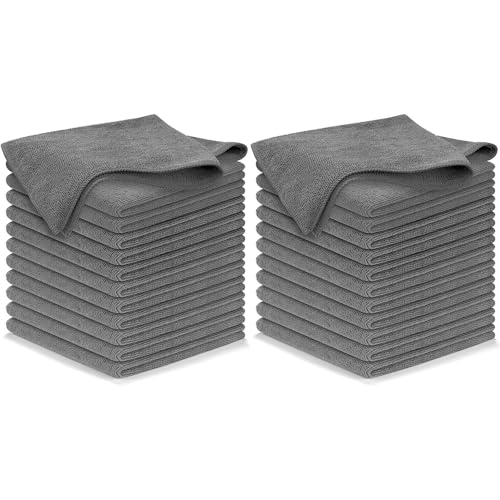
USANOOKS Microfiber Cleaning Cloths — Best for the final wipe
Every spill has two acts: removing the liquid, and removing the evidence. These grey microfiber cloths star in the second act. Once a bar mop or shop towel has taken up the bulk, a USANOOKS cloth passed over the counter, hob, or floor tile lifts the last film and leaves the surface genuinely dry and streak-free — the difference between a floor that looks clean and a floor that still feels faintly tacky under socks.
The cloths measure twelve and a half inches square, come twenty-four to a pack, and use a dense microfiber weave that grabs grime and liquid together. They are proven car cloths, which tells you how they treat delicate finishes: glass, mirrors, chrome, and paint all come up polished rather than smeared. The maker rates them for a very long wash life, and the grey colour hides the permanent shadow that cleaning cloths acquire. Keep four in the kitchen for finishing, four in the bathroom for mirrors and taps, and the rest wherever glass and gloss live.
- Size: 12.5 x 12.5 inches per cloth
- Count: 24 cloths per pack
- Material: microfiber, grey
- Best jobs: final wipe on counters, glass, chrome, car paint, mirrors
- Care: machine washable; avoid fabric softener to protect absorbency
Strengths
- Leaves hard surfaces dry and streak-free after bulk liquid is removed.
- Gentle on glass, chrome, and paint while still lifting greasy film.
- Compact size and big pack count make multi-room staging easy.
Trade-offs
- Saturates fast under a real flood; it is a finisher, not a first responder.
- Microfiber loses its edge if washed with softener or very high heat.
- Can drag on rough surfaces like unfinished wood or coarse stone.
Best for: the final pass on any hard surface, and glass or car finishing. Not suited for: leading the response to a litre-scale spill on its own.
Comparison Table
| Pick | Format | Count / size | Reusable? | Strongest spill type |
|---|---|---|---|---|
| Scott Shop Towels Original | Disposable roll sheets | 55 per roll, 30 rolls | No | Oil and grease |
| Fresh Towel Pop-Up Shop Towels | Disposable pop-up box | 160 sheets | No | Everyday kitchen splashes |
| Utopia Cotton Shop Towels | Cotton rags | 100 pack, 12 x 14 in | Yes | Water-based mopping |
| Avalon Cotton Shop Rags | Cotton rags | 150 pack, 12 x 14 in | Yes | Grubby garage cleanup |
| Corporate Hills Terry Bar Mop Towels | Cotton terry bar mops | 60 pack, 14 x 17 in | Yes | Large kitchen floods |
| USANOOKS Microfiber Cleaning Cloths | Microfiber cloths | 24 pack, 12.5 x 12.5 in | Yes | Final film and streaks |
How Should You Store Spill Towels So They Are There When You Need Them?
Placement is half the product. A spill towel earns its keep in the first five seconds, so stage small stacks where spills are born: beside the sink for jug and dishwasher mishaps, in the drawer nearest the hob for oil and sauce, on the garage bench for everything automotive, and by the back door for muddy water and pet accidents. Rolls and pop-up boxes belong on the bench itself, not in a cupboard, because a closed door costs the seconds that decide whether a spill reaches the skirting board.
Give dirty towels a destination that is not the floor. A small ventilated bin or a hook rail near the utility sink keeps soaked rags off surfaces while they await the wash, and stops a sodden towel from souring inside a closed cupboard. Wash reusable spill towels hot, skip fabric softener because it coats fibres and dulls absorbency, and dry them fully before folding. Retire rags honestly: when a cotton towel thins, tears, or stays grey after a hot wash, demote it to one final dirty job and then the bin.
Label the tiers if your household has more than two people. A strip of masking tape on the shelf edge — blue for garage, white for kitchen, old for pets — sounds fussy for exactly one week, after which nobody needs it because the habit has set. The cost of skipping the labels is paid in ruined good towels and one memorable incident of a garage rag drying the salad bowl. Every professional kitchen and workshop colour-codes or labels for this reason; it is not bureaucracy, it is how a system survives contact with tired, busy people at the end of a long day.
Rotation is what makes bulk packs pay off. Work through the stack from one side so every towel ages evenly, and restock the station the moment laundry returns rather than letting clean towels pile up in a bedroom basket. Households with children or dogs should double the kitchen station; the spill rate in those homes is simply higher, and a bare hook at the wrong moment is how floors get damaged.
What Mistakes Do People Make When Mopping Up a Spill?
The classic error is grabbing the nearest pretty towel. A decorative tea towel with a smooth weave skates over liquid, spreads the puddle, and gets ruined in the process — three losses in one grab. Keep work towels visibly distinct and within reach so the right cloth is also the nearest cloth. The second error is scrubbing a fresh spill on carpet or upholstery, which drives liquid deeper and frays fibres; blotting with a folded pad and patience removes more and damages less.
Third, people wash all their spill towels with softener and then wonder why the towels have gone waterproof. Softener and dryer sheets coat absorbent fibres with a waxy film, and terry and microfiber both suffer. Wash spill towels plainly, with heat, and they will keep drinking for years. Fourth, they mop an oil spill with a reusable towel and then wash that towel with the family laundry, perfuming everything with grease. Oil-soaked cloth goes to the bin or to a dedicated hot wash of its own — never into the general load, and never left balled up in a warm garage, where oily rags should always be laid flat to dry or disposed of safely.
Finally, people underestimate the second pass. Most spills need a bulk removal, a rinse or damp pass for residue, and a dry finish — especially sugary drinks, milk, and anything on wood, where residue left behind draws dirt or swells the finish. The picks in this guide map onto those three passes almost exactly: disposables or bar mops first, a wrung cotton rag second, microfiber to finish.
Why Does Wringing Matter More Than Towel Size?
Shoppers compare spill towels by size, but a spill is cleared in passes, and what decides a pass is how much liquid the towel gives back at the sink. A big towel that holds its water stubbornly becomes a heavy, dripping slab after one circuit of the puddle, while a smaller rag that wrings nearly dry returns to the floor with most of its capacity restored. Cotton terry is the champion of this cycle: its loops release water willingly under a two-handed twist, which is why a single bar mop can clear a mop-bucket spill that would defeat three larger but un-wringable cloths. When you test towels at home, judge the second pass, not the first.
There is a simple kitchen test that ranks any two towels honestly. Weigh or measure a fixed spill — say a mug of water across a washable floor — then count the passes each towel needs, wringing into the sink between passes, until the floor passes a dry-hand check. The towel that finishes in fewer passes with a drier hand is the better spill towel, whatever its dimensions claim. Disposable sheets play a different game: no wringing, no second pass from the same sheet, but a fresh dry sheet every time, which is why they clear greasy spills so decisively — the capacity resets completely with each tear from the roll.
Saturation behaviour also explains why thin towels disappoint even when they feel thirsty at first touch. A thin cloth reaches its limit quickly and then begins returning liquid to the floor under hand pressure, so you end up chasing the puddle in circles. Deep pile and textured disposable sheets both delay that moment — pile by storing liquid inside loops, texture by trapping it in the sheet’s structure. If your current towels feel like they move spills rather than remove them, they are saturating, and the fix is depth or disposability, not a bigger square of the same thin cloth.
Temperature plays a small but real part too. Hot spills, like a tipped pot of tea, spread faster because heat thins the liquid, so the first towel down should be laid flat and left for a slow count of three before you move it — that pause lets the pile engage before the liquid reaches the grout line. Cold, viscous spills such as honey or oil move slowly and reward patience of a different kind: scrape the worst up with a bench scraper or an old card first, then let the towel handle the film, rather than grinding a thick layer into the cloth and the floor alike.
Which Spill Towel Belongs in Each Room of the House?
The kitchen needs two stations, not one. At the sink, where spills are water, soap, and vegetable washings, a stack of bar mops handles the volume and can be washed hot without ceremony. At the hob, where the liquid is oil and sauce, a small stash of disposable sheets or a dedicated, clearly-marked cotton rag keeps grease out of the general laundry. Trying to serve both stations with one towel type is how good towels get ruined and greasy films end up on the tea towels.
The garage and workshop are disposable-first territory with a cotton reserve. Rolls of shop towels live on the bench for oil, coolant, adhesive, and paint — everything that should never meet a washing machine. The cotton rags sit beneath them in the hierarchy, for water, dust, and the wipedown jobs where a washable cloth is perfectly safe: drying a washed car panel before the finishing cloth, mopping rainwater at the door, wiping down tools. Keeping the two tiers physically separate — rolls on the bench, rags in a labelled bin — prevents the expensive mistake of grabbing cloth for an oil job out of habit.
Bathrooms spill differently: smaller volumes, but constant — toothpaste water, splashed baths, the ring under a soap dispenser, a toddler’s enthusiastic handwashing. A pop-up box earns its place here because the sheets stay clean inside the box in a steamy room, and one sheet handles one incident completely. Laundry and utility rooms deserve a bar mop or two of their own for the washing machine’s occasional overflow and the tumble dryer’s condensate tray, both of which arrive without warning and spread under appliances where only a flat-laid towel can reach.
For homes with babies, toddlers, or elderly relatives, add one more station wherever drinks are carried — the hallway end of the sofa, the foot of the stairs. Spills in transit are the ones that sit longest because nobody fetches a towel for a few drops, and a few drops of milk in carpet underlay become next week’s smell. A small folded stack of cotton rags in a basket at that spot costs nothing and quietly prevents the deepest-clean category of household spill entirely.
How Do You Wash Reusable Spill Towels Without Ruining Them?
Shake and rinse first. A rag carrying grit, coffee grounds, or paint flecks should be shaken outside and rinsed at the utility sink before it joins a wash load, both to protect the machine and to stop debris redepositing on the rest of the load. Wash spill towels as their own load where you can: hot water, a thorough detergent dose, and no fabric softener, ever. Softener is the single most common reason a good towel turns into a water-repelling disappointment, and the effect builds gradually enough that people blame the towel instead of the wash.
Dry them completely before they return to the drawer. A spill towel folded while still holding core dampness will smell within a day, and a smelly towel gets used reluctantly, which defeats the whole station system. Tumble drying also re-lofts cotton terry, restoring the loop structure that does the absorbing; line drying is fine in dry weather but leave them until they are truly done. Microfiber follows stricter rules — wash it separately from cotton so it does not harvest lint, keep the heat moderate, and never use softener, because microfiber’s split fibres clog faster than cotton loops do.
Grease deserves its own paragraph because it ruins more laundry than any spill it came from. A rag that has mopped cooking oil should be washed hot with the other kitchen-duty cloths only, or retired to the garage tier. A rag soaked in engine oil, fuel, or solvent does not belong in a domestic wash at all — that is disposable-towel work, and if cloth was used by accident, laying it flat outdoors to dry before disposal is the safe course, never leaving oily cloth balled in a warm enclosed space.
Does Towel Size and Shape Change How a Spill Gets Cleared?
More than the product pages suggest. A twelve-inch square rag is a hand tool: it folds into a palm-sized pad, works corners, wraps around a tap base, and wrings out with a satisfying twist. It is the right shape for counters, hobs, and car interiors, where the spill is contained and the surfaces have edges. A fourteen-by-seventeen bar mop is a floor tool: laid flat it covers a tile and a half, and its weight keeps it in contact with the puddle as you draw it towards you. Trying to clear a floor flood with hand-sized rags triples the passes, and trying to detail a hob with a bar mop bunches fabric into every control knob.
Rolls and boxes remove the size question by making the sheet the unit: one sheet for a mug’s worth, three for a jug. That scalability is a quiet advantage of disposables in the first chaotic seconds — you meter the response to the spill instead of committing a whole towel. With cloth, the equivalent trick is the fold: a bar mop folded in quarters gives you four clean faces, and refolding as each face saturates stretches one towel across a spill that looks like it needs two. Experienced cleaners fold instinctively; if your household does not, the first week with bulk cotton teaches it quickly.
Edges matter too. Hemmed cotton rags hold their shape through hundreds of washes and slide under appliance plinths and fridge doors where spills love to hide. Loose-weave or fraying cloths catch on rough grout and leave fibres behind, which is why the picks here are all properly finished products rather than cut-up remnants. When a rag’s edges finally go, retire it to the one-last-job pile rather than letting it shed its way through a month of mopping.
Weight in the hand is the last underrated factor. A saturated bar mop is heavy, and that weight is information: it tells you the towel is full before it starts dripping. Lightweight cloths give less warning, which is why thin towels so often trail drips between sink and spill. Whichever picks you adopt, learn their full weight in the first week and you will swap towels at the right moment without thinking about it again.
Should You Go Disposable, Reusable, or Both?
The honest answer for most homes is both, assigned by liquid rather than by room. Disposables earn their waste honestly when the alternative is worse: an oil-soaked rag demands a hot wash, detergent, and water, and still may retire early, while a single shop sheet removes the oil from the household entirely. For the daily tide of water-based spills, though, disposables are pure overhead — a cotton rag clears the same puddle for the hundredth time at no marginal cost beyond a shared wash load. Households that track their usage for a month usually find the split lands near four cloth jobs to every disposable job, with the garage reversing that ratio.
There is also a hygiene argument that cuts both ways. A disposable sheet is guaranteed clean at the moment of use, which matters around food preparation and illness. A reusable towel is only as clean as its last wash, but it is washed — and a well-run rotation of hot-washed bar mops is cleaner in practice than the grubby single cloth that hangs by many sinks for a fortnight. The system matters more than the material: whichever type you choose, the towel that gets replaced or laundered promptly beats the towel that festers.
Storage and habit decide the rest. Rolls need a dry shelf and a household willing to tear rather than grab linen; bulk cotton needs a drawer, a laundry rhythm, and a retiring rule. If your home already runs a tight laundry routine, cloth will feel effortless. If laundry is the household bottleneck, lean disposable for the garage and keep a modest cloth stack for the kitchen only. The worst outcome is the grand mixed purchase that nobody maintains, so buy for the routine you actually have, not the one you admire.
Final Recommendation
Build a two-layer kit and most households will never think about spills again. Put the Corporate Hills bar mops at the kitchen station for volume, a roll of Scott Shop Towels in the garage for anything oily, and the USANOOKS microfiber cloths wherever glass and gloss need a clean finish. Add the Utopia or Avalon cotton packs if your home mops daily and prefers cloth, and keep the Fresh Towel pop-up box on whichever bench sees the most small chaos. When the next saucepan jumps, you will already be holding the right towel — and that readiness, more than any single product, is what turns a spill from a small disaster into a thirty-second interruption.
How Should You Handle the Spills That Stain, Smell, or Spread?
Red wine on a pale surface is the spill people panic about, and panic causes the damage: frantic rubbing spreads the pigment and drives it into fibres. The calm method is to blot with a clean cotton rag, working from the outside of the stain inward so the coloured liquid is drawn into the towel rather than pushed into fresh territory, then keep swapping to a clean face of the cloth. A bar mop’s deep pile is ideal here because it holds a surprising amount of coloured liquid away from the surface once lifted. Speed helps, but gentleness helps more.
Milk is the spill whose cost arrives later. Fresh milk wipes up easily and fools people into a single quick pass, but the residue left in grout lines, carpet backing, or the seams of a car seat sours over the following days. Treat milk like a two-stage spill: bulk removal with a cotton rag, then a second pass with a clean damp towel to lift the film, then a dry finish. In a car, add a third pass once the seat has dried, because dried milk in foam keeps releasing odour in warm weather long after the surface looks clean.
Paint and adhesives belong to the disposable tier without debate. A sheet of shop towel lifts wet emulsion paint cleanly and goes straight into the bin; a cotton rag used for the same job carries paint into the washing machine and onto everything washed after it. For sticky residues — jam, syrup, honey — warm water is the towel’s best ally: a bar mop dampened hot dissolves the sugar as it absorbs, while a dry towel just smears it thinner. Work sticky spills in small sections, rinsing the towel often, because a sugar-loaded cloth quickly becomes a sugar-spreading cloth.
Pet accidents reward the same blot-don’t-scrub discipline plus a dedicated towel tier. Keep a small, clearly separate stack of older cotton rags for animal messes, wash them hot as their own load, and never let that stack migrate back to kitchen duty. The colour-coded packs in this guide make that separation easy to maintain: red rags for the garage, a retired set for pets, white bar mops for food areas, blue disposables for oil. When everyone in the house can read the system at a glance, the system survives busy weeks.
Finally, the spill nobody sees: the slow leak. A weeping pipe joint, a dishwasher hose sweating into a cupboard, a fridge drip tray overflowing behind the unit — these spread quietly into flooring and kickboards. A folded cotton rag placed under any suspect joint works as both absorber and witness: check it weekly, and a damp or stained rag tells you the leak is real long before the floor does. It is the least glamorous job any towel in this guide will ever do, and possibly the most valuable.
Frequently Asked Questions
Can one towel type handle both water and oil spills?
Disposable shop towels come closest, because their sheets drink both willingly and carry the oil away to the bin. Reusable cotton handles water beautifully but keeps grease in its fibres, so most homes do best with cotton for water and disposables for oil.
How many spill towels should a household keep?
Enough to staff each spill station plus a laundry buffer — in practice, a working stack of eight to twelve reusables per busy room, or a roll and a spare for disposable users. Bulk packs exist because rotation, not scarcity, is the system that works.
Why did my absorbent towels stop absorbing?
Fabric softener and dryer sheets are the usual culprits; their coating repels the water the fibres should drink. A hot wash with no softener, sometimes twice, restores most towels. Microfiber also fades if boiled or tumble-dried very hot.
Are paper shop towels wasteful compared with cloth rags?
They create more bin waste but save the hot washes, detergent, and water that greasy rags demand, and they keep oil out of your plumbing and laundry. Many households split the difference: cloth for water, disposables for grease.
What should I do about a large oil spill in the garage?
Stop the spread first with disposable towels laid as a dam, then switch to purpose-made absorbent pads or granules for the volume, ventilate the space, and dispose of soaked material according to local guidance. Cloth towels alone are not the right tool at that scale.
Do shop towels work on hardwood and laminate floors?
Yes for spills, with one caution: mop the bulk up promptly, because any liquid left standing on wood or laminate finds the seams. Disposable sheets and cotton rags both lift floor spills well; follow with a dry microfiber pass so no damp film remains along the board edges.
Can I wash disposable shop towels and reuse them?
They are built for one job, and washing usually breaks the sheet’s structure down into a limp rag that sheds. A lightly used sheet that only touched clean water can be dried and demoted to dusting, but plan on single use for anything oily or dirty.
How do I keep white bar mops from looking permanently grey?
Wash them hot and promptly, keep them for food-area duty only, and accept that hard-working white cotton eventually greys — it stays hygienic long after it stops looking new. Retire the greyest to garage duty and promote fresh ones.
What is the fastest way to clear a big water spill on a hard floor?
Drop a dry bar mop flat on the puddle and let the pile drink for a few seconds before dragging it slowly towards you, wringing hard at the sink between passes. Two towels rotated — one soaking while you wring the other — clear a large spill faster than any single-towel method, because the floor never waits on your wringing.
Related Guides
Spill readiness sits inside a wider towel system. If your everyday drying workhorse needs the same grab-fast quality in a larger format, our guide to Best Absorbent Quick-Drying Towels covers towels that drink and then dry fast between uses. For the café corner and the espresso machine’s daily puddles, Best Barista Towels looks at small cloths built for steam wands and drip trays. Flat-woven options that mop a beach bag spill and dry on a line in an hour appear in Best Fouta Bath Towels, and the classic bench staple behind several picks above is rounded up in Best Shop Towels.



[…] whole-bathroom overview in Best Bathroom Towels places these picks in the wider linen closet, while Best Absorbent Towels for Liquid Spills covers the utility end of absorbency. And for the bar-station towels that share a shelf with the […]