What's inside
- Key Takeaways
- Quick Picks
- How Did We Judge Drying Speed Fairly?
- Where Does a Quick-Drying Towel Earn Its Keep During One Day?
- Comparison Table
- How Can You Make Any Towel Dry Faster Between Uses?
- Why Do Some Quick-Drying Towels Start to Smell, and How Do You Stop It?
- What Mistakes Make Quick-Drying Towels Slow and Clammy?
- Microfiber, Waffle, or Cotton — Which Drying Physics Suits Your Home?
- What Size Towel Does Each Quick-Dry Job Actually Need?
- How Do You Build a Rotation That Never Hands You a Damp Towel?
- How Do Quick-Drying Towels Cope in Humid Homes and Small Flats?
- How Long Should a Quick-Drying Towel Last, and When Should You Replace It?
- How Does a Quick-Drying Towel Change a Weekly Cleaning Round?
- What Changes in a House With Children, Dogs, and Constant Small Floods?
- Final Recommendation
- Frequently Asked Questions
- Related Guides
As an Amazon Associate I earn from qualifying purchases. This post may contain affiliate links at no extra cost to you.
cottageverdict.com is reader-supported. When you buy through links on our site, we may earn an affiliate commission.
Where to buy: Each pick below is sold on Amazon. Follow a linked pick name to its listing to check price on Amazon, confirm the size and pack count, and check the care instructions before ordering.
A towel that is still damp from breakfast cannot dry the lunch dishes, and a gym towel that leaves the bag smelling swampy by Thursday is a towel you stop packing. The best absorbent quick-drying towels solve a timing problem as much as a water problem: they have to drink a full load of moisture, then give that moisture back to the air fast enough to be ready again in a few hours. This guide is about that everyday, multi-use category — kitchen work, gym bags, cleaning rounds, and hand drying — in microfiber, waffle weave, and light cotton builds that cycle several times a day.
That framing matters, because quick-drying is a different promise in the bathroom. A bath towel dries a person once or twice a day and hangs undisturbed between uses; a working towel dries hands twenty times, wipes a counter, mops a spill, and goes back on the hook still expected to perform at dinner. Drying speed between uses is therefore the headline test here, ahead of plushness or size. A towel that feels luxurious but stays damp is, for this job, simply a slow towel wearing nice clothes.
One clarification before the picks, because the search phrase itself invites confusion: these are not bath towels that happen to dry quickly, and they were not judged as such. If your morning problem is stepping out of a shower, this site’s dedicated bath-towel guide is the right read. If your problem is a towel that must work five shifts a day, you are in the right place.
Materials divide the field into three honest camps. Microfiber dries fastest because its fine synthetic fibres hold water in the spaces between them rather than inside the fibre itself, so air reaches the moisture easily. Waffle weave dries nearly as fast by architecture: the recessed pockets expose a huge surface area to the air while the raised threads do the wiping. Lightweight cotton is the slowest of the three but still far quicker than a plush bath towel, and many people simply prefer how cotton feels and ages. Every pick below names its camp plainly, so you can shop by the physics you prefer.
Key Takeaways
- Drying speed between uses is the deciding test for a working towel — judge the second and third job of the day, not the first.
- Microfiber dries fastest, waffle weave is a close second with better scrubbing texture, and light cotton trails but feels most familiar.
- Thin beats thick for cycle work: a lean towel that dries in two hours outperforms a plush one that needs all day.
- Rotation is a drying strategy — three modest towels used in turn stay fresher than one premium towel used relentlessly.
- Gym and kitchen towels live different lives; a towel sized for a workout bag is wasted on a countertop, and vice versa.
- Wash microfiber without softener and keep it away from high heat, or its fast-drinking fibres clog and slow down.
Quick Picks
| Pick | Badge | Why it earns its place |
|---|---|---|
| POLYTE Multipurpose Microfiber Towels | Best all-round workhorse | Big 16×24 microfiber sheets at 340 GSM that mop, dry, and are ready again by the next job. |
| Vnoss Quick Dry Gym Towel | Best for the gym bag | Five lint-free workout towels sized for benches and shoulders that leave the bag dry, not swampy. |
| Trailoom Microfiber Gym Towels | Best sport set | A five-towel set built for hot yoga, tennis, and running, with quick turnover between sessions. |
| White Cotton Quick-Dry Towels 12-Pack | Best cotton option | Lightweight 22×44 cotton towels that dry far faster than plush cotton and cover bath-to-kitchen duty. |
| RECYCO Waffle Kitchen Towels | Best kitchen specialist | Waffle microfiber in a coastal design that scrubs, dries glassware, and hangs dry before the next meal. |
| MOONQUEEN Quick-Drying Hand Towels | Softest hand towel | Coral velvet microfiber hand towels that feel plush yet still cycle quickly beside a busy sink. |
How Did We Judge Drying Speed Fairly?
We treated dry time as a relay rather than a single event. Each candidate was assessed on three turns of the same day: a morning job, a midday job, and an evening job, with ordinary hanging on a hook or rail in between — not spread over a heated dryer, not outdoors in a breeze. A towel that aced the first turn and failed the third was marked down, because that third turn is exactly when real households reach for a towel and find it clammy. This relay test is why lean builds dominate the list: thickness stores water beautifully and releases it reluctantly.
Absorbency still had to clear a bar. A quick-drying towel that merely moves water around is a squeegee with good marketing, so every pick here also had to clear standing water from a counter, dry a full set of dishes without going limp, or handle a soaked gym session, according to its role. The balance point differs by material. Microfiber holds water between its fibres and releases it to air quickly; waffle holds it in pockets that ventilate; light cotton holds less to begin with, which is its own kind of speed.
We also weighed the unglamorous details that decide whether a towel stays in service: whether it sheds lint onto glassware, whether it picks up odours quickly in a bag, whether the edges survive weekly washing, and whether the pack count supports a real rotation. A single brilliant towel is a bottleneck; five good towels are a system. Pack sizes and sizes per towel are quoted from each listing as verified for this guide, and where a pick is a specialist — the gym pair, the kitchen pair — the review says so instead of pretending universality.
We also paid attention to how each towel behaves at the unglamorous end of its day: draped over a bag, a radiator that is off, or the back of a dining chair in a flat with no airing cupboard. Laboratory drying happens on a line in moving air; household drying happens wherever there is space. Picks that only performed in ideal conditions were marked down, because the households who need quick drying most are usually the ones with the worst places to do it. The survivors in this list forgive real homes.
Finally, we kept the bathroom out of it on purpose. Shoppers who need a towel that dries a body after a shower and dries fast on the rail have a dedicated guide elsewhere on this site, linked at the end. Everything here was chosen for the shorter, more frequent jobs that fill a day between showers.
Where Does a Quick-Drying Towel Earn Its Keep During One Day?
Follow a working towel through a ordinary day and the relay becomes obvious. At seven it dries the breakfast dishes and a wipedown of the hob. At nine it is the gym towel, drinking sweat through a session and then riding home in a bag where a slow towel would start to smell by noon. At one it is back on kitchen duty for lunch plates and a spilled glass of water. By six it is drying hands between cooking tasks, and by nine it takes the final counter wipe of the night. Five jobs, four of them impossible for a towel that needs twelve hours to dry.
Different rooms stress different parts of that relay. The kitchen punishes lint — a towel that sheds onto wet glassware fails no matter how fast it dries — and rewards scrubbing texture for dried-on splashes. The gym punishes odour and bulk: the towel must pack small, drink heavily for an hour, and dry across a locker or car seat before tomorrow. Cleaning rounds punish saturation, because a cloth that goes limp at the third mirror wastes the round. Hand drying punishes clamminess most of all; a hand towel beside a busy sink may be used thirty times a day, and its whole virtue is feeling dry at touch twenty-nine.
There is a small psychological dividend worth naming. A towel that is reliably dry feels clean even before you check, and a towel that feels clean gets used properly — hands dried fully, counters wiped completely, gym kit packed without dread. Damp towels train people into half-measures: the quick swipe, the sleeve used as a towel, the dish left to air-dry on a crowded rack. Speed, in other words, is not a luxury specification. It is the property that keeps every other good habit in the kitchen and the gym bag alive, which is why it headlines this guide.
Households that camp, caravan, or keep a boat will recognise the same relay under harsher rules: limited hooks, humid air, no tumble dryer. The microfiber and waffle picks here double as travel answers for exactly that reason, while the light cotton pack suits a holiday rental where towels must turn around between a morning swim and an evening shower. Speed is a lifestyle feature long before it is a laundry feature.
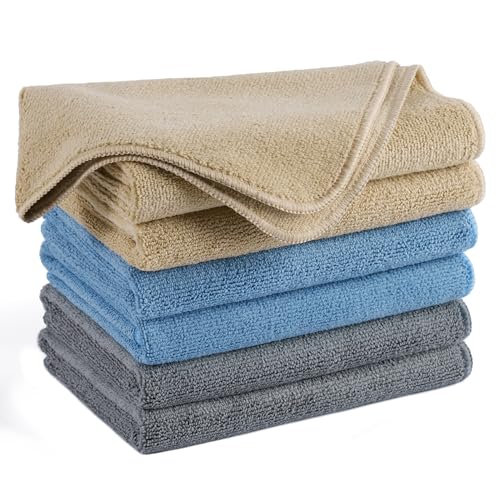
POLYTE Multipurpose Microfiber Towels — Best all-round workhorse
If one pick here deserves the word multipurpose, it is this one. The POLYTE towels are generous sixteen-by-twenty-four-inch microfiber sheets at a midweight 340 GSM — large enough to fold into a proper pad for counter work, light enough to dry on a hook between jobs, and smooth enough to finish glass without leaving lint behind. In a day’s relay they are the towel we would hand to a household that wants one purchase to cover dishes, counters, bathroom mirrors, and the weekly cleaning round.
The drying behaviour is the headline: microfiber this weight gives up its water to ordinary room air within a few hours, so the towel that dried the lunch dishes is honestly ready for the dinner shift. Six towels in the pack support a two-station rotation with a laundry buffer. They are also forgiving workmates — no special size, no delicate weave — and they tolerate the frequent washing that working towels demand, provided softener stays out of the load.
- Size: 16 x 24 inches per towel
- Weight: 340 GSM microfiber
- Count: 6 towels per pack
- Best jobs: dishes, counters, cleaning rounds, glass finishing
- Care: machine wash without softener; moderate heat
Strengths
- Genuinely versatile size and weight; one towel type can staff kitchen and bathroom.
- Lint-free finish keeps glassware and mirrors clean while drying.
- Dries fast enough for three or four turns of duty in a single day.
Trade-offs
- Microfiber feel divides people; it grips skin slightly rather than gliding like cotton.
- Not the softest option for hand drying beside a sink all day.
- Needs softener-free washing, which may mean a separate load from family laundry.
Best for: households wanting one quick-drying towel system for kitchen and cleaning. Not suited for: anyone who dislikes the hand feel of microfiber for personal drying.

Vnoss Quick Dry Gym Towel — Best for the gym bag
Gym towels fail in a specific, miserable way: they work beautifully during the session and then ferment in the bag. The Vnoss set is engineered against that failure. Five microfiber towels at sixteen by twenty-seven inches — long enough to drape a bench or a shoulder — drink hard through a workout, then dry quickly once draped over a locker door, a car headrest, or the bag itself left open at home. The listing emphasises a lint-free, odour-resistant fibre, and the grey colour shrugs off the permanent shadowing that gym towels collect.
Five towels is the other half of the design. A five-pack maps neatly onto a training week: one per session, wash at the weekend, no day where the only towel is yesterday’s. They pack flat enough that carrying a clean spare costs no space, which removes the temptation to reuse a damp towel — the habit that makes gym bags smell in the first place. For runners and lifters who train before work, that rotation is worth more than any single towel’s specs.
- Size: 16 x 27 inches per towel
- Count: 5 towels per pack, grey
- Material: microfiber, lint-free
- Best jobs: workouts, bench cover, sweat duty, sports bags
- Care: machine wash; air dries quickly after use
Strengths
- Five-towel rotation matches a training week and ends the damp-reuse habit.
- Dries fast in poor conditions — locker rooms, cars, closed flats.
- Bench-friendly length with a colour that hides gym grime gracefully.
Trade-offs
- Sized and styled for sport; it looks out of place as a kitchen towel.
- Microfiber on skin feels functional rather than comforting after a shower.
- Grey only in this pack, so no colour-coding between users in one household.
Best for: regular trainers who want a clean towel every session without laundry stress. Not suited for: kitchen duty, or households wanting one towel style everywhere.

Trailoom Microfiber Gym Towels — Best sport set
Trailoom’s set of five aims at the hotter, sweatier end of sport: hot yoga, tennis, running, and long summer sessions where a towel is used continuously rather than occasionally. The microfiber is highly absorbent for its weight and built to dry fast between a morning run and an evening class, and the set format means a household with two active people can still run a rotation without daily washing.
In practice the difference between this set and the Vnoss pack is emphasis. Trailoom leans into session performance — how the towel behaves draped over a yoga mat’s end, carried on a run, or wrung out at a court-side break — while Vnoss leans into the weekly bag system. Either serves both purposes, but hot-yoga practitioners in particular will appreciate a towel that keeps drinking through a ninety-minute heated class and still dries on the drive home. The odour-free positioning matters here too; heat plus sweat is where slow towels develop their permanent funk.
- Count: set of 5 towels
- Material: microfiber, quick dry
- Best jobs: hot yoga, tennis, running, gym sessions, camping
- Colour: as listed on the product page
- Care: machine wash without softener
Strengths
- Sustained absorbency through long, hot sessions rather than just quick dabs.
- Fast turnaround between a morning and evening workout on the same day.
- Five-towel set supports couples or heavy training schedules.
Trade-offs
- Sport-first design; not intended for dishes or delicate glass finishing.
- Microfiber needs its own wash discipline to stay fast and fresh.
- Serious yogis may still want a full mat-length towel for some practices.
Best for: hot yoga, racket sports, and runners training most days. Not suited for: kitchen rotation or anyone wanting cotton’s feel for sport.

White Cotton Quick-Dry Towels 12-Pack — Best cotton option
Some households will always choose cotton, and this twelve-pack is how cotton competes on speed: by being light. At twenty-two by forty-four inches these are proper full-size towels, but the weave is deliberately leaner than a plush bath towel, so they hold less water and release what they hold far sooner. The listing pitches them across bath, gym, pool, kitchen, salon, and pet duty, and that breadth is believable precisely because the towels make no luxury claims — they are honest, quick-turnaround cotton.
Twelve towels transforms the laundry maths. A family can run a swim-heavy week, a set of guests, or a pet-heavy rainy spell without the towel rail ever standing empty, and white cotton tolerates hot washing that keeps shared towels genuinely fresh. They will never dry as fast as microfiber — physics is physics — but among cotton options the difference between these and a heavy plush towel on the rail is the difference between ready tonight and ready tomorrow.
- Size: 22 x 44 inches per towel
- Count: 12 towels per pack
- Material: 100% cotton, white, lightweight
- Best jobs: pool, gym, guests, pets, general household rotation
- Care: machine wash hot; tumble or line dry
Strengths
- Fastest-drying cotton here by a clear margin, thanks to the lean weave.
- Twelve-pack supports big households, guests, and swim-season volume.
- White cotton takes hot, hygienic washing without colour worries.
Trade-offs
- Lean feel; nobody will mistake these for a spa towel after a bath.
- Still slower to dry than any microfiber pick in this guide.
- White shows outdoor and pet-duty staining over time.
Best for: cotton loyalists, big families, pool and guest duty. Not suited for: shoppers chasing the absolute fastest dry time, which is microfiber’s crown.
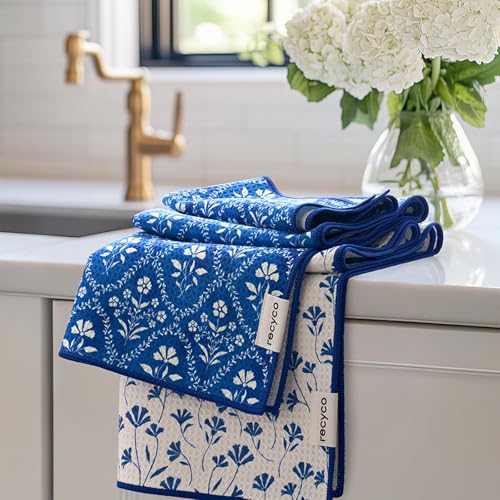
RECYCO Waffle Kitchen Towels — Best kitchen specialist
Waffle weave is the kitchen’s own quick-dry technology, older than microfiber and still hard to beat at the sink. The RECYCO pair builds that weave in microfiber at a generous sixteen by twenty-eight inches, in a coastal design that looks at home hanging from an oven rail. The pockets trap water fast, the raised threads scrub at dried splashes, and the whole structure ventilates so well that the towel is usually dry before the next meal’s prep begins.
Two towels is a small pack, and the review should be honest about what that means: this is a specialist pair for a household that already owns everyday kitchen cloths and wants two genuine performers for glassware, dish finishing, and the constant hand-drying between tasks. Used in rotation with a rest day each, they stay fresh a long time. The sustainability angle in the listing — reusable microfiber replacing disposable kitchen roll — is the quiet benefit: a pair this durable covers months of small jobs.
- Size: 16 x 28 inches per towel
- Count: set of 2
- Material: waffle weave microfiber
- Best jobs: dishes, glassware, hand drying, counter finishing
- Care: machine wash without softener
Strengths
- Waffle structure dries exceptionally fast on the rail between meals.
- Scrubbing texture handles dried splashes that smooth cloths skate over.
- Attractive coastal design earns its place on display on the oven rail.
Trade-offs
- Only two towels; heavy households will want a second set for rotation.
- Kitchen-sized only — no use as a gym or pool towel.
- Waffle pockets can catch on rough Velcro or splintered wood edges.
Best for: cooks who want two excellent kitchen towels that dry between meals. Not suited for: stocking a whole household’s towel system from this one purchase.

MOONQUEEN Quick-Drying Hand Towels — Softest hand towel
Hand towels beside a busy sink face the cruellest version of the relay: used every few minutes, rarely given a full day to recover. MOONQUEEN’s answer is coral velvet microfiber at sixteen by twenty-eight inches — a plush, soft pile that feels kind on skin washed raw by winter or by kitchen work, mounted on a microfiber base that still dries far faster than a cotton hand towel of similar plushness. Six grey towels per pack keep the rail supplied through a wash cycle.
The listing suggests hotel, bathroom, spa, and shower use, and the honest home translation is: anywhere hands are dried constantly. Beside the kitchen sink they out-dry cotton by hours; in a family bathroom they end the clammy shared-towel problem that makes people wipe hands on their clothes instead. Grey is a forgiving colour for a towel that meets makeup, hair dye, and cooking stains in the same week.
- Size: 16 x 28 inches per towel
- Count: 6 towels per pack, grey
- Material: microfiber coral velvet
- Best jobs: hand drying at kitchen and bathroom sinks, guest bathrooms
- Care: machine wash without softener; avoid high heat
Strengths
- Plush hand feel without the all-day dampness of plush cotton.
- Six-pack rotation keeps a fresh-feeling towel on the rail all week.
- Grey hides the mixed staining that sink-side towels inevitably collect.
Trade-offs
- Too soft and smooth to scrub; it dries rather than cleans.
- Coral velvet pile needs gentler washing than flat microfiber.
- Not a dish towel substitute for heavy kitchen loads.
Best for: busy sinks where the hand towel never gets a rest. Not suited for: scrubbing duty or households wanting cotton against skin.
Comparison Table
| Pick | Material | Size | Count | Dry-speed camp |
|---|---|---|---|---|
| POLYTE Multipurpose Microfiber Towels | Microfiber 340 GSM | 16 x 24 in | 6 | Fast |
| Vnoss Quick Dry Gym Towel | Microfiber | 16 x 27 in | 5 | Fast |
| Trailoom Microfiber Gym Towels | Microfiber | Set of 5 | 5 | Fast |
| White Cotton Quick-Dry Towels 12-Pack | Cotton, lightweight | 22 x 44 in | 12 | Moderate |
| RECYCO Waffle Kitchen Towels | Waffle microfiber | 16 x 28 in | 2 | Fast |
| MOONQUEEN Quick-Drying Hand Towels | Coral velvet microfiber | 16 x 28 in | 6 | Fast for its plushness |
How Can You Make Any Towel Dry Faster Between Uses?
A heated rail, where one exists, changes the maths for every material and can rescue even a mid-speed towel in winter. Treat it as a bonus rather than a plan, though: rails get switched off, bathrooms get steamy, and a towel chosen for genuine air-dry speed performs in every month of the year.
Start with the wring or the shake. A towel hung dripping carries its whole load into the drying process; a towel wrung hard over the sink, or shaken out sharply if it is a gym towel at a locker, starts the race a lap ahead. Then give it air on both sides: draped over a rail or a chair back dries roughly twice as fast as the same towel bunched on a hook, because both faces meet the air. In a humid bathroom, even moving the towel to a bedroom door hook overnight transforms next-morning readiness.
Washing habits quietly set the ceiling on drying speed. Softener residue makes fibres hold water in a film instead of releasing it, and an overloaded wash leaves towels so compressed that they dry stiff and slow. Wash working towels in a reasonably sized load, skip the softener, and add an extra spin if your machine offers one — the extra spin is the cheapest dry-time upgrade in the whole laundry. Tumble drying re-lofts microfiber and cotton alike, but line or rail drying is where these picks shine, since fast air-drying is the entire point of choosing them.
Rotation discipline finishes the job. The rule that keeps a system fresh is simple: a towel that has done two heavy turns rests for a day, whatever the calendar says. That is why the pack counts in this guide matter more than any single towel’s heroics — five gym towels, six hand towels, twelve cotton towels all encode the same wisdom. Households that fight damp-towel smell are usually not fighting a towel problem; they are fighting a rotation shortage, and one more pack fixes it more reliably than any premium replacement.
Why Do Some Quick-Drying Towels Start to Smell, and How Do You Stop It?
The smell is a drying failure with a time delay. A towel that stays damp for many hours gives odour-causing residue a warm, wet home, and each slow cycle adds another layer until the towel smells sour the moment it gets wet again — even straight from a wash. Gym towels suffer most because they combine heavy moisture, skin oils, and a closed bag. The defence is boring and total: dry the towel fully after every use, in moving air, before it goes anywhere near a bag or a drawer.
Once a towel has the smell baked in, recovery starts with a genuinely hot wash for cotton, or a thorough wash with an extra rinse for microfiber, followed by complete drying in the driest air you have — outdoors if possible. Towels that still smell after two honest attempts are telling you their fibres are saturated with residue beyond rescue; retire them to outdoor duty and replace them, because a towel you hesitate to use has already failed its job. Prevention is cheaper: the fast-drying builds in this guide exist precisely to shrink the damp window where the smell takes hold.
One more habit helps every towel in this guide: never leave a used towel in a closed washing basket while it is still damp. Either wash that day or hang it until it is dry enough to wait. The basket is where more towels are ruined than in any workout, and it takes ten seconds to hang a towel instead.
What Mistakes Make Quick-Drying Towels Slow and Clammy?
The first mistake is buying plush when the job is frequent. A thick, luxurious towel beside a family sink is a damp towel with good intentions; the relay always wins. Match thickness to turnaround: the more often a towel is used, the leaner it should be. The second mistake is the single-towel system — one gym towel for five sessions, one hand towel for a week — which no material can survive gracefully. Rotation is not upselling; it is how the physics works.
Third, people wash microfiber with their cotton and wonder why it stops drinking. Cotton sheds lint into microfiber’s fine structure, softener coats it, and high heat can damage the split fibres that do the work. Give microfiber its own cooler, softener-free load and it stays fast for a very long time. Fourth, they hang towels in the steamiest room of the house and blame the towel. A bathroom after two showers is a drying oven running in reverse; move working towels to airier hooks and the same towels suddenly perform.
Finally, shoppers confuse absorbency claims with drying claims. A towel can hold an impressive amount of water and still be the wrong choice for cycle work, because holding and releasing are different talents. When a listing talks only about how much a towel absorbs and never about how fast it dries, read that silence as your answer and look for the picks — like the ones above — where quick drying is the design brief itself.
Microfiber, Waffle, or Cotton — Which Drying Physics Suits Your Home?
Microfiber’s speed comes from geometry. Each fibre is split into fine wedges, so a cloth presents an enormous surface area and holds water in the capillary spaces between fibres rather than inside them. Air moving across the cloth reaches that water quickly, which is why a microfiber towel hung after the dinner dishes is dry before bed. The same geometry explains its weaknesses: those fine spaces trap lint from cotton laundry, clog with softener, and can feel grabby on dry skin. Microfiber is the performance choice — fastest, lightest, most packable — for households willing to wash it on its own terms.
Waffle weave is architecture rather than chemistry. The woven pockets create thin films of water across a large ventilated area, and the raised threads give the towel a gentle scrubbing action that flat weaves lack. In cotton, waffle is the traditional European answer to the slow bath towel; in microfiber, as with the RECYCO pair above, it combines both speed systems at once. Waffle’s compromise is capacity: the pockets hold less total water than deep terry pile, so a waffle towel needs a wring sooner on a genuine flood. For the relay of daily jobs, that trade is almost always worth making.
Cotton’s case is about feel, familiarity, and washing freedom. Cotton stores water inside the fibre, so it starts slower and dries slower, but it tolerates hot washes, needs no separate load, and feels like the towels most people grew up trusting. The lightweight build of the twelve-pack in this guide narrows the speed gap by simply holding less water per towel. Households with babies, sensitive skin, or a strong preference for natural fibres can stay with cotton and still get a workable relay — they just need more towels in rotation to cover the slower turnaround.
There is no universal winner, only a match between material and household rhythm. A flat with no tumble dryer and a steamy bathroom should lean microfiber and waffle. A family home with a hot-wash routine and a sunny line can run light cotton happily. A sport-heavy household should put microfiber in the bags regardless of what hangs in the kitchen, because the closed-bag hours are where slow materials fail most completely. Many of the best systems mix all three, which is exactly what the pick list above is designed to let you do.
What Size Towel Does Each Quick-Dry Job Actually Need?
Hand drying wants a towel that covers two hands with drape to spare: the sixteen-by-twenty-eight hand-towel format exists because it hangs neatly, presents a dry face all day, and launders in bulk without eating the machine. Anything smaller becomes a flannel you chase around the sink; anything larger bunches and stays damp in its folds. The MOONQUEEN set and the RECYCO pair both live at this size for good reason, one optimised for softness, the other for scrubbing and glass.
Dish and counter work wants a step up. Sixteen by twenty-four or sixteen by twenty-eight lets you fold the towel into a pad that protects hands from hot pan edges, carries a stack of plates’ worth of water, and still wrings out one-handed at the sink. The POLYTE towels sit at the smaller end of that band and fold beautifully; the cotton twelve-pack, at twenty-two by forty-four, is really a different tool — a body-and-pool size that happens to dry fast, better for swim bags and guest bathrooms than for a galley kitchen where a long towel trails in the sink.
Gym sizing follows the bench and the shoulder. Sixteen by twenty-seven covers a weight bench’s width and drapes a neck without trailing on the floor, and the Vnoss and Trailoom sets both honour that logic. Oversized gym towels feel generous in the shop and become dead weight in the bag, while washcloth-sized sport towels force a choice between face and equipment. For yoga, runners, and court sports, the mid-size also rolls into a water-bottle-sized cylinder, which is the difference between a towel that gets packed and a towel that gets left.
Cleaning rounds want the smallest efficient square: a cloth around twelve to sixteen inches folds into the hand, works mirrors and taps without trailing edges, and swaps quickly when it saturates. Several picks in this guide double for cleaning even though they headline other jobs — the POLYTE especially — and that doubling is a virtue in small homes where every item should hold two posts. Buy sizes for the job list you actually run, and the drying relay takes care of itself.
How Do You Build a Rotation That Never Hands You a Damp Towel?
Start by counting stations, not towels. A station is any place a towel works: the kitchen rail, the bathroom rail, each gym bag, the cleaning caddy. Each station needs a working towel plus a resting towel, because the rest day is what keeps fibres fresh and odours away. Two stations therefore mean four towels minimum, before laundry buffering — which is why the pack sizes in this guide cluster at five, six, and twelve rather than one or two.
Then set the laundry rhythm to the fastest station, not the slowest. Kitchen hand towels usually set the pace, needing a wash every few days in a busy house; gym towels should join that wash or run just after training days. The mistake to avoid is letting the slowest station — say, a guest bathroom — dictate a weekly cycle that leaves the kitchen towels fermenting in the basket. Fast stations wash fast; slow stations can always join a later load.
Mark the rotation physically until it becomes habit. Work left to right along the rail, or keep clean towels in one basket and move them in order, so every towel ages evenly and no favourite gets used to death while its pack-mates stay new. Even ageing matters because a mixed set — two tired towels and four fresh — performs unevenly and tempts you to keep reaching for the fresh ones. When the whole set finally tires together, one replacement pack restores the entire system at once.
Finally, give the system a seasonal review. Summer adds swim and sport loads that argue for pulling the cotton twelve-pack into service; winter slows all drying and argues for an extra microfiber set in the kitchen. The households whose towels always feel ready are not the ones with the most expensive towels — they are the ones whose rotation quietly flexes with the calendar, and building that flex in from the start costs one honest count of your stations today.
How Do Quick-Drying Towels Cope in Humid Homes and Small Flats?
Humidity is the silent opponent in this category. In a steamy flat where the bathroom never fully dries between showers, even a fast towel slows down, and cotton slows to a standstill. The countermeasures are placement and airflow rather than new purchases: hang working towels outside the bathroom wherever possible — a hook on a kitchen wall, a rail near a window, the back of a door in a room that gets opened and closed. Moving air matters more than warm air; a towel near a frequently used doorway dries faster than one in a still, warm airing cupboard.
Small homes also benefit from choosing towels that dry flat and fast over towels that dry eventually. Microfiber’s thin profile means a full rotation can hang along a single over-door rail without dominating the room, and gym towels can drape a chair overnight instead of sealing their damp into a bag. If you take one habit from this section, make it the overnight rule: no used towel spends the night folded, bunched, or bagged. Spread or draped, every pick in this guide is ready by morning even in a humid home; folded on a hook in a steamy bathroom, even the best of them is gambling.
Renters and students face the strictest version of this problem — shared bathrooms, no heated rail, laundry at intervals. For them the five-packs in this guide are close to essential equipment: enough towels to keep the rotation alive between launderette trips, in materials that forgive imperfect drying conditions. A single plush cotton towel in a student bathroom is a small tragedy repeated daily; five lean microfiber towels are a system that survives the term.
How Long Should a Quick-Drying Towel Last, and When Should You Replace It?
A working towel’s life is measured in washes more than months. Microfiber in regular service typically stays fast and lint-free for a long run of weekly washes, fading gradually as its split fibres clog with the residue of ordinary detergents and hard water. Cotton’s decline is easier to see: loops flatten, edges thin, and the towel starts pushing water rather than drinking it. Waffle sits between the two, keeping its structure well but slowly losing the crispness that makes its pockets work.
The honest replacement test is the relay itself. When a towel that used to be ready for the evening job starts arriving damp — washed properly, hung properly — its fibres are telling you they are done, whatever the calendar says. Demote rather than bin where you can: tired kitchen towels become garage and pet towels, tired gym towels become cleaning cloths, and only the truly spent leave the house. That cascade is another argument for buying honest mid-tier packs like the ones here rather than precious singles; a system you can afford to refresh is a system that keeps performing.
Care stretches every timeline in this section. Softener-free washing, moderate heat, full drying before storage, and a rest day between heavy uses can double the useful life of the same towel. The households that complain towels do not last are usually washing them hardest and resting them least. Treat the rotation in this guide as part of the product, and these picks repay it with years of unglamorous, reliable speed.
How Does a Quick-Drying Towel Change a Weekly Cleaning Round?
Cleaning is where drying speed hides its second benefit: a cloth that dries fast between rooms does not carry one room’s moisture into the next. Start in the bathroom, where mirrors, taps, and the sink surround all want a cloth that wipes and finishes in one pass. A microfiber towel that leaves glass dry does not need a second buffing cloth, and because it gives up its water to the air while you scrub the bath, it arrives at the kitchen still useful rather than limp. Slow cloths force a mid-round swap or, worse, a mid-round compromise where surfaces get wiped damp and dry streaky.
In the kitchen the same towel meets grease, which changes the rules: use the towel’s later life for this room, or dedicate one towel to kitchen cleaning outright, because a grease-loaded cloth will smear a bathroom mirror for weeks. The rotation system handles this naturally — the freshest towels start in bathrooms and on glass, graduate to kitchen duty as they age, and finish their careers on floors and outdoor jobs. That cascade costs nothing and keeps every surface matched to a cloth in the right condition for it.
Floors and windows reward the fast-dry property differently. A mop-assist towel wrung around a flat mop head, or a window cloth that must stay merely damp rather than wet, both depend on controlled moisture: too wet streaks, too dry drags. Quick-drying builds return to that just-damp state quickly after a rinse, so the round keeps its rhythm. By the end of a whole-house clean, the difference between a fast set and a slow set is one load of cloths versus three, and a caddy that smells clean versus one that needs its own cleaning.
None of this requires a cupboard of specialised products. It requires the relay mindset applied to Saturday morning: towels chosen for turnaround, rotated by condition, and washed on their own terms. The picks above were selected with exactly that round in mind, which is why the most versatile of them — the POLYTE — reads almost like cleaning equipment that happens to dry dishes, rather than a dish towel that can be pressed into cleaning.
What Changes in a House With Children, Dogs, and Constant Small Floods?
Mess-heavy households do not need better towels so much as they need more drying cycles per day. A toddler’s water play, a dog’s drinking style, and a teenager’s shower habits can put a kitchen or bathroom towel through a dozen turns before lunch. In that environment the lean, fast builds in this guide stop being a preference and become the only workable option: a plush towel is simply out of the game by ten o’clock, while a microfiber or waffle towel wrung and rehung is back in play within the hour.
Colour and count become the parents’ best tools. Grey and mid-tone towels hide the evidence of a hard week between washes, and big packs mean the answer to any spill is a fresh towel rather than the increasingly tragic one already on the rail. Keep one fast towel at child height by the bathroom sink and another by the dog’s water bowl; those two stations absorb a remarkable share of a young family’s daily mopping, and both are places where a slow towel would live permanently damp.
The gym-bag lesson applies to school and swim bags too. A quick-dry towel packed for swimming lessons comes home damp, gets draped over a chair, and is ready for tomorrow’s lesson without a wash — where a cotton towel would need the machine after every outing or start to smell by Friday. For families running multiple kits, the five-packs in this guide divide neatly: one per child, colours or bags keeping ownership clear, and a shared wash at the weekend resetting the whole fleet.
Final Recommendation
Most households should start with the POLYTE six-pack as the kitchen-and-cleaning backbone, add the MOONQUEEN set if the sink-side hand towel is a daily irritation, and choose between the Vnoss and Trailoom sets by sport: Vnoss for the weekly gym-bag rotation, Trailoom for hot, heavy sessions. Cotton loyalists and big families are genuinely well served by the twelve-pack, and the RECYCO pair is the finishing touch for a kitchen that takes its glassware seriously. Pick by the relay your towels actually run, keep the rotation honest, and the damp towel draped over your morning will quietly become a problem you used to have.
Frequently Asked Questions
Is microfiber always faster-drying than cotton?
Yes, in like-for-like weights, because microfiber stores water between fine fibres where air reaches it easily, while cotton stores water inside the fibre itself. A very light cotton towel can beat a very plush microfiber one, which is why this guide compares builds, not just materials.
How many quick-drying towels do I need for the gym?
One per session between washes is the rule that keeps bags fresh. Training four or five times a week points to a five-pack; training twice a week, three towels give you a spare for the day laundry slips.
Can quick-drying towels replace my bath towels?
They can dry a body, but that is a different job with its own guide on this site. Working towels here are sized and built for repeated daily tasks; bath duty rewards larger sizes and a different balance of softness and speed.
Why does my microfiber towel repel water now?
Almost always residue: fabric softener, dryer sheets, or lint and detergent buildup from mixed loads. Wash it separately in warm water with no softener, add an extra rinse, and dry it fully — most towels recover their thirst within a wash or two.
Do waffle towels really dry faster than flat ones?
Yes. The recessed pockets expose far more surface to the air and hold water in thin films rather than deep pile, so a waffle towel on a rail is typically ready again hours before a flat terry towel of similar weight.
Are quick-drying towels a good choice for a holiday rental or Airbnb?
They are close to ideal for hosts. Fast turnaround between guests is the whole business, and lean microfiber, waffle, and light cotton towels wash and dry within a changeover window that plush towels cannot meet. The cotton twelve-pack in this guide suits hosts who prefer natural fibres, while microfiber sets cut drying time further in properties without a dryer.
How should I pack a quick-dry towel for travel?
Dry it fully before it goes in the bag, roll rather than fold it to save space, and keep it in an outer pocket so you can drape it over a hotel rail the moment you arrive. Microfiber picks here pack flattest; the light cotton pack suits longer stays with laundry access.
Related Guides
The sink-side specialists get their own close-up in Best Absorbent Kitchen Hand Towels, which focuses on the hand-towel size that hangs by the tap all day. If your quick-dry need is actually post-shower, the bathroom version of this brief is covered in Best Absorbent and Quick-Drying Bath Towels. Long-staple luxury in a slower, plusher register appears in Best Egyptian Cotton Bath Towels, and for glassware and mirrors where a stray fibre ruins the finish, see Best No-Lint Bath Towels.


