What's inside
- Key Takeaways
- Quick Picks
- How Did We Choose the Best Bath Towels That Don’t Smell?
- Comparison Table
- Why Do Towels Develop That Sour Smell in the First Place?
- What Laundry Rhythm Actually Keeps Towels Fresh?
- How Should You Rescue a Towel That Already Smells?
- How Do You Set Up a Humid Bathroom So Towels Can Dry?
- What Mistakes Make Towels Smell Faster Than They Should?
- Where Do Silver Threads and Odor-Control Claims Fit, Honestly?
- How Do Hand Towels and Washcloths Fit the Freshness System?
- What About Guest Rooms, Dorms, and Other Towels That Sit?
- How Does Climate Change the Freshness Calculation?
- How Should You Introduce a Freshness System to a Whole Household?
- What Does a Fresh Towel Have to Do With the Rest of the Bathroom?
- Final Recommendation
- Frequently Asked Questions
- Related Guides
As an Amazon Associate I earn from qualifying purchases. This post may contain affiliate links at no extra cost to you.
cottageverdict.com is reader-supported. When you buy through links on our site, we may earn an affiliate commission.
Where to buy: Each pick below is sold on Amazon, where you can check price on Amazon and confirm sizes and set contents on the listing. In this category, the weave and weight on the listing predict more about freshness than any odor wording does.
The smell arrives quietly. A towel that was fine last week greets you one morning with a sour, swampy note the moment it gets wet — and from then on, every shower ends with the faint suspicion that you are drying off with the problem instead of the solution. The best bath towels that don’t smell are not magic textiles; they are towels whose construction gives moisture nowhere to linger, matched to the laundry and drying habits that do the real work. This guide is built on that order of importance: behavior first, bathroom second, towel third — because a towel chosen for a humid bathroom and dried properly will out-freshen an expensive towel abandoned in a damp heap, every single time.
Two ideas run through the picks. The first is drying speed as an odor strategy: waffle weaves, lighter terry, sculpted airflow channels, and quick-dry builds all shorten the hours a towel spends damp, and damp hours are when the musty smell is manufactured. The second is the freshness technologies some makers build in — silver threads woven into cotton, odor-control branding — which this guide reports strictly as manufacturer claims about staying fresher between washes. Those claims may be a useful tiebreaker. They are not a substitute for hot water, detergent, and a towel that actually gets dry, and no towel in this guide is presented as protecting health or sanitizing anything. A towel is laundry, and laundry is a system.
Consider, too, that the smell problem is usually worst exactly where households can least afford embarrassment: the guest bathroom and the shared family bathroom at holiday season, when rails are crowded, showers run back to back, and the room’s air never fully dries between uses. The picks and the system in this guide were assembled with those peak weeks in mind, because a towel strategy that only works in an empty house in spring is not a strategy at all.
A note on scope: this site’s earlier guide to antimicrobial towels approached freshness from the fiber-technology side. This guide takes the other road — the daily behavior road — because in most homes the smell problem is not a technology shortage. It is a thick towel in a windowless bathroom, a wash that ran too cool with too much detergent, and a rail where three towels overlap like shingles. Fix the road, then choose the towel that travels it best.
Key Takeaways
- Towel odor is manufactured during damp hours; the fastest-drying towel in the room is usually the freshest one.
- Waffle weaves and lighter builds dry hours sooner than plush terry in the same bathroom air.
- Detergent residue and softener buildup make towels smell sooner and absorb less; correct dosing is an odor strategy.
- Silver-thread and odor-control features are manufacturer claims about freshness between washes — a tiebreaker, never the system.
- A towel must dry completely between uses; rails beat hooks, spacing beats stacking, and airflow beats everything.
- A towel that already smells can usually be rescued with a hot strip-wash routine before it needs replacing.
Quick Picks
| Pick | Badge | Why it made the cut |
|---|---|---|
| SUTERA Silverthread Waffle Bath Towel | Best for Humid Bathrooms | An oversized Pima cotton waffle towel whose maker weaves in silver threads and claims no musty smell between washes. |
| Arm & Hammer Quick Dry Bath Towels | Best Odor-Control Brand Pick | A four-piece quick-dry set from the laundry aisle’s most famous odor name, built around drying speed first. |
| Gilden Tree Waffle Bath Towels | Best Classic Waffle | The long-running 100 percent cotton waffle towel in a two-pack, the weave purists’ answer to the damp bathroom. |
| American Cotton Quick Dry Bath Towels | Best Terry That Dries Like Waffle | 550 GSM American cotton terry with sculpted airflow channels, engineered to dry far faster than plush terry should. |
| Amazon Basics Quick-Dry Bath Towels | Best Budget Quick-Dry | A lightweight two-pack at 54 by 30 inches that dries fast simply because there is less towel to dry. |
| Venture 4th Odor-Resistant Travel Towel | Best for Gym Bags | A microfiber travel towel sold as odor-resistant, for the bag where damp towels go to be forgotten. |
How Did We Choose the Best Bath Towels That Don’t Smell?
Drying architecture came first, because it is the variable with evidence behind it. We favored weaves and builds that expose maximum surface to air — waffle’s recessed grid, lighter-weight terry, and terry engineered with airflow channels — over dense plush constructions that hold water in their depths for half a day. A towel’s smell future is written in the hours between the shower and the moment it is dry again, and every pick here was chosen to shorten those hours in a real, still, humid bathroom rather than on a breezy line.
Second, we read freshness claims with deliberate skepticism. Where a maker states that silver threads are woven into the cotton, or positions a towel as odor-resistant, we report that as the maker’s claim about freshness between washes — nothing more. No pick was chosen because of a claim alone; each had to earn its place on drying behavior first, with any freshness technology as a secondary consideration. Readers of this site’s antimicrobial guide will recognize the discipline; it matters even more here, where the headline promises freshness outright.
Third, we chose for the bathrooms that actually have this problem: small, windowless, shared, humid rooms where towels dry slowly and wash infrequently relative to their use. Guest towels that sit damp for days, gym towels that live in bags, family towels in a bathroom with one rail — the picks cover those theaters, at sizes and pack counts that let a household rotate properly, because rotation is itself an odor defense.

SUTERA Silverthread Waffle Bath Towel — Best for Humid Bathrooms
The SUTERA is the pick where construction and claim point the same way. The construction is a waffle weave in 100 percent Pima cotton at an oversized 60 by 30 inches — a grid of recessed pockets that exposes far more surface to the air than flat terry, in a long-staple cotton that starts soft and stays smooth. Waffle is the classic humid-bathroom answer for reasons of pure geometry: water held in a thin, open grid evaporates in hours, while water buried in plush pile is still there at bedtime. On drying behavior alone, this towel belongs at the top of a freshness guide.
The claim, stated as the maker states it: silver ion threads are woven into the towel, and SUTERA says the result is no musty smell between washes. This guide reports that as a manufacturer claim about freshness — plausible as a comfort feature, unproven as anything more, and no substitute for washing. What can be said without qualification is that the waffle half of the proposition does its work regardless: a towel that dries fast gives odor little time to form, whatever its threads contain. Buy this towel for the waffle and the Pima cotton; let the silver be the tiebreaker it honestly is.
The oversized cut suits the towel’s other advertised theaters — gym, travel, guest bath — because a 60-inch towel wraps fully and then hangs to dry from a single hook in a strange bathroom. In grey, it coordinates with the monochrome bathrooms where humidity problems concentrate, and it shows neither lint nor soil dramatically. For the reader whose bathroom has no window and whose towels have never once been fully dry by evening, this is the first pick to try.
- Fabric: 100% Pima cotton, waffle weave
- Size listed: 60 x 30 in
- Color shown: Grey
- Maker’s claim: silver ion threads woven in; no musty smell between washes
- Character: oversized bath sheet format, quick dry
Strengths
- Waffle grid dries hours faster than plush terry in still air
- Oversized 60 by 30 inch cut wraps fully and hangs anywhere
- Pima cotton keeps a smooth, soft surface across washes
Trade-offs
- The freshness claim is the maker’s; the waffle is the proven part
- Waffle texture feels different from the terry most bathers expect
- Sits in a higher tier than the basic quick-dry picks
Best for: windowless, humid bathrooms and guest baths where towels sit between uses. Not suited for: bathers who want plush terry loft above every other quality.

Arm & Hammer Quick Dry Bath Towels — Best Odor-Control Brand Pick
Arm & Hammer’s name is built on household odor management, so its appearance in the towel aisle is a deliberate piece of positioning: a four-piece set of quick-dry bath towels in light blue, from the brand whose orange box has deodorized refrigerators and laundry rooms for generations. This guide includes the set on the strength of the words it can verify — quick dry, four pieces, bath size duty — and treats the brand’s odor associations as exactly that: associations. The mechanism that will keep these towels fresh in your bathroom is the same one that governs every pick here, namely that a towel designed to dry quickly spends fewer hours in the damp state where mustiness forms.
A four-piece set is the right scale for the freshness system, because rotation is half the system. With four towels in play, no single towel needs to be dried, washed, and returned within a day; each gets its full dry and its proper wash, and the set as a whole stays ahead of the odor curve. Light blue is a forgiving household color — calmer than white about soil, brighter than grey about mood — and it suits the family bathrooms where towel freshness is usually lost to volume and haste.
Choose this set if your household responds to systems with names on them — if the visible reminder that these are the quick-dry, freshness-first towels helps the whole family hang them properly and wash them on rhythm. The towel will not do the behavior for you, but a household that buys its intention in the linen aisle often keeps the intention. Paired with the rescue and routine guidance below, it is a sensible centerpiece for a bathroom reforming its habits.
- Fabric: quick-dry construction (see listing for fiber detail)
- Format: 4 piece set
- Color shown: Light Blue
- Brand positioning: odor-control household name
- Character: quick dry first
Strengths
- Four-piece count supports a real rotation, the core of freshness
- Quick-dry build shortens damp hours between uses
- Light blue forgives soil while staying bright
Trade-offs
- Odor benefit rests on drying speed, not on any verified treatment
- Listing detail is spare; confirm fiber and sizes before ordering
- Brand premium buys positioning more than construction
Best for: families reforming laundry habits who want a freshness-first set as the centerpiece. Not suited for: buyers who want a specified fiber technology with published detail.

Gilden Tree Waffle Bath Towels — Best Classic Waffle
Gilden Tree’s waffle towel is the quiet veteran of this category: a 100 percent cotton waffle weave, sold as a set of two in classic white, that has been the default recommendation for damp bathrooms for years. Its virtues are entirely structural, which is this guide’s favorite kind. The waffle grid holds water at the surface of a thin cloth rather than in the depths of a thick one, so the towel both absorbs a full shower’s worth and releases it to the air with unusual speed. Hung over a rail in the morning, it is the towel most likely in this guide to be bone dry by lunch.
White, in a freshness system, is an honesty device. It shows the faint greying that signals detergent buildup or a wash rhythm slipping, long before the smell announces the same news, and it tolerates the hot washes and occasional brightening that reset a towel completely. A household running white waffle towels gets early warnings and full remedies — the two things odor management actually consists of. The classic styling, with the waffle’s tailored grid, also hangs neater than terry, which in a small bathroom is a daily visual mercy.
The trade-offs are the waffle family’s own: the texture is crisp rather than plush, the hand feel is more linen than cloud, and bathers who wrap up and linger will find it businesslike. But for the stated mission — a towel that does not smell, in the bathroom where towels go to smell — the Gilden Tree’s decades of quiet service are the argument. It is the pick for purists who want the mechanism and nothing but the mechanism.
- Fabric: 100% cotton, waffle weave
- Format: set of 2
- Color shown: White
- Character: classic waffle, quick dry, lightweight
- Also sold for: travel, per maker
Strengths
- Pure structural freshness: thin waffle dries exceptionally fast
- White reveals buildup early and tolerates full reset washes
- Long track record as the damp-bathroom standard
Trade-offs
- Crisp, linen-like texture rather than plush comfort
- Two-pack scope; larger households order multiples
- White demands its hot-wash routine to stay bright
Best for: purists, small humid bathrooms, and anyone who trusts mechanism over marketing. Not suited for: bathers whose first priority is a sumptuous wrap.

American Cotton Quick Dry Bath Towels — Best Terry That Dries Like Waffle
This pick exists for the bather who has read the waffle argument, believed it, and still wants terry. The towels are 100 percent American-grown cotton terry at 550 GSM and 28 by 55 inches — genuinely plush raw material — but the terry is sculpted with airflow channels, a surface architecture the maker describes as plush terry that dries like waffle. The channels break the pile into ventilated sections, giving air a path through the cloth that unbroken plush denies it. In a humid bathroom, that path is the difference between a terry towel that is dry by morning and one that is still cool and damp at its core when you reach for it.
The supporting specifications suit the freshness mission: the maker lists the towels as lint-free and OEKO-TEX certified, in a spruce colorway that gives a bathroom real color without publishing every trace of soil. At 550 GSM the hand feel stays in the territory plush loyalists recognize — this is not a thin towel wearing a terry costume — yet the drying behavior belongs to the quick-dry class, which is precisely the compromise this category has always needed and rarely delivered.
Honesty about limits: channels help air move, but a 550 GSM towel still carries more water mass than a waffle cloth, and in the worst bathroom — no fan, no window, four bathers — it will dry slower than the Gilden Tree. What it offers is the best freshness-per-plush ratio in this guide, for households where the towel choice is negotiated between someone who reads drying charts and someone who simply wants a proper towel. Both can sign this one.
- Fabric: 100% American cotton terry
- Weight listed: 550 GSM
- Size listed: 28 x 55 in
- Format: 2 pack
- Details: sculpted airflow channels; lint-free and OEKO-TEX per maker
- Color shown: Spruce
Strengths
- Real terry plush with ventilated channels for faster drying
- Best freshness-to-plushness balance in this guide
- American-grown cotton with OEKO-TEX certification
Trade-offs
- Still slower to dry than a true waffle in the worst bathrooms
- Heavier towels mean heavier laundry loads
- Spruce is a committed color for a whole rotation
Best for: plush loyalists in humid homes who refuse to give up terry. Not suited for: the most airless bathrooms, where only waffle or microfiber keeps pace.
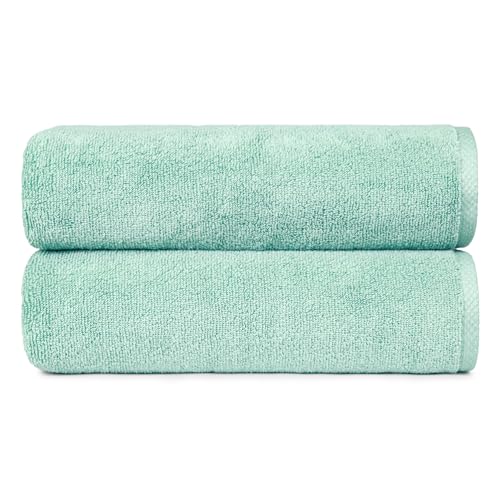
Amazon Basics Quick-Dry Bath Towels — Best Budget Quick-Dry
Sometimes freshness is an arithmetic problem, and this two-pack is the arithmetic answer. These are lightweight 100 percent cotton bath towels at a full 54 by 30 inches in seafoam green, sold as quick-dry and moisture-absorbing — and their freshness mechanism is the simplest in this guide: there is less towel. A light cotton towel holds less water, exposes what it holds across a thinner cloth, and returns to dry in a fraction of a plush towel’s time. In a steamy bathroom, that plain physical fact outperforms most marketed technologies.
The accessible tier is part of the strategy, not an apology for it. A household that can afford four or six of these can run the rotation that freshness actually requires — fresh towel every day or two, proper hot washes, no towel worked damp for a week because its replacement is still in the dryer. Odor problems are often rotation problems wearing a product problem’s clothes, and the cheapest complete solution in this guide is a stack of light, quick towels deep enough to rotate without anxiety.
The limits are the familiar ones of light cotton: the hand feel is working rather than luxurious, absorbency per pass is lower than plush terry (the towel compensates by drying you in two passes and itself in two hours), and longevity will be measured in solid years rather than in decades. For rentals, dorms, gym-adjacent bathrooms, and any household whose freshness reform starts this week on a budget, none of that outweighs the central virtue: these towels will be dry, and dry is fresh.
- Fabric: 100% cotton, lightweight
- Size listed: 54 x 30 in
- Format: 2 pack
- Color shown: Seafoam Green
- Character: quick-dry, moisture absorbing per maker
Strengths
- Lightweight build dries fast by simple physics
- Accessible tier lets a household buy rotation depth
- Full 54 by 30 inch size despite the light build
Trade-offs
- Working hand feel, not a luxury towel
- Lower absorbency per pass than plush terry
- Shorter service life than the premium picks
Best for: budget freshness reforms, rentals, dorms, and high-rotation households. Not suited for: buyers furnishing a spa bathroom for the long term.

Venture 4th Odor-Resistant Travel Towel — Best for Gym Bags
The worst towel environment in ordinary life is not a bathroom at all; it is a gym bag at 6 p.m. A damp towel, sealed in a warm bag with workout clothes, is an odor incubator with a zipper — and it is the environment this microfiber travel towel was built for. Venture 4th sells it as odor-resistant and quick-drying, with a tear-resistant carry bag included, and the combination addresses the gym-bag problem at both ends: the microfiber dries fast wherever it is finally hung, and the maker’s odor-resistant positioning speaks to the hours it spends waiting to be hung.
This guide files the odor resistance where it files every such feature — as a manufacturer claim about freshness, welcome as a secondary property. The primary properties need no claims at all: microfiber absorbs heavily for its weight (the maker quantifies it against cotton; the practical point is that it handles a full shower), wrings out nearly dry, and packs into its bag at a size that leaves the gym bag’s other contents alone. The red and white colorway is easy to spot in a dark bag and unlikely to be confused with anyone else’s towel at a shared facility.
Its theater extends past the gym: camping, swimming, and any routine where a towel travels damp-adjacent. The discipline still applies — hang it the moment you arrive home, wash it with the week’s workout clothes, and never let the carry bag become a sealed long-term home for a wet towel, because no claim on any listing survives that treatment. Used with that much sense, this is the pick that ends the gym-bag smell at its source.
- Fabric: microfiber
- Format: single towel with carry bag
- Color shown: Red/White
- Maker’s claim: odor-resistant; fast-drying
- Character: travel and gym duty
Strengths
- Built for the gym bag, the hardest freshness environment
- Quick-dry microfiber wrings out nearly dry after use
- Included carry bag isolates it from other gear
Trade-offs
- Odor resistance is a maker claim, not a guarantee
- Microfiber feel and technique differ from home terry
- Still fails if left sealed and damp for days
Best for: gym members, swimmers, campers, and commuters who shower away from home. Not suited for: anyone seeking a primary home bath towel with a plush hand.
Comparison Table
| Pick | Construction | Freshness mechanism | Format | Drying speed | Choose it if… |
|---|---|---|---|---|---|
| SUTERA Silverthread Waffle Bath Towel | Pima cotton waffle | Fast-drying grid; silver threads per maker | Single, 60 x 30 in | Fast | your bathroom is windowless and humid |
| Arm & Hammer Quick Dry Bath Towels | Quick-dry build | Drying speed plus rotation depth | 4 piece set | Fast | you want a freshness-first family set |
| Gilden Tree Waffle Bath Towels | Cotton waffle | Thin open grid, white reset washes | Set of 2 | Fastest cotton | you trust mechanism over marketing |
| American Cotton Quick Dry Bath Towels | Terry with airflow channels | Ventilated plush | 2 pack, 28 x 55 in | Moderate-fast | you refuse to give up terry |
| Amazon Basics Quick-Dry Bath Towels | Lightweight cotton | Less towel to dry; deep rotation | 2 pack, 54 x 30 in | Fast | budget and rotation are your strategy |
| Venture 4th Odor-Resistant Travel Towel | Microfiber | Fast dry; odor-resistant per maker | Single with bag | Fast | the gym bag is your problem |
Why Do Towels Develop That Sour Smell in the First Place?
A towel’s working life is a cycle of wet and dry, and the smell is produced in the wet part of the cycle when it runs too long. A used towel carries warm water, skin cells, soap residue, and the ordinary microbes of skin and bathroom air. Given hours of damp warmth — a thick towel bunched on a hook in a steamy room — that mixture ferments, in effect, and the sour, mildewy note is its exhaust. The towel is not dirty in the visible sense; it is simply a damp textile that stayed damp, which is why a towel can smell stale the day after a wash if the wash was cool, the load was crowded, and the towel never fully dried afterward.
Residue accelerates everything. Detergent used too generously does not rinse fully from dense cotton, and fabric softener coats fibers with a film; both leave the towel holding organic residue in a damp matrix, and both reduce absorbency so the towel carries more water into its hanging hours. This is the vicious circle of towel odor: the worse a towel smells, the more product its owner adds, and the more product, the worse it smells. Breaking that circle — correct dosing, no softener, full rinsing, complete drying — is the unglamorous core of this entire category.
Notice what this explanation does not require: exotic contamination or defective towels. The smell is the predictable output of moisture, time, and residue, which means it is preventable by managing moisture, time, and residue. Every section that follows is one of those three levers, pulled properly.
What Laundry Rhythm Actually Keeps Towels Fresh?
Wash bath towels every three to four uses as a household baseline, hand towels every two or three days, and any towel immediately when it has failed to dry fully for a day — a towel that stayed damp is a towel whose clock has run out regardless of use count. Wash warm to hot with a measured dose of detergent; more detergent than the load needs does not clean more, it rinses less, and the residue becomes next week’s smell. An extra rinse cycle is worth more than an extra scoop, every time.
Skip fabric softener and dryer sheets on towels permanently. Their coating is absorbency’s enemy and residue’s friend, and towels are the one laundry category where softness should come from fiber and weave rather than from chemistry. A cup of white vinegar in the rinse, used occasionally, helps clear accumulated residue and mineral stiffness without coating anything; it is a reset, not a routine, and its effect is on the towel’s cleanliness rather than on any living thing.
Dry completely — this clause is the rhythm’s downbeat and cannot be skipped. In the dryer, that means actually dry, not nearly; on the line or rail, it means hours of air after the surface feels done, because a thick towel’s core finishes last. A towel put away at 95 percent dry will scent the shelf it sleeps on. The households whose towels never smell are not doing anything exotic; they are doing these ordinary things without exceptions, which is precisely what makes the system work.
How Should You Rescue a Towel That Already Smells?
Before replacing a smelly towel, strip it. The rescue routine addresses the usual cause — accumulated detergent, softener, and mineral residue — rather than the towel itself. Wash the towels hot with no detergent at all, adding a cup of white vinegar to the cycle; then wash again hot with a modest amount of detergent, or with a half cup of baking soda, and dry completely. Many households find one such double cycle returns a towel they had written off, because what they were smelling was the residue’s fermentation, not the cotton’s failure.
Judge the rescue honestly after two attempts. A towel that comes back fresh and stays fresh under the corrected rhythm was a laundry problem, now solved. A towel whose smell returns within a use or two, despite hot washing and complete drying, is telling you its fibers are worn and holding residue beyond washing’s reach — that towel should be demoted to pet, car, or cleaning duty and replaced on the rail. Replacement is not defeat; it is the correct final step of a diagnostic process that begins with the wash.
While rescuing, audit the environment that produced the smell, or the new towel will inherit it. Check that the bathroom’s fan actually moves air, that towels hang with space between them, and that the washing machine itself is clean — a machine with a stale drum perfumes every load it washes, and more than one household has replaced a linen closet before discovering the culprit was the appliance.
How Do You Set Up a Humid Bathroom So Towels Can Dry?
Airflow is the whole assignment. Run the exhaust fan during the shower and for a good while after — the mirror clearing is your signal that the room’s moisture load has dropped — and where there is no fan, a cracked window or an open door after bathing does the same work more slowly. A towel cannot dry into saturated air; the room must be dried for the towel to dry in it, and households in humid climates sometimes add a small dehumidifier to the bathroom with transformative results for every textile in the room.
Hanging geometry comes second. A towel spread fully over a rail dries several times faster than the same towel folded over it, and a towel on a hook — bunched into folds with its core sealed — dries slowest of all. Give each bather’s towel its own rail space with air on both sides where possible, keep towels from overlapping like shingles, and in shared bathrooms consider a second rail or an over-door rack before blaming the towels. The heated rail, where a household has one, is the deluxe solution; the free solution is simply space and air.
Rotation completes the setup. A bathroom where each towel rests a full day between uses — which requires owning roughly two towels per bather — gives every towel the drying margin that odor cannot survive. Households that cannot add rails can add towels; households that cannot add towels can add a midweek wash. One of the three margins must exist, and the picks in this guide were chosen to work with whichever margin your home can offer.
What Mistakes Make Towels Smell Faster Than They Should?
Leaving a used towel in a heap — on the floor, in a closed hamper, in the gym bag — is the champion mistake, because it grants the smell its three ingredients at once: moisture, warmth, and unlimited time. The second is the crowded rail, where towels overlap and the inner surfaces never see air. The third is the lukewarm, overloaded wash with a generous pour of detergent and a softener chaser: a cycle that perfumes the towels for an hour and feeds their residue for a month.
Over-drying has a quieter cousin — under-drying, the towel folded and shelved while its core is still cool with moisture, scenting the whole stack by proximity. And there is the mistake of the single heroic towel: one bath towel per person, used daily, washed weekly, in a bathroom with no fan. No product survives that arithmetic, and households running it should fix the arithmetic — more towels, more washes, or more air — before shopping for a technological rescue.
The last mistake is misreading the evidence: treating a residue problem as a towel problem and replacing towels repeatedly, or treating a worn-out towel as a laundry problem and strip-washing it forever. The rescue section above exists to separate the two. Diagnose first, and both the laundry shelf and the linen closet will make more sense.
Where Do Silver Threads and Odor-Control Claims Fit, Honestly?
They fit at the margin, and the margin is real. Some towels in this category weave silver threads into the cotton, and their makers claim the construction helps the towel stay fresher between washes; other makers position quick-dry towels under odor-control branding. This guide’s position, held consistently, is that such claims describe a possible comfort benefit reported by the manufacturer — they are not verified by this guide, they make no health promise, and they never outrank the towel’s drying behavior, which is measurable in any bathroom with a clock.
Used correctly, a freshness claim is a tiebreaker between two towels that dry equally fast and feel equally good: if one carries a maker’s freshness technology and the other does not, choosing the claimed towel costs nothing and may gain something. Used incorrectly — as a reason to wash less often, dry less carefully, or forgive a thick towel in a wet bathroom — the claim becomes the most expensive sentence on the listing. The households that benefit from these towels are the ones whose systems were already sound and wanted the last few percent.
Readers who want the technology-first view of this category will find it in this site’s antimicrobial towels guide, which examines silver-thread construction as its main subject. This guide’s behavior-first view is the complement, not the contradiction: technology may assist a system, but the system — wash, rinse, dry, rotate, ventilate — is what a fresh towel is actually made of.
How Do Hand Towels and Washcloths Fit the Freshness System?
The bath towel gets the attention, but the hand towel lives the harder life: wetted twenty times a day, hung in the bathroom’s most humid corner, and washed on the bath towels’ schedule rather than its own. In many homes the first towel to smell is the one at the sink, and its odor is a rotation failure, not a product failure. Hand towels should cycle every two or three days — daily in a busy family bathroom — which means owning four to six per sink and treating them as a separate, faster laundry rhythm nested inside the household’s main one.
Washcloths run faster still. A cloth used on the face should be used once and washed, full stop; the households that keep a stack of inexpensive washcloths and a small laundry basket beside the sink never face the damp-cloth problem at all, because the cloth’s whole service life between washes is a single use. Both smaller textiles also dry faster than bath towels by simple size, so their freshness is the easiest in the bathroom to secure — it costs only the decision to own enough of them.
Coordinate the system by weave where you can. A household that moves its bath towels to waffle or quick-dry builds often finds the hand towels should follow, because a plush hand towel in a humid bathroom reintroduces exactly the damp-hour problem the bath towels escaped. The sink is not a separate country; the same air governs it, and the same physics applies at smaller scale.
What About Guest Rooms, Dorms, and Other Towels That Sit?
A towel that sits unused has its own freshness risk: folded in a closet it stays as fresh as the day it was shelved, but hung in a guest bathroom for a month of readiness, it slowly takes on the room’s ambient humidity and dust, and the first guest’s shower reactivates a faint staleness nobody intended. Hosts should hang guest towels shortly before guests arrive, or store them folded and place them fresh — a small choreography that separates bathrooms that feel prepared from bathrooms that merely look it.
Dorms and shared houses compress every problem in this guide: one rail, many bathers, a laundry room across the building, and towels that dry in rooms full of other people’s steam. The dorm answer is the rotation answer at its starkest — two or three lightweight, quick-drying towels per person, washed weekly without exception, and never a plush towel, because plush in a dorm is a towel that is damp from September to May. The Amazon Basics quick-dry pick and the Venture 4th exist in this guide largely for these addresses.
Short-term rentals face the host’s version: towels must be completely fresh at every changeover, which means full hot washes and complete drying between guests, with enough sets in reserve that no towel is ever rushed back to the rail still cool at its core. Operators who build that reserve once stop thinking about towel freshness entirely, which is the mark of a system that works.
How Does Climate Change the Freshness Calculation?
In arid climates, towel odor is a minor genre: air itself does the drying work, even a plush towel on a hook is dry by midday, and households can buy purely for feel. The freshness system still matters — residue and dosing are climate-independent — but the towel choice relaxes, and terry loyalists in dry regions should enjoy their plush without a twinge of guilt. The calendar’s damp seasons may tighten things briefly, and a household with one quick-dry set in reserve is prepared for them.
In humid climates, and in humid seasons everywhere, the calculation inverts: drying architecture becomes the first specification, ahead of softness, ahead of size, ahead of everything except basic absorbency. Waffle and light builds are not compromises in such places; they are the correct engineering, and the plush towel is the specialty item, reserved for the bathroom with the heated rail or the dehumidifier. Coastal homes, Gulf summers, Pacific Northwest winters, and tropical postings all teach the same lesson within a month of arrival.
Travelers meet the climate question in miniature: the towel that behaves in a dry home bathroom may sulk in a humid destination, which is one more reason the travel and gym picks in this guide dry as fast as fabrics allow. Read your own room’s air honestly — ideally on its worst August afternoon rather than its best April morning — and buy for the room you have at its dampest, not its driest.
How Should You Introduce a Freshness System to a Whole Household?
A freshness system fails when it lives in one person’s head, because towels are handled by everyone. The introduction that works is embarrassingly simple: a short household agreement, stated once, covering where towels hang (spread, not bunched), when they change (the rhythm from this guide), and what never goes in their wash (softener). Households with children can make the agreement physical — a rail per person, a hook with a name — because a towel with an owner dries better than a towel with a committee.
Sequence the reform over a fortnight rather than a weekend. Week one fixes hanging and rotation with the towels already owned; the strip-wash rescue resets them; week two replaces only the towels that failed the rescue, with the fast-drying picks their bathroom’s air demands. Reformed this way, the household learns the system on familiar textiles and buys replacements with evidence in hand, instead of hoping a delivery will reform the bathroom by itself.
Expect one relapse, usually at the busiest season, when laundry slips and a towel goes sour again. Treat it as the system’s fire drill: strip-wash, re-check the fan and the rail spacing, and carry on. A freshness system is not a purchase or a purge; it is a small household habit with a long memory, and its second year is easier than its first in every home that keeps it.
What Does a Fresh Towel Have to Do With the Rest of the Bathroom?
More than the linen closet suggests. A bathroom whose towels stay fresh is usually a bathroom whose other textiles behave too, because the same air and the same habits govern the bath mat, the shower curtain liner, and the hand towels at the sink. Households that fix towel odor often find the whole room’s background freshness improving, since the fixes — ventilation run longer, textiles dried completely, laundry dosed correctly — are room-wide interventions wearing a towel problem’s name.
The reverse is also diagnostic: if every textile in a bathroom trends stale, the room itself is the patient, and no towel purchase will cure it. Check the fan’s actual pull with a tissue at the grille, look for the slow leaks and standing water that feed a room’s humidity, and confirm the washing machine is not perfuming loads from a stale drum. Towels are the bathroom’s most sensitive instrument; when they report a problem persistently, they are usually reporting the room.
That is the final reason this guide insists on behavior before product. A fresh towel is not a thing you buy once; it is a condition a bathroom maintains, and the six picks above are simply the towels that cooperate best with the maintaining.
Final Recommendation
Start with the towel whose drying matches your bathroom’s honesty. For the windowless, humid room, the SUTERA’s waffle — with its maker’s silver-thread claim as a bonus — and the Gilden Tree’s classic white waffle are the strongest answers, one modern and one purist. Terry loyalists should take the American Cotton with its airflow channels and accept its slightly slower dry as the price of plush. Households reforming on a budget should buy depth in the Amazon Basics quick-dry towels and let rotation do the work, gym-goers should put the Venture 4th in the bag, and families who want a named freshness system can build around the Arm & Hammer set.
Then run the system the picks assume: measured detergent, no softener, hot enough water, complete drying, air between towels, and a strip-wash rescue before any towel is condemned — because the freshest linen closet in this category belongs not to the household that bought the cleverest towel, but to the one whose towels are never, ever left damp and forgotten.
If you take only one measurement from this guide, take this one: tonight, an hour after the last shower, touch the center of each hanging towel. The ones that are still cool and damp at the core are tomorrow’s smell, already scheduled. Move them apart, give them air, and let that small nightly check become the habit the whole system hangs on.
Frequently Asked Questions
Why does my towel smell fine out of the wash but sour when it gets wet?
That pattern points to residue. Detergent, softener, and mineral buildup sit dormant in dry fibers and release their stale note when warm water reactivates them during your shower. A hot strip-wash — vinegar cycle, then a detergent cycle, dried completely — usually clears it, and correcting detergent dosing keeps it from returning.
Do silver-thread towels really keep towels from smelling?
Their makers claim the silver threads help the towel stay fresher between washes, and this guide reports that as a manufacturer claim about comfort and freshness. What is certain is that the silver-thread pick here is also a fast-drying waffle, and drying speed is the proven half of its freshness. No towel, silver or otherwise, replaces washing and complete drying.
Does line drying outdoors help with freshness?
Yes, when the weather cooperates — moving air and sunlight are the oldest drying system there is, and a towel dried fully outdoors returns to the rail in the freshest condition laundry can produce. In humid or still weather the advantage disappears, and a towel left out in damp air can come in worse than it went out, so judge by the day rather than by the doctrine.
How often should bath towels be washed to prevent odor?
Every three to four uses is a sound baseline for bath towels in ordinary bathrooms, sooner in humid rooms or shared bathrooms, and immediately for any towel that failed to dry fully between uses. Hand towels work harder and should cycle every two or three days. The rhythm matters more than any single wash’s intensity.
Is waffle really better than terry for odor?
In a humid or poorly ventilated bathroom, yes — not because waffle is cleaner, but because it dries hours faster, and odor is manufactured during damp hours. In a bright, airy bathroom with heated rails, terry’s drying disadvantage shrinks and plush towels stay perfectly fresh. The room decides which weave is right.
Can I use bleach to fix a smelly towel?
Bleach belongs to the stain toolbox more than the odor toolbox. Most towel odor is residue and damp-time, which hot water, correct dosing, a vinegar reset, and complete drying address directly. Reserve bleach for white towels that need brightening, use it diluted and occasionally, and remember it spends cotton’s strength each time.
Do darker towels hide odor problems longer?
They hide the visual evidence — the greying that warns a household its rhythm is slipping — while the smell develops on the same schedule as any color. That is an argument for white or light towels in problem bathrooms: they report trouble early, in a form you can see at folding time, rather than letting it announce itself at face height during a shower.
When should a smelly towel simply be replaced?
After the rescue has honestly failed: two strip-wash attempts, correct laundry rhythm, complete drying — and the sour note still returns within a use or two. At that point the fibers are worn and holding what washing cannot reach. Demote the towel to pet or garage duty and put a fast-drying replacement on the rail.
Related Guides
For the technology-first companion to this guide, read Best Antimicrobial Towels, which examines freshness fibers as its main subject. The whole-bathroom overview in Best Bathroom Towels places these picks in the wider linen closet, while Best Absorbent Towels for Liquid Spills covers the utility end of absorbency. And for the bar-station towels that share a shelf with the hard-working textiles here, see Best Barber Towels.



[…] natural next stop is Best Bath Towels That Don’t Smell, since hard-worked towels face odor as well as marks. For the guest-room floor, Best Coral Fleece […]