What's inside
- Key Takeaways
- Quick Picks
- How Did We Choose These Six for Dusty Work?
- How Do the Six Compare Side by Side?
- What Does Negative Air Actually Do for a Renovation?
- How Should a Lived-In Renovation Be Run, Day by Day?
- What Mistakes Do Renovators Make With Air?
- Which Jobs Make the Worst Dust, and How Should Each Be Handled?
- How Do You Seal a Work Zone Without Turning the House Into a Sauna?
- What Protective Habits Belong Beside the Machine?
- How Should Filters Be Handled Mid-Project?
- What Happens to the Rest of the House While the Zone Is Defended?
- How Do You Clean the House When the Work Finally Ends?
- Should a Homeowner Buy a Scrubber or Hire One?
- How Does a Workshop Differ From a Jobsite in Its Air?
- What Should Be Checked on a Scrubber Listing Before Ordering?
- How Loud Is Too Loud on a Working Site?
- What Does the First Day With a Scrubber Teach a Household?
- How Should a Finished Renovation Be Handed Back to Its Owners?
- Where Should the Scrubber Stand Inside the Zone?
- What About Dust That Arrives From Outside the Project?
- How Do You Keep Morale Up in a House Under Dust Discipline?
- What Is the Cheapest Air Improvement on Any Site?
- Final Recommendation
- Frequently Asked Questions
- Related Guides
As an Amazon Associate I earn from qualifying purchases. This post may contain affiliate links at no extra cost to you.
cottageverdict.com is reader-supported. When you buy through links on our site, we may earn an affiliate commission.
Where to buy: all six machines in this guide are listed on Amazon, and each pick name in the Quick Picks table, each review heading and each comparison row links to that product’s own page, where you can check price on Amazon and confirm the airflow figure, the filter stages and the current configuration before ordering. The best air purifiers for construction dust are a different species from the quiet boxes in a bedroom guide, and this introduction will not pretend otherwise: most of them are air scrubbers, industrial machines built to be loud, heavy and effective on a working site.
Renovation dust is an invasion with a schedule. Demolition day fills a house with plaster and grit. Sanding hangs fine particles in the air for hours after the tool stops. Cutting boards, mixing compounds and sweeping up each restart the cloud, and the dust that escapes the work zone settles into every other room, every fabric and every vent in the building. Controlling it is a matter of capturing air at industrial rates while the work happens, and then, only afterwards, polishing the living spaces back to domestic standards.
The six picks divide into three honest classes. Four are true jobsite scrubbers: the VEVOR and CADPXS at 550 CFM, the BlueDri Air Shield 550 with its daisy-chain wiring, and the MOUNTO at a full 1,000 CFM on wheels. One, the WEN 3410, is a ceiling-mounted workshop filtration system for the garage or shop where dusty work happens every week rather than once a decade. One, the Levoit Core300-P, is a domestic machine included deliberately for the phase after the builders leave, when the house needs its fine dust gathered quietly at night.
Nothing in this guide makes health claims. Dust control on a site is about protecting the rest of the house, the finished work and everyone’s comfort, and about keeping a renovation liveable for the people still cooking and sleeping in it. Figures are taken from the listings themselves, and anything a listing omits is recorded as the listing leaves unstated.
One expectation should be set in concrete: a scrubber running at full effort is not a background appliance. It is a fan in a steel or moulded case moving hundreds of cubic feet a minute, and it sounds like one. The trade is deliberate. Sites accept noise during working hours in exchange for air that is visibly clearer by lunch, and this guide judges each machine inside that bargain rather than apologising for it.
Key Takeaways
- Air scrubbers are the real tool for active work; domestic purifiers belong to the weeks after the dust settles.
- Three-stage filtration, a coarse first filter, carbon and an H13 HEPA final stage, is the pattern the VEVOR and CADPXS both follow.
- Negative air, exhausting filtered air out of the work zone, keeps dust from migrating into clean rooms.
- The MOUNTO’s stated 1,000 CFM and wheeled format suit whole-house renovations and restoration work.
- The WEN 3410 serves the permanent workshop, hanging from the ceiling and filtering on a remote’s command.
- The Levoit Core300-P earns its place for quiet nights in a finished room once the heavy work is done.
Quick Picks
| Pick | Badge | Why it earns its place |
|---|---|---|
| VEVOR Air Scrubber 550 CFM | Best All-Round Jobsite Scrubber | Three stages from MERV10 through carbon to H13 HEPA, in a stackable negative air machine. |
| CADPXS Shield-550 Air Scrubber | Best for Restoration Work | A 550 CFM stackable scrubber framed for water damage restoration and commercial cleanup. |
| BlueDri Air Shield 550 | Best for Daisy-Chained Setups | Covers a stated 1,400 square feet and can link power with sister units on larger jobs. |
| WEN 3410 Air Filtration System | Best for the Permanent Workshop | Ceiling-mounted filtration at 300, 350 or 400 CFM, run by remote while you work below. |
| MOUNTO 1000 CFM Air Scrubber | Best for Whole-House Projects | A 1-horsepower motor, true HEPA filtration, two speeds and wheels, with a three-year warranty stated. |
| Levoit Air Purifier for Home Pets | Best After the Builders Leave | A quiet domestic HEPA machine, AHAM VERIFIDE, for finished rooms up to a stated 1,073 square feet. |
How Did We Choose These Six for Dusty Work?
Airflow came first, measured in the industry’s own currency of cubic feet per minute. A scrubber’s job is to turn over the work zone’s air repeatedly while dust is being made, and the listings here state their CFM plainly, which made honest comparison possible. Filtration staging came second: a coarse first stage to catch the heavy fraction cheaply, and a HEPA final stage for the fine remainder, because a single expensive filter asked to eat demolition dust whole will choke on the coarse share within days.
Site manners came third. Stackable cases, handles, wheels and daisy-chain power all sound like brochure details until a machine must be carried up two flights, parked in a doorway’s negative-air position or run in a series down a corridor. The scrubber that fits the site’s logistics gets used from the first morning; the awkward one gets left in the van by the second week.
The two non-scrubbers were chosen for the phases scrubbers cannot serve. A workshop generates dust weekly for decades and deserves a fixed, ceiling-level answer rather than a borrowed jobsite box. A finished home, once the work ends, needs quiet and finesse rather than CFM. Including both is this guide’s way of refusing to sell one machine as the answer to every dusty question.

VEVOR Air Scrubber 550 CFM — Best All-Round Jobsite Scrubber
The VEVOR states the classic scrubber recipe without embroidery: 550 CFM of air movement, three filtration stages named as MERV10, carbon and H13 HEPA, a stackable case, and a design intended to run as a negative air machine, exhausting cleaned air so the work zone sits at lower pressure than the rooms around it. Its listing addresses home, industrial and commercial use together, which in practice means the serious renovator as much as the small contractor.
The staging is the substance. Demolition and sanding produce a blizzard of coarse particles that would blind a fine filter in a day; the MERV10 first stage exists to be sacrificed to that blizzard cheaply, while the HEPA stage at the end handles the fine fraction that hangs in the air and travels farthest. The carbon stage between them addresses the smells of a site, the adhesives, paints and damp plaster that make a renovation’s air as unpleasant as its dust.
Stackability sounds minor until two units must share a hallway or a van. Cases that pile securely let a small crew scale a job by adding machines in a column or a row, and a homeowner mid-renovation can store the unit in a corner footprint when the weekend’s work pauses. Negative air ducting, run from the machine to a window, is where this design earns its renovation reputation: dust made inside the zone is drawn toward the scrubber rather than drifting under the door into the clean half of the house.
Be clear about what ownership feels like. This is a working fan in a jobsite case, audible across a house at full effort, and its filters are consumables on a site’s schedule, not a calendar’s. Buy it because a renovation is coming or a property habit demands it, run it hard while dust is being made, and it will repay you in rooms that never needed dusting twice.
- Airflow stated in the listing: 550 CFM
- Stages named: MERV10, carbon, H13 HEPA
- Format: stackable negative air machine
- Uses named: home, industrial and commercial
- Noise figure: not stated in the listing
Strengths
- Textbook three-stage path protects the expensive final filter.
- Negative air duty defends the clean rooms of a lived-in renovation.
- Stackable case scales and stores gracefully.
Trade-offs
- Jobsite noise rules it out as a living-room appliance.
- Filters are working consumables during dusty phases.
- Its talents are wasted on a finished, quiet home.
Best for: lived-in renovations with a defined work zone and a door to defend. Not suited for: bedrooms, nurseries or anyone expecting domestic manners.

CADPXS Shield-550 Air Scrubber — Best for Restoration Work
The Shield-550 arrives wearing its trade openly: a 550 CFM scrubber with three-stage filtration, a stackable negative air design, and a listing that names water damage restoration equipment among its purposes, in blue. Restoration is construction’s tidier cousin, the work of drying, cleaning and clearing after leaks and floods, and it generates the same demand for controlled air in a house that is often still occupied and always still furnished.
That occupancy changes how a scrubber is judged. On a restoration job the machine runs for days in a home whose owners are sleeping down the hall, so reliability across long, unattended shifts matters as much as peak airflow. A stackable case lets the restorer park the unit neatly in the affected room’s corner, duct its exhaust out, and let negative pressure keep the disturbed air from visiting the clean bedrooms.
For the homeowner, this is the pick that speaks the language of the insurance-era project: the kitchen ceiling that came down after a pipe failed, the bathroom rebuilt after a slow leak, the floor replaced after a flood. Such jobs are dusty in bursts and damp in character, and a scrubber framed for restoration understands the assignment without translation.
The listing does not break its three stages down by name in the way the VEVOR does, nor does it print a noise figure, so buyers comparing stage by stage should interrogate the listing’s current details before ordering. What it states, it states plainly: airflow, staging, format and purpose, which is the vocabulary this class of machine is honestly bought in.
- Airflow stated in the listing: 550 CFM
- Filtration described as: 3-stage, HEPA scrubber
- Format: stackable negative air machine
- Purpose named: water damage restoration equipment, commercial use
- Finish named: blue
- Stage breakdown by name: not stated in the listing
Strengths
- Restoration framing suits occupied-home repair projects.
- Negative air format contains disturbed, dusty zones.
- Stackable case stores and transports like trade equipment.
Trade-offs
- Stage composition needs confirming on the listing.
- Commercial character means commercial noise.
- Overbuilt for a single weekend of sanding.
Best for: post-leak and post-flood rebuilds in homes still being lived in. Not suited for: light cosmetic work or quiet-room duty.

BlueDri Air Shield 550 — Best for Daisy-Chained Setups
BlueDri’s Air Shield 550, model BD-AS-550 in blue, is a HEPA scrubber from the water damage restoration world, stated to cover 1,400 square feet and described as daisy chain capable, for commercial use. That last phrase is its distinguishing talent: units can be linked so several machines run in a series from a shared power arrangement, which is how professionals air out long corridors, multi-room jobs and the sprawling floor plans of a whole-house project.
A homeowner might reasonably ask why chaining matters to them. The answer arrives in the second week of a big renovation, when one scrubber defends the kitchen zone admirably while dust from the bathroom refit migrates down the hall untouched. Two linked units placed along the dust’s route govern the whole territory without a spider’s web of extension leads, and a single switch’s discipline governs both.
The stated coverage, 1,400 square feet, should be read in the trade’s spirit: a volume of work space under active management, not a promise that one box perfumes a furnished house of that size. Within a stripped, sealed work zone, it is a meaningful planning figure; across a lived-in home’s closed doors, no scrubber’s number survives contact with architecture.
BlueDri’s restoration pedigree also implies a certain indifference to cosmetics. This is equipment designed to be knocked, stacked, hosed down in spirit and sent to the next job, and a homeowner buying it is buying into that ethic: performance and logistics first, living-room elegance nowhere on the list.
- Model named: BD-AS-550, blue
- Coverage stated in the listing: 1,400 sq. ft.
- Power feature named: daisy chain capable
- Filtration: HEPA air scrubber
- Purpose named: water damage restoration, commercial use
- Airflow in CFM: not stated in the listing
Strengths
- Daisy chaining scales cleanly across multi-room jobs.
- Restoration trade design shrugs off site conditions.
- Stated coverage helps plan a work zone’s layout.
Trade-offs
- CFM is not printed in the listing for direct comparison.
- Commercial build has no domestic quiet mode.
- One unit alone cannot govern a divided house.
Best for: multi-room renovations and restoration projects run in phases. Not suited for: a single small room, or finished living spaces.
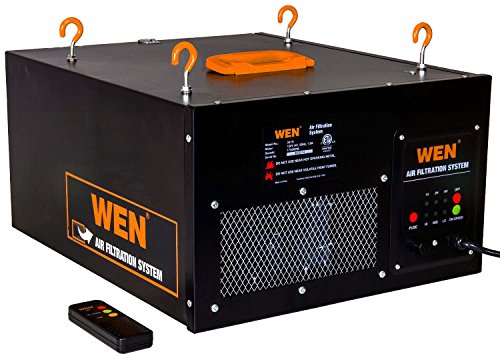
WEN 3410 Air Filtration System — Best for the Permanent Workshop
The WEN changes the scene from the temporary site to the permanent shop. It is a ceiling-mounted air filtration system with three speeds stated at 300, 350 and 400 CFM, controlled by a remote, in black, designed to hang above a workshop and quietly process the air of a space where wood is cut, sanded and finished every week of the year. Where a scrubber visits a house for a project, the WEN takes up residence in the building where dust is a way of life.
Ceiling mounting is its central insight. Warm, dust-laden air in a shop rises and circulates at height, and a filter living up there intercepts the cloud without occupying the floor, the bench or the walkway where boards are carried. The remote completes the logic: the woodworker starts it with the saw, raises it during sanding and lets it run on after leaving, clearing the shop’s air before the next session without climbing or reaching.
Its numbers are modest beside the scrubbers, deliberately. A shop needs steady turnover across hours rather than a violent purge, and 400 CFM at its top speed, applied continuously in a single room, is a different and appropriate arithmetic. Judged as a scrubber it would look underpowered; judged as a shop’s permanent lung, its sizing is the point.
Homeowners mid-renovation should note what it is not: it is not portable, not a negative air machine and not the tool for demolition week. Its moment in a renovation story is afterwards, in the garage workshop where the project’s shelves, cabinets and repairs will be made for years, long after the scrubbers have gone back to the hire shop.
- Mounting: ceiling, fixed installation
- Speeds stated: 300, 350 and 400 CFM
- Control: remote, described as RF remote
- Finish named: black
- Negative air duty: not part of its design
Strengths
- Permanent placement means the shop is always protected.
- Remote control fits the rhythm of working with tools.
- Frees floor and bench space entirely.
Trade-offs
- Fixed mounting makes it useless for roaming site work.
- Airflow is modest beside true scrubbers.
- Installation takes a ladder, fixings and an afternoon.
Best for: garage and basement workshops with weekly woodworking. Not suited for: one-off renovations or rented spaces.

MOUNTO 1000 CFM Air Scrubber — Best for Whole-House Projects
When the project is the whole house, the MOUNTO is the scale of answer the job describes: a portable industrial scrubber and negative air machine with a stated 1,000 CFM, a one-horsepower motor, true HEPA filtration, two speeds, a handle and wheels, and a three-year warranty printed in its listing. Nearly double the airflow of the 550-class machines, it is built to govern large, open work zones: the gutted ground floor, the barn conversion, the fire-or-flood restoration where rooms have temporarily become one continuous site.
Wheels and a handle matter more at this size than any brochure admits. A machine of this capability is a substantial object, and a project moves through a house in phases; being able to roll the scrubber from the kitchen’s demolition to the bathroom’s refit, by one person, between breakfast and the first cut, is the difference between a tool that follows the work and a tool that guards wherever it was first abandoned.
Two speeds give the big machine a working diplomacy. Full effort belongs to the dusty hours; the lower setting can hold a zone’s negative pressure through a lunch break or a drying afternoon without the full voice. The stated warranty deserves a nod in a category where equipment is expected to suffer: three years of backing suggests a maker prepared for the machine to be used as intended.
Everything about it is industrial, including the sound and the appetite for filters during heavy phases. It is not a machine to run beside a crib or a desk, and this guide lists it with respect precisely because it does not pretend to be. For the largest domestic projects, though, renting time and again costs more than owning the right hammer once, and this is the right hammer.
- Airflow stated in the listing: 1,000 CFM
- Motor stated: 1 HP
- Filtration stated: true HEPA filter
- Speeds stated: 2
- Mobility: handle and wheels
- Warranty stated: 3 years
Strengths
- Airflow for whole-floor, open work zones.
- Wheeled portability keeps it following the work.
- Three-year warranty backs a hard-used machine.
Trade-offs
- Size, weight and noise are unapologetically industrial.
- Heavy phases will consume filters at a trade pace.
- Absurd overcapacity for a single-room refit.
Best for: whole-house renovations, conversions and major restorations. Not suited for: small jobs, occupied quiet rooms or tight budgets of space.

Levoit Air Purifier for Home Pets — Best After the Builders Leave
The Levoit Core300-P enters this guide at the moment the scrubbers leave. It is a domestic HEPA machine for rooms up to a stated 1,073 square feet, AHAM VERIFIDE, with a quiet sleep mode, in white, whose listing speaks of dust, pollen, smoke and pet odor in a bedroom’s vocabulary. Its construction brief is the fine residue that outlives the project: the pale film that keeps appearing on shelves for a fortnight after the last board is cut, resuspended by ordinary life from carpets, vents and soft furnishings.
That residue phase is real and frequently misjudged. The heavy cleaning after a renovation removes the visible dust, yet the finest share has travelled everywhere the site’s air travelled, and it returns to the air a little at a time whenever a cushion is sat on or a rug is crossed. A quiet machine running in the main bedroom and the living room across those weeks gathers the return steadily, at hours and volumes no scrubber’s voice would be tolerated for.
The listing’s own figure for particle removal, printed as removing 99.97 percent of the dust and companions it names, belongs to its filter’s laboratory framing, and this guide repeats it only as the maker’s statement. The practical claim a buyer should hold is simpler: a verified domestic machine, sized honestly for one room, running nightly, will visibly shorten the fortnight of film on the furniture.
Do not reverse the order. Asked to face active demolition, this machine would choke its filter in days and forgive nothing. Its inclusion here is a sequencing argument: scrubbers for the making of dust, this for the long, quiet aftermath, and a household that respects the sequence will find the renovation’s air story ends weeks earlier than the household that buys either tool alone.
- Coverage stated in the listing: up to 1,073 ft²
- Verification named: AHAM VERIFIDE
- Mode named: quiet HEPA sleep mode
- Model named: Core300-P, white
- Maker’s removal figure: printed in the listing as 99.97%
- Airflow in CFM: not stated in the listing
Strengths
- Quiet night running suits the aftermath phase perfectly.
- Verified domestic design sized honestly per room.
- Gathers the fine residue scrubbers leave behind.
Trade-offs
- Must never be asked to face active site dust.
- One-room territory in a house that may need two.
- Its filter is a domestic consumable, not a trade part.
Best for: bedrooms and living rooms in the weeks after work finishes. Not suited for: any room where tools are still running.
How Do the Six Compare Side by Side?
| Pick | Class | Stated airflow | Where it works |
|---|---|---|---|
| VEVOR Air Scrubber 550 CFM | Jobsite scrubber | 550 CFM | Sealed work zones, negative air |
| CADPXS Shield-550 Air Scrubber | Jobsite scrubber | 550 CFM | Restoration in occupied homes |
| BlueDri Air Shield 550 | Jobsite scrubber | Not stated in the listing | Multi-room, daisy-chained layouts |
| WEN 3410 Air Filtration System | Workshop system | 300 to 400 CFM | Ceiling of a permanent shop |
| MOUNTO 1000 CFM Air Scrubber | Industrial scrubber | 1,000 CFM | Whole-floor open work zones |
| Levoit Air Purifier for Home Pets | Domestic purifier | Not stated in the listing | Finished rooms, overnight |
What Does Negative Air Actually Do for a Renovation?
It reverses the direction of betrayal. Without it, a work zone’s air leaks outward under doors and through gaps, carrying dust into rooms nobody is renovating. A scrubber ducted to the outside exhausts more air than the zone receives, so the leakage runs inward: clean house air seeps toward the work, and the dust’s escape route closes. The plastic sheeting over the doorway stops being a decoration and becomes part of a system.
Setting it up is a craft of small seals. The exhaust duct needs a window or opening it can leave by without gaps, the zone’s other openings need taping or covering, and the machine should run whenever dust is being made and for a while after each session ends. Households that seal carelessly and run a powerful scrubber have bought a pump for a leaking boat; the principle is sound, the preparation decides.
How Should a Lived-In Renovation Be Run, Day by Day?
Start the scrubber before the first tool, because the earliest dust of the day is made by people who have not yet thought about air. Keep the work zone’s door policy strict enough to be boring. At the day’s end, let the machine run on while the site is swept gently, since sweeping re-raises exactly what the day produced, and only then switch down or off. Filters deserve a glance at the week’s end, when the coarse stage will confess how the days actually went.
The clean half of the house has its own small duties: shoes changed at the border, work clothes shaken outside rather than in the hall, and a damp cloth over surfaces near the zone each evening. None of this is heroic. All of it together is the difference between a renovation the household lives alongside and one it flees.
What Mistakes Do Renovators Make With Air?
The first is buying a domestic purifier for demolition week and concluding that air cleaning is a fraud when its filter dies by Friday. The second is running a scrubber in an unsealed zone and wondering why the nursery is dusty. The third is forgetting the coarse filter until the expensive HEPA stage is wearing the whole job. The fourth is switching everything off the day the builders leave, abandoning the residue phase just as it begins.
A fifth, quieter mistake is dry sweeping a finished site at full energy, launching a week’s settled dust back into the air in an afternoon. Damp methods, patience and the domestic machine running in the next room close a project more cleanly than any amount of vigorous broom work.
Which Jobs Make the Worst Dust, and How Should Each Be Handled?
Plaster and drywall work is the great producer. Sanding joint compound releases a fine, pale dust that floats for hours, coats everything with a matte film and finds its way through gaps nobody believed existed. This is the scrubber’s defining exam: sealed zone, negative air running before the sander starts, and no eating in the clean rooms in work clothes. Households that survive a drywall phase with their sanity intact all describe the same discipline, and it never begins on the second day.
Demolition is coarser but more various. Its dust carries the house’s history, plaster, soot, old paint layers and decades of attic sediment, and its volume can overwhelm a filter’s first stage in a single morning. Work in shorter bursts, empty and check the coarse stage between them, and treat the day’s end clean as part of the demolition rather than as an afterthought to it.
Floor sanding and concrete cutting sit at the extremes. Wood floor dust is fine, abundant and surprisingly mobile on the slightest draught, while concrete and tile work produces a gritty, heavy fallout that settles fast but grinds into every surface it lands on. The first demands air discipline; the second demands surface discipline, covering, sealing and damp wiping, with the scrubber governing whatever each job throws into suspension between times.
How Do You Seal a Work Zone Without Turning the House Into a Sauna?
Plastic sheeting, a zippered doorway and tape are the classic materials, and their effectiveness depends entirely on the boring details: the sheet sealed to the ceiling and floor rather than draped, the zip placed where traffic actually flows, and the gaps around pipes and vents hunted down one by one. A zone sealed at ninety percent behaves, under negative pressure, almost like a sealed one; a zone sealed at fifty percent is a suggestion the dust politely ignores.
Heat and airlessness are the honest costs, and they are managed by scheduling rather than by surrender. The heaviest work can be timed for the cooler hours, the exhaust duct doubles as the zone’s ventilation, and breaks happen in the clean air on the other side of the zip. Crews and households that plan the comfort question in advance keep their seals intact; those that improvise at noon on a hot day tear a corner open by two o’clock and spend the evening dusting the nursery.
What Protective Habits Belong Beside the Machine?
The machine governs the room; the household must still govern itself. Dust masks appropriate to the work, eye protection during demolition and gloves for the handling of old materials are the site’s ordinary uniform, and this guide mentions them as housekeeping rather than as any kind of medical counsel. Work clothes that live in the zone, shoes that change at the border and hands washed before food are the customs that keep the clean rooms clean in the ways air cannot.
Children and animals deserve a plain rule: the zone is not a place to visit, however fascinating the machinery, and the clean half of the house is where they conduct the renovation as spectators. Most households find that a scrubber’s steady noise usefully marks the border for everyone, a sound that means the dusty country begins here.
How Should Filters Be Handled Mid-Project?
A loaded coarse filter should be treated as a small bag of the site itself: removed gently, outdoors where possible, bagged before it travels through the clean rooms, and replaced without shaking it back into the air it just cleaned. The HEPA stage deserves a visual inspection whenever the coarse stage is changed, because its condition is the audit of whether the sacrificial layer is being changed often enough.
Spares belong on site from the first day. A project that must pause while a filter is ordered is a project whose crew will work unprotected rather than idle, and the scrubber will sit silent during exactly the dusty hours it was bought for. One spare coarse stage per machine, minimum, is the cheapest insurance in the whole renovation budget.
What Happens to the Rest of the House While the Zone Is Defended?
Life continues, which is the point, yet it continues with a border. Cooking migrates away from the dusty end, laundry avoids the line strung anywhere near the zone, and the household learns the small geography of clean routes between bedroom, bathroom and kitchen. A scrubber holding negative pressure makes that geography stable; without it, the border moves daily and the whole house slowly becomes the site’s annex.
Heating and cooling systems need a decision. A ducted system that draws air from the work zone will distribute dust with professional efficiency to every room it serves, so vents in the zone should be sealed for the duration and the system’s intake kept on the clean side of the house. Discovering this on the third day, by the evidence of dusty registers in the bedrooms, is the renovation story nobody wants to tell twice.
How Do You Clean the House When the Work Finally Ends?
From the top down and from the zone outward, with damp cloths rather than dry dusters, because dry dusting is merely dust relocation with better publicity. Ceilings and high shelves first, walls and woodwork next, floors last and twice, with a pause between passes for the air to surrender what the first pass raised. The domestic machine should run in each room as it is finished, like a clerk stamping the paperwork of a room returned to civilian life.
Soft furnishings get their own amnesty process: curtains washed or vacuumed with an upholstery tool, cushions beaten outdoors, rugs cleaned properly rather than shaken at the door. Only when the textiles have been processed does the film stop returning to the shelves, because the textiles were its reservoir all along.
Should a Homeowner Buy a Scrubber or Hire One?
Hire for the single, defined project with a contractor’s timetable; buy when the property habit is real. Owners who renovate in phases across years, maintain rental properties, or run a workshop’s worth of projects will recover a purchase price in hire fees forgone, and they will own the machine on the unscheduled day, the burst pipe’s aftermath, when hire shops are closed and the dust is not waiting.
The middle path deserves mention: buy the domestic machine for the aftermath, which every project shares, and hire the scrubber for the dusty weeks, which vary. That division puts the permanent money into the appliance the household will use for years and rents the industrial muscle only for the days it is genuinely needed.
How Does a Workshop Differ From a Jobsite in Its Air?
A jobsite is an emergency with an end date; a workshop is a climate. The shop’s dust arrives in smaller daily quantities across decades, generated by tools whose positions are fixed and habits whose rhythms are known. That is why the WEN’s ceiling perch and remote make sense there and nowhere else in this guide: the shop can be plumbed for air the way it is plumbed for light, permanently, above the benches where the dust is born.
Shop owners should still respect the coarse fraction. A ceiling system polishes the air of a working shop; it does not collect the pile beneath the saw, and the broom, the extractor at the tool and the bin remain the first line. The WEN’s gift is the fine remainder, the haze that used to settle on every shelf and project by morning, reduced to a memory in a shop that runs it faithfully after each session.
What Should Be Checked on a Scrubber Listing Before Ordering?
Confirm the airflow in CFM and whether the figure describes the machine’s top speed. Confirm the stages by name where the listing offers them, and price the replacement filters before the machine, because the consumables are the true cost of a dusty season. Check the case’s manners: stackable, wheeled, handled, daisy-chainable, in the order your site’s logistics demand. Finally, plan the exhaust route from the zone to the outside before the machine arrives, since a scrubber without a duct path is a very powerful fan for redistributing dust indoors.
How Loud Is Too Loud on a Working Site?
The honest answer is comparative. A scrubber at full effort competes with the tools themselves, and during cutting, sanding and demolition its voice is one instrument in an orchestra nobody calls quiet. Its noise becomes a problem in the pauses, at lunch, during measuring and marking, and in the evening tail when the household returns to the clean rooms. Machines with a lower gear, like the two-speed MOUNTO, earn gratitude in those hours, and every crew develops the habit of stepping the scrubber down when the tools rest and up before they start again.
Neighbours deserve a sentence in this arithmetic. A scrubber exhausting through a window toward a neighbouring house, run at full voice from dawn, will generate the kind of diplomacy no renovation needs. Site hours, a thoughtfully aimed exhaust and a word over the fence before the dusty phase begins are cheaper than any specification in this guide.
What Does the First Day With a Scrubber Teach a Household?
Mostly, how much dust a familiar job makes. A machine started before the first cut, in a sealed zone, will show a fine pale load in its coarse stage by evening that would otherwise be distributed, invisibly, across the whole house’s future. Owners consistently describe the same conversion: air control stops being a luxury line in the budget and becomes, like the skip and the scaffolding, part of what a proper job simply includes.
The second lesson is humility about sealing. Dust appears in one clean room through one forgotten gap, a vent left open, a cupboard that connects two spaces through the wall, and the household learns to hunt leaks the way sailors do, by evidence and without embarrassment. Each found gap improves the system more than any upgrade in machinery could.
How Should a Finished Renovation Be Handed Back to Its Owners?
With the air story told honestly: which rooms were zones, which were defended, what was cleaned and in what order, and what the next fortnight will still bring down from the textiles and vents. Owners who expect the residue phase forgive it; owners ambushed by a pale film on the piano conclude the clean was a fraud. The domestic machine, running in the main rooms from the first evening, is both a practical tool and a visible promise that the aftermath is being managed rather than denied.
Then the scrubber leaves, the plastic comes down, and the house performs its oldest trick: within a month, nobody remembers the dust at all, which is the whole purpose of every machine and habit described in this guide.
Where Should the Scrubber Stand Inside the Zone?
Near the dust’s birthplace but never inside the worker’s swing, with its exhaust duct taking the shortest honest route outside and its intake facing the room rather than a wall. In a long zone, the machine belongs toward the exhaust end, drawing the room’s air along the work’s length so fresh leakage air sweeps past the tools toward the filter. In a small room, a corner angled into the space beats a flat placement against the wall, because a scrubber breathing its own freshly cleaned output in a tight loop governs a puddle instead of a room.
Cords and ducts are trip hazards with consequences, so route them along walls and tape the crossings. A scrubber knocked silent by a kicked plug during the sanding hour is worse than a smaller machine that stayed running, and the site’s tidiness, as always, turns out to be an air quality measure in disguise.
What About Dust That Arrives From Outside the Project?
Not every dusty house is renovating. Rural roads, nearby building work, a neighbour’s demolition and dry, windy seasons all import a fine load through the same gaps the household’s own dust uses in reverse. The domestic end of this guide serves those homes: a verified machine in the main room, windows managed on the worst days, and mats and shoe discipline at the door. The scrubbers, though, should stay in their parish; importing industrial noise to fight a seasonal nuisance is a cure whose side effects outlast the disease.
How Do You Keep Morale Up in a House Under Dust Discipline?
Small rituals carry a household through a long project. One room kept ceremonially clean, with a door that closes and a kettle that lives there, gives everyone a country to retreat to. A Friday pause in which the zone is swept, the filters checked and the clean rooms wiped down converts an endless siege into a series of held positions. The scrubber’s steady voice, oddly, becomes part of the comfort: it is the sound of the border being held while dinner happens on the other side of it.
And keep the end in view, literally if possible, with one finished corner, one painted wall, one room returned early. Renovations fail emotionally more often than technically, and air discipline, which can feel like pure burden, reveals its purpose the first evening the household eats in a clean room while dust storms politely elsewhere.
What Is the Cheapest Air Improvement on Any Site?
Time, applied at the right moment. Ten minutes of scrubber running before the first cut clears the overnight accumulation so the day starts from clean rather than from yesterday’s leavings. Ten minutes after the last tool, while the crew tidies, gathers the day’s final suspension before it can settle into the building’s fabrics. Neither interval costs a filter or a decibel of goodwill, and households that adopt the two tens consistently report the clean rooms staying cleaner than the machinery alone ever promised. Discipline, on a dusty site, is a specification like any other, and it is the only one that arrives free.
Final Recommendation
Sequence the purchase by the phase you are in. Facing a lived-in renovation with a defined zone, start with the VEVOR Air Scrubber 550 CFM and seal the border properly. Governing a whole gutted floor calls for the MOUNTO 1000 CFM Air Scrubber and its wheels. When the tools fall silent, hand the house to the Levoit Air Purifier for Home Pets for the quiet weeks of residue.
Respect the order of operations, coarse air with coarse machines and fine air with fine ones, and the dust of even an ambitious renovation can be kept where it was made, which is all any household has ever honestly asked of it.
One final proportion is worth stating before the questions. Construction dust feels like a failure of tidiness, yet it is really a by-product of improvement, the visible evidence that a house is being made better at some cost to its present comfort. The machines and habits in this guide exist to keep that cost from being paid by every room in the building, so the project can be remembered for its result rather than for the month the whole house wore a grey film.
Keep the project’s filter receipts and change dates in the same folder as the contracts and paint colours, because the next phase, the next room and the next year will all ask the same questions, and the household that can answer them from paper starts every job a week ahead of the household relying on memory.
None of this asks for perfection, only for the same few acts performed in the same order on every dusty day, until the order becomes the crew’s and the household’s shared habit.
Frequently Asked Questions
Can I just use a normal purifier during the renovation?
In the work zone, no; its filter will load with coarse dust at a ruinous pace and its airflow was never sized for a room being actively filled. In the clean rooms, a domestic machine is a reasonable rear guard, provided the zone itself is sealed and, ideally, under a scrubber’s negative pressure.
How often will scrubber filters need changing on a real job?
The coarse stage may need attention within days during demolition and weekly during lighter phases, while the HEPA stage should last far longer if the coarse stage is kept honest. Treat the first filter as a fuse: cheap, sacrificial and inspected often, because its whole purpose is to die instead of the expensive one.
Is a scrubber too loud to run in an occupied house?
It is loud in the work zone during working hours, which is the bargain the category makes. Occupied rooms on the other side of a sealed door hear it as a muffled industry rather than a presence, and most households adapt within a day, especially once they see the clean rooms staying clean.
What size scrubber does a single-room refit need?
The 550 CFM class in this guide is the sensible scale for a room or a small zone, run with the door sealed and the exhaust ducted out. The 1,000 CFM machine earns its size when several rooms are open to each other as one continuous site.
When can the domestic machine take over?
Once no more dust is being made: tools down, surfaces wiped, floors cleaned with damp methods. From that evening the quiet machine’s steady night work gathers the travelling residue, and the household can judge its progress by how quickly the film on shelves stops returning.
Can a scrubber run overnight in an empty house?
Restoration crews do run machines across long unattended stretches, and the trade’s habit is instructive: filters checked before the shift, ducts secured, the zone sealed and nothing combustible leaning where it should not. A homeowner copying the practice should copy the whole discipline rather than the single act, and should favour the machine’s steadier gear over its maximum voice for hours when nobody is present to notice a change.
Do I need to cover furniture in the clean rooms too?
If the zone is sealed and holding negative pressure, clean-room furniture can live uncovered, which is rather the point of the system. During the first day, before the seals have proved themselves, a sheet over the best sofa near the border is cheap prudence; once a day of evidence shows the border holding, the household can relax into its own system and stop furnishing the whole house in dust sheets.
What should happen to the scrubber when the project ends?
Clean it like a tool being put away properly: filters inspected and replaced if spent, case wiped inside and out, cord and duct stored with it rather than in a separate mystery. A scrubber stored dirty starts its next job by redistributing the last one’s dust, while a scrubber stored ready can be carried into an emergency, a burst pipe on a Sunday, and be working within the hour, which is often the moment that justifies having bought it at all.
Is one scrubber per floor a rule?
Only where each floor is its own sealed zone with its own dusty work. A single zone that happens to span a stairwell can be governed from its base if the exhaust path and the seals are arranged with care, while two separate projects on two floors are two territories and deserve two machines or one machine moved carefully between phases as work proceeds across the whole project.
Related Guides
For the neighbouring heavy-air problem in this batch, read Best Air Purifiers for Wildfire Smoke, then Best Water Coolers Without Plastic Taste for the crew’s hydration station, and Best Outdoor Kitchen Faucets for the utility water point every dusty project ends up wanting.



[…] working on neighbouring problems can continue with Best Air Purifiers for Construction Dust for a very different kind of heavy air, then Best Self-Cleaning Water Coolers for Home for the […]