What's inside
- Key Takeaways
- Quick Picks
- How We Chose These Picks
- How Do the Six Living Room Picks Compare at a Glance?
- How Should You Read a Coverage Claim Before Trusting It?
- Where Does a Big Purifier Belong in a Room Full of Furniture?
- What Changes When the Living Room Is Open-Plan?
- How Do These Machines Handle Pet Hair at Living-Room Scale?
- Can a Purifier Keep Up With a Wood Stove or Fireplace in the Room?
- How Quiet Must a Living Room Machine Be, Really?
- What Does a PM2.5 Display Actually Teach a Household?
- How Should You Run One Across a Normal Week?
- What Maintenance Keeps a Big Machine Honest?
- How Does a Living Room Purifier Earn Its Place Visually?
- What Happens on Guest Night, Party Night and Other Stress Tests?
- Can a Purifier Help a Living Room With Allergy-Season Dust and Pollen Drift?
- How Do Two Purifiers Compare With One Big One?
- What Should You Check in the First Fortnight?
- How Does the Season Change What the Machine Faces?
- What Role Does the Living Room Door Play?
- Which Mistakes Do Large Living Room Buyers Make Most Often?
- Final Recommendation
- Frequently Asked Questions
- Related Guides
As an Amazon Associate I earn from qualifying purchases. This post may contain affiliate links at no extra cost to you.
cottageverdict.com is reader-supported. When you buy through links on our site, we may earn an affiliate commission.
Where to buy: the six best air purifiers for large living rooms below are sold through Amazon, and their names in the Quick Picks table, the detailed reviews and the comparison table link to the matching listing, where you can check price on Amazon and confirm coverage claims, filter details and dimensions before ordering. A large living room defeats small purifiers in a particular way: not dramatically, but by dilution. The machine hums bravely beside the sofa while the far end of the room — the reading chair, the dog’s corner, the dining end of an open-plan space — carries on exactly as before, dusty and faintly stale.
Scale is therefore the whole question in this guide. Every pick here is a genuine room machine whose listing claims coverage in the thousands of square feet or close to it, with the motors and filter area to move serious air. But coverage numbers are the Wild West of this category: each brand measures by its own method, some quoting a room cleaned thoroughly in an hour, others a much larger room cleaned gently. We print each figure exactly as its listing states it, flag the method when the listing gives one, and judge the machines on the things that survive the marketing — filter grade, washable pre-filters, stated noise, sensor quality and how the unit behaves across a real evening in a real room.
The living room is also the house’s public stage and its dust factory combined. It hosts guests, pets, fireplaces, open kitchen doors and the through-traffic of everyone who lives there. The right purifier for it is infrastructure: placed once, running most of the day at a speed nobody comments on, and noticed only in its absence — in the dust that stops filming the television stand and the cooking smell that no longer survives until breakfast. Nothing here is a medical device; these machines manage dust, hair and everyday odours for comfort, and that honest job is the one this guide scores.
Key Takeaways
- Coverage claims run from 1,800 ft² (FreAire HAP606) to 3,000 sq. ft. (DBFIT) in these listings, but the methods differ, so treat the numbers as class indicators, not precise promises.
- Two picks state their method outright: the WINIX 5520 and its 1,882 ft² are framed as cleaning within one hour, the strictest way of quoting a room.
- Washable pre-filters on the MOOKA, DBFIT and AIUZLK matter in living rooms, where pet hair and lint arrive in industrial quantities.
- Quiet sleep figures of 20dB (FreAire) and 22dB (AIUZLK) let a big machine share the room with films and conversation instead of competing with them.
- The Levoit Core 600S-P adds app and voice control, which suits a machine parked across a large room from the sofa.
- Placement beats power: a well-sited mid-size unit cleans a living room better than a stronger one sealed behind furniture.
Quick Picks
| Pick | Badge | Why it earns its place |
|---|---|---|
| Levoit Core 600S-P | Best Overall Room Anchor | A smart, AHAM-verified Levoit claiming up to 2,933 ft², with app and Alexa control for across-the-room adjustments. |
| WINIX 5520 Air Purifier | Best Honest Coverage Method | Its 1,882 ft² claim is stated as cleaning within one hour, with a high-deodorization carbon filter for real household smells. |
| MOOKA Air Purifier 2200 Ft² | Best Washable Pre-Filter | A 2,200 ft² claim, a PM2.5 monitor and a pre-filter you can wash instead of replacing, built for pet-heavy rooms. |
| FreAire HAP606 Air Purifier | Best Display and Quiet Sleep | True HEPA, a real-time AQI and PM2.5 display, 360° airflow and a stated 20dB sleep mode in one tidy tower of information. |
| DBFIT Double-Sided Air Purifier | Best Double-Sided Intake | It drinks air from both faces, claims up to 3,000 sq. ft., and suits the middle of an open-plan space rather than a wall. |
| AIUZLK Air Purifier | Best H13 Simplicity | An H13 HEPA filter, a washable pre-filter and a stated 22dB quiet level, claiming 2,000 ft² without app fuss. |
How We Chose These Picks
We set a floor for ambition: a living-room machine must claim, at minimum, coverage in the high hundreds of square feet by somebody’s method, and carry a filter sized to match the claim. Mini and desktop units were excluded however charming, because the failure mode of this category is a small machine drowning politely in a big room. Beyond the floor, we favoured listings that expose their workings — a named filter grade, a stated sleep-mode noise figure, a sensor that displays numbers rather than a mysterious coloured light alone.
Pet reality shaped the shortlist heavily. Large living rooms are where dogs sleep, cats patrol and visitors sit, so washable pre-filters scored as first-class features: they are the difference between a main filter that lasts its season and one matted with hair by midwinter. Carbon earned its own respect for the odour side of living-room life — cooking drift from an open kitchen, the fireplace’s morning-after note, the dog bed’s permanent ambience — and the WINIX’s explicitly high-deodorization carbon filter is the clearest statement of intent in the group.
Control distance was the last test. In a big room, the purifier often lives metres from the sofa, behind the television’s glow, and a machine you must cross the room to adjust is a machine that stays on one setting forever. App and voice control, honest auto modes driven by real sensors, and displays you can read from your seat all counted — not as gadgets, but as the difference between a machine that adapts to the evening and one that merely attends it.

Levoit Core 600S-P — Best Overall Room Anchor
The Core 600S-P is Levoit’s flagship argument for the big room: a smart purifier whose listing claims up to 2,933 ft², carries AHAM verification, and wraps a 3-in-1 filter in app and Alexa control with a HEPA sleep mode. The AHAM line matters. Whatever one thinks of the headline coverage figure, an outside verification programme gives the claim a reference point most rivals here do not offer, and Levoit’s own ecosystem — the app, the filter supply chain, the sheer number of these machines in homes — makes ownership the lowest-friction in the group.
Smart control finds its true home in a room this size. From the sofa you can lift the machine for the half hour after the dog comes in wet, drop it to its sleep setting when the film starts, and check its filter status without crossing the room and crouching by a panel. Voice control through Alexa sounds like a luxury until the first evening you use it with your hands full of dinner plates. None of this changes the filtration; all of it changes how faithfully the machine is used, which in a living room is most of the battle.
The sleep mode deserves its sentence: Levoit lists a HEPA sleep mode rather than a decibel figure, so the precise quiet is unquoted here, but the design intent — a big machine that can share a room with conversation and television without raising its voice — is the correct one. If your living room is the house’s evening headquarters, this is the anchor pick, the one the other five are measured against.
- Format: full-size smart purifier for large rooms
- Filtration: 3-in-1 filter with HEPA sleep mode, per the listing
- Coverage stated in the listing: up to 2,933 ft², AHAM VERIFIDE
- Controls: app and Alexa voice control, remote operation
- Noise figure in decibels: not stated in the listing
Strengths
- Outside verification behind the coverage claim, rare in this group
- App and voice control suit a machine stationed across a big room
- Levoit’s filter supply and support are the easiest to live with long-term
Trade-offs
- Smart features need home Wi-Fi and an account to shine
- No published decibel figure; quiet is described, not numbered
- Full-size body needs a permanent floor position, not a shelf
Best for: an open-plan or generously sized living room that is the house’s evening centre, with a household happy to use an app.
Not suited for: a buyer who wants no accounts, no Wi-Fi and a single dial.
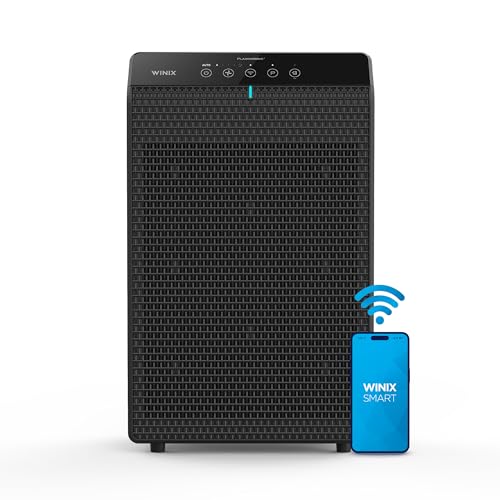
WINIX 5520 Air Purifier — Best Honest Coverage Method
Winix quotes its room the strict way: up to 1,882 ft² in one hour, per the listing. That phrasing implies repeated full air changes rather than a single gentle pass, which is why the number looks smaller than some rivals’ while describing a stronger promise. Add a true HEPA filter, a high-deodorization carbon filter, an air quality monitor and an auto mode, and the 5520 reads as the engineer’s pick in this group — a machine whose claims you can interrogate and whose components match its ambitions.
The carbon filter is the living-room headline. Winix explicitly calls it high-deodorization, and in a room that absorbs cooking smells from an open kitchen, fireplace notes and the general evidence of pets and people, carbon capacity is what separates a purifier that freshens from one that merely filters dust. Particle filtration handles the visible grey; the carbon handles the moment a guest walks in and the room introduces itself. Households that cook seriously, or keep a dog bed by the sofa, should weight this pick heavily.
Auto mode driven by a real air quality monitor closes the loop. The machine watches the room so you do not have to, rising when the kitchen door opens mid-roast and settling when the evening calms. It is the set-and-forget philosophy at room scale, and for a living room — a space nobody wants to administer — that philosophy is worth more than any single specification.
- Format: full-size purifier with air quality monitor
- Filtration: true HEPA with high-deodorization carbon filter
- Coverage stated in the listing: up to 1,882 ft² in 1 hour
- Controls: auto mode driven by the air quality monitor
- Noise figure: not stated in the listing
Strengths
- Coverage quoted with its method, the most honest framing here
- High-deodorization carbon targets living-room smells directly
- Monitor-driven auto mode removes daily management entirely
Trade-offs
- Headline number looks modest beside looser four-figure claims
- Carbon-rich filters are a recurring cost to plan for
- No app control named in the listing; automation is on-board only
Best for: an open-plan living space joined to a kitchen, or a pet-owning household where odour matters as much as dust.
Not suited for: a buyer ranking purely by the largest printed coverage figure.

MOOKA Air Purifier 2200 Ft² — Best Washable Pre-Filter
MOOKA’s KJ190H is built around a truth about living rooms: the first thing that reaches a filter is not fine dust but hair, lint and fluff, in quantities a bedroom never produces. Its listing claims 2,200 ft², names a HEPA filter, and then gets practical — a washable pre-filter, an auto mode, a quiet sleep mode and a PM2.5 air quality monitor. The washable pre-filter is the soul of the design. Rinse it under a tap monthly, and the expensive main filter behind it stays a filter instead of becoming a hair mat with a fan attached.
The PM2.5 monitor earns its place in a room with a fireplace or a busy kitchen nearby. Numbers change behaviour: watching the reading climb when the wood stove door opens, then fall as the machine works, teaches a household more about its own air in a weekend than a year of guessing. It also settles arguments — the purifier is neither magic nor useless, and the display shows which, in real time, which is a healthy relationship to have with any appliance.
As with its rivals, the coverage figure is the maker’s own and should be read as class rather than contract. Within that class, the MOOKA’s combination — big-room claim, honest sensor, washable first line of defence — is aimed squarely at the pet-heavy, high-traffic living room where filters go to die young. If your vacuum already fills its bin with hair weekly, this is the purifier designed by people who understand your house.
- Format: full-size purifier, white finish
- Filtration: HEPA filter with washable pre-filter
- Coverage stated in the listing: 2,200 ft²
- Display: PM2.5 air quality monitor
- Modes named in the listing: auto mode and quiet sleep mode
Strengths
- Washable pre-filter directly answers the pet-hair problem
- PM2.5 numbers make the machine’s work visible and teachable
- Auto and sleep modes cover the room’s day and evening moods
Trade-offs
- Coverage method is not stated in the listing
- Washing the pre-filter is a chore you must actually do
- No smart app or voice control mentioned in the listing
Best for: a pet-owning household in a large living room, tired of main filters clogging with hair ahead of schedule.
Not suited for: a pet-free minimalist who would rather never wash anything.

FreAire HAP606 Air Purifier — Best Display and Quiet Sleep
The HAP606 is the informant of the group. Its listing promises a true HEPA filter, coverage up to 1,800 ft², a real-time AQI and PM2.5 display, 360° intake and outlet, and a sleep mode stated at 20dB. That combination — full information by day, near-silence by night — suits the living room’s double life better than any other pick here. During the day the display turns air quality into a household fact, like the time or the weather. During a film, the same machine drops to its stated whisper and stops asking for attention.
The 360° airflow deserves emphasis in big rooms, where placement is often dictated by furniture rather than by the purifier’s preferences. A unit that draws and releases air in every direction can live on a side table between seating zones, or at the end of a sofa, without a wrong side facing the wall. Combined with the most modest coverage claim in this group — 1,800 ft² is a comparatively honest neighbourhood — the HAP606 reads as the pick for a large but not cavernous room, sized truthfully rather than heroically.
Its trade is headroom. In a genuinely vast open-plan space, or one with a working fireplace adding load all winter, the FreAire will run closer to its ceiling than the Levoit or DBFIT, and a machine near its ceiling is a machine you hear. Match it to the room it claims, though, and it offers the most civilised daily experience here: numbers when you want them, silence when you do not.
- Format: full-size purifier with 360° intake and outlet
- Filtration: true HEPA filter, per the listing
- Coverage stated in the listing: up to 1,800 ft²
- Noise figure stated in the listing: 20dB sleep mode
- Display: real-time AQI and PM2.5 readouts
Strengths
- Best information display in the group, readable across the room
- Stated 20dB sleep mode suits film nights and conversation
- 360° airflow forgives furniture-dictated placement
Trade-offs
- Smallest coverage claim here; vast open-plan spaces may outsize it
- Display light may need dimming for very dark film rooms
- No app control named in the listing
Best for: a large living room that hosts films and conversation, where the machine must inform by day and vanish by night.
Not suited for: the biggest open-plan spaces with fireplaces adding constant load.
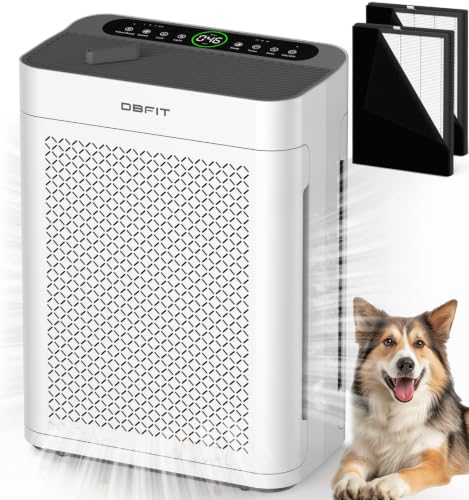
DBFIT Double-Sided Air Purifier — Best Double-Sided Intake
Every other pick in this guide assumes a wall. The DBFIT AP300 assumes a floor plan. Its listing describes a double-sided HEPA purifier — intake on both faces — with a washable filter, a PM2.5 display and air quality sensor, claiming coverage up to 3,000 sq. ft. Double-sided intake changes the placement logic completely: instead of backing the machine against a wall and cleaning outward, you can station it between zones — between the seating end and the dining end of an open-plan room — where it draws from both halves at once.
That is a genuinely useful idea for the way large living spaces are actually arranged, with furniture floating in the middle and walkways on all sides. A conventional purifier in the middle of such a room wastes its back; the DBFIT has no back. The washable filter continues the practical theme, and the PM2.5 display gives the household the same feedback loop the MOOKA and FreAire offer.
The cautions are the usual ones, doubled. The 3,000 sq. ft. figure is the largest claim here and arrives without a stated method, so read it as ambition rather than measurement. And a double-sided machine in the middle of a room needs its cable managed — a cord across a walkway is a trip hazard and an eyesore. Solve the cable honestly, with a floor cover or a route along the furniture, and the DBFIT becomes the most architecturally literate pick in the guide.
- Format: double-sided purifier for central placement
- Filtration: HEPA with washable filter, per the listing
- Coverage stated in the listing: up to 3,000 sq. ft.
- Display: PM2.5 display with air quality sensor
- Noise figure: not stated in the listing
Strengths
- Intake on both faces suits open-plan rooms with floating furniture
- Largest stated coverage in the group, however loosely measured
- Washable filter keeps the hair and lint stage cheap to maintain
Trade-offs
- Central placement demands honest cable management
- Coverage claim has no stated method behind it
- Exposed on all sides, it must earn its place visually
Best for: an open-plan living and dining space where the purifier belongs between zones, not against a wall.
Not suited for: a traditional room where all furniture hugs the walls and corners are free.

AIUZLK Air Purifier — Best H13 Simplicity
The AIUZLK P260 strips the big-room formula to its essentials and states them cleanly: an H13 HEPA filter, a washable pre-filter, a quiet level of 22dB, and coverage claimed up to 2,000 ft². H13 is a specific filtration grade, the same specificity we praised in smaller machines, and at living-room scale it means the filter at the heart of this uncomplicated box is a serious one. There is no app in the listing, no voice assistant, no ambient light show — the machine filters, quietly, and that is the entire proposition.
That restraint will read as relief to a certain kind of household. Living rooms accumulate remote controls and accounts like dust; a purifier that asks for neither, that simply runs at a chosen speed with a washable pre-filter to rinse and a main filter to swap on schedule, fits a house that values calm over telemetry. The stated 22dB sits a breath above the FreAire’s figure and in the same practical territory: a machine that can share a room with a conversation without joining it.
What you give up is feedback. With no PM2.5 display named in the listing, you will not watch numbers fall after a cooking session; you will judge by the older evidence of dust and smell, which is slower but not worthless. Households that enjoy data should look to the MOOKA or FreAire. Households that want a strong filter, honestly specified, without a dashboard — the AIUZLK is your machine.
- Format: full-size purifier, straightforward design
- Filtration: H13 HEPA filter with washable pre-filter
- Coverage stated in the listing: up to 2,000 ft²
- Noise figure stated in the listing: 22dB on its quiet side
- Display or app features: none named in the listing
Strengths
- Specific H13 filter grade at full living-room scale
- Washable pre-filter keeps the pet-hair stage nearly free
- No accounts or apps; operation stays at the machine
Trade-offs
- No air quality display, so feedback is by dust and smell
- Coverage method unstated, like most of its rivals
- Fewer modes and refinements than the sensor-driven picks
Best for: a household that wants big-room filtration with a named H13 filter and zero digital overhead.
Not suited for: data lovers who want to watch PM2.5 fall in real time.
How Do the Six Living Room Picks Compare at a Glance?
| Pick | Filtration (per listing) | Stated coverage | Standout trait |
|---|---|---|---|
| Levoit Core 600S-P | 3-in-1 filter, HEPA sleep mode | Up to 2,933 ft², AHAM verified | App and Alexa control |
| WINIX 5520 Air Purifier | True HEPA plus high-deodorization carbon | Up to 1,882 ft² in 1 hour | Carbon strength for household odours |
| MOOKA Air Purifier 2200 Ft² | HEPA, washable pre-filter | 2,200 ft² | PM2.5 monitor, pet-ready pre-filter |
| FreAire HAP606 Air Purifier | True HEPA, 360° airflow | Up to 1,800 ft² | AQI display, 20dB sleep mode |
| DBFIT Double-Sided Air Purifier | HEPA, washable filter, double-sided | Up to 3,000 sq. ft. | Central placement between zones |
| AIUZLK Air Purifier | H13 HEPA, washable pre-filter | Up to 2,000 ft² | 22dB stated, no-app simplicity |
Two honest patterns hide in that table. First, the strictest-sounding claim (the WINIX’s, with its one-hour method) carries the second-smallest number, which is how honest measurement usually looks. Second, every machine here pairs its big claim with a maintenance idea — washable stages, carbon for odour, sensors for feedback — because at this scale the filter’s working life, not the first week’s performance, decides whether the purchase was wise.
How Should You Read a Coverage Claim Before Trusting It?
Ask one question: cleaned how often? A room figure means nothing without a rate. A purifier that moves enough air to cycle a 1,800 ft² room’s volume several times an hour — the spirit of the WINIX’s one-hour framing — is doing heavy, continuous work. A figure twice that size, quoted for a single gentle pass, may describe the weaker machine. Since most listings, including several here, do not state their method, the safe habit is to buy a class above your room: if your living room measures around 400 square feet of floor, any machine in this guide has headroom to spare, and headroom is what lets a purifier run quietly at half effort instead of straining at full.
Ceiling height is the silent variable nobody prints. Coverage figures assume a standard ceiling; a double-height or vaulted living room holds far more air over the same floor, and the machine must cycle all of it. Owners of tall rooms should mentally demote every claim by a class and favour the stronger motors and the double-sided DBFIT’s placement advantage. The tape measure, as always in this category, is a better counsellor than the marketing.
Where Does a Big Purifier Belong in a Room Full of Furniture?
Near the life of the room, with air around it. The instinct to hide a purifier behind the sofa or inside a media unit defeats it: intakes starve, outlets bounce off upholstery, and the machine ends up filtering the small cave it lives in. Give it a position on the room’s main air path — beside the sofa rather than behind it, at the end of a sideboard, or, for the DBFIT, between the seating and dining zones — with a hand’s breadth of clearance on its working faces and nothing draped over the top.
Distance from sources is the second rule. Beside the dog’s bed, the purifier gorges on hair and its pre-filter mats in weeks; across the room, it receives the room’s mixed air and its filter ages evenly. The fireplace corner poses the same trap in winter: an arm’s length away, the machine catches what escapes the flue into the room; inside the hearth’s immediate plume, it simply eats heat and ash dust. Placement is free performance, and in a large room it is worth more than the difference between rival models.
What Changes When the Living Room Is Open-Plan?
Open-plan space is really three rooms wearing one name, and air treats the kitchen end, the seating end and the dining end as separate countries connected by weather. Cooking sends a daily front of smell and fine particles across the whole space; the seating end generates dust and pet hair; the dining end mostly hosts. A single purifier placed at the seating end will keep that end pleasant while the kitchen’s evidence drifts over the dining table unchallenged.
The workable strategies are position and timing. Position the machine between the kitchen boundary and the seating, where it intercepts the drift — or choose the DBFIT’s central, double-sided approach for the same reason. Then use timing: a higher setting during and after cooking, dropped back for the evening, does more than a constant medium. Sensor-driven auto modes, like the WINIX’s, automate exactly this response, which is why they earn their keep specifically in open-plan homes.
How Do These Machines Handle Pet Hair at Living-Room Scale?
By surviving it, if you help. A large dog produces hair at a rate that turns filter maintenance from a seasonal event into a monthly rhythm, and the washable pre-filters on the MOOKA, DBFIT and AIUZLK exist precisely for this household. The pre-filter is the sacrificial layer: it catches the hair and lint, you rinse or shake it out, and the costly HEPA behind it stays a particle filter instead of becoming a felt blanket. Skip the rinsing for a season and even the best design here will fade into noise and weakness.
Vacuuming remains the senior partner. Hair on the carpet that a vacuum lifts is hair the purifier never has to catch, and a weekly vacuum of the dog’s favourite square metre does more for the filter’s lifespan than any feature on any listing. Think of the system as a relay: vacuum takes the floor, purifier takes the air, pre-filter takes the abuse, and the main filter — protected by all three — takes its time.
Can a Purifier Keep Up With a Wood Stove or Fireplace in the Room?
With the everyday leakage, yes; with a smoking flue, no, and the distinction matters. A well-drawing stove still releases a puff at loading and a faint note of woodsmoke into the room’s air, and a living-room purifier trims that background noticeably over an evening — this is comfort work squarely in the category’s territory. But a stove that spills smoke at every opening has a draught problem, not an air-quality problem, and no filter purchase should be asked to compensate for a chimney that needs a sweep or a door seal that needs replacing.
Ash discipline helps the machine enormously. Ash emptied carelessly raises a grey cloud that a filter will catch once and remember for weeks in shortened life. Empty ash when it is fully cold, gently, with the purifier running on a higher setting nearby to catch what escapes — then let the machine settle back. The households that burn wood all winter and keep pleasant rooms are not using stronger purifiers; they are using tidier habits around the same machines.
How Quiet Must a Living Room Machine Be, Really?
Quieter than the television at your normal volume, at the speed you use during films — that is the whole test. Conversation and television forgive a steady low hum far more readily than a bedroom does, which is why living-room machines can be larger and stronger than bedroom ones. But pitch matters as much as volume: a high, thin whine at a modest level annoys more than a deeper, softer rush, and listings rarely describe pitch. The stated sleep figures here — 20dB for the FreAire, 22dB for the AIUZLK — at least certify that the makers designed a genuinely gentle bottom gear.
Use the room’s own acoustics. Hard floors and bare walls return sound to you; rugs, curtains and upholstered furniture absorb it. A purifier that seems assertive in a sparse, echoing room may vanish in a furnished one, which is another reason to audition a machine in its actual home during its first week rather than judging it by a showroom impression or a number alone.
What Does a PM2.5 Display Actually Teach a Household?
Patterns. Within a fortnight, a household with a display — the MOOKA, FreAire and DBFIT offer them — learns its own signature: the spike when the front door opens on a dusty day, the climb during a frying session, the slow fall as the machine works, the flat calm of a rainy Sunday. That literacy changes small decisions for the better. You learn to run the machine up before guests arrive rather than after, to open the stove door more briefly, to vacuum the rug on the day the reading says the room is already loaded.
It also disciplines expectations in both directions. The display proves the machine works — numbers fall, reliably, every time — and proves its limits, because a fresh source beats it instantly. Households without a display judge by dust and smell alone, which is slower evidence but points the same way. Neither relationship with the machine is wrong; they are simply different kinds of ownership, and this guide includes both because living rooms contain both kinds of people.
How Should You Run One Across a Normal Week?
Let the room’s rhythm set the machine’s. Mornings, a medium setting while the house wakes and doors open and shut. School and work hours, a low background gear — the room is empty but the dust is not, and holding the line cheaply beats recovering ground later. Evenings, the machine earns its money: up a gear for cooking and arrivals, down to its quiet setting for the film or the conversation, and either off overnight or left whispering if the living room doubles as a guest bed.
Auto modes exist to play this rhythm without a conductor, and in this room size they are worth using if your pick has one. The manual alternative is a household habit, like the thermostat’s: whoever passes the machine at six o’clock turns it up, whoever goes to bed turns it down. What fails is the third pattern — heroic blasts when a smell is noticed, silence the rest of the week. Background consistency is the entire science of this category.
What Maintenance Keeps a Big Machine Honest?
Scale changes the stakes, not the tasks. A large purifier’s filter is a large purchase, so protecting it matters more: rinse or shake the washable pre-filter monthly in a pet home, less often in a pet-free one; vacuum the intake faces when you vacuum the room; and swap the main filter on evidence — softening airflow, a faint sour note at the outlet, a display that no longer falls as fast as it did. In a living room, also wipe the top and controls when you dust, because a machine in the house’s public room should look maintained, not archaeological.
Keep the filter’s identity somewhere findable — a note in the kitchen drawer beats a memory — and order the replacement when the old one starts its decline rather than after it has failed, so the machine never sits idle during the dusty weeks waiting for a delivery. Big machines forgive a lot, but an empty filter slot forgives nothing.
How Does a Living Room Purifier Earn Its Place Visually?
A full-size purifier is furniture whether the maker admits it or not, and in the house’s most public room that fact deserves respect rather than embarrassment. The machines here are mostly clean-lined towers and boxes in white or neutral finishes, designed to stand in a room the way a speaker stands: visibly, but without demanding conversation. The households that stay happy with a big purifier are the ones that chose its position as deliberately as a lamp’s — a spot with air around it that also makes compositional sense beside a cabinet or at a sofa’s end.
What corrodes the arrangement is not the machine but the evidence of neglect around it: a cable trailing across the rug, a filter box stored against its side for six months, a top surface used as a shelf for remotes and mugs. Keep the cord honest, the top clear and the intake wiped, and the purifier reads as part of the room’s equipment. Let those small disciplines slide and even the most elegant design starts to look like clutter with a fan inside.
What Happens on Guest Night, Party Night and Other Stress Tests?
Visitors multiply everything a living room produces: coats shedding fibres, shoes importing the street, bodies and conversation stirring the settled dust, doors opening every few minutes. This is the one occasion where running a purifier up a gear in advance genuinely pays — an hour on a strong setting before guests arrive draws the room’s background load down, so the evening starts from clean rather than merely keeping pace. Sensor-driven machines will climb on their own as the room fills; manual ones reward the host who thinks of the purifier while thinking of the ice.
After the guests leave, let the machine run on through the night at its quiet setting rather than switching it off with the lights. The evening’s accumulated load — the stirred dust, the cooking evidence, the coats’ contribution — settles slowly, and the purifier’s overnight shift is what returns the room to its weekday baseline by morning. Hosts who build this into the tidy-up routine stop associating parties with a house that smells of them for two days.
Can a Purifier Help a Living Room With Allergy-Season Dust and Pollen Drift?
Within the comfort limits of this category, it helps with the indoor half of the problem. Pollen enters a living room on clothes, on pet fur and through every opened door, then settles on upholstery and carpets to be re-stirred by ordinary life. A purifier running daily draws down the airborne fraction and the reservoir that feeds it, so the room’s soft surfaces hold less of the season. We make no medical claims here — these machines are not treatments — but a room that is visibly less dusty is a room most people simply find easier to relax in during the high season.
Habits multiply the machine’s effect. Shoes off at the door during the worst weeks, the dog wiped down after walks, cushion covers washed while the season peaks — each reduces what the filter must carry. The purifier is best understood as the still centre of that routine, quietly processing the room’s air while the household manages the borders, rather than as a force field that makes the borders irrelevant.
How Do Two Purifiers Compare With One Big One?
Long, L-shaped or heavily divided living spaces sometimes defeat a single machine however strong, because air does not turn corners politely. Two mid-size units — one at each end of the space — can serve such a room more evenly than one flagship straining from a single corner, and they offer redundancy when a filter change or a fault takes one offline. The costs are obvious: two purchases, two filters to maintain, two positions to negotiate with the furniture.
For most rectangular rooms, one well-chosen machine from this guide remains the simpler and better answer, with headroom doing the work that a second unit would. Reserve the two-machine strategy for genuinely awkward architecture — a room with a chimney breast dividing it in half, a conservatory opening off one end — and if you adopt it, matching models keep the filter errands singular. Complexity should always have to argue its way into a living room.
What Should You Check in the First Fortnight?
Run the machine where you intend it to live and keep a short, honest diary in your head. Notice the television stand: how many days until the dust film you wiped on day one becomes visible again, compared with before? Notice the room’s smell on returning from a day out, which is the only unbiased review a house ever gets. Notice whether anyone has turned the machine down, or off, and why — that answer is the real noise specification, whatever the listing states.
Check the pre-filter at the fortnight mark even if the manual suggests longer. Its loading is your room’s fingerprint: heavy hair says the monthly rhythm applies to you; light dust says you can relax the schedule. And confirm the replacement filter’s exact model while the packaging is still in the recycling — write it in the note with your other household consumables, so the first replacement, whenever it comes, is a two-minute errand rather than an evening of archaeology.
How Does the Season Change What the Machine Faces?
A living room purifier works four different jobs a year. Spring brings pollen through every opened window and a fine yellow dust on every sill. Summer brings open doors, barbecue drift and the maximum traffic of bare feet and garden comings and goings. Autumn brings the first fires, the return of closed windows, and the dust that heating systems wake after their summer sleep. Winter is the long shift: sealed rooms, a stove or fireplace in daily use, guests at their most frequent, and the machine running more hours than in any other quarter.
The practical response is a seasonal rhythm rather than a constant one. Pre-filters want their most frequent attention in the pet-shedding and fireplace months; the main filter’s decline is best checked at the turn of autumn, before the sealed season makes the machine indispensable; and a household that reviews its purifier twice a year, the way it reviews the gutters or the boiler, will never be ambushed by a clogged filter during the holidays, which is when these failures traditionally schedule themselves.
What Role Does the Living Room Door Play?
An unglamorous truth: the purifier’s hardest opponent is an open door to a dusty house. A living room with its door standing open all day shares its air with the hall, the stairs and every room beyond, and the machine ends up filtering a volume several times the one it was bought for. Closing the door during the machine’s strong hours — cooking, post-vacuum, the evening settle — concentrates its work where the family actually sits, and the difference is visible on any PM2.5 display in the room.
This is not an argument for living in a sealed box. Doors open, people circulate, and a house that cannot breathe through its rooms is a miserable one. It is an argument for rhythm: open circulation when the house is being lived in and aired, a closed door when you ask the machine to finish the job. The purifier and the door are partners in the same small system, and the households that understand that get living-room air their neighbours assume cost far more machinery than it did.
Which Mistakes Do Large Living Room Buyers Make Most Often?
Undersizing by optimism is the first: believing a desktop unit’s inflated claim, or buying for the room’s floor area while ignoring a vaulted ceiling’s volume. The second is banishment — hiding the machine behind furniture for the sake of the room’s looks, then concluding that purifiers do not work. The third is ranking by coverage number in a market where the numbers are not measured alike; this guide’s own table contains claims from 1,800 to 3,000 in the same class of machine, which should cure anyone of taking the largest figure at face value.
Two quieter errors follow. Households place the machine beside the strongest source — the dog bed, the hearth — and burn through filters wondering why, when a few metres of distance would have halved the load. And households run the purifier as an event, on for guests and off for themselves, when its whole value lies in the unglamorous background weeks between occasions.
Final Recommendation
Start with the room’s shape and let it choose. A conventional large room with a free corner belongs to the Levoit Core 600S-P, whose verified claim and app control make it the easiest big machine to live with. An open-plan space fused with a kitchen belongs to the WINIX 5520 Air Purifier, whose carbon filter and honestly framed coverage were built for exactly that drift of cooking and living. Floating furniture argues for the DBFIT Double-Sided Air Purifier in the middle of things; pet hair argues for the MOOKA; film nights for the FreAire; and a household that wants filtration without telemetry for the AIUZLK. Measure your ceiling, forgive the marketing its arithmetic, place the machine where the room actually breathes, and a large living room stops being a space you dust defensively and becomes one that simply stays pleasant.
Frequently Asked Questions
How big a purifier does a 500-square-foot living room need?
Any machine in this guide has headroom for that floor area at standard ceiling height, and headroom is the point: it lets the purifier hold the room at a quiet, middle speed. With a vaulted ceiling, count the room as a class larger and favour the stronger claims. Judge by filter grade and stated noise after that, not by ever-larger numbers.
Why do coverage claims differ so much between similar machines?
Because brands choose their own methods — some quote a room cleaned repeatedly within the hour, others a far larger room cleaned gently. The WINIX listing states its one-hour method; most do not state a method at all. Treat every figure as a class indicator, and prefer the machine whose other specifications you can verify.
Will a large purifier help with cooking smells in an open-plan space?
It softens and shortens them, especially a model with serious carbon in its filter, like the WINIX’s high-deodorization design. Particle filters alone do little for smell. Position the machine between the kitchen zone and the seating, run it up during and after cooking, and expect the room to return to neutral in a fraction of the time it would take unaided.
Is a washable pre-filter really worth having?
In a pet-owning living room, it is close to essential. Hair and lint are the main filter’s fastest route to an early death, and a pre-filter you can rinse monthly absorbs that abuse for free. In a pet-free, low-traffic room it matters less, but it never hurts — the MOOKA, DBFIT and AIUZLK include one without giving up filter grade.
Can one purifier serve the living room and the bedrooms too?
Not at the same time, and wheeling a full-size machine around nightly is a routine nobody keeps. A living-room purifier earns its keep by permanence. If the bedroom needs its own, buy a smaller, quieter unit for it; the two rooms ask for different machines, and each works better for being chosen honestly.
How will I know the main filter needs replacing?
By behaviour: airflow softens, the machine sounds busier at the same setting, the outlet air develops a faint dusty smell, and a PM2.5 display, if your model has one, falls more slowly than it used to. In a pet-heavy room, check the pre-filter first — a matted pre-filter imitates a dead main filter almost perfectly.
Related Guides
From the biggest room to the most personal ones: Best Air Purifiers for Wood Stove Dust takes the same machines’ logic to the hearth, Best Wall-Mount Kitchen Faucets covers the open-plan kitchen at the other end of the space, and Best Slip-Resistant Bath Mats looks after the smallest room’s most-used square metre.



[…] the rooms around the office: Best Air Purifiers for Large Living Rooms scales the same thinking up to family space, where coverage and seating take over from call […]