What's inside
- Key Takeaways
- Quick Picks
- How Did We Judge Affordable Clawfoots Without Quoting a Single Price?
- Why Does the Clawfoot Shape Keep Outliving Every Bathroom Fashion?
- How Do the Six Clawfoots Compare?
- Can an Ordinary Floor Carry a Clawfoot, and Where Do the Feet Stand?
- How Do You Solve the Faucet Question, and Can a Clawfoot Take a Shower?
- What Does Painting the Outside of a Clawfoot Actually Involve?
- How Do You Style a Room Around a Tub With Feet?
- Should You Hunt a Reclaimed Antique Instead?
- How Do You Keep a Clawfoot Soak Warm Without a Heated Shell?
- How Much Clearance Does a Clawfoot Need to Look Right?
- What Mistakes Do Clawfoot Buyers Keep Making?
- What Happens on Installation Day?
- How Does a Clawfoot Serve a Family Across the Years?
- Final Recommendation
- Frequently Asked Questions
- Related Guides
As an Amazon Associate I earn from qualifying purchases. This post may contain affiliate links at no extra cost to you.
cottageverdict.com is reader-supported. When you buy through links on our site, we may earn an affiliate commission.
Where to buy: You will find each of these six clawfoot tubs on Amazon by following the name in its review. Decide your length, your foot finish, and your faucet plan first — then check price on Amazon for the silhouettes that remain.
The clawfoot tub is the oldest silhouette in the bathroom and, for a century, one of the most expensive ways to bathe: a cast-iron shell heavy enough to need its own logistics, enamelled inside, painted outside, and priced like furniture because it was furniture. The best affordable clawfoot tubs exist because acrylic quietly rewrote that equation. A modern acrylic clawfoot keeps the raised slipper ends, the rolled rim, and the four ornamental feet that make the shape unmistakable, while shedding the iron’s crushing weight and a large share of its cost tier. Two people can carry one upstairs. A normal floor can hold one without a structural consultation. And the bathroom gains the vintage centrepiece without the vintage invoice — or the vintage hernia.
Affordable, in this guide, is a positioning word rather than a price tag, and it will be used honestly throughout: these tubs occupy the accessible tiers of the clawfoot market, below the cast-iron originals and the designer reproductions, while remaining real, warrantied, soak-in-them-tonight fixtures rather than decorative props. What the accessible tier asks in return is a few clear-eyed acceptances. The feet are cast metal or finished alloy rather than iron foundry work. The shell will not hold heat in its mass the way iron does, though the water itself behaves identically. And the faucet question — the clawfoot’s eternal companion problem — must be answered by the buyer, because these tubs are sold as vessels, with the plumbing romance left to you.
Six tubs follow: three lengths of WOODBRIDGE slipper, a double slipper, a traditional tap-deck design from Signature Hardware, a vintage-styled GarveeLife, and a ball-and-claw purist from Vintage Tub and Bath. After the reviews come the ownership chapters the brochures skip — floors, faucets, shower converters, and painting the outside of the tub to match a room that has not been invented yet.
Key Takeaways
- Acrylic is what makes the clawfoot affordable: the silhouette survives while the cast-iron weight and tier fall away.
- Length is the first decision — the list spans 54 to 69 inches, from ensuite slipper to full-length statement.
- Foot finish is the room’s jewellery: matte black reads modern, chrome reads classic, Imperial feet read period.
- No pick includes a faucet unless its listing says so; budget the filler as a separate, deliberate purchase.
- A filled acrylic clawfoot is a load ordinary floors carry, which is the quiet revolution under the romance.
- The Eden II is the purist’s seat — ball-and-claw feet and no faucet drillings to argue with.
Quick Picks
| Pick | Badge | Why it made the list |
|---|---|---|
| WOODBRIDGE 67″ Slipper Clawfoot Tub, Matte Black Feet | Full-length slipper, black feet | Sixty-seven inches of raised-end soaking with modern matte black feet and hardware. |
| WOODBRIDGE 54″ Slipper Clawfoot Tub, Chrome Feet | Compact slipper, chrome feet | The clawfoot silhouette compressed to fifty-four inches for ensuites and cottages. |
| WOODBRIDGE 59″ Double Slipper Clawfoot Tub | Double-ended slipper value | Both ends raised for reclining at fifty-nine inches, in the black-footed finish. |
| Signature Hardware Audrey 69″ Clawfoot Tub | Tap-deck traditionalist | The longest tub here, with Imperial feet and a tap deck for rim-mounted faucets. |
| GarveeLife 59″ Slipper Clawfoot Bathtub | Vintage-look remodel pick | A fifty-nine-inch slipper with chrome feet aimed squarely at bathroom remodels. |
| Vintage Tub & Bath Eden II Clawfoot Tub | Ball-and-claw purist | Imperial ball-and-claw feet and an undrilled rim for total faucet freedom. |
How Did We Judge Affordable Clawfoots Without Quoting a Single Price?
Value in this category is a ratio, not a figure: silhouette fidelity divided by everything the tub asks of the house. We scored the numerator first. A convincing clawfoot needs the raised back or backs shaped for an actual spine, a rolled rim that reads from across the room, feet with genuine ornamental presence rather than apologetic stubs, and an exterior smooth enough to take paint if the household later wants colour. Every pick here clears that bar, which is why the list can be short without being thin. The denominator came second: weight the floor must carry, hardware included or left as homework, and the faucet freedom the rim allows. A tub with a tap deck answers the faucet question one way; an undrilled rim answers it with total freedom and total responsibility, and both answers are represented because households divide honestly on which they prefer.
One boundary of the brief deserves stating while value is on the table. A clawfoot, however affordable, asks its bather to step over a high rim, and households planning a bathroom for ageing in place or for a family member with limited mobility should compare this silhouette against the step-in formats compared in Best Affordable Walk-In Tubs before romance decides. The clawfoot’s century of popularity was built by the able-bodied, and this guide recommends it warmly to exactly the households whose bathers can enjoy its step-over as part of the ceremony.
We also kept the list honest about its material. All six picks are acrylic, because at the accessible tiers that is what the market actually sells, and pretending a cast-iron option belongs in an affordable guide would be a romantic lie with a freight bill attached. What acrylic gives up in thermal mass it returns in installation mercy, and the reviews note the trade where it matters rather than litigating it in every paragraph. Finally, lengths were spread deliberately — fifty-four to sixty-nine inches — because the affordable clawfoot’s whole purpose is to fit the silhouette into real bathrooms, and real bathrooms disagree about length more than about any other dimension.
Why Does the Clawfoot Shape Keep Outliving Every Bathroom Fashion?
Because it was designed by the body before it was styled by an era. The raised end is a backrest discovered by generations of bathers who had nothing to do but soak; the rolled rim is a handhold, a headrest ledge, and a splash guard in one continuous curve; the feet lift the vessel so the bather steps into a bath that presents itself like furniture rather than emerging from the floor like plumbing. Fashions in bathrooms arrive as rectangles and depart as rectangles, while the clawfoot’s curves keep being rediscovered by each new cohort of renovators who walk into a period house, see the tub the house was built around, and understand in one glance why it was never thrown away.
There is also a practical immortality underneath the romance. A freestanding clawfoot can be plumbed, painted, moved to another room, sold to another house, and re-enamelled or re-finished across a longer life than any built-in fixture in the bathroom. Households renovating in stages feel that flexibility as money: the tub bought for this year’s bathroom can anchor next decade’s, wearing a different exterior colour and a different faucet, while the alcove tub from the same renovation is demolished with the room. Hold the thought that the clawfoot’s longevity is itself a form of affordability, because a fixture that survives three bathrooms costs less per bathroom than any fixture that survives one.

WOODBRIDGE 67″ Slipper Clawfoot Tub, Matte Black Feet — Full-length slipper, black feet
The flagship of the affordable end pairs the longest WOODBRIDGE slipper body with the finish that defines the modern clawfoot revival: matte black feet with matching matte black drain and overflow. Black hardware against a white shell is the combination that lets a nineteenth-century silhouette hold a twenty-first-century room, agreeing with black-framed mirrors, dark grout, and the monochrome palette that currently rules renovation photography — while remaining, underneath the fashion, a raised-end soaker long enough for a tall bather to occupy with genuine intent. Sixty-seven inches in a single slipper means one glorious raised end for the back and a lower end for the feet, the classic arrangement for the solo reader-soaker.
WOODBRIDGE describes the shell as heavy duty acrylic, and in a clawfoot that phrase carries specific weight, because the shell is also the structure: the tub stands on its feet with no deck, no apron, and no wall to lean on, so rim rigidity and wall substance are what a hand tests first. A clawfoot that flexes when gripped feels like a costume; this one is built to feel like furniture. The raised slipper end shapes the soak into the chaise posture the silhouette promises, with the shoulders supported out of the water and the legs low and warm — the exact geometry that made the shape famous in the era before showers annexed the bathroom’s daily routine.
Faucet planning for this tub follows the freestanding rule: a floor-standing filler beside the raised end, or a wall-mounted spout where the plumbing already lives, because the rim’s traditional drilling question should be settled from the listing’s specification before the order, not discovered on installation day. The matte black finish on the feet and hardware will compose best with a filler in the same family, and sourcing that filler alongside the tub — rather than after it — is the difference between a room that looks designed and a room that looks accumulated. Tall bathers renovating in a modern palette have found their pick; the WOODBRIDGE listing on Amazon is the place to check price on Amazon and confirm the drilling specification.
- Length: 67 inches, single slipper
- Feet: matte black, with matching hardware
- Shell: heavy duty acrylic per listing
- Posture: raised-end chaise recline
- Palette: monochrome and modern rooms
Strengths
- Full length with the fashionable black finish
- Substantial shell feels like furniture
- Matched hardware ends finish guesswork
Trade-offs
- Single raised end fixes the reclining direction
- Filler is a separate purchase to plan
- Black feet show dust in bright rooms
Best for: tall solo soakers in modern monochrome bathrooms. Not suited for: couples wanting a raised end each.

WOODBRIDGE 54″ Slipper Clawfoot Tub, Chrome Feet — Compact slipper, chrome feet
Fifty-four inches is where the clawfoot becomes possible in the rooms that need it most: the cottage bathroom under a sloping ceiling, the ensuite carved from a dressing room, the period house’s second bath that was drawn when five feet was a luxury and four and a half was a plan. WOODBRIDGE’s compact slipper keeps every element of the silhouette at the smaller scale — the raised end, the rolled rim, the four feet in bright chrome — and the proportions survive the shrinking with surprising grace, because the clawfoot’s charm lives in its curves rather than its dimensions. A small clawfoot in a small room reads as a jewel; an alcove tub in the same room reads as a compromise, and that difference is the entire case for this pick.
Chrome feet place the tub in the classic register: bright metal, white shell, the bathroom of a Victorian terrace or a white-tiled cottage where black hardware would feel like an intrusion from a later decade. The bathing posture is the compact posture this guide has described honestly in other size classes — knees softly bent, water high, the raised end doing the supporting — and at fifty-four inches the bather should be of average height or below, or be a person who soaks curled in the way some people sleep curled, happily and by preference. Children, incidentally, regard a compact clawfoot as a ship, a castle, and the best room in the house, in that order, every bath night.
The installation mercy of the small footprint deserves emphasis: the tub turns corners that defeat its longer siblings, stands on floors whose joist spans suit lighter loads, and leaves a small room with floor space for the stool, the towel rail, and the door’s swing — the supporting cast that makes a bathroom work daily. Pair it with a wall-mounted filler to keep the floor clear, or a compact floor-standing model if the wall is spoken for. For the smallest bathrooms with the largest ambitions, this is the list’s essential pick, and its Amazon page is where to check price on Amazon and verify the foot finish photographs.
- Length: 54 inches, compact slipper
- Feet: chrome, with chrome hardware
- Shell: heavy duty acrylic per listing
- Setting: cottages, ensuites, period seconds
- Posture: high water, softly bent knees
Strengths
- Silhouette survives at the smallest scale
- Easiest delivery route in the list
- Chrome suits period and cottage rooms
Trade-offs
- Tall bathers will fold, not stretch
- Compact volume cools a little faster
- Strictly a one-bather instrument
Best for: small bathrooms refusing to surrender the clawfoot dream. Not suited for: tall bathers or shared soaking plans.

WOODBRIDGE 59″ Double Slipper Clawfoot Tub — Double-ended slipper value
The double slipper splits the difference between its two siblings and, for many households, lands on the answer. Both ends of the fifty-nine-inch shell rise into backrests, so the bather chooses an end by the window light or the door’s position, and two bathers can occupy the tub facing each other with a raised support behind each — the social configuration that single slippers cannot offer at any length. The matte black feet and hardware carry the modern finish of the sixty-seven into the more versatile shape, and the whole composition reads as the list’s most balanced object: not the longest, not the smallest, but the one whose geometry answers the most households’ evenings.
Symmetry has a plumbing dividend worth naming. A double-ended tub places its drain and overflow at the centre, which frees the installation from the room’s directional assumptions — the tub can be turned end-for-end during placement without the hardware changing its mind, a forgiveness that matters in renovations where the waste pipe’s exact loyalty is discovered late. The bathing geometry rewards the same symmetry: the flat floor between the two raised ends is the tub’s shared ground, and a solo bather who switches ends mid-soak — a small pleasure nobody lists as a requirement — will find both ends equally fluent in the language of support.
Value is this pick’s closing argument, stated in positioning words as this guide’s rules require: within the WOODBRIDGE slipper family it occupies the accessible middle, delivering the double-ended versatility that usually belongs to the tier above, in the finish of the moment, at the length that fits the standard bathroom’s open floor. Households torn between the flagship’s stretch and the compact’s footprint should notice that the double slipper is not a compromise between them but a different thesis — that direction, not dimension, is what a soak is made of. The double slipper’s Amazon listing carries its centre-drain drawings, so confirm the floor’s waste position and check price on Amazon when the symmetry has persuaded you.
- Length: 59 inches, double slipper
- Feet: matte black, matching hardware
- Drain: centre position, direction-free
- Posture: raised support at both ends
- Role: the family’s most versatile shape
Strengths
- Two backrests serve solo and shared soaks
- Centre drain forgives room direction
- Modern finish on a classic symmetry
Trade-offs
- Neither end offers the flagship’s stretch
- Raised ends shorten the flat floor
- Black finish commits the room’s metals
Best for: households wanting one clawfoot for every bathing mood. Not suited for: the tallest bathers measuring by legroom alone.
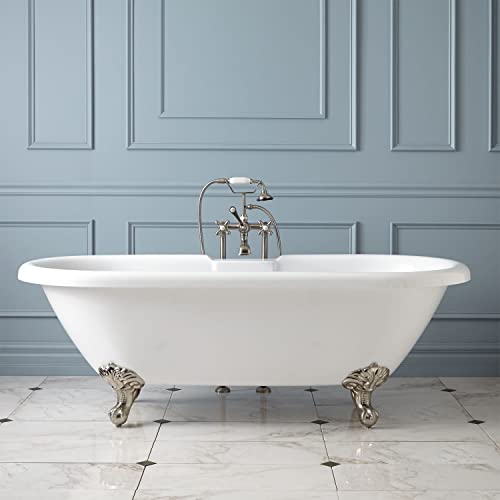
Signature Hardware Audrey 69″ Clawfoot Tub — Tap-deck traditionalist
At sixty-nine inches the Audrey is the longest vessel in this guide, and Signature Hardware — a maker whose catalogue is a love letter to period bathrooms — finishes it in the traditional manner: Imperial feet below, and a tap deck above. The tap deck is the feature to dwell on, because it solves the clawfoot faucet problem in the oldest way available: a flat shelf at one end of the rim, drilled to accept a faucet mounted on the tub itself. Households that dream of the classic telephone-style faucet rising from the rim, exactly where a Victorian bather would have found it, need a deck to mount it on, and most affordable clawfoots — including the three WOODBRIDGE picks — decline to provide one. The Audrey provides it, and that single provision reorganises the whole installation conversation.
The Imperial feet carry the same traditional argument at floor level. Where ball-and-claw feet quote the baroque, Imperial feet offer a cleaner, more architectural ornament — a stylised paw-and-scroll that suits houses whose period details run to the early twentieth century rather than the late nineteenth. The integrated drain and overflow remove one errand from the project list, and the soaking interior at sixty-nine inches gives the tallest bathers in this guide their fullest stretch inside a clawfoot silhouette, with the raised-end posture the Audrey’s slipper profile provides. This is the pick for the renovator restoring a period bathroom who wants the fixtures to agree with the house’s own century.
Traditionalism has its own practical notes. A deck-mounted faucet places the plumbing on the tub, which simplifies the wall and floor work but asks the bather to accept the faucet’s presence at the bathing end — the eternal tap-deck trade, and one period houses made happily for a hundred years. The Audrey’s length also asks the room for the full presentation: clearance at both ends and a doorway view that includes the feet, because a sixty-nine-inch traditionalist wedged into a corner is a sonnet read in a cupboard. Signature Hardware’s Amazon listing details the tap deck’s drilling pattern, so match your chosen faucet’s spread against it and check price on Amazon when the period details align.
- Length: 69 inches, longest here
- Feet: Imperial style, period profile
- Faucet: tap deck for rim-mounted sets
- Hardware: integrated drain and overflow
- Character: traditional restoration fit
Strengths
- Tap deck ends the faucet dilemma classically
- Fullest stretch of any pick here
- Period detailing suits older houses
Trade-offs
- Deck faucet shares the bathing end
- Needs a room that can present 69 inches
- Traditional register will not suit minimal rooms
Best for: period restorations and the tallest clawfoot bathers. Not suited for: compact bathrooms or stark modern palettes.

GarveeLife 59″ Slipper Clawfoot Bathtub — Vintage-look remodel pick
GarveeLife aims its fifty-nine-inch slipper directly at the remodel, and its listing says so in as many words: an elegant vintage design for relaxing home spa evenings and bathroom remodels. The formula is the classic one — heavy duty acrylic shell, chrome feet, chrome drain and overflow — arranged without a single element that would startle a traditional room. Where the WOODBRIDGE double slipper at the same length argues for symmetry and a black finish, the GarveeLife argues for the single raised end and bright metal, which makes the pair a clean either-or for the fifty-nine-inch shopper: recline both ways in black, or recline one way in chrome.
The single slipper’s case is worth hearing on its own terms. One raised end means the other end falls away low, which gives the bather’s legs a longer, flatter floor and gives the room a silhouette with a clear front and back — a directionality that suits tubs placed against a long wall, where the raised end can stand beneath a window or a piece of art and the low end can meet the door’s view with its gentlest profile. Chrome feet keep the composition in the period register, agreeing with the chrome taps and rails that most existing bathrooms already own, so a remodel can adopt this tub without re-casting every other metal in the room — a small mercy with a real budget attached.
For the renovator, the GarveeLife’s appeal is that it asks the fewest new decisions. The finish matches the installed base of bathroom hardware, the size fits the standard open floor, the included drain and overflow settle their errands, and the vintage styling flatters both the farmhouse renovation and the Victorian terrace without belonging exclusively to either. What it does not offer is the double-ended versatility or the tap deck of its neighbours, and households who want either should shop those picks with this one’s blessing. GarveeLife’s Amazon page presents the remodel case plainly, so verify the dimensions against your floor and check price on Amazon when the chrome-and-single-slipper argument has won.
- Length: 59 inches, single slipper
- Feet: chrome, with chrome hardware
- Shell: heavy duty acrylic per listing
- Intent: remodel and home-spa brief
- Style: vintage, period-friendly register
Strengths
- Chrome agrees with existing bathroom metal
- Directional silhouette suits wall placement
- Included hardware shortens the project list
Trade-offs
- One backrest direction only
- No tap deck for rim-mounted faucets
- Classic looks offer no modern accent
Best for: traditional remodels keeping their chrome fittings. Not suited for: black-hardware rooms or two-ended soakers.

Vintage Tub & Bath Eden II Clawfoot Tub — Ball-and-claw purist
The Eden II closes the list at the purist’s end of the market. Its feet are Imperial ball-and-claw — the full historical ornament, talon gripping ball, that gave the entire category its name — and its rim carries no faucet drillings at all. That absence is the design’s thesis. A drilled rim decides where your faucet lives for the life of the tub; an undrilled rim leaves the question open to the room, the plumbing, and the future, accepting a floor-standing filler, a wall-mounted spout, or a later change of heart with equal grace. Vintage Tub and Bath, a specialist in exactly this corner of the bathroom, sells the Eden II to renovators who regard that freedom as the authentic clawfoot condition, because the iron originals were plumbed by the house, not by the catalogue.
The slipper profile keeps the bathing story inside the tradition the feet announce: a raised end shaped for the long recline, a rolled rim, and an acrylic shell that spares the floor the iron original’s demands. It is worth pausing on that last exchange, because the Eden II is the pick most likely to be compared against a reclaimed antique, and the comparison favours the reproduction more often than romantics expect. The antique brings unknown enamel, a century of other people’s baths, feet that may or may not match, and a weight that turns installation into a production; the Eden II brings the same silhouette with a warranty, a known drain, and a shell two people can carry through the house it will serve.
Choose the Eden II when the renovation is a restoration in spirit — when the feet will be seen, the filler will be a considered floor-standing piece, and the room is being composed around the tub rather than merely containing it. The undrilled rim also suits households whose faucet decision is genuinely undecided at ordering time, because this is the one pick that lets the tub arrive before the faucet question closes. Vintage Tub and Bath’s Amazon listing describes the feet and the undrilled rim in detail, so study the ornament at full size and check price on Amazon when the purist’s argument has carried your room.
- Feet: Imperial ball-and-claw ornament
- Rim: no faucet drillings, total freedom
- Shell: acrylic slipper, vintage profile
- Maker: Vintage Tub and Bath specialist
- Role: restoration-grade centrepiece
Strengths
- Authentic foot ornament, honestly made
- Undrilled rim keeps every faucet option
- Specialist maker, restoration fluency
Trade-offs
- Filler must be planned and bought separately
- Ornate feet demand to be visible
- Purist register overwhelms quiet rooms
Best for: restoration-minded renovators composing a period room. Not suited for: buyers wanting faucet decisions made for them.
How Do the Six Clawfoots Compare?
| Pick | Length | Feet and hardware | Defining trait |
|---|---|---|---|
| WOODBRIDGE 67″ Slipper Clawfoot Tub, Matte Black Feet | 67 in | Matte black | Longest modern slipper |
| WOODBRIDGE 54″ Slipper Clawfoot Tub, Chrome Feet | 54 in | Chrome | Compact silhouette |
| WOODBRIDGE 59″ Double Slipper Clawfoot Tub | 59 in | Matte black | Two raised ends |
| Signature Hardware Audrey 69″ Clawfoot Tub | 69 in | Imperial feet | Tap deck included |
| GarveeLife 59″ Slipper Clawfoot Bathtub | 59 in | Chrome | Remodel-ready classic |
| Vintage Tub & Bath Eden II Clawfoot Tub | Slipper | Ball-and-claw | Undrilled rim freedom |
Can an Ordinary Floor Carry a Clawfoot, and Where Do the Feet Stand?
The clawfoot’s four feet concentrate its load into four small arguments with the floor, and the arithmetic is kinder than the image suggests — provided the household actually does it, on paper, before the tub is filled for the first time and the argument becomes a demonstration. An acrylic shell light enough for two carriers, filled with water and one bather, distributes a total that sound bathroom floors accept routinely, especially when the feet land near joists rather than mid-span and any elderly or springy floor has had a builder’s glance. The feet themselves deserve a level, unyielding surface: a foot that rocks will worry its fixing and creak its opinion through every soak, so shimming and levelling at installation are not fussiness but the difference between furniture and appliance. On delicate tile or old boards, load-spreading pads beneath the feet are cheap insurance that also protects the finish beneath from the feet’s metal edges.
Placement has a second, quieter dimension: the clawfoot is the one tub whose underside is part of the room. The floor beneath it will be seen, mopped, and occasionally used to store the bath mat, so the romance of the raised shell includes the housekeeping of the space it reveals. Owners consistently report that the under-tub crescent stays cleaner than the hidden gap behind a freestanding oval, precisely because it is visible and reachable — a small, honest dividend of the silhouette. Position the tub so that access is real on at least one long side, and the feet’s floor will stay as composed as the feet themselves.
How Do You Solve the Faucet Question, and Can a Clawfoot Take a Shower?
Every clawfoot purchase is secretly two purchases, and the second is the filler. The menu has three honest items. A floor-standing filler rises beside the tub and keeps the rim entirely clear; it is the most theatrical option and requires supply lines in the floor, planned before the flooring closes. A wall-mounted spout reuses the wall’s plumbing and suits tubs placed near a wall, with reach checked against the rim’s width. A deck-mounted faucet, available only where a tap deck exists — the Audrey in this list — mounts on the tub in the period manner. Each route has a finish to match to the feet, and the matching should happen in the same order, because a chrome filler beside matte black feet is the kind of small dissonance a household will notice daily for a decade.
The shower question follows, because many clawfoots must serve as the household’s daily wash as well as its ceremonial soak. The classic answer is the converter: a faucet with a riser pipe, a shower head above, and a curtain ring that encircles the tub, turning the clawfoot into a shower stall with a bath built in. Converter kits exist for deck-mounted and freestanding arrangements, and the curtain ring’s full circle is the detail that makes the system work — a straight curtain across one side will billow, cling, and leak in the ways that give converters their mixed reputation. Done completely, with the ring, the curtain weighted at the hem, and the bathroom’s ventilation respected, a clawfoot showers perfectly respectably. Done halfway, it showers the floor. The difference is entirely in the completeness of the kit, and households should budget the whole ring rather than discover it in instalments.
What Does Painting the Outside of a Clawfoot Actually Involve?
The clawfoot is the only tub that invites the owner to choose its colour after purchase, because the exterior is a visible, paintable surface that no water ever touches. The classic treatments run from white-on-white discretion through the deep greens, inky blues, and charcoals of period bathrooms to a single bold colour that makes the tub the room’s entire argument. Acrylic exteriors accept paint readily with the right preparation — a thorough clean, a light keying of the surface where the paint maker directs, a primer compatible with the shell, and thin coats built patiently — and the feet can be painted to match, contrasted, or left in their metal finish as the room’s jewellery. The whole project is a weekend’s work that changes the bathroom more than any comparably priced gesture available to a renovator.
Two disciplines separate a painted clawfoot that ages gracefully from one that peels into regret. The first is product honesty: use paints and primers the makers rate for bathroom humidity and for the shell’s material, because the room’s steam will test every shortcut monthly. The second is restraint at the rim — the paint line should finish cleanly below the rolled edge, where the hand and the water never travel, so the bathing surface remains the maker’s own finish throughout. Households that keep those two disciplines gain a tub that can be re-coloured when the room is repainted, which closes the clawfoot’s affordability argument in its strongest form: this is the fixture that can be redecorated instead of replaced. Readers comparing that lifetime value against every other route into a serious tub will find the full value survey in Best Bang-for-Your-Buck Bathroom Tubs, where installation and longevity are counted alongside the ticket.
How Do You Style a Room Around a Tub With Feet?
A clawfoot composes a room differently from every other tub, because it is furniture first and plumbing second, and the styling should follow the furniture logic. Sight lines lead: the tub wants to be seen whole from the doorway, feet included, which usually means the long axis angled or aligned to the room’s longest view rather than tucked along its shortest wall. The floor beneath and around it becomes a stage, and the stage rewards a deliberate material — patterned tile that can hold its own against the silhouette, or plain boards that let the feet cast their small shadows undisturbed. Rugs, where used, should stop short of the feet rather than sliding beneath them, because a clawfoot standing on a rug looks like a guest who has not decided whether to stay.
The supporting cast is small and specific, and it should be auditioned with the same care as the tub itself, because in a room organised around a single beautiful object, every lesser object either serves the composition or argues with it nightly. A stool or a narrow side table at the raised end holds the towel, the book, and the glass at the height the rim cannot. A hook or rail within a dripping arm’s reach prevents the nightly towel-on-floor epilogue. Lighting flatters the silhouette from the side rather than from directly above, where a clawfoot’s curves flatten into a white oval and its feet vanish into their own shadow. Plants, where the room’s light allows them, agree with the shape’s garden-party ancestry, and a single large plant behind the raised end composes the photograph every guest will take. None of this requires a designer’s budget; it requires only the recognition that the tub is the room’s protagonist and everything else is casting.
Should You Hunt a Reclaimed Antique Instead?
The reclaimed cast-iron clawfoot is the romantic alternative, and this guide — which sells the acrylic reproduction — will give the antique its honest due before arguing against it for most households. A genuine antique brings mass that holds heat in the shell, enamel with a century’s depth of character, and the unarguable authenticity of an object that has already outlived several houses. It also brings a search measured in months, feet that may be mismatched or missing, enamel whose chips and stains must be assessed tub by tub, a refinishing bill if the interior has failed, and a delivery that requires a crew, a plan, and occasionally a window removed. The total, in money and in weekends, routinely exceeds the accessible acrylic tier by a distance that surprises romantics who priced only the tub.
The households who should still hunt the antique are specific: restorers of listed or genuinely period houses, where authenticity is the brief; bathers for whom the iron’s thermal mass is a felt requirement; and patient people who enjoy the hunt itself as a hobby with a bathtub at the end of it. Everyone else — which is to say, households who want the silhouette bathing their family this season, on a floor that already exists, at a tier that leaves budget for the rest of the renovation — is better served by the reproduction, and should buy it without a whisper of apology. The acrylic clawfoot is not the antique’s understudy. It is the same play, staged for a house that has a life to live this year.
How Do You Keep a Clawfoot Soak Warm Without a Heated Shell?
The iron original’s one genuine advantage is thermal mass, and the acrylic owner’s answer is a handful of habits rather than a lament. Begin by running a first splash of hot water around the shell while the tub fills, so the acrylic takes its small warmth tax from the tap rather than from the bath. Fill a degree or two above the target comfort, because the room and the rim will collect their share in the first minutes. Keep the bathroom door closed and the extractor silent during the soak, since moving air across an exposed, high-sided water surface is the fastest cooling machine in the house — the clawfoot’s generous freeboard, the distance from waterline to rim, also shelters the surface from draughts better than a low modern shell does, a small ancestral kindness built into the silhouette.
For the longest soaks, the top-up is the tradition: every clawfoot era bathed with the hot tap within reach, and a filler positioned for a seated bather turns the mid-soak addition into a ten-second ritual rather than a reconstruction. A bath caddy with a lid or cover board across the unused end slows surface loss on reading soaks, and a towel warmed on the rail changes the exit from a shock into a ceremony. Bathers who adopt these habits report, consistently, that the iron-versus-acrylic warmth debate shrinks to a footnote by the third soak — the water is the same water, the posture is the same posture, and the room, if anything, is warmer for the money the acrylic saved being spent on its heating instead.
How Much Clearance Does a Clawfoot Need to Look Right?
Less than a freestanding oval, more than an alcove — and the exact answer is measured in sight rather than in code. A hand’s breadth beyond each end lets the silhouette separate from the wall; a forearm’s depth along the visible long side lets the feet cast their shadows and the mop make its weekly pass. The clawfoot’s raised stance forgives tighter quarters than a ground-hugging shell, because the eye reads the tub as furniture occupying the room’s air rather than as a block consuming its floor, and small bathrooms across the period housing stock have hosted clawfoots happily for a century on clearances that would embarrass a modern oval. The one clearance that is not negotiable is the step-over zone: a clear, dry, mat-covered landing where the bather’s foot arrives, because every other inch in the room is aesthetics and that one is anatomy.
What Mistakes Do Clawfoot Buyers Keep Making?
Forgetting the faucet is the founding error, and it is made by intelligent people every week: the tub arrives, magnificent and entirely without a way to fill it, because the listing’s vessel-only nature was read as a detail rather than as the second half of the budget. The second mistake is its cousin — choosing the filler after the floor is finished, when the floor-standing route has quietly expired and the wall route must be argued with a tiled wall. Third is levelling neglect: four feet on an old floor will find every millimetre of its slope, and a tub installed unlevel shows it in the waterline and feels it in a faint, aristocratic creak that no amount of romance can rebrand as character.
The aesthetic mistakes complete the set. Buyers sometimes hide the feet — pushing the tub into a corner where its ornament faces a wall — which spends the silhouette’s whole premium on an audience of skirting board. Others match nothing: chrome feet, black filler, nickel towel rail, each handsome alone and quarrelsome together, in the one room where all four are visible in a single glance. And households with genuine space ambitions sometimes buy the clawfoot for a bathroom whose bathing would be better served by a party-scale vessel entirely — the garden, after all, has its own answer for ten bathers at once, surveyed in Best 10-Person Hot Tubs. The clawfoot’s kingdom is the bathroom, the solo soak, and the long view from the doorway; buy it for that kingdom and it rules kindly.
What Happens on Installation Day?
A clawfoot’s installation is the gentlest in the bathroom, and its order of operations rewards calm. The shell is carried in by two people, inspected in daylight for transit marks, and stood dry in its intended position while the household judges the view from the door — the view the tub will present for decades — before a single connection is made. The feet are levelled on their pads, the drain is connected to the floor’s waste with the tolerance the assembly allows, and the filler, ordered in the same week as the tub if this guide has done its work, is fitted and tested with a partial fill before anyone trusts the arrangement with a full depth. A clawfoot shows a slope honestly in its waterline, so the levelling check is repeated with water aboard, and only then is the room declared finished. By the standards of bathroom renovation, where most fixtures punish improvisation for years, the clawfoot’s installation day is a half-day of decisions made visible immediately — which is precisely why it suits households renovating one room at a time with their own hands on the tools.
How Does a Clawfoot Serve a Family Across the Years?
The clawfoot’s family biography tends to run in chapters. It begins as the parents’ evening ceremony and the children’s Saturday ship, the raised end serving as prow, the feet as the castle’s legs, the rolled rim as the rail of a vessel that has never once failed to reach its destination by bath time’s end. It becomes the teenager’s locked-door sovereignty, the guest room’s quiet boast, and eventually the bathroom’s elder — the fixture around which later renovations are planned rather than the fixture they replace, because a freestanding tub can be replumbed, repainted, and re-fauceted without demolition, and each refresh reads as a new tub at a fraction of a new tub’s tier. Households choosing between the picks in this list with a twenty-year horizon should weigh that biography heavily: the clawfoot is not merely the most romantic silhouette in the bathroom, it is the most revisable one, and revisability, compounded across decades, is the deepest form the word affordable takes anywhere in this guide.
Final Recommendation
Let length and finish cast the votes in that order. Tall bathers in modern rooms take the sixty-seven in black; small rooms take the fifty-four in chrome and gain a jewel; households that bathe in both directions take the double slipper and its centre drain. Restorers should divide by faucet philosophy — the Audrey’s tap deck for the period solution on the rim, the Eden II’s undrilled freedom for the purist’s open question — and traditional remodels keeping their chrome take the GarveeLife without a backward glance. Whichever feet you choose, choose the filler in the same week and level the floor’s four small arguments with care, because an affordable clawfoot, honestly plumbed and proudly placed, delivers the oldest luxury in the bathroom at the newest tier of sense, and it will still be the room’s best sentence when every other fixture has been revised twice.
Frequently Asked Questions
Is an acrylic clawfoot a real clawfoot?
It is the silhouette in a modern material: raised slipper ends, rolled rim, ornamental feet, and a freestanding soak, without the cast-iron weight or tier. The bathing experience — posture, depth, the furniture-like presence — is faithfully delivered. What changes is the logistics: two carriers instead of a crew, and a floor conversation measured in minutes.
Do these tubs include faucets?
Generally no, and buyers should treat the filler as a planned second purchase. The Audrey’s tap deck accepts a rim-mounted faucet; the other picks pair with floor-standing or wall-mounted fillers. Check each listing’s specification for drillings before ordering, and order the filler in the same week as the tub.
Can I shower in a clawfoot tub?
Yes, with a complete converter arrangement: a riser, a shower head, and a full curtain ring that encircles the tub. The ring is the component that makes the system civilised. Households that shower daily and soak weekly often find the converted clawfoot serves both rituals better than expected.
How do I clean under and around the feet?
The raised shell is the clawfoot’s housekeeping gift: the floor beneath is visible and reachable with a mop or cloth, and the feet themselves wipe clean with the bathroom’s ordinary routine. Keep the levelling pads in place when you mop around them, and the under-tub space stays as composed as the room around it.
Can I paint my clawfoot a colour later?
Yes — the exterior is the one tub surface designed to be re-imagined. Prepare the surface as the paint maker directs, use bathroom-rated primer and paint compatible with acrylic, and finish the paint line below the rolled rim. Many owners re-colour the tub when the room is repainted instead of replacing the fixture.
Are the feet purely decorative?
No — the feet are the structure, carrying the shell and its filled weight to the floor at four levelled points, and their fixing and pads deserve the same respect as any load-bearing joint in the house. The ornament is real craftsmanship laid over real engineering, which is the clawfoot’s whole character in miniature: nothing on the silhouette is only for show, and nothing that works is hidden from view.
Which length should a tall bather choose?
Start at sixty-seven inches: the WOODBRIDGE flagship and the sixty-nine-inch Audrey are the list’s full-stretch answers, with the Audrey adding the tap deck. Bathers of average height will be served by the fifty-nine-inch pair, and the fifty-four is a compact specialist whose charms are aimed at smaller rooms and smaller frames.
Related Guides
For a soaking aesthetic at the opposite pole — open-air lines, tropical materials, and the resort bathroom’s relaxed geometry — continue to Best Bali-Style Bathtubs, where the tub leaves the Victorian terrace behind and learns to breathe in a warmer climate, trading feet and rolled rims for open-air lines and materials chosen for humidity, sunlight, and the long, slow evenings of a house that treats bathing as a landscape rather than a room.



[…] and the clawfoot shape, history’s original freestanding tub, is compared at family sizes in Best Affordable Clawfoot Tubs for readers whose next home has a bathroom worth furnishing […]