What's inside
- Key Takeaways
- Quick Picks
- How Did We Choose These Washers for Soak-Minded Buyers?
- What Is a True Pre-Soak, and How Do You Spot One on a Control Panel?
- How Do the Picks Compare Side by Side?
- Steam Versus Soaking: Which Actually Removes Your Stains?
- How Do You Pre-Soak Effectively When Your Machine Has No Soak Stage?
- Which Loads Deserve a Soak, and Which Are Wasted on One?
- Which Detergents and Boosters Belong in a Soak?
- How Does Hard Water Change Soaking and Steam Results?
- What Is the Sensible Stain Workflow for a Busy Household?
- How Do You Test Whether a Washer’s Soak or Steam Actually Works?
- Front-Load Versus Top-Load: Where Did the Pre-Soak Go?
- How Should You Read a Washer Listing Like an Engineer?
- How Should You Set Up a Stain Station in a Small Laundry Space?
- What Should a Soak-Minded Buyer Do in the First Week With a New Machine?
- How Do You Talk a Household Out of the Default Cycle?
- What Mistakes Do Buyers Make When Shopping for a Pre-Soak?
- Final Recommendation
- Frequently Asked Questions
- Related Guides
As an Amazon Associate I earn from qualifying purchases. This post may contain affiliate links at no extra cost to you.
cottageverdict.com is reader-supported. When you buy through links on our site, we may earn an affiliate commission.
Where to buy: each washer below is listed on Amazon, and the linked name on every pick opens its listing so you can check price on Amazon and read the cycle list in the seller’s own words before deciding.
The best front-load washers with a pre-soak option should be easy to find, and they are not, so this guide begins with the honest disclosure the whole category deserves. None of the six listings in our verified pool prints the words pre-soak. Not one. What the listings do print are steam treatments and soak-adjacent cycle designs: steam that loosens soil before or during the main wash, express and deep-clean cycles, and machines whose programmes give heavily soiled laundry extended contact with detergent and water. We have selected the six front-loaders whose listed features come closest to doing pre-soak’s job, and we will teach you how to spot a true soak stage on any control panel, including these.
That distinction matters because a real pre-soak is a specific mechanical event: the drum fills, agitates briefly to wet and dose the load, then rests, letting chemistry work on stains before the main wash begins. Steam achieves a neighbouring result by heat and moisture rather than by resting time, and long heavy-duty cycles achieve it by duration. For muddy sports kits, cloth nappies, workwear and table linen with yesterday’s dinner in it, all three approaches beat an ordinary cycle, but they are not the same feature wearing different names.
Read this guide as a buyer’s translation exercise. Each pick states exactly what its listing claims, in its own terms, and then explains how a soak-minded owner would actually use that machine on stain day. If a true, labelled pre-soak is non-negotiable for you, the panel-reading section below tells you what wording to demand on any listing, here or anywhere else.
A final framing before the machines: pre-soaking is a laundry philosophy as much as a feature. It says that time is an ingredient, that the cheapest cleaning agent is patience, and that the wash itself should begin after the soil has already lost its grip. Households that think this way will get value from every pick below, including the ones with no soak-adjacent claim at all, because they will use cycle choice and the pause button the way earlier generations used the enamel soaking bucket that lived under every sink.
Key Takeaways
- No listing in this pool prints the words pre-soak; these picks are the closest steam and soak-style alternatives, stated honestly.
- A true pre-soak rests the load in dosed water before the main wash; steam loosens soil by heat instead.
- Kenmore’s steam treatment appears on both its full-size and compact models here, the strongest soak-adjacent claim in the set.
- Learn the panel vocabulary: soak, pre-wash, steam and heavy-duty cycles each do different work on stains.
- Capacity choice still rules: the six span 2.2 to 5.0 cu. ft., from RV compacts to family drums.
- A bucket pre-soak in the sink remains the zero-cost benchmark every machine feature must beat.
Quick Picks
| Pick | Badge | Why it earns its place |
|---|---|---|
| Kenmore 4.5 Cu. Ft. Front Load Washer, White | Best Steam-Assisted Soak Alternative | A 4.5 cu. ft. front-loader whose listing names stain-removing steam treatment and Accela Wash, in white. The closest soak spirit here. |
| LG WM4200HWA 5.0 Cu. Ft. Front Load Washer with Steam | Largest Drum With Steam Wash | A 5.0 cu. ft. LG with steam wash, an Allergiene cycle and SmartThinQ Wi-Fi, the biggest drum in this set. |
| BLACK+DECKER 4.5 Cu. Ft. Front Load Washer, 120V | Best Full-Size 120V Option | A full-size 4.5 cu. ft. front-loader running on 120V with twelve cycles, LED display and hot and cold inlets included. |
| West Bend Compact Front Load Washing Machine | Best Compact Cycle Variety | A 2.2 cu. ft. stackable compact with fifteen wash cycles, LED display and a see-through door, for apartments and RVs. |
| KoolMore 2-in-1 Front Load Washer and Dryer Combo | Best Wash-and-Dry Combo for Small Spaces | A 2.7 cu. ft. 120V combo with sixteen wash and four dry cycles, washing and drying in one drum for dorms and RVs. |
| Kenmore 2.2 Cu. Ft. Compact Front Load Washer | Best Compact With Steam Treatment | A 2.2 cu. ft. compact Kenmore whose listing names wrinkle-relaxing steam treatment plus Express and Accela Wash. |
How Did We Choose These Washers for Soak-Minded Buyers?
Our first pass through the pool was a word search, and it returned an empty set: no verified listing offered a labelled pre-soak. Rather than inventing the feature for attractive machines, we rebuilt the selection around mechanisms. Priority went to listings naming steam treatment, since steam’s heat and moisture loosen dried soil in the same spirit as a soak, and to machines whose cycle lists suggest extended or staged washing for heavy soil. Capacity spread was protected deliberately, because soak-minded buyers include both families with muddy weekly loads and apartment dwellers with one stained shirt at a time.
Each pick below therefore carries a plain statement of what its title actually claims, drawn only from the listing: steam treatment, a steam wash, an Allergiene cycle, cycle counts, capacities and voltages where printed. Where a listing is silent about soaking entirely, the pick is included for its size class and cycle breadth and is labelled as the weakest soak candidate in its section rather than dressed up. That honesty is the guide’s usefulness: a reader who finishes it can interrogate any washer listing, ours included, and know which questions expose a true pre-soak.
We also protected the set against a subtle bias: the temptation to rank purely by steam count and ignore the households whose constraint is not stains but wiring, space or the need to dry in the same drum. A guide that only serves the ideal laundry room serves few readers, so the generalist and compact picks stand here on their honest merits, labelled with their limitations rather than edited to hide them.
What Is a True Pre-Soak, and How Do You Spot One on a Control Panel?
A true pre-soak is a distinct stage, selectable or built into a programme, in which the machine fills with water and detergent, tumbles briefly to wet the load thoroughly, and then rests (sometimes with occasional turns) for a set period before draining or proceeding into the main wash. The resting is the point: time lets water and chemistry penetrate dried soil in a way agitation alone cannot rush. On a control panel it appears under names like Soak, Pre-Soak or a soak duration added to a cycle, and in a manual it is described as a stage, not an adjective.
Do not let neighbouring vocabulary impersonate it. Pre-wash is a short preliminary wash with its own detergent dose, useful for very dirty loads but brief and active rather than restful. Steam treats with heat and moisture, powerful for loosening, yet it works during the wash rather than before it. Heavy-duty cycles extend time and agitation together. Each has honest uses, and the guides in this series treat them distinctly, as readers of Best HE Top-Load Washers will recognise from the way efficiency claims are separated there into water, energy and time rather than blended into one promise.

Kenmore 4.5 Cu. Ft. Front Load Washer, White — Best Steam-Assisted Soak Alternative
What the listing claims: stain-removing steam treatment, Accela Wash to reduce laundry time, touch controls and Energy Star certification, wrapped around a 4.5 cu. ft. family drum. What that means for a soak-minded buyer: steam is this machine’s answer to the pre-soak’s purpose. Where a soak rests fabric in warm dosed water so chemistry can loosen soil, steam drives heat and moisture into the fibres at the cycle’s start, softening dried food, sweat salts and ground-in grime before the main agitation begins its work.
In practice, the stain-day routine on this Kenmore runs steam treatment for the loads that would once have queued for the soaking bucket, and Accela Wash handles the ordinary laundry quickly so the machine is free for them. The white finish and touch panel suit bright laundry rooms. It is not a labelled pre-soak, and this guide will not call it one; it is the full-size pick whose listed mechanism most faithfully reproduces what a pre-soak is for.
One more practical note on the white Kenmore: its touch controls make the pause-and-rest technique from this guide’s how-to section easy to perform, since holding a programme mid-cycle and resuming it later is a single deliberate press rather than a dial’s guesswork. Households new to soak-thinking should start with the loads where results are undeniable (sports kit, gardening clothes) and let two or three visible victories build the habit before extending it to the general laundry.
White finishes, like this Kenmore’s, forgive laundry-room light and show detergent splashes honestly, which matters in a machine bought for stain warfare: the cabinet itself becomes a noticeboard of how the week’s loads went, wiped clean in seconds.
The white Kenmore’s Accela Wash has a stain-day role beyond speed: it clears the ordinary laundry out of the machine’s schedule early, buying the afternoon in which the stain load gets its unhurried treatment.
- Listing claims: stain-removing steam treatment
- Capacity: 4.5 cu. ft. front load drum
- Speed: Accela Wash reduces laundry time
- Controls: touch panel; Energy Star certified per listing
- Soak status: no pre-soak wording in the listing
Strengths
- Steam mechanism directly serves the anti-stain purpose
- Family drum swallows a full muddy kit load
- Fast standard cycles keep stain loads from queueing
Trade-offs
- Steam is a substitute mechanism, not a true resting soak
- Full-size footprint needs proper laundry space
- Touch panel offers no dedicated soak button to press
Best for: families whose stain loads are weekly and who accept steam as the soak’s working substitute.
Not suited for: buyers who require a labelled, timed pre-soak stage above all else.

LG WM4200HWA 5.0 Cu. Ft. Front Load Washer with Steam — Largest Drum With Steam Wash
What the listing claims: a 5.0 cu. ft. front-load washer with steam wash, an Allergiene cycle, large capacity and SmartThinQ Wi-Fi, in white. For the soak-minded, the steam wash is again the operative feature, and here it works in the largest drum of the six, which changes the stain arithmetic for big households: a whole team’s kit, a week of workwear or a set of guest linens can take the steam treatment together instead of in serial loads.
The Allergiene cycle name signals a steam-intensive programme aimed at thorough treatment of bedding and similar loads, the sort of laundry owners traditionally pre-soak for reassurance. Wi-Fi control lets a long stain programme be started and monitored without haunting the laundry room. As with every pick here, the listing does not use the words pre-soak; what it offers is steam at family scale, which for most real stain loads is the part of pre-soaking that actually did the work.
The big LG rewards batch thinking: save the week’s worst loads for one steam session rather than scattering them through ordinary cycles, and the machine’s capacity turns stain day into an event with an end. Its intensive cycle for bedding-type loads also answers the guest-room problem, where linens stored for months emerge wanting more than a freshening rinse. Wi-Fi notifications close the loop, calling you back when the long programme ends instead of letting treated laundry sit and undo the work.
The LG’s size invites one caution worth repeating: a 5.0 cu. ft. drum run habitually with three shirts in it wastes the machine’s talents and its water, so this pick assumes a household whose ordinary loads, not just its stain loads, fill it respectably.
The LG’s Wi-Fi also serves the pause technique politely, since a programme’s progress can be checked from the kitchen rather than by opening a laundry-room door onto a resting load and a curious cat.
- Listing claims: steam wash and Allergiene cycle
- Capacity: 5.0 cu. ft., the largest here
- Connectivity: SmartThinQ Wi-Fi enabled
- Colour: white, per the listing
- Soak status: no pre-soak wording in the listing
Strengths
- Steam treatment at the largest capacity in this guide
- Dedicated intensive cycle for bedding-type loads
- Wi-Fi oversight suits long stain programmes
Trade-offs
- Big drum is wasted on small households’ loads
- Steam substitutes for, rather than replicates, a resting soak
- Premium feature set aims above basic laundry needs
Best for: large households whose stain and bedding loads arrive in bulk.
Not suited for: small households or buyers wanting a simple, labelled soak button.

BLACK+DECKER 4.5 Cu. Ft. Front Load Washer, 120V — Best Full-Size 120V Option
What the listing claims: a 4.5 cu. ft. front load washer on 120V power, twelve cycles, Energy Star certification, LED display, and hot and cold inlet hoses in the box, model BFLW45M. Its soak relevance is breadth rather than a named feature: twelve cycles give a stain-minded owner room to choose longer, hotter, heavier programmes for the loads that need extended detergent contact, and a full-size drum means those loads need not be split.
The 120V operation is the quiet headline for homes whose laundry wiring is ordinary, removing an installation barrier that stops many full-size purchases. We label this pick honestly as the set’s generalist: no steam is claimed in its title, and no soak wording appears, so a buyer whose stains are severe should weigh the Kenmore or LG steam claims above this machine’s convenience. A buyer whose stains are ordinary and whose wiring is the real obstacle will find the balance reversed.
The BLACK+DECKER’s included hoses deserve a sentence of gratitude, because installation friction kills more laundry upgrades than price does, and a full-size machine that arrives ready to plumb into a 120V life is a machine that gets used this month rather than next season. Its twelve cycles should be explored rather than defaulted: owners who live on one programme own a one-cycle machine, and the heavier programmes in the list are where this pick quietly earns its place in a soak-minded guide.
BLACK+DECKER owners should explore the temperature options inside those twelve cycles before judging the machine’s stain work, since the difference between its gentlest and heaviest programmes is where this generalist hides its range.
BLACK+DECKER’s full-size drum on 120V makes it the set’s quiet answer for garage and basement laundry rooms, where wiring is ordinary, space is generous and stains arrive with the gardening season.
- Listing claims: 12 cycles, LED display
- Capacity: 4.5 cu. ft. full-size drum
- Power: 120V, per the listing
- Included: hot and cold inlet hoses
- Soak status: no steam or pre-soak wording in the listing
Strengths
- Full-size capacity on ordinary 120V power
- Twelve cycles allow longer heavy-soil programmes
- Inlet hoses included simplify installation day
Trade-offs
- No steam mechanism to loosen dried soil
- Soak effect depends on cycle choice by the owner
- White full-size cabinet needs a standard laundry bay
Best for: homes with ordinary wiring whose stains are moderate and loads are large.
Not suited for: heavy-stain households needing steam’s extra loosening power.

West Bend Compact Front Load Washing Machine — Best Compact Cycle Variety
What the listing claims: a compact front-load machine of 2.2 cu. ft. with fifteen wash cycles, LED display, see-through door and a stackable, space-saving design aimed at apartments, RVs and small spaces. Fifteen cycles in a compact is genuine variety, and variety is how a small machine serves stain duty: somewhere in a list that long, the longer and warmer programmes live that give a stained load extended working time.
The see-through door is a small honesty feature: you can watch whether a load is actually tumbling through water or plastered to the drum, the kind of feedback soak-minded owners appreciate. Stackable design pairs it with a compact dryer in one floor tile of space. No steam and no soak wording appear in its listing, so consider it the compact for owners whose stains are light and whose space problem is severe, rather than a stain specialist in miniature.
The West Bend’s stackability pairs it naturally with a compact dryer in a single vertical footprint, which makes it a considered choice for the apartment laundry cupboard rather than a compromise tolerated there. Its fifteen cycles at 2.2 cu. ft. also suit the wardrobe pattern of small households, where loads are frequent, small and varied, and where a stained item is usually one garment, treatable by choosing the long programme and adding a pause, rather than a weekly mountain needing industrial help.
The West Bend’s see-through door has a second use on stain day: a paused load can be inspected through the glass, letting you judge whether the soak is working before committing to the full cycle, a small laboratory window for laundry scientists.
The West Bend’s stackable promise should be verified against the specific dryer intended, since stacking kits and dimensions are marriages, not friendships, and the listing’s stackable claim deserves a confirmed partner.
- Listing claims: 15 wash cycles, LED display
- Capacity: 2.2 cu. ft. compact drum
- Design: stackable, space-saving format
- Door: see-through for load visibility
- Soak status: no steam or pre-soak wording in the listing
Strengths
- Fifteen cycles is broad choice at compact size
- Stackable format fits one-tile laundry stacks
- Visible drum helps judge load behaviour mid-cycle
Trade-offs
- Small drum limits bedding and family loads
- No steam to assist with dried-on stains
- RV and apartment hookups need checking first
Best for: apartment and RV owners with light stain loads and tight space.
Not suited for: families or heavy-stain laundry in any quantity.
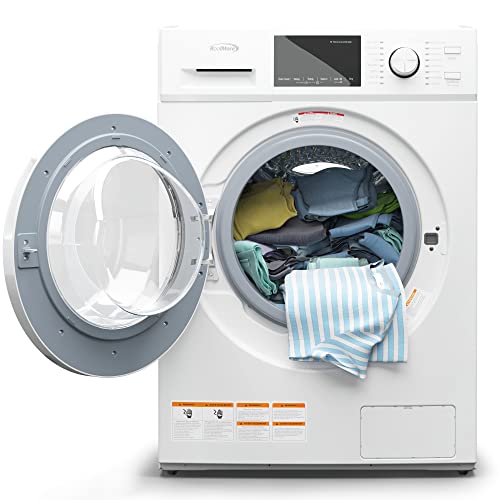
KoolMore 2-in-1 Front Load Washer and Dryer Combo — Best Wash-and-Dry Combo for Small Spaces
What the listing claims: a 2-in-1 front load washer and dryer combo of 2.7 cu. ft. on 120V, with sixteen wash cycles and four dry cycles, model FLC-3CWH, aimed at apartments, dorms and RVs. Sixteen wash programmes is the broadest list in this guide, and breadth serves the stain-minded owner of a small space: the heavy and extended cycles in such a list are where a combo machine does its soaking-adjacent work, holding small loads in detergent solution longer than a quick wash allows.
The combo format adds a soak-relevant virtue of its own: laundry cannot sit forgotten in a separate washer awaiting transfer, because the same drum dries it. Forgotten damp laundry is a stain and odour factory, and eliminating the transfer eliminates the forgetting. No steam or pre-soak wording appears in the listing, and combo drying is slower than a standalone dryer, so this pick serves small-space households whose loads are small and whose stains are everyday rather than industrial.
The KoolMore combo’s soak-adjacent virtue compounds over time: because washing and drying share a drum, heavily soiled small loads can be given the longest programme without any planning about transfers, and the load emerges finished. Dorm and RV owners, whose laundry competes with everything else in a small life, benefit most from that absence of logistics. Just respect the combo’s pace, since a machine that washes and dries serially rewards owners who run it steadily rather than in weekend avalanches.
KoolMore combo owners should keep loads modest even when the drum looks inviting, because a combo that must also dry its contents performs its wash stages best with room to tumble, and stain work especially needs that room.
KoolMore combo owners in RVs should weigh the machine’s water appetite against tank life, and will find its smaller loads and long programmes kinder to a travelling water supply than avalanche laundry days.
- Listing claims: 16 wash and 4 dry cycles
- Capacity: 2.7 cu. ft. washer-dryer combo
- Power: 120V, per the listing
- Model: FLC-3CWH, white
- Soak status: no steam or pre-soak wording in the listing
Strengths
- Broadest cycle list in this guide for small spaces
- One drum removes the forgotten-load problem
- 120V combo suits dorms, RVs and apartments
Trade-offs
- Combo drying takes longer than a separate dryer
- No steam mechanism for stubborn soil
- Capacity suits singles and couples, not families
Best for: small-space households wanting wash-and-dry in one footprint with many cycles.
Not suited for: families or anyone with heavy weekly stain loads.

Kenmore 2.2 Cu. Ft. Compact Front Load Washer — Best Compact With Steam Treatment
What the listing claims: a 2.2 cu. ft. compact front-load washer with wrinkle-relaxing steam treatment, Express and Accela Wash, touch controls and Energy Star certification. That makes it the only compact in this set whose title names steam, and for small-space buyers who refused to surrender the steam mechanism, it is the obvious landing place: the same soil-loosening logic as its full-size Kenmore sibling, scaled to a drum that fits under counters and in laundry closets.
The steam here is framed by the maker around wrinkles, and we report that framing faithfully; steam’s loosening effect on soil is a property of hot moisture, not of the marketing sentence attached to it, so stain-minded owners can reasonably press it into service on lightly soiled loads. Express and Accela options keep small everyday loads quick. No pre-soak wording appears, as with the whole set, but among compacts this is the strongest soak-adjacent claim available.
The compact Kenmore closes the set with the tidiest summary of the guide’s argument: a small machine, honestly labelled, whose steam treatment gives a small-space owner the same soil-loosening tool the big machines advertise, while its Express options admit that most loads need no treatment at all. Buyers choosing between it and the West Bend are choosing between a mechanism and a margin: steam assistance here, a little more cycle-list simplicity there. Either is defensible; pretending either has a labelled pre-soak is not.
The compact Kenmore’s touch panel wipes clean in a second, a detail that matters in the small laundry spaces it will inhabit, where the machine often doubles as the folding surface and collects the room’s splashes accordingly.
The compact Kenmore’s steam claim, modest as its framing is, makes it the pick most likely to be underestimated by headline readers and most appreciated by owners who actually press the button on stain day.
- Listing claims: wrinkle-relaxing steam treatment
- Capacity: 2.2 cu. ft. compact drum
- Speed: Express and Accela Wash options
- Controls: touch panel; Energy Star certified per listing
- Soak status: no pre-soak wording in the listing
Strengths
- Only compact here whose listing names steam
- Fast options keep small loads moving
- Touch controls suit modern small laundry spaces
Trade-offs
- Steam framed for wrinkles, not marketed for stains
- Compact drum excludes bulky bedding loads
- Premium claim in a small machine class
Best for: small-space buyers unwilling to give up steam assistance with stains.
Not suited for: families or buyers needing a true labelled soak stage.
How Do the Picks Compare Side by Side?
| Pick | Machine format | Key specification | Standout point |
|---|---|---|---|
| Kenmore 4.5 Full-Size, White | Full-size washer | 4.5 cu. ft., steam treatment | Soak via steam mechanism |
| LG WM4200HWA 5.0 Steam | Full-size washer | 5.0 cu. ft., steam wash | Soak via steam at large scale |
| BLACK+DECKER 4.5 Full-Size 120V | Full-size washer | 4.5 cu. ft., 120V, 12 cycles | Soak via long heavy cycles |
| West Bend Compact 2.2 | Compact washer | 2.2 cu. ft., 15 cycles | Soak via longer cycle choice |
| KoolMore 2-in-1 Combo 2.7 | Washer-dryer combo | 2.7 cu. ft., 16 wash cycles | Soak via extended programmes |
| Kenmore 2.2 Compact Steam | Compact washer | 2.2 cu. ft., steam treatment | Soak via steam in miniature |
Steam Versus Soaking: Which Actually Removes Your Stains?
Match the mechanism to the soil. Dried protein and food stains, sweat salts in collars and cuffs, and the general grime of workwear respond beautifully to time in warm dosed water, the classic soak, because the chemistry needs contact time more than force. Greasy and heat-set marks, odorous sportswear and bedding that needs a thorough freshening respond better to steam’s heat, which loosens and lifts what cold soaking leaves behind. Many real loads contain both, which is why experienced laundry keepers soak first and wash hot second, in a bucket if the machine offers no stage.
That is also why the steam-bearing picks in this guide are defensible answers to a pre-soak question rather than evasions: for the majority of household stain loads, steam treatment delivers the outcome the owner wanted from soaking, by a different road. Where the road matters (delicate dyes that dislike heat, or soil that truly needs a long cold rest), the bucket remains undefeated and free, and no honest guide should let a feature list talk you out of it.
How Do You Pre-Soak Effectively When Your Machine Has No Soak Stage?
Use the machine as a soaking vessel with a manual pause: start the heaviest suitable cycle, let the drum fill and tumble for several minutes until every item is saturated and the detergent is distributed, then pause the programme and leave the load resting in its solution. Most front-loaders hold a pause happily, keeping the door locked and the water in place. After half an hour or an overnight rest for the worst loads, resume and let the cycle complete. You have manufactured a pre-soak from a pause button.
The bucket method remains the controlled alternative for single garments: cool or warm water, the dose the detergent maker specifies for soaking, full immersion with a weight to keep buoyant items under, and patience proportional to the stain. Rinse or transfer the load to the machine afterwards. Small households with portable machines will find kindred improvisation in Best Portable Washing Machines and Compact Washers, where compact equipment is likewise stretched beyond its label by owners who understand the underlying process.
Which Loads Deserve a Soak, and Which Are Wasted on One?
Soak the loads where soil has dried into the fibres: sports kits after a weekend in the bag, gardening and work clothes, table linen after a feast, cloth nappies and baby clothes, and anything carrying food spills that missed wash day. These gain visibly from resting time, and treating them separately also protects the rest of the laundry from their company. Everyday lightly worn clothing gains almost nothing; its soil is surface dust and body oil that a normal cycle handles, and soaking it wastes water, time and detergent for no visible return.
Respect exclusions with the same care: wool and silk dislike prolonged immersion, some dyes bleed given time and an audience, and elastic ages faster in long hot baths. Read care labels before committing a load to any soak, machine or bucket, and test suspect colours alone first. Households choosing machines for volume will find the capacity side of these judgements expanded in Best Gas Dryers With Moisture Sensors, where matching machine size to real household loads is argued from the drying side of the same laundry day.
Which Detergents and Boosters Belong in a Soak?
A soak works with whatever detergent the load will be washed in, dosed as the maker directs for soaking, and that restraint matters: standing water with excess detergent coats fibres and demands rinsing that eats the gentleness you were buying. Oxygen-based stain boosters are the soak’s natural partner for colourfast cottons and linens, since they work slowly and kindly over exactly the timescale a soak provides. Chlorine bleach has its narrow, labelled place on whites and should never be improvised into coloured loads on a hopeful whim.
Enzyme products deserve their reputation with protein soils, food, sweat and grass, because enzymes literally dismantle those stains given time and lukewarm water, which is a description of a soak. Very hot water defeats them, so the soak for enzyme treatment starts warm, not scalding. Whatever chemistry you choose, one product at a time, mixed and dissolved before the load goes in, beats the folk tradition of adding everything the cupboard contains and hoping the stains are impressed.
How Does Hard Water Change Soaking and Steam Results?
Hard water taxes every laundry method, and soaking feels it first: minerals blunt detergent, deposit on fibres during long immersion, and can leave a grey cast that owners mistake for unremoved soil. If your water is hard, a soak needs the detergent dose adjusted as the maker suggests for hard water, and results improve more from that adjustment than from any extension of time. Steam machines in hard-water districts also appreciate the maintenance their manuals describe, since mineral scale gathers wherever water is heated.
None of this requires a water softener purchase to begin; it requires honesty about which variable is limiting you. A reader in a soft-water city and a reader in a limestone valley can own the same machine from this guide and report different stain results, both truthfully. Test your water once, write the result on the detergent shelf, and let that small fact govern doses, soak times and expectations from then on.
What Is the Sensible Stain Workflow for a Busy Household?
Triage at the hamper, not at the machine. A soaking bucket or a designated stain basket beside the laundry area collects the week’s genuine cases as they occur, each item noted mentally with its soil type, while ordinary laundry flows past untouched. On wash day, the stain load is assembled deliberately: similar colours, similar fabrics, the worst items given their soak or steam treatment together, and the rest of the household’s laundry runs its normal programmes in parallel rather than queueing behind the drama.
Speed lives in the noticing. A food spill blotted and wetted the evening it happens often needs no soak at all by Saturday, while the same spill dried for a week becomes the load this entire guide was written about. Households that master that single habit, treating stains when they are news rather than history, find their machines’ features suddenly seeming more powerful, because the features were only ever waiting for loads they could actually help.
How Do You Test Whether a Washer’s Soak or Steam Actually Works?
Run the household’s own experiment rather than trusting any guide, this one included. Take two comparable stained items from the same recurring load (the twin terrors of a sports kit serve perfectly), wash one on the machine’s ordinary cycle and the other with its steam treatment or your pause-and-rest soak, and compare them in daylight, not laundry-room gloom. Repeat across two or three stain types your household actually produces, because a feature that conquers grass and fails gravy is still the right feature for a gardening family and the wrong one for a saucier’s.
Keep the test honest: same detergent, same dose, same load size, and photographs if the difference is subtle enough to argue about. The result governs your routine for years, so an afternoon of method is cheap. Households often discover their machine’s best stain programme is not the one its marketing names, which is precisely why the experiment outperforms the brochure, and why this guide keeps returning readers to mechanisms and observations rather than badges.
Front-Load Versus Top-Load: Where Did the Pre-Soak Go?
Long-time laundry keepers remember pre-soak as a top-load ritual: fill the tub, agitate a minute, stop the machine and let the load rest in a full bath of solution, a technique the open tub made trivially easy. Front-loaders, washing in a shallow pool at the drum’s base with a sealed door, never hosted that ritual as naturally, and their makers instead competed on steam, on extended and staged programmes, and on detergent systems that dose at intervals. The feature did not vanish from laundry; it migrated into other mechanisms and into the pause button.
That history explains this guide’s pool: front-load listings speak steam because steam is what front-load engineering does well. Readers for whom the classic deep soak is non-negotiable, in quantity, should know the honest options are a top-load machine with a soak stage, a laundry sink and a bucket, or the pause technique taught here. Everyone else, which is most households with most stains, will find the modern front-load substitutes entirely sufficient, provided they are used deliberately rather than left on the default cycle forever.
How Should You Read a Washer Listing Like an Engineer?
Read for verbs and numbers, in that order. The verbs tell you the mechanisms the maker is willing to assert (steam treatment, express wash, a named cycle), and the numbers tell you the scale at which those mechanisms operate: drum capacity, cycle count, voltage. Adjectives cost the maker nothing and should be priced accordingly in your attention. When a listing’s title, as with every pick here, declines to claim the feature you searched for, believe the title; it is the most legally careful sentence on the page.
Then read the questions other buyers asked, since the answers often clarify cycle behaviour that marketing omits, and read the manual if the listing links one, because manuals describe stages with an honesty brochures avoid. A pre-soak, where it truly exists, appears in the manual’s cycle chart with a duration. Its absence there is the answer, whatever the search results implied, and learning to find that answer in ten minutes is worth more than any single machine recommendation in this guide.
How Should You Set Up a Stain Station in a Small Laundry Space?
Small spaces soak too, and the station that serves them fits on one shelf: a soaking bucket that nests inside the utility sink or the machine’s own drum when idle, the household’s chosen booster in a sealed tub, a soft brush for working solution into collars, and a hook for the cloth that wipes rims and bottles. Add a small waterproof notebook or a phone note listing what is soaking and since when, because an unlabelled bucket is a mystery that ends in either a second soak or a forgotten garment, and both waste the patience the method runs on.
The station’s position matters as much as its contents: within reach of the machine, under light good enough to judge a stain by, and away from the clean laundry’s landing zone so treated and untreated never mingle. Households that give soaking a physical home find the habit survives; households that improvise it weekly on the kitchen counter find it dies by the third month, mourned by nobody and missed by every stained shirt thereafter.
What Should a Soak-Minded Buyer Do in the First Week With a New Machine?
Resist the default cycle. Spend the first week learning the panel the way you would learn a new oven: run the steam programme on the load it was born for, try the heaviest cycle on the week’s worst laundry, and perform one deliberate pause-and-rest soak so the technique is practised before it is needed in anger. Note what each programme actually does with time and temperature, since the display’s quiet facts teach more than the brochure’s adjectives, and write the two or three programmes you will genuinely use on a card kept with the detergent.
That small apprenticeship converts a feature list into a household skill, which was this guide’s argument from its first paragraph. A machine whose owner knows its mechanisms will out-clean a technically superior machine run forever on its quickest setting, and the stained shirt, which cannot read brochures, will testify to the difference without knowing any of the words involved.
How Do You Talk a Household Out of the Default Cycle?
Every laundry household has a default cycle, chosen in the machine’s first week and defended thereafter like a family recipe, and stain loads suffer under its government more than under any missing feature. The way out is demonstration, not argument: wash the recurring worst load once on the default and once on the machine’s proper heavy or steam programme, hang the results side by side in daylight, and let the fabric make the case. Households believe their eyes at a rate no manual has ever achieved, and the default usually falls within a fortnight of the experiment.
Replace the fallen default with a tiny written repertoire, three programmes maximum, taped inside the detergent cupboard: the everyday, the heavy, and the treatment, each with its load described in the household’s own words. That card is the true pre-soak option most homes were shopping for all along: not a button, but a remembered intention, available on every machine in this guide and, in fairness, on the machine already standing in most readers’ laundry rooms.
What Mistakes Do Buyers Make When Shopping for a Pre-Soak?
The founding mistake is trusting the keyword over the listing: assuming a machine offers pre-soak because a search page grouped it under the term, or because a salesperson used soak as a loose synonym for steam, pre-wash or a long cycle. Read the cycle list. If no stage rests the load, the machine has no pre-soak, whatever the headline implied. The second mistake is the mirror image: dismissing steam machines entirely, then buying a labelled soak on a machine whose drum, capacity or reliability suits the household worse.
Owners also misuse the feature they have: soaking everything, including loads that gain nothing, until laundry day doubles in length and the habit dies within a month. And detergent dosing for soaks is its own trap, since more powder in standing water mostly means more rinsing later. Measured doses, targeted loads and honest mechanisms are the whole craft; the feature name on the panel is only the beginning of it.
One more buyer error completes the set: purchasing capacity for the stain load and forgetting the everyday one. A household that soaks a small basket weekly but washes family loads daily should size the drum for the daily truth and treat the stain basket with the pause technique or the bucket. Machines bought for their rarest load disappoint daily, while machines bought for the daily load, used cleverly once a week, disappoint almost never.
Final Recommendation
If your stains are family-scale and weekly, choose between the two steam full-sizers: the Kenmore for its straightforward steam-and-speed package, the LG when the 5.0 cu. ft. drum and its intensive cycle match your bedding and kit volume. Small-space buyers should take the compact Kenmore for its steam claim, or the KoolMore combo when one-drum washing and drying matters more. The BLACK+DECKER and West Bend serve buyers whose wiring or space constraints outrank their stain severity, and they serve them honestly.
Above all, take the translation skill this guide tried to teach: read any panel for what its stages actually do, and no keyword will ever mislead you again. A machine whose mechanism matches your soil is a pre-soak machine in every way that matters to the laundry, whatever words its maker chose to print.
So the honest headline stands: the pre-soak you can buy today, in a front-loader, is mostly a mechanism and a method rather than a button. Choose the mechanism that matches your soil, learn the method in an afternoon, and your laundry will behave as though the button existed, which, for every practical purpose that matters to a clean shirt, it will.
Keep the bucket, whatever machine you buy. It costs nothing, asks nothing, and remains the control group against which every feature must prove itself, the humble standard of patience against which steam, cycles and panels are measured. A household that keeps a soaking bucket beside a modern machine is not behind the times; it is the only household in the street that knows exactly what its machine’s features are worth.
Frequently Asked Questions
Why does no washer here list an actual pre-soak cycle?
Because in the verified pool for this guide, no listing prints the term. Pre-soak survives more often as a selectable stage on some top-load designs and as a manual pause technique on front-loaders, while front-load makers have largely replaced it with steam and extended cycles. We chose honesty about that over inventing the feature.
Is a pre-wash the same thing as a pre-soak?
No. A pre-wash is a short, active preliminary wash that drains before the main cycle, good for loosening surface dirt on very dirty loads. A pre-soak rests the load in dosed water, letting chemistry work over time. They can complement each other, but one does not substitute for the other on dried, set stains.
Can steam damage the clothes I would have soaked gently?
Steam programmes run hot, so heat-sensitive fabrics, some dyes and elastic deserve the caution their care labels advise. For delicate items you would soak cool and briefly, the bucket remains the right tool. Use steam for the sturdy, heavily soiled loads it suits, as the listings frame it.
How long should a pre-soak last for typical stains?
For everyday dried soil, thirty minutes to an hour in correctly dosed water accomplishes most of what soaking can do. Very stubborn loads can rest several hours or overnight, though beyond that the water itself becomes the problem, and a fresh solution serves better than an ageing one.
Does soaking reduce the wash cycle I need afterwards?
It can. A well-soaked load often washes clean on a normal cycle where an unsoaked load needed the heavy programme, saving time, water and fabric wear overall. Judge by results on your own recurring loads, and reserve heavy cycles for the loads that still demand them.
Should I add extra detergent for a soak?
Use the dose the detergent maker specifies for soaking, which is printed on most packaging, rather than improvising a stronger mixture. Excess detergent in standing water coats fabric and demands extra rinsing, undoing the gentleness that made soaking attractive in the first place.
Will soaking fade my clothes?
Prolonged immersion can fade some dyes, particularly in warm water and with oxygen boosters, which is why care labels and a first solo test govern suspect items. Most everyday cottons tolerate a normal soak without complaint; the risk concentrates in deep, cheap dyes and delicate fabrics that should not be soaked long in any case.
Can I soak a load overnight in the machine itself?
Using the pause technique, many owners do, though a very long rest in dirty water has diminishing returns and the load should be washed promptly in the morning. For overnight treatment the bucket is arguably the better vessel, freeing the machine and letting you inspect the water and the stain before committing to a cycle.
Does soaking help with odours in sportswear, or only stains?
Both, though by different chemistry: soaking gives detergent and boosters time to reach the residue that hosts odour in synthetic fibres, and steam programmes are often chosen for sportswear for the same reason. Persistently odorous kit may also be carrying detergent build-up from overdosing, which a plain hot rinse cycle sometimes cures better than any treatment.
Is it worth paying more for a steam model if I mostly wash lightly soiled clothes?
Probably not, and the honesty cuts both ways: steam earns its premium on the loads that need loosening, and a household without those loads is buying a mechanism it will admire rather than use. Spend the difference on capacity or efficiency you will touch daily, and keep the bucket for the rare stain that deserves it.
Related Guides
If your laundry routine runs from soaking to drying in one small room, our companion guide to Best Bath Rugs for Front-Load Washers covers the floor in front of the machine, sized and chosen for exactly these appliances.



[…] the geometry. Readers comparing machine formats will find the same mechanism-first thinking in Best Front-Load Washers With a Pre-Soak Option, where cycle design is likewise explained by what the water and drum are actually […]