What's inside
- Quick Picks
- How We Chose These Picks
- Key Takeaways
- Detailed Reviews
- Comparison Table
- How to Choose the Right Loft When You Sleep on Your Side
- How Do You Keep a Down Pillow Lofty Month After Month?
- Common Mistakes People Make With a First Down Pillow
- What Does Fill Power Actually Tell a Side Sleeper?
- How Does a Down Pillow Change With the Seasons?
- What Should Couples Do When One Partner Sleeps on Their Side and the Other Does Not?
- How Do You Judge a New Pillow Across Its First Three Nights?
- Why Do Protectors and Cases Change How These Pillows Feel?
- What Is the Difference Between the Down and the Feather Inside These Pillows?
- What Does Hotel Collection Actually Mean on a Pillow Listing?
- Should a Side Sleeper Keep a Second Pillow in the Bed?
- Final Recommendation
- Frequently Asked Questions
- Related Guides
As an Amazon Associate I earn from qualifying purchases. This post may contain affiliate links at no extra cost to you.
As an Amazon Associate, cottageverdict.com earns from qualifying purchases made through links in this guide — at no extra cost to you.
Where to buy: all six pillows below are sold on Amazon, and you will find each name linked in the Quick Picks table, again in its review heading, and once more in the comparison table near the end, so check price on Amazon on the listing itself and double-check the size, the set count and the colour before you order. Anyone hunting for the best goose down pillows for side sleepers is really hunting for loft that survives the night, because a side sleeper’s head rests higher off the mattress than a back sleeper’s does, and the gap between mattress and ear is exactly what a good pillow has to fill without feeling like a folded towel.
Down and feather pillows behave differently from the foam and fibre pillows most people grew up with. The fill is loose rather than moulded, so it can be punched, folded and scrunched into the hollow under your neck, and it springs back when you shake it in the morning. That adjustability is why side sleepers keep returning to natural fill even though it asks for more care: a pillow you can reshape nightly can follow a shoulder that sits wide one night and a curled, knees-up posture the next. What varies across this group is the blend of down to feather, the shell fabric, the firmness the listing claims, and the size on offer, from standard through queen to a full king at twenty by thirty-six inches.
Feathers give structure. Their quills are the reason a feather-heavy pillow holds a shape instead of collapsing into a puddle, while down clusters are the soft part that keeps the surface from feeling prickly or hard. Listings in this guide mix the two in different proportions, although most do not publish an exact ratio, and we have not invented one anywhere below. Where a title states a fill power figure we report it as the listing states it; where it stays silent, the spec box says so plainly. Side sleepers should read firmness words carefully too, because one maker’s medium firm is another maker’s soft, and the only honest comparison is the one built from the words each listing actually uses.
Quick Picks
| Pick | Badge | Why it earns its place |
|---|---|---|
| puredown Goose Down Pillows | Best Standard Pair | A standard-size set of two in a full cotton cover, the straightforward starting point for a first natural-fill pillow. |
| DOWNCOOL Goose Down Pillows | Best Queen Value Pair | Queen pillows at twenty by thirty inches, sold as a pair, with soft support the listing aims at all three sleep positions. |
| Shilucheng Goose Down Pillow King | Highest Stated Fill Power | A single king pillow whose listing states a 1050+ fill power figure, the only numbered loft claim in this group. |
| COZSINOOR Goose Down Feather Pillows | Softest Hotel Feel | A queen pair under a 600 thread count cotton cover, described by its maker as soft and fluffy for mixed-position sleepers. |
| Pacific Coast Goose Feather and Down Pillows | Firmest Build | Gusseted king pillows the listing calls firm, with an organic cotton fabric shell for sleepers who dislike sink. |
| Three Geese Feather Down Pillows | Best Medium Firm Balance | Feather and down wrapped around cotton batting, a construction the listing rates medium firm in a queen and standard size. |
How We Chose These Picks
We began with the keyword itself and kept only pillows whose listings name goose down, goose feather, or both in the fill, because a guide with goose in the title owes the reader actual goose fill rather than a down-alternative substitute wearing similar language. From that field we wanted a spread of sizes, since side sleepers shop standard, queen and king beds alike, and a spread of stated firmness, since shoulder width and mattress softness push different sleepers toward softer or firmer pillows. Sets of two dominate the list because most buyers replace pillows in pairs, but we kept one single king pillow whose stated fill power made it too distinctive to leave out.
Every fact in the reviews below traces back to the wording of the assigned listing title. When a title gives dimensions, a thread count, a shell fibre or a set count, we use it. When a title is silent about fill ratio, loft height or care instructions, the spec box records the gap instead of filling it with a guess, and the review judges the pillow on what is known: its size, its shell, its stated firmness and the way loose natural fill behaves in ordinary use. Listing phrases about comfort outcomes are treated as the maker’s language, never as promises this guide endorses, and our guidance for side sleepers stays with loft, shoulder room and reshaping, which are the things a buyer can actually assess.
Key Takeaways
- Loose goose down and feather fill can be punched and folded into the space under the neck, which is the main reason side sleepers favour it over a fixed-shape pillow.
- Only one listing here states a fill power number; for the other five, judge by stated firmness, size and shell rather than by a loft figure nobody published.
- Gussets and batting change how a natural-fill pillow holds its height, so construction details matter as much as the fill itself.
- King pillows at twenty by thirty-six inches suit wide shoulders and restless sleepers who travel across the pillow during the night.
- Natural fill rewards a morning shake and a pillow protector, and it punishes neglect faster than synthetic fill does.
Detailed Reviews
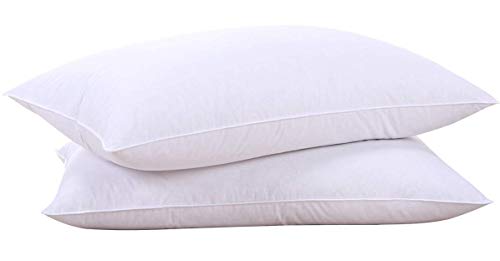
puredown Goose Down Pillows
The puredown pair is the least complicated purchase in this guide, and that is its appeal. The listing describes goose feathers and down inside a cover of one hundred percent cotton, sold as a set of two in standard size, and positioned as part of a hotel collection. Nothing in that description reaches for superlatives, and for a first step into natural fill, restraint is useful: you learn how loose fill feels under your head without also adjusting to an unusual size or an extreme firmness claim. Standard dimensions fit the pillowcases most households already own, which quietly removes the extra purchase that queen and king pillows often trigger.
For a side sleeper, the working question is whether a standard pillow gives enough length. A sleeper who stays near the centre of the pillow will be fine; a sleeper who migrates toward the edge, or who folds the pillow double for extra height, may find the standard footprint used up quickly. The feather component should keep the pillow from flattening into a sheet by morning, since feather is the structural part of any down blend, while the down softens the surface against the ear. Because the listing gives no fill power and no ratio, we cannot rank its loft against the Shilucheng’s stated figure, and we will not pretend otherwise; what we can say is that the all-cotton shell is the right partner for natural fill, since cotton breathes and lets the fill dry out fully between uses.
Households buying for a guest room often land here, and the pair format suits that job. Two matching pillows dress a bed evenly, the hotel-collection framing matches how guests expect a bed to feel, and a protector over each one keeps the natural fill clean through many short stays. If your own sleep is the priority and your shoulders are broad, read on toward the larger sizes before deciding, because the next picks give you more pillow to work with.
- Fill as titled: goose feathers and down
- Cover as titled: 100% cotton
- Size as titled: standard
- Set count as titled: set of 2
- Fill power: not stated in the listing
- Fill ratio: not given
Strengths
- Full cotton cover over genuine goose feather and down fill
- Standard size works with pillowcases already in the cupboard
- Pair format dresses a bed evenly for guests or couples
Trade-offs
- Shortest footprint here, so edge sleepers run out of pillow
- No fill power or ratio published to judge loft by
- Loose fill needs daily plumping to keep its height
Best for: first-time natural-fill buyers and guest rooms in standard size. Not suited for: broad-shouldered side sleepers who need maximum length and height.

DOWNCOOL Goose Down Pillows
DOWNCOOL sells its goose down pillows as a queen-size set of two and gives the dimensions outright: twenty by thirty inches. That extra length over a standard pillow is not a trivial detail for a side sleeper. It means the pillow spans more of the bed’s width, so turning from one side to the other does not require dragging the pillow along, and there is enough material to bunch a supportive roll under the neck while the head stays on the flatter middle. The listing describes the support as soft and addresses the pillow to side, back and stomach sleepers alike, which tells you the design aims at a general audience rather than at side sleepers alone.
Soft support deserves an honest translation. A soft natural-fill pillow lets the head sink deeper, and a side sleeper with narrow shoulders or a soft mattress may find that sink exactly right, because the mattress itself is already giving under the shoulder and the pillow needs less height to bridge the remaining gap. A heavier sleeper on a firm mattress is the opposite case: the same softness can leave the head dropping toward the mattress through the night. DOWNCOOL’s own framing, a better sleep experience, is maker language we report without endorsing; the measurable facts are the queen footprint, the pair count and the white colourway of this listing.
Consider this pair if your household sleeps in mixed positions and one pillow style has to serve a side sleeper most nights and a back sleeper on others. A reshapeable fill handles that rotation gracefully, since each sleeper can punch the pillow into a personal shape in seconds. What the listing does not state is the shell fabric or any fill power figure, so buyers who care about an all-cotton shell should note the gap and weigh the puredown or COZSINOOR pairs, whose covers are spelled out, against this one’s larger stated dimensions.
- Fill as titled: goose down
- Size as titled: queen, 20 x 30 inches
- Set count as titled: set of 2
- Support as titled: soft support
- Shell fabric: none stated in the listing
- Fill power: not stated in the listing
Strengths
- Stated queen dimensions give side sleepers room to turn
- Soft fill reshapes easily between different sleep positions
- Two pillows in the box cover a full bed in one order
Trade-offs
- Soft support may sink too far for heavy sleepers on firm beds
- Shell material is not named in the listing title
- No fill power figure to compare loft against rivals
Best for: mixed-position couples on queen beds who like a softer feel. Not suited for: side sleepers who already know they need firm, high support.

Shilucheng Goose Down Pillow King
One number sets the Shilucheng apart from everything else in this guide: its listing states a fill power of 1050+, the only quantified loft claim among the six. Fill power describes how much space a given weight of down occupies, and a higher figure generally means a lighter, loftier cluster, so a maker willing to print a number is at least inviting a comparison the other five decline. The pillow itself is a king, twenty by thirty-six inches, sold singly, with a shell the listing describes as one hundred percent cotton, filled with goose down and feather. That is a serious amount of pillow, and side sleepers with wide shoulders are the audience who will use all of it.
Length changes how a side sleeper sleeps. Thirty-six inches lets you anchor the far end with a forearm, keep a raised section under the neck and still have pillow left under the head, and it fills the width of a king bed the way two standard pillows never quite do. The listing also carries comfort language aimed at side sleepers, which we treat strictly as the maker’s phrasing; our own case for this pillow rests on its stated size, its cotton shell and that published fill power figure, not on any outcome a pillow could promise. Buyers should also register the practical side of a single: if your partner wants the same pillow, you are ordering twice, and king pillowcases are a separate purchase if your linen cupboard holds only standard and queen.
Treat this as the enthusiast’s pick. It asks the most commitment in size and in care, since a large natural-fill pillow needs a proper shake-out and airing space, and in return it offers the most material to shape and the only stated loft specification in the group. If you have ever folded a standard pillow in half and still felt under-supported, the Shilucheng is the shape of answer you have been improvising toward.
- Fill as titled: goose down and feather
- Fill power as titled: 1050+
- Shell as titled: 100% cotton
- Size as titled: king, 20 x 36 inches
- Set count as titled: set of 1
- Loft height in inches: not given
Strengths
- Only listing here that publishes a fill power figure
- Full king length gives broad shoulders real room
- Cotton shell stated plainly in the listing
Trade-offs
- Sold singly, so a matching pair costs two orders
- Needs king pillowcases many households do not own
- Large loose-fill pillow takes space to air and plump
Best for: broad-shouldered side sleepers who want maximum length and a stated loft spec. Not suited for: buyers furnishing a whole bed quickly on a pair budget.

COZSINOOR Goose Down Feather Pillows
COZSINOOR leans into the hotel idea harder than any rival here. The listing promises hotel quality, a soft feel, and a cover of six hundred thread count cotton over its goose down and feather fill, in a queen-size set of two. Thread count is a shell specification rather than a fill one, and a denser cotton weave matters on a feather pillow for a practical reason: the tighter the weave, the harder it is for a stray feather quill to work its way through the fabric and announce itself against your cheek at two in the morning. A smooth, dense shell also slides into a pillowcase more easily and feels cooler and crisper against the skin than a coarse weave does.
The fill description uses the word fluffy, and the support is addressed to back, stomach and side sleepers together. Read that as a soft, yielding pillow rather than a high, firm one. Side sleepers who choose it should expect to fold or bunch it for height, which loose fill permits, and should think of the pillow as raw material for a shape they build nightly instead of a shape that arrives ready-made. Sleepers who toss between back and side often prefer exactly that bargain, because a pillow soft enough for back sleeping rarely arrives firm enough for side sleeping unless its owner reshapes it at each turn, and this fill invites reshaping.
Where the COZSINOOR gives ground is specification depth. The listing states no dimensions in figures, no fill power and no down-to-feather ratio, so the buyer is trusting the queen label and the maker’s softness language. For many households that trust is well placed, because the tangible facts, a dense cotton cover and a pair of queen pillows with genuine goose fill, cover what nightly use actually tests. If you keep a spreadsheet in your head while shopping, the Shilucheng and DOWNCOOL listings give you numbers to file; this one gives you a shell worth touching.
- Fill as titled: goose down and feather
- Cover as titled: 600 TC cotton
- Size as titled: queen
- Set count as titled: set of 2
- Dimensions in inches: none stated in the listing
- Fill power: not given
Strengths
- Dense 600 thread count cotton shell resists quill poke-through
- Soft, fluffy fill reshapes for back and side positions alike
- Queen pair suits the most common bed size in this guide
Trade-offs
- Softness means side sleepers must bunch it for height
- No numeric dimensions published in the title
- Hotel-soft feel will disappoint firm-pillow loyalists
Best for: sleepers who rotate between back and side and love a crisp cotton shell. Not suited for: anyone who wants a pillow that stays tall without being folded.

Pacific Coast Goose Feather and Down Pillows
Pacific Coast is the firm answer in a group of soft ones. Its listing describes king-size pillows, sold as a set of two, filled with goose feather and down, wrapped in a fabric it names as one hundred percent organic cotton, and built with gussets. A gusset is a strip of fabric sewn around the pillow’s edge so the pillow has a side wall rather than pinched seams, and that construction lets the fill spread toward the edges instead of being squeezed into a central mound. For a side sleeper, a gusseted edge is the part of the pillow that meets the shoulder and the side of the neck, so the shape is more than a styling detail.
The listing’s firm label is the other headline. Firm natural fill usually means a higher feather share doing structural work, although this listing does not publish its ratio, so we describe the claim as the maker states it rather than reverse-engineering a recipe. What firmness buys a side sleeper is height that stays: the head rests on a surface that compresses less through the night, and the morning pillow looks closer to the evening pillow than a soft fill ever manages. The cost of that stability is give. A firm feather pillow does not mould around the ear and jaw the way a soft down pillow does, and stomach sleepers borrowing it will find it far too tall.
The organic cotton wording belongs to the listing, and we repeat it as the shell description the maker chose. Buyers for whom that fabric claim matters should read the full listing for whatever supporting detail the maker provides there, since the title alone carries no certifier’s name. Taken on its stated facts, this is the pick for the sleeper who has tried soft down, woken with the pillow flattened, and decided that structure matters more than sink. Two king pillows in the box also make it the easiest route to a matched, firm pair for a king bed.
- Fill as titled: goose feather and down
- Fabric as titled: 100% organic cotton
- Size as titled: king
- Set count as titled: set of 2
- Construction as titled: gusseted, firm
- Fill ratio: not stated in the listing
Strengths
- Firm build holds height through the night for side sleepers
- Gusseted edges spread fill toward the pillow’s border
- King pair covers a king bed with matched firmness
Trade-offs
- Firm surface gives less moulding around the head
- Too tall and solid for stomach sleeping
- Ratio behind the firmness claim is not published
Best for: side and back sleepers on king beds who want structure over sink. Not suited for: soft-pillow devotees or anyone who sleeps mostly face down.

Three Geese Feather Down Pillows
Three Geese builds its pillow differently, and the listing says so in an unusual amount of detail: white goose feather and down surrounded by cotton batting, inside a six hundred thread count cover of one hundred percent cotton, rated medium firm, in a queen and standard size sold as a set of two. The batting layer is the interesting part. Wrapping the loose fill in batting gives the pillow a more uniform surface and a more defined shape than a plain bag of feathers and down, because the batting holds the fill’s outline while the centre stays soft. It is a hybrid instinct inside a natural-fill pillow, and it suits buyers who like down’s feel but dislike the lumpy, drifting character of an unstructured fill.
Medium firm is the rating side sleepers most often end up keeping, and the reasoning is mechanical. A pillow that yields a little lets the head settle into a stable pocket; a pillow that yields not at all pushes back all night. With batting moderating the fill, this pillow should hold a middle course, supportive at the neck edge and forgiving at the centre. The listing’s phrase soft support sits beside its medium firm rating, which reads like a maker describing exactly that split personality: structured first impression, soft landing.
The size wording, queen and standard, is the one ambiguity in an otherwise specific listing, so confirm which footprint you are ordering on the listing page before the box arrives. Beyond that caution, this is the most construction-forward option in the guide, and the one we would show a sceptic who assumes every down pillow is a shapeless sack. It keeps the natural materials and the dense cotton shell while borrowing a little discipline from the batting wrap, and for households replacing pillows for two different sleepers, a middle firmness is the diplomatic choice.
- Fill as titled: white goose feather and down
- Construction as titled: fill surrounded by cotton batting
- Cover as titled: 600 thread count, 100% cotton
- Firmness as titled: medium firm
- Size as titled: queen/standard
- Set count as titled: set of 2
Strengths
- Batting wrap gives loose fill a steadier, smoother outline
- Medium firm rating fits the widest range of side sleepers
- Dense cotton cover matches the COZSINOOR’s shell quality
Trade-offs
- Size wording needs confirming on the listing before ordering
- Batting makes it less scrunchable than a plain loose fill
- Middle firmness may still feel soft to firm-pillow loyalists
Best for: side sleepers who want natural fill with a tidier, more held shape. Not suited for: buyers who love folding a pillow into extreme shapes nightly.
Comparison Table
Six pillows, three sizes and three firmness directions: the table gathers the facts each listing actually publishes, so the gaps are as visible as the claims. Notice how rarely a number appears, and let that teach you how this category sells itself.
| Pick | Size | Set | Shell | Stated firmness |
|---|---|---|---|---|
| puredown Goose Down Pillows | Standard | 2 | 100% cotton | Not in listing |
| DOWNCOOL Goose Down Pillows | Queen 20 x 30 in | 2 | Shell not in listing | Soft support |
| Shilucheng Goose Down Pillow King | King 20 x 36 in | 1 | 100% cotton | Fill power 1050+ stated |
| COZSINOOR Goose Down Feather Pillows | Queen | 2 | 600 TC cotton | Soft |
| Pacific Coast Goose Feather and Down Pillows | King | 2 | 100% organic cotton fabric | Firm, gusseted |
| Three Geese Feather Down Pillows | Queen/Standard | 2 | 600 TC 100% cotton | Medium firm |
How to Choose the Right Loft When You Sleep on Your Side
Begin with your mattress, because the pillow does not work alone. Sink into the bed on your side and notice how far your shoulder presses in: a soft mattress swallows the shoulder and shrinks the gap the pillow must fill, while a firm mattress leaves the shoulder perched on top and the gap at full size. Firm-bed sleepers should lean toward the Pacific Coast’s firm build or the Shilucheng’s generous king fill, and soft-bed sleepers can happily choose the softer pairs. Shoulder width is the second measurement, and it is the one people skip. Broad shoulders need height; narrow shoulders on a tall pillow end up with the head tipped all night.
Then decide how you treat a pillow. Some sleepers lay their head down and stay; others knead, fold and rebuild. Stayers can choose construction, like the Three Geese batting wrap or the Pacific Coast gusset, that holds a shape for them. Builders should choose loose, unstructured fill like the puredown or COZSINOOR pairs, which tolerate endless reshaping without a batting layer resisting the fold. Finally, count your pillowcases. A king pillow without a king case is a nightly wrestling match with spare fabric or a too-tight squeeze, so let the linen cupboard vote before the size does.
How Do You Keep a Down Pillow Lofty Month After Month?
Natural fill stays lofty through air and agitation, not through washing. Shake the pillow from all four sides each morning, because the fill migrates toward the middle overnight and a thirty-second redistribution undoes it. Give the pillows an hour of fresh air on a dry day when you change the bed, since down and feather hold moisture from sleep and loft returns as they dry. A washable protector is the single best accessory purchase in this whole category: it intercepts skin oil and moisture, the two things that slowly mat natural fill, and it washes in minutes while the pillow itself stays out of the machine. When washing the pillow itself cannot be avoided, follow whatever instructions the maker gives on the listing or the sewn label, use a large machine, and dry thoroughly, because fill put away damp loses loft and gains odour in equal measure.
Common Mistakes People Make With a First Down Pillow
The most common mistake is judging the pillow in the first ten seconds. Loose fill arrives compressed from its packaging and needs shaking and a few hours of air before it shows its real height, so a pillow condemned at unboxing might have been the right one by bedtime. The second mistake is buying softness by name alone. Soft, medium and firm are unregulated words, and this guide’s own table shows makers using them for quite different constructions; the shell, the size and the structure tell you more than the adjective. Third, sleepers forget the protector and then blame the fill for flattening that skin oil caused. Fourth, couples buy one pillow each in different sizes because each shopped alone, and end up with a lopsided bed and mismatched cases. Agree the size as a household, then argue about firmness, which is the argument actually worth having.
What Does Fill Power Actually Tell a Side Sleeper?
Fill power measures how much volume a small weight of down puffs into, so it describes the down’s efficiency rather than the pillow’s height. A high figure means the maker can reach a given loft with less fill by weight, and the pillow feels lighter for its size. Only the Shilucheng listing in this guide publishes a figure, 1050+, which is why we flag it rather than building a league table nobody else entered. The trap is assuming a pillow without a published figure must be worse; several makers simply sell on firmness language and shell quality instead. Use fill power when it is offered, as one fact among several, and never let its absence disqualify a pillow whose size, shell and stated firmness match your bed.
How Does a Down Pillow Change With the Seasons?
Natural fill breathes in a way foam cannot, because air moves between the clusters instead of sitting trapped in a solid block, and that airflow is why down pillows feel less clammy in summer than their warmth suggests. In winter the same clusters trap air and feel insulating around the head and shoulders, which side sleepers notice most on the exposed upper shoulder that a blanket keeps slipping off. The seasonal catch is humidity. Down absorbs moisture from the air as well as from the sleeper, and in a damp week a pillow can feel fractionally heavier and flatter until a dry, airy day restores it. Households in humid climates should build the airing habit described earlier into the weekly bed change rather than treating it as an occasional rescue, because small regular drying beats one heroic annual effort.
Cotton shells help across all four seasons, and every pick in this guide whose shell is described at all names cotton, at either a plain weave or a six hundred thread count. Cotton takes up moisture and releases it again as the room dries, it feels cool on first contact in a warm room, and it does not rustle the way some synthetic shells do when a sleeper turns. If you sleep hot, the shell may matter as much to your comfort as the fill does, which is another reason the spec boxes above record shell wording so carefully and mark the one listing that leaves it unstated.
What Should Couples Do When One Partner Sleeps on Their Side and the Other Does Not?
Shared beds create a negotiation that single sleepers never face, because the pair format of most listings in this guide pushes couples toward matching pillows even when their needs diverge. Resist the matching instinct where it hurts. There is no rule that both sides of a bed must carry the same pillow, and the bed will still look dressed if the pillowcases match while the pillows inside differ. A side sleeper can take the Pacific Coast’s firm king while a back-sleeping partner takes the softer COZSINOOR queen, and the eye reads the cases, not the fill.
Where one pillow style must serve both, perhaps in a guest room or a small flat with one set of spares, choose the middle of the range and choose loose fill. The Three Geese pair, medium firm with its batting-stabilised shape, is the diplomatic option in this group precisely because neither a side sleeper nor a back sleeper finds it extreme. Loose fill also lets each person rebuild the pillow at their own side of the evening, one punching a neck roll, the other flattening the centre, and that nightly customisation quietly resolves arguments that firmness labels never settle.
How Do You Judge a New Pillow Across Its First Three Nights?
Night one tells you almost nothing except whether the size fits your bed and your cases, because the fill is still expanding and your body is still comparing the new pillow with the old one it remembers. Spend that night noticing logistics: does the pillow stay on the bed when you turn, does the case fit without squeezing the loft away, does the shell feel pleasant against your face. Night two is when shaping experiments belong. Try the pillow flat, then folded, then with a bunched roll at the neck edge, and note which arrangement you stop adjusting, because the arrangement you stop fiddling with is the one your body has voted for.
By night three, judge the morning evidence. A pillow that suits you leaves you reaching for it rather than pushing it aside in the night, and it should still hold a reasonable shape at waking instead of arriving at dawn as a flat mat with one sad mound. If the pillow fails by night three despite honest shaping attempts, the mismatch is real and no fourth night of loyalty will fix it; side sleepers in particular should trust that verdict, because a pillow that is too soft or too low announces itself the same way every night. Keep packaging until the third morning if your retailer’s policy makes returns time-sensitive, and photograph the pillow’s loft beside a book or a ruler on night one, so later comparisons rest on evidence rather than on mood.
Why Do Protectors and Cases Change How These Pillows Feel?
A protector is not a neutral wrapper. A thick, quilted protector adds its own padding and can mute the softness that made you choose a down pillow, while a thin cotton protector guards the fill with barely any change to the feel. Choose thin for the soft pairs, and let the firm Pacific Coast carry a slightly padded protector if its surface feels unyielding at first, because there the extra layer works for you. The pillowcase matters in the same direction: a case cut too small compresses loose fill and steals height, which is why king pillows squeezed into queen cases feel mysteriously disappointing. Match the case to the pillow’s stated size, allow a little ease, and prefer smooth cotton weaves that let the head settle rather than grippy fabrics that drag at the hair and skin through a turn.
Protectors also decide how often the pillow itself meets water, and for natural fill, less is more. Wash protectors with the weekly linen, air the pillows while the bed is stripped, and the fill can go long stretches without a full wash, which preserves the clusters’ spring. Households with allergies in the family often ask whether a natural-fill pillow is a sensible purchase at all; that is a question for their own clinician rather than for a buying guide, and our part is limited to noting that washable protectors and dense cotton shells are the features such households usually look for first.
What Is the Difference Between the Down and the Feather Inside These Pillows?
Down and feather come from the same bird and do opposite jobs, and understanding the division explains nearly every firmness word in this guide. Down is the soft undercoating that grows beneath a goose’s outer feathers: it has no hard quill, just a tiny centre with filaments radiating outward, and those filaments trap air in three dimensions, which is where loft and lightness come from. Feather is the outer plumage, flatter, heavier, and built around a quill shaft that gives it spring and structure. A pillow filled mostly with down feels cloudlike and moulds closely, but it can collapse under a heavy head unless the clusters are of high quality. A pillow with a generous feather share feels firmer, pushes back more, and holds a shape through the night, at the cost of occasional quill awareness through a thin shell.
Makers blend the two because each covers the other’s weakness, and the blend is the real recipe behind labels like soft, medium firm and firm. The frustration for buyers is that most listings in this guide, like most of the category, decline to publish the blend, so the firmness adjective and the construction details have to stand in for the missing numbers. That is why the reviews above keep returning to what can be verified: the Pacific Coast calls itself firm and adds a gusset, the Three Geese wraps its blend in batting and calls the result medium firm, and the COZSINOOR calls itself soft and fluffy. When a maker does publish a hard specification, as Shilucheng does with fill power, it deserves the attention this guide gives it, not because one number settles the purchase but because a published number can be checked, compared and held to account in a way an adjective cannot.
There is also a sourcing footnote worth one honest paragraph. Listings here describe white goose fill in several cases, and colour of fill is mostly an aesthetic tradition, since the fill hides inside an opaque shell; white fill matters under very pale, thin shells where darker fill could shadow through. Beyond that, the titles in this guide make no claims about sourcing standards or certifications for the fill itself, and we have added none. A buyer who wants documented sourcing should look for it in the full listing text and treat its absence as a gap, exactly as the spec boxes treat absent dimensions.
What Does Hotel Collection Actually Mean on a Pillow Listing?
Three of the six listings in this guide reach for hotel language, and the phrase deserves translation because it shapes expectations. Hotels buy pillows that must please a different stranger every few nights, survive industrial laundering, and feel welcoming to back, side and stomach sleepers alike, so hotel-style pillows tend toward medium, inoffensive softness, standardised sizes and covers that wash well. When a retail listing calls itself a hotel collection pillow, it is promising that middle-of-the-road versatility, not a secret luxury specification. For a household, that promise is genuinely useful in a guest room, where the sleeper changes nightly and versatility beats specialisation.
For your own bed, though, the hotel framing can mislead. You are not a different stranger every night; you are the same side sleeper with the same shoulders, and a pillow tuned to offend nobody may serve your specific posture less well than a pillow with a point of view, like the firm gusseted Pacific Coast or the long, high-specified Shilucheng. Read hotel language as a versatility claim, enjoy it where versatility is the goal, and let your own measurements overrule it where your sleep is the goal. The puredown pair wears the hotel label most lightly and pairs it with the plainest specification in the guide, which is a coherent combination: a straightforward pillow, honestly described, for beds that host many kinds of sleeper.
Should a Side Sleeper Keep a Second Pillow in the Bed?
Many side sleepers quietly run a two-pillow system, and it is worth discussing openly because it changes which main pillow you should buy. A second pillow between the knees, or hugged against the chest with the upper arm resting on it, takes over jobs that the head pillow was never designed to do, and once those jobs are delegated, the head pillow can be chosen purely for the head and neck gap. Households often discover this arrangement by accident, stealing a spare pillow during a hotel stay and sleeping unusually well, then trying to reproduce the effect at home by buying a taller head pillow, which solves the wrong half of the equation.
If you adopt the arrangement, the spare pillow does not need to match the main one, and this guide’s pairs become more flexible than they first appear: one pillow of a puredown or COZSINOOR pair can serve as the hugged pillow while its twin handles head duty on a smaller bed, or a pair can split between two rooms entirely. Natural fill suits the hugging role because it compresses softly against the chest and reshapes without a fight, while a firmer spare gives the upper arm a more stable shelf. None of the listings here is sold for that secondary role, and we are not reclassifying any pick; we are simply noting that the way a bed is actually used includes more than the posture on the label, and a thoughtful buyer budgets for the whole bed rather than for one pillow in isolation.
The same logic applies to reading in bed, where side sleepers prop themselves at angles no sleeping pillow is shaped for. A spare pillow behind the back, or the far end of a king pillow like the Shilucheng folded once, makes a serviceable prop, and keeping that duty off your main pillow preserves its loft for the hours that matter. Small habits of delegation like these extend the working life of good fill more reliably than any care product sold for the purpose.
Final Recommendation
Start where your bed starts. For most side sleepers on queen beds, the Three Geese Feather Down Pillows offer the calmest compromise: medium firm, densely shelled, and structured by batting so the fill stays where you put it. Broad shoulders on a king bed point to the Pacific Coast Goose Feather and Down Pillows for firmness, or to the Shilucheng Goose Down Pillow King when the stated fill power and full thirty-six inches matter more than a pair discount. Softer sleepers and guest rooms are well served by the puredown and COZSINOOR pairs. Whichever box you open, shake it, air it, and give it three nights before you judge it, because a down pillow introduces itself slowly and then stays for years.
Frequently Asked Questions
How long should a goose down pillow last?
With a protector and regular airing, a natural-fill pillow commonly serves for several years, outlasting the flattened foam pillows many households replace annually. Judge retirement by behaviour rather than birthday: when the fill no longer recovers after a thorough shake and a day of air, or when folding the pillow in half leaves it folded, the clusters have tired and the pillow has told you its news.
Can side sleepers use a soft down pillow?
Yes, with technique. A soft loose fill can be folded or bunched into a taller shape at the neck edge, and sleepers on soft mattresses often need less height than they expect. The arrangement fails when the sleeper is heavy, the mattress is firm and the pillow is soft all at once, which is why this guide keeps the firm Pacific Coast and the king Shilucheng in view for that combination.
Why does my feather pillow sometimes feel prickly?
A quill has worked its way toward the surface. Dense shells, like the six hundred thread count covers on two picks here, resist that migration, and a protector adds a second barrier. Work the quill back in with your fingers rather than pulling it out, because pulling widens the weave hole it escaped through and invites its neighbours to follow.
Should I wash a down pillow before first use?
Most makers suggest airing rather than washing a new natural-fill pillow, and the listings here give no contrary instruction in their titles. Shake it well, let it expand for several hours, and put a clean protector and case on it. Save washing for when the pillow genuinely needs it, and then dry it completely before it returns to the bed.
What size pillow fits a queen bed for side sleeping?
Queen pillows at twenty by thirty inches, like the DOWNCOOL pair, fill a queen bed edge to edge and give a turning sleeper continuous support. Standard pillows also work and leave a gap some sleepers prefer for an arm. King pillows belong on king beds; on a queen they crowd the middle and push both sleepers toward the edges.
Is a gusseted pillow better for side sleepers?
A gusset gives the pillow a side wall, so the edge that meets your neck and shoulder is a surface rather than a seam, and the fill spreads wider instead of mounding. Many side sleepers find that edge more comfortable, which is why the Pacific Coast construction earns its place here, but it is a preference to test rather than a rule to obey.
How should I store a spare down pillow?
Store natural fill loose and breathing, never compressed in a vacuum bag and never sealed in plastic, because clusters held flat for months recover slowly and trapped moisture invites odour. A cotton storage bag on a shelf, or simply the pillow resting on top of the linen stack, keeps the fill aired and ready. Before a stored pillow returns to a bed, give it a thorough shake and a few hours near an open window, and check the shell for any quill that worked loose in storage. Guest-room pillows live most of their lives in storage, which is one more reason the straightforward puredown pair suits that room: simple construction, honestly described, and no delicate structure for storage to ruin.
Do down pillows smell when they are new?
A faint natural scent can linger on new feather and down fill, especially after sealed packaging, and it usually fades with a day of airing in a ventilated room. Shake the pillow, leave it unprotected on the bed while you are out, and let moving air do the work before the first night. A scent that survives several days of airing is a reason to contact the seller rather than to mask the pillow with sprays, which coat the fill and work against the breathability you bought it for. None of the six listings here makes an odour-related claim in its title, so treat airing as standard practice for the category rather than as a comment on any single pick.
Related Guides
Three companion guides sit closest to this one in the library, covering the neighbouring pillow sizes and two very different rooms of the house.
Best King Pillows for Back Sleepers
Best Extra Large Beach Blankets


