What's inside
- Quick Picks
- How We Chose These Picks
- Key Takeaways
- Detailed Reviews
- Comparison Table
- How to Choose a Contour Height Without Guessing Blind
- Common Mistakes People Make When Switching to a Contour Pillow
- How Does Memory Foam’s Slow Response Feel to a Back Sleeper?
- What Should You Do With Your Old Pillow When the Contour Arrives?
- How Do the Two Heights on One Pillow Actually Get Used?
- How Is a Moulded Contour Different From the Shredded Pillows in the Next Guide?
- Can You Travel With a Contour Pillow?
- What Happens When Your Partner Hates Your Contour Pillow?
- How Should a Contour Pillow Be Aired and Kept Fresh?
- How Do You Measure Your Current Setup Before Ordering?
- Should You Read or Watch Screens on a Contour Pillow?
- Final Recommendation
- Frequently Asked Questions
- Related Guides
As an Amazon Associate I earn from qualifying purchases. This post may contain affiliate links at no extra cost to you.
As an Amazon Associate, cottageverdict.com earns from qualifying purchases made through links in this guide — at no extra cost to you.
Where to buy: the six shaped pillows below all sell through Amazon, with links waiting in the Quick Picks table, in every review heading and in the closing comparison table, so you can check price on Amazon and confirm the pillow’s stated dimensions and colour on the listing before you commit. Readers searching for the best memory foam contour pillows for back sleepers are choosing a shape rather than a softness, because a contour pillow arrives with its height profile already sculpted, and the whole purchase turns on whether that sculpture matches the way your head and shoulders meet the bed.
A contour pillow is a single piece of memory foam moulded with a wave across its width: a higher ridge, a dip, and often a second, lower ridge on the opposite edge. Lying on your back, your head rests in the dip while the ridge sits under the neck, and turning the pillow around swaps which ridge does that work. Several listings here offer two heights in one pillow, and two describe an adjustable or layered build. The vocabulary in this category runs hot, and this guide cools it deliberately: words like cervical and orthopedic appear in these listings as the makers’ chosen language, and we quote them as listing language where they matter. What we assess is comfort and shape, the height of a ridge, the depth of a dip, the size of the footprint, because those are the things a buyer can compare honestly from a listing.
Sizes in this group cluster tightly. Most of these pillows are far smaller than a standard bed pillow, nearer a travel footprint than a king, and that surprises buyers who expect a shaped pillow to fill the bed’s width. It will not, and it is not meant to: the shape does the work, not the acreage. Read the stated dimensions in each spec box as the first fact of every review, because a contour pillow that is too small for a restless sleeper, or too tall at the ridge for a slight one, fails for geometry rather than for quality.
Quick Picks
| Pick | Badge | Why it earns its place |
|---|---|---|
| Royal Therapy Contour Pillow | Best Stated Dimensions | A queen contour whose listing publishes full measurements, twenty-four by fourteen by five inches, in white. |
| UTTU Cervical Pillow | Best Two-Height Design | An adjustable layered build whose title states two heights, so one pillow offers a taller and a lower ridge. |
| Osteo Cervical Pillow | Most Distinctive Shape | A hollow-centre design with a cooling case, the most recognisably different sculpture in this group. |
| Polovo Neck Pillow | Best Colour Option | An ergonomic contour in blue, for buyers who want the shaped option without another white pillow on the bed. |
| CosBed Cervical Pillow | Best Breathable Cover | A dual-height white contour whose listing leads with a breathable cover and an odorless foam description. |
| VYLEE Cervical Pillow | Best Grey Finish | A dual-height contour in grey, the simplest stated specification here for a two-ridge choice. |
How We Chose These Picks
Every pick had to be a moulded memory foam contour, because the keyword promises a shaped pillow and a shredded fill, however good, answers a different question. Within that field we looked for variety a buyer can act on: single-height against dual-height, fixed against adjustable, plain against hollow-centred, and the ordinary colours of the category against the two listings that break the white pattern. We kept the group at the sizes the listings state, mostly queen in name, and we treated each maker’s comfort vocabulary as theirs alone.
The honesty rule for this batch deserves stating in the open. Several of these titles use strong outcome language, and none of it is repeated in this guide as our claim. A pillow review written from listings can describe a ridge’s height, a foam’s feel and a cover’s fabric; it cannot certify what a shape will do for a body, and this one does not try. Where a title’s wording is quoted in a spec box, it is labelled as the maker’s wording, and the sources file maps every factual claim in the reviews to the title fragment behind it. Anything a title leaves out, a dimension, a cover fibre, a care instruction, is recorded as a gap rather than filled with category folklore.
Key Takeaways
- A contour pillow is a fixed sculpture: judge the ridge heights and the stated footprint first, because no amount of plumping changes them.
- Three listings here offer two heights in one pillow, which doubles your chances of a comfortable match without a second purchase.
- These pillows are smaller than standard bed pillows, so check the stated inches against your bed and your turning habits.
- Category words like cervical and orthopedic are listing language in this guide, quoted as the makers’ phrasing and never adopted as promises.
- Cooling cases, breathable covers and odorless foam descriptions are the comfort features the titles actually offer, and they differ pick by pick.
Detailed Reviews

Royal Therapy Contour Pillow
Royal Therapy earns the opening slot by doing something this category often avoids: publishing its full dimensions in the title. Twenty-four by fourteen by five inches, queen in name, white in colour, a memory foam contour pillow whose maker calls it a cervical pillow in the listing. Those three numbers let a back sleeper do real homework before ordering. Fourteen inches of depth is the front-to-back territory your head and neck share, twenty-four inches of width is what your shoulders’ turning habits must fit inside, and five inches is the pillow’s maximum height, the figure to set against the ridge height your current pillow provides. A buyer who measures their existing setup against those numbers knows more than a buyer who reads a hundred adjectives.
The shape itself follows the classic pattern of the category: a moulded wave in a single foam piece, head in the valley, ridge beneath the neck. Memory foam’s contribution is its slow response, the way it softens under warmth and weight and holds the impression while you stay still, which back sleepers who sleep in long, quiet stretches tend to appreciate. The same slowness is the trade-off for restless sleepers, because a foam that holds an impression needs a moment to recover when you shift, and a pillow this size gives a frequent turner less room to roam than the fibre pillows in our king guide do. The listing addresses side and stomach sleepers alongside back sleepers, although a five-inch shaped pillow asks stomach sleepers for a tolerance many will not have; the shape is a back sleeper’s design first, whatever the address list says.
The title’s own outcome language is quoted in the sources and left there. Judged on shape and specification, this is the most measurable pillow in the group and the safest first contour purchase for a methodical buyer: the dimensions are stated, the format is the category’s classic, and the single height keeps the decision simple. Buyers who suspect they need a choice of heights should read the next reviews before ordering, because three rivals below build that choice into the pillow itself.
- Material as titled: memory foam
- Shape as titled: contour
- Size as titled: queen, 24 x 14 x 5 inches
- Colour as titled: white
- Maker wording in title: “Cervical Pillow” — listing language only
- Cover fabric: not stated in the listing
Strengths
- Full dimensions published in the title for honest measuring
- Classic single-wave contour in slow-response memory foam
- Queen naming with a footprint that suits single sleepers well
Trade-offs
- One fixed height, so a mismatch means a return, not an adjustment
- Compact footprint limits sleepers who travel across the pillow
- Cover material is not named in the listing title
Best for: methodical back sleepers who measure before they buy. Not suited for: restless sleepers who need width to roam across.

UTTU Cervical Pillow
UTTU’s design answers the fixed-height problem with layers. The listing describes an adjustable orthopedic sandwich pillow, those last words again being the maker’s language, built as a memory foam contour with a cooling description, in a queen footprint of 23.6 by 13.8 inches and two stated heights, 5.2 and 4.5 inches. A sandwich build in this category means stacked foam layers, and adjustability means a layer can be removed or the pillow turned to present the lower profile, so the sleeper gets two related heights from one purchase. For a back sleeper unsure whether a taller or lower ridge suits the way they rest, that built-in second chance is the most consumer-friendly idea in this guide.
The two heights are close to each other, less than an inch apart, and that closeness is worth understanding rather than mocking. Small height changes are exactly the scale at which back sleeping comfort is decided, because the head’s resting angle shifts noticeably across fractions of an inch, so a pillow offering 5.2 or 4.5 is offering a real choice, not a marketing echo. The cooling wording attaches to the pillow’s description in the title without a mechanism being named there, and we report it as the maker’s comfort language. What is verifiable is the footprint, slightly narrower than the Royal Therapy, and the layered construction, which also changes how the pillow ages: layers can be aired separately, and the sleeper can revisit the height decision months later when a mattress changes.
Choose the UTTU if your contour history includes a pillow that was nearly right, because nearly is the specific failure this design addresses. The cautions are the category’s usual ones plus one of its own: a layered pillow has more parts to keep track of, the removed layer needs a home, and the first week involves the same patient alternation between heights that any adjustable product demands. Sleepers who want the shape decided for them should look at the single-height picks instead and spend their patience elsewhere.
- Material as titled: memory foam
- Design as titled: adjustable, layered (“sandwich” in maker’s wording)
- Size as titled: queen, 23.6 x 13.8 inches
- Heights as titled: 5.2 / 4.5 inches
- Comfort wording in title: contour cooling
- Cover fabric: not given
Strengths
- Two stated heights soften the risk of a height mismatch
- Layered build can be re-aired and re-decided over time
- Dimensions published, like the Royal Therapy’s
Trade-offs
- Spare layer needs storage somewhere in the bedroom
- Slightly narrower footprint than the Royal Therapy
- Height choice still asks for a week of patient testing
Best for: back sleepers who have missed on pillow height before. Not suited for: buyers who want one shape, decided, with nothing left over.
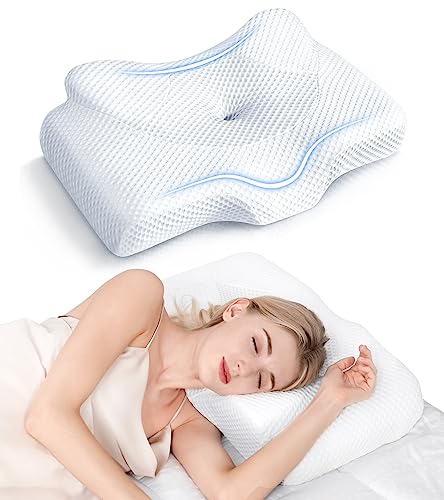
Osteo Cervical Pillow
The Osteo is the shape rebel of the six. Its listing describes a hollow design in odorless memory foam, an adjustable orthopedic bed pillow in the maker’s phrasing, supplied with a cooling case, and addressed to side and back sleepers. The hollow centre is the idea to examine: where a classic contour dips in a smooth valley, a hollow design scoops the middle more decisively, so the head rests in a defined pocket and the foam’s raised surround does the positioning. Sleepers who complain that ordinary contours let their head wander may find the pocket reassuring, while sleepers who turn often may find it confining, and both reactions are about the same geometry viewed from different habits.
Two supporting details in the title deserve their plain reading. Odorless is the maker’s description of the foam, and anyone who has unpacked a memory foam product knows why a maker would print it: new foam can carry a manufacturing scent, and a listing that addresses the point directly is answering a real buyer’s question, although the claim remains the maker’s to stand behind. The cooling case is likewise a comfort feature as titled, a case fabric the maker describes as cooling, and we note it as such without inventing a fibre or a mechanism. Adjustability appears in this title too, which puts the Osteo in the flexible camp alongside the UTTU, although the title does not state the pillow’s dimensions or its heights, and the spec box records those absences honestly.
That missing tape measure is the Osteo’s main cost. A buyer choosing the most distinctive shape in the group must visit the listing page for the numbers the Royal Therapy and UTTU titles publish freely, and should do so before ordering, because a hollow-centre design in the wrong size is a very specific disappointment. If the dimensions fit your bed and your build, the Osteo offers the clearest reason in this guide to switch from a classic wave: a centre that holds the head where you put it, in foam the maker describes as odorless, under a case the maker describes as cooling.
- Material as titled: memory foam, described by maker as odorless
- Design as titled: hollow design, adjustable
- Case as titled: cooling case
- Positions as titled: side and back sleepers
- Dimensions: none stated in the listing
- Heights: not given
Strengths
- Hollow centre gives the head a defined resting pocket
- Adjustable build keeps a height decision open
- Cooling case and odorless wording answer common foam worries
Trade-offs
- No dimensions published in the title to measure against
- Pocket shape may confine sleepers who turn frequently
- Most distinctive design is also the biggest change from habit
Best for: back sleepers who want their head held in one settled place. Not suited for: buyers who refuse to hunt a listing page for basic dimensions.

Polovo Neck Pillow
Polovo’s contour arrives in blue, and in a category drowned in white that is a genuine service, because a coloured pillow is easier to tell apart in a shared linen cupboard, kinder about showing the marks of nightly use, and simply more cheerful on the bed. The listing describes a memory foam neck pillow with an ergonomic cervical contour in the maker’s vocabulary, addressed to side, back and stomach sleepers. Ergonomic, like cervical, is a word we report as the maker’s framing; the reviewable facts are the foam, the contoured shape and the colour, plus what the title withholds, which is a longer list here than on the Royal Therapy: no dimensions, no heights, no cover description appear in the title at all.
That thin specification cuts two ways. A buyer who has already owned a contour and knows their size can shop the Polovo on shape and colour with confidence, treating it as a replacement in a familiar format. A first-time contour buyer, by contrast, is being asked to trust that the sculpture suits them without a single published measurement in the title, and for that buyer the listings that state their inches are the more responsible starting point. We keep the Polovo in the guide because colour choice and a classic contour are real value, but we place it honestly: it is the pick for the experienced contour owner who wants the same idea in blue.
The foam itself follows the category’s pattern, a moulded piece that softens where the head rests and holds the ridge’s line under the neck, and the three-position address in the title is the broadest in this group alongside the Royal Therapy’s. Breadth of address, though, should be read as versatility language rather than as evidence that one sculpture flatters every posture equally; a shaped pillow is at its best in the position its valley was carved for, and for every pillow in this guide that position is the back. Buy the Polovo for its colour and its classic shape, confirm its size on the listing page, and it will do the contour job without pretending to be a measuring exercise.
- Material as titled: memory foam
- Shape as titled: contour, ergonomic in maker’s wording
- Colour as titled: blue
- Positions as titled: side, back and stomach sleepers
- Dimensions: not stated in the listing
- Heights: none stated in the listing
Strengths
- Blue finish stands out in a category of white pillows
- Classic moulded contour for experienced shaped-pillow owners
- Broadest position list in its title alongside the Royal Therapy
Trade-offs
- Thinnest specification in the group, with no published inches
- Single fixed shape with no adjustment described
- First-time contour buyers must research size on the listing
Best for: returning contour owners who want a coloured replacement. Not suited for: first-time buyers who need measurements before confidence.

CosBed Cervical Pillow
CosBed builds its offer around the cover and the second height. The listing describes a memory foam pillow with dual height, in white, with a breathable cover, and an odorless description for the foam, in the maker’s ergonomic and support vocabulary, addressed to side, back and stomach sleepers. Dual height is the phrase to unpack: the pillow carries a taller ridge on one edge and a lower ridge on the other, and the sleeper chooses by rotating the pillow, which is the simplest form of adjustability in this category because nothing is removed, stored or lost. A back sleeper can spend a week on the tall side and a week on the low side and let the comparison make the decision that a product page cannot.
The breathable cover is the second deliberate feature, and it answers the most persistent complaint about memory foam, which is warmth. A moulded foam core will never move air like a fibre fill, but the cover is the layer against the skin, and a cover the maker designs and describes as breathable is the correct place for that battle to be fought. We report the description as the maker states it, without inventing a fabric, since the title names no fibre. The odorless wording repeats the Osteo’s reassurance and is reported the same way, as a maker’s description of its foam rather than a laboratory finding of ours.
Against the UTTU, the other height-flexible option, the CosBed trades the layered sandwich and its published dimensions for a simpler rotation and a cover story, and it withholds its measurements where the UTTU publishes them. That is the honest fork in this guide’s road: numbers or cover, layers or rotation. Buyers who sleep warm and hate homework will lean CosBed; buyers who measure will lean UTTU; and both are choosing between two legitimate answers to the same fixed-height risk that defines this category.
- Material as titled: memory foam, described by maker as odorless
- Design as titled: dual height
- Cover as titled: breathable cover
- Colour as titled: white
- Dimensions: not given
- Case or cover removability: not stated in the listing
Strengths
- Dual-height rotation needs no spare parts or storage
- Breathable cover addresses foam’s warmth where it matters
- Odorless foam wording answers the new-foam scent question
Trade-offs
- No dimensions or ridge heights published in the title
- Cover fabric itself is not named, only its breathability
- Two heights are fixed; a miss on both means a return
Best for: warm sleepers who want a height choice without loose layers. Not suited for: measurement-first buyers who want inches in the title.

VYLEE Cervical Pillow
VYLEE closes the six with the quietest listing of the group: a memory foam contour pillow in grey, with an ergonomic dual-height neck support design in the maker’s phrasing, for side, back and stomach sleepers. Quiet is not a criticism here. The title states the material, the shape family, the dual-height idea and the colour, and then stops, which makes the VYLEE the second coloured option in the guide and the second rotation-adjustable one, a combination no other pick offers. Grey, like the Polovo’s blue, forgives the visible wear of nightly use and distinguishes the pillow in a cupboard full of white bedding.
Because the specification is short, the review must be disciplined about what can be said. The dual-height arrangement works by rotation, as with the CosBed, giving the back sleeper a taller and a lower ridge to alternate between during the trial fortnight. The foam is a moulded contour, so expect the category’s slow response and settled feel rather than fibre’s bounce. Beyond that, the listing page holds the dimensions, the cover facts and the care instructions, and the buyer’s visit there is not optional homework but the main source, which the spec box below states plainly.
Who should choose the quiet listing? A buyer who has already settled the category’s big questions, knows a dual-height contour in a standard sort of footprint is the target, and prefers grey. That buyer is not under-served by a short title; they are simply being asked to confirm the details at the point of sale, which careful shoppers do anyway. First-time contour buyers, and anyone whose bed or build sits at an unusual size, should start where the inches are published and treat the VYLEE as the colour-led alternative once their measurements are known.
- Material as titled: memory foam
- Shape as titled: contour pillow
- Design as titled: dual-height
- Colour as titled: grey
- Dimensions: none stated in the listing
- Cover facts: not given
Strengths
- Only pick combining a coloured finish with dual height
- Rotation adjustment keeps both heights always available
- Grey hides the wear a white pillow displays
Trade-offs
- Shortest specification in the guide alongside the Polovo
- All measurements must be confirmed on the listing page
- No cooling or breathable cover claim in the title
Best for: decided buyers who want dual height in grey. Not suited for: anyone who needs a fully specified title before ordering.
Comparison Table
The table below separates what each title publishes from what it leaves to the listing page, because in this category the pattern of disclosure is itself buying information.
| Pick | Heights offered | Dimensions in title | Cover or case note | Colour |
|---|---|---|---|---|
| Royal Therapy Contour Pillow | Single | 24 x 14 x 5 in | Cover not in title | White |
| UTTU Cervical Pillow | Two, 5.2 / 4.5 in | 23.6 x 13.8 in | Cooling in title | Colour not in title |
| Osteo Cervical Pillow | Adjustable, heights not in title | Not in title | Cooling case | Colour not in title |
| Polovo Neck Pillow | Single | Not in title | Cover not in title | Blue |
| CosBed Cervical Pillow | Dual height | Not in title | Breathable cover | White |
| VYLEE Cervical Pillow | Dual height | Not in title | Cover not in title | Grey |
How to Choose a Contour Height Without Guessing Blind
Start from the pillow you already own, even if you dislike it, because it gives you a measured baseline instead of a mood. Note how high it holds your head, then decide the direction of your complaint: if you wake having pushed the pillow away or folded an arm under it, you were probably asking for more height or more presence under the neck; if you wake having slid down off it or with your chin tucked, less height is the direction to shop. Dual-height models exist precisely for buyers who can name a direction but not a number, since the two ridges bracket a range and the trial nights settle it. Single-height buyers should prefer the listings that publish their inches, the Royal Therapy at five inches overall and the UTTU with its two stated figures, and compare those numbers with a ruler against their current setup rather than against an ideal they have never slept on.
Mattress softness edits the answer the same way it does for ordinary pillows. A soft mattress lets the shoulders sink and reduces the height the ridge must supply, while a firm mattress leaves the body riding high and asks more of the pillow. If you change mattresses, expect to revisit the contour decision, and favour the adjustable and dual-height designs if a mattress change is already on your calendar. Finally, respect the trial: a moulded shape feels foreign for the first nights even when it is right, so judge across a fortnight of consistent use, alternating ridges methodically if your model offers two, and keep notes if your memory for mornings is as unreliable as most people’s.
Common Mistakes People Make When Switching to a Contour Pillow
The classic mistake is expecting the first night to feel like the tenth. A shaped pillow rearranges where your head rests, and the unfamiliarity of the right shape is routinely misread as wrongness, sending good pillows back to the warehouse by day three. The second mistake is buying the shape for the wrong position: these sculptures are designed around back sleeping, whatever their titles’ address lists say, and a committed side sleeper who buys one for side use is shopping against the geometry. Third, buyers ignore the footprint and discover that a twenty-four-inch pillow on a king bed leaves territory they used to occupy, which bothers restless sleepers out of all proportion to the pillow’s quality. Fourth, people force contour pillows into pillowcases cut for standard pillows and compress the ridge they paid for; check case dimensions as carefully as pillow dimensions, and let the shape keep the profile the mould gave it.
How Does Memory Foam’s Slow Response Feel to a Back Sleeper?
Memory foam answers weight and warmth by softening and flowing, slowly, into a cast of whatever rests on it, and a back sleeper is the sleeper best placed to enjoy that behaviour because back sleeping is the stillest of the common positions. You settle, the foam receives you, the surface quiets, and the pillow’s moulded ridges do their positioning while the material holds the arrangement without bouncing back at every small movement. Side sleepers turn too often to let the cast form, and stomach sleepers need so little height that the material’s talents go unused, which is why this foam and this posture keep finding each other in product categories.
The same slowness explains the two honest complaints. Warmth is the first: a material that responds to heat also holds it, and the makers here fight back with the tools their titles name, cooling descriptions on the UTTU, a cooling case on the Osteo, a breathable cover on the CosBed. Those are comfort features as their makers describe them, and a hot sleeper should weight them heavily in the choice. The second complaint is the recovery pause when you do shift, a second or two where the foam feels committed to your previous position. Back sleepers who move in long, deliberate turns rarely notice it; fidgety sleepers notice it nightly and should weigh the category carefully before buying any moulded pillow at all.
What Should You Do With Your Old Pillow When the Contour Arrives?
Keep it, at least for the trial fortnight, because the old pillow is your control group and your fallback on a night when everything feels wrong. Alternate nothing during the trial itself, since swapping nightly teaches your body neither shape, but let the old pillow wait in the spare room rather than in the donation bag until the contour has won or lost honestly. If the contour wins, the old pillow retires to guest duty, where a conventional shape serves every posture politely. If the contour loses, the old pillow’s return to the bed comes with useful information attached, because a failed contour experiment tells you the direction of your preference, toward more height or less, toward shape or toward freedom, and the next purchase gets to be smarter than the first.
There is also a hygiene footnote that shaped pillows make more urgent. A moulded foam core is not a pillow you casually launder, and the listings here mostly leave care instructions to their full pages, so read yours before the first spill rather than after it. A washable protector sized for a contour, or at least a case that follows the shape without strangling it, is the accessory that keeps a foam sculpture clean across its working life, and it belongs in the same order whenever the listing’s own cover arrangements are unclear.
How Do the Two Heights on One Pillow Actually Get Used?
Owners of dual-height pillows develop habits worth copying. Most settle on one ridge for ordinary nights and keep the other as the answer to a changed circumstance: a different mattress at a holiday rental is beyond a home pillow’s reach, but a stuffed-up evening, a new mattress topper at home, or a week of sleeping slightly more propped with a book habit all shift the preferred height by exactly the small margin the second ridge offers. The UTTU’s layered version of the idea adds a further habit, revisiting the removed layer when the seasons change the bedding stack, since a winter duvet arrangement can alter how high the head needs to ride.
The mistake to avoid is treating the two heights as a daily variety show. Alternating nightly prevents either setting from being judged, and the buyer ends the fortnight with two half-formed impressions instead of one verdict. Choose a ridge, give it the honest week, then cross to the other for its week, and let the comparison happen in memory where it belongs. That discipline is the whole secret of the adjustable category, in this guide and everywhere else it appears.
How Is a Moulded Contour Different From the Shredded Pillows in the Next Guide?
The neighbouring guide in this batch covers shredded memory foam, and the contrast sharpens both categories. A shredded pillow is a bag of foam pieces: it can be plumped, flattened, folded and re-heighted by moving fill, and its shape on any given night is a collaboration between the maker and the sleeper. A moulded contour is the opposite philosophy, a single piece of foam whose shape the maker decided completely, offering consistency in exchange for control. The same sleeper can rationally own both, the contour for disciplined back sleeping at home and the shredded pillow for travel or for the spare bed, but nobody should buy one expecting the other’s behaviour.
Feel differs as much as philosophy. The moulded piece responds as one surface, smooth and continuous, while the shredded fill has a livelier, more granular response that some sleepers describe as restless. Care differs too: a moulded core stays out of the wash and relies on its cover and your protector, while shredded models in the next guide include washable claims in their titles. If you are cross-shopping the two guides, decide first whether you want a shape that is given or a shape that is negotiated, because that answer selects the guide, and the individual pick inside it matters less than the philosophy does.
Can You Travel With a Contour Pillow?
You can, and committed contour sleepers do, because a hotel’s soft fibre pillow can undo a fortnight of careful adjustment in a single night. The footprints in this guide, around twenty-four inches wide where stated, fit a suitcase’s length more kindly than a king pillow does, and memory foam tolerates being rolled or compressed for a journey and then aired back into shape at the destination, given a few hours to recover before bedtime. Pack the pillow where it will not be crushed flat for days, and unpack it on arrival rather than at midnight, so the foam’s slow response works for you instead of against the clock.
The honest costs are bulk and dedication. A moulded pillow occupies the luggage territory of several changes of clothes, and a traveller who sleeps perfectly well on hotel pillows is carrying sculpture for nothing. Judge by your own history: if unfamiliar pillows have spoiled trips before, the contour earns its suitcase space as surely as a pair of shoes does; if you sleep anywhere, leave it home and let the trip be lighter. For car travel the calculation collapses entirely, since the pillow rides in the back seat without negotiation, and many owners keep a second, older contour permanently in the car for exactly that reason.
What Happens When Your Partner Hates Your Contour Pillow?
Shaped pillows are the most personal objects in the bedroom, and a partner’s dislike is common enough to plan for. The usual complaints are vicarious rather than direct: the contour looks odd on the dressed bed, it does not match the other pillows, it cannot be borrowed comfortably on a night when the partner’s own pillow feels wrong. The matching problem dissolves with cases, since a cased contour at the head of the bed reads as simply a lower-profile pillow, and the borrowing problem dissolves with honesty, because a pillow tuned to one sleeper’s back was never going to serve another’s side sleeping, and a household spare solves the borrowing night better than a compromise ever will.
What a partner’s dislike should not do is end the experiment early. The trial fortnight belongs to the sleeper whose back is at stake, and household diplomacy is better spent on the pillow’s daytime appearance than on its night-time existence. Couples who share a king bed have the width to run a contour on one side and a conventional pillow on the other without either crowding the middle, and many long-term contour owners report that the arrangement stops being discussed within a month, which is the natural lifespan of most bedding controversies.
How Should a Contour Pillow Be Aired and Kept Fresh?
Foam appreciates air the way natural fill does, for different reasons: a moulded core absorbs the night’s warmth and moisture at its surface, and an hour standing on its edge on sheet day lets the whole sculpture dry and cool before the fresh case goes on. Stand it where air moves, out of direct harsh sun, which foam tolerates poorly over long exposures, and give a new pillow a longer first airing on a spare bed or a clean chair, since the category’s fresh-from-the-box scent, which two makers here address with odorless descriptions, fades fastest with ventilation and time.
Rotation matters for a one-sided sculpture too. If your model is symmetrical front to back, turning it end for end spreads the compression across both halves of the valley; if it carries two heights, the rotation is already part of your life and the wear spreads itself. Keep liquids away from the core as a rule of the house, use the protector as the washable sacrifice, and the pillow’s shape, which is its entire value, will hold its lines for the long term rather than softening into a vague lump that resembles its younger self only in photographs.
How Do You Measure Your Current Setup Before Ordering?
A ruler and ten quiet minutes will do more for this purchase than an evening of reading listings. Lie on your current pillow in your ordinary sleeping clothes, on your own mattress, and have someone slide a hand or a slim book beside your head to judge where your head rests relative to the mattress surface; better still, photograph the arrangement from the side, because a photograph shows the head’s angle with a honesty that mirrors and memory both lack. Then measure the pillow itself, its width across the bed and its height at the point where your head actually rests rather than at its proudest corner, since a tired fibre pillow’s working height is far below its showroom height.
Compare those working numbers, not the labels, with the stated figures in this guide: the Royal Therapy’s twenty-four by fourteen by five, the UTTU’s two heights at 5.2 and 4.5. If your current working height sits well below five inches and your sleep is comfortable, a five-inch moulded ridge deserves a cautious trial rather than an enthusiastic one, and a dual-height model is the safer vehicle for the experiment. If your current pillow has collapsed to a fraction of its original height and you wake having folded it or stacked it, the taller ridges here are answering a need you have already diagnosed. Measurements will not choose the pillow for you, but they will stop you buying a sculpture in a size your bed has already voted against.
Should You Read or Watch Screens on a Contour Pillow?
Briefly, no, and the reason is geometry rather than virtue. A contour is carved for a horizontal head, and propping it against a headboard to read turns the ridge into a wedge at the wrong angle, so the pillow feels uncooperative in a posture it was never asked to serve. Households that read in bed should keep a conventional pillow for the reading hour and swap it for the contour at lights-out, a small ceremony that also protects the moulded foam from the sustained, angled compression of a long reading session, which is exactly the load a sculpture least enjoys.
The swap habit has a second benefit: it separates the evening’s two activities in your mind as well as in your bedding, and many new contour owners find the little ritual helps the trial fortnight stay honest, because the contour only ever meets them in sleeping position and every judgement they form about it is a judgement about sleep. Keep the reading pillow on the far side of the bed or on a chair, let the contour live under its case by day, and the arrangement will feel less like a compromise than like a household that has simply organised itself around a specialised tool.
Final Recommendation
Buyers who measure first should open with the Royal Therapy Contour Pillow for its published inches, or with the UTTU Cervical Pillow when the two stated heights answer a history of near misses. Warm sleepers should weigh the CosBed Cervical Pillow and its breathable cover, while the settled, stay-put sleeper is the audience for the Osteo’s hollow centre. Give whichever sculpture you choose a full fortnight of consistent nights, and let the shape you stop thinking about by the second week be the verdict you keep.
Frequently Asked Questions
How long does a contour pillow take to get used to?
Most sleepers need somewhere between several nights and two weeks, because the shape changes where the head rests and the body keeps its old habits for a while. Judge the trend across the second week rather than the shock of the first night, and if your model offers two heights, test each for a block of nights instead of alternating, so the comparison means something when you make it.
Can a contour pillow be used with an ordinary pillowcase?
Only if the case is large enough to follow the shape without compressing it. A tight standard case can flatten a ridge and quietly undo the design you paid for, so compare the case’s dimensions with the pillow’s stated size, and where a listing gives no dimensions, check the full page for the maker’s own case guidance before improvising with whatever the linen cupboard holds.
Why are contour pillows smaller than my old pillow?
Because the shape does the positioning that size used to approximate. A moulded pillow needs to be where your head and neck are, not spread across the whole bed, so makers build them nearer twenty-four inches wide than thirty. Restless sleepers who roam should weigh that footprint honestly, since no ridge design can help a head that has travelled off the pillow entirely.
Do these pillows sleep warm?
Memory foam holds more warmth than loose fibre, and the makers in this guide answer with cover-side features their titles name: cooling descriptions, a cooling case, a breathable cover. Treat those as the makers’ comfort language, weight them if you sleep hot, and help any foam pillow along with a breathable case of your own and a bedroom kept at the cooler end of your comfort.
What does dual height mean in practice?
The pillow carries a taller ridge along one edge and a lower ridge along the other, and you choose between them by rotating the pillow. It is the simplest adjustment in the category, with nothing to remove or store, and it suits back sleepers who know they need a shaped pillow but cannot yet name their height, which describes most first-time contour buyers.
Should I throw away the removable layer of an adjustable contour?
No. Keep it clean, bagged and findable, because the layer is your future adjustment when a mattress, a topper or your own preference changes. The UTTU’s layered design assumes the layer survives in a cupboard rather than a bin, and the small storage cost buys back the flexibility that made the adjustable design worth choosing in the first place.
What if I sleep on my back but also snore my way onto my side?
Plenty of back sleepers finish the night elsewhere, and a contour tolerates the occasional side excursion better than its reputation suggests, especially the dual-height models whose taller ridge gives a turned head something to rest against. What a contour will not do is serve as a full-time side pillow, so a sleeper who knows they spend most of the night on one side should shop the side-sleeper guides instead of asking a back sleeper’s sculpture to moonlight. Judge by where you spend the majority of the night, not by where you fall asleep or where you wake, and the occasional migration becomes the minor event it should be.
How firm should a contour pillow feel when I press it?
Firmer than you expect, because your hand is a poor instrument for judging a material designed to respond to the weight and warmth of a head over minutes rather than to a thumb over seconds. A contour that feels unyielding in the shop often feels merely supportive by the third night, which is why this guide keeps returning to the fortnight trial and to the stated heights, both of which tell you more than any amount of squeezing in a showroom or on the doorstep can.
Can children or teenagers use these contour pillows?
These six listings are adult bed pillows in size and address, and nothing in their titles aims them at children, so households should treat them as adult equipment and shop the children’s pillow guides for younger sleepers, whose proportions and needs differ from an adult’s in ways a moulded adult sculpture does not accommodate. A teenager built like an adult is a judgement for the household to make with the stated dimensions in hand, measuring the pillow against the sleeper rather than assuming the category transfers downward by enthusiasm alone.
How do I store a contour pillow I am not using?
Store it flat and uncompressed, on a shelf rather than under a stack of blankets, because a moulded shape held under weight for a season can take a set that airing only partly reverses. Keep it in its case or a cotton bag away from dust, and when it returns to the bed, stand it on edge for a few hours to air before the first night. Guest-room contours live most of their lives in storage, so the habit matters more for them than for a nightly pillow, and a stored contour that comes out smelling of the cupboard needs air, not perfume, before it meets a guest.
Related Guides
Neighbouring shelves hold the shredded-fill pillows, the sheet library and the inflatable spa corner, each a short step from this one.
Best Shredded Bamboo Organic Pillows


