What's inside
- Quick Picks
- How We Chose These Picks
- Key Takeaways
- Detailed Reviews
- Comparison Table
- How Do You Pick the Right Size of Extra Large Beach Blanket?
- Stakes, Pockets or Ballast: How Do You Stop a Big Mat Blowing Away?
- Common Mistakes When Buying an Oversized Beach Mat
- How Do You Clean and Store a Beach Mat After a Trip?
- How Do You Spread, Anchor and Fold a Ten-Foot Mat Without a Fight?
- What Is the Difference Between a Beach Mat and a Picnic Blanket?
- Buying a Second Mat: When One Blanket Stops Being Enough
- How Do You Choose Between Two Mats That Look Identical in Photographs?
- Where Else Does an Extra Large Mat Earn Its Keep?
- Final Recommendation
- Frequently Asked Questions
- Related Guides
As an Amazon Associate I earn from qualifying purchases. This post may contain affiliate links at no extra cost to you.
As an Amazon Associate, cottageverdict.com earns from qualifying purchases made through links in this guide — at no extra cost to you.
Where to buy: you will find every blanket below on Amazon, with each name linked to its listing in the Quick Picks table, in its own review and once more in the comparison table, so you can check price on Amazon and confirm the colour, the packed size and what is included before you order. Shoppers comparing the best extra large beach blankets should look past the headline dimensions for a moment and ask who is actually coming to the beach, because a blanket for two adults and a blanket for seven are different pieces of equipment.
An ordinary beach towel seats one person and a towel’s worth of belongings. An extra large beach blanket changes the social geometry of a day out: it becomes the base camp where the cooler lives, where children return to, where four adults can sit without negotiating for corners, and where nobody’s sandwich ends up directly on the sand. The six blankets in this guide all call themselves extra large, but they earn the description differently, from a seven-by-seven-foot mat for a small group to a ten-by-nine-foot sheet that one listing says fits seven adults.
Construction is the second dividing line. These are mostly thin, quick-drying mats rather than padded blankets, built to shed sand instead of trapping it, to fold into a bag rather than fill a car boot, and to survive being spread on grass, gravel and decking as happily as on sand. Several titles state stakes and corner pockets, which are the two answers the category has developed to the oldest problem of a lightweight sheet outdoors: wind. Weight the corners with sand in the pockets, or pin the edges with stakes where the ground allows, and a light mat stays a mat instead of becoming a kite.
Water behaviour is the third thing to understand before buying. Titles here use words like waterproof, sandproof, water resistant and sand free, and they are not interchangeable promises. A waterproof base keeps damp grass from soaking through at a picnic. A sandproof surface is really a sand-shedding one, where dry grains brush off instead of lodging in pile. Quick drying, stated by several picks, is what makes a blanket usable again after lunch instead of travelling home as a damp bundle. This guide repeats each title’s wording as its own claim and judges the blankets on size, anchoring and packability, the things a buyer can verify.
Finally, consider where else the blanket will work. Nearly every title here reaches beyond the beach, naming picnics, camping, hiking, travel and festivals, and that breadth is honest for a thin mat in a way it would not be for a towel. The same sheet that hosts a beach base camp on Saturday can be a picnic rug on Sunday and a groundsheet under a tent porch next month. Buy the size for the largest group you regularly host, choose the anchoring that suits your usual ground, and the blanket will earn its space in the car all year.
Quick Picks
| Pick | Badge | Why it earns its place |
|---|---|---|
| Genovega Beach Blanket | Best for Road Trips | A waterproof, sandproof extra large mat whose title pitches it squarely at road trips, car essentials and RV travel. |
| WEKAPO Beach Blanket | Best for Small Groups | A seven-by-seven-foot sandproof mat for one to three people, with six stakes and four corner pockets stated in the title. |
| WEKAPO Beach Blanket 10×9 | Best for Big Groups | The oversized ten-by-nine-foot version stating room for seven adults, with the same six stakes and four corner pockets. |
| EASYFUN Beach Blanket | Best Mid-Size All-Rounder | A seventy-nine by eighty-three inch sandproof mat pitched at family travel, camping and hiking, with water resistant wording. |
| Utopia Home Beach Blanket | Largest Stated Footprint | One hundred and eight by one hundred and twenty inches, with stakes and a carry bag stated, and quick dry wording. |
| WIWIGO Beach Blanket | Widest Stated Capacity Range | A waterproof, sandproof mat whose title claims room for two to eight adults and adds windproof and quick drying wording. |
How We Chose These Picks
We required each listing to present itself as an extra large or oversized beach blanket or mat, then recorded the dimensions wherever a title states them, because in this category the inches are the product. Four picks publish full dimensions in their titles, one gives a seven-by-seven size inside a colour and capacity note, and one reaches for descriptive language instead of figures, which we flag plainly in its review rather than filling the gap with a guess. Capacity language was treated the same way: where a title says seven adults or a range of two to eight adults, we quote it as listing language.
Anchoring came next, since a huge lightweight sheet without a plan for wind is a liability. We noted which titles state stakes, which state corner pockets, and which state both, and we separated those facts from general words like windproof, which appears in one title as a claim we report but cannot test from a listing. Packability and drying language were recorded next, then the breadth of stated uses, because a blanket bought for beach, camping and picnics must fold small enough to justify its place in shared luggage. Price never entered the reasoning; every pick is a check-price decision on the day.
Key Takeaways
- The largest stated footprint here is the Utopia Home at 108 by 120 inches; the most compact group size is the WEKAPO seven-by-seven foot mat.
- Two WEKAPO picks state both six stakes and four corner pockets, the fullest anchoring kit described in any title here.
- The ten-by-nine WEKAPO title states room for seven adults, the clearest capacity claim in the group.
- Every title reaches beyond the beach to picnics, camping, hiking or travel, so these are general outdoor mats.
- Genovega’s title gives no dimensions at all, so its size must be confirmed on the listing before ordering.
- Quick drying is stated by four of the six titles and matters as much as size for day trips.
Detailed Reviews

Genovega Beach Blanket — Best for Road Trips
Genovega’s title reads like a packing list, and that is its charm. It calls the blanket waterproof and sandproof, extra large and foldable, and then aims it at the car, the road trip and the RV, with hiking and general outdoor use in the same breath. For travellers who keep a permanent kit in the boot, a mat described this way is easy to picture: it lives folded among the emergency supplies and comes out at beaches, viewpoints, festivals and roadside picnic stops alike, which is a wider working life than a dedicated beach towel ever gets.
The honesty note for this pick is size. The title says extra large, big and giant, but prints no inches, no feet and no capacity, so the single most important fact about this blanket is not stated in the listing title and must be confirmed on the listing itself before it can be compared fairly with the measured picks below. The title also names no stakes or corner pockets, so anchoring is not given either. Buyers who travel by car and will verify those two facts on the listing get a versatile mat; buyers who order on adjectives alone are gambling on the one specification this category lives by.
- Size: extra large per title; exact dimensions not stated in the listing
- Surface claims: waterproof and sandproof
- Format: foldable outdoor mat or rug
- Anchoring: stakes or pockets not given
- Stated uses: road trip, car, RV, hiking
- Drying behaviour: not stated in the listing title
Strengths
- Framed for car and RV kits, where a mat gets year-round use
- Waterproof wording suits damp grass as well as sand
- Foldable format suits permanent boot storage
Trade-offs
- No dimensions appear anywhere in the title
- No anchoring kit is mentioned in the title
- Quick-drying behaviour is not claimed in the title
Best for: drivers and RV travellers building a permanent outdoor kit for the boot. Not suited for: shoppers who compare blankets by printed dimensions before anything else.
WEKAPO Beach Blanket — Best for Small Groups
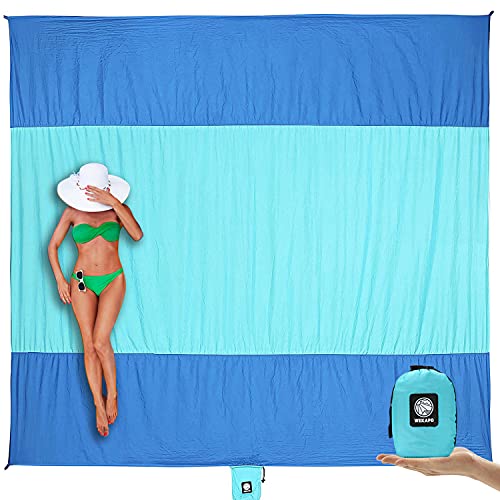
The smaller WEKAPO is the most completely specified modest-size mat in this guide. Its title states seven by seven feet, a capacity of one to three people, a blue colour for this listing, and a full anchoring kit of six stakes and four corner pockets. That combination suits couples and small families precisely because it does not try to be enormous: forty-nine square feet is room for two adults to lie down or three to sit with a cooler, and the mat still folds into the compact, lightweight package the title describes.
Sandproof, sand free and quick drying are all claimed in the title, and the anchoring deserves a word of explanation for first-time buyers. Corner pockets are filled with sand to weight the edges from above, which works on any beach, while stakes pin the mat to softer ground such as grass, which is why having both systems in one kit covers the picnic-and-beach double life this mat is built for. The limitation is headroom: a group of four adults will outgrow seven feet quickly, and those buyers should look at this same brand’s larger sibling below rather than squeezing onto a mat sized for three.
- Size: 7×7 FT, stated in the listing
- Capacity as titled: 1–3 person
- Colour of this listing: blue
- Anchoring: 6 stakes and 4 corner pockets
- Surface claims: sandproof, sand free, quick drying
- Build wording: lightweight and durable
Strengths
- Both anchoring systems are included per the title
- Honest one-to-three-person sizing avoids overselling
- Compact fold suits couples who travel light
Trade-offs
- Seven feet square is quickly outgrown by groups of four
- Capacity tops out at three people per the title
- Only the blue variant is described in this title
Best for: couples and parents with one child who want a fully anchored, honest-size mat. Not suited for: groups of four or more adults planning to share one base.
WEKAPO Beach Blanket 10×9 — Best for Big Groups
Everything the smaller WEKAPO does, this one does at gathering scale. The title states ten by nine feet and room for seven adults, which is ninety square feet of base camp: enough for a multi-family beach day, a team picnic or a festival pitch where the blanket marks your territory from morning to evening. Despite that size, the title still describes the mat as big and compact, lightweight and durable, quick drying and sand free, because the cloth stays thin even as the footprint grows, and thin cloth is what keeps a ninety-square-foot sheet packable.
The anchoring kit, six stakes and four corner pockets, matters even more at this size, because a large light sheet catches wind like a sail and an unanchored corner will flap across somebody’s lunch. Fill the pockets, stake where the ground allows, and place the cooler and bags as extra ballast along the windward edge. The trade-off is handling: one person can spread and fold a seven-foot mat without thinking, while a ten-by-nine sheet is a two-person job on a breezy day, and it needs a bigger wash and more line space at home. For the groups it serves, that is a fair exchange.
- Size: 10 x 9 feet, stated in the listing
- Capacity as titled: for 7 adults
- Anchoring: 6 stakes and 4 corner pockets
- Surface claims: sandproof, sand free, quick drying
- Build wording: lightweight and durable, big and compact
- Colour of this listing: not given in the title
Strengths
- Largest stated group capacity in this guide at seven adults
- Full anchoring kit matches the oversized footprint
- Thin cloth keeps a very large sheet packable
Trade-offs
- Spreading and folding is a two-person job in wind
- Needs more storage and drying space at home
- Colour is not given in this title
Best for: multi-family beach days, team picnics and festival groups. Not suited for: solo travellers or couples who value a tiny packed size.

EASYFUN Beach Blanket — Best Mid-Size All-Rounder
EASYFUN occupies the thoughtful middle of this guide. At seventy-nine by eighty-three inches it is far beyond towel territory, roughly forty-five square feet, yet it stops short of the gathering-scale sheets, which makes it the natural size for a family of three or four who want one base without wrestling a sail. The title calls it sandproof and oversized, describes it as a portable picnic mat for travel, camping and hiking, and adds water resistant wording, a useful distinction for picnics on grass that is not quite dry.
Lightweight is claimed in the title and matters for the hiking and travel uses it names, because a mat that earns a place in a rucksack must justify every fold. What the title does not mention is anchoring: no stakes and no corner pockets are stated, so on a windy beach this mat will rely on coolers, bags and bodies to hold it down, and buyers whose local beach is famously breezy should weigh that gap seriously. For sheltered bays, lakesides and campsite use, the EASYFUN’s balance of size, weight and water resistance is the most versatile compromise in the middle of the range.
- Size: 79 x 83 inches, stated in the listing
- Surface claims: sandproof, water resistant
- Format: portable picnic and beach mat
- Anchoring: not stated in the listing title
- Stated uses: travel, camping, hiking, family use
- Weight wording: lightweight per the title
Strengths
- Family size without gathering-scale handling
- Water resistant wording suits grass and lakesides
- Lightweight build matches its travel and hiking pitch
Trade-offs
- No stakes or pockets are mentioned in the title
- Capacity in people is not given in the title
- Water resistant is a softer claim than waterproof
Best for: families of three or four splitting time between beach and campsite. Not suited for: windy-beach regulars who need a stated anchoring kit.

Utopia Home Beach Blanket — Largest Stated Footprint
Utopia Home publishes the biggest numbers in this guide: one hundred and eight by one hundred and twenty inches, which is nine by ten feet and ninety square feet of mat. The title calls it sand proof and waterproof, describes it as a lightweight travel beach mat, and states two inclusions the other titles mostly skip, stakes and a carry bag. The carry bag deserves emphasis, because the difference between a large mat that gets used and one that stays in the cupboard is often whether it has a home of its own that keeps it folded, clean and grabbable.
Quick dry wording completes a specification aimed at frequent use: beach, camping, hiking and picnics are all named. The cautions are the usual companions of maximum size. A nine-by-ten sheet is a handful for one person in a breeze, it will dominate a small beach pitch, and its title states stakes but no corner pockets, so on hard sand where stakes will not bite, ballast from bags and coolers has to do the anchoring work. Buyers with the group size to justify it, though, get the largest stated footprint here with the tidiest storage story in the group.
- Size: 108 x 120 inches, stated in the listing
- Surface claims: sand proof and waterproof
- Included per title: stakes and carry bag
- Anchoring: stakes; corner pockets not stated in the listing
- Drying wording: quick dry
- Stated uses: beach, camping, hiking, picnic
Strengths
- Largest stated dimensions of the six picks
- Carry bag stated in the title keeps storage tidy
- Waterproof wording broadens it beyond dry sand
Trade-offs
- Too much mat for couples or small pitches
- No corner pockets are mentioned for hard sand
- One person will struggle to spread it in wind
Best for: large families and groups who want maximum stated size with a carry bag. Not suited for: light packers or anyone short of storage space at home.

WIWIGO Beach Blanket — Widest Stated Capacity Range
WIWIGO makes the boldest capacity claim in this guide, two to eight adults, and pairs it with a full set of surface words: waterproof, sandproof, windproof and quick drying all appear in its title. That breadth of claim is exactly why this review separates what the title states from what a buyer can verify. The capacity range is listing language, and since the title prints no dimensions, there is no way to check eight adults against square feet from the title alone, so confirming the inches on the listing is essential homework for this pick in particular.
Taken on its own terms, the WIWIGO is pitched at the family vacation end of the market, naming travel, camping, hiking, picnics and festivals among its uses and framing itself as a holiday essential. A mat that genuinely serves a wide range of group sizes earns that framing, because the same sheet can host a couple’s quiet morning and a full family afternoon. The windproof wording is unusual in this group and should be read as the maker’s claim rather than a mechanism, since no stakes or pockets are mentioned in the title to explain how the mat stays down. Verify size and anchoring on the listing, and this could be the flexible family pick its title promises.
- Size: dimensions not stated in the listing title
- Capacity as titled: for 2–8 adults
- Surface claims: waterproof, sandproof, windproof, quick drying
- Anchoring: not given in the title
- Stated uses: travel, camping, hiking, picnic, festival
- Framing: family vacation accessory per the title
Strengths
- Widest stated capacity range, from couples to large families
- Full set of surface claims in one title
- Use list covers nearly every outdoor setting
Trade-offs
- No dimensions in the title to test the capacity claim against
- Windproof is claimed without a stated anchoring mechanism
- Buyers must do the most listing homework of any pick here
Best for: families whose group size changes from trip to trip. Not suited for: shoppers who want every key fact printed in the title itself.
Comparison Table
| Pick | Listing highlights | Size or format | Standout trait |
|---|---|---|---|
| Genovega Beach Blanket | Waterproof, sandproof, foldable | Extra large; inches not in listing | Road trip and RV framing |
| WEKAPO Beach Blanket | Sandproof, quick drying, 6 stakes | 7×7 FT, 1–3 person | Stakes plus corner pockets |
| WEKAPO Beach Blanket 10×9 | Sandproof, quick drying, oversized | 10 x 9 FT, 7 adults | Ninety square feet of base camp |
| EASYFUN Beach Blanket | Sandproof, water resistant, portable | 79 x 83 in | Mid-size family all-rounder |
| Utopia Home Beach Blanket | Sand proof, waterproof, quick dry | 108 x 120 in | Stakes and carry bag included |
| WIWIGO Beach Blanket | Waterproof, sandproof, quick drying | Size not in listing; 2–8 adults claimed | Broadest capacity claim here |
How Do You Pick the Right Size of Extra Large Beach Blanket?
Count people honestly, then add the furniture. A seated adult occupies roughly a two-foot square of mat once legs, bags and a plate are accounted for, and a lying adult needs a six-foot run in one direction. The titles here translate that arithmetic into their own claims, seven feet square for one to three people at the modest end and ten by nine feet for seven adults at the generous end, and those two data points are a useful ruler for the whole category. A family that regularly hosts six should not buy the three-person mat and hope; hope is not an anchoring strategy or a seating plan.
Then think about the ground you actually use. On soft sand, corner pockets filled with sand are the reliable anchor, because stakes can pull out of loose dry sand just when a gust arrives. On grass, stakes come into their own and pockets become decoration. On decking, patios and hard ground, neither system works and the mat lives or dies by ballast, which favours the smaller sizes that a cooler and two bags can genuinely hold down. The two WEKAPO titles state both systems, the Utopia Home states stakes with a carry bag, and the EASYFUN, Genovega and WIWIGO titles state no anchoring at all, which should shape your shortlist as much as size does.
Packability decides whether the blanket leaves the house. Thin mats fold or roll to a fraction of their spread size, but a ninety-square-foot sheet is still a bigger parcel than a forty-five-square-foot one, and it needs a bag, a boot corner or a rucksack pocket that can take it. A stated carry bag, as on the Utopia Home, removes one excuse. For walkers and cyclists, the mid-size mats are the realistic ceiling. For drivers, size is nearly free, which is why the road-trip framing of the Genovega and the big WEKAPO and Utopia sheets makes sense for car-based households.
Last, match the surface words to your weather. Waterproof wording matters for British picnics, damp campsites and morning grass; water resistant wording, as on the EASYFUN, is a lighter promise for lighter damp. Quick drying matters everywhere, because a mat that dries between the beach and the car park is a mat that does not perfume the boot. Sand claims matter least of all, since every thin, smooth mat here sheds dry sand well by design. Spend your attention on size, anchoring and drying, in that order, and the blanket will fit your life instead of your optimism.
Stakes, Pockets or Ballast: How Do You Stop a Big Mat Blowing Away?
Wind is the tax on every lightweight blanket, and it scales with size. A ten-foot sheet presents enough area for a moderate gust to lift a corner, walk it across the picnic and deposit it over the food, and the larger your blanket, the more seriously you should take the unglamorous question of what holds it down. The category offers three answers, and the titles in this guide distribute them unevenly, which makes anchoring one of the clearest ways to choose between otherwise similar mats.
Corner pockets are the beach-native solution. You fill each pocket with sand, and the weight sits exactly where lift begins, at the corners, with no tools and no dependence on the ground’s softness. Stakes are the grass-native solution, pinning edges to soil, turf or soft earth, and six of them, as both WEKAPO titles state, let you pin corners and edge midpoints alike. Ballast is the universal fallback: coolers, rucksacks and water bottles parked along the windward edge. It works on any surface, including the decking and rock where the other systems fail, but it anchors only where the objects sit.
The practical routine combines all three without thinking hard about it. Spread the mat with its long edge facing the wind, fill the pockets or drive the stakes on the windward side first, park the cooler upwind, and let people and belongings weight the rest. On a gusty day with a very large sheet, fold the windward third under until the group sits down; a slightly smaller, calm blanket beats a full-size one that fights you all afternoon. Buyers on chronically windy coasts should treat a stated anchoring kit as a requirement, not a bonus.
Common Mistakes When Buying an Oversized Beach Mat
The first mistake is buying for the biggest day of the year. A household that hosts eight people twice each summer and two people every other weekend will spend most of its life folding, carrying and drying a gathering-scale sheet bought for those two days. Size for the regular group and borrow or add a second mat for the reunion. The second mistake is trusting capacity claims without dimensions. This guide contains a title claiming two to eight adults with no inches printed anywhere, and another claiming extra large with no figures at all; both may be excellent mats, but the claim cannot be checked until you read the listing, so check it.
A third mistake is ignoring the anchor question until the first windy afternoon, then concluding that all big mats are unusable when the real conclusion is that unanchored mats are unusable. Fourth, shoppers forget the return journey: a mat that is quick drying, a claim four of these titles make, goes home light and clean, while a slow-drying one travels as a damp, sandy bundle that nobody wants to unpack, and unpacking postponed is how mats develop a permanent holiday smell. Fifth, people spread a waterproof mat on hot sand at midday and sit on it in swimwear, discovering that a sealed surface can feel warm and slightly sticky where a breathable cloth would not.
The last mistake is treating the mat as beach-only and storing it out of reach for ten months. Every title here names picnics, camping or travel among its uses, and a mat that lives in the car or by the front door will be used twenty times a year instead of four. Storage is part of the purchase: a stated carry bag, a boot corner or a hallway hook turns an occasional blanket into household equipment, and equipment that gets used is the only kind worth its space.
How Do You Clean and Store a Beach Mat After a Trip?
Shake first, wash second, and let the surface do the work. Thin mats shed dry sand best when they are fully dry, so hang the blanket over a rail or line for half an hour before shaking it out, rather than wrestling a damp, gritty sheet at the beach. Most sand will leave in one firm shake per corner. At home, a gentle wash or a thorough rinse and line dry handles salt, sunscreen and picnic spills, and the quick-drying cloth these titles describe will be ready to fold the same day in decent weather.
Folding is a small skill worth learning for the big sizes. Fold a ten-foot sheet in thirds lengthwise first, bringing it to a manageable strip, then fold or roll the strip toward the end with any bag or pocket, so the parcel stays together without ties. Two people folding toward each other keeps a large sheet off the ground and out of the wind. Store the mat dry, always, because a sealed bag with a damp mat inside is a smell waiting for next season, and keep stakes and any small parts in the mat’s own bag or pocket so the kit arrives complete at the next beach.
A seasonal rhythm helps. Rinse the mat after the last trip of summer, dry it thoroughly, and store it where you will find it in spring, ideally with the rest of the outdoor kit rather than buried under winter bedding. Check stakes for bends and pockets for seam stress at the same time, while there is leisure to replace a small part. A mat that is stored clean, complete and findable is a mat that gets used on the first warm weekend, which is the entire point of owning one.
How Do You Spread, Anchor and Fold a Ten-Foot Mat Without a Fight?
Technique matters more than strength with a very large sheet. Unfold it in stages rather than shaking the whole thing open at once: lay the folded parcel at the centre of your pitch, unroll it along its length first, then open the sides outward one at a time, weighting each corner as it lands. Two people should take opposite corners and walk the mat open together, communicating like people carrying a pane of glass. On a windy day, keep your body between the wind and the loose cloth, work from the windward edge, and never let go of two corners at the same time until ballast is in place.
Anchoring is a sequence, not a single act. Set the windward corners first, with pockets filled or stakes driven at a slight outward angle, then the windward edge’s ballast, then the remaining corners, and only then arrange the group’s belongings, heaviest items upwind. If a gust still lifts a corner, the answer is rarely more weight on that corner; it is usually a loose opposite edge funnelling air underneath, so walk the perimeter and tuck any fluttering edge under itself or weight it. A mat lying truly flat in a breeze looks almost vacuumed to the ground, and that look is the sign the job is done.
Folding reverses the process with one addition: cleanliness. Shake each section as it comes free rather than folding sand into the parcel, fold lengthwise in thirds toward the centre so the dirty underside wraps inside, then roll or fold the strip tightly toward its bag. At home, a ten-foot mat folds best on a lawn or a large floor, and the two minutes spent doing it properly are repaid at the next beach, when the mat opens clean, complete and without the archaeological layer of last summer’s sand that greets households who folded in a hurry.
What Is the Difference Between a Beach Mat and a Picnic Blanket?
The two products share a silhouette and diverge in cloth. A picnic blanket traditionally has some padding or a soft upper surface, because grass is forgiving and picnics are stationary, while the mats in this guide are thin, smooth sheets built for an environment, sand, that punishes texture. Every loop, fleece fibre and padded quilting on a beach is a sand trap, which is why these titles emphasise sand shedding, quick drying and waterproof or resistant bases over softness. Judged as picnic blankets they can feel austere; judged as beach equipment their thinness is the entire engineering brief, honestly pursued.
That distinction decides where each product should live. A household with one outdoor blanket must choose its primary terrain. Beach-first households should buy a mat from this guide and accept its firmness on grass, perhaps adding a cushion for long sits. Grass-first households with occasional beach days may prefer a padded picnic blanket and accept the sand it brings home. Households that do both weekly will end up owning one of each, and should not feel extravagant about it: the two tools overlap in shape the way a spade and a fork overlap in a garden, usefully and incompletely.
The titles here straddle the line in their own wording, most of them naming picnics alongside beaches, and that is fair because a thin mat is a perfectly good picnic surface in dry weather. The honest cautions run the other way: a mat will not cushion a root or a stone, its sealed or resistant surface can feel warm in direct sun, and it offers no insulation from cold ground in the way a padded blanket does. Buy the mat for the beach and enjoy it at picnics as a bonus, and the expectations will be met in both places rather than disappointed in one.
Buying a Second Mat: When One Blanket Stops Being Enough
Groups grow into second mats by a predictable path. The first mat hosts the household; then come the neighbours’ children, the cousins’ visit, the football team’s picnic and the festival weekend where one base camp becomes two, a kitchen camp and a quiet camp. A second mat bought at that point should not simply duplicate the first. Pair sizes instead: keep the gathering-scale sheet for the main base and add a seven-foot mat for the splinter group, the teenagers’ annex or the couple’s escape, because two different sizes cover more social geometry than two identical ones.
Colour and pattern, where a title states them, become logistics in a two-mat household. Two mats that look different are easier to assign, count and pack, and on a crowded beach they mark one group’s territory as a connected pair rather than a coincidence. Where titles do not state colour, as several here do not, the listing’s images carry that decision. Households should also divide the anchoring kits deliberately, stakes travelling with the mat that visits grass and pockets serving the one that lives on sand, rather than keeping all the hardware in one bag that is always with the wrong blanket.
Storage completes the system. Two mats rolled together become an unmanageable bolster; two mats bagged separately, labelled by size in the plain language of the household, and stored where the car is loaded will be used twice as often as a single mat stored awkwardly. The second mat is rarely a luxury purchase. It is the moment a family’s outdoor life outgrows one rectangle, and recognising that moment a season early, while the choice can be made calmly from guides like this one, beats discovering it on the morning of the year’s biggest beach day.
How Do You Choose Between Two Mats That Look Identical in Photographs?
Photographs are where beach mats go to look the same, because a rectangle of cloth photographed from above has nowhere to hide its similarities and no way to show its differences. The tie between two such mats is broken by the unphotogenic facts this guide has kept returning to: printed dimensions, stated anchoring, drying language and what is included in the parcel. A mat with six stakes and four pockets in its title is a different tool from a mat with neither, however identical their colours, and a stated carry bag is a difference that will be felt fifty times a year, long after the photograph that sold both mats is forgotten.
Hands break the next tie. A mat’s cloth can be judged in seconds by anyone who has held one: it should feel smooth rather than papery, substantial enough not to crease like a crisp packet, and finished at the edges in a way that suggests the hundredth fold will go as well as the first. Titles cannot transmit that, which is why this guide treats them as evidence about specification rather than about feel, and why a buyer choosing between finalists should weight the stated facts heavily and the adjectives barely at all. Sand free, sandproof and windproof are claims; seven by seven feet, six stakes and ninety by one hundred and twenty inches are facts, and facts are what a household lives with.
The final tie-break is the return journey test, imagined in detail. Picture each mat at six in the evening: shaken, folded, carried to the car, unpacked at home, dried, stored. The mat whose story runs smoothly in that film, because it dries quickly, folds to its bag and stores in its place, is the mat that will still be in weekly service in three summers. The other mat, however impressive its spread dimensions, will slowly migrate to the back of a cupboard, and a mat in a cupboard has a packed size of infinity for every practical purpose. Buy the mat you can picture coming home, and you will rarely buy wrong in this category.
Where Else Does an Extra Large Mat Earn Its Keep?
Festival fields are the mat’s second home. A large sheet marks a group’s pitch in a crowd, gives everyone a dry layer between themselves and grass that thousands of feet have churned, and folds small enough to carry from a distant car park without complaint. The gathering-scale picks in this guide, the ten-by-nine WEKAPO and the Utopia Home, suit festival base camps best, while a seven-foot mat is the right size for two people who plan to move between stages and want their base to travel with them.
Camping changes the mat’s job description again. Under a tent porch it becomes the clean threshold where boots come off and cooking gear stays out of the mud. Beside a camper van it is the outdoor living room floor. Inside a large family tent it can serve as a groundsheet layer that is pleasanter to walk on than the tent’s own floor. The water resistant and waterproof wordings in these titles matter more in this setting than at the beach, because campsite grass is damp at dawn even in a dry week, and a mat that keeps that damp from soaking through earns its place in the tent bag.
Gardens and parks ask less of a mat and reward it more. A blanket that lives by the back door becomes the default surface for children’s picnics, for reading on the lawn, for sorting camping gear before a trip and for covering soil while seedlings are planted out nearby. None of those jobs needs a specialist product, which is exactly why a general mat gets used so often: it is the nearest large, washable, unprecious surface in the house. The mid-size EASYFUN and the smaller WEKAPO are the natural garden sizes, big enough for a family tea and small enough to shake out over the fence afterwards.
Travel by car turns a mat into emergency equipment of the pleasant kind. It is the layer that makes an unplanned stop at a lake into a swim and a picnic, the clean seat at a viewpoint, the groundsheet for changing out of walking boots, and, folded thick, an extra cushion layer in the back of an estate car for a tired child. The Genovega title leans into exactly this life, naming the car and the RV in its own wording, and households that keep a mat permanently in the boot consistently report the highest use per purchase of any owners in this category.
There is also the question of sharing. A big mat is a social object: it invites neighbours on a crowded beach to sit rather than hover, it gives grandparents a defined, clean place at a family picnic, and it keeps a group’s belongings visibly together, which quietly reduces the lost-sunglasses and buried-phone incidents of a beach day. Buying one size up from your strict need is rarely wasted, because the extra square feet become hospitality. The exception is the walker or cyclist, for whom every fold of size is carried, and who should buy the smallest mat that seats their real group.
A mat also earns a place in the photograph album of family life, in the background of a decade of beach pictures, and households that buy one in a colour they actually like will see it there with pleasure rather than tolerance. Where a title states a colour, as the smaller WEKAPO states blue, weigh it as you would a car’s colour: you will look at it more than any other specification. Where no colour is stated, the listing’s gallery is the place to choose, and a colour that can be spotted from the water is a safety feature in disguise, because a recognisable base helps children navigate a crowded beach back to their own people.
Finally, a word for the solo beachgoer, who may wonder whether extra large is a category error for one person. It is not. A large mat gives a single swimmer room to dry, read, eat and nap without arranging their life in a towel-width strip, keeps their belongings off the sand in one clean territory and folds, in the mid sizes, to no more trouble than a towel. The seven-foot WEKAPO and the EASYFUN are the solo sizes to shortlist, while the gathering sheets belong to groups, and a solo traveller who buys by that rule will find the big mat a luxury rather than a burden.
Final Recommendation
For most families, the balanced choice is the EASYFUN Beach Blanket, big enough for a family base without gathering-scale handling, unless your beach is windy, in which case the fully anchored WEKAPO Beach Blanket earns its place with stakes and pockets stated in the title. Groups should step up to the WEKAPO Beach Blanket 10×9 or the Utopia Home sheet, the two largest stated footprints here. Whichever you choose, decide by inches, anchoring and drying first, and let the surface adjectives follow behind.
Picture the last hour of a good beach day, when the light softens and nobody wants to leave: the right blanket is the one still lying flat and dry beneath the whole group, holding the picnic together while the tide does its slow work at the water’s edge. That quiet, unglamorous reliability is what extra large really buys, and a mat chosen by measurement rather than by adjectives will deliver it summer after summer without ever asking to be the centre of attention.
Frequently Asked Questions
How big should a beach blanket be for four adults?
Four seated adults with bags and a cooler need roughly fifty to sixty square feet, which points to the mats in the seventy-nine-by-eighty-three-inch class and upward. Four adults lying down need a six-foot run in one direction plus width for everyone, so look at the seven-by-seven-foot size as a minimum and the ten-by-nine as comfortable. The titles here state their own capacities, from one to three people up to seven adults, which gives a useful cross-check.
Do corner pockets really hold a blanket down?
Yes, when filled properly. A pocket filled with sand places weight at the exact corners where wind lift starts, and it works on any beach regardless of how hard the sand is. Pockets work best combined with ballast along the windward edge on gusty days. Stakes, stated alongside pockets in the WEKAPO titles, are the better system on grass and soft soil, where they pin the edge itself rather than weighting it.
What is the difference between sandproof and sand free?
In these titles the words describe the same practical behaviour: a smooth, thin surface that dry sand brushes or shakes off instead of lodging in pile the way it does in a towel. No cloth is proof against wet sand, which clings to everything, so the working habit is to let the mat dry briefly and then shake it. Judge the claim by the cloth’s smoothness and quick drying, both of which you can verify, rather than by the adjective a brand chose.
Can I use one of these mats as a picnic blanket on grass?
Every title in this guide names picnics among its uses, and grass is where the waterproof and water resistant wordings earn their keep by slowing damp from below. On grass, stakes anchor better than pockets, and a mat should be shaken and aired after use because grass holds more moisture and debris than sand. A mat that rotates between beach and park gets used far more often than one stored as beach-only equipment.
How small do extra large beach blankets fold?
Thin mats fold to a small fraction of their spread size, and the titles here describe the group as foldable, compact or lightweight in various wordings. The honest variable is footprint: a ninety-square-foot sheet will always pack larger than a forty-five-square-foot one made of similar cloth. A stated carry bag, as on the Utopia Home title, keeps the folded parcel tidy and makes the real packed size easy to live with.
Which pick suits a windy beach best?
Choose a title that states its anchoring. The two WEKAPO picks state six stakes and four corner pockets, the fullest kit described here, while the Utopia Home states stakes. The WIWIGO title uses the word windproof but names no mechanism, and the EASYFUN and Genovega titles state no anchoring at all, so on a chronically windy coast the stated kits are the safer evidence to buy on.
Related Guides
A well-run day out and a well-run house share the same habits, and the guides below move from the beach back indoors.
Best Deep Soaking Tubs for Small Bathrooms


