What's inside
- Quick Picks
- How We Chose These Picks
- Key Takeaways
- Detailed Reviews
- Comparison Table
- How Do You Choose a Down Camping Blanket Without a Temperature Rating?
- Down, Feather Fibre or Down Alternative: What Is Actually Inside?
- Common Mistakes When Buying a Camping Blanket
- How Do You Care for a Down Blanket on a Trip and at Home?
- How Do You Build a Sleep System Around an Unrated Blanket?
- Packing a Camping Blanket: Sacks, Compression and Car Tetris
- Camping Blankets Beyond the Campsite
- How Do You Test a Camping Blanket at Home Before the First Trip?
- Four Ways Campers Actually Use These Blankets
- Final Recommendation
- Frequently Asked Questions
- Related Guides
As an Amazon Associate I earn from qualifying purchases. This post may contain affiliate links at no extra cost to you.
As an Amazon Associate, cottageverdict.com earns from qualifying purchases made through links in this guide — at no extra cost to you.
Where to buy: each blanket below is listed on Amazon, and its name links to that listing from the Quick Picks table, from its review heading and again from the comparison table, so you can check price on Amazon and confirm the colour, the packed size and the exact fill wording before you order. Anyone weighing up the best down camping blankets should read the fill line of every title twice, because this group contains true down, feather blends, a down alternative and one blanket whose title never names its fill at all.
A camping blanket lives a harder life than a bed quilt. It gets stuffed into a sack at dawn, shaken out beside fires, draped over shoulders in hammocks, spread on grass at stadiums and folded under sleeping pads on cold ground. Down is prized for that life because it packs to a fraction of its lofted size and weighs little for the warmth it gives, which is why backpackers have carried it for generations. The six picks here gather around that idea, but they are not six versions of the same blanket, and the differences begin with what is actually inside them.
Only the first pick states a fill power figure, six hundred and fifty, in its title. The ROSE FEATHER and ONETIGRIS titles say down without a number. The puredown entry is a feather and down fibre throw sized for a couch as much as a campsite. The COVACURE is honestly labelled a down alternative, which is a different material with different behaviour in damp weather, and the Wise Owl title describes a packable puffy quilt without naming a fill at all. A guide that blurred those distinctions would fail its readers, so each review below states plainly what its title does and does not claim.
Temperature honesty matters even more. Not one of these six titles prints a temperature rating, comfort limit or season rating, and this guide will not invent any. Where a title says warm or cold weather, we repeat it as the maker’s general wording and say clearly that no rated figure is given. That restraint is deliberate: a camper who plans around an invented number can have a genuinely cold night, while a camper who knows a blanket is unrated can layer it sensibly over a sleeping bag, under a pad or around a campfire with realistic expectations.
Size and shape finish the picture. Stated dimensions range from a fifty-by-seventy-inch throw to a fifty-seven-by-seventy-eight-inch blanket with snap buttons that can be worn, and one poncho-style design that unfolds to six and a half by four and a half feet. Waterproof and water resistant wordings appear on several titles, packable appears on nearly all of them, and those two ideas together define the category: a blanket that travels small and shrugs off the damp grass and light weather of outdoor life.
Quick Picks
| Pick | Badge | Why it earns its place |
|---|---|---|
| Get Out Gear Down Blanket | Best True Down Pick | The only title here stating a fill power, 650, in a lightweight packable blanket pitched at backpacking and hammocks. |
| ROSE FEATHER Down Blanket | Best Stated Size | A lightweight down travel blanket with printed dimensions of fifty-five by seventy-nine inches and waterproof, packable wording. |
| ONETIGRIS Down Blanket | Best for Cold-Weather Wording | A warm, lightweight, packable down travel quilt whose title names cold weather backpacking among its uses. |
| puredown Feather Down Throw | Best Indoor-Outdoor Throw | A soft feather and down fibre throw at fifty by seventy inches, lightweight and packable, for couch and campsite alike. |
| COVACURE Down Alternative Blanket | Best Down Alternative | A packable, waterproof down alternative blanket at fifty-seven by seventy-eight inches, with snap buttons for wearing. |
| Wise Owl Camping Blanket | Best Poncho Style | A packable puffy quilt in a woobie-style poncho design, unfolding to six and a half by four and a half feet, with snap clasps and tie-down loops. |
How We Chose These Picks
We began with the fill line, because the keyword promises down and a reader deserves to know which picks deliver it as titled. Blankets whose titles state down were ranked as down blankets; the feather and down fibre throw was kept for its indoor-outdoor versatility and labelled exactly; the down alternative was kept because many campers deliberately choose synthetic fill for damp trips, and it is labelled exactly too, in its name and throughout its review. Any product whose title had hidden its fill behind the word puffy alone would have been excluded, and one pick here sits close to that line, which its review discusses openly.
Packability and weight language came next, since a camping blanket that does not pack small is just a quilt outdoors. Every title here uses packable, lightweight or compact wording, and we recorded those claims as stated. Dimensions were noted wherever printed, and their absence noted too. Water behaviour was separated into waterproof and water resistant as titled, never merged into one claim. Temperature ratings were looked for carefully and found in none of the six titles, a fact this guide states rather than papers over, because the absence of a rating is itself decision-relevant information for anyone planning a cold trip.
Key Takeaways
- Only the Get Out Gear title states a fill power figure, 650, and no title in this group prints a temperature rating.
- COVACURE is a down alternative by its own title, and the puredown pick is a feather and down fibre throw; both are labelled as such.
- The Wise Owl title never names its fill, describing a packable puffy quilt instead, so fill is not stated for that pick.
- Snap buttons on the COVACURE and a poncho style on the Wise Owl make two of the six wearable as well as spreadable.
- Stated sizes run from 50×70 inches for the throw to 57×78 inches for the COVACURE blanket.
- Waterproof wording appears on three titles and water resistant on one; the ONETIGRIS title makes no water claim.
Detailed Reviews

Get Out Gear Down Blanket — Best True Down Pick
Get Out Gear earns the top spot by being the most specific title in the group. It states down, states a fill power of six hundred and fifty, and describes the blanket as lightweight, packable, compact, waterproof and warm, aimed at camping, hiking, travel and hammock use. Fill power is the one number in this category that tells an experienced buyer something real about loft per ounce, and its presence here, and absence everywhere else in the group, is the clearest quality signal a title can send without a temperature rating attached.
That restraint still applies to this pick: no temperature rating appears in its title, so plan it as an unrated down blanket and layer it according to your own experience rather than a printed promise. The title also gives no dimensions, which is the pick’s one real gap, since a backpacker planning stuff-sack space and a hammock camper planning coverage both need inches. Confirm the size on the listing before ordering. For campers who want genuine down with a stated fill power and a waterproof claim in one title, this is the most complete specification here, and the standard the other five should be measured against.
- Fill: down, 650 fill power, stated in the listing
- Temperature rating: not stated in the listing
- Dimensions: not printed in the title
- Water wording: waterproof
- Format wording: lightweight, packable, compact
- Stated uses: camping, hiking, travel, hammock
Strengths
- Only stated fill power figure in the group
- Waterproof wording suits ground and hammock use
- Compact packable framing aimed at backpackers
Trade-offs
- No temperature rating appears in the title
- Dimensions are not printed in the title
- Warmth must be judged by experience, not a rating
Best for: backpackers and hammock campers who read fill power and layer sensibly. Not suited for: anyone who needs a printed temperature rating before a cold trip.

ROSE FEATHER Down Blanket — Best Stated Size
ROSE FEATHER does the opposite favour to Get Out Gear: it prints the dimensions and skips the fill power. Fifty-five by seventy-nine inches is a genuinely useful size, long enough to tuck around a sleeper and wide enough to share across two camp chairs, and the title describes the blanket as a lightweight, waterproof, packable down blanket and puffy sleeping bag blanket for camping, travel, aeroplanes, hiking and picnics. The blue colour of this listing is named too, which helps buyers coordinating kit more than they admit.
The sleeping bag blanket phrase in the title should be read as shape language rather than a promise of bag performance, because no temperature rating, zip or hood is mentioned anywhere in the title. Treat this as a down blanket of stated size and waterproof wording, and it is a strong one: the aeroplane and travel mentions suit it, since a blanket that packs down and spreads to seventy-nine inches is exactly what a long journey wants. Its gap is the mirror of the first pick’s: fill power is not stated, so loft efficiency must be taken on trust from the down wording alone.
- Fill: down; fill power not stated in the listing
- Temperature rating: none stated in the listing
- Dimensions: 55 x 79 inches
- Colour of this listing: blue
- Water wording: waterproof
- Stated uses: camping, travel, airplane, hiking, picnic
Strengths
- Full dimensions printed in the title
- Generous seventy-nine-inch length for tall campers
- Waterproof and packable wording for travel use
Trade-offs
- Fill power is not given in the title
- No temperature rating despite sleeping bag language
- Puffy shape is not a substitute for a rated bag
Best for: travellers and campers who shop by printed dimensions first. Not suited for: buyers who want a fill power figure to judge loft efficiency.

ONETIGRIS Down Blanket — Best for Cold-Weather Wording
ONETIGRIS writes the boldest weather language in this group, calling its blanket a warm down camping blanket and a puffy outdoor travel quilt for cold weather backpacking, alongside hiking, stadium, gardening, beach and picnic use. That cold weather phrase is the maker’s wording, and this review repeats it as exactly that, because the title offers no temperature rating, no fill power and no dimensions to convert the phrase into a number a camper could plan around. Read honestly, this is a down blanket the maker positions for cold conditions, with the planning left to the buyer’s layering judgement.
The breadth of the use list is the other story. Stadium and gardening sit beside backpacking, which describes the real life of a packable quilt: it warms spectators, wraps gardeners on spring mornings and lines a picnic as readily as it tops a sleeping bag. Lightweight and packable are both claimed, and no water wording appears in the title at all, so damp-ground performance is not given and a separate groundsheet would be prudent on wet trips. Buyers who want a down blanket with an outdoors brand’s cold-weather positioning, and who are comfortable layering without a rating, will find this pick aimed at them.
- Fill: down; fill power not given
- Temperature rating: not stated in the listing
- Dimensions: none stated in the listing
- Water wording: not stated in the listing title
- Format wording: lightweight, packable, puffy quilt
- Stated uses: cold weather backpacking, hiking, stadium, gardening, beach, picnic
Strengths
- Cold weather positioning is stated in the title
- Widest list of everyday uses in the group
- Lightweight packable format suits many settings
Trade-offs
- No dimensions appear in the title
- No water wording appears in the title
- Cold weather claim carries no rated figure
Best for: campers who layer by experience and want one quilt for many settings. Not suited for: planners who need dimensions and ratings before buying.

puredown Feather Down Throw — Best Indoor-Outdoor Throw
The puredown entry is the gentlest product in this guide and does not pretend otherwise. Its title describes a soft feather down fibre throw blanket, lightweight and packable, sized fifty by seventy inches in navy, for indoor and outdoor use as a couch throw. Feather and down fibre is a different fill description from the lofted down of the first three picks, and in a throw format that is no criticism: this is the blanket for a sofa arm, a reading chair, a camper van bunk and a cool evening on a porch, where packability means folding into a tote rather than compressing into a stuff sack.
That honesty about role is the pick’s strength. Campers building a strict backpacking kit should pass it by for the true down picks above, but households wanting one natural-fill throw that can travel to a picnic or a rental cabin will use this weekly. The title makes no water claim and no temperature suggestion, and gives no fill power, so its outdoors should be understood as fair-weather outdoors. Within that understanding, a named feather and down fibre fill at a stated size, from a bedding brand, is a clear and fairly described product.
- Fill: feather down fiber, as titled
- Temperature rating: not given
- Dimensions: throw 50 x 70 inches
- Colour of this listing: navy
- Water wording: none stated in the listing
- Stated setting: indoor and outdoor use, couch throw
Strengths
- Stated size and honest throw format
- Natural feather and down fibre fill as titled
- Works daily at home, not just on trips
Trade-offs
- Not a backpacking blanket despite packable wording
- No water wording for damp ground
- Fill power is not stated in the title
Best for: households wanting a natural-fill throw for home and fair-weather trips. Not suited for: backpackers counting ounces for a multi-day carry.

COVACURE Down Alternative Blanket — Best Down Alternative
COVACURE is in this guide under its own honest label: down alternative. Its title says so directly, and campers who choose synthetic fill usually do it deliberately, for trips where damp is expected, for easier washing, or for household members who avoid animal fill. The specification around that fill is the fullest in the group: fifty-seven by seventy-eight inches, waterproof and lightweight wording, snap buttons, a wearable design, and a puffy quilt described as blocking wet, in green, aimed at camping, hiking and backpacking.
The snap buttons deserve attention because they change how a blanket gets used. Snapped, the blanket stays around shoulders hands-free at a cold campsite, wraps a spectator at a match, or closes around a sleeper who tosses. That wearable quality, plus the waterproof wording, makes this the most damp-trip-friendly pick here, with the standing caveat that no temperature rating appears in its title either. Shoppers who came specifically for down should choose one of the first three picks; shoppers who came for a camping blanket and are open about fill will find this the most fully featured option in the guide.
- Fill: down alternative, as titled
- Temperature rating: none stated in the listing
- Dimensions: 57 x 78 inches
- Colour of this listing: green
- Water wording: waterproof; blocks wet per title
- Feature: snap buttons, wearable design
Strengths
- Largest stated dimensions of the travel blankets here
- Snap buttons make it wearable hands-free
- Waterproof wording suits damp trips
Trade-offs
- Fill is synthetic alternative, not down
- No temperature rating in the title
- Wearable snaps add hardware some minimalists skip
Best for: damp-climate campers and anyone who prefers to avoid down fill. Not suited for: shoppers whose brief is genuine down and nothing else.
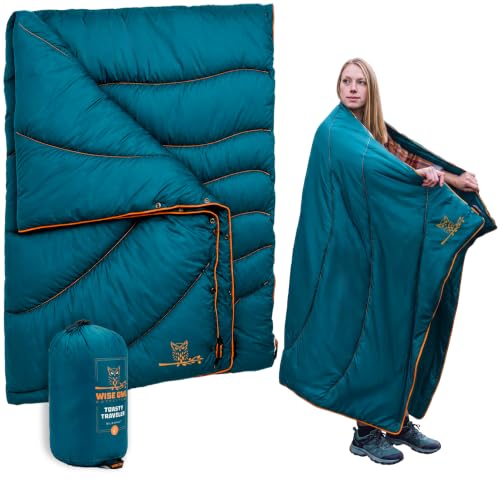
Wise Owl Camping Blanket — Best Poncho Style
Wise Owl takes the wearable idea furthest. Its title describes a packable puffy quilt in a woobie-style poncho design, a reference to the military poncho liner that generations of campers have adopted as a blanket, with quick-snap clasps and tie-down loops, unfolding to six and a half by four and a half feet. Tie-down loops are a feature no other title here mentions, and they matter: a blanket that can be tied as a hammock under-layer, hung as a windbreak or secured over gear is a tool as much as a comfort item.
The disclosure this pick requires is about fill. The title says puffy quilt and names no fill material at all, so fill is not stated for this blanket, and a shopper who needs down specifically cannot confirm it from the title and should check the listing or choose a pick whose fill is printed. Water wording is water resistant, a step below the waterproof claims elsewhere, and no temperature rating appears. Judged as a versatile poncho-style quilt with stated size and hardware, it is distinctive and useful; judged as a down blanket, it is the one pick here whose credentials the title leaves unproven.
- Fill: not stated in the listing title
- Temperature rating: not given
- Dimensions: unfolds 6.5 x 4.5 ft
- Style: woobie-style poncho quilt
- Water wording: water resistant
- Hardware: quick-snap clasps and tie-down loops
Strengths
- Tie-down loops appear in no other title here
- Poncho style keeps warmth hands-free
- Stated unfolded size in feet
Trade-offs
- Fill material is not stated in the title
- Water resistant is a lighter claim than waterproof
- Poncho shape is narrower than the widest blankets
Best for: hammock campers and tinkerers who will use loops and snaps fully. Not suited for: down purists who need the fill printed in the title.
Comparison Table
| Pick | Listing highlights | Size or format | Standout trait |
|---|---|---|---|
| Get Out Gear Down Blanket | Down, 650 fill power, waterproof | Size not in listing title | Most specific down specification here |
| ROSE FEATHER Down Blanket | Down, waterproof, packable | 55 x 79 in | Stated size with travel framing |
| ONETIGRIS Down Blanket | Down, warm, packable quilt | Size not in listing title | Cold weather wording per title |
| puredown Feather Down Throw | Feather down fiber throw | 50 x 70 in | Couch-to-campsite versatility |
| COVACURE Down Alternative Blanket | Down alternative, waterproof, snaps | 57 x 78 in | Wearable puffy quilt design |
| Wise Owl Camping Blanket | Puffy quilt, poncho style, water resistant | 6.5 x 4.5 ft unfolded | Snap clasps and tie-down loops |
How Do You Choose a Down Camping Blanket Without a Temperature Rating?
Begin by accepting the central fact of this group: none of these six titles prints a temperature rating, so none of them should be your only insulation on a night where cold is a safety question. Used as they are designed to be used, as a layer over a sleeping bag, a wrap around camp, a hammock blanket or a travel cover, unrated blankets are excellent equipment. Used as a substitute for a rated bag in freezing weather, any of them is a gamble, and the honest titles here do not ask you to take it. Plan the blanket as one layer in a system and its lack of a rating stops being a flaw.
Next, read the fill line with a lawyer’s care. Down with a stated fill power, as on the Get Out Gear, gives the most information. Down without a number, as on the ROSE FEATHER and ONETIGRIS, is a claim of material without a measure of loft. Feather and down fibre, as on the puredown throw, describes a heavier, home-friendly fill. Down alternative, as on the COVACURE, is a deliberate synthetic choice with damp-weather advantages. And a title that names no fill, as the Wise Owl does not, should be treated as an unknown until the listing answers it. Those five situations look similar in a search result and behave differently in a rucksack.
Size and hardware come third. A blanket under fifty-five inches wide will not wrap two people or tuck far around one, while the fifty-seven-by-seventy-eight COVACURE and the seventy-nine-inch ROSE FEATHER give real coverage. Snaps and poncho shapes suit spectators, hammock campers and anyone who wears a blanket more than they sleep under it. Tie-down loops suit campers who improvise shelters and hammock layers. Plain rectangles suit sleeping and sharing. Match the shape to the verb you will use most: sleep, sit, wear or hang.
Finally, weigh water wording against your climate. Waterproof claims on the Get Out Gear, ROSE FEATHER and COVACURE titles suit damp ground and misty mornings. Water resistant wording on the Wise Owl suggests lighter protection. No water wording, as on the ONETIGRIS and the puredown throw, means planning a groundsheet or keeping the blanket for dry settings and indoor use. None of these phrases makes a blanket a rain shelter, and down in particular should be kept as dry as a trip allows, stored loose at home and packed in a dry sack on the trail.
Down, Feather Fibre or Down Alternative: What Is Actually Inside?
The word down describes clusters from beneath the outer feathers of waterfowl, and those clusters trap air in a three-dimensional loft that solid fibres cannot match for warmth per ounce or for compression. Fill power measures that loft, which is why its presence on one title here and absence on the others matters: six hundred and fifty fill power tells a buyer the down will loft well and pack small, while an unnumbered down claim asks to be taken on trust. Neither is automatically the better purchase, but they are different levels of evidence, and a careful shopper should know which one they are holding.
Feather and down fibre, the puredown throw’s stated fill, behaves differently. Feathers have quills, add weight and give a throw its familiar, substantial drape, which is a pleasure on a sofa and a penalty in a rucksack. Down alternative fills are synthetic, usually polyester in some form, and their virtues are practical: they tolerate damp better than down, wash more casually and suit households avoiding animal products, at the cost of packing larger for similar warmth. The COVACURE states its alternative status in its name, which is the honest way to sell it.
The practical rule is to match fill to failure mode. On a dry, cold backpacking trip, down’s compression and lightness protect you from a heavy pack. On a wet coastal trip where everything gets damp by day three, an alternative fill’s tolerance protects you from a blanket that has lost its loft. At home and in camper vans, where weight hardly matters, feather blends give daily pleasure at the throw’s stated size. Problems begin when a buyer purchases one fill while imagining another, which is why this guide repeats the exact fill wording of every title rather than smoothing them into one story.
Common Mistakes When Buying a Camping Blanket
The most dangerous mistake is treating the phrase camping blanket as a temperature promise. A shopper reads warm or cold weather in a title, packs the blanket as their only insulation and spends a miserable night discovering the difference between marketing warmth and a rated sleeping bag. None of the six titles here prints a rating, and the correct response is layering: blanket over bag, blanket under pad, blanket plus proper clothing, with the blanket adding comfort and a margin rather than carrying the whole night alone.
The second mistake is ignoring the fill line, either by assuming every puffy blanket is down or by assuming down alternative is a deception. Both errors are reading failures. Titles in this very group state down, feather fibre, down alternative and nothing at all, in plain words, and five minutes spent on those words prevents the commonest disappointment in the category. A third mistake is buying by packed photographs: a blanket that looks tiny in a listing may simply be photographed compressed, while its spread size, the number that decides coverage, goes unread. Two of these titles print no dimensions at all, and those inches must be confirmed on the listing before money moves.
Fourth, campers store down badly. Any lofty blanket, down or alternative, should live loose or in a large storage sack at home, not crushed in its travel sack for months, because permanent compression tires the fill. Fifth, people use a camping blanket as a groundsheet on rough ground and then blame its shell for abrasion it was never built to take; a cheap foam pad or footprint belongs under it. The blanket’s job is insulation and comfort. Give it that job, store it kindly, and it will do the job for years of trips.
How Do You Care for a Down Blanket on a Trip and at Home?
On a trip, care is mostly about dryness. Keep the blanket in a dry sack inside the pack, air it over a branch or line whenever the sun allows, and shake it out each evening so the fill redistributes and lofts before the cold arrives. Around fires, keep a respectful distance, because a single drifting spark can melt a hole in a lightweight shell before anyone notices. If the blanket gets damp, dry it at the first real opportunity rather than packing it wet for another day, since loft and damp are enemies in any fill, and doubly so in down.
At home, washing should be occasional and gentle, following the maker’s instructions on the listing or label, because over-washing wears shells and fill alike. The down alternative pick will generally tolerate the most casual laundry routine, one of its genuine advantages, while true down rewards patience: a full, complete dry matters more than the wash itself, and a blanket put away even slightly damp will smell of the decision for months. Check snaps, clasps and tie-down loops during the same routine, since hardware failures are cheap to fix at home and annoying at a campsite.
Storage completes the cycle. Hang the blanket or keep it in a roomy cotton sack in a dry cupboard, let it loft fully between trips, and resist the tidy instinct to leave it compressed with the camping gear. Once a season, spread it out, check the shell for small tears and repair them before they leak fill. A camping blanket is a simple object with a long memory for how it was treated, and ten minutes of care after each trip is the whole secret of one that still lofts like new after five summers.
How Do You Build a Sleep System Around an Unrated Blanket?
A sleep system is a set of layers with jobs, and a camping blanket’s job is flexible insulation: it is the layer you add, remove, double over or lend without rebuilding the bed. Under it, a sleeping pad does the unglamorous work of insulating you from the ground, which no blanket in this guide is designed to replace. Over a sleeping bag, the blanket adds loft where heat escapes. Inside the bag, on milder nights, a light blanket can serve as a liner that keeps the bag cleaner and the sleeper more comfortable. Understanding those roles is what turns an unrated blanket from a gamble into a tool.
Doubling is the blanket’s hidden specification. A blanket folded in half over the torso delivers roughly twice the loft where the body needs it most, at the cost of coverage at the feet, and on a cold night that trade is usually correct. The larger stated sizes here, the seventy-eight and seventy-nine inch blankets, double more gracefully than the fifty-inch throw, which is a concrete reason dimensions matter beyond mere coverage. Campers should rehearse the fold at home, in daylight, rather than inventing it at midnight with cold hands and a torch held in their teeth.
Ventilation is the system’s other half. A blanket’s great advantage over a zipped bag is that it can be thrown off, half off or wrapped tighter in seconds, which lets a sleeper regulate through the temperature swings of a real night, cold at dusk, warm at midnight, coldest before dawn. Campers who sleep in their insulating clothing layers, with the blanket as the adjustable outer layer, get the steadiest nights this equipment can offer. The system’s weakness remains the one this guide has repeated: none of it is rated, so for genuinely cold trips the bag underneath should carry a rating with margin, and the blanket should be the comfort on top of that safety, never a substitute for it.
Packing a Camping Blanket: Sacks, Compression and Car Tetris
How a blanket is packed decides whether it comes on the trip at all. Down blankets compress into their smallest parcel when they are stuffed rather than folded, because stuffing distributes the fill randomly instead of creasing it along the same lines trip after trip. A stuff sack a size smaller than seems reasonable will usually accept a down blanket with patience, and the parcel that results can fill the dead spaces of a rucksack, around a tent or beside a stove, in a way a rigid object never can. Down alternative blankets resist compression more firmly and should be given their space honestly rather than fought.
In a car, the logic reverses. A blanket carried loose or in a large sack lofts the moment it is unpacked, doubles as padding around fragile gear on the drive, and can be reached at the first stop without excavating the boot. Many experienced campers therefore pack the same blanket two ways depending on transport: compressed and deep in the bag for the trail, loose and on top for the road. The puredown throw, at its stated fifty by seventy inches, is the natural car blanket of this group, living in the vehicle full time in many households and earning its keep weekly rather than seasonally.
Weight distribution is the final packing thought for walkers. A blanket rides best close to the back and high in the pack, where its softness can cushion harder items, and its sack should be waterproof or live inside a liner on any trip where rain is possible, because a wet blanket at journey’s end is worse than no blanket, it is extra weight that also needs drying. The waterproof wordings on several titles describe the blanket’s shell behaviour, not a licence to pack it unprotected in a storm, and the distinction is one every camper learns exactly once, the hard way or the reading way.
Camping Blankets Beyond the Campsite
The stadium and garden uses named in the ONETIGRIS title deserve to be taken seriously, because for many owners they become the majority of the blanket’s working life. A packable blanket in the car boot covers school sports in November, fireworks in a field, outdoor theatre, fishing banks and every other occasion where a household sits still outdoors for two hours and slowly gets cold. Those evenings ask nothing of fill power or temperature ratings; they ask for a blanket that is present, large enough to share and unbothered by grass, which is a description of every pick in this guide.
At home, a camping blanket becomes the household’s spare layer of first resort: the guest bed’s extra warmth, the sofa’s winter upgrade, the covering for a convalescent on the couch and the wrap for reading in a cold corner. The puredown throw was designed for exactly this double life, but the travel blankets serve it too, and their packability makes them easy to store in the room where they are used rather than in a linen cupboard far from the need. A blanket bought for four trips a year and used forty evenings at home is not a failed purchase; it is a successful one with a misleading name.
There is also the matter of lending, which camping blankets attract because they look casual and pack small. Lend the down alternative before the good down, lend with its sack so it comes home in one, and lend to people who will air it rather than return it sealed after a damp weekend. Owners who lend generously and store carefully find their blankets develop the patina of well-used kit, a few marks, a softened shell, a history of places, and that patina is the sign the purchase was right. The blanket that stays pristine in its sack for five years is the one that should not have been bought.
How Do You Test a Camping Blanket at Home Before the First Trip?
A camping blanket should be auditioned before it is trusted, and the audition takes one evening on a living room floor. Spread it, lie under it at the room’s ordinary temperature and learn its coverage honestly: where it reaches, where it gaps, whether its stated size, if it states one, matches the tape measure you run along its edges. Campers are routinely surprised by blankets that measure smaller than their titles suggest once seams are accounted for, and discovering that at home, where a return is possible, is infinitely better than discovering it at altitude. The two titles here that print no dimensions deserve this tape-measure welcome most of all.
Next, pack it the way the trip will pack it. Stuff it into the sack you intend to carry, note the parcel’s true size against your rucksack’s remaining space, and carry the loaded pack around the house for ten minutes. A blanket that only fits when nothing else does is a blanket that will be left behind by the second trip, and a blanket that compresses kindly, as good down should, earns its place in the system. While it is packed, note how the snaps, clasps or loops behave, because hardware that tangles in a sack at home will tangle in a tent at midnight with far less forgiveness available.
Finally, sleep under it for one night in a bed, with the window open if the season allows. A single night teaches the things no specification can: whether its shell rustles, whether its loft feels generous or thin against your own warmth, whether you reach for it or push it away by morning. None of those answers is a rating, and this guide has been careful never to invent one, but a blanket matched to its owner’s actual sleep by an honest home trial will outperform a theoretically superior blanket chosen from adjectives alone. Trips are too few and too good to spend them discovering what a floor, a tape measure and one night could have told you in advance.
Four Ways Campers Actually Use These Blankets
As a sleeping bag topper, the blanket is the layer that turns a adequate bag into a comfortable one. Spread over a bag on cold nights it adds loft where heat escapes upward, and on mild nights it can replace the bag entirely for campers who sleep warm, with the standing caution that no rating in these titles supports planning a freezing night around a blanket alone. Rectangular blankets like the ROSE FEATHER and COVACURE suit this job best, because their stated dimensions tuck and drape without the shaping a poncho brings.
In a hammock, a camping blanket solves the problem of insulation that moves. Hammock campers drape it inside the hammock as a top layer, and the Wise Owl’s tie-down loops and the Get Out Gear’s hammock mention in its title both speak to this world. A blanket that can be secured stays where the sleeper put it instead of pooling at the hammock’s low point, and packability matters doubly because hammock kit is carried on the back. Campers who have never tried a blanket in a hammock usually convert after one night of adjusting a sleeping bag inside a swinging bed.
Around camp, the blanket becomes clothing. This is where snaps and poncho shapes earn their hardware: a snapped COVACURE or a Wise Owl poncho stays on shoulders while hands cook, read or hold a mug, and a plain blanket worn as a shawl slides off at the first task. Stadium use, named in the ONETIGRIS title, is the same job in a different seat, and so is the early-morning gardening it also names. Any blanket in this guide can be worn; the two with fasteners are simply better at staying worn.
In transit, the blanket is the difference between enduring a journey and enjoying it. A packable down blanket in a carry-on covers aeroplane chill, long train rides and passenger-seat naps, then returns to the bag without the bulk of a coat. The ROSE FEATHER title names aeroplane use outright, and the puredown throw, at fifty by seventy inches, is the size of a generous travel wrap for car journeys. Travellers should keep the blanket accessible at the top of the bag rather than buried, because a blanket that cannot be reached without unpacking might as well have stayed at home.
Renting, borrowing and second-hand blankets all deserve a sentence in a guide about equipment that is often shared. A borrowed blanket should be aired before and after use and returned in its sack with its hardware complete, because the social cost of camping gear is paid in small omissions. A second-hand down blanket can be a bargain if its loft springs back when shaken and its shell is intact, and a disappointing one if the fill has migrated into corners and left the middle thin, a fault visible the moment it is held up to a window. Check any used blanket against the light before money changes hands.
For winter campers, a blanket’s most realistic role is inside a vehicle or a hut rather than a tent, topping a bed that already has a mattress and a rated duvet beneath it. In that setting the unrated question disappears, because the building and the bedding carry the safety, and the blanket returns to being what it is in every other section of this guide: a light, packable, generous layer of comfort that can be moved from bed to chair to fireside as the evening demands. Equipment judged in the setting it will actually serve is equipment that rarely disappoints.
Children on their first camping trips form their idea of the outdoors partly through its textures, and a blanket they can drag, wrap and build with is a piece of that education. The wearable and snap designs in this guide suit small campers particularly, because a blanket that stays on shoulders leaves hands free for torches and marshmallows. Let the child choose the colour where a title offers one, keep the good down for the adults’ sleep system, and the family’s blanket drawer will organise itself by affection, which is the correct filing system for camping kit.
One more setting deserves the blanket’s talents: the sick day. A convalescent on a sofa, a child home from school, an older relative resting in a chair all need warmth that can be adjusted without remaking a bed, and a camping blanket is the household’s most movable insulation. It goes where the patient goes, washes when the episode ends and returns to the cupboard without ceremony. Households discover this use by accident and then rely on it deliberately, which is how camping equipment quietly becomes medical-adjacent furniture without anyone ever calling it that.
And a last packing truth: the blanket you bring is worth ten you own. Every system in this section, every fold and layer and rehearsal, exists to make one decision easy at the moment of departure, the decision to take the blanket along. Campers who have simplified that decision, with a sack that fits and a place in the pack reserved for it, bring the blanket on spec, for evenings that might turn cold and mornings that might dawn bright, and are right far more often than they are wrong. Versatility unused is inventory; versatility carried is comfort.
Final Recommendation
If genuine down is the brief, begin with the Get Out Gear Down Blanket, the only pick whose title states a fill power, and consider the ROSE FEATHER Down Blanket when printed dimensions matter more than a fill figure. If your trips run damp or you prefer to avoid down, the COVACURE Down Alternative Blanket is the most fully specified alternative here, with snaps, waterproof wording and the largest stated size. Every one of the six should be layered with clear eyes, since no title in the group prints a temperature rating.
Choose the fill you actually want, in the size you actually need, with hardware that matches how you camp, and an unrated blanket becomes one of the most versatile pieces of kit you own rather than a promise it never made. On the last evening of the season, with the fire burned down to embers and the cold settling over the quiet campsite, a good blanket around two shoulders is worth more than every specification printed above it.
Frequently Asked Questions
Do any of these blankets have a temperature rating?
No. None of the six titles prints a temperature rating, comfort limit or season score, and this guide has not invented any. Titles use general words such as warm or cold weather, which are the makers’ positioning rather than measured ratings. Plan any of these blankets as a layer within a sleep system, and rely on a rated sleeping bag where cold is a safety question.
Which picks are genuinely down?
By their titles, the Get Out Gear, ROSE FEATHER and ONETIGRIS are down blankets, and only the Get Out Gear states a fill power, 650. The puredown pick is a feather and down fibre throw, the COVACURE is a down alternative, and the Wise Owl title names no fill at all. Those distinctions are printed in the titles themselves and are the first thing to check on any similar listing.
What does 650 fill power mean in practice?
Fill power describes how much space a given weight of down lofts to fill, so a higher figure generally means more warmth and better compression for the same weight. It is a measure of the down’s quality, not a temperature rating, and it cannot by itself tell you how cold a night a blanket will handle. In this group it appears only in the Get Out Gear title, which is why that specification stands out.
Are down alternative blankets better in wet weather?
Synthetic alternative fills generally keep more of their loft when damp and wash more casually than down, which is why many campers choose them for wet climates. The COVACURE pairs its alternative fill with waterproof wording and a wearable snap design, making it the natural damp-trip pick here. Down still wins on compression and weight for dry trips, so the better fill depends on the weather you actually camp in.
Can a camping blanket replace a sleeping bag?
On a mild night, for an experienced camper who sleeps warm, a blanket alone can be comfortable, and several titles here use sleeping bag blanket language. As a general rule, no: none of these titles carries a temperature rating, zips or a hood, and a blanket cannot seal warmth the way a bag does. Treat the blanket as a topper, a wrap and a travel layer, and let a rated bag do the rated work.
How should I store a down blanket between trips?
Loose, dry and unhurried. Keep it hanging or in a large storage sack rather than crushed in its travel sack, air it after every trip, and make sure it is completely dry before it goes away. Compression for the length of a trip is harmless; compression for a season tires any lofty fill, down or alternative, and is the commonest avoidable cause of a blanket that feels thinner every year.
Related Guides
From the campsite back to the house, the guides below cover cloth and comfort in two more corners of home life.
Best Customized Throw Blankets


