What's inside
- Quick Picks
- How We Chose These Picks
- Key Takeaways
- Detailed Reviews
- Comparison Table
- How to Choose a Heated Soaking Bathtub With the Right Heater and Jets
- Inline Heaters Versus Heated Soaking: Reading the Listing Carefully
- Whirlpool Jets and Air Bubbles: Two Systems, Two Sensations
- Common Mistakes When Buying a Heated Jetted Tub
- Living With a Heated Jetted Tub: Routines That Keep It Wonderful
- Heated Tubs and the Rest of the Bathroom: Designing the Whole System
- What Heated Soaking Costs to Run, and How Owners Keep It Sensible
- Specifying a Heated Tub With Your Installer: The Conversation to Have First
- Heated Tubs for Different Bathing Lives: Athletes, Readers, Shift Workers and Soaking Couples
- Final Recommendation
- Frequently Asked Questions
- Related Guides
As an Amazon Associate I earn from qualifying purchases. This post may contain affiliate links at no extra cost to you.
As an Amazon Associate, cottageverdict.com earns from qualifying purchases made through links in this guide — at no extra cost to you.
Where to buy: Each tub in this guide is sold on Amazon, and every name links to its listing from the Quick Picks table, from its own review heading and again from the comparison table, so you can check price on Amazon and confirm the size, drain side and jet configuration before ordering. Shoppers comparing the best heated soaking bathtubs want the water to stay warm for the whole soak and, in most of these designs, to move as well, and the six models below deliver that with heaters and jet systems their listings describe in specific, checkable terms.
A heated soaking bathtub solves the oldest problem in bathing: water cools. Every bather knows the cycle of the long soak, topping up with hot water as the bath fades toward tepid. Heated tubs attack that problem with a heater in the system, holding the water at temperature while you stay put. In this group the heating arrives alongside jet systems, because all six picks are jetted designs: four WOODBRIDGE models combining whirlpool and air bubble jets with heated soaking, and two Empava models whose listings state an inline heater explicitly.
The WOODBRIDGE range spans the sizes a real renovation needs: a 72 inch double slipper, a 66 and a half inch spacious model, a compact 59 inch version, and a 60 inch alcove model with a left drain for a standard tiled recess. The three freestanding WOODBRIDGE tubs each state 16 jets across their whirlpool and air systems, adjustable air blower speed, an LED control panel and a chromotherapy light. The Empava pair go further on paper, with 17 and 20 jets respectively, waterfalls, and inline heaters named in the listings.
These are the most installation-serious tubs in this batch: they need electrical supply for heaters, pumps and blowers, access for future servicing, and plumbing planned around stated drain positions. The reviews below hold every claim to its listing, noting exactly which model states a heater type, a jet count or a certification, because with powered tubs the difference between stated and assumed is the difference between the bath you bought and the bath you imagined.
Quick Picks
| Pick | Badge | Why it earns its place |
|---|---|---|
| WOODBRIDGE 72 Heated Tub | Best Overall | The flagship: a 72 by 35-3/8 inch double slipper with 16 whirlpool and air jets, adjustable blower, LED panel and chrome drain. |
| WOODBRIDGE 59 Heated Tub | Best Compact Heated | The same 16 jet heated package at a compact 59 by 31-1/2 inches, with a matte black drain for darker schemes. |
| WOODBRIDGE 66 Heated Tub | Best Mid-Size Balance | A spacious 66-1/2 by 31-7/8 inch version of the same heated 16 jet design, with a chrome drain. |
| WOODBRIDGE 60 Alcove Heated Tub | Best Alcove Heated | A 60 inch acrylic alcove tub, rectangular with a left drain and matte black pop-up drain included, described as whirlpool heated and jetted. |
| Empava 67 Heated Tub | Best Inline Heater, Back-to-Wall | A 67 inch back-to-wall tub stating 17 hydro and air jets, an inline heater, a waterfall, handshower and 59 gallon capacity, ETL certified. |
| Empava 71 Heated Tub | Most Jets Stated | The group’s highest stated jet count at 20, with an inline heater, dual waterfalls and colour-changing LED lighting at 71 inches. |
How We Chose These Picks
We required every pick’s listing to support the heated claim in its own words, whether through a heated soaking designation or an inline heater named outright, and we recorded jet counts, drain finishes and control features exactly as stated. The field was balanced across installation types, with freestanding double slipper and back-to-wall designs beside a true alcove model, and across sizes from 59 to 72 inches so compact and generous bathrooms both find a candidate. Where a listing omits a detail its siblings state, such as a jet count on the alcove model, the spec boxes mark the gap rather than copying the figure across.
Key Takeaways
- Two Empava listings state an inline heater explicitly; the WOODBRIDGE models are described as heated soaking tubs with whirlpool and air systems.
- The three freestanding WOODBRIDGE tubs each state 16 jets, adjustable air blower speed, an LED control panel and a chromotherapy light.
- Jet counts where stated run from 16 to 20, and the Empava 71 lists dual waterfalls among its features.
- The WOODBRIDGE 60 alcove model is the only left drain alcove design, and its listing does not state a jet count.
- Both Empava listings state ETL certification; no certification is mentioned in the WOODBRIDGE listings quoted here.
Detailed Reviews

WOODBRIDGE 72 Heated Tub
Bathrooms being built around the tub itself should start with the 72 inch double slipper. Its listing combines the heated soaking format with whirlpool and air bubble jets totalling 16, an adjustable air blower speed so the bubble intensity is yours to set, an LED control panel and a chromotherapy light, finished with a chrome drain. The double slipper shape raises both ends, suiting bathers who sit up in moving water with a supported back at either end of a genuinely large tub.
Powered tubs need an electrician in the plan from the first sketch. Heaters, pumps and blowers draw real current, require the protected circuits your local code demands for bathroom water appliances, and must be wired before walls close. Bring the specific model’s requirements to your electrician early, because discovering a supply problem after tiling turns a finished bathroom back into a building site for the sake of one cable.
The heater changes bathing habits in one specific way: the soak stops being a race against cooling. Owners of these tubs report settling in with a book because the water at minute thirty feels like the water at minute five. That steadiness is the entire product. It also means the bath you draw is the bath you get, so set the temperature honestly at filling rather than planning to correct it later with the hot tap.
Strengths
- Largest tub in the group at 72 by 35-3/8 inches
- 16 jets across whirlpool and air bubble systems, as stated
- Adjustable air blower speed and LED control panel are listed
Trade-offs
- Size plus powered systems make this the most demanding installation here
- Heater type is not specified beyond the heated soaking description
- No certification is mentioned in the listing
- Size: 72 x 35-3/8 inches
- Shape: Double slipper
- Jets: 16 whirlpool and air bubble jets
- Controls: LED panel, adjustable blower speed
- Drain: Chrome drain
Best for: statement bathrooms wanting the biggest heated double slipper in the group.
Not suited for: small rooms, simple installations, or buyers needing a named heater type.
The WOODBRIDGE 72 Heated Tub is listed on Amazon, where you can check price and show the specification to your installer.

WOODBRIDGE 59 Heated Tub
Compact bathrooms are rarely offered the full powered package, which is what makes the 59 inch WOODBRIDGE interesting: its listing states the same package of 16 jets split between whirlpool and air bubble systems, adjustable blower speed, LED control panel and chromotherapy light as its larger siblings, in a footprint nearly a foot shorter than the flagship. The matte black drain suits the darker fitting schemes common in new renovations. If your room is small but your ambitions for the bath are not, begin here.
Access panels are the unglamorous feature that decides how ownership feels in year five. Pumps, blowers and heaters are serviceable parts, and a tub sealed in with no access turns a routine repair into demolition. Plan a discreet panel on the side where the equipment sits, sized for hands and tools, and photograph the installation before closing up so future you, or a future plumber, knows exactly where everything lives.
Whirlpool and air systems feel different and suit different moments. Water jets give directed, stronger movement; air bubbles give an all-over fizz whose intensity the WOODBRIDGE models let you adjust at the blower. Many bathers run the air for liveliness and the water jets for focus on tired legs after a long day, in the plain comfort sense of the words. Learning which system you reach for is part of the first month’s pleasure with a combined tub.
Strengths
- Full 16 jet heated specification at a compact 59 inches
- Matte black drain matches contemporary dark fittings
- Adjustable air blower speed is stated, as on the larger models
Trade-offs
- A compact interior with jets suits one bather’s soak, not sharing
- Heater type is again described only as heated soaking
- Powered systems in a small room demand careful access planning
- Size: 59 x 31-1/2 inches
- Jets: 16 whirlpool and air bubble jets
- Controls: LED panel, adjustable blower speed
- Drain: Matte black drain
- Heater type: not stated in the listing
Best for: small bathrooms refusing to compromise on jets and heated soaking.
Not suited for: couples wanting to share, or buyers wanting the heater type named.
WOODBRIDGE 59 Heated Tub — check price on Amazon, and confirm the electrical requirements before the walls close.
WOODBRIDGE 66 Heated Tub
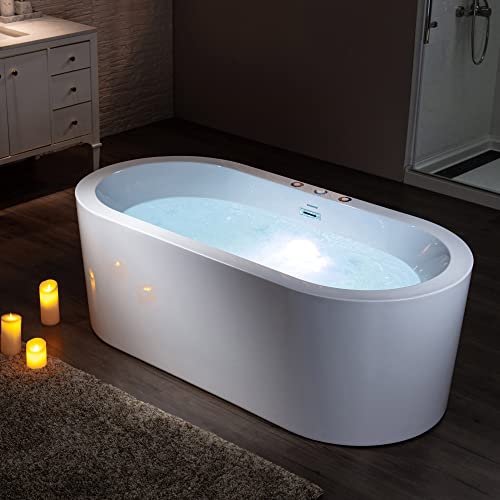
The middle child is often the right answer, and the 66 and a half inch WOODBRIDGE makes that case: spacious by its own listing’s description, with the family’s full specification of 16 jets across its whirlpool and air bubble systems, adjustable air blower speed, LED controls and chromotherapy light, this time with a chrome drain. It suits the common primary bathroom that cannot quite take 72 inches but would waste a compact tub, and bathers who want genuine stretch in moving, heated water.
Drain position splits this group cleanly. The alcove WOODBRIDGE drains on the left and needs its recess plumbed to match. Freestanding and back-to-wall models route their waste through the floor or wall according to their design, and the back-to-wall Empava pair hide their connections against the wall, which is tidy but makes the rough-in positions less forgiving. Confirm every position against the actual unit’s paperwork before pipes are fixed.
Jetted systems ask for a cleaning rhythm that plain tubs escape. Water sits in pipework between baths, so follow the maker’s guidance for periodically flushing the system with an appropriate cleaner, and run the jets briefly as directed after use if the manual asks for it. Households that keep this small routine own clear, fresh systems for years; households that skip it meet stale pipework eventually, and the fix is always more tedious than the habit would have been.
Strengths
- Spacious mid-size footprint suits most primary bathrooms
- Full stated package of 16 jets, blower adjustment and LED panel
- Chrome drain matches the most common existing fittings
Trade-offs
- Still a two-person installation job with electrical work to plan
- Heater specification is not detailed beyond heated soaking
- No capacity figure is given for judging water and heating load
- Size: 66-1/2 x 31-7/8 inches
- Jets: 16 whirlpool and air bubble jets
- Controls: LED panel, adjustable blower speed
- Drain: Chrome drain
- Capacity: not given
Best for: primary bathrooms wanting the full heated jet package at a balanced size.
Not suited for: very small rooms, or shoppers who need capacity and heater details stated.
On Amazon, the WOODBRIDGE 66 Heated Tub page carries its current price and the jet details in the maker’s own terms.

WOODBRIDGE 60 Alcove Heated Tub
Renovators keeping the standard alcove layout get the group’s only built-in option here: a 60 inch rectangular acrylic tub with a left drain, described in its listing as a whirlpool heated jetted tub, with a matte black pop-up drain included. It drops into the recess a conventional tub vacates, bringing heated jetted soaking to bathrooms where freestanding placement makes no sense. Note honestly that its listing states no jet count, unlike the freestanding WOODBRIDGE models, so ask if the number matters to you.
Floor load deserves respect even though these are acrylic tubs. Water is the heavy ingredient in any bath, and the Empava 67’s stated 59 gallons gives a sense of the working weight once a bather climbs in. Upper floors that happily carried a basic tub usually carry these too, but a joist check is cheap certainty, and the larger 71 and 72 inch models deserve it most, filled to their brims with a bather aboard.
The lighting features, chromotherapy on the WOODBRIDGE models and colour-changing LED on the Empava 71, are atmosphere rather than therapy, whatever the brochures imply. Used with that expectation they are genuinely enjoyable: a low coloured glow turns an evening soak into a different room without a single candle’s fire risk near towels. Treat them as the bathroom’s mood lighting and they will never disappoint you by failing to be medicine.
Strengths
- Alcove format fits the standard 60 inch recess with a left drain
- Matte black pop-up drain is included in the listing
- Heated whirlpool jetted design in a conventional rectangular shape
Trade-offs
- Jet count is not stated, unlike the 16 jet freestanding models
- Acrylic alcove styling is plainer than the slipper silhouettes
- Left drain only, so right drain alcoves need plumbing changes
- Size: 60 inches, rectangular
- Install: Alcove, left drain
- Material: Acrylic
- Drain: Matte black pop-up drain included
- Jet count: none stated in the listing
Best for: alcove renovations wanting heated jetted soaking in a standard recess.
Not suited for: right drain alcoves, or buyers who need a stated jet count.
Visit the WOODBRIDGE 60 Alcove Heated Tub listing to check price on Amazon and verify the drain position for your room.

Empava 67 Heated Tub
Detail hunters will find the Empava 67 the most completely specified listing in this guide. It states an inline heater by name, 17 jets across hydro and air systems, a waterfall feature, chromatherapy LED lighting, a handshower, a 59 gallon capacity and ETL certification, in a 67 inch back-to-wall acrylic design that sits against the wall to save the space a fully freestanding tub spends on its surround. If you buy on verifiable specification, this is your strongest sheet of paper.
Water supply speed matters more with big heated tubs. A heater holds temperature beautifully, but it cannot rescue a bath that took forty minutes to fill through an undersized filler and lost its heat on the way in. Check that your filler and supply lines can deliver a sensible fill rate for a tub of this class, and consider the water heater’s capacity for back-to-back baths in a busy household’s evening routine.
Waterfalls and handshowers earn their place in daily practicality. A waterfall filler, stated on both Empava models, fills the tub with a broad quiet stream, and a handshower, stated on the Empava 67, makes rinsing hair and washing down the tub after cleaning notably easier. These are the features owners end up using weekly, long after the novelty of the jet count has settled into routine, so weigh them accordingly when comparing listings.
Strengths
- Inline heater is stated explicitly, not implied
- Capacity is stated at 59 gallons and ETL certification is listed
- Waterfall and handshower are included among the stated features
Trade-offs
- Back-to-wall placement limits layout compared with true freestanding tubs
- The feature list is long, and every system is a future maintenance item
- Massage wording is the listing’s language; expect moving water, not medical outcomes
- Size: 67 inches, back-to-wall
- Jets: 17 hydro and air jets
- Heater: Inline heater, as stated
- Capacity: 59 gallons, as stated
- Certification: ETL certified, as listed
Best for: specification-driven buyers wanting a named inline heater and stated capacity.
Not suited for: minimalists, or rooms designed around a centre-of-room tub.
For the current price and the full stated feature set, see the Empava 67 Heated Tub on Amazon with your access plan in mind.

Empava 71 Heated Tub
Bathers who want the fullest feature set on paper end at the Empava 71: 20 jets, the most stated in this guide, an inline heater named in the listing, dual waterfalls, colour-changing LED lighting and chrome fixtures, in a 71 inch back-to-wall acrylic whirlpool design with ETL certification stated. It is the maximalist option, sized generously and specified completely, for a primary bathroom planned as a home spa in the literal, fittings-and-features sense of the phrase.
Leave the room’s moisture a way out. Long, hot, agitated baths produce serious steam, and jetted tubs run longer than plain soaks because the water stays inviting. A capable extractor fan, sized for the room and actually used, protects paint, grout and mirrors. It is the cheapest component in the entire project and the one whose absence is noticed every single day, so give it the same attention as the tub itself.
Finally, listen to the tub as you would to any machine you own. Pumps and blowers have a normal voice; a new rattle, a weaker jet or a blower that labours is information, best acted on while the fix is small. Keep the manual, note the model number somewhere durable, and keep that access panel’s location in the household’s shared knowledge. Powered tubs reward attentive owners with very long, very warm service.
Strengths
- 20 jets is the highest count stated in this group
- Inline heater is named explicitly in the listing
- Dual waterfalls and colour-changing LED lighting are stated features
Trade-offs
- Capacity does not appear in the listing despite the detailed specification
- The longest feature list here means the most systems to maintain
- Back-to-wall format fixes the tub against one wall by design
- Size: 71 inches, back-to-wall
- Jets: 20 jets, as stated
- Heater: Inline heater, as stated
- Features: Dual waterfalls, colour-changing LED
- Capacity: not stated in the listing
Best for: feature-first buyers wanting the most jets and a named inline heater.
Not suited for: simple tastes, tight budgets for maintenance, or centre-room layouts.
Check price on Amazon for the Empava 71 Heated Tub, and count its stated jets one more time while you are there.
Comparison Table
| Pick | Type | Size | Drain / Heating | Headline fact |
|---|---|---|---|---|
| WOODBRIDGE 72 Heated Tub | Double slipper, whirlpool and air | 72 x 35-3/8 inches | 16 jets stated | Heated soaking per listing; Chrome drain, LED panel |
| WOODBRIDGE 59 Heated Tub | Compact whirlpool and air | 59 x 31-1/2 inches | 16 jets stated | Heated soaking per listing; Matte black drain |
| WOODBRIDGE 66 Heated Tub | Spacious whirlpool and air | 66-1/2 x 31-7/8 inches | 16 jets stated | Heated soaking per listing; Chrome drain, LED panel |
| WOODBRIDGE 60 Alcove Heated Tub | Alcove whirlpool heated | 60 inches | Jet count not in listing | Heated jetted per listing; Left drain, pop-up included |
| Empava 67 Heated Tub | Back-to-wall whirlpool | 67 inches | 17 jets stated | Inline heater stated; 59 gal, ETL certified |
| Empava 71 Heated Tub | Back-to-wall whirlpool | 71 inches | 20 jets stated | Inline heater stated; Dual waterfalls, ETL listed |
How to Choose a Heated Soaking Bathtub With the Right Heater and Jets
Start by pinning down what heated means on the listing in front of you. The Empava models state an inline heater, which heats water as it circulates through the jet system and is the clearest specification in this guide. The WOODBRIDGE models are described as heated soaking tubs without the heater type being detailed in the quoted listing. If the heating mechanism matters to you, and for a heated tub it reasonably should, favour the listing that names it, or ask the seller until the answer is equally clear.
Choose the installation family before the features. The alcove WOODBRIDGE fits a standard recess and a left drain. The back-to-wall Empava pair sit against a wall with concealed connections. The freestanding WOODBRIDGE slipper and spacious models stand alone and need floor space on every side. Each family dictates different plumbing, access and cleaning realities, and no jet count compensates for a tub installed in a format your room fights against daily.
Read jet counts as a map, not a score. Sixteen jets across whirlpool and air systems, as the WOODBRIDGE freestanding models state, divides between directed water movement and general bubbling. The Empava counts of 17 and 20 describe their own hydro and air mixes. What matters is the blend and the adjustability: the WOODBRIDGE listings state adjustable air blower speed, which lets one tub serve a gentle evening and a lively one. Raw count alone has never soaked anybody.
Total the project honestly. Beyond the tub: electrical work to code, possible supply upgrades for a fast fill, access provisions, a capable extractor, and the filler’s cost all belong in the budget. A heated jetted tub is closer to an appliance installation than to a furniture purchase, and the households happiest with theirs are the ones who budgeted for the whole system from the start rather than discovering it line by line.
Match the size to the room and the bather together. The compact 59 inch WOODBRIDGE brings the full stated jet package to small bathrooms, the 66 and a half splits the difference for most primary rooms, and the 71 and 72 inch models reward space with stretch. Measure the room’s door as carefully as its floor, because a large powered tub that cannot enter the bathroom is a very sophisticated object to keep in a garage.
Inline Heaters Versus Heated Soaking: Reading the Listing Carefully
The word heated covers more than one engineering arrangement, and the listings in this guide illustrate the range. An inline heater, named explicitly by both Empava models, sits in the circulation path and warms water as the jet system moves it, maintaining temperature during the soak. A tub described as a heated soaking bathtub, as the WOODBRIDGE models are, promises temperature maintenance without the quoted listing specifying the mechanism. Both descriptions can describe a satisfying bath; they are not equally informative.
Why does the distinction matter? Because a buyer comparing two tubs deserves to know whether they are comparing the same system or two different ones wearing similar words. It also matters for servicing, since the heater’s type and position shape what a technician will look for in a decade. The remedy is simple and this guide models it: quote what the listing states, mark what it does not, and direct your questions to the seller until the specification is complete.
None of this should sour anyone on the category. A heated soak is a genuine, daily pleasure, and every tub here is listed as heated by its maker. The advice is about paperwork, not suspicion: with powered appliances, the specification sheet is part of the product. Buy the tub whose sheet answers your questions, and keep that sheet with the manual for the life of the installation.
Whirlpool Jets and Air Bubbles: Two Systems, Two Sensations
Combined tubs carry two different ways of moving water, and the WOODBRIDGE listings name both: whirlpool jets and air bubble jets. Whirlpool jets pump the bath water itself through directed outlets, producing focused streams you can feel against your back or legs. Air systems blow air through many small openings, filling the tub with rising bubbles and a general fizzing turbulence whose strength, on these models, adjusts at the blower.
The Empava listings describe their mixes in their own terms, hydro and air jets on the 67, air bubble massage among the 71’s features, with counts of 17 and 20. Across brands the vocabulary wobbles, so compare the underlying systems rather than the adjectives: is there pumped water movement, is there air, can either be adjusted, and how many outlets serve each? Those four answers describe the bath you will actually feel.
A practical note follows from the physics. Air systems cool the water slightly as they run, since they introduce room air, which is one more reason the heater matters in a combined tub: it quietly replaces what the bubbles spend. Whirlpool systems, recirculating the bath’s own water, do not carry that cost. Owners typically settle into a pattern, air for liveliness early in the soak, water jets later, heater holding everything steady underneath both.
Common Mistakes When Buying a Heated Jetted Tub
Buying the feature list and forgetting the access is the classic error. Every pump, blower and heater in these tubs will eventually want attention, and a tub tiled in with no service panel converts a modest repair into a building project. Decide where the panel goes while the room is open, make it genuinely usable, and record the installation with photographs before the walls close. Future you sends thanks in advance.
Underestimating the electrical work is the second error. Heated jetted tubs are appliances, and their supply requirements belong in an electrician’s hands at the planning stage, not as a surprise when the tub is already plumbed. The same goes for the fill rate and the room’s extraction. A project plan that lists power, water supply, drainage, access and ventilation on one page, each with an owner and a date, prevents nearly every expensive discovery this category offers.
The third mistake is neglecting the cleaning routine for jet pipework. Water rests in those lines between baths, and the systems stay fresh only if the maker’s flushing guidance is followed on schedule. It is a small, infrequent task. Skipping it for years and then attempting a rescue clean is the joyless version of the same job. Put the first flush in the calendar the week the tub is installed, and let habit carry it from there.
Living With a Heated Jetted Tub: Routines That Keep It Wonderful
The first month with a heated jetted tub teaches a household its new evening shape. Baths get longer because the water no longer sets a deadline, and the bather who once hurried learns to arrive with a book and no plan to leave. This is the moment to set the household’s small conventions: who runs the system flush and when, where the manual lives, and how the temperature is set for the bather who likes it cooler. Powered tubs reward households that treat them like the appliances they are, with a shared routine rather than a series of individual improvisations.
Weekly care settles into a short list. The tub surface gets the same gentle treatment as any quality acrylic: a rinse after use, a soft cloth, mild cleaners, and nothing abrasive near the jets or the drain finish. The waterline deserves attention in homes where bath oils are popular, since oils and agitated water are enthusiastic collaborators in building a film. Five unhurried minutes after the week’s longest soak keeps the shell looking new and the jets’ surrounds free of the crust that makes later cleaning a project.
The system flush belongs on a calendar, not in memory. Makers specify their own intervals and products for cleaning the pipework, and the households that keep jetted systems sweet for years are the ones that treat those dates like a car’s service schedule. Put the reminders in the same phone calendar that holds everything else, note which product the manual names, and keep a supply of it in the house so the scheduled day never gets postponed for want of a bottle. Postponement is how small routines become big rescues.
Sounds and sensations become familiar reference points. The blower’s voice at each speed, the heater’s quiet work, the feel of the jets at their best: owners learn the tub’s normal the way drivers learn an engine. That familiarity is a maintenance tool in itself, because the first sign of a tiring pump or a scaled heater is usually a change in the ordinary, noticed by someone who soaks often. Attentive ownership is mostly just regular use plus the willingness to act on a small difference while it is still small.
Heated Tubs and the Rest of the Bathroom: Designing the Whole System
A heated tub raises the bathroom’s ambitions, and the room’s other systems should be promoted to match. Ventilation leads the list, because long hot agitated soaks fill the air with moisture faster than any shower, and a fan sized generously for the room protects everything else you have paid for. If the renovation includes retiling, the extractor upgrade is at its cheapest while the ceiling is open. Owners who skip it spend years wiping mirrors and repainting ceilings, which is a poor exchange for one saved line in the budget.
Lighting design changes around a tub with its own glow. The chromotherapy and colour-changing features in these listings work best in a room that can go genuinely dim, so the main lighting should be dimmable and the mirror lighting separately switched for the practical morning. A bather who wants the tub’s low coloured light in the evening and a clear bright mirror at seven the next morning is not being fussy; they are describing exactly how the room will be used, twice a day, for decades.
Storage and surfaces adapt to longer baths. Everything a bather might want sits within reach of a tub designed for staying in: a shelf or stool for the book and the drink, products stored where they can be reached without climbing out dripping, and towels warmed or at least waiting within one step. The handshower stated on the Empava 67 quietly serves the room too, rinsing the tub after cleaning and washing down walls, one of those features whose value is measured in weekly minutes saved rather than in brochure excitement.
Flooring and safety finish the system honestly. Long soaks mean wet exits, and a heated tub’s bather is relaxed, warm and in no hurry to concentrate. Floor surfaces that stay secure under wet feet, a mat that covers the exit zone, and a grab point planned into the wall beside the larger models are not decorations on the design; they are part of it. The most luxurious bathroom is the one nobody has ever slipped in, and that outcome is decided at specification stage, not by luck.
What Heated Soaking Costs to Run, and How Owners Keep It Sensible
The running cost of a heated tub has three parts: the energy to fill it hot, the heater’s work holding temperature during the soak, and the pumps and blower while they run. The first part is shared with every bath ever taken and depends on the tub’s volume, which is why the Empava 67’s stated 59 gallons is such useful information. The second part is where heated tubs surprise sceptics pleasantly: holding water at temperature takes far less energy than reheating it, and a well covered, well insulated tub sips rather than gulps between uses.
Household habits move the bill more than specifications do. A tub filled nightly for long soaks will cost what it costs, and owners who love it pay gladly; a tub used twice a week costs a fraction of that. The honest exercise is to picture your real week before purchase and size both the tub and the expectation to it. The compact WOODBRIDGE exists for households that want the full experience at a smaller volume, and choosing it over a 72 inch model is a running cost decision as much as a space decision.
Covers and lids are the unglamorous economisers. A tub that stands filled or is used daily keeps its heat vastly better under a fitted cover, and even in a heated indoor bathroom the cover slows evaporation, which is heat leaving by another door. Where a cover is impractical, simply keeping the bathroom door closed and the room warm reduces the gradient the heater fights. None of these habits requires technology; they are the same common sense that governs a kettle or an oven, applied to a larger body of water.
Maintenance spending should be budgeted as calmly as energy. System cleaners on schedule, seals and jets inspected occasionally, and a technician’s visit when the tub’s normal voice changes: these are the costs of keeping a powered appliance at its best across a long life. Set against the alternative, a plain tub replaced or a bathroom that never quite delivers the soak it promised, owners consistently judge the heated tub’s ledger fair. The pleasure is daily, the costs are predictable, and predictability is what turns a luxury into a fixture.
Specifying a Heated Tub With Your Installer: The Conversation to Have First
The most valuable meeting in a heated tub project happens before anything is ordered, with the tub’s listing open on the table and the installer asking questions the brochure never raises. Which circuit will the heater and pumps draw from, and does the consumer unit have the capacity and the protection the installation requires? Where exactly will the equipment sit inside the tub’s frame, and what access will exist when a pump needs replacing in year six? A good installer answers these while sketching, and the sketch becomes the project’s foundation document.
Bring the drain conversation to the same meeting. The alcove model in this guide drains on the left; the back-to-wall models conceal their waste against the wall; freestanding models route through the floor. Each arrangement interacts with your joists, your existing waste run and your floor finish in a different way, and moving a waste by a few inches is trivial at sketch stage and miserable after tiling. The installer who walks the floor with a tape and a torch at this meeting is earning their fee before a single pipe is cut.
Water supply deserves equal billing. A large heated tub filled slowly is a tub whose first impression suffers, and the heater, for all its virtues, is designed to hold temperature rather than to rescue a bath that arrived lukewarm through a thin supply. Ask about the filler’s flow, the pipe sizes feeding it and the water heater’s capacity for the household’s real evening pattern. If two baths and a shower share an hour in your house, say so now, while the answers are still cheap.
Agree the access provision in writing. Where the panel will be, how large, how it will be finished to sit quietly in the room’s design, and what clearance the equipment needs are decisions that belong in the project documents, not in a installer’s memory. Photograph everything before it is closed in, label the photographs, and keep them with the manual. This is the least exciting paragraph in the entire guide and, across a twenty year ownership, possibly the most valuable one in it.
Finally, agree what finished looks like. Who seals the junctions and when, relative to a test fill? Who commissions the systems and demonstrates the controls to the household? Who registers any paperwork the maker provides? A heated tub project ends properly with a handover: systems run in your presence, the flush routine explained, the manual in your hand. Households that insist on that ending start their ownership confident, and confidence, with a powered appliance full of hot water, is worth the small ceremony.
Keep the installer’s name with the tub’s documents when the project closes. The person who knows where every pipe and cable runs is a resource for the life of the installation, and the household that can phone them in year eight with the model number and the photographs ready will get its problem solved in a fraction of the time. Heated tubs are long lived, well understood machines; the paperwork and relationships around them are what make their long life easy rather than archaeological.
Heated Tubs for Different Bathing Lives: Athletes, Readers, Shift Workers and Soaking Couples
Different households buy the same heated tub for entirely different evenings, and it is worth naming a few, because the right model follows from the life it will serve. The runner or gardener who comes home with tired legs wants the water jets’ directed movement and a temperature that holds while they sit still in it, in the plain comfort sense of recovery at the end of a working day. For that bather the combined systems in this guide, water and air together with an adjustable blower, are the specification that matters, and the tub earns its place several times a week.
The reader wants something else: steadiness. A bath that stays at temperature for the length of a long chapter, lighting low and warm, jets off or barely breathing, and no cooling clock forcing the book closed. That bather should weigh the heater story above the jet count entirely, favouring the listings that name their heating plainly, and should think about where the book rests and how the pages stay dry, because their tub is a library with plumbing and should be specified like one.
Shift workers keep hours that make them connoisseurs of the reliable soak. The nurse or driver home at dawn wants a bath that is ready without a project: filled, heated, quiet enough not to wake the house. For them the control panel’s simplicity and the systems’ ordinary running sounds matter as much as any feature, and a compact model that heats a smaller volume to readiness fits a life where the soak is maintenance for the next shift rather than an occasion. The guide’s compact WOODBRIDGE exists for exactly this honest use case.
Couples bring the tape measure back into the story. Two bathers in a jetted tub need the interior length and width to be genuine, which pushes toward the 71 and 72 inch models and toward layouts, like the double slipper, that give each person a shaped end. They should also expect the water displacement of two bodies to raise the level considerably, filling lower than instinct suggests. A couple that buys the size honestly the first time avoids the cramped disappointment that no jet count can massage away.
Across all these lives the heated tub’s promise is the same sentence with different emphasis: the water will be there, at temperature, moving as you like it, for as long as the evening asks. Naming your household’s version of that sentence before shopping turns a bewildering feature list into a shortlist, and it is why this guide ends where it began, with the advice to buy the bath you will actually take, in the room you actually have, on the evenings your life actually contains.
One more decision belongs at the end of the shortlist, and it is about service rather than specification: satisfy yourself that the model you choose can be looked after where you live. Heated jetted tubs are well understood machines, and any competent bathroom technician can work on them given the manual, the model number and access to the equipment, which is why this guide keeps returning to paperwork and panels. Before ordering, a quick call to the plumber or electrician who will install it, asking whether they are content to maintain that brand and type, closes the last open loop in the project. An affirmative answer, from the person who will actually kneel beside the tub in year seven, is worth more than another page of features. With it, the purchase is complete in every sense that matters: the right size, the right heater story, the right access, and a human being who knows the machine and will answer the phone. The rest is hot water and time, which is all any bather ever asked a tub to provide, delivered nightly, at temperature, for years.
Final Recommendation
Price three before you decide: the WOODBRIDGE 72 Heated Tub for scale, the WOODBRIDGE 59 Heated Tub for compact rooms, and the WOODBRIDGE 66 Heated Tub as the balanced middle of the range.
For a specification you can verify line by line, the Empava 67 Heated Tub leads with its stated inline heater, 59 gallon capacity and ETL certification, while the WOODBRIDGE 72 Heated Tub is the grand double slipper choice and the WOODBRIDGE 66 Heated Tub its balanced mid-size sibling. Check price on Amazon for the models on your shortlist, confirm the electrical requirements with your installer, and plan the access panel before anyone reaches for a tile.
A heated tub changes the contract of bathing: the water waits for you, instead of you hurrying for the water. Choose the size your room can honestly hold, the heater story you can read in plain words, and the jets you will actually switch on, and the tub becomes the room’s warm centre of gravity. On the first evening the temperature holds steady from the first page of your book to the last, the purchase will have explained itself completely.
Frequently Asked Questions
What is an inline heater in a jetted tub?
It is a heater fitted in the tub’s circulation path, warming the water as the jet system moves it, so the bath holds its temperature during a long soak. Both Empava listings in this guide state an inline heater explicitly. The WOODBRIDGE models are described as heated soaking tubs in their listings without the heater type being specified, so if the mechanism matters to your decision, confirm it with the seller for the exact model.
How many jets do these heated tubs have?
Where the listings state counts: the three freestanding WOODBRIDGE models each state 16 jets across whirlpool and air bubble systems, the Empava 67 states 17 hydro and air jets, and the Empava 71 states 20 jets. The WOODBRIDGE alcove model’s listing does not state a jet count. Counts describe outlets, not strength, so weigh the mix of water and air systems and any adjustability alongside the number.
Do these tubs need special electrical work?
Yes, plan on it. Heaters, pumps and blowers require proper protected electrical supply installed to your local code for bathroom appliances, arranged before walls and tiling close. The exact requirements come from the specific model’s documentation, which your electrician should see at the planning stage. Treat the electrical line in the budget as a core part of the purchase, not an optional extra discovered at installation.
What is the difference between whirlpool jets and air bubble jets?
Whirlpool jets pump the bath water through directed outlets, giving focused streams of moving water. Air bubble jets blow air through many small openings, surrounding the bather with rising bubbles and gentle turbulence. The WOODBRIDGE freestanding models combine both and state adjustable air blower speed. Most owners use them differently through a soak, air for general liveliness and water jets where they want directed movement.
Can a heated jetted tub fit in a standard alcove?
One pick here is built for exactly that: the WOODBRIDGE 60 alcove model is a rectangular acrylic tub for a standard recess, with a left drain and a matte black pop-up drain included, described as a whirlpool heated jetted tub. Alcove installations still need the same electrical supply, service access and ventilation planning as freestanding models, and the left drain position must match your recess or the plumbing must be moved.
How do I keep the jet system clean?
Follow the maker’s flushing guidance on its stated schedule, using the type of system cleaner the manual specifies, and keep up the ordinary habit of rinsing the tub after use. Water resting in jet pipework between baths is what the routine addresses. The task is brief and infrequent when done on time. If a used system has been neglected, expect a longer rescue process, and consider a professional service for a newly installed second-hand situation.
Related Guides
A heated tub is rarely the only upgrade a home is weighing, so these guides cover three adjacent decisions.
Best Goose Down Pillows for Side Sleepers
Best Heated King Size Blankets


