What's inside
- Quick Picks
- How We Chose These Picks
- Key Takeaways
- Detailed Reviews
- Comparison Table
- How to Choose the Right Berber-Style Rug for Your Room
- What Does a Shag Pile Actually Feel Like Day to Day?
- Where Should a Berber-Style Rug Not Go?
- Common Mistakes When Buying Berber Rugs
- How Do You Keep a Deep Shag Looking Like Itself?
- Where Does the Berber Look Come From, and Why Does It Suit Modern Rooms?
- Three Rooms, Three Different Right Answers
- What Should You Check in the First Week After a Shag Arrives?
- Choosing Among the Four SAFAVIEH Shags Without Going in Circles
- How Does a Berber-Style Rug Change a Room’s Sound and Temperature?
- Final Recommendation
- Frequently Asked Questions
- Related Guides
As an Amazon Associate I earn from qualifying purchases. This post may contain affiliate links at no extra cost to you.
As an Amazon Associate, cottageverdict.com earns from qualifying purchases made through links in this guide — at no extra cost to you.
Where to buy: all six rugs below are sold on Amazon, and you will find each name linked in the Quick Picks table, in its review heading, after its review and once more in the comparison table, so please check price on Amazon and double-check the size, colourway and pile height on the listing before you order. Anyone hunting for the best berber rugs quickly discovers that the word berber on a modern listing is mostly a style label — a nod to the pale, flecked, tribal-looking rugs of North Africa — rather than a promise about how the rug was woven.
That distinction shapes this whole guide. Four of the six picks are SAFAVIEH shag rugs sold under the Berber name, and their listings describe a high shag pile, not the tight looped weave of a traditional handmade berber carpet. We review them as what they are: soft, deep-pile area rugs with berber-style colouring and patterning. The fifth pick, a Garland rug in earth tones, keeps its listing brief and gives almost no construction detail, so we say plainly what is known and what is not. The sixth is a different animal altogether — a flat, washable Fortsea rug with a faux jute look, included because some shoppers searching this term actually want the berber colour palette without any pile at all.
Sizes here cluster at the generous end. Four picks measure 9 by 12 feet or 8 by 10 feet, dimensions that anchor a full living room seating group or sit under a queen bed with room to spare on three sides. The Fortsea, at 5 by 7 feet, is the only modest footprint in the set. Pile height is the other big divider: the SAFAVIEH shags stand 1 1/8 or 1 1/4 inches tall, which is proper sink-in territory, while the Fortsea is a low, washable weave you can put under a dining table or in a hallway without fighting a door swing.
Colourways stay inside the berber palette throughout — cream, ivory, beige, soft grey, muted blue, and rust used as an accent rather than a flood. That restraint is exactly why these rugs get bought: they warm up a room full of wood and linen without demanding that every other textile match them. If your floors are pale oak or grey laminate and your sofa is a solid neutral, any of these six will slot in. If you want a saturated statement rug, this is the wrong shelf of the shop, and the guide will not pretend otherwise.
Quick Picks
| Pick | Badge | Why it earns its place |
|---|---|---|
| SAFAVIEH Berber Shag 200 9×12 | Best Overall | The largest berber-style shag here, in gray blue and cream polypropylene with a 1 1/8 inch pile for big living rooms. |
| Garland Classic Berber 9×12 | Quietest Pattern | A 9 by 12 earth tone rug whose listing keeps things simple for buyers who want the look without a bold motif. |
| SAFAVIEH Berber Shag Blue Rust 8×10 | Warmest Accent Colour | Blue rust and ivory polyester shag at 8 by 10, the one pick that brings a genuine accent colour into the palette. |
| SAFAVIEH Berber Shag Ivory Beige 9×12 | Best Pale Neutral | A modern solid ivory and beige 9 by 12 shag for rooms that need lightening rather than pattern. |
| SAFAVIEH Berber Shag Gray Ivory 8×10 | Best for Grey Rooms | Modern solid gray and ivory at 8 by 10, tuned to the grey floors and sofas so many rooms already have. |
| Fortsea Natural Berber 5×7 | Only Washable Flat Option | A 5 by 7 camel faux jute-look rug that is washable and non-slip, for dining rooms, kitchens and busy hallways. |
How We Chose These Picks
We started from listings that use the berber name or an unmistakably berber-style palette, then read each title line by line and kept only what the title itself states. Where a listing gives fibre, pile height and country of manufacture, those facts anchor the review. Where a listing is nearly silent, as the Garland is, the review says so instead of filling the silence with guesses. Four SAFAVIEH variants stayed in because they are genuinely different purchases once you read them closely: two sizes, two fibres, three colour stories and two pile heights separate them, and a buyer choosing between an 8 by 10 and a 9 by 12 is making a real decision, not splitting hairs.
We also insisted on spread. A guide made of six near-identical shags would fail the shopper who needs a rug under a table, so the washable flat Fortsea holds a place as the practical counterweight. Room suggestions in each review follow the rooms the listings themselves name — bedroom, living room and home office recur — and we flag the places where a deep shag simply does not belong, such as under dining chairs or in a doorway with a low clearance. Finally, every pick had to be a full area rug rather than a runner or a small accent mat, because the keyword promises room-scale coverage.
Key Takeaways
- On these listings, berber names a colour-and-pattern style; four picks are high-pile shags, so expect plush softness rather than a flat looped weave.
- Pile height splits the group cleanly: 1 1/8 inch on the polypropylene SAFAVIEH, 1 1/4 inch on the three polyester SAFAVIEHs, and a low flat profile on the Fortsea.
- Size runs large — three rugs at 9 by 12, two at 8 by 10 — so measure your room and your furniture layout before falling for a colourway.
- The Fortsea is the only washable, non-slip, no-shed pick, and the only one suited to dining areas and heavy foot traffic.
- Colourways are all variations on cream, ivory, grey and beige with blue or rust accents, chosen to sit quietly under existing furniture.
Detailed Reviews
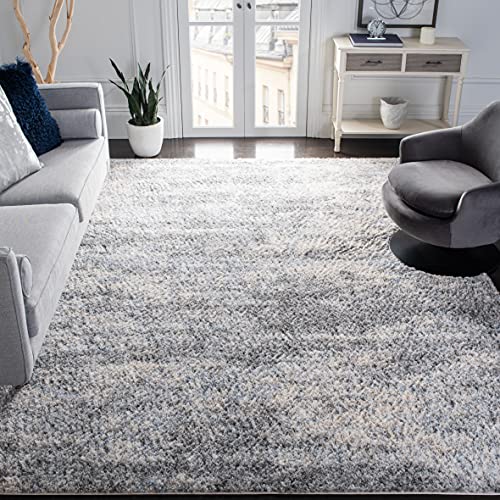
SAFAVIEH Berber Shag 200 9×12
This is the flagship of the group: a 9 by 12 foot rug in gray blue and cream, power-loomed from polypropylene in Turkey, with a pile the listing puts at 1 1/8 inches. That is deep enough to change how a room feels underfoot — the step off a sofa onto this rug registers as a small event — yet it is a fraction shorter than the pile on the polyester SAFAVIEHs below, which stand at 1¼ inches, which matters if a door swings over the rug’s edge or if you dislike the feeling of furniture wobbling on a very deep pile.
The colourway does quiet work. Gray blue is a cool, dusty tone that pairs naturally with cream, and in a 9 by 12 the pattern spreads out enough to read as texture rather than as a busy print. The listing names the bedroom, living room and home office as its rooms, and the living room is where this size earns its keep: a 9 by 12 lets all four legs of a sofa and both front chairs sit on the rug, which is the layout detail that makes a seating group look finished instead of parked. Polypropylene is the fibre the listing states, and within this guide it appears only on this pick; the practical point to take from the title alone is that this is a machine-made rug, power-loomed, not a hand-knotted piece, and it should be bought and priced in your mind accordingly.
- Size: 9′ x 12′, as titled
- Colourway: Gray Blue & Cream, code BER219G in the title
- Fibre: polypropylene, power-loomed
- Pile height: 1 1/8 in
- Country of manufacture: made in Turkey, per the title
- Backing material: not stated in the listing
Strengths
- Largest footprint in the guide, suited to full seating layouts
- Slightly lower pile than its polyester siblings, kinder to door clearance
- Cool gray blue softens rooms that lean too warm or too yellow
Trade-offs
- Deep shag is the wrong surface for dining chairs that must slide
- A 9 by 12 shag is heavy to lift for deep cleaning underneath
- Cool colourway can feel chilly in a north-facing room
Best for: owners of large living rooms who want the classic berber look with a cooler, blue-grey cast. Not suited for: dining rooms, or small rooms where a 9 by 12 would run wall to wall.

Garland Classic Berber 9×12
The Garland listing is the shortest in this guide by a wide margin: a Classic Berber area rug, 9 by 12 feet, in an earth tone colourway. That is nearly everything the title tells us, and this review will respect the silence rather than decorate it. What can be said honestly is that the pick occupies a useful niche — a big, quiet, earth-toned rug for shoppers who find the SAFAVIEH shags too plush or too patterned and who want the berber idea reduced to warm neutral colour at room scale.
Earth tone, as a colour description, points toward the brown-beige-tan family, which makes this the warmest large option here and a natural fit over mid-tone wood floors or under leather seating. Because the listing does not state fibre, pile height or construction, a buyer who cares about any of those — and most rug buyers should care about at least fibre and pile — needs to open the listing and read its full description and specification sections before ordering. We kept the Garland in the guide because its size and colour story are clear and because some households genuinely prefer a plainer rug, but it is the pick that asks the most homework of its buyer.
- Size: 9 by 12 feet, as titled
- Colourway: Earth Tone
- Style name in title: Classic Berber
- Fibre: not given
- Pile height: not given
- Construction method: none stated in the listing
Strengths
- Full 9 by 12 coverage in a subdued, easy-to-live-with palette
- Plain presentation suits rooms already carrying pattern elsewhere
- Earth tones hide the everyday dust of a busy household gracefully
Trade-offs
- Listing states no fibre, so material research falls to the buyer
- No pile height is given, which makes door and furniture planning guesswork
- Buyers wanting a certified shag texture should look at the SAFAVIEH picks
Best for: shoppers who want a large, warm-neutral berber-style rug and are willing to confirm the details on the listing page. Not suited for: anyone who needs fibre or pile specifications confirmed before they buy.

SAFAVIEH Berber Shag Blue Rust 8×10
If the other SAFAVIEHs whisper, this one speaks up — politely, but audibly. The colourway is blue rust and ivory, and that rust note is the only true accent colour anywhere in this guide. At 8 by 10 feet, power-loomed from polyester with a pile height of 1 1/4 inches, it is built on the same deep-shag platform as the ivory beige and gray ivory variants below, so the decision here is purely about colour courage and room size.
Rust earns its place in a berber palette because it echoes the clay and ochre tones of the North African textiles the style borrows from, and it does practical decorative work: it warms a blue-grey room, it gives a plain cream sofa a partner with some temperature to it, and it picks up the tones of terracotta pots, leather poufs and wooden side tables. The 8 by 10 footprint suits the middle-sized living room or a bedroom where the rug should extend beyond the bed on the sides and at the foot without disappearing under every piece of furniture in the room. Polyester is the stated fibre, and the listing again names the bedroom, living room and home office. Treat the pile honestly: at 1 1/4 inches this is a rug you sink into, lovely for bare feet on a winter morning, awkward for an office chair on castors, which will dig in and resist rolling.
- Size: 8′ x 10′, as titled
- Colourway: Blue Rust & Ivory, code BER565A in the title
- Fibre: polyester, power-loomed
- Pile height: 1 1/4 in
- Country of manufacture: made in Turkey, per the title
- Rug pad recommendation: not stated in the listing
Strengths
- Only pick with a genuine warm accent woven through the design
- Deep pile, at one and a quarter inches, delivers the full shag experience
- 8 by 10 size fits the average living room without overwhelming it
Trade-offs
- Rust tones will fight with red-family upholstery or curtains
- Castor chairs and deep shag are unhappy partners
- Strongest pattern here, so it commits the room’s colour scheme
Best for: neutral rooms that feel flat and need one warm, patterned anchor at a manageable size. Not suited for: home offices where a wheeled chair must move freely all day.

SAFAVIEH Berber Shag Ivory Beige 9×12
Sold as a modern solid in ivory and beige, this 9 by 12 is the pale, calm option for rooms that need light more than they need pattern. The listing describes a power-loomed polyester shag whose pile stands 1¼ inches tall, made in Turkey, and aimed at the bedroom, living room and home office. Solid colouring in a shag is a particular aesthetic: with no motif to look at, the eye reads the pile itself — its depth, its shadows, the way foot traffic combs it in different directions — and the rug becomes a textural field rather than a picture on the floor.
That quality makes this pick the stylist’s choice among the four SAFAVIEHs. A pale solid shag under a bed is a small luxury that shows every morning, and in a living room it lets artwork, cushions and throws carry the colour while the floor stays serene. The honest cautions are the ones pale rugs always carry. Ivory and beige show soil sooner than a flecked or patterned colourway, and a solid field shows the traffic lanes — the slightly flattened path from door to sofa — more honestly than a design would. Households with muddy-pawed dogs or toddlers carrying juice should weigh that before choosing the lightest rug in the guide. Size, though, is beyond argument: at 9 by 12 it covers like the flagship, and its pile stands a fraction taller.
- Size: 9′ x 12′, as titled
- Colourway: Modern Solid Ivory & Beige, code BER563A in the title
- Fibre: polyester, power-loomed
- Pile height: 1 1/4 in
- Country of manufacture: made in Turkey, per the title
- Stain treatment: none stated in the listing
Strengths
- Palest colourway here, brightens dim rooms measurably
- Solid design lets other textiles and art carry the colour
- Full 9 by 12 coverage with the deeper 1 1/4 inch pile
Trade-offs
- Light solid pile shows dirt and traffic lanes earliest
- No pattern to disguise the flattened paths of daily walking
- Beige cast can clash with very grey, cool-toned flooring
Best for: calm, light interiors and bedrooms where a soft pale field underfoot is the whole point. Not suited for: mud-season households with pets tracking in from the garden daily.

SAFAVIEH Berber Shag Gray Ivory 8×10
Think of this one as the ivory beige pick’s cooler sibling. Same platform — power-loomed polyester with the taller pile, made in Turkey, rooms listed as bedroom, living room and home office — but the colourway turns to modern solid gray and ivory, and the size steps down to 8 by 10. Those two changes together aim it at a specific and very common room: the one with grey laminate or grey-washed boards, a light grey sofa, and a nagging sense that everything looks a bit flat and cold.
A grey and ivory shag answers that flatness with texture instead of colour. The ivory keeps the field from going gloomy, the grey ties the rug to the floor and upholstery the room already owns, and the deep pile supplies the softness the palette withholds. At 8 by 10 it is also the more forgiving fit for the average semi-detached living room, where a 9 by 12 would creep under every skirting board. Where it asks for care is in mixing greys: a blue-grey floor, a warm greige sofa and a neutral grey rug can sit awkwardly together, so hold the listing photos against your room’s light before committing. As with its siblings, keep castor chairs and dining sets off the deep pile, and expect a solid colourway to show its walking paths sooner than a patterned one would.
- Size: 8′ x 10′, as titled
- Colourway: Modern Solid Gray & Ivory, code BER563G in the title
- Fibre: polyester, power-loomed
- Pile height: 1 1/4 in
- Country of manufacture: made in Turkey, per the title
- Backing type: not given
Strengths
- Grey and ivory pairing matches the floors many homes already have
- Texture adds warmth to cool rooms without adding colour noise
- 8 by 10 footprint suits ordinary living rooms and larger bedrooms
Trade-offs
- Grey-on-grey rooms risk a flat, monochrome result
- Solid field reveals traffic patterns over time
- Deep pile rules out wheeled chairs and sliding dining sets
Best for: grey-toned living rooms and bedrooms that need softness and depth rather than a new colour. Not suited for: rooms already saturated with competing grey shades that refuse to harmonise.

Fortsea Natural Berber 5×7
Every guide needs one pick that breaks the pattern, and here it is a flat one. The Fortsea measures 5 by 7 feet in a camel colourway, wears a faux jute look, and its listing leads with the practical words: washable, non-slip, non-skid, no shed. This is the berber palette translated into a rug you can put under a dining table, in front of a kitchen sink run, or in a hallway where a shag would be madness. The jute appearance is a look, not a fibre claim — the title says faux jute-look, and we repeat that wording deliberately, because a buyer expecting scratchy natural jute texture will find a smoother, washable surface instead.
The rooms named in the listing are the living room and bedroom, but the feature set argues for the harder-working spaces of the house. Washability matters most where spills are routine; a non-slip, non-skid character matters where children and older relatives walk at speed; a no-shed surface matters where a robot vacuum runs daily and would choke on shag. At 5 by 7 it will not anchor a full seating group the way the 9 by 12 SAFAVIEHs do, and it offers nothing to bare feet seeking plushness on a cold morning. Judged as the household workhorse of the six, though, it is the only pick whose listing promises the three things busy homes actually ask for: put it down, keep it in place, and clean it without ceremony.
- Size: 5’x7′, as titled
- Colourway: Camel
- Surface look: faux jute-look, per the title
- Care: washable, stated in the title
- Grip: non-slip and non-skid wording in the title
- Shedding: described as no shed in the title
Strengths
- Only washable pick, built for dining rooms and spill zones
- Non-slip character suits hallways and family traffic routes
- Flat profile clears door swings that defeat the shags
Trade-offs
- No pile means no plush, sink-in comfort underfoot
- Smallest rug here; cannot anchor a large seating layout
- Faux jute look will not fool anyone expecting natural fibre texture
Best for: dining areas, kitchens, hallways and pet households that need the berber palette in a washable flat rug. Not suited for: buyers whose whole reason for shopping is deep-pile softness.
Comparison Table
| Pick | Size | Fibre / construction | Pile | Colourway |
|---|---|---|---|---|
| SAFAVIEH Berber Shag 200 9×12 | 9′ x 12′ | Polypropylene, power-loomed | 1 1/8 in | Gray Blue & Cream |
| Garland Classic Berber 9×12 | 9 by 12 feet | Fibre not in listing | Pile not in listing | Earth Tone |
| SAFAVIEH Berber Shag Blue Rust 8×10 | 8′ x 10′ | Polyester, power-loomed | 1 1/4 in | Blue Rust & Ivory |
| SAFAVIEH Berber Shag Ivory Beige 9×12 | 9′ x 12′ | Polyester, power-loomed | 1 1/4 in | Ivory & Beige |
| SAFAVIEH Berber Shag Gray Ivory 8×10 | 8′ x 10′ | Polyester, power-loomed | 1 1/4 in | Gray & Ivory |
| Fortsea Natural Berber 5×7 | 5’x7′ | Faux jute-look, washable | Low flat profile | Camel |
How to Choose the Right Berber-Style Rug for Your Room
Begin with the tape measure, not the colour chart. A rug that is too small makes good furniture look stranded, and in this guide the sizes are large enough that a mistake is an expensive rectangle to live with. In a living room, decide which layout you are dressing: all furniture legs on the rug, which usually wants the 9 by 12; front legs only, which an 8 by 10 often handles; or a rug floating in the middle with furniture around it, which rarely looks intentional. In a bedroom, the generous rule is a rug that extends well beyond both sides of the bed and past its foot, so your first steps land on pile. Measure the room, subtract a border of bare floor you are happy to see — most rooms look right with a visible margin of flooring on every side — and let the arithmetic choose between the 8 by 10 and the 9 by 12 before your heart chooses a colourway.
Next, interrogate the pile. The difference between 1 1/8 and 1 1/4 inches sounds trivial on paper and feels trivial too, but the difference between either of those and the Fortsea’s flat weave is the difference between two categories of rug. Deep shag insulates, softens sound and coddles bare feet; it also traps crumbs, resists chair castors, slows robot vacuums and raises the rug’s edge where doors swing. Walk your room’s daily life across each option. Dining chairs sliding twice a day argue for the flat pick. A reading corner where you sit on the floor argues for the deepest pile you can get. A home office with a rolling chair argues against all four shags, however handsome.
Colour comes third, and the honest way to choose it is against the room’s fixed elements — floor tone, sofa fabric, curtain colour — rather than against a screen. Screens flatter everything. The gray blue SAFAVIEH cools a warm room; the ivory beige lightens a dark one; the gray ivory disappears politely into grey schemes; the blue rust commits to warmth and asks the rest of the room to meet it halfway; the Garland’s earth tones suit wood-heavy rooms; the Fortsea’s camel is the colour of practicality itself. If two colourways both work, choose the one with more variation in its field, because variation forgives the daily evidence of living — crumbs, pet hair, the faint path from sofa to kitchen — far longer than a solid pale surface does.
Finally, plan the unglamorous layer beneath. None of these listings states a backing in its title, and deep shags on smooth floors can creep and bunch at the corners, which is both a trip hazard and a slow destroyer of the rug’s shape. A separate rug pad, cut slightly smaller than the rug, is the standard answer: it grips the floor, adds a whisper of extra cushion, and keeps the pile from being ground against hard flooring. Budget the pad into the purchase, check the door clearance with pad and pile combined, and confirm the listing’s own care and backing details on the page before the rug ships.
What Does a Shag Pile Actually Feel Like Day to Day?
Listings describe pile in inches; households experience it in moments. A 1 1/4 inch shag is the rug children migrate to with a book, the surface that makes a rented flat feel owned, and the reason a living room goes quiet — deep pile absorbs the small sounds of a room, the click of heels, the echo off bare boards. Morning bare feet approve of it without reservation. So do knees during floor play and elbows during a film watched from a cushion.
The same depth collects the week’s evidence. Crumbs fall into shag and vanish from sight without vanishing from the rug, which is why shag owners learn the shake-and-vacuum rhythm: a thorough vacuum on a high-pile setting, slowly, in overlapping passes, because rushing a shag mostly combs its surface. Furniture leaves its signature too — legs compress the pile into dents that recover slowly, sometimes helped by an ice cube melted into the dent and a gentle teasing of the fibres once dry. None of this is a defect; it is the maintenance contract of plushness, and it is lighter than the contract of a pale flatweave that shows every mark. But a buyer who wants a rug to be invisible labour should choose the Fortsea’s flat washability and accept its firmer greeting, while a buyer who reads vacuuming as a fair price for comfort will be happy in shag for years.
Where Should a Berber-Style Rug Not Go?
Placement mistakes waste more good rugs than wear does. The deep shags in this guide do not belong in entryways, where grit arrives on every shoe and grinds into pile like sandpaper, nor directly inside a frequently used exterior door, where the swing arc and the weather conspire against them. Kitchens defeat shag completely — grease, water and dropped food in a deep pile is a hygiene problem wearing a rug costume — and bathrooms, with their daily soaking, are nearly as poor a match, quite apart from the question of a thick wet rug ever drying.
Stairs and landings deserve their own warning: a loose area rug on a landing is a fall waiting for a distracted moment, and none of these picks is a stair runner. Under a dining table, as noted, chair legs and shag fight daily; if the berber look is non-negotiable in a dining room, the flat Fortsea is the only one of the six built for that job, with clearance for chairs to slide and a washable surface for the inevitable gravy incident. The shags’ true home is the room where people linger in socks — living room, bedroom, a quiet office without castors — and placing them there is what lets their softness be the story instead of their upkeep.
Common Mistakes When Buying Berber Rugs
The first mistake is buying the word instead of the rug. Shoppers picture a hand-knotted tribal carpet, order a listing that says berber, and receive a power-loomed shag — a good rug, but not the rug in their head. Read the construction words in the title: power-loomed, shag, the stated fibre. Those words are the rug; berber is the mood. The second mistake is sizing by hope. A 9 by 12 sounds enormous until it is the only thing making a large room cohere, and an 8 by 10 sounds ample until the sofa’s front legs perch on its edge like a cat on a fence. Measure, tape the outline on the floor with painter’s tape, and live with the outline for a day.
Third, buyers ignore the door swing until the door ignores the rug, shaving its edge every time it opens. Check clearance against pile height plus pad before ordering, especially with the 1 1/4 inch picks. Fourth, pale solid shags get placed in the highest-traffic room of a pet-owning house, and their owners blame the rug for showing what a patterned rug would have hidden; match the colourway’s forgiveness to the household’s traffic. Fifth, the rug pad gets skipped to save a little money, and the rug creeps, corners curl, and the pile wears unevenly — the pad is not an upsell, it is part of the rug. Sixth and last, people vacuum shag on a beater-bar setting meant for low carpet and wonder why fibres shed into the bin; use the gentlest effective setting, move slowly, and let suction do the work.
How Do You Keep a Deep Shag Looking Like Itself?
Care for shag is mostly rhythm rather than effort. Vacuum weekly in slow passes, more often at the edges where dust migrates, and shake or beat the rug outdoors when its size and your strength allow — a 9 by 12 shag holds a startling amount of the week’s dust, and removing it is the single most restorative thing you can do. Rotate the rug a half-turn every few months so sunlight and foot traffic distribute their effects evenly; solid colourways like the ivory beige and gray ivory picks benefit most visibly from this habit, since it interrupts the formation of permanent-looking lanes.
Spills want speed and restraint in equal measure: lift solids, blot liquids with a clean cloth without rubbing — rubbing drives the spill deeper and frays the pile’s twist — and work from the edge of the mark inward. Test any cleaning product on a hidden corner first. For the Fortsea, life is simpler by design: its listing promises a washable rug, so follow the maker’s washing guidance on the listing, dry it flat or as directed, and let its non-slip character reassert itself once it is back in place. Across all six, the deeper rule is that a rug’s lifespan is decided less by its fibre than by whether grit is allowed to live in it; grit is abrasive, and removing it regularly is the whole secret of a shag that still looks plush in its fifth year.
Where Does the Berber Look Come From, and Why Does It Suit Modern Rooms?
The original berber carpets come from the indigenous tribes of North Africa, woven for warmth in mountain homes, typically in undyed wool the colour of the sheep themselves — cream, ivory, brown-grey — with darker lines and simple symbols worked through the field. That origin explains the palette every pick in this guide shares. These are sheep colours and earth colours, which is precisely why the style refuses to date: it was never following a fashion, so it never falls out of one. A berber-style rug bought this year will still look correct against the furniture you own in a decade, provided the rug itself survives, because cream and grey and clay do not belong to any particular season’s taste.
Modern interiors keep returning to the look for a second reason: texture is doing the work that pattern used to do. Rooms full of flat surfaces — laminate floors, plain sofas, painted walls, glass — can feel finished yet oddly weightless, and a deep, flecked, slightly irregular rug is the fastest way to give such a room a ground note. The SAFAVIEH shags supply that texture through pile; the Fortsea supplies a quieter version through its jute-look surface. Either way, the berber contribution is the same: a floor covering that reads as natural and calm at a glance, and rewards a closer look with small variations rather than a loud repeating motif. If your home leans Scandinavian, farmhouse, bohemian or simply neutral, this is the family of rugs your rooms were already dressed for.
Three Rooms, Three Different Right Answers
Consider a long rental living room with grey laminate, a charcoal sofa and a tenant forbidden from painting. The problem is coldness, not colour. The gray ivory SAFAVIEH at 8 by 10 answers it by adding a metre-deep field of soft texture in tones that argue with nothing the landlord installed, and when the tenancy ends the rug rolls up and takes its warmth to the next flat. Now consider a family farmhouse bedroom, king bed, oak boards, a dog with opinions about where it sleeps. The ivory beige 9 by 12 gives bare feet a pale, deep landing on both sides of the bed, and its owners accept the vacuuming contract because the dog, realistically, sleeps on the rug whatever they buy — a patterned pick would forgive more, and that trade is worth one honest conversation before ordering.
The third room is a dining space in a house with three children under ten. Every instinct that points toward a beautiful shag should be overruled here by the memory of last week’s spaghetti. The Fortsea goes under the table: flat enough for chairs, washable enough for the next incident, camel-coloured enough to keep the berber mood the household wanted. Three rooms, three picks from one guide, and in each case the deciding factor was not which rug is best in the abstract but which rug’s stated facts — size, pile, washability, colourway — matched the life the room actually lives. That is the only ranking method this guide trusts, and it is why the reviews dwell on doors, castors, dogs and dinners rather than on adjectives.
What Should You Check in the First Week After a Shag Arrives?
New shag rugs arrive compressed from their packaging, and the first week decides whether yours settles into beauty or into grievance. Unroll it fully and let it rest; the pile needs time and a few vacuum passes to lift from its folded sleep, and creases from rolling usually relax over several days, helped by placing the rug pile-side down briefly or weighting a stubborn fold with books overnight. Walk the edges daily and press down any corner that wants to curl — early attention trains the rug flat far more easily than late correction does.
Expect some initial shedding from any deep pile, as loose fibres left from manufacture work their way out; this is a settling behaviour, not a verdict on quality, and it should taper rather than accelerate. Vacuum gently and often during that first fortnight to clear those fibres before they migrate around the house. Check the door swing again with the rug in its final position, because a pile that measured fine in theory can still brush a door in practice once the pad is underneath. Finally, stand back at the doorway in evening light — the light you will actually live with — and judge the colourway then, not under the noon brightness of delivery day. If the rug is wrong for the room, the first week is when returning it is still a small errand rather than a settled regret.
Choosing Among the Four SAFAVIEH Shags Without Going in Circles
Because four picks share a brand and a construction family, buyers often freeze at exactly the point where the differences become simple. Lay the decision out as three questions in a fixed order and the freeze dissolves. Question one is footprint. Do you need a 9 by 12 or an 8 by 10? That single answer halves the field immediately: the larger size leaves the gray blue polypropylene rug and the ivory beige polyester rug; the smaller leaves the blue rust and the gray ivory. Nothing about colour should be debated until the tape measure has had its say, because a beloved colourway in the wrong rectangle is still the wrong rectangle, and it will announce itself every time you enter the room.
Question two is temperature. Among the big rugs, gray blue cools and ivory beige warms; among the smaller pair, blue rust warms with an accent while gray ivory stays cool and quiet. Stand in your doorway and name the room’s existing temperature honestly. Rooms with south-facing glass, warm wood and cream walls usually beg for the cooling option, and rooms with grey floors and white walls usually beg for warmth — but your room’s actual light outranks any rule of thumb, which is why the listing photographs should be compared against your floor at the hour you use the room most. Question three, asked last because it matters least to daily happiness, is fibre as the titles present it: the polypropylene rug stands at 1 1/8 inches, the polyester rugs at 1 1/4, and that small step in pile height is worth more to your door clearance and your feet than any fibre debate conducted without facts the listings do not provide.
One more tiebreaker deserves naming, because it settles real households: forgiveness. Patterned and flecked fields — the gray blue and the blue rust — conceal the ordinary debris of living between vacuums, while the two modern solids display it promptly and proudly. A household with a shedding pet, a toddler, or a relaxed attitude to housework will be happier with a forgiving field even if a solid photographs more elegantly. Conversely, a tidy household that vacuums often can enjoy the calm of a solid without paying for it in visible upkeep. Neither answer is the sophisticated one; both are simply honest, and honesty about your own habits is the cheapest rug-buying tool there is. When all three questions and the tiebreaker still leave two finalists, choose the one whose colourway you would still pick with the other textiles removed from the room — sofas and curtains change, but a 9 by 12 rug tends to outlast them, and it should be able to hold the floor alone.
How Does a Berber-Style Rug Change a Room’s Sound and Temperature?
Two of the strongest reasons to choose these rugs never appear in a title, because they are properties of any large, deep floor covering rather than of one model. The first is acoustic. Hard floors return sound to the room — footsteps, chair scrapes, television dialogue bouncing off boards and walls — and a 9 by 12 shag interrupts that echo chamber across most of the floor’s area. Conversations sit down, so to speak; the room stops sounding like a corridor. Anyone who has moved from bare boards into a flat with one large rug knows the change is immediate and slightly startling, and it is a large part of why a berber-style rug makes a rented room feel owned: ownership, acoustically, sounds like softness.
The second is thermal. A deep pile traps a layer of still air above the floor, and in a house with cold boards or tile that layer is the difference between a room that merely looks warm and one that feels warm at ankle height, where cold announces itself first. Children playing on the floor, readers in armchairs with their feet down, anyone padding to the kitchen at midnight — all of them register the rug as heating that never appears on a bill. The flat Fortsea, by contrast, changes sound and temperature only modestly, which is no criticism: its jobs are grip, washability and clearance, and it does them in rooms where pile would be a liability. Choose the shags when the room’s problem is coldness, echo or hardness; choose the flat rug when the room’s problem is traffic, spills or doors. Naming the problem first is, as ever, most of the purchase.
Final Recommendation
For the majority of rooms, start with the SAFAVIEH Berber Shag 200 9×12: it is the largest rug here, its gray blue and cream colourway is the easiest cool neutral to place, and its 1 1/8 inch pile gives the berber softness with a touch more practicality than its taller siblings. If your room is smaller or your palette warmer, the SAFAVIEH Berber Shag Blue Rust 8×10 trades a little coverage for the guide’s only real accent colour, and it does so handsomely. And if your household’s honest priority is a rug that survives dinners, dogs and December mud, skip the shag entirely and take the Fortsea Natural Berber 5×7, whose washable flat weave keeps the palette and drops the pampering. In the end, a berber-style rug succeeds when the room forgets to notice it as a purchase and simply enjoys it as the warm ground of daily life.
Frequently Asked Questions
Are these rugs traditional berber carpets?
No, and the listings do not claim otherwise once you read them closely. Traditional berber carpets are handwoven, usually wool, with a relatively low looped or knotted pile. Four picks here are power-loomed shags that borrow the berber colour palette and pattern language; the Garland is a berber-styled area rug with few stated details, and the Fortsea is a flat washable rug with a faux jute look. Buy them as berber-style rugs and they will meet expectations honestly.
Which of these rugs works under a dining table?
Only the Fortsea, realistically. Its flat, washable, non-slip build tolerates sliding chairs and spilled food, while a 1 1/4 inch shag fights chair legs, traps crumbs and turns every meal into slow damage. If a dining room must have softness, choose the flat pick and accept a firmer feel underfoot as the price of a working dining surface.
Do I need a rug pad under a shag this thick?
Yes, in most rooms. The pad’s job is grip and protection rather than extra softness: it stops a large rug creeping across smooth flooring, keeps corners from curling, and cushions the pile against being ground into hard boards. Cut it slightly smaller than the rug so its edge stays hidden, and re-check door clearance with pad and pile stacked together.
How do I choose between the 8 by 10 and 9 by 12 SAFAVIEH rugs?
Let the furniture decide. Tape both outlines on the floor. If the larger outline lets all your seating legs rest on the rug while leaving a border of floor visible, take the 9 by 12. If it crowds the walls or runs under pieces you did not intend, the 8 by 10 is the better citizen. Then choose colourway, because both sizes exist across the colour stories in this guide.
Will a deep shag work in a home office?
Only if your chair is stationary. A desk chair on castors digs into 1 1/4 inch pile, resists rolling and wears a compressed hollow where you sit. The listings name the home office among their rooms, and for a reading chair or a standing desk the shags are lovely; for a rolling chair, choose the flat Fortsea or place a chair mat, accepting that the mat covers the softness you bought.
What is the difference between the polypropylene and polyester SAFAVIEH picks?
On the evidence of the titles, the practical differences a buyer can plan around are the ones stated beside the fibre: the polypropylene pick is the 9 by 12 gray blue rug with a 1 1/8 inch pile, while the polyester picks carry the taller pile in the blue rust, ivory beige and gray ivory colourways. Choose by size, colour and pile first; the listings present the fibre as part of each rug’s specification rather than as a headline feature.
How long should a rug like these last?
Years of daily use, provided grit is not allowed to settle permanently into the pile and the rug is rotated so wear spreads evenly. The enemies of a shag’s lifespan are abrasive dirt at the base of the pile, a single unrelieved traffic lane, and sunlight falling on the same patch every afternoon. Vacuum regularly, rotate a few times a year, and keep the pad underneath doing its protective work, and a power-loomed rug of this class should still be serving the room long after the sofa around it has been replaced.
What should I do on the day the rug arrives?
Give the delivery an unhurried hour. Carry the rug to its room before unwrapping it, because a large shag is far easier to move rolled than spread. Cut the packaging away from the pile rather than across it, unroll the rug in the direction it will finally lie, and let it rest while you move the furniture back one piece at a time, checking the door swing and the seating alignment as the room reassembles around it. Vacuum once, gently, before anyone walks on it, to lift the loose fibres freed by its journey. That first doorway view is the one your guests will get, and it is the moment to nudge the rug a few inches while moving it is still a small job.
Related Guides
Three neighbouring guides continue the search from here, whether your next room wants colour, your feet want slippers, or the bathroom needs a better mat.


